Posts
-
Skynet's Avengers: The Damaxuri Deception, Part 2
Looks like my “real-time” gaming group liked the first session of the Damaxuri Deception so much that they decided to alternate between D&D 5th Edition and Planet Mercenary until we’re done with it. This made me quite happy, because I missed being the GM and the system is quite fun. Descriptions for our cast of player characters can be found here.
Rumble at the Warehouse
When we last left Skynet’s Avengers, they had just defeated a bunch of Kostavi’s thugs guarding a fake hideout, and interrogated the survivor before leaving the scene of the fight. The guy told them Kostavi had holed up in another abandoned warehouse with a small army of henchthings. This other warehouse had a cargo elevator that led right into the building from the spaceport on the surface.
The party figured that if they were the ones hiding, they would play to use the shaft as an escape route. After arguing about it for a while they came up with the following plan: Rufus and his fireteam would go topside and infiltrate the warehouse through the elevator shaft, while the rest of the company performed a frontal assault on the warehouse. This would trap the enemies inside and give the Avengers an edge in the fight.
There was one small wrinkle in that plan: the elevator door was locked! It had a big “Out of Order” sign on it, behind which hid a fairly sophisticated lock. The PCs would need to hack that lock or find another way to open the door.
So Orangus decided he would build a bomb. He didn’t have any boomex, and the company had no money with which to buy some, so he used household chemicals, random debris and a large trash can to build a home-brewed monstrosity. He succeeded by just enough to build something, drew the “Spit, Balling Wire and Brass Ball Bearings” Mayhem card, and succeeded in the Engineering roll it asked for despite not having the skill. The effect of that of course went into the bomb, which I ruled was what allowed it to breach the door when it went off.
With the bomb in place, they split up according to the plan, and begun the assault. Kostavi’s hideout was protected on the outside by a pair of minigun drones disguised as trash cans, and once the shooting started someone fired a rocket through the door from within, nearly missing Orangus.
It’s here that the party was formally introduced to what I call the Powered Armor Conundrum. Heavy armor in Planet Mercenary has 1 Hull Point, making it equivalent to an armored vehicle. This means it and its wearer can only be hurt by anti-vehicular weapons. However, even one hit by such a weapon will destroy the ruinously expensive suit, which means PCs wearing the best armor are the ones most afraid of being hit in any fight involving heavy weapons. Such as this one.
Aside from the two drones, Kostavi had four goon squads inside the warehouse, hiding amongst piles of containers arranged to serve as cover. I ruled one of these had rocket launchers - they’d still do the damage listed in their basic stat block, but that damage would have the Anti-Vehicular Payload tag. That prevented Orangus from running amok without fear of being hit.
Kostavi herself was in a suit of flying powered armor equipped with a rocket launcher and plasma cannon, in addition to a Goaltender drone. She fought openly until Orangus managed to tag her with a plasma bolt and destroy her armor. From that point on, her tactic consisted of hiding and sneaking around the warehouse while her goons distracted the PCs, taking every opportunity to snipe at the geatest threats. When Rufus revealed himself, it became obvious that the greatest threat was him, since he was blocking Kostavi’s retreat.
Kostavi broadcast that she had a bomb tied to a heart monitor, and would manually detonate it unless the PCs stood down and let her leave. The PCs called her bluff and kept fighting.
Unfortunately I never managed to hit anyone with a heavy weapon - the players wisely began to use one action each turn to dodge, and kept rolling well on those attempts. Some of the more lightly armored characters did get hit. I told them how much damage they would suffer and gave them a chance to spend a RiPP on Ablative Meat, which meant that the rule got used fairly often. Thus did poor Jonas from the grunt pool meet his death in battle. Other uses of the rule caused one Leto’s Joy clones to be named Joy Katislene1, and Rufus to remind me that he named most of his fireteam after the cast of Avatar: The Last Airbender.
Rufus was in a particularly bad position here because a lot of enemies were targetting him, and I ruled that since he on the opposite side of the battlefield from most of the company he didn’t have access to the Grunt Pool for Ablative Meat purposes. He also didn’t remember to dodge in the first few rounds. Fortunately, his grunts were lucky, and would survive to complain about him another day.
Soon the party began to spend more actions looking for Kostavi in the middle of the fight than actually fighting! The problem here was that only Orangus and Max had even middling Perception, and she had a Stealth of 11 and rolled really well.
Orangus decides he’s going to end this swiftly by finding the best place to plant a bomb on this building and doing that. He not only found the perfect spot, but also found that someone had already planted a bomb there. A nuclear bomb. That bluff wasn’t quite as bluffy as they thought!
Orangus recognizes the device as an Urthreep Industries Dial-a-Yield, which is currently set to something equivalent to 1 ton of TNT. He decides to disarm it right then and there, and between his high Demolitions skill, his specialty in Disarming and generous RiPP expenditure, manages to roll a 23. The bomb is deactivated!
Kostavi still eludes them for a while longer. Finally I turn to Leto, whose turn it was at the time:
Me: Pay me one RiPP and I’ll let you find Kostavi.
So Leto spots her hiding out aways from the main body of the fight, lining up another shot, and communicates her location to the company. Rufus leaves his position to charge hers, and attempts to subdue Kostavi in unarmed combat. She nimbly dodges away and shoots him point-blank with a plasma cannon.
Now, some time before the fight started, Rufus had drawn the “Oh Captain, My Captain” Mayhem card. This card can be invoked when the PC in question is about to take damage and has the effect of applying the damage to the Captain instead, essentially using them as free Ablative Meat for that attack.
I initially considered voiding the card, since the company Captain is Skynet, which is also their ship. Then I decided I would come up with something if the card came into play, and told him to keep it. Since Rufus was more afraid of losing his extremely pricey EX Supersuit than of losing his captain, he used the card when Kostavi hit him.
This means that the sound of an explosion was heard over the company comms, and Skynet cooly ordered them to finish that firefight already and come help her repel these pesky boarders. So yeah, Rufus was safe but the Captain took a hit.
The fight did end soon after that, when Leto attempted to charge Kostavi and melee her. He had a Melee of 1, she had a Defense of 18, he rolled a natural 17. Leto does a fixed 11 damage with his claws, which left Kostavi with 1 hp. I ruled she had been squashed like a bug and was unconscious.
Leto broadcasts to the enemies that he has their boss and that if they don’t stand down he’ll finish her off and make the bomb explode. The bomb in question has been very publically disarmed, so I he rolls Bluff to make the threat stick. It turns out Kostavi is so underhanded her goons are ready to believe she had another bomb hidden somewhere. They drop their weapons and surrender. The party lets them leave, since they claim they were just hired muscle and that’s something they can empathize with. Their stuff stays, of course.
That’s All, Folks!
And that’s where we stopped the session, since we were out of time. The party has to take the unconscious Kostavi to the authorities without getting implicated in the many shootouts and explosions they engaged in, and now they also have the matter of the boarders currently trying to enter their ship2.
Who are these boarders? I don’t know yet! We are entering uncharted territory here, since that bit isn’t in the published adventure. I have two weeks to come up with them.
This session was a little more “rules-intensive” from my point of view, which left less space for levity. The players, however, told me they found it even more fun than the first session, so I’m happy. I discovered I was operating under a slight misconception regarding Mayhem: only players draw Mayhem cards, and only when the test in question succeeds. Before this, they managed to turn at least one failure into a success due to a serendipitous Mayhem draw.
For the next session I’ll also refresh my memory on how goon squads work - for this fight, I ruled that a non-area-effect attack would kill at most one individual in the squad, so even though the goons only had 2hp apiece it took 3 successful attacks to take the whole squad out. It made them a suitable threat for the players and their up-gunned fireteams.
-
Agnostic Dungeon Fantasy
The Dungeon Fantasy Roleplaying Game follows a pretty traditional split for its magic. Wizards can do almost everything, but healing and other related magic are the sole province of clerics, who in turn get their spells from the gods. Druids also have their own “turf” staked out, receiving their powers from the might of Nature. This, of course, means that in your typical Dungeon Fantasy setting the gods are real and Nature as a whole is itself a sort of deity.
That’s not a problem for groups who want to play in the game’s implied setting, or in an established setting that follows the same conventions. On the contrary, it makes playing in those worlds very straightforward!
However, not all settings follow these conventions. One popular example is Thedas, the setting of the Dragon Age games. Another is the world of Dragon’s Dogma, which I have been covering in some detail on this blog. Though faith and religion are prominent themes in these worlds, priests don’t gain any supernatural powers from their deities. In fact, the very existence of the gods is a matter of, well, faith. All magic is wizardly in nature, even spells that deal with healing or with plants and animals.
Even some D&D settings take a similar approach. Eberron still restricts access to healing magic to “divine” characters, but their powers come from specialized training rather than being granted through prayer. Does the training put clerics in direct contact with their gods, or is it just a specialized form of wizardry? Once again, it’s a matter of faith.
And then there’s Final Fantasy, a series that does its own thing by having very present “god-like” entities in each of its games yet stating that the magic traditionally associated with clerics is wielded by especially trained wizards that don’t necessarily have any relation to those entities.
GMs who want to use Dungeon Fantasy to run a campaign in one of those settings, or in a home-brewed setting following similar themes, need to do a bit of work. I’ve included several suggestions on how to do it below.
First Step: Clerics are Wizards
In an “agnostic” Dungeon Fantasy setting, all magic is wizardly! Neither type of Power Investiture exists. Druids and clerics rely on Magery instead. In effect, they are wizards who underwent somewhat different training.
-
The “set” advantages in the Cleric template become Clerical Investment {5} and Magery 3 {35}, leaving 40 discretionary points for advantages.
-
The “set” advantages in the Druid template become Green Thumb 1 {5} and Magery 3 {35}, leaving 35 discretionary points for advantages.
This step is the same no matter what other decisions you make for the campaign.
Second Step: Spells
Since everyone is a wizard, everyone draws from the same spell list! This list should include all the spells that were previously forbidden to wizards, since that particular kind of niche protection is now unnecessary. All former clerical and druidic spells rely on mana, and are affected by the same countermeasures as wizardly spells.
If you’re using the Dungeon Fantasy boxed set, this presents a bit of a problem. Wizardly spells have complex prerequisite chains, while the others have no requirements beyond a certain level of Power Investiture. How to effectively combine the two? Here are some alternatives:
The Simple Option
If you’re trying to learn a spell from the Cleric or Druid lists that isn’t also on the Wizard list, look up its required level of Power Investiture, and read that as the required level of Magery for the spell. That is its only prerequisite! If the spell in question is on the Wizard list, you must use its standard wizardly prerequisites.
This is a good option for settings like that of Dragon Age or Dragon’s Dogma, where healing or nature magic is something any wizard can learn.
The Complex Option
Under this option, clerics and druids train in exotic styles or wizardry only taught to members of their church or circle. Record the Cleric’s Magery as Magery (Holy), and the Druid’s as Magery (Druidic)1. They use their traditional spell lists and prerequisite structure, though their spells still count as wizardly and are affected by mana levels and magical countermeasures.
All three spell-casting professions also gain access to the following advantage:
Magical Style Familiarity (2 points/level)
Prerequisite: Magery (Any) 1+
You have learned the secrets of another magical style. Specify which one (Wizardly, Holy, or Druidic) when you first buy this advantage. This must obviously be different from your first style!
You can learn spells from your new style as if you had that style’s Magery at a level equal to your level in this advantage. You can’t have more levels of this advantage than you have Magery. When you learn a spell, also write down which style it is from. Spells learned as part of one style can’t serve as prerequisites for another!
The GM might ask for a story reason for you to learn this advantage, such as joining a religious order, druidic circle, or wizard’s guild. If you already know two styles, you can buy the advantage again to learn the third one!
This is a good option for settings in the vein of Eberron or Final Fantasy, where the different types of magic are all gained through training but their practitioners jealously guard their secrets from each other2.
The Expensive Option
Use the prerequisite chains from GURPS Magic, which already organizes all of its spells as if they were wizardly. This is the expensive option because you would need to acquire the book if you don’t have it already, and using it just for the prerequisites might be a bit wasteful. It does have a fair number of spells that aren’t present in the Dungeon Fantasy boxed set, though those would need some careful scrutiny before you can let them into your game.
Third Step: Special Abilities
Clerical and Druidic magic are more than just spells! Each includes a set of intrinsic powers bought as advantages, known as Holy Might and Druidic Arts. They are an important part of these templates, and vital to the Holy Warrior, who relies entirely on Holy Might instead of spells.
What should we do with them? Once again, there are several options.
The Harsh Option
These abilities simply don’t exist in the setting. Magic means spells, period. This means that those discretionary points for Druids and Clerics that don’t go into advantages will go to spells instead, and that the Holy Warrior template cannot be used as-is in your campaign.
The appropriate template to use in its place depends on what the player’s central concept is. A warrior who is a member of a Church could be a Knight, perhaps with Clerical Investment added in. A character who needs to combine martial prowess with a bit of supernatural help could be a well-armed Cleric who put a few additional points into ST and weapon skills.
Spell-casting characters can still spend their points on supernatural advantages permitted to wizards, such as Wild Magic or Improved Magic Resistance.
This is harsh because it significantly cuts down on the number of available character options! It most resembles the very oldest versions of D&D, which didn’t have a cleric class. Most other fantasy settings I know of feature at least some kind of non-spell supernatural power, even if it’s just the ability to turn undead.
The Cool Option
Both Holy Might and Druidic Arts are now considered “wizardly” powers! Magery becomes the applicable talent for them. Instead of depending on the wielder’s virtuous conduct or on the strength of Nature, they now depend on mana, just like spells.
This means they work normally when the mana level is normal or higher. When it’s low, the character either gets a -5 to any rolls to use the ability, or a 50% reduction in potency if the ability doesn’t require a roll. In a no mana zone, they don’t work at all!
The flavor of each ability’s description should change to reflect their new nature, where appropriate. For example, Holy Might abilities whose descriptions imply divine guidance would instead be based on divination magic. Where a specific ability has an effect that overlaps with an existing Wizard power-up, use the Wizard version instead. This mostly means using Wild Magic (Adventurers, p. 41) instead of Contingency Casting (Adventurers, p. 20).
In a setting where any magician can learn any spell, they can also learn any of these abilities. In settings that use the Complex option, a character can learn the abilities for their own “style” and for any other for which they bought Magical Style Familiarity, with the level of that advantage serving as the talent for the power. Everyone who would have access to Contingency Casting still has access to Wild Magic instead without having to pay extra for it.
Mana-based Holy Might abilities don’t go away if their wielder stops behaving virtuously, which allows for stories where villains hide among the ranks of the Church, or where the organization itself behaves terribly while claiming virtue is on their side. These are the hallmark of “grittier” settings like that of Dragon Age.
Conclusion
By picking one option for spells and one for abilities from the ones outlined above you would be well on your way to having an “agnostic” Dungeon Fantasy setting.
For comparison, the Dragon’s Dogma adaptation I’ve been writing on this blog uses the Expensive option for spells because it predates the Dungeon Fantasy boxed set and assumes the GM will already have GURPS Magic. For magical abilities, it takes an approach similar to the Harsh option but adds a custom list of power-ups any magical character can learn. It would work just as well with the Simple and Cool options instead.
Which options do you prefer?
-
-
Who is that One-Eyed Man?
Say you’re a GURPS player who’s inspired to make a dashing pirate, a badass veteran soldier with a cool eyepatch, or maybe even a cyclops knight. Then you look up the One Eye disadvantage and notice that it gives you major penalties in combat.
While this is realistic, the type of story that likely inspired you is quite cinematic, which makes seeing those penalties a bit disappointing. One-eyed movie and game protagonists never seem to be inconvenienced by their disability. In fact, it’s often turned into an asset, as it makes enemies underestimate them. Here’s a new disadvantage to emulate that.
One Eye, Cinematic (-5 points)
You may have only one eye, but that doesn’t even slow you down! You do not suffer from the DX and skill penalties from the realistic version of this advantage, and may generally behave as if you had perfect depth perception and a full field of view. This is typical of action heroes, and naturally one-eyed aliens or fantasy creatures.
This is worth points as a disadvantage because you still do have only one eye! If that eye is crippled, you’re blind. You also suffer any other consequences that might be attached ot the condition in your setting, such as social penalties or bonuses for other people to recognize you.
This disadvantage is also still worth points in Dungeon Fantasy. Its implied setting might not attach any social penalties to the condition, but it does make losing an eye something far more likely to happen than in other settings, which puts you at an increased risk of going blind.
-
Review: The Dungeon Fantasy Roleplaying Game
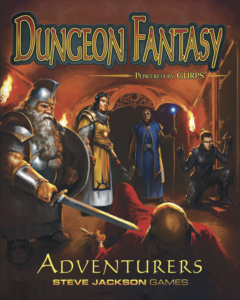
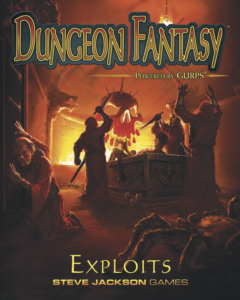
Some of the covers fit together! I’ll begin this review by saying I’m really not the best person to review the Dungeon Fantasy Roleplaying Game (DFRPG). It’s not that dislike it: in fact, I loved it! However, I’m really bad at reading through the text in detail and spotting all the differences between the game and the GURPS supplements that originated it. I know these differences exist, and I know they make the game better, but I’ll probably only internalize them when I reference the text in play enough times.
Fortunately, it seems I’m late to the party when it comes to reviewing the DFRPG, so I can point you to lots of other reviews by other people who are better at this than me! Just Roll 3d6 has very detailed reviews of the Adventurers and Exploits books. Let’s GURPS is reviewing all the recently-released books too. And I’m sure many other reviews will pop up in time.
What I’ll do in this article is something only I can do: give you my own opinion on the game. Whether that is of any value is left as an exercise for the reader.
TL; DR
The Dungeon Fantasy Roleplaying Game is my favorite edition of D&D. Go out and buy it as soon as it comes out.
Wait, What?
Technically, my favorite edition of D&D is 4th, but it occupies that position for very specific reasons. It allows me to run cool, flashy battles in the style of turn-based tactical RPGs such as Disgaea, Fire Emblem, or Final Fantasy Tactics. If I want a campaign that feels like that, I reach for D&D 4.
If I don’t want to run a campaign that feels like that, my tastes get a bit fiddlier. I will play D&D 5th edition if no other alternative presents itself, but it doesn’t look very exciting to GM. Earlier editions add to that an elaborate list of varied complaints that I’m sure anyone familiar with them can guess, and I’m not one of those enlightened souls who can forget about them for long enough to enjoy a session.
The Dungeon Fantasy Roleplaying Game has a premise that’s exactly like that of Basic D&D (one of the most popular OSR darlings), married to a ruleset that does everything most editions of D&D do in a way I find better. It’s point-based! It has a unified mechanic! It has a good skill system! Warrior-types are actually better at combat than spellcasters!
You can of course also run flashy set-piece battles with it, and they’ll tend to have a feel that’s closer to that of the old-school editions.
It takes all of that from GURPS. Its rules are a specialized version of GURPS 4th Edition, with everything that’s not relevant to dungeon-crawling fantasy campaigns stripped out and the rest adapted to the purpose. Some parts are simpler than in the original rules, some are not, but they’re all useful. A lot of those things which usually lead to heated arguments between players and DMs are given proper rules and effects here. Want to stab that ogre in the eye? Perform some unlikely feat of parkour? Check to see if that dead monster has valuable body parts? The system has you covered.
Dungeon Fantasy gives you 11 “professional templates” that are roughly equivalent to some of the most popular D&D classes, and which can be humans or one of a selection of 8 racial templates that includes all the usual suspects plus the Catfolk1.
While the game focuses very heavily on dungeon-delving, it’s certainly possible to use it for fantasy campaigns that go beyond the dungeon. It has more support for social interaction than Basic D&D does2, and bringing in more detailed rules from GURPS is extremely easy, if the GM thinks it’s necessary.
So yes, if I was planning on running a D&D-ish campaign and wasn’t after the very specific feel of D&D 4 combat, I would use Dungeon Fantasy in preference to any other actual edition of D&D. In fact, I have been doing just that for years using the previous iteration of these rules, and will gladly switch to the new one now that I have it in my hands.
Dungeon Fantasy isn’t yet available to the public as of this writing, but the Kickstarter backers have already begun receiving their copies. Both the printed and PDF versions should appear on Warehouse 23 in October.
-
Skynet's Avengers: The Damaxuri Deception, Part 1
Having finished our characters, we gathered ‘round in the second “gap” weekend to play through The Damaxuri Deception. We started one hour later than usual, due to some uncertainty over whether I would be able to make it and due to one other player having spent the previous night at a party. Everyone else, including me, was able to make it at the usual time of 9 AM, so we spent that hour finishing up our fireteams.
Now, the players were well-aware of their company’s financial dire straits, and from the skills they had chosen it was clear that they expected to get into fights early and often. So I told then this adventure started in a dangerous and unfamiliar place fraught with tension and itchy trigger fingers… a mercenary convention! The quotes below are freely translated from Portuguese, since that was the language we played in.
Scene 1: MercCon 713
Welcome to the 713th edition of Merc-Con! Taking place in a quaint historical habitat above scenic Damaxuri, and partly sponsored by the city of Mellsen-Anlied (located on the surface under the station). And if you believe the habitat is quaint or the planet is scenic, I’ve got a bridge to sell you. This flating hunk of junk they call a station was the only place that would consent to hosting an event for 2000 mercenaries.
Into it go the officers of Skynet’s Avengers, accompanied by a small drone projecting the unblinking red eye that is the avatar of Skynet herself1. Why are they going to a conference when the company is in the red? Skynet paid for it ages ago and the fee is non-refundable, so they might as well make the most of it. And hey, someone there might be hiring!
The station is quite hot and stinky because its creaky life support systems can’t keep up with the body heat and body odor of 2000 sweaty mercs and the assorted vendors who set up shop here for the event. Fortunatly, most of the PCs are wearing their climate-controlled suits of armor. The sole exception is poor Orangus, whose armor is a bit too heavy (and illegal!) to be acceptable attire for anything that’s not a firefight. He’s wearing a respirator for the smell, but his civvies and thick fur don’t help against the heat. The player’s vivid description of his suffering earned him the game’s first RiPP.
The PCs linger for a while at the booth of an Unioc named Banjo Tabberlin2 as they watch an O’benn customer of his try out a Phubhar Shurikannon3 and cover every inch of the shooting gallery’s back wall with metal stars, leaving the paper target at the center untouched. Banjo comments that the Phubhar lot he received today is quite above-average in quality. Only two weapons exploded so far!
They talked with Banjo a bit and were interested in the capabilities of the M3 Incapacitator he showed them… but gave up on it whey they heard it cost twice what they paid for the company APC. They ended up trading comm numbers, and went to the food court.
There, Leto socialized a bit with Fulda Purrgathor, the medic of all-Ursumari company Icewall Security. She and some of her buddies were ear-deep into large bowls of shaved ice. Fulda was a bit insensitive in her comments that working on any patient smaller than an ursumari was much too fiddly for her tastes, but Leto assured her it was good practice.
After a while Skynet reminded the group that the keynote would start in 15 minutes. The speaker was Colonel Drake Pranger, the leader of one of the galaxy’s top mercenary companies. Skynet paid a fortune for her officers to hear this blowhard speak, and she didn’t want them to waste the money.
Before heading to the keynote the PCs decided to mingle and try to look for contracts in the con by looking for anyone who seemed to be tied to one of the galaxy’s major ongoing conflicts. A task at which they failed miserably due to their lack of relevant skills. The only conflict that came to their minds was the biggest of them all - the war between the godlike AIs of the Plenipotent Dominion and the dark matter entities of Andromeda.
Orangus: Hey, Cap’n, you’re an AI! Can’t you talk to the PD?
Skynet: No. I do not wish to be assimilated.
Orangus: Then can’t we work for the other guys?
Skynet: No. I do not wish to destroy all baryonic life in the galaxy4.
Orangus here was the recipient of the game’s first Mayhem card: “Spin Control”. He now felt extremely driven to make the company look good, and his efforts would result in a +1 increase in Reputation for every RiPP he had left at the end of the session.
Rufus decided to appeal to a higher authority and ask Skynet if she knew of someone who was hiring. The AI reminded him he had just acquired the contact information of a known arms dealer. Rufus asked her to call him, and she delegated the duty right back to him.
It turns out Banjo did have a hot tip for them! A big bounty was going to be posted to the local hypernet during the keynote, so they should keep an ear out for it. So forewarned, they moved on.
Scene 2: The Keynote, and What Came After
The PCs found their seats in the improvised lecture hall. Orangus put his feet up on a chair in the row ahead of him, only to have the tiny Esspererin seated there take a perch on his feet instead. “Hey man, thanks for the lift!” Leto has brought a tub of ice cream and is paying more attention to it than to the hall.
Rufus scans the crowd, trying to spot competing companies. He fails to recognize any, but deduces that the huge group of Esspererin in the two rows in front of them probably belong to the same company, as does a group of humanoids further away wearing matching uniforms.
Pranger enters the stage and swaggers up to his podium like the high-level NPC he is5. He takes a deep breath, opens his mouth to speak… and is interrupted by a deafening chime as every monitor in the hall, and every handbrain in the room, flashes the alert that a very substantial bounty has been posted for a human arms dealer named Kostavi, who has been sighted in Mellsen-Anlied.
The players don’t need to roll to figure out who she is: Kostavi is quite infamous for selling weapons to the sort of people who should never have them, and causing lots of civilian casualties in the process. Sooner or later something like this was bound to happen, and since the bounty is equivalent to 5 Resources, it’s just what the Avengers need to make payroll for the next few months.
A lot of the keynote audience thinks the same, and everyone begins getting up and rushing to their ships. At this point all players begin talking, and I begin to employ the game’s initiative system: whoever speaks first, goes first. This time, it’s Rufus, who engages his Supersuit’s flight mode and tries to carry Max with him. He rolls a natural 18 on 3d6, which is a critical success.
Me: Pick one other PC to carry along with you.
Rufus: I choose the bear!
So there he goes, carrying Max over one shoulder and Leto by the scruff of the neck as the bear roars as loud as he can to clear a path. Orangus runs after them, and meets his powered armor suit on the way so he can fly too.
With Banjo’s forewarning and their impressive die rolls, the party manages to leave the hangar first, and is almost immediately fired upon by the Esspererin vessel Neoshka Kree, crewed by an Esspee merc outfit based out of a piratical cluster. Behind them is a crew of human piratical mercs, and behind them is the huge, lumbering Icewall Security vessel Advancing Ice.
Time for some starship combat! I tell my players they’re all controlling the actions of Skynet as she pilots the Star Destroyer. Their PCs are cowering in their crash seats inside.
Leto’s player is very tempted to fire on the Advancing Ice, but gives up when I specify how much bigger the other ship is. The group ends up engaging the Neoshka Kree and firing to disable. The Star Destroyer takes a missile hit, but it’s not enough to put it out of commision. The other ship is disabled, and drifts down to the planetary surface. The PCs land on Mellsen-Anlied on their flying APC.
Scene 3: Search and Destroy
I ask for Perception rolls to abstract the initial search for Kostavi. They know she’s in the city, but not exactly where. Rufus and Leto beat the TN of 15, and both Rufus and Max draw Mayhem. Rufus gets a good card that allows him to declare a failed roll by someone else is actually a critical success as long as he can explain how. Max gets “Friendly Fire”.
Me: For your information, you can always pay a RiPP to negate a card.
Max: Screw that, I want to see what happens!
So I narrate that they learn that Kostavi’s hideout is in an abandoned warehouse in the lower levels of the city. There’s a transit elevator that should bring them very close to it… but it’s old, rusted, and alarmingly creaky. Due to the effect of the card, Max assures all of them the elevator is perfectly safe. As the company engineer, he knows machines, so they all should believe him!
The whole party (which numbers 20 with the fireteams) walks into the elevator. The thing’s cables snap halfway to their destination, so now every PC must explain how they avoid taking 2d6 points of armor-ignoring damage when they hit the bottom of the shaft6.
Orangus speaks first: he wants to use his UNS I-CC powered armor to fly through the elevator’s ceiling and hold the elevator up to slow its fall! I ask him to make an Aerial Vehicles and an Athlethics roll. Both succeed by lots, and the Athletics roll draws Mayhem!
The card is simply hilarious given the situation. Orangus is overcome with the need to stop what he’s doing and tell a story the situation reminded him of. Since what he’s doing is saving the lives of half the company, the player wisely decides to spend a RiPP to negate this, as soon as he can stop laughing for long enough to talk.
Orangus: But man, was that going to be one heck of a story!
Shaken but mostly intact, the party heads to the warehouse where Kostavi is hiding. Rufus scouts ahead stealthily along with his unit, and draws a Mayhem card that he immediately uses to turn the following Perception roll into a critical success, allowing him to find the mooks waiting in ambush and relay their position to the rest of the unit.
Leto speaks first, and gets the drop on a mook not by being stealthy, but by walking up to him and saying:
Leto: Hello, good sir. I’m a doctor, and I couldn’t help but notice your unhealthy pallor. Do you have a history of heart disease in your family?
I had him roll Deception, and the result was so high I ruled the guy lost an action in surprise. So Leto sat on him.
The other mooks spring into action. One of them manages to shoot Leto for some damage, and is vaporized by Orangus in return.
Me: You have a BH-209, right? The fusion reactor makes this ominous hummmmm sound and a jet of plasma shoots forth. Where the enemy stood is now a little pile of ash and a pair of smoking boots.
Orangus: I LOVE MY JOB!!!7
The two remaining guards suffer similar fates at the hands of the PCs’ fireteams, and once the survivor is interrogated he shows them the address of the real hideout stored in his handbrain.
The group sends a picture of the guy to Skynet. Is he worth anything?
Skynet: What you see here is a typical specimen of the common thug.
They tie him up and leave him for the police, which Skynet will call as soon as the party is far enough away no one can pin this on them. They now know Kostavi is on another warehouse on an even lower level of the city. Time to bag a bounty!
That’s All, Folks!
That’s where we stopped, since it was already noon. It’s fair to say everyone had a blast. The “shout first, go first” initiative mechanic worked a lot better than I thought it would, and the timing marks for the adventure were mostly spot-on.
The Mayhem Deck was fun beyond all my expectations. The group got really lucky with it too, drawing mostly good cards this time around. The bad cards did a lot more to reshape the game and make everyone laugh, though. Let’s see how funny they make the next session.
When will that be? I’m still not sure. We’re back to D&D next week. We might alternate the two games, or wait until there’s another “gap”. I do know the group wants to finish this adventure at some point. Orangus’ player bought the corebook after this session, and we’ve been discussing the game online.
And yeah, the “Spin Control” effect happened here, giving the company +3 Reputation. We explained it as Orangus’ heroic stunt with the falling elevator getting caught by various security cameras. Which he posed for.
-
Skynet doesn’t care what pronouns you use to refer to him/her/them/it as long as you stay consistent. Players used male pronouns, I used female ones because she speaks with the voice of GlaDoS. ↩
-
Originally “Benjo”, but the joke was too good to pass up. ↩
-
My subtle nudgings to try to get the PCs to buy a shurikannon in character creation came to naught. Once they learned what the Failure-Prone quality did for weapons, Skynet’s Avengers became a Strohl shop. ↩
-
This might come as a surprise, but Skynet is not actually evil despite being a living reference to every evil AI in fiction. ↩
-
Those were my literal words. ↩
-
I would have to toss a lot of coins for the fireteam NPCs, too. ↩
-
Friends, I think we have a natural. ↩
-
subscribe via RSS