Posts
-
Amiri the Barbarian in the Dungeon Fantasy RPG
As I explained in my previous post, now that the DFRPG has been published and is nearly available for sale, I’m redoing my set of Pathfinder Iconics. Since the professional templates names haven’t changed, Amiri the Barbarian is once again our first subject. We’ll repeat the summary of her bio with the link to the full d20 stats so you don’t need to read both articles to understand the character. If you’re curious, you can see a link to the old article at the end of this one, along with a discussion on what changed from one to the other.
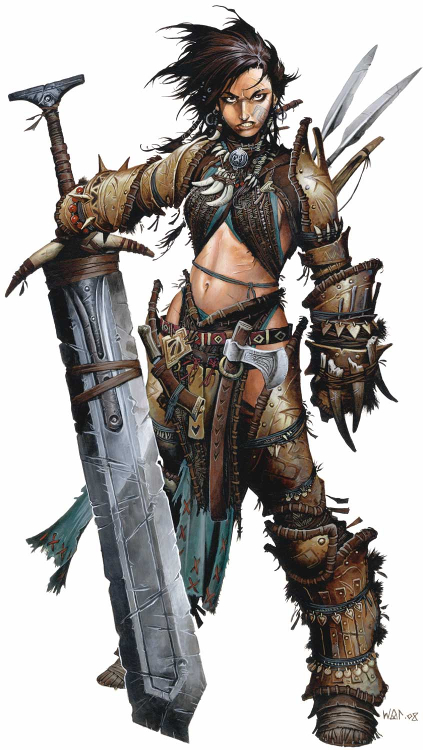
By Wayne Reynolds, Copyright 2008 Paizo Publishing Amiri’s full official bio and character sheet can be found here. Judging from those, we can glean a few facts about her:
-
Amiri is good at outdoor survival in cold climates, since she returned from a “suicide” scouting mission.
-
Amiri is of normal human size, but fights with an oversized sword that used to belong to a frost giant.
-
She’s fiercely competitive and doesn’t like being outdone at barbarian heroing.
-
She relies a lot on the d20 Barbarian Rage power when fighting, and might get angry enought to lose her mind. In other words, the purpose of Amiri is to flip out and kill people.
Here’s what she looks like in the new rules:
Amiri, 248-Point Human Barbarian
ST 19 {90}; DX 13 {60}; IQ 10 {0}; HT 13 {30}.
Damage 2d-1/3d+1; BL 36kg; HP 24 {10}; Will 10 {0}; Per 12 {10}; FP 13 {0}; Basic Speed 6 {-10}; Basic Move 6.
Dodge 9; Parry 12 (Greatsword);
Advantages
- High Pain Threshold {10}
- Outdoorsman 4 {40}
Disadvantages
- Berserk (12) {-10}
- Impulsiveness (12) {-10}
- Odious Personal Habit (Overly Competitive) {-5}
- Overconfidence (12) {-5}
- Social Stigma (Minority Group) {-10}
Skills
- Animal Handling (Mammoths) (A) IQ-1 {1} - 9
- Bow (A) DX+1 {4} - 14
- Brawling (E) DX {1} - 13
- Camouflage (E) IQ+4 {1}1 - 14
- Carousing (E) HT {1} - 13
- Climbing (A) DX-1 {1} - 12
- Disguise (Animals) (A) IQ+3 {1}1 - 13
- First Aid (E) IQ {1} - 10
- Fishing (E) Per+4 {1}1 - 16
- Hiking (A) HT-1 {1} - 12
- Intimidation (A) Will {2} - 10
- Mimicry (Animal Sounds) (H) IQ+2 {1}1 - 12
- Naturalist (H) IQ+2 {1}1 - 12
- Navigation (A) IQ+4 {1}1 - 13
- Running (A) HT-1 {1} - 12
- Stealth (A) DX {2} - 13
- Survival (Mountains) (A) Per+3 {1}1 - 15
- Swimming (E) HT {1} - 13
- Tracking (A) Per+3 {1}1 - 15
- Two-Handed Sword (A) DX+5 {20} - 18
- Weather Sense (A) IQ+4 {2}1 - 14
- Wrestling (A) DX {2} - 13
Equipment
$1793, 38.85kg. No Encumbrance.
- Ordinary Clothing [Torso, Limbs]: Free, 1kg.
- Greatsword [Torso]: Damage 3d+4 cut (Reach 1,2) or 2d+2 imp (Reach 2). $900, 3.5kg.
- Regular Bow (ST 19) [Torso]: Damage 2d imp, Acc 2, Range 285/380, Bulk -7. $100, 1kg.
- Hip Quiver [Torso]: Holds 20 arrows. $15, 0.5kg.
- 20 arrows [Quiver]: $40, 1kg.
- Backpack, Small [Torso]: Holds 20kg of gear. $60, 1.5kg.
- Blanket [Backpack]: $20, 2kg.
- Personal Basics [Backpack]: $5, 0.5kg.
- Rope, 3/8”, 10m [Backpack]: Supports 150kg. $5, 0.75kg.
- Rations x4 [Backpack]: $8, 1kg.
- Shovel [Backpack]: $12, 3kg.
- Armor Suit [Torso, Limbs, Head]: Light Scale (DR 3/2) on Torso, Heavy Leather (DR 2) everywhere else. $628, 20.1kg.
- $207 in coin.
Design Notes
Amiri spent 2 points on extra starting cash to buy the big sword.
Changes from the First Iteration
You can see her GURPS Dungeon Fantasy version here. Like in the previous iteration, Amiri is still pretty faithful to her bio and original stats, but some things had to change to fit the DFRPG ruleset.
The biggest one that the Great Rage powerup does not exist in the boxed set, so she can’t have it here. The 20 points it cost instead went to buy 2 more points of ST, which turned out to be a pretty good compromise! The new Amiri might not be quite as strong as the old one while her Rage was on, but she’s stronger at all other times and doesn’t need to worry about keeping track of rage-induced Fatigue.
Another noticeable change is that her giant sword is slightly smaller here, as there are no rules for oversized weapons in the boxed set. This ends up working in her favor, as the new weapon is much cheaper and lighter while doing only one less point of damage (the loss of which is compensated by her higher ST). In the end, we can just say it was a giant’s shortsword instead of a giant’s broadsword and call it a day.
And while we’re speaking of equipment, you might notice her armor is significantly different now. It was built using the GURPS Low-Tech-inspired rules from the boxed set. Torso and head DR are lower, but now her limbs are covered. This is roughly equivalent to the hide armor listed in the d20 stats, so I’m happy.
-
-
Pathfinder Iconics in Dungeon Fantasy, Take 2
A while ago I spent quite some time statting up Pathfinder Iconic characters for GURPS Dungeon Fantasy, one for each template from DF1. That project even has its own page here, where you can see all the completed characters. Aside from being fun in itself (I like making characters!), the main motivation was to provide a resource for players just getting into GURPS Dungeon Fantasy, and into the as yet unreleased Dungeon Fantasy Roleplaying Game.
Well, the DFRPG is out to backers now, and will be out to everyone else pretty soon. Now that I can get a good look at its text, I see that the difference between it and the GURPS DF line is not unlike that between the first and second edition of, say, AD&D. A lot of things are the same, but there are enough differences that you might need to do a little work to use material from one game in the other.
And so it turned out that my set of converted Pathfinder Iconics doesn’t quite fit the DFRPG rules, mostly because a lot of them include material from the GURPS line that didn’t make it into the standalone boxed set. As I still want them to be useful to players of the latter, it’s time to do a little conversion!
Here’s what’s going to happen: I’m going to redo all of the Iconics that correspond to the templates present in the DFRPG boxed set, which is everyone except for Seoni the Sorceress. Each of them is going to go up as a new article that will be linked alongside the old one in the project page. The new PCs will be built using only material found in the DFRPG boxed set, with perhaps a bit of original material tossed in where needed (like for Lini’s racial template). Each article will also comment on the differences between the resulting stats.
Like GURPS DF versions, these are inspired by the official published bios and stats for the iconics. Their capabilities are mostly inspired by the 7th-level version of the stats, and their gear by the 1st-level version, since that’s closer to what a character’s starting money can buy. This time around I’ll also take inspiration from the GURPS DF stats, of course, since my decisions on how to adapt stuff from d20 to GURPS haven’t really changed. I hope you enjoy the new versions!
-
Eberron Changelings for Dungeon Fantasy
The Doppelganger is a particularly unnerving D&D monster, not because of its direct combat power but because of its ability to look like anyone. Adventures involving them tend to be the urban, intrigue-filled kind where you never know who’s on your side and who’s been secretly replaced by a monster.
Eberron was the first setting to give that ability to a playable character race! As a Changeling, you get to enjoy the ability to look like anyone… and to be the target of a lot of prejudice from people who assume you’re secretly replacing innocent victims, even if you’re the most saintly of paladins. With the racial template in this article, you get to do those things in either version of the Dungeon Fantasy game.
Changelings
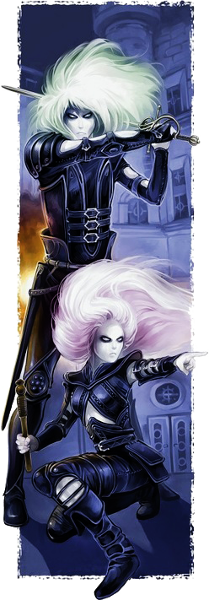
Copyright 2009 WotC Racial Cost: 25 points
Changelings are humanoids capable of altering their appearance at will. The story of their origin varies depending on who you ask. Some say “Changeling” is just a more polite way to call a Doppelganger. Some say the Changelings are the offspring of a human and a true Doppelganger, who is much more dangerous. The truth depends on which edition of D&D you’re stealing from.
A changeling’s basic appearance is that of a slender, pale-skinned, androgynous humanoid with large sunken eyes and an almost non-existent nose. They can quickly change to look like any humanoid of similar size and mass.
Changelings have no society of their own, and tend to live among humans. Their abilities tend to give rise to lots of terrible stories about, well, Doppelgangers, so most assume a “secret identity” in order to live peaceful lives. Some have several, in order to have a backup in case one of their covers is blown… and those who get too paranoid end up lending truth to those terrible stories.
In times of changeling-fueled intrigue, gnomes and halflings are prized as counter-intelligence agents. Members of both races tend to be quite crafty themselves, and can’t be replaced by changelings due to their small size.
Advantages: Changeling Shapeshifting {20}; Charisma 1 {5}; Night Vision 5 {5}.
Disadvantages: Terrible Secret {-5}.
Special Changeling Traits
Changeling Shapeshifting1
By concentrating for 10 seconds, you can assume the form of any humanoid with the same Size Modifier as you (0). Your weight remains the same and you don’t gain any abilities with game effects posessed by that type of humanoid (but see below). You do, however, retain your other racial advantages. Your clothing and possessions don’t change with you.
The Appearance and Honest Face advantages work differently for you. Instead of applying to your natural form, they allow you to assume humanoid forms that possess these advantages. In the case of Appearance, consider the level you pay for to be the maximum you can transform into. You can also take on less good-looking forms for no extra cost. You can’t take Appearance as a disadvantage, but changing into uglier forms doesn’t cost extra (or give you points!).
This power is of obvious use in Disguise attempts. When using this skill, you never require any tool more elaborate than a change of clothes, and need at most 5 minutes of preparation instead of the 30 required by others. You also never suffer penalties for race-crossing or trying to disguise yourself as someone “very different”. Copying the appearance of a specific person always requires a Disguise roll.
Terrible Secret2
“Civilized” society considers you a monster, but you are usually able to hide your true nature. The GM rolls 3d every time you go to town or start a session there. On a 6 or less, your cover is blown and you suffer the effects of Social Stigma (Savage) - including another immediate 3d roll to see if you’re kicked out of town! This lasts until you can re-establish your cover. How you can do that is up to the GM. It could range from a few skill rolls to a full adventure!
Optional Traits
Changelings can always buy the Disguise and Acting skills even if those aren’t part of their professional template. Even honest changelings often need these skills to escape persecution.
Changeling Characters
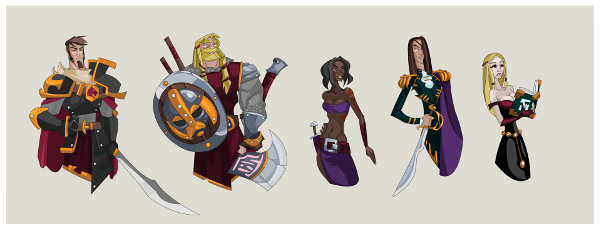
Any of these could be a changeling! Changelings often become delvers - it’s the only line of work where they don’t look much weirder than their colleagues. They do particularly well as Bards and Thieves! Even on the pure dungeon-crawling campaigns assumed by the default Dungeon Fantasy setup, their shape-changing ability can eliminate some reaction penalties from humanoid monsters if the character has time to prepare for the encounter (“You can trust me, I’m an orc too.”). They could also infiltrate a group of such monsters and gather precious information about the enemy. In campaigns with more social interaction or even intrigue, their utility skyrockets.
Changeling names tend to be short, unisex affairs: Qin, Kell, Tan, and so on. Most go by a pseudonym when in their cover identities, and some just are just given names from the society where they grew up from the start. Most changelings tend to think of themselves as being whatever gender matches their current form, though some do have a stronger preference for a single identity.
-
GURPS Stats: This is Morph (Cosmetic -50%; Mass Conservation -20%; Retains Shape -20%). The maximum cost reduction from limitations is -80%, so it costs 20 points. ↩
-
GURPS Stats: This is a -5 point Secret that converts into Social Stigma (Savage) when revealed. Since your cover can be re-established, the disadvantage doesn’t change in value while the Secret is out. ↩
-
-
Warforged for Dungeon Fantasy
Eberron is pretty much my favorite published D&D setting, and Warforged are my favorite Eberron race. What would they look like in Dungeon Fantasy? Let’s find out!
In the racial template below I’ve tried to follow the same guidelines as the races in the DFRPG: they must alter the character enough for you to feel like you’re playing a member of that race, and they can’t cost more than about 40 points. This should allow characters following almost any professional template to be a Warforged if they so wish.
Warforged
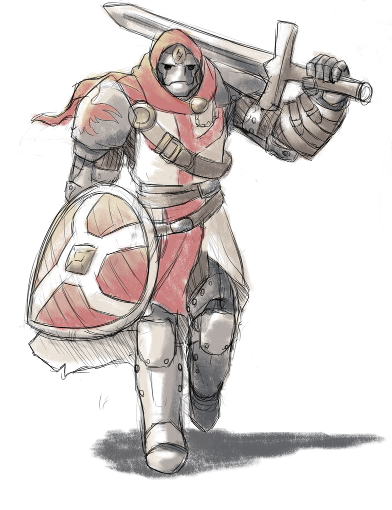
Illustration by Will-E-H Racial Cost: 30 points
Warforged are living constructs. In Eberron, they were created and mass-produced by a powerful enchanter house, which sold them as ready-made armies to some of that setting’s warring nations. Once the war was over, most were freed and given citizenship. In other settings, their origins are usually less industrial: a warforged delver might be an experiment by a lone wizard, a relic from a lost civilization who was only activated now, and so on.
Warforged are more or less human-sized and -shaped, but are obviously made of metal, wood, and stone rather than flesh. Most look nearly identical save for the mystic sigil in their foreheads, which is different for every individual. A few have taken the time to customize their bodies and individualize their appearance.
Warforged are a little stronger than humans, but their real advantage over human soldiers lies in ther immunity to most weaknesses of the flesh. They don’t need food, water or even air, and though they must spend some time at rest each day, they don’t really sleep either. Unlike a “proper” golem, a warforged has a fully sapient mind and soul, too.
They are still alive, though, and still subject to some of those fleshy weaknesses. They have and can spend Fatigue Points. They are not considered Unliving or Homogenous, and still vulnerable to poisons and such that enter their bodies via means other than breathing or ingestion. They can be affected by Mind Control spells and other similar magic. And no-mana areas are deadly to them, which is something most other delvers don’t need to worry about. On the good side, Healing magic works fine on Warforged.
Even a newly-created Warforged will have the skills of a veteran fighter and an adult-level intellect, but that individual will also lack most of the social graces you would expect from someone with an adult-level intellect. Even after they overcome this initial awkwardness, people still tend to look at then a bit oddly given their exotic appearance and origin.
Attribute Modifiers: ST+1 {10}; HT+1 {10}.
Advantages: Composite Plating 1 {5}; Doesn’t Breathe {20}; Doesn’t Eat or Drink {10}; Unsleeping Watcher {10}.
Disadvantages: Dependency (Mana) {-25}; Social Stigma (Minority Group) {-10}.
Features: Individuals look very similar to each other.
Special Warforged Traits
Composite Plating1
Your skin is made of metal and wooden plates. This works like one level of the Barbarian’s Tough Skin (DRRPG Adventurers, p. 16), but it’s not flesh! It does protect against attacks that require a scratch or skin contact but don’t manage to get past its DR. You can still wear armor normally.
At the GM’s option, a warforged character might be able to buy up to two more levels of this trait in play. It requires spending some time in a machine shop along with 5 points and $500 per level.
Dependency (Mana)
As the monster trait on DFRPG: Monsters, p. 13. You lose 1 HP per minute you spend in a no mana area.
Doesn’t Breathe/Doesn’t Eat or Drink
As the monster traits in DFRPG: Monsters, p. 10.
Unsleeping Watcher2
Instead of sleeping, you must enter a state of inactivity for at least 4 hours per day. While in this state, you remain conscious and aware of your surroundings, so you can keep watch while resting. If you can’t rest like this on a given day, treat it as a night of missed sleep.
Optional Traits
Warforged characters may add the following disadvantages to the list of optional traits for their professional template, if those aren’t already there: Chummy {-5}; Clueless {-10}; Gregarious {-10}; Gullibility {-10}; Code of Honor (Soldier’s) {-10}. These represent the social awkwardness or initial programming of a newly-created warforged. Since they are personal disadvantages, they do count toward your disadvantage limit.
Warforged Characters
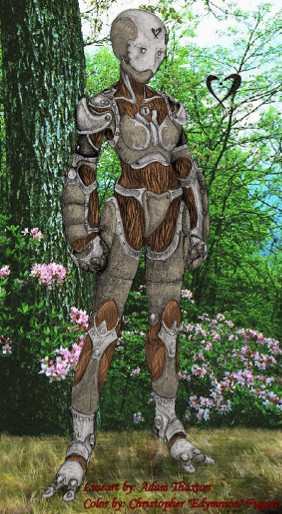
A female warforged While warforged were made to be members of the fightier professions, they can do equally well at any of them! That little bit of extra DR will come in handy to delvers who have to rely on lighter armor. Warforged are an excellent choice for players who don’t want to bother with buying rations and sleeping bags, or succumbing to poison gas traps. On the other hand, they have social difficulties in town, and their fleshbag buddies will always ask them to take the watch when setting up camp.
Warforged gender is mostly a matter of personal preference, perhaps accompanied by the use of the Armory skill. Warforged usually choose names from the culture in which they live, but some prefer simple one-word names that allude to their vocation or personality. A holy warrior who lives to protect the weak might name himself Shield, and there’s that one guy who called himself Awesome Bucket.
-
A Review of Pyramid #3/106: Dungeon Fantasy
I’m a little later to this party than I thought I’d be, but here it goes anyway. Pyramid #3/106 is the first issue of the magazine to be released after the completion of the Dungeon Fantasy Roleplaying Game. While the game itself is still not available to the public at the time of this writing, the many Kickstarter backers have started receiving their copies. I guess this issue is meant to both appeal to them and to get other players interested in the upcoming game.
What’s In It?
The cover is an illustration from the game itself, depicting an armored knight and a wizard or druid cautiously advancing through a tunnel whose walls are covered in glowing sigils. Maybe it’s the style of the knight’s armor, but the piece gives me a bit of a Dark Souls vibe.
After the usual introductory blurbs about what’s in the issue, we get the first “real” article: Designer’s Notes for the DFRPG, by Sean Punch himself. It tells us what it was like to write the game, and gives us an incredibly detailed account of what’s in each of its books (including the stretch goals and add-ons) and how that content differs from what’s in the Basic Set. If none of the excellent DFRPG reviews published on the Internet so far have answered all of your questions about the game, then it might be worth buying this issue for the six pages of designer’s notes alone - you won’t get a more complete description without reading the game itself.
Next comes an article on Quick Equipment Kits, by Peter V. Dell’Orto. It has loadouts in it, which is good because I love loadouts! The article is only four pages long, so if you don’t love loadouts you can rest assured that this isn’t reprinting the whole of GURPS Dungeon Fantasy 13 for the new “edition”. This article leaves weapon and armor selection entirely to players, and instead focuses on all the other stuff. It has a basic delver package with a minimum of generally useful gear like ropes and blankets. It then presents a set of add-ons separated not by character template, but by function within the party: Cartographer, Door Breaker, Medic, and so on. It also devotes some space to pre-filled quivers of arrows or bolts, pre-filled bags of sling stones, and bulk rations of all kinds, which are nifty time-savers all by themselves.
Next comes a whole bunch of Deathtraps by Cristopher R. Rice. While I haven’t gotten around to reading the Dungeon Fantasy Traps PDF, I’m told these are much more cruel than the ones on that book. This makes this a useful tool for GMs who want to go Gygaxian on their players with false-door crossbow traps or the Magical Magnetic Murder Machine.
In the Eidetic Memory column, David Pulver talks about Demi-Human Dungeons. Contrary to what you’d expect from a David Pulver article, there are no math-intensive rules here. Rather, this is a nice set of guidelines for designing dungeons built by dwarves, halflings, elves and gnomes. Why would each of these peoples build a large underground complex? What would they use it for? How can it fall into ruin and be infested by monsters, and what treasure would be left behind? Given that the implied Dungeon Fantasy setting is built on well-worn cliches, the answers will probably not come as big surprises to veteran GMs, but the descriptions are clear and filled with interesting references in their examples. Do you want to know what it would be like to delve into the shattered ruins of Bag End? Read this.
Secrets of the Living Tomb by Steven Marsh details the dungeon from the solo adventure in Pyramid #3/104 in a GM-friendly format, complete with some backstory and possible campaign hooks. I only skimmed this one, as I intend to play the adventure eventually.
Undead, Undead Everywhere by Sean Punch gives us six new undead monsters to play with. You have two new varieties of zombie (drowned and frozen), Swamp Wisps made of toxic gas, and Mummies which are every bit as dangerous as their OD&D counterparts. There’s also a couple of more exotic selections in the Herd Horrors and the Tomb Trees. The Mummies and the two “exotics” were by far the most interesting ones to me, though I liked all of them because you can never have enough monsters.
The State of the Dungeon is a short update on where in the official release process the game is. It’s close to the end, but not there yet. It does focus more on the physical product, which makes me think widely available PDF versions might take a while longer than that to show up, if they do at all. Personally, I would like to see them earlier rather than later. I already have mine, but I want something to link to people who are averse to shipping charges.
We end with a Random Thought Table by Steven Marsh on simplifying things to ease players into the Dungeon Fantasy RPG. It’s mainly a big old plug for the Delvers To Go! supplement, but some of the suggestions here are also interesting.
What Do I Think of It?
Overall, I quite liked this issue, and found it to be worth the price. My personal favorites were Quick Equipment Kits and Undead, Undead Everywhere, with Demi-Human Dungeons coming in close behind.
subscribe via RSS