Posts
-
Planet Mercenary Actual Play: Character Creation
This last weekend I finally got to GM in real time again! It wasn’t exactly an in-person game, seeing as it happened over Google Hangouts, but it was the next best thing.
I’ve been playing a bit of D&D 5th Edition with this particular group every Sunday morning, also over Hangouts. It so happened that the habitual GM wouldn’t have the materials handy for a couple of weeks due to a trip, so I proposed a session of Planet Mercenary to fill the gap and keep our momentum going. I had just gotten the book (read my review [here][1]) and this would be a perfect opportunity to try it out.
Character and Company Creation
Since everyone was new to the system, I decided to set one of our two “gap” sessions aside for creating characters. I started with a very basic overview of the setting, and proceeded to use screen sharing to show the possible choices for Command Package, Background and Sophont Type. The sophont type illustrations were a big hit, particularly those of the Earth-born species.
I banned AI and Amorph PCs to start with, since those were marked as “Advanced” and no one had much in the way of system experience. I’m glad I did, because in my experience with science fiction games is that someone always wants to play a robot. We ended up with an all-Earthling crew, whom we’ll get to meet shortly.
Point distribution was done simultaneously: I screen-shared the character sheet for reference and answered questions along the way. Company creation was very easy to explain: since most of the group was familiar with Ars Magica, I just had to say it worked more or less like a Covenant. We took the suggested starting stats to speed things up, because I knew that the next step there was going to eat up most our time. Yes, I’m talking about shopping.
Starship selection was surprisingly quick, simply because the Dragon-class Interdiction Cruiser looks like a Star Destroyer. It’s also pretty good for its class, mechanically, and one of the most versatile designs they could afford. So I was pretty happy to let them choose it as their ship. The players named it Star Destroyer, of course. It has the optional gun package and an add-on set of light shields that I let them buy. When I told them startships were piloted by powerful AI, they promptly named their ship AI Skynet.
Buying personal equipment was… less than quick, which is something I already expected. Using Hangouts screen-sharing to show the lists to everyone at the same time did make it a lot faster than it would have been if I had to keep passing a physical book or PDF-in-a-device around. The group got an APC so that all players and their fireteams could ride around on the same vehicle, and spent all the time I saved with the screen share trying to make their remaining Supplies buy armor and weapons for all PCs after a couple of them blew mountains of cash on expensive flying suits.
The finishing touches of character creation actually stretched into some Whatsapp messaging over the week and the first hour of session 2. Here are our results.
Company: Skynet’s Avengers
No one wanted to be the captain, so I was free to make one. Looking at the mountain of pop-culture references thrown around both during general chatter and in naming the ship and its AI, I decided that the AI itself would be the Captain.
Skynet is a ship-scale AI whose past is a bit of a secret. It’s completely addicted to old (or, in other words, comtemporary) Earth pop culture. All those jokes the players made? They’re canon. Skynet named itself after the evil AI from Terminator, named the ship Star Destroyer because it resembles a star destroyer, and speaks like GlaDoS because it likes GlaDoS. How it managed to liberate itself and its ship from the UNS military is still a bit of a mystery, but it currently runs a small mercenary company (named after the Avengers). Few other people in the galaxy (aside from the Gavs) get all the jokes.
The company has the default attributes of AI Rating 3, Starting Resources 9, and Reputation 4. Players spent 10 Resources on their ship, turned the remainder into 70 supplies, and spent every last penny of that in personal gear, which means Skynet’s Avengers are desperate to find a job, any job, or else they won’t be able to make payroll next month. And we all know how bad that is.
Player Characters
Our PCs make up the officer corps for Skynet’s Avengers, and all of them hail from Earth. I messed up a bit during fireteam creation, and they each ended up with fireteams made up of 4 grunts. I’m leaving that as it is for now.
-
Max, Human/Engineer/Driver. His fireteam is the most diverse, with a Neophant, a Ursumari, an O’benn and an Oth, all of varying specialties. The O’benn and the Oth are the two named company members who are not from Earth. Carries a Strohl G/G 1000 sniper rifle and wears Blue Collar armor (which is standard for company grunts, too).
-
Kerchak “Orangus” Strongheart, Rilla/Quartermaster/Infantry Grunt. Promoted to officer status when the gorilla in front of him got blown up. An enthusiastic Heavy Weapons Guy(rilla), he carries around a BH-209 plasma cannon and wears a suit of USMF I-CC power armor. His fireteam is similarly all-Rillas, all-Heavies.
-
Leto “Master of Puppets”, Ursumari/Medic/Crime Boss. Like Walter White, but a polar bear1. Leto is a highly skilled medic and a surprisingly good liar. He also has a BH-209 plasgun, though his armor is a standard Blue Collar suit. His fireteam is made up of four identical pink-haired human women from the same clone family, all Medics, all named Joy. Yes, it’s a Pokemon reference, but my mind immediately went to the Honokas of Sidonia2 (which are also clones, but fightier).
-
Rufuz Leet, Purp/Ops Commander/Military Officer. Hails from a proud lineage of decorated soldiers, wields a G/G 511 carbine and wears an EX Supersuit, the most expensive suit of armor in the entire company. Completely ignores how much he looks like Master Chef from HALO3. His fireteam is composed of three Purp Infantry named after actors from Expendables and one neophant named Babar who acts as the voice of wisdom in the unit. Fairly sneaky and skilled with nearly every weapon in the book.
All of them are very good at fighting in addition to being skilled at what their command package implies. None of them have much in the way of social or mental skills, with the exception of Leto who has Deception 8.
Coming Up Next: The Damaxuri Deception
Damaxuri Deception is the adventure that comes in the corebook, and it’s intended to be an introduction to both the game’s mechanics and its philosophy of adventure design. It laid out as a succession of scenes, each accompanied by an estimate of how long it should take to run. I found that extremely useful, as it allowed me to direct my efforts somewhat to keep things moving as they should and to better fit our limited 9:00-12:00 time slots.
We’ll see how Skynet’s Avengers handled this mission in the next post!
-
-
Dreams of Ruin Whodunnit: A Stroll Through AD&D's Deities and Demigods
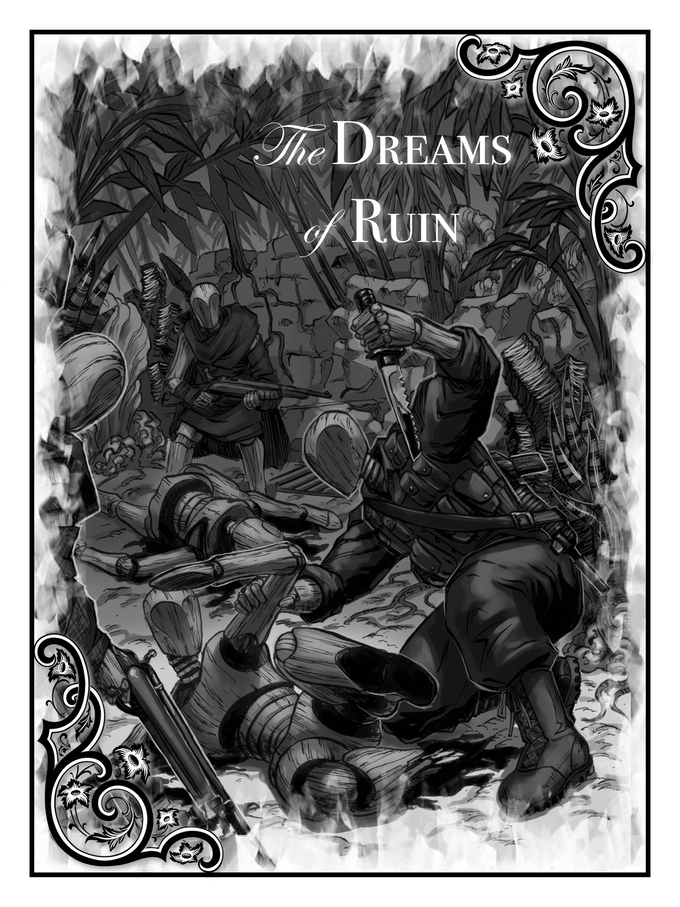
Art by Melissa Uran. The Dreams of Ruin aren’t a natural phenomenon - they were created by someone (or someones) who wanted the multiverse to get a little more Chaotic Evil. In my X-COM campaign it was all the work of the Ebon Masters,who make no particular effort to hide that fact as they use the Dreams as a weapon of conquest and a tool of terraforming. But in the original text the identity of the people who created the Dreams is supposed to be a mystery.
Geoff C. Grabowski, the book’s author, mentioned in a thread over at the RPG.net forums that you could find the real culprit from clues present in the book by looking at the Deities and Demigods supplement for AD&D 1st Edition. He couldn’t mention that in the book itself because it would violate the OGL, and was apparently reluctant to point fingers explicitly for the same reason.
Well, I got Deities & Demigods during a recent DTRPG sale, and I have no legal ties to the Dreams of Ruin, so let’s try to figure out who’s to blame for this mess!
Clues in Dreams of Ruin
Anyone trying to look into this mystery directly will eventually come across a vision of the Malediction that opens the book - you know, the bit with Old Woman Crow and and the Wind. That vision was put in place to hide the true identities of the perpetrator(s) of the Dreams, but it does make some allegories to the actual process. Investigating the process itself yields more clues, which are listed in a section near the end of the book. All of them are stated in AD&D 1st Edition terms:
-
Creating the Dreams requires the abilities of a 20th-level Magic User, a 20th-level Illusionist, a 14th-level Cleric, and a 14th-level Druid. Those are minimum levels - the perpetrators either had plenty of time or lots of extra power. If one of them was a god of some sort they could even fulfill multiple prerequisites.
-
The Illusionist was likely the mastermind, as Illusionist spells are the basis on which the system was built.
-
The Druid was largely responsible for designing the ecology of the Dreams and might have used this expertise as a bargaining chip to get included.
-
The work involved a truly ridiculous amount of wishes and limited wishes, among many other spell effects.
-
Four cards from the Deck of Many Things were involved. One of them was the Moon, which grants a wish, which means the perpetrators might have found a way to cheat the Deck and draw as many Moons as they wanted.
The result of the process was a single spore, created by a final limited wish cast by the illusionist which brought all the other factors together. This spore then multiplied on its own and brought forth all the other horrors in the book.
What’s In Deities and Demigods
Knowing old D&D supplements were “quirky” and actually experiencing it are two different things. A lot of modern books try to emulate this style, but this thing here is the genuine article. The layout and typography are readable enough, but they give me this feeling of being amateurish. It’s not something the authors were trying to do on purpose either, like in the Dungeon Crawl Classics line - this really was the best they could do at the time. The introduction also has Gary Gygax boasting about how writing the book involved extensive consultations with himself, which is, uh, something.
I’ve heard a lot about how this book was nothing but a jumped-up bestiary, but the introduction says exactly the opposite! It advises the GM to use the information as reference for roleplaying and to not treat the deities as just a collection of stats. I guess the reason they get full stat writeups is that the concept that you didn’t need to stat everything up hadn’t yet become popular. Which is kinda ironic considering the complaints about “games these days” from hardline old-school adepts.
Anyway, the book presents several different pantheons here. Each one begins with a very brief description of how their mortal religions operate, and follows up with full stat blocks for what Gygax considered to be their main figures. Each one has an illustration and a very brief description of the being in question, usually focusing more on physical appearance and any special abilities than in mythological information.
The stat blocks are different from your usual monster writeup, unless the entity in question is an actual monster. This writeup includes ability scores as well as a list of classes and levels that acts as a shorthand for what sort of PC-like abilities the being in question possesses. Heroes get a similar writeup to gods, and monsters get Ye Olde Monster Statblock.
Most pantheons are drawn from real-world mythology as filtered by Gygax in his extensive consultations with himself, but my copy of the PDF also has the pantheon of the Farfhd and The Grey Mouser stories and a bunch of original nonhuman deities that would proceed to become fixtures in every future edition of D&D, like Moradin, Corellon and Gruumsh. Earlier printings of the book also had writeups for Melniboné and the Cthulhu Mythos, which were taken out to avoid copyright troubles.
The Suspect Line-Up
We’re looking here for an entity or group of entities who fulfills the following criteria:
-
Chaotic Evil alignment, or as close to it as possible. The mastermind is most likely CE, accomplices might be NE or CN depending on their individual personalities.
-
Is or contains at least a 20th-level Magic User, a 20th-level Illusionist, a 14th-level Cleric and a 14th-level Druid.
I’m assuming the information on Deities & Demigods is basically correct, which probably wouldn’t be true in a campaign which cared even a bit about real-world accuracy. I’ll consider a credible suspect any listed entity that has the requisite alignment and fulfills at least one of the level requirements. Any pantheon from the book not mentioned here lacks a listed entity who could be a credible suspect.
The Native American Mythos
Coyote has the requisite Druid and Cleric levels and is Chaotic Neutral, so he could theoretically be convinced to aid in the creation of the Dreams… but that sounds a bit too actively malicious for him.
The Babylonian Mythos
We have two suspects, but they’d need help from outside the pantheon.
Anshar the god of darkness is CE and can play the role of the Cleric. His ability to “catch” and store arcane spells is powerful, but I’m not sure it would allow him to play the MU or Illusionist role, so he would need co-conspirators.
Nergal is NE and both a 25th-level Cleric and a 20th-level Magic User. He sounds like he’d be on board as a helper.
Central American Mythos
Plenty of suspects to go around here!
Quetzalcoatl seems like an unlikely suspect at first, but power-wise he’s a single druid level short of being able to do the whole thing himself. That’s a rounding error when it comes to greater deities. And despite being listed as Lawful Neutral, even Gygax acknowledges it’s hard to fit him into the alignment system, as you have several stories where he acts in a Chaotic or Evil manner. If this was one of those times, then you can see why there would be unbreakable measures in place to prevent others from figuring out who did it.
If you take inspiration from those bits of real-world Aztec mythology that say Tetzcatlipoca is comparable to Quetzalcoatl in power, he becomes an even likelier suspect than the Big Q, because his behavior is consistent enough to be rated as Chaotic Evil in the book. Simply going by the supplement, though, he lacks the levels.
Camazotz the bat god is CE and has the necessary MU and Illusionist levels. He’d need some help to fulfill the other roles.
Tlazolteotl the goddess of vice is also CE and can almost do the whole thing herself, lacking only a few levels of Magic User.
This leaves us with a very strong chance of the Dreams being the fault of these Aztec deities! Maybe Tzazolteotl enlisted Camazotz as an accomplice; maybe it was one of Quetzalcoatl’s Chaotic Evil moments; or maybe it was just Tetzcatlipoca being himself. The Dreams certainly look bad enough to be the thing that ends the Fifth Sun.
Chinese Mythos
Lu Yueh the god of pestilence is CE, has 20 cleric levels and 19 MU/Illusionist levels. I’m sure he could compensate for the two missing arcane caster levels by being the god of pestilence, and he could create the Dreams if he recruited a high-level druid. No likely druid presents himself in the pantheon, though.
Egyptian Mythos
Set might be listed as Lawful Evil, but the Dreams sound right up his alley. He’s a 30th-level illusionist, which might compensate for his lack of Magic User levels… Or he could probably recruit a powerful enough wizard and druid through his infectious alignment change ability. Or you could stick by the alignment restriction and have him look at the Dreams and go “not even I would do that”.
Finnish Mythos
The cast of the Kalevala gives us our second group of suspects who could have done it without help from outside the pantheon.
Tuonetar the goddess of the underworld looks like a prime suspect, being CE and only lacking Druid levels. If she did it, then her husband Tuoni was likely involved as the Cleric.
Kiputtyto the demigoddess of sickness has the necessary Druidic expertise, so she would complete Team Evil for the Finnish Dreams of Ruin.
Greek Mythos
Surprisingly few ideal candidates present themselves here, but a couple of them make for a really tempting picture.
Hecate is listed as Lawful Evil… but she has the requisite arcane power and can cast arcane spells without limit, making her the only deity in the book who could produce unlimited wishes without cheating the Deck of Many Things. She’s also powerful enough as a Cleric to fill that role too, and would need only a Druid helper.
Circe is labeled as Chaotic Evil and has the requisite Druid levels, so she would be the ideal henchwoman.
A NE or CE Hecate teaming up with Circe make an awfully evocative Team Evil for a Greek version of the Dreams.
Nehwon Mythos
These are the deities of the Farfhd & Grey Mouser stories. Most of them tend to the Neutral, but if the CE Gods of Trouble teamed up with the CE Nehwon Earth God they’d have all they need to unleash the Dreams.
Norse Mythos
Loki certainly has the inclination, but by himself he can only fill the Illusionist role. Hel can fill the Cleric role, but they’d need outside help for the Druid and MU slots.
And the Culprit Is…
Gee, we ended up with quite a big list of suspects there, didn’t we? Who should we finger in this lineup of cosmic evil?
Personally, I’m disinclined to consider mythological crossovers, so let’s strike out any pantheon who doesn’t have enough listed suspects to produce the Dreams without outside help. That leaves only the Aztec, Greek, Finnish and Newhon Gods as possible culprits. Mr. Grabowski has made use of plenty of Aztec and Sword and Sorcery influences on his work before, so I think I’m on to something here.
Let us next consider the base traits of the Dreams. They spread like a disease; and they thin the barriers between the targeted plane and the “evil astral”, which is to say the underworlds where demons and other horrors come from. They are as opposed to Law as they are to Good; A Lawful Evil interloper is as likely to be considered an enemy of the forest as a Chaotic Good one.
With all of that in mind I have to say my choice for culprits goes to the Finnish Gods - more specifically, Tuonetar, Tuoni and Kiputtyto working in concert. The first two are Greater Gods of an evil underworld. Kiputtyto is a demigoddess of sickness and has Druid levels, which fits the clue about the druid being at the start of this article. The Kalevala pantheon also has a history of being a source of D&D deities, with Loviatar and Mielikki being from there originally.
The Aztec gods come in at a close second, with the most probable cause there being a collaboration between Tzazolteotl and Camazotz due to their compatible alignment and stats. It’s not hard to fit the Dreams as an attempt to end the Fifth Sun if you read up on Aztec Mythology on Wikipedia, with more reliable sources likely providing better material, and the imagery of Aztec-influenced Dreams of Ruin sure does seem evocative. But going from just Deities & Demigods, the two deities in question seem to lack the “pestilence” portfolio, which puts a slight dent in their credibility.
The Hecate/Circe team lost out because Hecate is listed as Lawful and the notes don’t contradict it like they do with the Big Q. And the Nehwon gods lost out because while the Gods of Trouble seem to be perfect fits the Earth God wants to return the earth to a molten state, which doesn’t seem to be very much in line with how the Dreams work. I’m sure someone interested in using that pantheon as the source could scare up a suitably evil druid from the setting, though.
So did I get close, Mr. Grabowski?
-
-
Let's Read Hell's Rebels: Adventure 1, Part 3

Welcome to another installment of “Let’s Read Hell’s Rebels!” You can find links to the whole series in its project page. This time we’ll go through Part 3 of its first adventure. It’s titled “Redactions and Revelations”.
As always, we’ll be taking a look at how our hypotethical party consisting of Valeros, Lem, Merisiel and Kyra would fare here as GURPS Dungeon Fantasy delvers.
As I probably mentioned in a previous post, Rexus’ parents were members of the Sacred Order of Archivists, a secret society of Irori1 worshippers dedicated to discovering and preserving the true history of Kintargo and Cheliax. The Chelish government dislikes them intensely, since they’re all about redacting that truth and replacing it with their own propaganda2. That’s why they burned the Victocora estate down with most of the family inside.
Rexus, however, believes his parents might still be alive and hiding in the Order’s secret headquarters. His conviction that this must be the case grows as he works on the Silver Ravens document cache the PCs retrieve in part 1. Some time after that work is complete, he approaches the Ravens and proposes they look for his parents.
He reveals the hideout’s location, under an abandoned museum of curiosities named Hocum’s Fantasmagorium. He’s never been there, but one of the things in the box his parents left for him was a mytrhil key that opens the secret door to the compound. At the very least, the place should contain some of his mother’s personal effects. Laria also encourages the PCs to go there, since if the Archivists survive they’d be the perfect allies.
Unlike the more freewheeling part 2, this one consists of a single large dungeon delve, but we still have some flexibility in deciding when it starts. Rexus will only approach the PCs for this after he finishes the translation, but you can decide exactly when that happens. Starting it while multiple other missions from Part 2 are still ongoing is perfect to give your players a sense of “so many things to do, so little time”, but if you think they’re already feeling overwhelmed it might be better to wait until the other stuff is done. The book recommends waiting since it thinks the PCs should be level 3 to have a chance here… but if you’re running this using GURPS Dungeon Fantasy, there’s no need for that.
Hocum’s Phantasmagorium
One thing the PCs will quickly discover when they begin casing this joint is that the Asmodeans got here first. The Barzilai himself visited this place years ago disguised as a traveling scholar, on his quest to learn about the dark ritual that would make him immortal. Once he took power in Kintargo, he turned over the hideout’s location to the Church of Asmodeus, and they sent a team of ninja librarians to take it out and Redact All The Things. Some of them are still here, hard at work, and Thrune sometimes sends his henchwoman Nox to keep an eye on them.
Some judicious information gathering by the PCs prior entering the site can reveal the presence of the Asmodeans, otherwise they’re in for a surprise. The museum’s doors are all sturdy with good locks, but the mytrhil key opens all of them.
Searching the Box Office (E2) will net the PCs some loose change and a ring of swimming3. The Hall of the Cryptids (E3) is full of fake or mislabeled skeletons, some of which have been animated by the Asmodeans to act as guardians. The Hall of the Seas (E4) has a couple of spontaneously generated undead mermaid-things who rise from their aquarium at night.
The Hall of Insects (E5) is now home to a clutch of giant spiders who were accidentally broken out of stasis by a greedy Asmodean who mistook the souvenir badge amid the eggs as a big treasure, which makes the stuff on his corpse the actual treasure at this location.
That’s it for the west wing of the building. The east wing has a wax gallery in room E7 that might give the PCs a scare if they think he statues will animate (they won’t, but one of their eyes is a gem). Room E8 has a bunch of charred zombie guards who will attack anyone not wearing Asmodean colors. These are the corpses of the people who were inside the Victocora estate, including Rexus’ parents, who still wear their wedding rings. Bringing the rings back to Rexus will give him some closure and a bonus XP reward.
Rooms E9 and E10 are the gift shop and the administrative office. They currently house a team of ninja librarians (AKA Asmodean Redactors with levels in Monk) and their evil cleric boss, hard at work reviewing museum documents for inconvenient truths. They’ll probably move to investigate any commotion in the museum level. The redactors should be built on 125 points with Martial Artist skills and abilities, and the cleric is a full 250-point Evil Cleric with a spell selection that allows invisibility and paralysis.
Room E6, right in the middle and back of the building, is a small exibit on the dead god Aroden. His statue hides the secret passage to the hideout below. PCs can figure out the combination to open it if they pay attention. They can also brute-force the lock through skill checks or actual brute force.
The Many-Steps Monastery
This is the hideout proper. It’s occupied by the bulk of the redactor task force and their assorted bodyguards and defenses, including Nox, the regenerating henchwoman they met in passing during Part 1. It’s deep enough underground that the enemies here can’t hear fights happening topside. The name is a joke about the amount of stairs in the place, made by its former Iroran occupants. Unlike the museum, the layout of this lower level is mostly linear.
The stairs from area E6 above lead into The Sacred Archive (F1), a cavernous library that used to be filled with historical records and rare tomes (made rarer by Chelish redacting). The place is now almost bare, with the few remaining tomes waiting to be examined by the redactors. It’s guarded by a type of outsider called a Scrivenite, which is basically a living book that can take a humanoid form made out of fluttering pages and long bookmark ribbons. This one has been bound to aid the redactors, is quite resentful of the fact, and will gladly answer questions about the other defenses and enemies down here as long as the PCs don’t try to advance further into the complex. They will eventually have to, which will cause the spirit to warn the other redactors telepathically. If the PCs can somehow prevent it from doing so, they will have the element of surprise.
Areas F2 and F3 were the living quarters for the Archivists, now taken over by the redactors. If the PCs manage to get here without raising an alarm, there’s a chance they can catch Nox sleeping.
Area F4 is the Artifact Recovery room. The Archivists were also in the business of locking dangerous cursed artifacts away, it seems. Most of the stuff here has been carted off to Barzilai’s opera house base, but something called a cubic gate was left behind. I suspect this is one of those Hellraiser puzzle boxes, given the mess it made when the redactors activated it by mistake. Four of them are in here trying to figure the thing out. They’ll hide in the room and watch the PCs fiddle with it for a while before attacking. See? Ninja librarians.
Area F5 is a mostly uninteresting lecture hall, currently used as a kennel for Nox’s pet hell hound. If the PCs get this far without raising an alarm, the creature will be here.
Next is the Common Room (F6), which is where most of the redacting work currently happens. There’s five Redactors in here plus a half-ogre bodyguard. Pathfinder half-ogres are horribly deformed and mentally handicapped wretches, in keeping with the game’s theme of “ogres as inbred cannibal hillbillies”. This one’s mind has been further muddled by years of Asmodean mental control. It should be built with the Brute and Half-Ogre templates, with particularly low IQ. Smart PCs can easily divide-and-conquer this lot, since the half-ogre won’t attack unless the PCs attack it directly or try to move past it to the next area.
The final area is the Meditation Garden (F7), a large chamber with an underground river running through it and some impressive landscaping. This is where Nox and her pet hellhound can usually be found, so you might as well call this place the “Boss Fight” room.
Nox is technically human, but she’s sold her soul to a devil in exchange for power. She’s a level 5 fighter specializing in polearms, who can also regenerate, teleport and summon a lemure. In GURPS, she should be built with the Knight template and wield a dueling glaive, and should have Unholy powers matching her supernatural abilities from D&D. Overcoming her regeneration should require Holy attacks, and the book also suggests that drowning her in the underground river would kill her for good. If Nox dies, she definitely won’t be coming back - her contract ensures her soul goes straight to hell.
Would a cleric’s spells automatically count as Holy Attacks? That’s an interesting question. The original Pathfinder weakness is “good spells or good weapons”, so maybe you have to use a Holy Might power from a Good deity. The general guideline is that she should have the same vulnerabilities as a real demon in your campaign.
After the PCs deal with Nox, they can loot the room of the books she’s been reading to pass the time. These were created by the scrivenite we described above, and contain a rendering of the memories and knowledge of several of the deceased Archivists… including Rexus’ parents. Through these, it’s possible to procure their aid, after a fashion.
Adventure Conclusion And Commentary
The Fantasmagorium looks like a pretty standard dungeon delve if you play it as written: enter room, kill enemies, loot, rinse, repeat. While it’s true that the people in one level can’t hear what goes on in the other, there’s no reason why all those ninja librarians and their assorted hencthings wouldn’t investigate fights happening on the same level. So you can run this dungeon as a brutal raid where most enemies in the level converge on your party as soon as the alarm is raised. This would be murder on a level 3 Pathfinder party, of course, but might be just the thing to make it really challenging to a party of Dungeon Fantasy delvers. Conversely, if the party takes pains to be stealthy and remain undetected, this could be a tense infiltration mission where success is rewarded with plenty of opportunity to shank surprised villains.
Clearing out the museum and hideout officially concludes the adventure. If you haven’t played through all the events of Part 2, the book advises doing so before moving on, and generally giving the PCs some room to breathe. By the end of Adventure 1 they should be well on track to becoming the most powerful opposition to Barzilai’s government.
-
State of the Octopus: May 2017
I would say it’s time for another State of the Octopus post, but the truth is I’m late! Let’s get to it already, then.
May saw a whopping 644 sessions from 448 unique visitors to Octopus Carnival, numbers which are almost twice those of April. This time the US had the clear lead in the number of sessions, with 304. Brazil came in second with 162. The others had a slightly higher number of sessions as well, but remained arrayed in more or less the same positions.
Facebook was still the largest source of referrals at 130 or so, but Google Plus was close behind it with 128. Looks like announcing posts in a general roleplaying group there paid off.
Looking at the most accessed pages for the month, we had two individual articles beat the home page in number of accesses for the first time ever: To GURPS or Not To GURPS and Alternatives to GURPS, a pair of opinion pieces on when I think it’s appropriate to use GURPS for a game and what I use when the answer to the first question is “no”. I was very surprised by their popularity, both in number of views (139 and 133) and in how much discussion they ended up generating (tough mostly in Google Plus instead of in the article comments). Note that both of them came out towards the end of the month, too.
I’m very satisfied with the blog’s performance in May, and quite surprised anyone cares about my opinion :). I hope I can keep the good work going forward.
-
Review: Planet Mercenary RPG
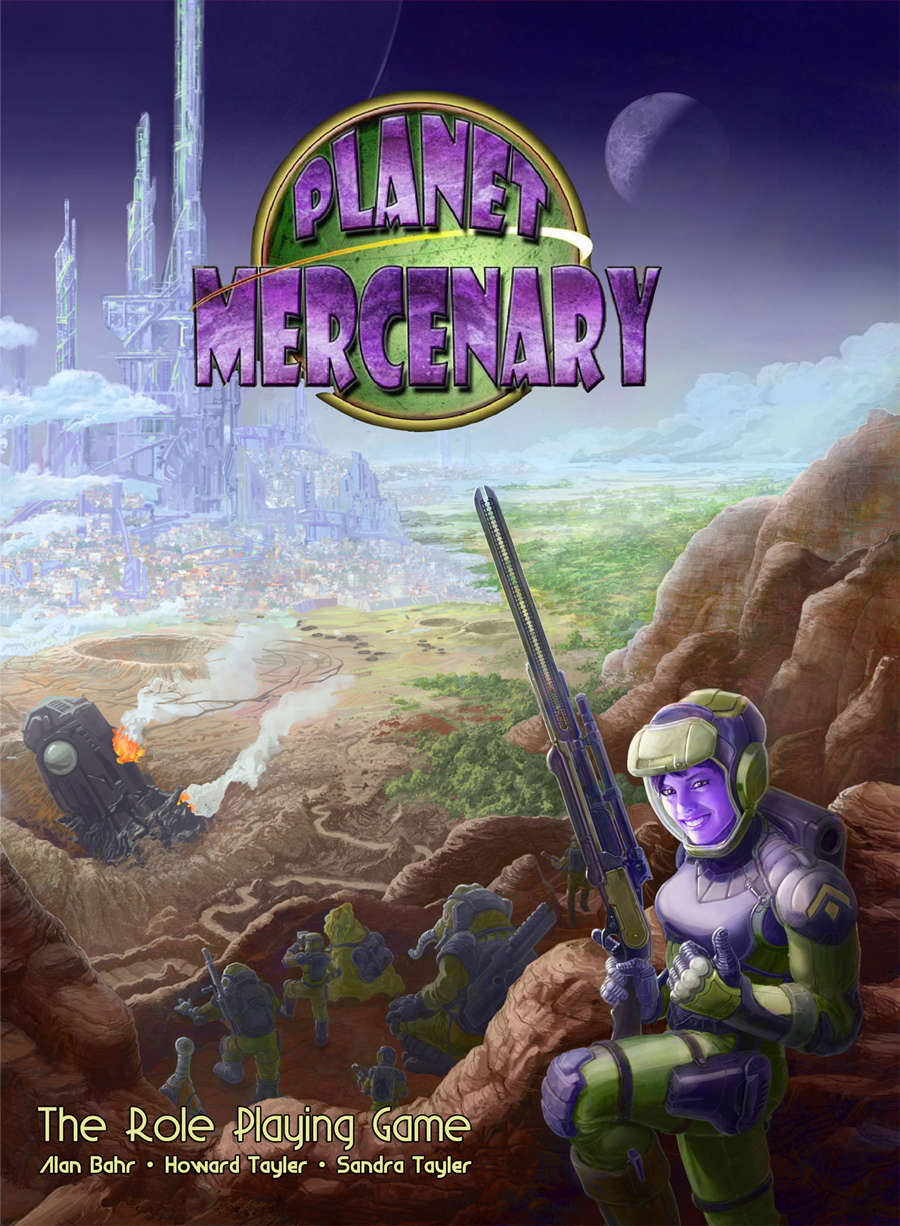
The Planet Mercenary cover. Illustration by Jeff Zugale. The Planet Mercenary RPG is a space opera game set in the same universe as the excellent webcomic Schlock Mercenary. In it, the players take the role of officers in a 32th-century mercenary company. They take on varied contracts from all manner of client, human or alien, lawful or shady. Said contracts often result in a copious amount of explosions with a healthy side order of humor.
This game started out as a Kickstarter project organized by the comic’s author, Howard Tayler. Being a fan of the comic, I backed it, and it recently reached a successful conclusion. The PDF can now be bought on the link above for US$25.00, and overall I consider it well worth the money if you’re looking for a relatively light and very chaotic action-oriented system. Familiarity with the comic only makes the whole thing better, but is in no way required for your group to have a good time with this game.
Presentation
The main text of the book is presented in a double-column layout, in a font I found easy to read. The page background is white, with light purple margins on the “outer” side of each page. The page numbers and associated decoration are done in a “techy” style meant to give the impression you’re reading the text on some futuristic electronic device. As I have the PDF version, that turned out to be the actual case!
There’s a fair number of well-done illustrations here, most of which depict whatever is being currently discussed in the text itself, be it a typical member of a species, a specific individual, a place or a piece of equipment (from pistols to warships). The images use a more realistic and detailed style than the Schlock Mercenary comic, and some of the landscapes done in this style can be quite spectacular (just look at the cover above).
The text of the book also contains one of the best examples of game fiction I ever saw. Instead of a short story or comic at the start of the book, this one is told through a series of editorial notes on its margins. “Planet Mercenary” is the name of an in-setting corporation that specializes in selling weapons to mercenary companies, and the RPG itself is written like a piece of promotional material for them. The editorial notes in question are from the fictional staff responsible for writing the book, the idea being that they were supposed to be removed but were left in by mistake. They serve to both add color to some of the passages in the main text and to tell a story about the characters making the comments. I was going to say it’s a surprisingly good story for in-game fiction, but it’s not actually surprising at all given it was written by Howard Tayler, the comic’s author (who also, IIRC, wrote all the setting information here).
Setting
Anyone familiar with the comic should know the setting of Planet Mercenary pretty well already. Even if you’re not, you shouldn’t have much trouble understanding the setting with the information included in the book.
Planet Mercenary takes place in our Milky Way galaxy, in the year 3100. Galactic society is incredibly diverse, encompassing a very large number of alien species and AIs with intellects ranging from “quite dumb” to “godlike”. All of these people get into fights with each other often enough that there’s no shortage of mercenary companies willing to get paid to do fight for them.
Humans have been a part of this hodge-podge for about 900 years, but there are many species far older than ours out there. Heck, there’s more than a few individuals older than our species.
The book includes detailed information on several important systems and worlds, most of which were featured in the comic at some point. There’s also a few places that are new to this book, and provide new and interesting ways to kill your PCs even if they’ve read all of the comic already. The descriptions are humorous, but also succeed in being good space opera on their own merits.
Characters
Such a wide-open setting can theoretically allow for any sort of game, but Planet Mercenary helps you out by narrowing the focus to something that should feel quite familiar to fans of the comic. As mentioned in the introduction, PCs in Planet Mercenary are officers in one of the setting’s many mercenary companies. Character creation should be a group effort, since the last step involves creating the company the characters work for!
The system is almost entirely skill-based. There are no attributes like “Strength” or “Dexterity”, and stuff that would modify those in other systems (such as your species) modifies skills instead. There are two derived stats, Health (which is basically HP) and Defense (how hard you are to hit). Players begin by picking a Command Package that describes their function in the company, a Background Package that describes what they did before enlisting, and a Sophont Type, or species. While the setting has thousands of sophont types, the book provides details on twelve particularly interesting or common ones, four of which are actually from Earth (humans are prolific uplifters).
All of these provide you with a set of skill modifiers and one or more species-specific special abilities. With those in front of you, you then distribute 40 skill points to round out your character.
With characters in hand, players then create their company by spending Resource Points, with are the game’s abstraction for large sums of money. They use this to buy a warship and its controlling AI, and convert the remainder into Supply Points (i.e, smaller chunks of money) used to outfit the PCs with their gear. Gear stats are usually quite simple, but they get the job done.
As officers, PCs never go into the field alone. Each is in command of a fire team of three NPC Grunts, which has simplified stats and acts on the PC’s orders. They may also be accompanied by a larger, more abstract group of grunts not under their direct control.
In addition to acting as an extension of your character, Grunts can also act as, well, Ablative Meat. That’s the actual name of the rule. This basically means a grunt can take an attack that would normally hit a PC. The more times they survive the experience, the more detailed their descriptions get! Losing a seasoned grunt can feel like losing a friend… but if they stick around long enough they can get promoted to full PC status when their comanding officer finally buys the farm.
Mechanics
If the mechanics of Planet Mercenary can be said to have an overall theme, that theme is chaos. The galaxy is a big, chaotic place and the PCs are expected to get into messy, unpredictable and often violent situations. Even with the best-laid plans, anything can happen once the excrement hits the ventilator.
The basic mechanics are simple. Players roll 3d6, add a relevant skill, and try to get a result higher than a GM-set difficulty, which goes from 7 for super-easy tasks to 30 for nearly impossible ones. The GM is expected to mostly eyeball these difficulties - there are no detailed tables of modifiers to be found here. Combat uses basically the same system, with the target number usually being the enemy’s Defense. Combat initiative doesn’t use dice at all - whoever speaks first, goes first. Yes, this makes fights quite lively, and yes, there’s a fairly large advice section on how to deal with potential problems.
The other thing that really gives Planet Mercenary its unique flavor is the Mayhem mechanic. One of those three dice should be distinct from the other two somehow, and is called the Mayhem Die. When a test is successful and the Mayhem Die has a higher number than the other two, the person who just rolled draws a card from the Mayhem Deck included in the game and (usually) immediately resolves the effect described there. There are about a hundred cards, sorted into descriptive suits such as “Kill”, “Die”, “Bleed”, “Block” and so on.
Mayhem effects can happen on any test, not just in combat! The effects are pretty varied and described a bit vaguely: the players and GM are expected to work them into something tht makes sense for the current ongoing scene. Some are beneficial, some quite detrimental, and most are somewhat ambiguous but guaranteed to make things more interesting in the Chinese curse sense.
There’s also a “Roleplaying Points (RiPP)” mechanic, which combines with Mayhem to make things more varied. Players can use RiPPs to re-roll some of all of their dice in a test, to negate a Mayhem effect, or to invoke the Ablative Meat Shield rule (see above). The GM, conversely, is expected to hand out RiPPs to players for good roleplaying and to negate Mayhem cards that would hurt the game rather than make it more fun.
Conclusion
Planet Mercenary was something of a rarity for me, in that it’s a system I feel like playing after reading through it. It has enough unique mechanics that it would be hard to replicate the same “feel” in another system, and it’s very well-suited to its setting (which I love).
In fact, the Planet Mercenary rule set even has utility outside its home setting. I can’t think of any other system I would rather use to play in the Warhammer 40.000 universe. It does Only War better than Only War itself, and I feel writing psyker rules for Planet Mercenary would be less painful to me than enduring a whole campaign with that percentile system.

subscribe via RSS