Posts
-
Seelah the Paladin in Dungeon Fantasy
In this post I continue to write up the Pathfinder iconic characters for use in the Dungeon Fantasy Roleplaying Game. Links to all of them will appear in the project page, which also contains links to the GURPS Dungeon Fantasy versions.
Today’s template is the Holy Warrior, which means today’s character is Seelah the Paladin. Here she is:
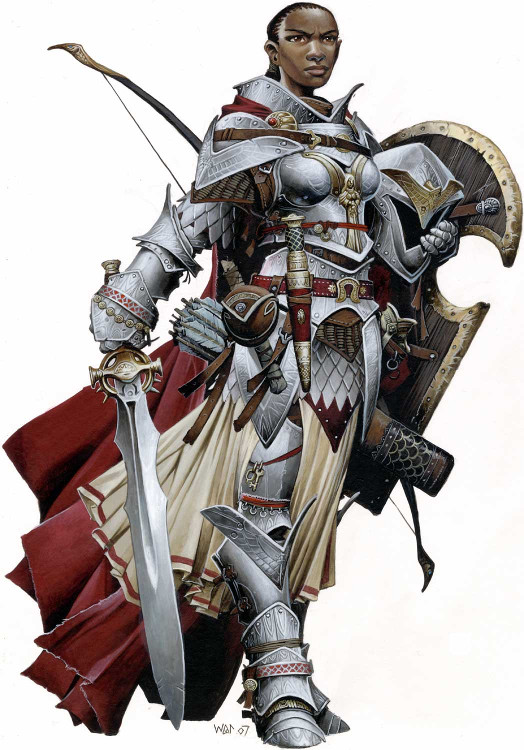
By Wayne Reynolds, Copyright 2008 Paizo Publishing Cool, huh? She’s my second favorite design so far, losing only to Kyra (Lini is a close third). Her bio, however, is by far the best. It’s quite tragic, but seems to hit a good balance between “biblical” and “Arthurian”. Her official stats are here. From these we can learn the following:
-
Seelah is a paladin of Iomedae the Inheritor, a Lawful Good deity of justice and protection. She wears heavy armor and fights with sword and shield, with a bow kept in reserve.
-
She has the usual varied suite of paladin powers, the ones most emphasized are her fearlessness, her ability to smite evil, and her healing hands, in that order.
-
While Seelah goes after all manner of evil foes, she fights fiends and evil dragons with particular fervor.
Given Iomedae’s description as the goddess of justice and valor, the Holy Warrior template fits her quite well. This Seelah has almost all of the abilities of a standard D&D Paladin. She lacks a “Lay on Hands” ability because its DFRPG equivalent, Faith Healing, is quite expensive. However, she’s still absolutely fearless, supernaturally resistant to disease, can channel divine might to enhance her strength, and is particularly adept at fighting demons.
Seelah, 248-point Holy Warrior
ST 13 {30}; DX 13 {60}; IQ 12 {40}; HT 13 {30}.
Damage 1d/2d-1; BL 16.9kg; HP 13; Will 14 {10}; Per 12; FP 13; Basic Speed 6.00 {-10}; Basic Move 6.
Dodge 7 (9); Parry (Broadsword) 11 (13); Block 11 (13).
Advantages
- Born War Leader 1 {5}
- Detect Evil {18}
- Enhanced Parry (Broadsword) 1 {5}
- Heroic Might 1 {9}
- Higher Purpose (Slay Demons) 1 {5}
- Holiness 2 {10}
- Resistant to Disease 3 {3}
- Rest in Pieces {1}
- Unfazeable {15}
Disadvantages
- Charitable (12) {-15}
- Compulsive Generosity (12) {-5}
- Honesty (12) {-10}
- Selfless (12) {-5}
- Sense of Duty (Adventuring Companions) {-5}
Skills
- Bow (A) DX+1 {4} - 14
- Brawling (E) DX+1 {2} - 14
- Broadsword (A) DX+3 {12} - 16
- Climbing (A) DX-1 {1} - 12
- Diplomacy (H) IQ {4} - 12
- Esoteric Medicine (Holy) (H) Per-2 {1} - 10
- Exorcism (H) Will {4} - 14
- Fast-Draw (Sword) (E) DX {1} - 13
- First Aid (E) IQ {1} - 12
- Hidden Lore (Demons) (A) IQ {2} - 12
- Intimidation (A) Will-1 {1} - 13
- Leadership (A) IQ {1}1 - 12
- Medidation (H) Will-2 {1} - 12
- Physiology (Demons) (H) IQ-1 {2} - 11
- Religious Ritual (H) IQ {1} - 10
- Riding (Horse) (A) DX-1 {1} - 12
- Shield (E) DX+3 {8} - 16
- Stealth (A) DX-1 {1} - 12
- Strategy (H) IQ {2}1 - 12
- Tactics (H) IQ {2}1 - 12
- Theology (H) IQ-2 {1} - 10
- Wrestling (A) DX+1 {4} - 14
Equipment
$1698, 40.78kg. Medium Encumbrance.
- Ordinary Clothing [Torso, Limbs]: Free, 1kg.
- Light Scale Armor [Torso]: DR 3/2. $336, 8.4kg
- Heavy Cloth Leggings [Legs]: DR 2. $112, 4.5kg.
- Heavy Cloth Sleeves [Arms]: DR 2. $75, 3kg.
- Heavy Leather Boots [Feet]: DR 2. $52, 2.1kg.
- Light Leather Gloves [Hands]: DR 1. $5, 0.3kg.
- Segmented Plate Helmet [Head]: DR 4. $225, 3kg.
- Shoulder Quiver [Torso]: Holds up to 12 arrows. $10, 0.25kg.
- Arrows x 12 [Quiver]: $24, 0.6kg.
- Medium Shield [Torso]: DB 2. $60, 7.5kg.
- Regular Bow [Torso]: Damage 1d+1 imp; Acc 2; Range 195/260. $100,
- Broadsword [Torso]: Damage 2d cut or 1d+2 imp; Reach 1. $600, 1,5kg.
- Backpack, Small [Torso]: Holds 20kg of gear. $60, 1.5kg.
- Blanket [Backpack]: $20, 2kg.
- Rations x4 [Backpack]: $4, 1kg.
- Personal Basics [Backpack]: $5, 0.5kg.
- Waterskin [Backpack]: Holds 4L of liquid (4kg if water). $10, 0.13kg.
- $302 in coin.
What Changed From Last Iteration
Seelah was almost the opposite of Lini, in that pretty much nothing changed point-wise between the GURPS Dungeon Fantasy and DFRPG versions. All the skills and abilities she has exist in the boxed set and work pretty much the same. The skills of this version are slightly different, but that was a personal decision rather than having to work around something that was missing from the books.
Her gear is the biggest change here, but even this was generally for the better. While her armor has a bit less DR than in the first version, the overall loadout is much lighter, leaving her at Medium Encumbrance instead of Heavy.
-
-
Lini the Druid in Dungeon Fantasy
In this post I continue to write up the Pathfinder iconic characters for use in the Dungeon Fantasy Roleplaying Game. Links to all of them will appear in the project page, which also contains links to the GURPS Dungeon Fantasy versions. Also, I wish the names of the two versions were a bit less similar.
Today’s the template is the Druid, which means today’s subject is Lini. Here she is:
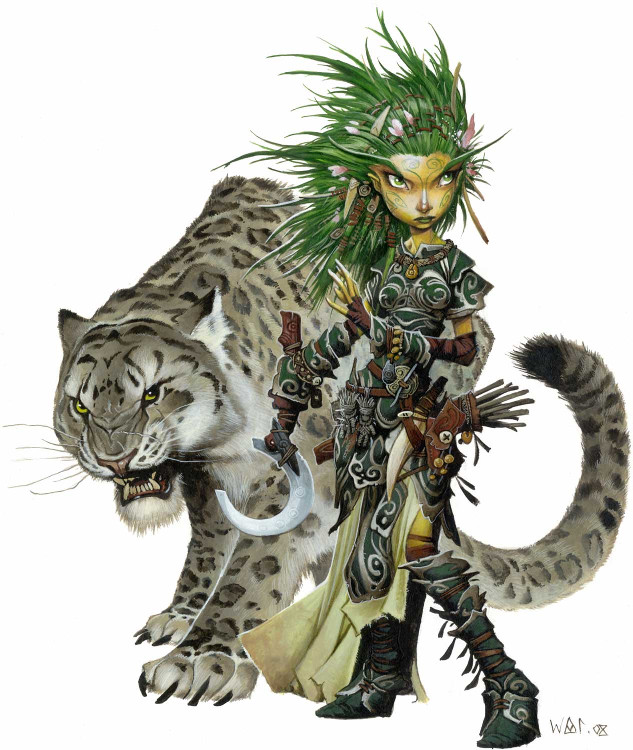
By Wayne Reynolds, Copyright 2008 Paizo Publishing You can find her full bio here, and her original Pathfinder stats here. From looking at these, we see the following:
-
Lini is a Golarion gnome, which is different from the Dungeon Fantasy gnome.
-
She is a druid and hails from the Land of the Linnorm Kings, home of the Not-Vikings. She was always good with animals, and left the place shortly after meeting her snow leopard animal companion.
-
She wields a sickle and a sling, but prefers to send her animal companion to fight for her. Her magic is more or less even mix of terrain-affecting, support and attack spells. She is also described as having a knack for handling animals, particularly large mammals.
Lini is the first character that presents us with some real difficulties in adaptation. Not because of her “exotic” race, since I’ve statted that one up in its own article, but because the DFRPG boxed set doesn’t have rules for animal companions! In fact, it doesn’t even have the Ally advantage, which they’re based on.
This lines up with their goals of presenting a “streamlined” set of rules, since Allies can bring a surprising amount of complexity to a game. They’re the only NPCs whose points you have to keep track of, and you need to remember to give them points in the correct ratio to keep them at the same percentage as the PC. Still, their lack prevents us from being truly faithful to Lini’s Pathfinder version.
This is what she ended up like:
Lini, 250-point Fey Gnome Druid.
ST 8 {-20}1; DX 12 {40}; IQ 15 {100}1; HT 13 {30}1
Damage 1d-3/1d-2; BL 6.4kg; HP 9 {2} 1; Will 16 {5}; Per 16 {5}; FP 13; Basic Speed 6.00 {-5}; Basic Move 5 {-5}1.
SM -2; Dodge 9; Parry 10 (Sickle).
Advantages
- Animal Empathy {5}
- Gnome Magic (Light Jet, Sound and Apportation) {3}1
- Green Thumb 1 {5}
- Magery 0 {5}1
- Night Vision 5 {5}1
- Power Investiture (Druidic) 4 {40}
- Resistant to Disease 2 {2}
- Speak with Animals {23}
Disadvantages
- Chummy {-5}
- Curious (12) {-5}
- Impulsiveness (12) {-10}1
- Odious Personal Habit (“Dirty Hippy”) {-5}
- Sense of Duty (Adventuring Companions) {-5}
- Vow (Never Sleep Indoors) {-10}
- Weirdness Magnet {-15}
Skills
- Animal Handling (Big Cats) (A) IQ-1 {1} - 14
- Axe/Mace (A) DX+2 {8} - 14
- Camouflage (E) IQ {1} - 15
- Climbing (A) DX {2} - 12
- Diagnosis (H) IQ-2 {1} - 13
- Disguise (Animals) (A) IQ-1 {1} - 14
- Esoteric Medicine (Druidic) (H) Per {4} - 16
- Herb Lore (VH) IQ {4}2 - 15
- Hidden Lore (Faeries) (A) IQ-1 {1} - 14
- Hidden Lore (Nature Spirits) (A) IQ-1 {1} - 14
- Hiking (A) HT-1 {1} - 12
- Innate Attack (Projectile) (E) DX+2 {4} - 14
- Mimicry (Animal Sounds) (H) IQ-2 {1} - 13
- Naturalist (H) IQ {2}2 - 15
- Observation (A) Per-1 {1} - 15
- Pharmacy (H) IQ-1 {1}2 - 14
- Religious Ritual (Druidic) (H) IQ-2 {1} - 13
- Shield (E) DX+2 {4} - 14
- Stealth (A) DX {2} - 12
- Survival (Forest) (A) Per-1 {1} - 15
- Theology (Druidic) (H) IQ-2 {1} - 13
- Veterinary (H) IQ-2 {1} - 13
- Weather Sense (A) IQ-1 {1} - 14
Spells
All have +4 from Power Investiture.
- Air:
- Lightning (H) IQ+2 {1} - 17
- Resist Lighning (H) IQ+2 {1} - 17
- Animal:
- Beast-Soother (H) IQ+2 {1} - 17
- Beast-Rouser (H) IQ+2 {1} - 17
- Beast Link (H) IQ+2 {1} - 17
- Mammal Control (H) IQ+2 {1} - 17
- Master (H) IQ+2 {1} - 17
- Protect Animal (H) IQ+2 {1} - 17
- Fire:
- Resist Cold (H) IQ+2 {1} - 17
- Food:
- Seek Food (H) IQ+2 {1} - 17
- Healing:
- Cure Disease (H) IQ+2 {1} - 17
- Instant Neutralize Poison (VH) IQ+2 {1} - 16
- Recover Energy (H) IQ+2 {1} - 17
- Knowledge:
- Pathfinder (H) IQ+2 {1} - 17
- Plant:
- Create Plant (H) IQ+2 {1} - 17
- Shape Plant (H) IQ+2 {1} - 17
- Tangle Growth (H) IQ+2 {1} - 17
- Walk Through Plants (H) IQ+2 {1} - 17
- Water:
- Frostbite (H) IQ+2 {1} - 17
- Hail (H) IQ+2 {1} - 17
Equipment
$225.0, 9.28kg. Light Encumbrance.
- Ordinary Clothes [Torso, Limbs]: Free, 1kg.
- Sickle [Torso]: Damage 1d-2 cut or imp, Reach 1. May get stuck if doing impaling damage. $40, 1kg.
- Sling [Torso]: Damage 1d-2 pi, Acc 0, Range 48/80. $20, 0.25kg.
- Small Pouch [Torso]: Holds 1.5kg. $10, 0.1kg.
- 10 x Sling Bullets [Pouch]: $1, 0.3kg.
- Backpack, Small [Torso]: Holds 20kg of gear. $60, 3kg.
- 2 x Glow Vial [Backpack]: Sheds light in a 2m radius for 12 hours. $60, 0.5kg.
- Wineskin [Backpack]: Holds 4L of liquid. $10, 0.13kg.
- Blanket [Backpack]: $20, 2kg.
- 2 x Rations [Backpack]: $4, 1kg.
- $775 in coin.
Design Notes and What Changed
This version of Lini lacks her snow leopard animal companion, as there are no rules for them in the boxed set. She has the Speak with Animals power instead.
If you have access to the full GURPS rules and to GURPS Dungeon Fantasy 5: Allies, then you can replace the Speak with Animals power with a 18-point Panther natural ally, 1 point in the Beast-Speech spell, and another 4 elsewhere.
If you don’t, a rough approximation is to use the Lion from DF: Monsters. It would cost 12 points to have that beast always be by your side, and it would gain 1 character point to improve itself for every 2 points you gained. Buying it would again involve replacing the Speak with Animals power and redistributing the left-over points as above.
Aside from that, the other big change is once again her gear, which is costlier and heavier. Though her weapons do a bit more damage, Lini is still better off using spells or talking animals into fighting for her.
-
-
Fey Gnomes in Dungeon Fantasy
Until relatively recently, Gnomes were kinda like the Ugly Ducklings of the small folk when it comes to games in the dungeon fantasy genre. In my experience, Halflings have always been the tiny sneak-thieves1 and dwarves the stocky, bearded axe murderers. Gnomes, on the other hand, just felt like a somewhat bland blend of dwarven and halfling traits.
Over time, as authors began to cast about for a stronger niche for them, I began to see a couple of different varieties. One of the most famous is the tinker gnome, whose shtick is being good at messing with “advanced” technology like clockwork mechanisms or steam engines. The Dragonlance setting takes this to an extreme by making them pint-sized mad scientists, and the world of Warcraft takes a similar tack. The gnome racial template present in both GURPS Dungeon Fantasy and the DFRPG is a less extreme version of this type, having access to a Talent that makes them good at dealing with locks, traps and making things like crossbows.
The other famous gnomish niche is the fey trickster. Gnomes of this type usually prefer the same type of forest that houses faeries and nymphs, can use a bit of innate magic, and have other stats conductive to becoming good magic users. Recent editions of D&D usually go with this type of gnome in most settings that aren’t Dragonlance, and Pathfinder follows suit.
If you want to play this type of gnome in your Dungeon Fantasy game, this racial template will help you!
Fey Gnome
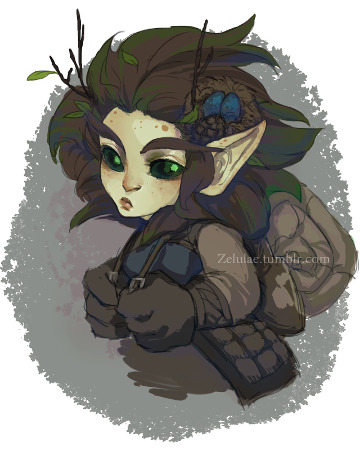
Illustration by Zelulae Racial Cost: 0 points
Fey Gnomes are about as big as halflings, but no one would confuse the two. With their slim builds, pointy ears, large eyes and wildly-colored hair they look more like tiny psychedelic elves. Tough they are mortal, these gnomes still have a strong connection to the faerie realm, which manifests in their natural talent for magic and their predilection for whimsy and pranks.
In Golarion (Pathfinder’s setting), these gnomes were native to an otherworldly faerie realm, and were kicked out of it in the distant past. They never quite adapted to mortal life, and to this day have some trouble relating to other peoples or settling down.
In other settings, most Fey Gnomes might still live in those realms, or visit them regularly! Gnomish communities would be more common here, and would rely heavily on illusion magic to protect themselves.
Attribute Modifiers: ST-3 {-30}; IQ+1 {20}; HT+1 {10}.
Secondary Characteristic Modifiers: SM -2; HP+1 {2}; Basic Move -1 {-5}.
Advantages: Magery 0 {5}; Night Vision 5 {5}; Gnome Magic {3}.
Disadvantages: Impulsiveness (12) {-10}.
Features: Wild, brightly colored hair and/or dark eyes without pupils.
Special Gnome Traits
Gnome Magic2
You may learn up to three wizardly or druidic spells without regard for pre-requisites! You must specify which spells those are during character creation, though you can wait to actually learn them later if you wish. You must still pay points to learn the spells as normal. If your Magery is 1 or more, it gives a bonus to these spells (even if they are druidic).
The spells don’t all have to be from the same “power source” - you can choose one wizardly and two druidic spells, or any other combination. Your choice is subject to GM approval. Popular spells for gnomes include Apportation, Sound, Light, Beast Speech, Invisibility or other illusions.
-
Kyra the Cleric in Dungeon Fantasy
In this post I continue to write up the Pathfinder iconic characters for use in the Dungeon Fantasy Roleplaying Game. Links to all of them will appear in the project page, which also contains links to the GURPS Dungeon Fantasy versions. Also, I wish the names of the two versions were a bit less similar.
Today’s template is the Cleric, which means today’s star is Kyra. Here she is:
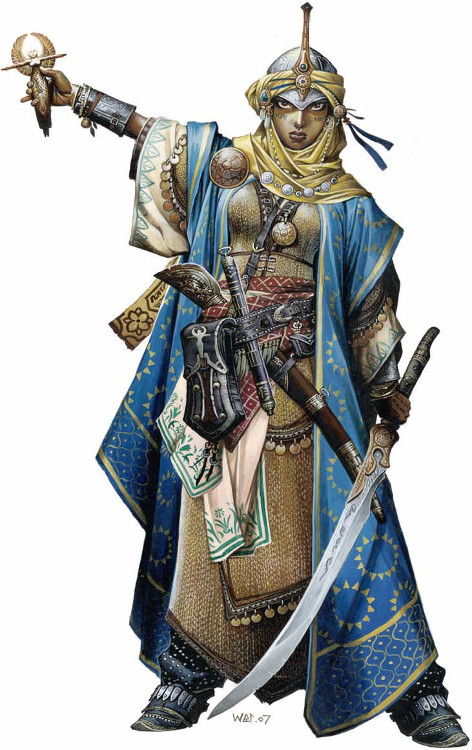
By Wayne Reynolds, Copyright 2008 Paizo Publishing Kyra’s character design is among my favorite from the Pathfinder iconics. You can find her full bio here, and her original Pathfinder stats here. From looking at them we can see the following:
-
Kyra is from Qadira, her world’s Persia/Arabia equivalent. She’s the sole survivor from a bandit raid on her farming village.
-
Kyra is a cleric of Sarenrae, the goddess of healing, redemption, honesty, and the sun. She teaches her devotees to always seek to redeem those who follow the path of evil, and to destroy them if that proves impossible.
-
She wields a scimitar, her deity’s favored weapon. Her cleric spells generally have a “light, fire and healing” theme, and she possesses the typical D&D cleric ability to turn undead.
The original version used the modified Sun Cleric template from GURPS Dungeon Fantasy 7: Clerics, but here we have no choice but to go with the basic Cleric template from the DFRPG boxed set. That’s not a bad thing, however! It turns out that the Cleric spell list has been tweaked to include a bit more righteous burnination, so it ends up being quite close to that of the Sun Cleric.
Kyra, 249-point Human Cleric
ST 13 {30}; DX 12 {40}; IQ 14 {80}; HT 12 {20}
Damage 1d/2d-1; BL 16.9kg; HP 13; Will 14; Per 14; FP 12; Basic Speed 6.00; Basic Move 6.
Dodge 8; Parry 10 (scimitar).
Advantages
- Clerical Investment {5}
- Power Investiture 4 {40}
- Turning {24}
- Resist Evil 1 {1}
Disadvantages
- Charitable (12) {-15}
- Fanaticism (Sarenrae) {-15}
- Sense of Duty (Adventuring Companions) {-5}
- Truthfulness (12) {-5}
- Vow (Always attempt redemption before violence) {-10}
Skills
- Broadsword (A) DX+3 {12} - 15
- Climbing (A) DX-1 {1} - 11
- Diagnosis (H) IQ-1 {1} - 12
- Diplomacy (H) IQ-1 {2} - 13
- Esoteric Medicine (Holy) (H) Per {4} - 14
- Exorcism (H) Will {4} - 14
- First Aid (E) IQ {1} - 14
- Hidden Lore (Undead) (A) IQ-1 {1} - 13
- Innate Attack (Projectile) (A) DX+2 {4} - 14
- Meditation (H) Will-2 {1} - 12
- Occultism (A) IQ-1 {1} - 13
- Public Speaking (A) IQ-1 {1} - 13
- Religious Ritual (H) IQ-2 {1} - 12
- Riding (Horse) (A) DX-1 {1} - 11
- Savoir-Faire (High Society) (E) IQ {1} - 14
- Surgery (VH) IQ-2 {2} - 12
- Teaching (A) IQ-1 {1} - 13
- Theology (H) IQ-2 {1} - 12
Spells
All get +4 from Power Investiture.
- Fire:
- Flaming Weapon (A) IQ+2 {1} - 16
- Resist Fire (A) IQ+2 {1} - 16
- Resist Cold (A) IQ+2 {1} - 16
- Healing:
- Cleansing (A) IQ+2 {1} - 16
- Cure Disease (A) IQ+2 {1} - 16
- Major Healing (A) IQ+2 {1} - 16
- Minor Healing (A) IQ+2 {1} - 16
- Recover Energy (A) IQ+2 {1} - 16
- Resist Disease (A) IQ+2 {1} - 16
- Resist Poison (A) IQ+2 {1} - 16
- Knowledge:
- See Secrets (A) IQ+2 {1} - 16
- Light and Darkness:
- Continual Light (A) IQ+2 {1} - 16
- Glow (A) IQ+2 {1} - 16
- Light (A) IQ+2 {1} - 16
- Sunbolt (A) IQ+2 {1} - 16
- Sunlight (A) IQ+2 {1} - 16
- Meta-Spells:
- Dispel Magic (A) IQ+2 {1} - 16
- Protection and Warning:
- Armor (A) IQ+2 {1} - 16
- Shield (A) IQ+2 {1} - 16
Equipment
$1250.0, 26.63kg. Light Encumbrance.
- Backpack, Small [Torso]: Holds 20kg of gear. $60, 1.5kg.
- Blanket [Backpack]: $20, 2kg.
- Clothing [Torso, Limbs]: Free, 1kg.
- First Aid Kit [Backpack]: $50, 1kg.
- Heavy Cloth Armor [Head, Torso, Limbs]: DR 2. $450, 18kg.
- Holy Symboo [Torso]: $50, 0.5kg.
- Personal Basics [Backpack]: $5, 0.5kg.
- Rations x2 [Backpack]: $5, 0.5kg
- Scimitar [Torso]: As broadsword. Damage 2d cut or 1d+1 imp; Reach 1. $600, 1.5kg.
- Waterskin [Backpack]: Holds 4L of liquid (4kg if water). $10, 0.13kg.
- $250 in coin.
Design Notes
Kyra spent 1 point in extra starting cash to afford the scimitar (which has the same stats as a broadsword). Her mandatory “holy” disadvantage is the Vow, which means she must always offer enemies a chance to surrender and repent, and only fight those who refuse. This is about as inconvenient as the Pacifism (Cannot Harm Innocents) disadvantage from the GURPS Basic Set, and so is worth the same.
She also has the Diplomacy and Riding (Horse) skills, which make sense for her and are in the rules despite not being on the template.
Changes from the First Iteration
The Psychic Guidance perk doesn’t exist in the boxed set, so it was replaced by 1 level of Resist Evil and she had to spend points on Innate Attack for her Sunbolt spell. And while Kyra was indeed able to keep most of her spell list she still had to trade Ignite Fire (which is not on the list) and Continual Sunlight (which is not in the box at all) for Resist Cold and Glow, respectively.
Kyra’s armor loadout also changed significantly, since mail is much more expensive when using the rules from the boxed set. She also lost the bow and arrows, relying on Sunbolts for ranged attacks.
-
-
Lem the Bard in the Dungeon Fantasy RPG
In this post I continue to write up the Pathfinder iconic chracters for use in the Dungeon Fantasy Roleplaying Game. Links to all of them will appear in the project page, which also contains links to the GURPS Dungeon Fantasy versions. Also, I wish the names of the two versions were a bit less similar.
Our second subject is Lem the Bard. Here he is:
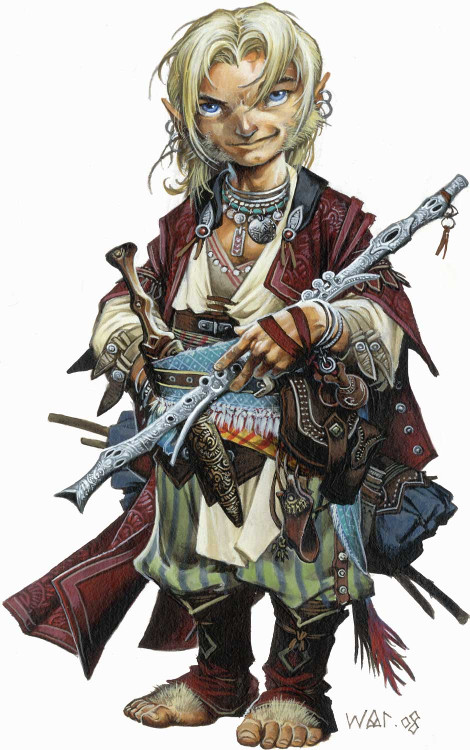
By Wayne Reynolds, Copyright 2008 Paizo Publishing You can find his full bio here, and his original Pathfinder stats can be found here. From looking at them we can see the following:
-
Lem was born a slave in the devil-worshipping nation of Cheliax. He escaped in a rather fiery fashion.
-
He hates slavery and slavers, and tends to side with the underdog in most conflicts.
-
Lem has a sling and a shortsword, both sized for a halfling, but prefers to use his magic in a fight. He mostly uses his bard song to bolster his allies, and targets particularly tough foes with hindering spells to make them easier to take down.
Here’s what he looks like in the DFRPG rules:
Lem, 250-point Halfling Bard
ST 8 {-20}1; DX 13 {60}; IQ 14 {80}; HT 12 {20}1
Damage 1d-3/1d-2; BL 6.4kg; HP 10 {4}1; Will 14 {0}; Per 14 {0}; FP 12 {0}; Basic Speed 6 {-5}; Basic Move 5 {-5}1; SM -2.
Advantages
- Bardic Talent 4 {40}
- Charisma 2 {10}
- Halfling Marksmanship 2 {10}1
- Honest Face {1}1
- Silence 2 {10}1
- Song of Echoes {14}
- Song of Terror {21}
- Voice {10}
Disadvantages
- Charitable (12) {-15}
- Chummy {-5}
- Gluttony (12) {-5}1
- Impulsiveness (12) {-10}
- Intolerance (Slavers) {-5}
- Kleptomania (12) {-15}1
- Sense of Duty (Adventuring Companions) {-5}
Skills
- Acrobatics (H) DX-2 {1} - 11
- Acting (A) IQ {2} - 14
- Carousing (E) HT {1} - 12
- Climbing (A) DX-1 {1} - 12
- Current Affairs (E) IQ {1} - 14
- Detect Lies (H) IQ-2 {1} - 12
- Diplomacy (H) IQ {1}2 - 14
- Fast-Draw (Sword) (E) DX {1} - 13
- Fast-Talk (A) IQ+1 {1}2 - 15
- First Aid (E) IQ {1} - 14
- Gesture (E) IQ {1} - 14
- Heraldry (A) IQ-1 {1} - 13
- Interrogation (A) IQ-1 {1} - 13
- Intimidation (A) Will-1 {1} - 13
- Merchant (A) IQ-1 {1} - 13
- Musical Composition (H) IQ+2 {1}3 - 16
- Musical Instrument (Flute) (H) IQ+2 {1} - 16
- Observation (A) Per-1 {1} - 13
- Performance (A) IQ+1 {1}2 - 15
- Poetry (A) IQ-1 {1} - 13
- Propaganda (A) IQ-1 {1} - 13
- Public Speaking (A) IQ+3 {1}24 - 17
- Savoir-Faire (E) IQ {1} - 14
- Scrounging (E) Per {1} - 14
- Shortsword (A) DX+2 {8} - 15
- Singing (E) HT+4 {1}23 - 16
- Sling (H) DX+1 {2}5 - 14
- Stealth (A) DX {2} - 13
- Streetwise (A) IQ-1 {1} - 13
- Throwing (A) DX+2 {2}5 - 15
Spells
All get +3 from Bardic Talent
- Communication and Empathy:
- Borrow Language (H) IQ+2 {1} - 16
- Borrow Skill (H) IQ+2 {1} - 16
- Compel Truth (H) IQ+2 {1} - 16
- Lend Language (H) IQ+2 {1} - 16
- Lend Skill (H) IQ+2 {1} - 16
- Mind Reading (H) IQ+2 {1} - 16
- Mind-Sending (H) IQ+2 {1} - 16
- Persuasion (H) IQ+2 {1} - 16
- Sense Emotion (H) IQ+2 {1} - 16
- Sense Foes (H) IQ+2 {1} - 16
- Truthsayer (H) IQ+2 {1} - 16
- Mind Control:
- Bravery (H) IQ+2 {1} - 16
- Daze (H) IQ+2 {1} - 16
- Fear (H) IQ+2 {1} - 16
- Foolishness (H) IQ+2 {1} - 16
- Loyalty (H) IQ+2 {1} - 16
- Mass Daze (H) IQ+2 {1} - 16
- Mass Sleep (H) IQ+2 {1} - 16
- Sleep (H) IQ+2 {1} - 16
Equipment
$867.0, 9.78kg. Light Encumbrance.
- Clothing [Torso, Limbs]: $50, 1kg.
- Shortsword [Torso]: Provides 4 FP as a power item. Reach 1; Damage 1d-2 cut or imp. $400, 1kg.
- Sling [Torso]: Acc 0; Range 48/80; Damage 1d-2 pi. $20, 0.25kg.
- Small Pouch [Torso]: Holds 1.5kg. $10, 0.1kg.
- 8 x Sling Bullets [Pouch]: $8, 0.25kg.
- 3 x Nageteppo, Smoke [Pouch]: $120, 0.3kg.
- Personal Basics [Pouch]: $5, 0.5kg.
- Flute [Torso]: $40, 0.5kg.
- Backpack, Small [Torso]: Holds 20kg of gear. $60, 1.5kg;
- Blanket [Backpack]: $20, 2kg.
- Lantern [Backpack]: 2m radius, burns for 24 hours on a full charge. $20, 1kg.
- Oil, 500ml [Backpack]: Good for 1 lantern charge. $20, 1kg.
- 2x Rations [Backpack]: $4, 0.5kg.
- Scroll Belt [Backpack]: Holds up to 20 scrolls and protects them from the elements. $75, 0.5kg.
- Rope, 1cm, 10m [Backpack]: Supports 150kg. $5, 0.75kg.
- Wineskin [Backpack]: Holds 4L of liquid. $10, 0.125kg.
- $133 in coin.
Design Notes
I find that this new iteration of Lem doesn’t match the original d20 stats quite as closely as the first one, despite still being a very serviceable DFRPG bard. Let’s take a look at what changed to see why.
Changes from the First Iteration
You can see the original version here. As I said above, this iteration is a bit less faithful to the d20 stats than the first, and the main reason for this is that the Alarum song is not in the DFRPG. That’s the song that bolsters your allies in combat, matching the effect of the basic d20 Bard Song power. In its place, he gets the Song of Terror and the Song of Echoes. This means that his general tactics stay the same, but now he focuses on scaring away his enemies rather than strengthening his allies.
There are several other changes, but they’re more beneficial. Lem now has a few more skills, and his musical skills in particular are higher because the Musical Ability advantage has been rolled into Bardic Talent. His Terror spell was removed because the Terror Song already does the same thing a bit better.
The other big change here is in his equipment. GURPS Dungeon Fantasy had detailed rules for under-sized gear to fit smaller races, and those are absent from the DFRPG. This means that all of Lem’s gear is human-sized or, in the case of his clothing, has the same cost and weight as the human sized version.
The good news is that his weapons do the more damage, though since he still has ST 8 his songs and spells are still a better option. The bad news is that he’s carrying a lot more weight and is at Light Encumbrance by default. And since even basic enchantments cost a lot more, he loses the Fortify enchantment in his clothes.
-
subscribe via RSS