Posts
-
Dragon's Dogma Bestiary: Hydras
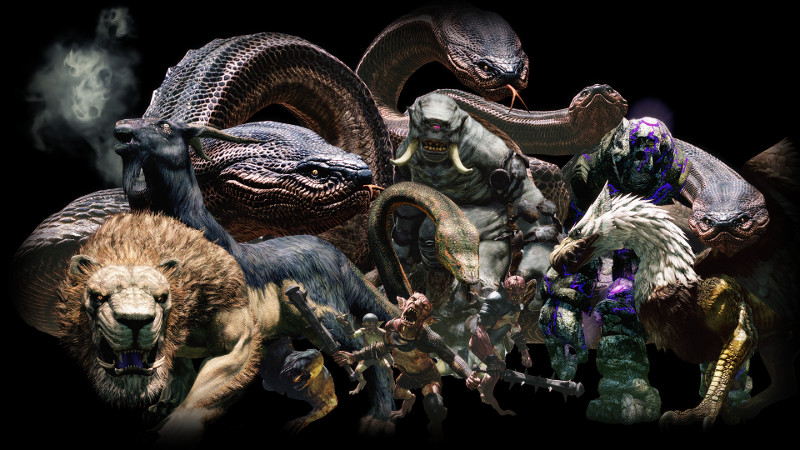
Copyright 2012 Capcom. This is an entry in the Dragon’s Dogma bestiary. You thought I had droppped this, didn’t you? The remaining entries along with the full adaptation can be found here.
Like gryphons and chimeras, hydras are a heraldic animal in Gransys, symbolizing endurance in battle. Hydra sightings are vanishingly rare, for not many of these monsters exist in Gransys and even fewer people who saw one up close lived to tell the tale.
A Gransys hydra looks like a gigantic four-headed snake, covered in shiny black scales. Its four necks tower over the ground at the height of a cyclops, and its main body is even larger. Its four heads can spit a jet of numbing poison, and and swallow a grown man whole. Despite this, the creature lacks substantial fangs and its jaw muscles are more suited for immobilizing victims than for outright crushing them. Should the hydra have need of crushing someone, though, it can simply slam its heads, necks, or tail into the victim.
ST 50; DX 13; IQ 5; HT 15;
HP 60; Will 12; Per 12; FP 15;
Speed 7; Move 8 (Slithers); SM +5;
Dodge 10; DR 6 (neck); 9 (elsewhere).
- Head Slam (15): 6d+3 crushing; Reach C-4; The hydra slams one of its heads into the target.
- Miasma Spit (15): A 2 meter radius area of effect in front of the hydra. Targets exposed to the venom must roll HT. Success means 1d injury, failure means 2d. Targets also suffer a -1 penalty to DX for every 2 injury sustained, which lasts for 1 minute. Costs 2 FP per use.
- Bite (15): The target is grappled with ST 52! In subsequent turns the hydra will attempt to swallow the target (treat it as an attempt to pin). See Notes below for how to rescue a swallowed target.
- Tail Sweep (15): 6d+3 crushing with double knockback; Targets a 3 meter radius area of effect behind the hydra. Can only be dodged, not parried or blocked!
Traits: Extra Attack 3; High Pain Threshold; Horizontal; Hydra Regeneration (see below); No Legs (slithers); No Fine Manipulators; Nictitating Membrane 3; Night Vision 9; Peripheral Vision;
Skills: Brawling-15; Wrestling-15; Innate Attack-15;
Class: Mundane.
Hydra Tactics
The hydra can do something with each of its heads each turn, or give up one head’s action for a tail sweep. Each head counts as a separate individual for the purposes of being targetted with mind-affecting spells or the like.
Despite its feasome size and prowess, a hydra has the mind of a beast. It will usually attack because it’s hungry! In these cases, its usual tactic is to impair one of more targets with its Miasma Spit, then bite and swallow them. It will retreat once it has had its fill or suffered significant injury.
Hydras are also highly territorial and will fight any who trespass on their lairs to the death.
Fighting a Hydra
A cumulative 15 injury from cutting weapons to a neck will sever one of the hydra’s heads. 2d seconds later, the head will grow back, and the hydra will regain the lost HP. The stump must be burned with natural or magical fire to prevent this from happening! Severing and cauterizing the last head will of course kill the beast.
Someone swallowed by a hydra can still be saved in the 10 seconds it takes for them to travel down the beast’s neck if the offending head is severed before then. If they reach the creature’s body they will automatically take 6d+2 cr damage per second from its innards, which practically guarantees a swift death.
Giant Climbing
It’s possible for a brave or suicidal warrior to climb the neck of a hydra! It’s skin is mostly smooth but still provides some handholds, giving a -2 to any Climbing rolls. Someone clinging to the neck of a hydra can target the neck at no penalty with a one-handed melee weapon, but the beast can still attempt to crush the pest by slamming its neck against the ground. Treat this as a “Head Slam” attack. The target has a -2 penalty to Dodge it unless they let go of the hydra.
Hydra Variants
Archydra
The original game also features the “Archydra” in its most difficult dungeons, beyond the Rift. This variant is white instead of black, harder to hurt, and does have fangs. It has DR 9 in the neck and 12 elsewhere and can bite for 6d+2 imp damage instead of grappling if it wishes.
-
Harsk the Ranger in the DFRPG
In this post I continue to write up the Pathfinder iconic characters for use in the Dungeon Fantasy Roleplaying Game. Links to all of them will appear in the project page, which also contains links to the GURPS Dungeon Fantasy versions.
Today’s template is the Scout, not because it’s in order but because it’s the one I’ve written. This means today’s character is Harsk the Ranger. Here he is:
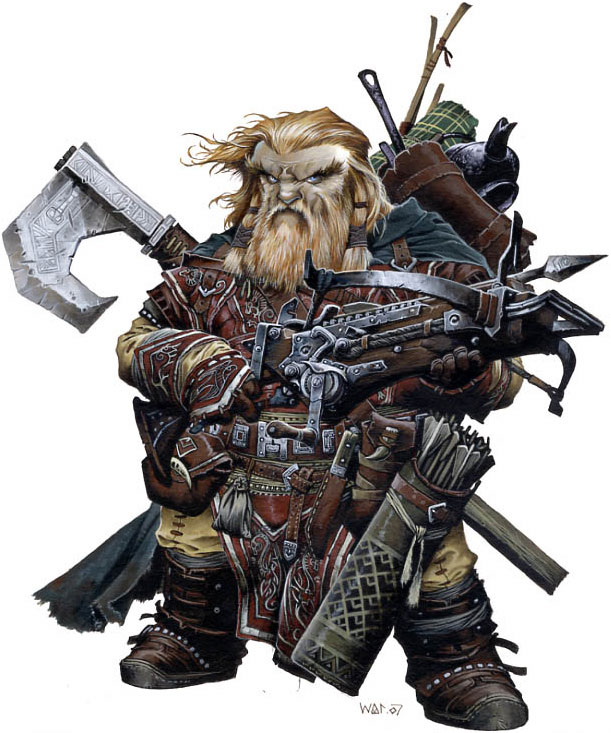
By Wayne Reynolds, Copyright 2008 Paizo Publishing Just Look at all that compressed rage! His bio does give him plenty to be angry about. Harsk’s official stats are here. From these we can learn the following:
-
Harsk is a Dwarf from Varisia, a “wild frontier” region that doesn’t have any blatant ties to real-world cultures. He was a bit of an outsider to his own stereotypically Dwarven community, and appointed himself a keeper of justice in the wild places after his brother was killed by raiding giants.
-
He carries his brother’s axe with him, but his preferred weapon is a heavy crossbow he made himself. Understandably, he has giants as a favored enemy and gains bonuses to fight them.
-
He’s skilled in wilderness survival, particularly in mountains, and very perceptive.
This puts us in something of a pickle. DF Scouts are excellent at shooting bows, but Harsk’s preferred weapon is the crossbow. While that’s much more in line with the dwarven idiom, it’s not supported by the standard Scout template in Adventurers. Fortunately, it’s possible for me to add new material to support him without copying anything printed in other GURPS books! Even in standard GURPS the traits below were only sort of implied, so I also had to do this for the previous version of the character.
Heroic Crossbowman (20 points)
This is just like Heroic Archer, but for crossbows instead of bows. You can choose this version instead of Heroic Archer when making a Scout. It gives almost exactly the same bonuses: simply replace the Bow skill with Crossbow where applicable. The only difference is that there isn’t a corresponding Weapon Master specialty for crossbows. All other advantages described under Special Scout Traits are compatible with this one.
Quick Reload (1 point)
If you have Heroic Crossbowman, you can also purchase this advantage. It allows you to reload a crossbow of your ST or lower in a single turn with a successful Fast-Draw (Arrow) row, reducing the total ready time of the weapon from 4 to 2 seconds: one to reload, one bring the weapon into position. If you do this and use Heroic Crossbowman’s fast-firing technique, you can fire your crossbow every turn!
Harsk, 250-point Dwarf Scout
ST 13 {30}; DX 14 {80}; IQ 11 {20}; HT 13 {30}
Damage 1d/2d-1; BL 22.5kg; HP 12; Will 11; Per 14 {15}; FP 16 {9}; Basic Speed 7.00 {5}; Basic Move 6 {-5}.
Dodge 10; Parry 12 (Axe).
Advantages
- Dwarven Gear {1}
- Heroic Crossbowman {20}
- Lifting ST 2 {6}
- Night Vision 8 {8}
- Outdoorsman 2 {20}
- Pickaxe Penchant 1 {5}
- Quick Reload (Crossbow) {1}
- Resistant to Poison 6 {6}
- Strongbow {1}
- Tough Skin 1 {3}
Disadvantages
- Greed (12) {-15}
- Honesty (12) {-10}
- Intolerance (Giants) {-5}
- Loner (12) {-5}
- No Sense of Humor {-10}
- Odious Personal Habit (Dour & Gruff) {-5}
- Sense of Duty (Adventuring Companions) {-5}
- Stubborness (12) {-5}
- Vow (Own no more than what can be carried) {-10}
Skills
- Armory (Missile Weapons) (A) IQ-1 {1} - 10
- Axe/Mace (A) DX+4 {12}1 - 18
- Brawling (E) DX {1} - 14
- Camouflage (E) IQ+3 {2}2 - 14
- Cartography (A) IQ+1 {4} - 12
- Climbing (A) DX-1 {1} - 13
- Crossbow (E) DX+5 {16} - 19
- Fast-Draw (Arrow) (E) DX+1 {2} - 15
- First Aid (E) IQ {1} - 11
- Gesture (E) IQ+1 {2} - 12
- Hiking (A) HT {2} - 13
- Jumping (E) DX {1} - 14
- Mimicry (Bird Calls) (H) IQ+1 {2}2 - 12
- Navigation (A) IQ+1 {1}2 - 12
- Observation (A) Per {2} - 14
- Prospecting (A) IQ {1}1 - 11
- Search (A) Per-1 {1} - 13
- Shadowing (A) IQ+1 {4} - 12
- Stealth (A) DX-1 {1} - 13
- Survival (Mountain) (A) Per+1 {1}2 - 15
- Tracking (A) Per+2 {2}2 - 16
- Traps (A) IQ+1 {4} - 12
- Wrestling (A) DX-1 {1} - 13
Equipment
$1000.0, 21.45kg. No Encumbrance!
- Ordinary Clothing [Torso, Limbs]: Free, 1kg.
- Light Leather Jacker [Torso, Arms]: DR 1. $78, 4.6kg.
- Crossbow [Torso]: ST 17. Damage 1d+6 pi; Acc 4; Range 340/425. $150, 3kg.
- Crossbow Sling [Crossbow]: $200, 1kg.
- Hip Quiver [Torso]: Holds up to 20 bolts. $15, 0.5kg.
- Bolts x 20 [Quiver]: $40, 0.6kg.
- Dwarven Axe [Torso]: Damage 2d+1 cut. $225, 2kg.
- Backpack, Small [Torso]: Holds 20kg of gear. $60, 1.5kg.
- Blanket [Backpack]: $20, 1kg.
- Canteen [Backpack]: $10, 1.5kg.
- Personal Basics [Backpack]: $5, 0.5kg.
- Rations x 4 [Backpack]: $8, 1kg.
- Rope, 3/8” (10m) [Backpack]: Supports 150kg. $5, 0.75kg.
- Torch x 2 [Backpack]: $6, 1kg.
- Tea Set [Backpack]: $7, 1.5kg.
- $171 in coin.
Design Notes
Strongbow and Lifting ST 2 allow Harsk to fire a ST 17 crossbow despite only having ST 13. While he’s also a pretty good axe fighter in a pinch, his main focus is reaching out and touching people from very far away.
Changes from the First Iteration
The dwarf racial template changed slightly, and following the DFRPG guidelines I just mixed its traits in with the professional template rather than taking the time to mark what belongs to the racial template and what doesn’t. And since there’s no general purpose Mortal Foe trait here, this version of Harsk doesn’t have it. Instead, he sees in the dark a lot better, and is able to shoot a bigger crossbow.
His gear actually doesn’t change all that much, as he only had a DR 1 leather jacket before too. There’s no tea set listed in DFRPG, I believe, but I didn’t think there would be any harm in keeping it.
-
-
Valeros the Fighter in Dungeon Fantasy
In this post I continue to write up the Pathfinder iconic characters for use in the Dungeon Fantasy Roleplaying Game. Links to all of them will appear in the project page, which also contains links to the GURPS Dungeon Fantasy versions.
Today’s template is the Knight, which means today’s character is Valeros the Fighter. Here he is:
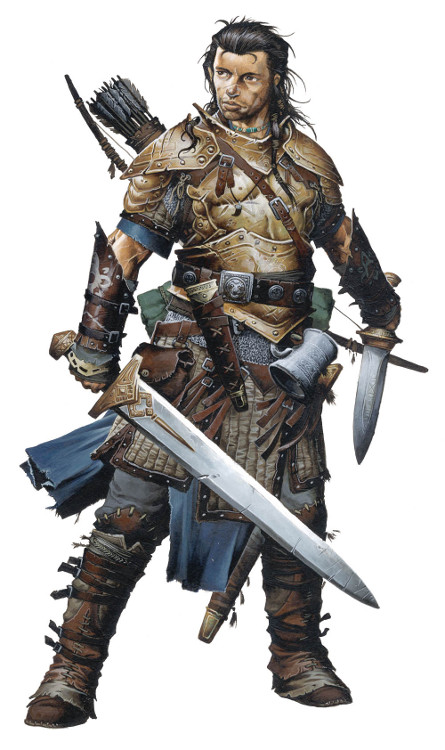
By Wayne Reynolds, Copyright 2008 Paizo Publishing I’m kinda torn on Valeros, to be honest. His character design and bio are the blandest among all the Iconics I’ve seen, but his adaptation is very interesting mechanically. This is because the Knight template is the complete opposite of the d20 Fighter. It really is as good at fighting as advertised, which means its as valuable to the party as any wizard or cleric.
Anyway, from Valeros’ bio linked above and his official stats, we learn the following:
-
Valeros is from the nation of Andoran, his world’s “18th century US” equivalent. He’s the typical farmboy who ran away from home and towards adventure.
-
He wears medium armor and fights with paired swords. He likes making lots of attacks on vulnerable enemy locations. He has a bow as a backup for ranged combat.
There’s not much more to him. In the GURPS version we’ll give him paired broadswords because unlike d20 there’s no restriction on using them here. The Knight template didn’t change much between GURPS DF and the DFRPG, but there is one thing preventing me from just copying the original stats here: the DFRPG lacks the Dual-Weapon Attack technique, not even in the form of a simplified powerup. So here I replaced it with Ambidexterity and Sacrificial Parry, making him a bit worse at attacking multiple times per action but better at protecting his buddies.
If you have access to GURPS Dungeon Fantasy 11: Power-Ups, simply switch those two traits for the Two-Weapon Fighting (Broadsword) advantage, which would allow him to attack twice in a turn without penalties. His skills in this version are also slightly different, and once again the gear list uses the new armor table.
Valeros, 248-point Human Fighter
ST 16 {60}; DX 14 {80}; IQ 10 {0}; HT 13 {30}
Damage 1d+1/2d+2; BL 25,6kg; HP 16; Will 10; Per 10; FP 13; Basic Speed 6.75; Basic Move 6.
Dodge 9; Parry 14;
Advantages
- Born War Leader 2 {10}
- Combat Reflexes {15}
- High Pain Threshold {10}
- Weapon Master (Broadsword) {20}
- Ambidexterity {5}
- Sacrificial Parry {1}
Disadvantages
- Code of Honor (Outlaw’s) {-5}
- Compulsive Carousing (12) {-5}
- Lecherousness (12) {-15}
- Pacifism (Cannot Harm Innocents) {-10}
Skills
- Armory (Melee Weapons) (A) IQ {2} - 10
- Bow (A) DX+1 {4} - 15
- Brawling (E) DX+1 {2} - 15
- Broadsword (A) DX+6 {24} - 20
- Carousing (E) HT {1} - 13
- Climbing (A) DX-1 {1} - 13
- Connoisseur (Weapons) (A) IQ+2 {2}1 - 12
- Fast-Draw (Sword) (E) DX+1 {1}2 - 15
- Forced Entry (E) DX {1} - 14
- Knife (E) DX {1} - 14
- Leadership (A) IQ+2 {2}1 - 12
- Shield (E) DX+2 {4} - 16
- Stealth (A) DX-1 {1} - 13
- Strategy (H) IQ+1 {2}1 - 11
- Tactics (H) IQ+1 {2}1 - 11
- Wrestling (A) DX {2} - 14
Equipment
$2000.0, 31.48kg. Light encumbrance.
- Ordinary Clothing [Torso, Limbs]: Free, 1kg.
- Heavy Leather Armor Suit [Torso, Limbs, Head]: DR 2. $450, 18kg.
- Shoulder Quiver [Torso]: Holds 12 arrows. $10, 0.25kg.
- Arrows x12 [Quiver]: $24, 0.6kg.
- Regular Bow [Torso]: Damage 1d+2 imp; Range 240/320; $100, 1kg.
- Large Knife [Torso]: Damage 2d cut, Reach C-1; or 1d+1 imp, Reach C; $40, 0.5kg.
- 2 x Broadsword [Torso]: Damage 2d+7 cut or 1d+6 imp; Reach 1. $1200, 3kg.
- Backpack, Small [Torso]: Holds 20kg of gear. $60, 1.5kg.
- First Aid Kit [Backpack]: +1 to First Aid. $50, 1kg.
- Blanket [Backpack]: $20, 2kg.
- Rations x4 [Backpack]: $4, 1kg.
- Personal Basics [Backpack]: $5, 0.5kg.
- Waterskin [Backpack]: Holds 4L of liquid (4kg if water). $10, 0.13kg.
- Tankard [Backpack]: Holds 0.5L of liquid. $5, 0.25kg.
- Rope, 3/8” [Backpack]: Length: 10m. Supports 150kg. $5, 0.75kg.
- $17 in coin.
-
-
Dungeon Fantasy RPG available in PDF!
I find myself struggling with minor writer’s block1, but while I deal with it you can rejoice with the fact that the Dungeon Fantasy RPG is finally available in PDF form!. At forty dollars it’s not exactly cheap, but it’s still considerably less expensive than the physical box and you don’t need to spend double its price on shipping if you live abroad!
-
Writing Valeros is like eating a big lump of raw bread dough. It tastes super bland and takes forever to get out of your system. ↩
-
-
My Review of Rick and Morty
This blog is supposed to be only about roleplaying games, but if I don’t get this out my mood will forever be ruined. In any case, please note that this article only represents my own opinion.
I’ve seen people rave about Rick and Morty for a while now, but until my brother decided to show it to me I had never actually watched it, save for the first minute or so of the pilot. The show’s fans, my brother included, always say it’s very smart and funny. Based on those first thirty seconds, I had the suspicion it would be “smart” and “funny” in the same way South Park and Family Guy were.
My brother showed me what he considers the most iconic episode of Rick and Morty, the one with the nested artificial universes. And based on that episode and on the others I watched that day I must say I was wrong. Rick and Morty is not as bad as South Park and Family Guy. It’s worse.
You see, when you watch this show you closely follow the antics of a sociopathic buffoon with the power to destroy the world. You see every horrible thing he does in lurid detail. And he always gets away with it, whatever “it” might be this episode. This is in turns horrifying and depressing. It’s too much like reading the news in real life. In short, it’s not funny.
But is it “smart”? Well, a lot of the show’s episodes use pretty nifty science fiction ideas as a starting point, and have Rick twist them into some sort of nightmare scenario. So yeah, this show is smart in the same way My Little Pony porn is cute. Both make me die a little inside.
And yes, I watched the Pickle Rick fight scene. It’s very well animated and coreographed, and its whole purpose seems to be making Rick look good. It’s the Fox News of fight scenes.
subscribe via RSS