Posts
-
Let's Read Hells Rebels!

This is the start of a series! Go to the project page to see all entries.
Introduction
Like most roleplayers, I am quite familiar with multiple versions of Dungeons & Dragons. The third edition ruleset, in particular, holds a rather peculiar position in my mind. I like that it streamlined the game’s basic rules, but I wouldn’t consider the editions that use it to be my favorite. In fact, I would rather do the work of converting a 3.x/Pathfinder adventure or campaign to another set of rules than play it out using its default system.
That said, I came into possession of a whole bunch of Pathfinder books due to a large Humble Bundle sale from a while ago, and in reading the setting guide and some of the adventures from that bundle I realized Golarion can be a rather interesting setting to play in, particularly if the PCs are allowed to affect it in significant ways.
I found the adventure path partially included in those rules (Hell’s Rebels) to be particularly fascinating, first because it was all about taking the horrible nation of Cheliax down a peg, and later because some of the events that happen there resonated with me in light of certain disappointing real-world developments. I want to read it in depth, I want to talk about it, and I want to include conversion notes for GURPS because why not? This blog is a perfect venue for that.
In this post I’ll give you some exposition on the setting in which this adventure takes place and the events that happen just before it begins.
First, Some Setting Background…
It’s likely some of the people reading this aren’t familiar with Golarion, which is perfectly understandable: I didn’t know anything about it myself until I lucked into those books. So here’s some background on it before we get into the nitty-gritty details of the adventure.
Golarion is basically a “kitchen sink” fantasy world: a setting meant to contain examples of everything published in any of Paizo’s books. The big backstory event that sets the tone for the world is that about a century ago Aroden, the god of humanity, died suddenly and without explanation, leaving a whole bunch of prophecies unfulfilled and throwing the mortal world into disarray. Golarion tends to be a bit darker than the typical D&D-ish setting. It occasionally veers into horrific territory, though usually not with the same glee as a Lamentations of the Flame Princess title (a fact for which I’m thankful).
This particular adventure path takes place in the city of Kintargo, inside the nation of Cheliax. Like Renaissance Spain or Italy, Cheliax can trace its existence back to a mighty, ancient empire; it’s economically and military mighty itself; possesses a rich cultural and artistic tradition; and its people will never let you forget that. The people of Cheliax were some of Aroden’s most fervent worshippers, and they believed the god granted them special blessings and protections. His death caused a civil war that threatened to unravel the kingdom, until the head of one of its most ruthless noble houses made a literal deal with the Devil and took the throne.
So now, 110 years later, Cheliax is pretty much a devil-worshipping fascist state. Queen Abrogail and the ruling house of Thrune will tell you that they don’t worship Asmodeus, ruler of the Nine Hells, they just admire the way he organizes his domain and try to emulate it. That doesn’t fool anyone - the Church of Asmodeus is pretty much the state religion, and any faiths that publicly oppose it are banned. As you would expect, slavery is a huge institution here, and the government employs a large army of censors to redact any inconvenient truths from the history books. The kingdom also houses multiple orders of “Hellknights”, all of them working in service to the state.
Despite all this, Paizo seems to be of two minds about the place. The setting text often calls Cheliax out as being a really bad place, but the rules material seems to say you can totally be a supporter of the regime without being Evil - that anyone with Lawful tendencies would be more in favor of keeping it in place than of changing it.
Fortunately, we won’t have to stomach that particular logical fallacy here, because the adventure text is very emphatic that players have to make PCs who will readily take up arms against Cheliax’s oppressive government and practically mandates Chaotic and/or Good alignments.
… And Now Some Adventure Background.
Kintargo and its surrounding province of Ravounel are located in Cheliax’s northern border and separated from the Chelish heartland by an imposing mountain chain. They took much longer for house Thrune to annex than the rest of the kingdom and remained somewhat rebellious and unruly even after that.
Just before the start of the campaign, recent victories in the heartland by a rebel army calling themselves the Glorious Reclamation have caused the Chelish government to crack down hard on any form of dissent. Though Kintargo has no direct ties to the Reclamation, it’s still getting a dose of martial law.
This bitter pill comes in the form of Paracount Barzilai
J.Thrune, a man so evil even his family of diabolist despots thinks he’s an asshole. He’s both a cleric of Asmodeus and a government official, and has been stuck in the equivalent of middle management in both organizations because further progress through the ranks in either one requires dropping the other, and if there is one thing BarzilaiJ.Thrune doesn’t like to do is divest himself from his conflicting interests. Recently however, he made a deal with Mephistopheles to learn an unholy ritual that will make him immortal. This ritual must be performed at a certain place beneath Kintargo, and will slowly turn him into a genius loci, a powerful “spirit of place” eternally bound to Kintargo and Ravounel. So he volunteers to become the city’s new Lord Mayor, secretly kills anyone who could oppose him before officially taking office, and begins his reign of petty oppression.With his ritual being the fruit of a devil’s bargain and all, it will only complete successfully if The Barzilai dies a natural death while near the site where it was performed, which means he has to live out his days in peace. If he’s killed before his time, he goes to Hell to be tormented until the transformation completes. This is a process that takes a long time, and can be stopped by exploiting the right loopholes in his infernal contract.
The adventure begins just as Thrune’s reign gets seriously bad, a time also known as “week 2”. It expects the PCs to form and lead a resistance movement capable of opposing him - anyone else who could do it has been killed or co-opted by dark magic. In the next post, we’ll look at the Player’s Guide and pick an hypothetical party to go through it.
-
GURPS X-COM: Operation DARK JUDAS
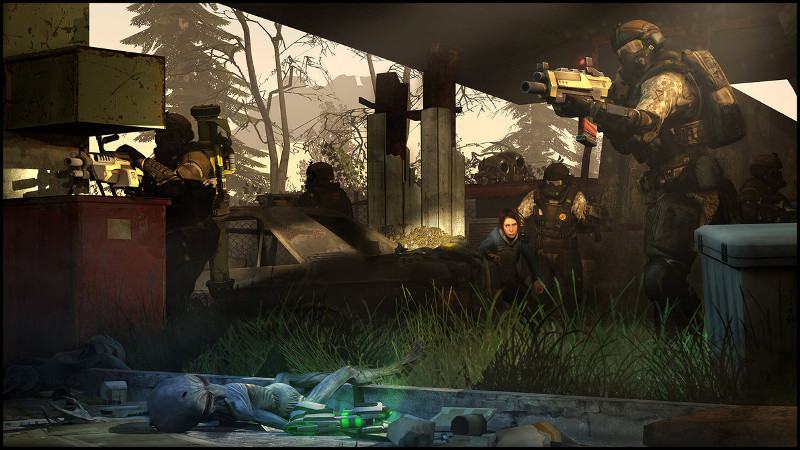
Illustration by AntiMingebag on DeviantArt Welcome to another mission report for GURPS X-COM: Noises in the Dark! Our characters for this mission are:
- Kendall Fairbarn: A paranoid hacker from the UK. Was completely convinced human society had been heavily infiltrated by shape-changing aliens… and it turned out he wasn’t entirely wrong.
- Minette Duvall: A bomb-disposal expert from Southern France, Minette is also quite handy with a rifle. She’s devoutly Catholic and swears a lot when faced with danger, which is all the time.
- Jack Choi: A former police detective from Hong Kong, and a staunch adherent of the “kick down the door” school of policing despite his light frame.
- Sam McCall: A brave and burly former US Army Ranger, run by a new player.
Julia participates in this one as an NPC, as her player dropped out quite early in the mission.
After the voting for the strategic phase concluded and I posted the rewards for it, we entered a small hiatus as I planned the next field op. The group made a few in-character posts with scenes from the month or so in which their PCs spent recovering from the last mission.
The general tone of those is that the soldiers were somewhat traumatized by the experience, but now that it’s over they’re all itching to get another shot at the aliens. Kendall mentioned something about BRUTAL ADVENT deserving the “Golden Slenderman Award for Most Fucked-Up Story”, which I thought was amusing.
Anyway, after a suitable rest period, the squad was reorganized with some of its members being transferred out and a new one joining in. About a month after the end of BRUTAL ADVENT, they had been cleared for duty. And soon after that, they were pressed into action!
Rushed Briefing
It started with a blaring alarm waking everyone up before dawn. All members of Strike One dressed as quickly as they could, picked up the loadouts Nobby had prepared for them, and piled into the Skyranger for a rushed takeoff, all the while wondering what exactly was that they were getting into. Out-of-character, the players got to pick their gear, but the characters themselves had no time for that.
Their briefing came after they were already in the air: X-COM’s satellites had finally spotted an UFO. More than that, they had spotted four of them entering Brazilian airspace, with three of them apparently chasing the fourth. X-COM fighters stationed nearby had already been scrambled to intercept the UFOs, and the Skyranger was launched early to minimize the time it would take to reach any resulting wreckage. Their mission was to sweep downed UFOs to mop up any survivors before they reached the local population, and to collect any artifacts before said population got to them. If one of their fighters was downed instead, they were to rescue the pilot.
Over the next few hours, the squad would get periodic updates about the situation. The pair of modified F-15SEs could barely keep up with the alien craft, only managing a few inconclusive engagements. The three pursuers eventually managed to take down the fourth UFO somewhere over Minas Gerais, and disappeared soon afterward.
The crash site was bad news, plain and simple:
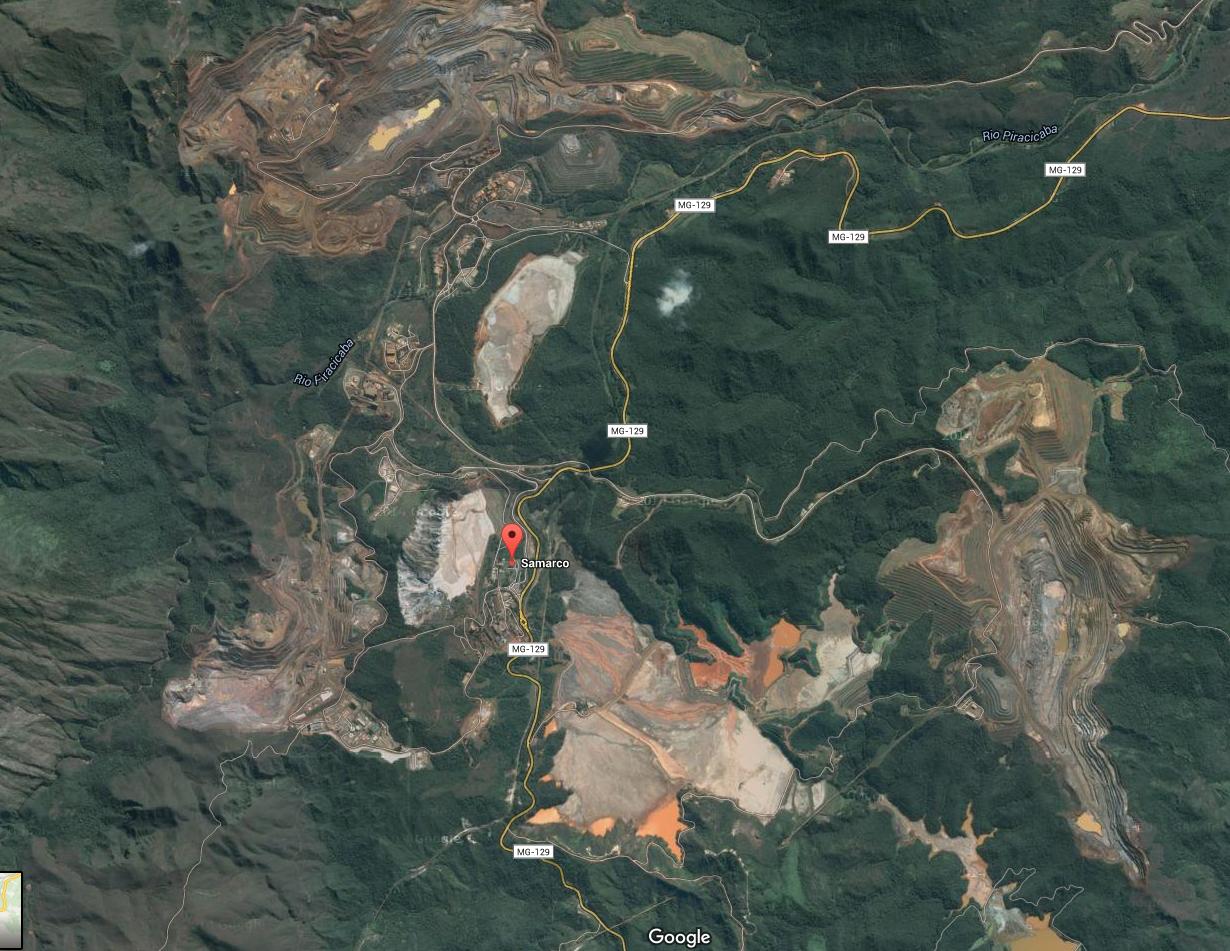
The area of operations. Click for a full-size version. Now, in real life, we began playing this mission in November 2015. Just a few weeks prior, the area depicted on the map had been the site of an horrendous environmental disaster. There’s a big iron mine in that location, and they have several large reservoirs to store the toxic byproducts of the mining process. The dams on one of those reservoirs burst, and the resulting toxic flood completely destroyed a nearby small town and tainted the surrounding rivers. To clarify, this is a real life disaster that actually happened. You can see a before/after map overlay here.
This was the first instance of me using real-life events directly in the game, and even then it made me a bit uneasy. At the time, I went forward because I figured it would be a good way for me to process what happened.
Now, in-setting, it had been about five years since the disaster happened, and the clean up efforts there had never amounted to much. The reason for this became obvious once an X-COM sattelite imaged the area: it was completely covered by an alien anomaly much like the one in Cologne. As this one covered a much greater area, the squad’s goal wasn’t to shut it down, as it would likely be impossible. Their main goal was recovering the downed UFO, and a secondary goal was to bring an intact sample of one of the black trees.
Rough Landing
The group looks over the map and agrees on a landing zone: a parking lot about 2.5km north of the crash site (which is located near the red map pin in the illustration above). From there they would proceed on foot, either on a road that leads from the parking lot to the main complex, or through the forest.
The landing zone seems peaceful from afar, but it’s quite creepy up close. The squad can see many of the black trees scattered about, not only amid the native vegetation but also growing out of the asphalt on the parking lot and even on the rooftops of nearby buildings. They look like slightly smaller versions of the trees found in the first mission - black ash trees, which are in no way native to the region. The temperature on the ground is several degrees colder than it should be. The buildings they can see are all defaced, and the only vehicles in the parking lot are a couple of rusted out car husks. One of the trees has a skeleton hanging from it by the neck, and many others have human bones scattered around their roots. Interestingly, Korsakov seems unable to see the trees, though he believes that they’re there when the party tells him.
The squad finds the landscape quite unsettling, which was my intent. They approach the tree with the hanging skeleton and examine it more closely. The skeleton is real and from someone who was hung to death on that branch. It’s tied with common rope. Aside from it, the tree also has several immature mines growing on it, as well as large yellow flowers the squad hadn’t seen before.
Kendall checks the airwaves for the now familiar patterns of alien interference, and finds them all around the group. Each tree emits its own field! It also becomes clear to him that this interference seems to be actively malicious, spoofing their sensors for maximum scare value. Listen to the static long enough and it begins to call out your name, but you’re the only one who can hear it.
Minette manages to cut the skeleton down without disturbing the mines, and with the help of the others she proceeds to brace one of the tree’s largest branches with rope and belts so she can cut it down with the chainsaw Nobby thoughtfully loaded into the Skyranger for just such an occasion.
As soon as she begins cutting, though, all the black trees in the area seem to have their branches shaken by a strong wind, though there is no wind at all. The yellow flowers begin to bloom, and then it’s like someone skipped ahead in a video as they suddenly look like large cocoons that open up and disgorge unclothed but fully armed puppet soldiers!
The ensuing firefight is quite brutal, as no one has decent cover in this open parking lot. The PCs drop what they’re doing and begin a fighting retreat towards the Skyranger, which is still landed in the middle of the lot. They take several hits on their trauma plates, and the puppets seem to immediately wise up to their armor as they begin aiming lower and manage to score a hit on Minette, crippling her leg. After that, they get a little reckless, and the PCs manage to keep their cool and kill all the opposition.
Julia (who by now was an NPC) treats Minette’s wound while the rest of the PCs manages to cut down the tree branch. I think it’s safe to say that this puts a damper on their original plan to torch every tree they come across. Julia’s ministrations recover most of Minette’s lost HP, but her mobility is still impaired and they have a 2.5km walk to look forward to. At this point, Minette’s player decides to switch to Julia for the rest of the mission, leaving their original character to guard the Skyranger. The squad packs the branch and a couple of the more intact puppet corpses into the craft, and proceed with the mission. What they found next will be told in Part 2!
-
Dragon's Dogma: Ferrystones and Portcrystals
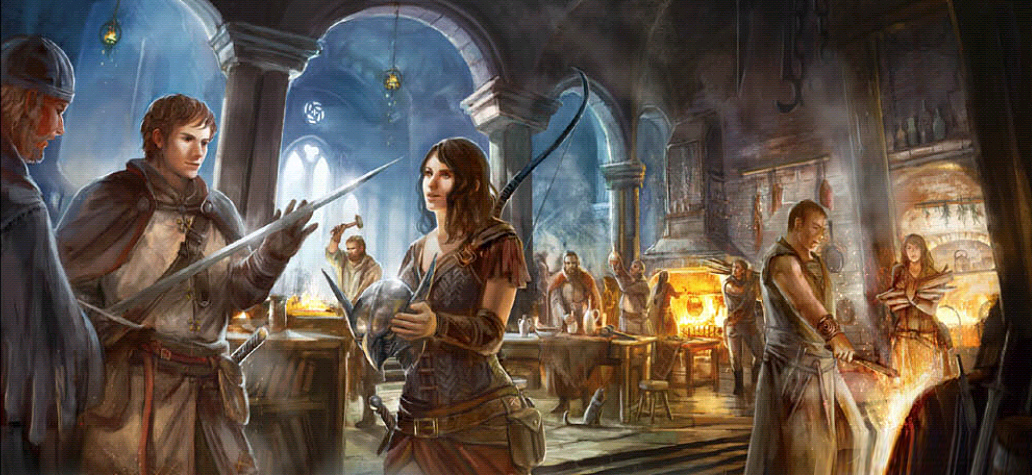
Copyright 2013 Capcom. Back when I discussed the Artifacts of Gransys, I focused more on bringing published artifacts from the GURPS Dungeon Fantasy line into a Dragon’s Dogma campaign. It’s time I did the reverse, at least for some of the more distinctive pieces. This post will deal with a pair of handy artifacts that always go together. They were used to implement the original game’s “fast-travel” system, and can do the same for a tabletop campaign if the GM wants to give players that ability.
Ferrystones (Power Item: N/A)
Ferrystones are palm-sized chunks of jade engraved with ancient arcane runes. They were made ages ago by the mysterious civilization that worshipped the Old Gods. The secret to their creation has been lost, and most remaining examples today are cracked and worn.
To use a ferrystone, a character must hold it in their hand, concentrate on one of the Portcrystals (see below) they have attuned, and toss the stone directly upwards. This will cause the stone to glow and instantly transport the whole party to the location of the Portcrystal. The stress of activation will destroy the stone.
Ferrystones are still common enough that they can be found in the inventories of certain specialty merchants, who sell them as expensive antiques. They can also be found in the ruins of the civilization that made them. While they are very useful to adventurers, most “civilian” inhabitants of Gransys see them as valuable bits of archaeology, and would balk at actually using one for its intended purpose.
Among those specialty collectors, rumors abound of an “Eternal Ferrystone” which, untouched by time, can be used an unlimited number of times. Such an item would be priceless and would largely render overland travel obsolete to its owner. Such an artifact could be worth 20 FP or more as a power item.
Portcrystals (Power Item: N/A or 15 FP)
Portcrystals are heavy quartz-like crystals that glow with a purple inner light. Someone who knows the proper rituals (which have been passed around as nursery rhymes since time immemorial) can attune themselves to a portcrystal by touching it. From that point on, they can use a Ferrystone (see above) to teleport to the crystal’s location from anywhere in the world!
These artifacts were likely used to make robust transportation networks in ages past. The most well-known are arranged in ancient ritual circles just outside of Cassardis and close to the Pawn Guild in Gran Soren. These are more landmarks than artifacts, and cannot be removed or made into Power Items.
There are also a handful of crystals that can be safely transported and still retain their power, but those are hidden deep inside some of the duchy’s most dangerous dungeons. These portable crystals only work when properly placed on the ground, and weight at least 10 kilograms, but can be made into power items. They’re worth quite a lot as collector items… unless the Eternal Ferrystone is known to exist, then they’re as priceless as it is.
-
GURPS X-COM: First Research Phase
Illustration by AntiMingebag on DeviantArt At this point in the campaign our PCs had completed their first assignment and brought home a ton of alien doodads, though they didn’t know much about them yet. It was time to do something about that last part, and this post will both tell you how they did it and give you a peek behind the curtain of my research system.
The Power of Science!
Research was always one of my favorite parts of any X-COM game, especially in that first playthrough where the tech tree is still a mistery. I wanted to bring the same sense of mistery and discovery to this campaign, while keeping bookkeeping to a minimum. This meant I needed an intriguing tech tree, and a simple way to walk it.
The composition of the tech tree was the easiest part: as it turns out, the Dreams of Ruin book already has a perfectly usable and quite comprehensive tree! I would need some conversion work before I could use it, but the general shape of the thing was already good.
The main conversion work lay in deciding how my version of X-COM could perform this research. The detailed descriptions in the original material are geared towards a D&D fantasy setting: a place with medieval technology but rich in magic where the greatest challenge lies in building scientific instruments precise enough to study the Dreams, each of which is a unique major artifact in its own right.
The research challenges faced by X-COM were the exact opposite of the scenario above: its scientists have an abundance of mass-produced high-precision instruments, but must discover magic from first principles over the course of the campaign in order to truly understand the threat they face. This means I would need to insert a few extra items on the research tree related to that. As pretty much all the alien technology involves some form of magic, discovering its principles is a very high priority strategic goal - the rest of the research will be severely limited until that happens.
Another important consideration was to figure out the pace of research. This is determined by your basic infrastructure, which in the original material is expressed in fantasy terms (“a single wealthy kingdom”, “all the world’s kingdoms”, “the combined might of the Nine Hells”). Each level gives you a shorter interval between possible breakthroughs, which is important because the spread of the Dreams becomes irreversible 13 years after the first trees appear. I had to decide how the X-COM project measured up in that scale.
The Noises in the Dark Research System
At the end of each field op, I would present the players with a list of research topics, drawn from the loot their PCs brought from this and previous missions, and from previous research or other story developments. Each topic would have a cost in Research Points, of which they would have an amount corresponding to X-COM’s research budget. This budget, in turn, would depend on how happy with the organization the Council nations were, just like in the computer games.
Paying for a technology in full meant it gets researched and yields it fruits before the next mission comes up. If they could only pay part of a topic’s cost, those points would remain “banked” until after the next mission.
Each of these “research phases” should represent the effort spent in one research interval, though this part didn’t end up mattering a lot in play as I never really tracked how much time passed between missions. I believe I settled internally on 1-month intervals in my head, though if we were doing this according to the Dreams of Ruin rules it should be three months for a starting X-COM (“intermediary” infrastructure).
The list after their first operation consisted of:
- Advanced Medkits
- Personal-Scale Combat Drones
- Bakegumo Corpse
- Puppet Corpse
- Alien Guns
- Alien Swords
- Alien Explosives (from mines and such)
- Black Tree Fragments
The first two items were the technologies they would have started with had they picked Vahlen or Shen as leads, respectively. The rest was from alien loot.
All of the items cost a single point, but they also had a single point to spend at the start. After some discussion, the players ended up voting for the Black Tree Fragments: the trees had really impressed them!
Strategically speaking, this was a good decision, since the Trees of Woe are one of the fundamental research topics in the original material. However, the fact that their destroyed the trees in the first mission using extreme amounts of explosive meant R&D only had a limited amount of material to work with, so I decided this topic alone wouldn’t give them the full information on the trees. It did give them a bit of data in their structure (“more like a fungus than a plant, traces of metal mixed in”), as well as giving them the goal of bringing in a proper tree sample. It also led to the researchers noticing the fragments and most alien artifacts had this weird red dust in all of their nooks and crannies, so the dust became a topic available for the next phase of research.
Soklov’s game benefit also came in handy here, as he also gave the group a more complete picture of what he termed the “Hostage Effect”, which is what the original material calls psychic numbness. No means to counter it yet, but now they know it exists and what it does.
This sort of decision is still something that causes me some worry, to be honest. Was I giving my players a good enough benefit for their choice? This was a PbP game, remember, so each mission took literally months to resolve. Research phases would be few and far between, and I didn’t want to give the group the impression they weren’t making progress. Here, opening up a new goal seems to have satisfied them, but in retrospect I should probably have given them the Red Dust information for free in addition to the other things. Knowing about the spores early on would likely have changed their perception of things quite significantly, and it’s something they never ended up voting for on their own.
-
Dragon's Dogma Bestiary: Ogres
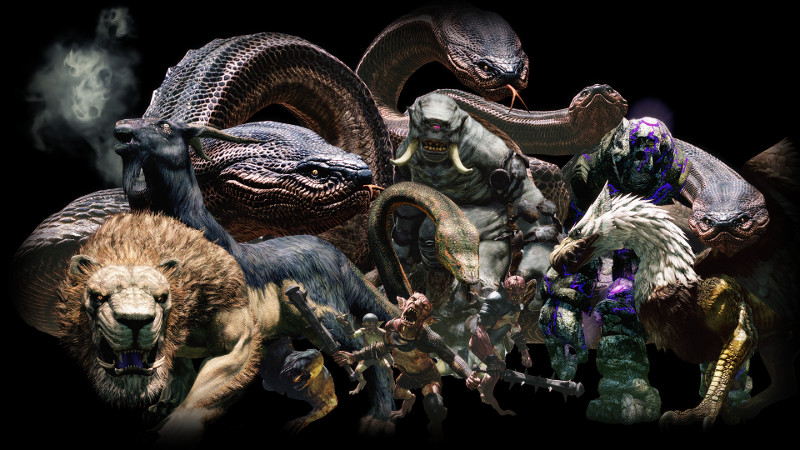
Illustration Copyright 2012 Capcom. Despite being smaller than cyclopes, ogres are actually more dangerous! A cyclops is a slow, stupid, and indecisive combatant that may be driven away by an insistent enough attack. None of that applies to ogres! While not really bright, they are very cunning and driven to satisfy their endless hunger. Ogres tend to live in caves and ruins, and their smaller size means they don’t require those ruins to be exceptionally spacious. They love to eat fresh meat, especially that of humans, and will attack any they perceive. While typically solitary, sometimes people do run into a pair of them.
In combat, ogres will make use of their great strength to strike enemies, but what they really like to do is grab a foe and twist. Faced with a large group, they will often grab a single for and try to drag them away, but it doesn’t take much to make an ogre go berserk. A berserk ogre fights to the death, but even then it has enough presence of mind to fight smart, targetting its weaker-looking foes and trying to get the others in a position where they can’t dodge effectively.
Ogres don’t typically carry weapons, but will gladly use any available objects as improvised clubs or projectiles.
ST 27; DX 12; IQ 7; HT 12;
SM +2; Dodge 8; DR 3;
HP 27; Will 10; Per 10; FP 11
Basic Speed 7.00; Move 7;
- Punch (14): 3d+1 cr. Reach C-2.
- Improvised Club (14): 6d+1 cr. Reach 1-3.
- Bite (14): 2d+2 imp. Reach C.
- Grab (14): Grapples at ST 28.
- Twist (24): The ogre uses Wrench Limb, Wrench Spine or Neck Snap at the listed skill level on a grappled target, depending on how it’s grappled.
Traits: Claws (Blunt Claws); DR 3 (Tough Skin); Night Vision 5; Teeth (Fangs); Gluttony (9); Bestial; Berserk (12); Bully;
Class: Mundane.
Variants
Elder Ogres: Legend has it that ogres grow stronger and tougher as they age, and that they are either immortal or extremely long-lived. Such an Elder Ogre would add extra ST, DR and combat skill on top of the stat block above depending on its age.
subscribe via RSS