Posts
-
Quick and Dirty Technical Grappling

This should be easier! (image source) 2018-04-09 Update: After receiving some feedback from Douglas Cole, who wrote the original Technical Grappling rules, I’ve updated this article to better handle people with wildly varying SMs and ST scores. I believe the resulting rules can still be considered “Quick and Dirty” :).
As I mentioned in my previous post, I like the Technical Grappling rules on principle but find them way too detailed for most games in practice. Here’s my attempt to simplify them into something I can use.
My main goal here is to completely eliminate on-the-fly ST adjustments from the game. In my experience, nothing has ever reduced the pacing of my games to a screeching halt like having to look up someone’s new damage dice and recalculate all their attacks. This is not just a Technical Grappling issue, but since that is the topic of the day let’s stick to it.
Referred Control as written also has to go, because it involves a similar amount of “recalculate everything right now”.
Any references to “the book” below refer to GURPS Technical Grappling, and the “core rules” are the ones from GURPS Characters and Campaigns.
Trained ST
This is gone. It’s one more thing to track for each individual skill and it raises too slowly to make any difference for most games.
Use the Wrestling bonus from the core rules for that skill and ignore the concept for the others. Buy Lifting ST instead.
Grappling Attacks and Damage
Grappling still does Control Point damage, because that’s the core of the system! CP damage is annotated as “control” in attack stat lines.
All unarmed grappling attacks inflict CP damage equal to the “thrust” value for your ST. Lifting ST improves your ST for this purpose and so does the Wrestling bonus when using that skill. Add +1 damage for each limb used beyond the first two. If attacker’s SM is larger than that of the target, apply the difference as a control damage bonus as well.
Armed grappling works mostly like in the book, except you always use your full ST to calculate control damage. Entangling weapons use your base skill level instead (not the effective one for that specific attack). This allows you to write the control damage for your armed grapples once and not worry about it later on, similar to how normal attacks work.
Any monster whose attacks “automatically count as a successful grapple” in things like Dungeon Fantasy do linked control damage equal to the basic damage of their attack. So if that Giant Enemy Crab has claws that do 2d+2 cut, they now also do 2d+2 control!
Grapplers can still only maintain a maximum amount of CP equal to their ST.
Control Threshold
Every creature has a Control Threshold (CT) equal to their ST/5, rounded down to the nearest whole number. This determines how easy it is to impair that character’s movements via grappling. In relatively “realistic” games with human-scale characters, 99% of people will have a CT of 2, and the remaining slabs of pure muscle will have a CT of 3. Things can get quite a bit more varied in Dungeon Fantasy or other fantastical games.
Write this down once during character creation, and only worry about changing it if your permanent ST changes.
Effects of Control Points
Every (CT) Control Points applied to a target translate into a -1 penalty to DX1. If the target’s torso or head is being grappled this applies to all their actions. If a limb is being grappled, the full penalty applies to any actions involving that limb. Half the penalty applies to all other actions. Treat grapples to multiple locations as a single grapple to the torso with their combined CP.
In the example from page 6 of Technical grappling, that would give our pal And’Rezik a total of 13 CP on his target. It’s only 2 CP less and you didn’t need to halt your fight for 5 minutes to figure that out!
Control points can be spent in the same ways as in the book, and grappled targets can attempt to erode them with their own grapple attacks subject to the DX penalty, as usual.
That’s All, Folks!
That’s pretty much it. I haven’t actually tested this system in play, but it’s what I’m going to use in the next game I run where grappling is a thing. I’m sure I’ve missed some edge cases from the original book, but if those ever become a problem I’ll address them at that time.
-
Creatures whose CT rounds down to 0 take -2 DX per CP applied to them. ↩
-
-
My GURPS House Rules
As a way to get back into the habit of writing I thought I would expound a bit on my preferred GURPS house rules. These are the modifications I make on every campaign I GM. Some are tried-and-true, some are experimental, and one I haven’t really used yet but intend to.
None of them are original creations, though. There’s so much stuff out there already that I don’t feel inclined to come up with my own stuff.
The Permanent Fixtures
These rules should be in effect in pretty much any game I GM.
Metric!
If I have one complaint about GURPS is that it uses Imperial measurements for everything. I don’t! I use metric instead. By now I’m pretty used to applying simple conversions for lengths and weights.
Areas and volumes are more annoying, though I suspect this site would help me there. I don’t agree with everything on it (for example, I’m not rounding Basic Lift to the nearest whole kilogram, that’s not granular enough), but it does a good job overall.
Alternate Guns Specialties
These are from Pyramid #3/65. It greatly simplifies the existing Guns specialties, and I think it makes a lot of sense. I use it on any game that has guns at all.
Occasional Appearances
These don’t always appear, but I like them nonetheless.
Complimentary Skills
This rule originally appeared on GURPS Dungeon Fantasy 2 and GURPS Action 2, and was restated on Pyramid #3/70. It encourages teamwork, and gives heroes a bit of an extra edge in general. It hasn’t appeared in all of my games because people rarely think to invoke this rule, but if anyone asks whether they can use it the answer is always “yes”.
Tactics For the Win
This originally appeared in GURPS Martial Arts. It allows the Tactics skill to grant rerolls when not using tactical maps, or to enable tricky positioning shenanigans when using them. It makes playing “warlord” characters mechanically viable, and the only reason it’s not a permanent fixture is that people don’t always make those types of character.
Team Efforts
Another one from Action and Dungeon Fantasy. It simplifies group tests.
Range Bands
This is from GURPS Action. It’s a lot easier to use than the Size/Speed range table for combats without a map! In practice it mostly means giving nearly everyone a -3 penalty for ranged attacks and calling it a day, since combats in my games rarely happen further away 20m that even when everyone has guns.
Experiments, Tried and Untried
These are rules I want to use more often, but I still don’t feel I’m good enough at applying them to so in every game.
Technical Grappling, Simplified.
This is obviously from GURPS Technical Grappling. I like the basic idea of the Technical Grappling system, but as written it’s way too complex to use in any game that is not entirely about playing through an entire MMA tournament at a high level of detail.
I would like to keep the central mechanic where grapplers to “control damage” according to their skill and strength, and where this damage makes it increasingly harder for the opponent to move. Referred Control has to go, however, and I strongly dislike the idea of adjusting people’s ST mid-fight. I’m also not too keep on calculating multiple ST scores for every possible combination of limbs you’re using for a grapple.
Sometimes I’m strongly tempted to buy Douglas Cole’s Dungeon Grappling supplement for D&D-alikes and port it back to GURPS, since it seems to do lot of what I described above already. However, now that I’ve discovered that the official GURPS conversion of his Hall of Tyr adventure is real, I’ll probably wait for that instead. In the meantime I might work something out on my own.
Hybrid Ritual Path Magic
I’m a big fan of the Ritual Path Magic system as described in, well, GURPS Ritual Path Magic. I like the energy accumulation model and the flexibility it allows. That book is more geared towards settings where magic is rare and/or hidden, though, which means it tends to limit magic by what is “mundanely possible” in the setting in question. You can exceed those limits with Greater effects, but it’s expensive.
GURPS Dungeon Fantasy 19: Incantation Magic describes a variant of this system meant to fit a D&D-like setting, where magic is known and common. The limits it imposes are a lot less fuzzy (you can do this much damage, or give this big a bonus). The exact amounts are dependent on Magery and there are no Greater effects that allow you to exceed them. That’s good for my purposes, but unfortunately the system is based on an “effect shaping” model where spells give you more skill penalties the more powerful they are.
What I want here is a hybrid system, one that’s based on energy but also geared towards obvious-magic settings. What I’d do here is basically use the system from RPM with the Magery-based limits from DF, and the removal of Greater effects. I haven’t tested this in actual play with real players, but I would like to.
-
Post-Combat Shakes in Dungeon Fantastic
I usually dislike April Fools posts, but this year Dungeon Fantastic has an excellent one on Post-Combat Shakes. It’s not always that you can try out something described in Dungeon Fantastic at home in real life.
-
Pathfinder Iconics in the DFRPG: Jirelle
In this post I continue to write up the Pathfinder iconic characters for use in the Dungeon Fantasy Roleplaying Game. Links to all of them will appear in the project page, which also contains links to the GURPS Dungeon Fantasy versions.
Today’s template is the Swashbuckler, which means today’s character is Jirelle. Here she is:
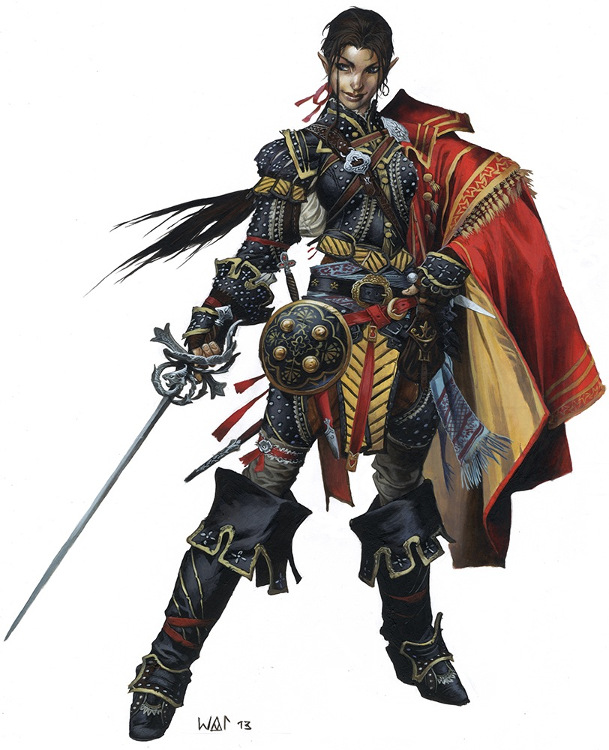
By Wayne Reynolds, Copyright 2014 Paizo Publishing Even if you’re familiar with Pathfinder’s Iconics, Jirelle might be somewhat new to you. This is because the class she represents, the Swashbuckler, is not from the core rules but from the “Advanced Class Guide” supplement. You can find her bio here, and the only place where I could find her stats is inside this free package of premade iconic characters that contains all of them.
From these, we can learn the following:
-
Jirelle is a half-elf born in the Shackles, a pirate-infested archipelago. She sunk her evil pirate’s mother ship to avoid becoming a demonic sacrifice, but the ship and its whole crew later returned as undead. Her main long-term goal is returning them to the depths.
-
Her fighting style is acrobatic and daring, relying a lot on precision and fencing skill.
-
She wields a rapier as her main weapon, and despite the illustration showing one of every traditional off-hand fencing weapon on her person, the character sheet indicates the buckler is her favorite.
This version of Jirelle is pretty much identical to the GURPS Dungeon Fantasy version, with the main difference being equipment. Her armor and buckler are a lot heavier, and thus I was forced to perform a little point shuffling to get her an Armor Familiarity perk. She’s still as good at fencing as ever, though.
One thing I noticed here is that the DFRPG version of Rapier Wit uses the Intimidation skill rather than Public Speaking. I don’t think it would be a stretch to allow it to be used with Public Speaking, so I’m keeping that skill here. If your GM sticks to the letter of what the book says, feel free to move those Public Speaking points to Intimidation instead.
Jirelle, 249-point Half-Elf Swashbuckler
ST 11 {10}; DX 16 {120}; IQ 10 {0}; HT 13 {30}.
Damage 1d-1/1d+1; BL 12.1kg; HP 11; Will 10; Per 10; FP 13; Basic Speed 7.25; Basic Move 7.
Dodge 11; Parry 16F (Rapier); Block 13;
Advantages
- Armor Familiarity (Rapier) {1}
- Charisma 2 {10}
- Combat Reflexes {15}
- Enhanced Parry (Rapier) 2 {10}
- Luck {15}
- Magery 0 {5}
- Perfect Balance {15}
- Rapier Wit {5}
- Weapon Master (Rapier & Buckler) {25}
Disadvantages
- Code of Honor (Outlaw’s) {-5}
- Gregarious {-10}
- Impulsiveness (12) {-10}
- Obsession (Acquire a ship and crew to defeat my evil mother) (12) {-10}
- Pacifism (Cannot Harm Innocents) {-10}
- Sense of Duty (Adventuring Companions) {-5}
- Social Stigma (Half-Breed) {-5}
Skills
- Acrobatics (H) DX+1 {4}1 - 16
- Brawling (E) DX {1} - 16
- Carousing (E) HT {1} - 13
- Climbing (A) DX {1}1 - 16
- Fast-Draw (Knife) (E) DX+1 {1}2 - 17
- Fast-Draw (Sword) (E) DX+1 {1}2 - 17
- Intimidation (A) Will {2} - 10
- Jumping (E) DX {1} ‐ 16
- Leadership (A) IQ+1 {1}3 - 11
- Public Speaking (A) IQ+2 {2}3 - 12
- Rapier (A) DX+4 {16} - 20
- Seamanship (E) IQ {1} - 10
- Shield (Buckler) (E) DX+2 {4} - 18
- Stealth (A) DX-1 {1} - 15
- Streetwise (A) IQ {2} - 10
- Thrown Weapon (Knife) (E) DX {1} - 16
- Wrestling (A) DX {2} - 16
Equipment
- Ordinary Clothing [Body, Limbs]: Free, 1kg.
- Light Leather Armor Suit: DR 1. $150, 9kg.
- Light Buckler [Body]: DB 1. $40, 4kg.
- Edged Rapier [Body]: Damage 1d+2 imp or 1d+3 cut; $1000, 1.5kg.
- Backpack, Small [Body]: Holds 20kg of gear. $60, 1.5kg.
- Personal Basics [Backpack]: $5, 0.5kg.
- Waterskin [Backpack]: Holds 4L of liquid (4kg if water). $10, 0.13kg.
- Small Throwing Knife x3 [Body]: Damage thr-1 imp. $90, 0.75kg.
-
-
Pathfinder Iconics in the DFRPG: Sajan
In this post I continue to write up the iconic characters from Pathfinder for use in the Dungeon Fantasy Roleplaying Game. Links to all of them will appear on the project page, which also contains the links to the GURPS Dungeon Fantasy versions.
Today’s template is the Martial Artist, which means today’s character is Sajan the Monk. Here he is:
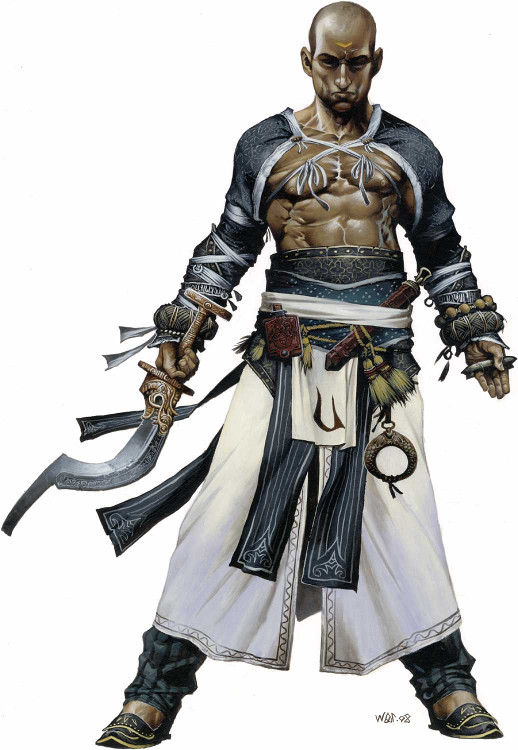
By Wayne Reynolds, Copyright 2008 Paizo Publishing I think he looks pretty cool! His bio and official stats give us the following information:
-
He was born in Vudra, his world’s India analogue, where he was a member of the warrior caste along with his beloved twin sister Sajni. Even after they were posted to separate barracks at the age of 12 they still met regularly to spar and hang out.
-
Sajni was given away as part of a peace agreement, and Sajan ran after her. He tracked her down to Absalom, his world’s “big cosmopolitan city”, and has been looking for her since.
-
As a monk he’s quite acrobatic and prefers to rely on his flurry of blows in combat. He might also grapple or trip opponents with his hooked “temple sword” if that’s more tactically advantageous.
The GURPS Dungeon Fantasy version used the stats for a khopesh from GURPS Low-Tech for the “temple sword”. Since this one is restricted only to the material in the DFRPG boxed set, we go with the Heavy Falchion stats and give up on the rules for weapon hooks. We also had to lose the gauntlets, as his light cloth armor is a bit heavier here. Sajan continues to be a very effective combatant either with his sword or with his fists, and has most of the abilities people have come to associate with monks in d20.
Sajan, 250-point Human Martial Artist
ST 11 {10}; DX 16 {120}; IQ 10 {0}; HT 12 {20}
Damage 1d/2d-1; BL 12.1kg; HP 11; Will 11 {5}; Per 10; FP 12; Basic Speed 7.00; Basic Move 8 {5}
Advantages
- Chi Talent 2 {30}
- Mantis Strike {9}
- Tiger Sprint {9}
- Trained by a Master {30}
- Weapon Master (Heavy Falchion) {20}
Disadvantages
- Disciplines of Faith (Chi Rituals) {-10}
- Honesty (12) {-10}
- No Sense of Humor {-10}
- Obsession (12) (Find my sister) {-10}
- Sense of Duty (Adventuring Companions) {-5}
- Vow (Vegetarianism) {-5}
Skills
- Acrobatics (H) DX-1 {2} - 15
- Broadsword (A) DX+1 {4} - 17
- Climbing (A) DX-1 {1} - 15
- Fast-Draw (Shuriken) (E) {1} - 16
- Hiking (A) HT-1 {1} - 11
- Judo (H) DX {4} - 16
- Jumping (E) DX {1} - 16
- Karate (H) DX {4} - 16
- Meditation (H) Will-1 {2} - 10
- Running (A) HT-1 {1} - 11
- Stealth (A) DX-1 {1} - 15
- Tactics (H) IQ {4} - 10
Special Skills
All include +2 from Chi Talent.
- Blind Fighting (VH) Per {2} - 10
- Body Control (VH) HT {2} - 12
- Immovable Stance (H) DX+1 {2} - 17
- Light Walk (H) DX+1 {2} - 17
- Parry Missile Weapons (H) DX+1 {2} - 17
- Pressure Points (H) IQ+1 {2} - 11
- Push (H) DX+1 {2} - 17
- Throwing Art (H) DX+1 {2} - 17
Equipment
$802.0, 12.1kg. No Encumbrance, but only just.
- Ordinary Clothing [Torso, Limbs]: Free, 1kg.
- Light Cloth Armor [Body, Limbs]: DR 1. $137, 8.25kg.
- Temple Sword [Torso]: As Large Falchion. Damage 2d+5 cut or 1d+1 imp. $625, 2.25kg.
- Pouch [Torso]: Holds 1.5kg of small items. $10, 0.1kg.
- Star Shuriken x5 [Pouch]: Damage 1d+1 cut. $15, 0.25kg.
- Spike Shuriken x5 [Pouch]: Damage 1d imp. $15, 0.25kg.
- $198 in coin.
-
subscribe via RSS