Posts
-
Modern Loadouts for Dungeon Delving
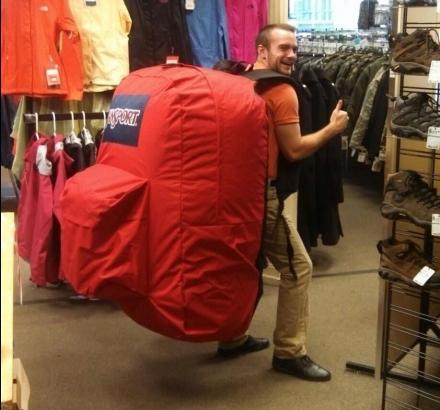
Ready for the dungeon! (image source) So you found a passage to fantasy world full of magic and wonder at the back of your grandmother’s old walk-in closet. You’ve read about things like this before, and you’re thinking of going in and
raiding the place for treasurehaving a wholesome and memorable sightseeing trip. What should you take in your expedition?The first thing that comes to a lot of player’s minds in a game like this are guns, but we’re not going to talk about that here. Plenty of other people already did, for once: there’s at least one Pyramid article about it, and GURPS Loadouts: Monster Hunters gives you a very complete treatment of what guns to take to fight monsters. No, we’re going to talk about all the other stuff that plays a role in keeping you alive: camping and expedition gear!
That sort of equipment is vital to every traditional dungeon fantasy adventurer and no less important for modern PCs venturing into such worlds. In fact, the less combat your game features, the more important this gear becomes. Even if the game is a pure dungeon crawl, that closet portal might not open directly into the dungeon. And even if it does you might have a hard time coming back home and might have to stay on the other side for a while. And who knows, maybe your game actually is about a wholesome and memorable sightseeing trip, making the journey the whole point.
Modern camping gear is often much lighter and better at its job than the TL 3 equivalents, and can give you as much of a comparative edge to traveling and survival as a brace of guns would give for combat. The loadouts described below are supposed to be modern versions of the Minimal, Deluxe, and Group kits described in GURPS Dungeon Fantasy 13: Loadouts. They assume an incursion into the fantasy realm might take several days but won’t last forever, so taking things that require batteries or fuel is allowed. All modern gear and attending rules are taken from GURPS High-Tech.
The goal is for these loadouts to be at least as effective and no heavier than the originals - if possible they should be both lighter and better. They’re inevitably going to end up being more expensive, but even a “settled” modern character has access to four times the entire life savings of a starting medieval adventurer, so keeping price down isn’t as big of a priority.
A Note on Clothing
If you follow the rules from High-Tech, your weight savings start with the good old set of Ordinary Clothing every character gets! The totally generic set from Dungeon Fantasy weights 1 kg (2 lbs.), but TL 8 garments weight half that. It might not seem much, but every pound you save is another pound of treasure you can bring home! The same savings would apply to winter and arctic clothing, which is good news if that portal opens into a winter wasteland.
A Note on Food
After looking at the options for travel-ready food in High-Tech, it turns out the generic “Traveler’s Rations” from Dungeon Fantasy are already as close to optimal as you can get in terms of weight per meal at 0.25kg/0.5lbs. Few of the “realistic” rations presented in High-Tech weight less than that. I went with Survival Tablets for travel rations here because they feel high-tech, weight about half of what the generic rations do, and can be eaten on the move just like those rations.
World-hopping delvers who insist on eating actual food and don’t mind doing a bit of campfire cooking can instead pack meals of Freeze-Dried Food (p. HT 35) and bring along a titanium Personal Mess Kit (p. HT57, $45, 0.15kg/0.3 lbs). The price and weight per meal of the two types of ration is close enough that the only difference for the whole loadout is the price and weight of the mess kit.
Minimal Modern Delver’s Kit
$424, 7.05kg/14.10 lbs
This kit provides a 30% weight savings over its medieval version, a much better light source, a much stronger rope, and a +1 to Survival rolls because of the sleeping bag.
The included batteries can last you for days. A set of spare batteries for all powered equipment here costs $4 and weights 0.4kg (0.8 lbs.)
- Sleeping Bag (p. HT56) [Torso]: +1 to Survival. $100, 1 kg (2 lbs.).
- UV purifier (p. HT 59) [Torso]: Holds 1L of water, which it purifies in 1-2 minutes. Given weight is for a full container. $100, 1.25kg (2.5 lbs.)
- Batteries for UV purifier (p. HT 13) [UV purifier]: 4 XS batteries, good for 20L. $2, weight already included.
- Backpack, Small (p. HT54) [Torso]: Holds 25kg (50 lbs.). $120, 1.5kg (3 lbs.).
- Personal Basics (p. B288 or HT53) [Backpack]: $5, 0.5kg (1 lb.).
- Bottle of Survival Tablets x 2 (p. HT35) [Backpack]: Provides nutrients equivalent to 12 meals in total. $50, 1.5kg (3 lbs.)
- Rope, 1cm (3/8”), 10m (p. HT56) [Backpack]: Synthetic. Supports 325kg (650 lbs.). $25, 0.8kg (1.6 lbs.).
- Flashlight (p. HT52) [Backpack]: 10m beam. $20, 0.5kg (1 lb.).
- Batteries for Flashlight (p. HT 13) [Flashlight]: 2 S batteries, good for 50 hours of illumination. $2, weight already included.
Deluxe Modern Delver’s Kit
+$393, +6,41kg/12,82 lbs
Like the original version, this is an add-on to the corresponding minimal kit. It weights a little over a quarter of the corresponding add-on kit and it’s cheaper, though the basic and deluxe kits combined are still a bit more expensive than the originals. The tent included here combines with the sleeping bag from the basic kit to add a combined +2 tool bonus to Survival. The price of the whole package ($817) also falls well within the budget of even a “settled” TL8 adventurer.
Further sets of spare batteries for the lantern add $4, 0.66kg (1.21 lbs) each.
- Backpack, Large (p. HT55) [Torso]: Replaces the minimal kit’s Small Backpack. Holds 50kg (100 lbs.). $200, 2.5kg (5 lbs.)
- Dive-Certified Electric Lantern (p. HT 51) [Backpack]: 5m radius. $60, 1.5kg (3 lbs.)
- Batteries for Lantern (p . HT 13) [Lantern]: 4 S batteries, good for 20 hours of illumination. $4, weight already included.
- Spare Batteries for Lantern (p. HT 13) [Backpack]: $4, 0.66kg (1.21 lbs.)
- Load-Bearing Vest (p. HT54) [Torso]: $30, 1kg (2 lbs).
- Bottle of Survival Tablets (p. HT35) [Backpack]: Provides nutrients equivalent to 6 meals. $25, 0.75kg (1.5lbs).
- Rope, 1.25cm (1/2”), 10m (p. HT56) [Backpack]: Synthetic. Supports 2 tons. $90, 1kg (2 lbs).
- Tent, Personal (p. HT57) [Backpack]: +1 to Survival. $100, 0.5kg (1 lb).
Modern Group Kit
+$563, +29kg/58 lbs
As I write the modern version of DF’s Group Kit, I notice it gets harder to find high-tech replacements for some of the stuff here. First-Aid Kits cost and weight the same, though obviously the TL8 version is a lot better than the medieval equivalent. We can replace the crowbar and shovel with titanium versions from Low-Tech for a little weight savings, but there’s no listed high-tech substitute for the good old pickaxe. High-Tech also doesn’t talk about Group Basics, opting to break that convenient abstraction down into its components. However, I believe it’s safe to assume that like Personal Basics the modern version costs and weights the same but includes more modern items (like a camp stove and its propane tank).
The resulting kit is still quite a bit lighter than the original because TL 8 tents are awesome, and fits entirely into a single large backpack with some room to spare. The party can still opt to split its items among themselves if they don’t manage to make a half-ogre barbarian friend in the fantasy realm.
- Backpack, Large (p. HT55) [Torso]: Holds 50kg (100 lbs.). $200, 2.5kg (5 lbs.)
- Crowbar, Titanium (p. HT30) [Backpack]: $50, 1kg (2 lbs).
- First-Aid Kit (p. HT221) [Backpack]: A modern first-aid kit. $50, 1kg (2 lbs).
- Group Basics (p. B288, see above) [Backpack]: $50, 10kg (20 lbs).
- Pickaxe (p. B288) [Backpack]: $15, 4kg (8 lbs).
- Pole, 3m (p. B288) [Torso]: $8, 2.5kg (5 lbs).
- Shovel, Titanium (p. HT26) [Backpack]: $40, 2kg (4 lbs).
- Tent, Dome (p. HT57) [Backpack]: +2 to Survival. $150, 6kg.
-
Review: Dragon Heresy Introductory Set
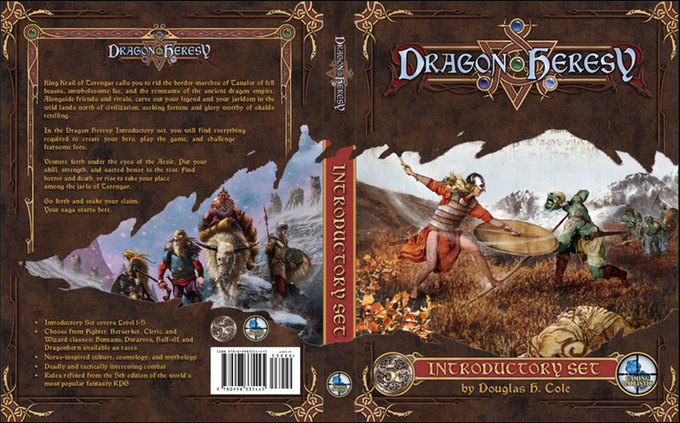
Copyright 2018 Gaming Ballistic LLC (image source) The Dragon Heresy Introductory Set is a book written by Douglas Cole and published by his company, Gaming Ballistic LLC. Mr. Cole has long been a freelancer for Steve Jackson Games, and he has to his name books such as GURPS Martial Arts, GURPS Technical Grappling and several others. I’ve been following his blog, also called Gaming Ballistic, for quite a while now.
The Introductory Set is the company’s latest offering, and it’s Kickstarter campaign is just wrapping up. As far as KS campaigns go, it was quite successful: it got the money it needed, hit some cool stretch goals, and is set to deliver on time. I expect the finished product will be availabe on the store before the end of this month.
Having read my preliminary backer copy, I will endeavor to give you my impressions of it.
TL; DR
Dragon Heresy might be the first iteration of D&D Fifth Edition that doesn’t put me to sleep. From now on, I will always be a bit sad when I play vanilla 5th edition because I could be playing Dragon Heresy instead.
On the Book Itself
The mostly-final PDF of The Dragon Heresy Introductory Set I have in front of me is around 285 pages long - the final book will have 288, so this is just missing the covers and perhaps a page or two of editorial information. People who backed it at a higher level than I did will also get a luxurious hardcover version (an offset print run was one of the stretch goals they achieved).
The book contains everything you need to play the game from levels 1 to 5, from basic die-rolling concepts to character creation, rules for lots of common situations and large catalogues of spells and monsters. You can see that all of this was taken from the as-yet-unpublished full game, since there are hints about higher-level stuff left here and there, but the text is self-contained. The hints act mostly as teasers of what the future might bring.
Layout-wise, the text is reminiscent of the official D&D books at a first look, but all the graphical elements on the page are specific to Dragon Heresy. The body font is a workable serif face, and the titles manage to be both fancy-looking and readable. The art that is already there is quite good overall. Several artists worked on this book, and their styles are usually dissimilar enough to be noticeable, but not enough to make the book look inconsistent.
The writing is generally clear, and occasionally sprinkled with the same delightful bits of humor you can find in GURPS Dungeon Fantasy supplements, which for me is always a plus.
Last, but not least, this thing has an table of contents and index comparable to those of a GURPS book. This is high praise: no one, and I mean no one publishes books that are as well-indexed as those of GURPS. The PDF also contains links in its text, which further helps referencing related concepts.
On Player Characters
Core mechanics and character creation options take up roughly the first 50 pages of the book. The basic mechanics are what you’d expect from any SRD 5.1 game: ability checks, advantage/disadvantage, and so on.
Character creation uses a set of three different number arrays. The player chooses one and assigns the numbers to the character’s abilities. As the author says, people who really want to roll 4d6-drop-lowest or even 3d6-in-order already know how to do it by heart.
The available races are Humans, Dwarves, Dragonborn, Half-Elves and Tieflings. None of them are what you’d expect from reading the names alone, and all of them get a detailed overview of their culture. Humans are basically ethnically diverse vikings. Dwarves look like they’re made of stone and have a stronger bond to their craft guild than to their biological family. Dragonborn can look like anything from humans with a bit of a skin condition to barely humanoid lizard-people, and have a history as former slaves of the Elder Dragons. Half-Elves and tieflings, in an interesting reversal of the cliche, are generally well-liked by others wherever they go, having innate bonuses to Charisma as they do.
You can’t play a full-blooded elf, because this is a Norse-inpired setting and full-blooded Norse elves are scary.
Class-wise, you have the Berserker (a renamed Barbarian), the Skald (a renamed Bard) plus Fighters, Clerics and Wizards. The basic rules for each are pretty much the same as in standard D&D, but their class options contain some interesting novelty. Berserkers who don’t just want to rage harder at 3rd level can choose to either channel rune magic or become monsters at grappling. Fighters can get what I think might be the best Warlord-like abilities I’ve ever seen in 5th edition material, and can start at first level with a fighting style that makes them Valkyrie-good at spear-fighting. Skalds, Clerics and Wizards also get their own flavorful options.
No rogues in this book, which is kind of appropriate as both the historical Norse and the people of Torengar consider theft to be dishonorable. The honorable thing to do is to first kill them, then take their stuff.
You also get a small selection of setting appropriate backgrounds, which segue into an interesting set of rules for social standing. The more lavish your lifestyle and the more expensive your bling, the more pull you have in Torengur society.
On the Setting
Dragon Heresy has its own setting: the Norse-inspired kingdom of Torengar, located in the world of Etera. The text takes pains to emphasize the inspired bit, and that you shouldn’t expect the setting to rigorously match real historical Norse facts, but you can still see that quite a bit of research went into it.
The wider cosmology is based on Norse myth: you have Yggdrasil and its Nine Realms, but there are several differences that are caused both by the need to bring this a bit closer to a D&D-ish arrangement and by the setting’s specific history. The latter are the most interesting.
For example, Jotunheim is inhabited by dragons, not giants. Giants used to live here at the beginning of time, but the dragons kicked them out. Alfheim was similarly changed by ancient historical events. These details make me feel like this is a post-Ragnarok world even though the Aesir are still kicking around.
The Aesir themselves are slightly changed from what you’d expect from reading up on Norse myth. Of the “main cast”, Freya and Frigga have been mashed up into a single deity (Valfreya), and several of the others go by names that as far as I know are historical, but not as popular in the present-day real world. Woden, Donnar, and such. There are also a whole bunch of other Aesir who don’t normally get top billing in Marvel movies but which play an important part in the lives of the people of Torengar.
The ancient history of Etera is dominated by a long war between the Winter Fae and the Elder Dragons, which ended when a Fae faction performed a desperate magical ritual of apocalyptic proportions that pretty much shattered both empires and allowed their former slaves to spread out and form many smaller, squabbling kingdoms. A few centuries ago, the dwarves of the island of Barakthel began exerting their influence on the neighboring lands to make them a bit more stable, resulting in the current political map.
Most Introductory Set adventures take place in Torengar, the most viking-like kingdom of Etera, or in the neighboring land of Tanalor where most of the ancient Fae and Dragon ruins are. There are other kingdoms that take more after other real-world cultures and which the Torengur love to trade with and/or raid, but they aren’t given much emphasis here. I imagine the full three-book set would have more on them.
Overall the setting as presented in the Introductory Set is quite gameable, and comes with plenty of advice and general hooks for creating adventures. It’s certainly a lot more flavorful than the Forgotten Realms the official 5th edition books stick to.
On the New Mechanics
I’ve touched upon this a tiny bit when describing the character creation options, but Dragon Heresy has a lot of new and interesting mechanics that, in my eyes, turn D&D 5th edition from the flavorless substrate of generic fantasy roleplaying into something interesting in its own right.
The most obvious change is that it ditches Armor Class and Hit Points in favor of a new Vigor/Wounds system. No, this isn’t the first wounds system in roleplaying: Star Wars d20 tried something similar, and any Brazilian readers will know Tagmar did it a decade before Star Wars d20. This is, however, one of the best-executed wounds system I’ve ever seen.
Your hit dice give you Vigor points, which explicitly represent your ability to protect yourself from harm via weapon parries, shield blocks or plain dodging. You gain more Vigor when you level up, and recover lost Vigor by resting (much like HP in vanilla D&D). You don’t take Vigor damage - you spend vigor to avoid taking Wounds. Wounds are serious business. They take days or weeks to heal without magic, and taking Wounds can seriously impair your character long before they’re at death’s door.
Instead of a single Armor Class value, characters have a relatively low Threat DC and a higher Hit DC. If an enemy beats your Threat DC, it means they will hit you unless you actively defend yourself by spending Vigor. Beating your Hit DC means they bypassed all of your defenses. Avoiding injury from that takes a “frantic defense”, which among other things costs your reaction for the round.
Armor no longer makes you harder to hit - instead, it provides damage resistance that reduces the amount of Wounds (not Vigor) you take from an attack. Shields do make you harder to hit, and you need a shield to be able to defend yourself normally from arrow fire or certain similar spells.
On top of this there’s grappling. Dragon Heresy uses a version of the grappling system introduced in Dungeon Grappling, where attempts to grapple an enemy cause Control Damage and enemies are more impaired the more Control has been applied to them. You can also turn control directly into wounds, which isn’t as efficient as just stabbing your enemy but is better than trying to punch them barehanded.
I quite like these systems! You can kinda see the influence from GURPS here - spending Vigor is the equivalent of making active defense rolls, and Dungeon Grappling was of course inspired by Technical Grappling. These rules do a good job of putting the age-old “hit points versus meat points” debate to rest.
Aside from these combat mechanics, there are other interesting additions. The social standing system was already discussed earlier, and there is also a simple system for Flyting, which is a ritualized contest of insults that was practiced by Norse. Yes, apparently social combat was a thing in the real world.
Conclusion
If you have any interest at all in the mechanic changes I summarized above, then you should definitely get this book. This goes double if you like vikings! This is only an introductory set, but the new mechanics and the setting could easily be transplanted into a game based on the vanilla SRD. The only thing you’d be missing are the new character options beyond level 5.
-
Catalog of Equipment For the Discerning Assassin: 1191 Edition
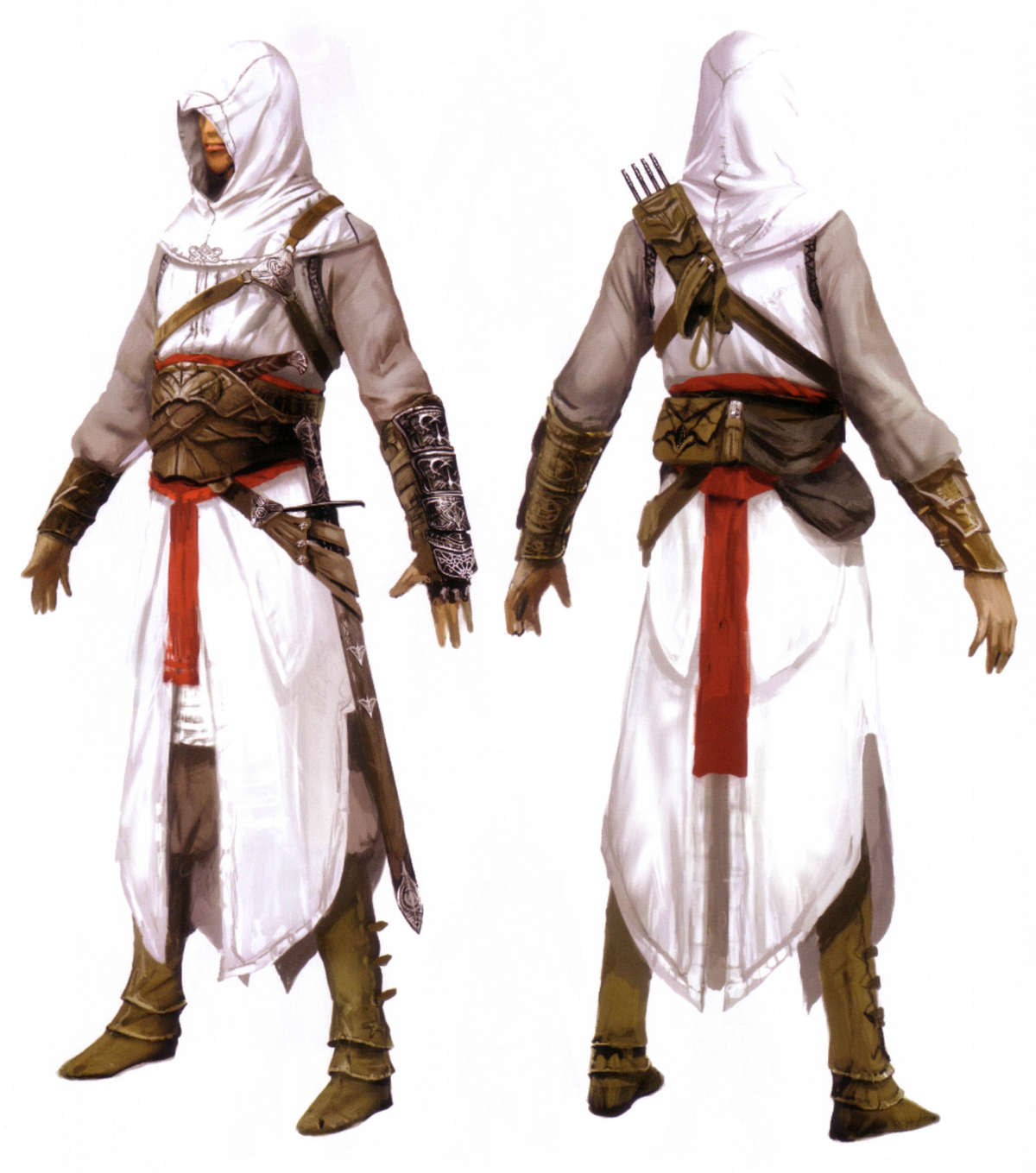
(image source) Like millions of people worldwide, I’ve been playing Assassin’s Creed games for a long time. One of the big draws of the games is all the cool gear you get to use, and I often bounce a few ideas around the inside of my skull about how this stuff would look on the tabletop. This is my first attempt at actually writing it down. In this post in particular we’ll look at the equipment used by Altaïr in the original Assassin’s Creed, using GURPS stats.
There’s one obvious Cool Gadget here, and we’ll get to it eventually, but the rest of the equipment is surprisingly mundane considering the crazy stuff that appears in later games.
Clothing And Armor
Altaïr and the rest of the Assassins don’t seem to wear too much in terms of armor, which makes sense since they’re portrayed as valuing stealth and mobility. Armor is a mainstay for the opposition in this game, and it seems to be portrayed in a historically accurate manner: check out GURPS Loadouts: Low-Tech Armor p. 27-29 for a very detailed breakdown. In short, both the Templars and Sarracens tend to wear DR 3 or 4 mail, with metal helmets.
The infamous hooded outfit (AKA the Menacing Hood) is probably not very historical, since looking cool was a greater priority in its design than being period-appropriate. There’s a million jokes out there about how absurd it is that Altaïr can hide amidst the crowd at all while basically dressed as Medieval Batman, but that’s clearly something the Assassins are supposed to be able to do in-setting.
It would make sense for Assassin characters in a tabletop game to wear Undercover Clothing (Low-Tech, p. 100). Altaïr’s iconic outfit isn’t quite bulky enough to count as a Long Coat (Low-Tech, p. 99), but wearing one in addition to the undercover clothes would definitely make sense for PC Assassins. The total +5 or +6 bonus to Holdout would make hiding all those weapons much easier!
Weapons
Assassin’s mostly fight with period-appropriate weapons. All the one-handed swords seen in the game would use the stats for a broadsword (and the Broadsword skill). Altaïr also gets access to a Long Knife, and to Small Throwing Knives. The opposition uses the same sort of sword. Those enemies posted as rooftop guards tend to carry Light Crossbows as well. You can find stats for these and many other suitable TL 2-3 weapons in the Basic Set, Low-Tech, or Martial Arts.
But that’s not what you’re here for, is it?
The Hidden Blade
This marvel of Fantasy Tech-style engineering is a pure assassination weapon unsuited to open combat. It consists of a leather and metal bracer with a built-in, retractable knife blade. The spring-loaded mechanism is controlled by a ring around the hand’s little finger, and the blade is concealed along the underside of the arm. The model used in the original game can only be used by someone who had amputated the ring finger on the corresponding hand.
The bracer is mostly leather covered with light metal plates that give DR 3 to that forearm. While the blade is retracted, the user has a +5 bonus to Holdout to conceal its nature as a weapon unless the people doing the searching know exactly what to look for. Extending the blade usually takes a Ready action, but the user can make a Fast-Draw (Knife) roll to do it instantly. Retracting the blade is a free action: just relax your hand!
Stabbing with the Hidden Blade uses the Knife skill. It cannot parry, and counts as Cheap quality for other breakage purposes. It’s different enough from a plain old knife to inflict a -2 unfamiliarity penalty to both Knife and Fast-Draw on users who haven’t trained with it before. Such a newbie would also probably lose their ring finger the first time they extended the blade!
TL Name Damage Reach Parry Cost Weight ST 3 Hidden Blade thr imp C No $150 1kg (2 lbs.) 6 -
Pathfinder Iconics in the DFRPG: Merisiel
In this post I continue to write up the Pathfinder iconic characters for use in the Dungeon Fantasy Roleplaying Game. Links to all of them will appear in the project page, which also contains links to the GURPS Dungeon Fantasy versions.
Today’s template is the Thief, which means today’s character is Merisiel. Here she is:
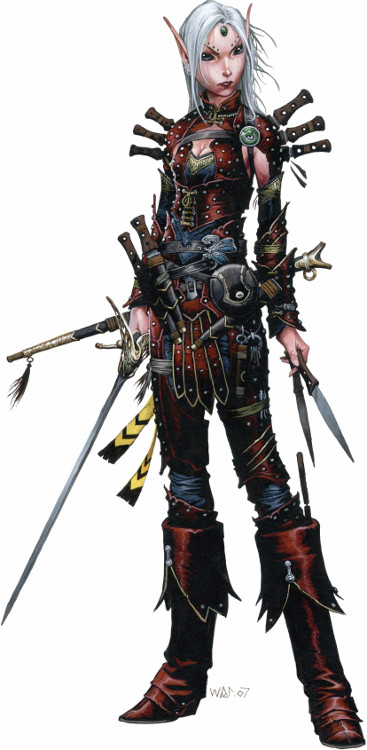
By Wayne Reynolds, Copyright 2007 Paizo Publishing Merisiel has all the knives. All of them. We’re back in familiar territory with her, as she’s one of the Iconics from the core book. Her bio is here and her stats are here. From these, we can learn the following:
-
Merisiel is one of the Forlorn, an elf raised among humans. They get this depressing name because Pathfinder elves are of the type that takes nearly a century to grow up. She spent these decades as a street urchin who stowed away on ships bound for different cities when her current buddies outgrew her.
-
She’s not the sharpest knife in the drawer but makes up for that by carrying a lot of really sharp knives on her person. She tries to start every combat hidden, to better backstab her foes.
-
Merisiel has an open and expressive personality, always tries to have fun in the moment, and is always chasing the next get-rich-quick scheme.
Despite being pretty much a bog-standard d20/Pathfinder character, Merisiel presents us with several interesting challenges when it comes to adapting her to the Dungeon Fantasy RPG.
First of all, she’s an elf, but not the woodsy type of elf shown in DFRPG: Adventurers. No, she’s a Forlorn elf, which means she grew up among humans and had no contact with elven culture to speak of. The racial template from Adventurers that best models this is actually the Half-Elf, down to the problems they have in relating to both humans and elves. She’s not an actual half-breed, but the effects of Social Stigman (Forlorn Elf) would be pretty much the same. And theorietically she would have a much longer lifespan than a half-elf, but that’s not worth any points in Dungeon Fantasy campaigns.
The other challenge is that the Thief professional template from Advanturers is built to resemble the Thief class of early D&D - a middling combatant who’s great at stealth, trap-finding, and reaching difficult places. The d20 Rogue class is still good at these non-combat things, but its main focus is stabbing monsters in the back for massive damage. This is why Merisiel’s Pathfinder stats give her a rapier despite her bio’s focus on knives - it’s the best melee weapon for rogues in that system. Fortunately, the list of Thief-appropriate traits in Adventurers gives us tools to fix this discrepancy.
As a result, Merisiel’s DX and IQ are both a point lower than you would expect for an elf thief, to make room for the extra stabby (Ambidexterity, Weapon Master, Expert Backstabber, and increased combat skills). She’s still quite a bit sharper than her original bio indicates, though it might not be apparent to someone who witnessed her failing two or more self-control rolls.
This version of Merisiel is almost identical to her GURPS Dungeon Fantasy counterpart, with the biggest variation being her armor. She’s now at Light Encumbrance, and must drop the backpack before entering a fight to avoid combat penalties.
Our advancement options here are many. As a member of a “skill monkey” profession Merisiel can always use more and higher skills. Players who want to save points for a while might want to consider buying back that “lost” IQ point for this reason. Those who want to make her stabbier would do well to add a couple points of ST for that sweet 2d swing damage, and more Expert Backstabber would make her sneak attacks even better. Spending treasure on a lighter loadout and better-quality knives would also bring a lot of benefit to the character.
Merisiel, 250-point Forlorn Elf Thief
ST 11 {10}; DX 15 {100}; IQ 12 {40}; HT 11 {10}
Damage 1d-1/1d+1; BL 12.1kg; HP 11; Will 12; Per 13 {5}; FP 11; Basic Speed 6.00 {-10}; Basic Move 7 {5}
Advantages
- Ambidexterity {5}
- Expert Backstabbing 5 {10}
- Flexibility {5}
- High Manual Dexterity 1 {5}
- Magery 0 {5}
- Night Vision 5 {5}
- Perfect Balance {15}
- Weapon Master (Knives) {20}
Disadvantages
- Compulsive Carousing (12) {-5}
- Curious (12) {-5}
- Greed (12) {-15}
- Impulsiveness (12) {-10}
- Sense of Duty (Adventuring Companions) {-5}
- Social Stigma (Forlorn Elf) {-5}
Skills
- Acrobatics (H) DX-1 {1}1 - 14
- Brawling (E) DX {1} - 15
- Carousing (E) HT {1} - 11
- Climbing (A) DX+3 {1}12 - 18
- Escape (H) DX+1 {1}2 - 16
- Fast-Draw (Knife) (E) DX {1} - 15
- Fast-Talk (A) IQ-1 {1} - 11
- Filch (A) DX {2} - 15
- Forced Entry (E) DX {1} - 15
- Gambling (A) IQ-1 {1} - 11
- Gesture (E) IQ {1} - 12
- Holdout (A) IQ {2} - 12
- Lockpicking (A) DX+2 {4}3 - 17
- Main-Gauche (A) DX+3 {12} - 18
- Pickpocket (H) DX {2}3 - 15
- Search (A) Per {2} - 14
- Shadowing (A) IQ {2} - 12
- Sleight of Hand (H) DX-1 {1}3 - 14
- Smuggling (A) IQ {2} - 12
- Stealth (A) DX+3 {12} - 18
- Streetwise (A) IQ+1 {4} - 13
- Thrown Weapon (Knife) (E) DX+2 {4} - 17
- Traps (A) IQ+1 {4} - 13
- Urban Survival (A) Per {2} - 13
Loadout
- Ordinary Clothing [Body, Limbs]: Free, 1kg
- Light Leather Armor [Body, Limbs]: DR 1. $137, 8.25kg.
- Backpack, Small [Body]: Holds 20kg of gear. $60, 1.5kg.
- Bull’s Eye Lantern [Backpack]: 10m beam, burns for 6 hours per 0.5L of oil. $100, 1kg.
- Oil, 1L [Backpack]: Includes flask. $4, 1kg.
- Personal Basics [Backpack]: $5, 0.5kg
- Rope, 3/8”, 10m [Backpack]: Supports 150kg. $5, 0.75kg.
- Lockpicks [Backpack]: $50, 0.05kg.
- Long Knife x2 [Torso]: Damage sw-1 cut or thr imp. $240, 1.5kg.
- Dagger x4 [Torso]: Damage thr-1 imp. May be thrown. $80, 0.5kg.
*Defenses
Assumes No Encumbrance (Merisiel needs to drop the backpack for that).
- Dodge 9
- Parry 11F (Long Knife)
*Attacks
- Long Knife (18): 1d+2 cut or 1d+1 imp; Reach C, 1.
- Long Knife Backstab (18): 2d+5 cut or 1d+3 imp; Reach C, 1;
- Thrown Dagger (17): 1d imp; Acc 0; Range 6/11.
-
-
Deterministic Heroic Feats
This should be easier, too. (image source) As I mentioned in my recent Quick and Dirty Technical Grappling post, the biggest GURPS showstopper in my experience has been recalculating ST scores on the fly, and this wasn’t only a Technical Grappling issue. Today I’ll try to tackle the other rule where this issue has bit me: The Blessed (Heroic Feats) advantage.
This is one of the most powerful Holy Warrior abilities in both versions of Dungeon Fantasy, and it allows you to temporarily increase your ST, DX, or HT. The problem here is that the increase is variable, expressed in dice (+1d or +2d). It’s also an increase that applies to the full attribute, which means the following:
-
Increasing ST changes your HP, Basic Lift and base damage.
-
Increasing DX changes your Basic Speed and potentially Move.
-
Increasing HT changes your FP, your Basic Speed and potentially your Move.
Of these, the HP and FP changes are pretty straightforward. Basic Speed changes are the next easiest to calculate on the fly, since each extra point of DX or HT changes it by 0.25. Basic Lift is not too bad, since the formula for it is easy to memorize (ST * ST/10 kg, or twice that in pounds).
But then you get to base damage, and the gears of your game grind to a halt while you look it up in a table. Now, I’ve been dealing with GURPS for a number of years now so I know that this table is in page 16 of the Basic Set, but people who are new to the system won’t have that memorized. And knowing that didn’t help me in the event that prompted me to write these articles, as I was using the Dungeon Fantasy RPG and had to look up the table like anyone else who is new to those books.
There is actually a specific algorithm for figuring out your change in basic damage, but it’s fiddly enough that finding and consulting the table is usually quicker. And whether you calculate or look up your new basic damage, you still have use that to figure out the damage of your actual attacks, with things like weapon modifiers, Weapon Master, or high Karate bonuses.
My Solution: Deterministic Heroic Feats
The Heroic Feats advantage now increases your attribute by a fixed amount: 4 per level. This still lasts for 3d seconds, to still keep the favor of the gods somewhat fickle. GMs who want to get rid of that remaining bit of randomness can just have it last 10 seconds instead.
When you take the Heroic Feats advantage, write down your new total stats somewhere, and use those when the power is active.
Example: Our friend Seelah has ST 13 and Heroic Might 1, so in a separate space in her character sheet we record her stats with ST 17: Basic Lift 28.9kg and Damage 1d+2/3d-1. We also pre-calculate her enhanced sword damage (3d cut or 1d+4 imp). When Seelah uses Heroic Might, we refer to those stats instead of her usual ones.
If she later increases Heroic Might to its maximum level of 2, her enhanced strength becomes 21, so we recalculate her secondary stats: Basic Lift 44.1kg and Damage 2d/4d-1. Her sword damage becomes 4d cut or 2d+2 imp.
If later still she buys Weapon Master, we apply the damage bonuses from that advantage to both sets of stats. Her normal sword damage becomes 2d+4 cut/1d+4 imp, and her enhanced sword damage becomes 4d+8 cut/2d+6 imp. Now that’s what I call a smite!
-
subscribe via RSS