Posts
-
Review: Hall of Judgment
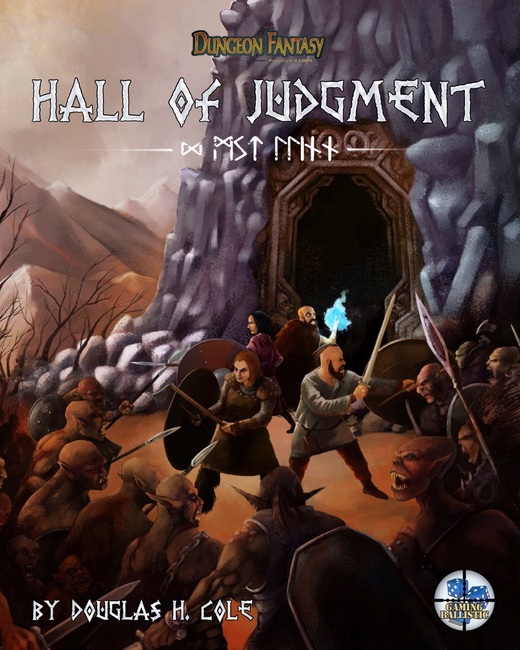
Copyright 2018 Gaming Ballistic LLC (image source) Hall of Judgment is a particularly notable adventure for the Dungeon Fantasy RPG, because it’s published not by Steve Jackson Games but by Gaming Ballistic LLC. It’s not only the first licensed DFRPG book, it’s also the first licensed GURPS book I’ve ever heard of.
It was published fairly recently as of this writing, after a successful kickstarter campaign. I backed it pretty early on, and now I have a copy of the final Hall of Judgment PDF in my screen. So let’s review it!
TL; DR
If you already have the DFRPG boxed set and are looking for supplements to add to your game, this should be at the very top of your shopping list. It contains a Viking-flavored mini-setting with plenty of cultural notes; four separate dungeons; a set of rules for wilderness travel; the GURPS version of the Dungeon Grappling rules; approximately 30 new monsters; and 16 setting-appropriate pre-made player characters.
If you also have the Dragon Heresy intro set and wanted to play in that setting using GURPS rules, then this book should get you most of the way there.
On the Book Itself
Hall of Judgment is a 132-page book describing all of the stuff I mentioned in the TL; DR section. I backed this at the PDF level, so this is what I have. The physical book will be softcover and produced via Print-on-Demand - it seems the campaign didn’t quite reach the stretch goal for fancier printing options.
The layout is a bit similar to that of the Dragon Heresy intro-set, but it feels “GURPSier”, as it should. The font is a bit different, the columns are closer together and the ornamentation around the edges of the pages is different. It all still feels pretty Vigking-ish. Hall of Judgement also reuses several pieces of art from the DH intro set, which is fine by me as they also fit well here.
The writing is reminiscent of plenty of other Dungeon Fantasy products, a style I personally like. The setting descriptions are written in a way that makes it more amenable to a full reading than quick reference, but the dungeons have a clearly labeled section for each room, with labeled paragraphs describing the challenges, rewards, alternative ways of dealing with the challenges, and anything that might be initially concealed from the PCs. I’m sure the Ten Foot Pole guy would think they’re still a little too verbose, though.
Along with the PDF I also got two zip files containing full-sized versions of the encounter and dungeon maps present in the book. The encounter maps have no grid, which means they’re suitable for use in a virtual table-top program.
And once again, this book has a table of contents and index comparable to those of a GURPS book, which is awesome.
On the Setting
The mini-setting contained in this book consists of the city of Isfjall and its surrounding region, which includes Lake Odin, a few other named-but-not-described villages, and a large and dangerous wilderness containing four separate dungeons. One of those is the titular Hall.
This is a significant expansion over this adventure’s initial incarnation as Lost Hall of Tyr for D&D 5th Edition, which from what I gather started with the PCs arriving near the Hall already. The whole setting is really a slice of Torengar, the Dragon Heresy world, but in the KS campaign’s words it has been “mildly de-Norsed” so as to be dropped into any Dungeon Fantasy campaign as the generic “Frozen North” from which barbarian characters frequently hail.
Isfjall is described in great detail for a Dungeon Fantasy work, in which “Town” is usually entirely abstract. You get a rundown of the town’s economy, a little primer on local culture, social hiearchies, religion and law, and a list of almost-weekly festivals covering the whole year. Reading this you get a real sense of why people built a town here, where the money and food comes from, and what their daily lives are like. You can set your adventure at any given day in a year and know what the town will look like on that day, from the information given here.
This plus a table of rumors and the hook for the main dungeon take up a little under 20 pages.
I liked this section quite a lot. It’s a nice departure from the “village of dirt farmers plagued by mysterious disappearances” that features in so many D&D-ish modules, and it’s easy enough to modify. You can add the serial numbers back on by replacing a few names, if you want to play in Torengar or stop pretending the local pantheon aren’t the Aesir. You can also take it in the other direction and, say, turn this into the basis for a Skyrim adaptation.
On the Adventure
Right after the chapter on Isfjall is a chapter on “The Journey”, which has a neat little set of wilderness travel rules. They won’t be news to people who already own GURPS Dungeon Fantasy 16, but they’re an awesome addition for anyone who only owns the boxed set. Each of the three sub-regions the PCs will need to traverse to reach the Hall are given their own encounter table, which contains a good mix of natural obstacles and non-hostile encounters in addition to hostile monsters. There is also a weather table covering the whole year. If you want to really challenge your party, have them set out to find the Hall in the middle of winter.
All this wilderness traveling can lead to one of four different dungeons. There’s a ruined fortress built atop a barrow that contains the spirits of all its inhabitants, two different fae lairs and the Hall of Judgment itself. At no point are your players forced to go to any of them - there’s a strong hook pointing them towards the Hall, but the adventure doesn’t impose any punishment on the PCs if they want to do something else first, or instead. There are also other minor hook suggestions here for GMs who want to make up their own adventures in the setting.
The ruined fortress and the Hall of Judgment feel suitably Nordic, and the PCs are likely to visit the first in their search for the second. The two faerie warrens are entirely optional deathraps that should be a blast to GM.
On the New Material
Aside from the town setting and dungeons, this book contains plenty of new material that should be useful for other campaigns. I already mentioned the wilderness travel rules - the generic portion of them takes up about two pages, and the specific portion provides a good worked example of how to stat up a region’s weather.
Then you have Fantastic Dungeon Grappling, which is basically the GURPS version of Dungeon Grappling rules Mr. Cole wrote for several editions of D&D, which in turn are a simplified version of the Technical Grappling rules he originally wrote as a GURPS. I posted my own take on a simplified Technical Grappling a few months ago, but the rules from this book are better and I recommend using them if you can. I’ve already used them to great effect in a game I’m GMing.
If grappling rules don’t ring your bell, the 30+ new monsters statted up here should make up for that. Each gets a page, with description, DFRPG stats, and an illustration. All of them show up somewhere in the adventure, though your PCs aren’t expected to fight every last one. You get a mix of wild and domestic animals, some humans, a few undead and demons, and a whole lot of faeries from Norse mythology. Even the weakest of those are quite a bit scarier than you’d expect from their appearance.
After the bestiary there’s a group of 16 ready-to-play PCs, most of which are local to the region. Since the adventure is written for a group of 4 to 6, this is more than enough to assemble a number of possible parties, which would make this adventure a lot easier to pick up and play provided the GM knows the book.
Conclusion
I got this book by backing the Kickstarter campaign at the US$10 tier. It’s now available on Warehouse 23 or Gaming Ballistic for US$12.50. In its 132 pages it contains an adventure, a setting, new rules, a bestiary and a pre-made PC portfolio. Given that your typical Dungeon Fantasy supplement only does one of these things, costs $8, and likely contains some of the same material that was put into the DFRPG boxed set, this book should probably be at the top of your shopping list if all you have is that boxed set.
Even if you’re a GURPS Dungeon Fantasy player, this is still excellent value for the money, as the only redundant bit here would be the 2 pages of wilderness travel rules, and that only if you already have DF 16.
-
Meltaguns in GURPS
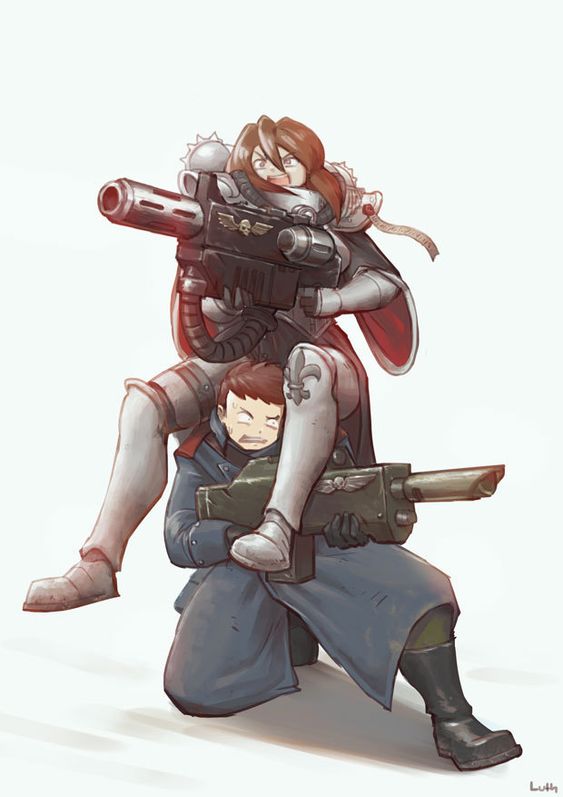
Perfectly cromulent battle tactics (image source) The theme for this month in the secretive cabal of GURPS bloggers is “fire or heat”, so I figured I would do something a bit different from my usual dungeonnesque fare and adapt Melta weapons from Warhammer 40K to GURPS.
Hasn’t that been done already? Yep! Many times, often for the whole of 40K rather than just one weapon, with results of varying quality. A quick search for “gurps meltagun” brings in this this thread in the SJ Games forums as the top result, and there are a whole lotta others below that. My only excuse for doing this is the Full Metal Jacket adage: “There are many like it, but this one is mine.”
Meltaguns
These bulky weapons fire short-ranged beams of concentrated heat with an effect similar to the blast of a shaped charge. They use canisters of highly compressed exotic gasses as ammo, which account for about a third of their considerable weight. There is pretty much no reason to use one of these instead of a good anti-vehicle missile, but the Imperium of Man never cared for reason.
A meltagun can punch through most personal and vehicular armor and cause grievous harm to the soft bits behind it. If you miss, though, your target will be in a prime position to shoot back or charge at you1.
Melta weapons come in several varieties:
Inferno Pistols can (barely) be fired with one hand, using Beam Weapons (Pistol). Their effective range is a bit shorter than that of your typical video game shotgun, which is quite a feat.
Standard Meltaguns are fired using Beam Weapons (Rifle). They do the same damage as inferno pistols, but have greater range and more shots per canister.
Multi-meltas, as the name implies, basically consist of several meltagun assemblies bolted together. The resulting weapon is huge and heavy, with a heat so intense it produces a 3d burn “backblast” that affects the shooter and anyone standing up to 2 meters behind them. For these reasons it’s usually either carried by large people in powered armor, mounted on vehicles, or attached to shielded tripods. In the first case it’s fired with Beam Weapons (Rifle); in the others with Gunner (Beams).
All melta weapons halve their armor divisor past 1/2D, and are affected by spaced, laminated or electromagnetic armor as if they were shaped charges.
TL Weapon Damage Acc Range Weight RoF Shots ST Bulk Rcl 9^ Inferno Pistol 6dx2(10) burn 3 10/30 3kg/1kg 1 3(3) 11 -4 1 9^ Meltagun 6dx2(10) burn 6 30/90 6kg/2kg 1 5(3) 12† -6 1 9^ Multi-melta 6dx5(10) burn ex 12 100/300 40kg/15kg 1 12 (5) 18M -8 1 Design Notes
Like Perfect Organism did over on his forum thread, I started by looking through Ultra-Tech in search of already existing weapons that would be similar to Warhammer 40K’s melta weapons. The plasma flamers on page 127 of that book looked almost promising, but look both too weak and too slim to fit the bill. The root of the problem is GURPS Ultra-Tech assumes a universe that makes sense, even when describing superscience. But this is Warhammer 40K! Nothing makes sense!
So in the end I took inspiration both from the plasma flamer stats in Ultra-Tech and from the melta weapon stats in the Only War corebook. Then I pulled the final numbers of out the Warp. The end result is even more insane and less realistic than UT’s plasma flamers, but that’s what the superscience tag is for.
Pricing these monstrosities is left as an exercise for the reader. If you’re playing in the 40K setting or somewhere similar, cost doesn’t really matter, since the people most likely to use these weapons will have them issued by their bosses. In other settings they’re perfect as the inventions of a pyromaniac mad scientist or the like. If they are available commercially, they should be expensive, and in all of these cases their Legality Class is no better than 1.
-
If you hit and your target is still standing, then you’ve just angered something that can stand up to melta-guns. Good luck surviving! ↩
-
-
Dragon's Dogma Bestiary: Lesser Dragons
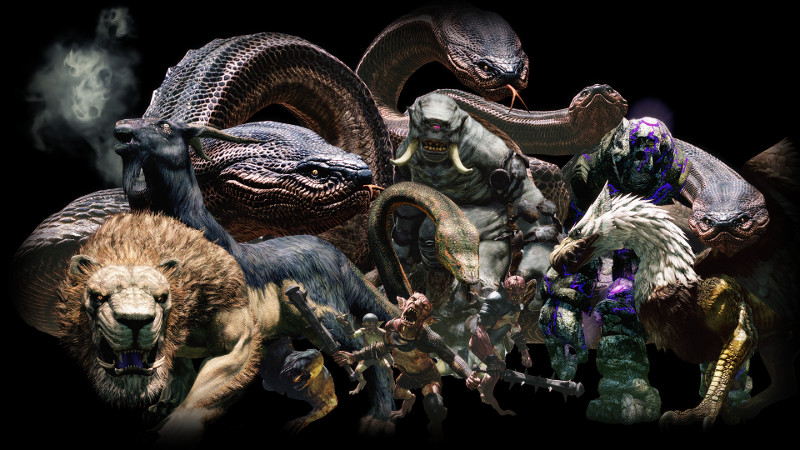
Copyright 2012 Capcom. This is another entry in the Dragon’s Dogma bestiary. So, uh, it’s been a while since I posted one of these hasn’t it? The reason for that is twofold. First, we’re getting into the final stretch of the game’s main plot here, and I confess I haven’t played it much past that point.
Second is that the only monsters really left to cover are dragons, and dragons are kinda hard to stat not only because I feel I have to get them right, but because the Dungeon Fantasy RPG already did such a good job of it that almost anything I tried to do would only end up looking like a straight copy from it. Here is my attempt to do something different.
Lesser Dragons
The path of the Arisen is a long and grueling one, and one of the most shocking revelations many of them face while walking it is that The Dragon is not the only such beast. There are others, smaller in size but still quite large and deadly.
Most people of Gransys ignore the existence of lesser dragons. Not even those who make it their business to study the cycle know much about them. The secret of their origin might only be learned from the dragons themselves, or from an ancient Arisen who survived past encounters with them: every lesser dragon was once an Arisen. One who was defeated by The Dragon, and as a result was reincarnated in a draconic body to be sent into the world during further incursions.
Lesser dragons have the same general body plan as their larger “cousin”. They fight with their natural weapons (teeth, claws, tail, elemental breath) but might also have access to some of the powers they posessed in their past lives. A lesser dragon’s recollection of that life varies from individual to individual, but all feel a compulsion to test the might of the Arisen in deadly combat. How they deal with that also varies from individual to individual.
All such creatures are sapient and capable of speech, though only the Arisen and the Pawns can understand their language.
If you have access to DFRPG: Monsters, the stats for SM+3 dragons contained there are perfectly adequate for representing Dragon’s Dogma lesser dragons. The stats for western dragons found in GURPS Dragons also work nicely.
If you can’t or don’t want to use those, keep reading!
Build-A-Dragon
Rather than giving you a “canonical” lesser dragon stat block, I’m going to give you a basic, generic template and instructions on how to customize it. This reinforces the notion that every lesser dragon is a unique individual.
Basic Lesser Dragon Stats
ST 20; DX 12; IQ 10; HT 13;
HP 20; Will 12; Per 12; FP 13;
Speed 6.25; Move 6 (Air Move 13); SM +3
DR 3
- Bite : thrust-1 cutting, +1 per die. Reach C, 1. Can count as a grapple!
- Front Claw: thrust-1 cutting, +1 per die. Reach C-2.
- Hind Claw: thrust cutting, +1 per die. Reach C-2.
- Horns: thrust-1 cutting, +1 per die. Treat as weapon for attacking and parrying. Reach C, 1.
- Tail: Thrust crushing, +1 per die, or double that for knockback only. Reach C-3.
- Wing: thrust -1 crushing, +1 per die, or double that for knockback only. Reach C-3.
- Breath Weapon: Costs 2 FP per use, with no recharge time or limit of uses per day. Can be any one of the types listed in DFRPG: Monsters or lightning (1mx10m cone, burn damage, metal armor only protects with DR 1; dragon has double DR vs lightning). Damage for the cone-shaped breaths weapons is based on thrust for the dragon’s ST.
- Dominate Pawn: As the Charm spell, cast at skill 15. Costs 3 FP and works only on Pawns.
Traits: Bad Grip 2, Extra Attack 1; Flight (Winged); High Pain Threshold; Horizontal; Immunity to Disease; Loner (12); Nictitating Membrane 3; Night Vision 9; Penetrating Voice; Peripheral Vision; Temperature Tolerance 2 (Cold); Temperature Tolerance 4 (Heat); Unfazeable.
Class: Mundane.
Customizing your dragon
To get a final stat block for your dragon, you’re going to have to decide who they were in life. Choose the DFRPG professional template that most closely matches the original person’s capabilities, and quickly select what advantages and disadvantages that person had. Let’s call that the original character. Combine it with the dragon stats above in the following way:
- ST: For every point ST the original character has over 10, add 2 to the dragon’s ST.
- DX, IQ, HT: For every point over 10 the character template has in these attributes, add 1 to the dragon’s corresponding attribute.
- Secondary Characteristics: Figure the new totals from the dragon’s final primary attributes, plus any modifying traits from the original character. Double any levels of Lifting ST, Striking ST or extra HP - all other such traits apply at the same level.
- Other Advantages and Disadvanatages: These all transfer directly to the dragon where applicable, and are modified to apply to the dragon’s natural DR or weapons where it makes sense. Points spent in things like Armor or Shield Mastery would convert into increased DR or defenses for the dragon, and a former Weapon Master might be considered Trained by a Master when fighting with its natural weapons.
- Skills: The dragon has a Brawling skill equal to the original character’s highest melee combat skill, or DX+2, whichever is highest. It also has an Innate Attack skill equal to the original character’s highest ranged combat skill or DX+2, whichever is highest. Points spent on Acrobatics or other such movement skills would transfer to Flight and Aerobatics instead. All other skills transfer directly.
- Magic: Magery, spells and any other magic powers transfer directly!
If you want tougher dragons, the easiest way to get them is to start with a more powerful original character. You can also increase the dragon’s base DR to a level you find appropriate before performing the rest of the operations above.
Example Dragons
These are the three lesser dragons you can find in the original game.
The Drake
This dragon was once a dutiful knight that protected his liege with sword and shield. Now he feels compelled to test the current Arisen’s resolve to face the challenges he himself could not.
The Drake prefers to stay on the ground and engage his opponents in melee combat, making use of Rapid Strikes and Deceptive Attacks. Enemies who try to keep their distance get hit with his fiery breath weapon, or dominated if they’re Pawns. All the while, he taunts them and questions their worth.
The Drake will not pursue foes who choose to flee and escape its chosen territory, unless the Arisen is among them. In that case, or if its opponents stand their ground, he will fight to the death.
ST 32; DX 16; IQ 10; HT 16.
HP 32; Will 12; Per 12; FP 16.
Speed 8.50; Move 8 (Air Move 16); SM +3
Dodge 12; Parry 14; DR: 6 (12 vs fire)
- Bite (20): 3d+3 cut; Reach C,1. Can count as a grapple!
- Front Claw (20): 3d+3 cut, Reach C-2.
- Hind Claw (20): 3d+4 cut, Reach C-2.
- Horns (20): 3d+3 cut, Reach C,1. Counts as a weapon for attacking and parrying.
- Tail (18): 3d+4 cr, or double that for knockback only. Reach C-3.
- Wing (20): 3d+3 cr, or double that for knockback only. Reach C-3.
- Dominate Pawn (15): As the Charm spell. Costs 3 FP and works only on Pawns.
- Fire Breath (16): Costs 2 FP per use. 1m-wide and 10m-long cone of flame; 3d+1 burn.
Traits: Bad Grip 2; Born War-Leader 2; Combat Reflexes; Extra Attack 1; Flight (Winged); High Pain Threshold; Horizontal; Immunity to Disease; Loner (12); Nictitating Membrane 3; Night Vision 9; Penetrating Voice; Peripheral Vision; Temperature Tolerance 2 (Cold); Temperature Tolerance 4 (Heat); Trained by a Master; Vow (never refuse a challenge to combat); Unfazeable.
Skills: Brawling-20; Carousing-16; Forced Entry-16; Innate Attack (breath)-16; Leadership-12; Strategy-11; Tactics-11;
The Wyrm
The Wyrm was once a wizard whose spells failed him when he needed them the most. As a lesser dragon he remains quite articulate and fully cognizant of his past life and current situation. He seeks to lair in the ancient ruins of his city and stay out of the conflict, but will still fight the Arisen should the two meet.
In an hostile encounter, the Wyrm will try to lead the PCs to an arena of his choosing before engaging. He will prefer to fight in an enclosed, flooded ruin chamber where his sound and ice spells are extra effective. In combat the Wyrm relies on his spells. He might try to incapacitate his opponents with Daze of Sleep (in single or mass versions), surprise non-Pawns by dominating them with Charm, or cast Resist Sound on himself and attack with Concussion and Thunderclap. His physical abilities remain formidable of course, and so does his breath weapon.
That said, out of all the example lesser dragons here the Wyrm is the most likely to be friendly if the party doesn’t include any Arisen, and could be convinced to impart some important piece of lore or teach some of his magic by sufficiently honey-tongued characters.
ST 20; DX: 14; IQ 15; HT 14;
HP 20; Will 16; Per 13; FP 16.
Speed 8.00; Move 8 (Air Move 16); SM +3
Dodge 11; Parry 13; DR: 3 (6 vs cold)
- Bite : 2d+1 cutting. Reach C, 1. Can count as a grapple!
- Front Claw: 2d+1 cutting. Reach C-2.
- Hind Claw: 2d+2 cutting. Reach C-2.
- Horns: 2d+1 cutting. Treat as weapon for attacking and parrying. Reach C, 1.
- Tail: 2d+2 cr, or double that for knockback only. Reach C-3.
- Wing: 2d+1 cr, or double that for knockback only. Reach C-3.
- Breath Weapon: Costs 2 FP per use. 1m-wide, 10m-long cone of cold, 2d-1 burn damage. Won’t set fires.
- Dominate Pawn: As the Charm spell, cast at skill 15. Costs 3 FP and works only on Pawns.
Traits: Bad Grip 2, Energy Reserve 8; Extra Attack 1; Flight (Winged); High Pain Threshold; Horizontal; Immunity to Disease; Improved Magic Resistance 1; Loner (12); Magery 4; Nictitating Membrane 3; Night Vision 9; Penetrating Voice; Peripheral Vision; Stubborness (12); Temperature Tolerance 4 (Cold); Temperature Tolerance 2 (Heat); Unfazeable.
Skills: Brawling-16; Innate Attack-16; Alchemy-15; Diplomacy-13; Hidden Lore (Demons, Magic, Magical Writings and Spirits)-14; Occultism-15; Teaching-14; Thaumathology-15; Writing-14.
Spells:
- Air:
- Create Air-17
- Concussion-17
- Shape Air-17
- Thunderclap-17
- Body Control:
- Frailty-17
- Debility-17
- Healing:
- Lend Energy-17
- Recover Energy-17
- Water:
- Breathe Water-17
- Create Water-17
- Dehydrate-17
- Destroy Water-17
- Freeze-17
- Fog-17
- Hail-17
- Shape Water-17
- Sound:
- Garble-17
- Resist Sound-17
- Sound-17
- Voices-17
- Mind Control:
- Bravery-17
- Charm-17
- Command-17
- Daze-17
- Foolishness-17
- Forgetfulness-17
- Loyalty-17
- Mass Daze-17
- Mass Sleep-17
- Weaken Will-17
The Wyvern
The Wyvern was a scout, quick and nimble, who zigged when she should have zagged. Only recently reincarnated, she is still confused and running on little more than instinct.
The Wyvern will fight any who approach her by taking to the air and doing strafing runs with her lightning breath or front claws, which don’t incur any of the usual penalties for Move and Attack. These can include attempts to grab a target and drop it from a great height. She will only fight for long enough to discourage pursuit before flying away to look for a safe place to rest, unless the party contains an Arisen - then, as usual for lesser dragons, she will be compelled to fight to the death.
The Wyvern departs from the generic template a bit more by trading the ability to dominate pawns for a beefier than usual breath weapon and the enhanced skirmishing ability described above.
ST 22; DX 16; IQ 11; HT 15;
HP 22; Will 13; Per 16; FP 15;
Speed 9.25; Move 9 (Air Move 18); SM +3
Dodge 13; Parry 13; DR 5 (10 vs. electricity)
- Bite (18) : 2d+2 cut. Reach C, 1. Can count as a grapple!
- Front Claw (18): 2d+2 cut. Reach C-2.
- Hind Claw (18): 2d+3 cut. Reach C-2.
- Horns (18): 2d+2 cut. Treat as weapon for attacking and parrying. Reach C, 1.
- Tail (16): 2d+3 cr, or double that for knockback only. Reach C-3.
- Wing (18): 2d+2 cr, or double that for knockback only. Reach C-3.
- Breath Weapon (20): Costs 1 FP per use, with no recharge time or limit of uses per day. 1m-wide, 20m-long cone doing 2d+2 burn damage. Metal armor protects with only DR 1.
Traits: Absolute Direction; Bad Grip 2, Combat Reflexes; Danger Sense; Extra Attack 1; Flight (Winged); High Pain Threshold; Horizontal; Immunity to Disease; Loner (12); Nictitating Membrane 3; Night Vision 9; Paranoia; Penetrating Voice; Peripheral Vision; Temperature Tolerance 2 (Cold); Temperature Tolerance 4 (Heat); Unfazeable.
Skills: Aerobatics-16; Brawling-18, Innate Attack-20; Flight-16
-
I'm done with Kickstarter
That’s it. I’m done with Kickstarter. It’s just too much of a hassle.
After an excruciating process that involved 2 permanently blocked credit cards, a 2-week wait for the replacements to arrive, a third (thankfully virtual) blocked card, a total of 2 hours of trying to convince the nice people at my bank and/or credit card operator that I was myself and that I did indeed want my card unblocked and that transaction completed, I’m finally an official backer of the Hall of Judgment campaign and have the preview PDF on hand.
Now, the thing with all the blocked cards was a first for me1, but the rest has been pretty much par of the course every single time I backed a KS project. It seems like either my bank (Banco do Brasil) or VISA really hate the way KS charges Brazilian cards. It always gets flagged as a security violation and there seems to be no way to let them know beforehand that it’s really OK. And by now I’m really tired of this whole Kafkaesque nightmare.
So until one or more of these corporations comes up with a better way to take my money, I won’t back anything else on Kickstarter and will instead wait for the stuff I’m interested in to be available through normal channels.
-
And boy did it mess up all my online subscriptions. ↩
-
-
New Kickstarter: Hall of Judgement
I thought Gaming Ballistic’s Lost Hall of Tyr1 looked like an interesting adventure when it came out, but I didn’t buy it because it was for D&D 5th Edition. I did think at the time that it would be really nifty if it ever came out for GURPS… and now I’m about to get my wish.
Gaming Ballistic has recently starter another kickstarter campaign for Hall of Judgement, which is a version of the same adventure for the Dungeon Fantasy Roleplaying Game.
It’s not a direct conversion. The setting part has been made a bit more generic so it can fit into ongoing DFRPG campaigns, and the adventure itself has been expanded to be more sandboxy, with more wilderness travel and a few sidequests added in. It’s also the first ever licensed third-party supplement for the DFRPG, so I’m backing this not just for the book itself but to send a message to Steve Jackson games that I want to see more of this type of deal.
subscribe via RSS