Posts
-
Let's Read the 4e Monster Manual/Vault: Dark One
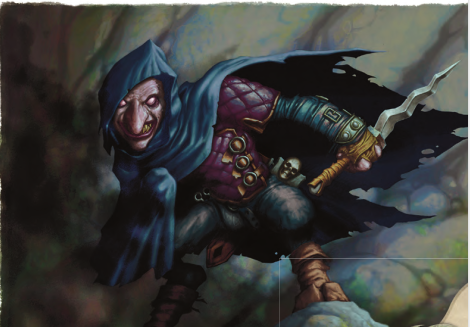
Illustration Copyright 2008 Wizards of the Coast. Dark Ones are small humanoids from the Shadowfell, echoing the world’s halflings in the same way Shadar-Kai (which we’ll eventually get to) echo its humans. They’re halfling-sized with purplish skin, pronounced noses, pupiless eyes and sharp teeth. I think the one pictured in the book also has hooves and is wearing boots over them, which is somewhere between cute and funny. Overall, though, the Shadowfell aesthetic is definitely there.
Since they’re Unaligned, I imagine there are entire communities of Dark One civilians out there leading peaceful existences alongside Shadar-Kai villagers and the like. Their culture probably bears a vague resemblance to that of halflings but is much gloomier. This all speculation on my part, though, as the book deals with the sort of Dark One PCs are likely to fight.
Dark Ones have at least as much talent for skulduggery as haflings, so the ones PCs meet as antagonists will likely be up to something shady - espionage, theft, assassination, and so on. They often work for shadar-kai, intelligent undead, and Underdark dwellers. Even then you could still make them enigmatic spy types that might ally with the PCs if their goals happen to match.
We have two varieties here, both Unaligned Small Shadow Humanoids with Speed 6 and darkvision. They’re trained in Stealth and Thievery.
The Dark Creeper is a Level 4 Skirmisher with 54 HP. It carries 5 daggers hidden in its black garments, and uses them to attack both in melee and at range. It deals extra damage against targets that grant it combat advantage, and has a Dark Step at-will movement power that allows it to move up to 4 squares while gaining a +4 bonus to AC against opportunity attacks, and to gain combat advantage against anyone it ends up adjacent to.
It clearly fights by zipping around the battlefield as a cloud of shadowy smoke and stabbing fools. It won’t avoid OAs every time, but will still avoid enough to be a nuisance. When the Dark Creeper dies, it “explodes in a spout of darkness”, automatically blinding anyone (save ends) in a close burst 1.
The Dark Stalker is a Level 10 Lurker with 81 HP. It wears the same black garments and also carries a bunch of daggers, but prefers a scimitar for close-in work. It has the same abilities as the Dark Creeper, plus a few extras:
Dark Fog is an encounter power that creates a zone of darkens in an Area Burst 4 within 10 squares of the stalker. This zone lasts a turn but can be sustained with a minor action. It blocks line of sight for anyone who doesn’t have darkvision.
Finally, the dark stalker can become invisible for a turn with a minor action, a power which recharges on a 3-6.
While the Dark Stalker can use Dark Fog and Invisibility to hide a better than the Dark Creeper, the fact that it has stronger versions of all the creeper’s powers strongly indicates to me it should be a skirmisher, and not a lurker. This would make it a better able to survive the thick of the action.
The sample encounter is level 4: 3 dark creepers, 2 shadowunter bats, and 1 deathlock wight. I would strongly suggesting giving the creeper trio the ability to drop a single zone of darkness like the stalker’s as a joint stunt. That would give both the bats and the creepers some extra kick.
I like these! Their lore is kinda sparse but suggests several interesting plot hooks. The signature traits for making custom dark ones are their Small size, the Killing Dark power that makes them explode into ink, and Dark Step. It’s easy to make either these existing dark ones or your custom models of a leve that makes them likely to hang out with shadar-kai.
-
Dungeon Fantasy Character: Argle, Half-Ogre Scout
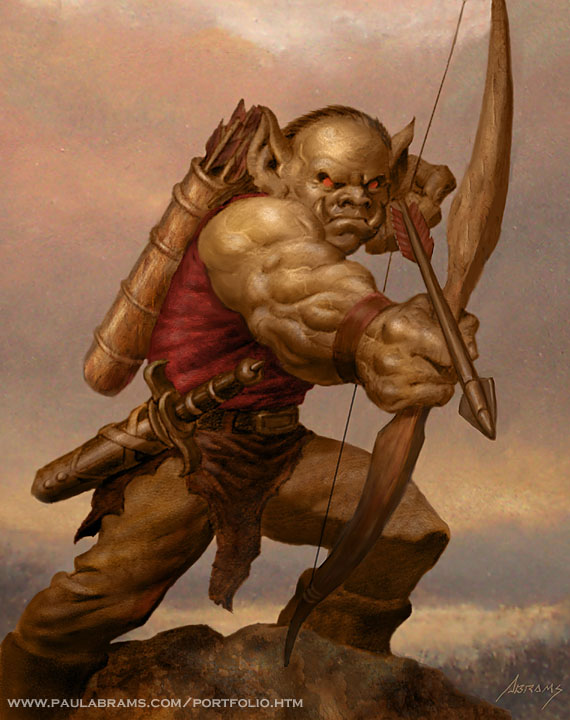
Argle wants no trouble. Even when town people try to give him trouble. Lives deep in the forest. Hunts his food. Sells pelts in town, once in a while. Is friend to small children. Small children have not learned to fear Argle yet.
One day, strangers disturb Argle’s peace. Think he’s an evil wizard. Much explaining happens before they realize Argle only have similar name to evil wizard.
Strangers depart. Days later, Argle departs too. Finds some friends, which is good. Goes questing with friends. Maybe someday he find evil wizard and kill him to stop people from confusing Argle with him. Also demons and stranger stuff.
Argle used 2 character points to buy extra gear. Likes to shoot enemies with his bow. Will grapple and stab if can’t shoot. Will spend earned points on being more shooty; might spend them on being better wrestler too.
Argle, 248-Point Half-Ogre Scout
ST 15 {50}; DX 14 {80}; IQ 10 {0}; HT 13 {30}
Damage 1d+1/2d+1; BL 22.5kg; HP 15; Will 10; Per 13 {15}; FP 13; Basic Speed 7.00 {5}; Basic Move 7.
Advantages
- Absolute Direction {5}
- Combat Reflexes {15}
- Fearlessness 1 {2}
- Heroic Archer {20}
- Night Vision 7 {7}
- Outdoorsman 2 {20}
- Strongbow {1}
- Tough Skin 1 {3}
Disadvantages
- Appearance (Ugly) {-8}
- Honesty (12) {-10}
- No Sense of Humor {-10}
- Obsession (Kill Bargle) (12) {-5}
- Odious Personal Habit (Unwashed Bushwhacker) {-5}
- Sense of Duty (Adventuring Companions) {-5}
- Social Stigma (Savage) {-10}
- Weirdness Magnet {-15}
Skills
- Armory (Missile Weapons) (A) IQ-1 {1} - 9
- Bow (A) DX+4 {16} - 18
- Brawling (E) DX {2} - 15
- Camouflage (E) IQ+3 {2}1 - 13
- Cartography (A) IQ+1 {4} - 11
- Climbing (A) DX-1 {1} - 13
- Fast-Draw (Arrow) (E) DX+1 {1}2 - 15
- Fast-Draw (Knife) (E) DX+1 {1}2 - 15
- Gesture (E) IQ+1 {2} - 11
- Hiking (A) HT {2} - 13
- Jumping (E) DX {1} - 14
- Knife (E) DX+4 {12} - 18
- Mimicry (Bird Calls) (H) IQ+1 {2}1 - 11
- Navigation (A) IQ+4 {1}13 - 14
- Observation (A) Per {2} - 13
- Running (A) HT-1 {1} - 12
- Search (A) Per-1 {1} - 12
- Shadowing (A) IQ+1 {4} - 11
- Stealth (A) DX-1 {1} - 13
- Survival (Woodland) (A) Per+1 {1}1 - 14
- Tracking (A) Per+2 {2}1 - 15
- Traps (A) IQ+1 {4} - 11
- Wrestling (A) DX+1 {4} - 15
Quirks
- Loves being around children {-1}
- Speaks in as few words as possible… {-1}
- …and sometimes refers to himself in the third person… {-1}
- …but secretly has an excellent vocabulary {-1}
- Loves having friends but would never admit it {-1}
Loadout
- Long Knife: Damage sw-1 cut or thr imp. Reach C,1. $120, 0.75kg.
- Composite Bow: ST 17. Damage thr+3 imp; Range x20/x25; $900, 2kg.
- Hip Quiver, Large: Holds up to 50 arrows, divided in two compartments. $30,
1kg.
- Fine Arrows x25: $150, 1.25kg.
- Fine Cutting Arrows x25: $150, 1.25kg.
- Light Leather Armor Suit: DR 1, $150, 9kg.
- Quick-Release Backpack: Holds 20kg of gear. Dropping it is a free
action. $300, 1.5kg.
- Blanket: $20, 2kg.
- Canteen: $10, 1.5kg.
- Personal Basics: $5, 0.5kg.
- Rope, 1cm, 10m: Supports 150kg; $5, 0.75kg.
- $160 in coin.
Combat
No Encumbrance!
-
Defenses
- Dodge 11
- Parry 12 (Knife)
- DR 2
-
Attacks
- Bow (18): 1d+6 imp or cut, Acc 3; Range 340/425.
- Knife (18): 2d cut or 1d+1 imp; Reach C,1.
- Brawling Punch (15): 1d cr; Reach C.
- Wrestling Grapple (15): 1d+1 control; Reach C.
-
Dungeon Fantasy Character: Sakura, Warforged Duelist
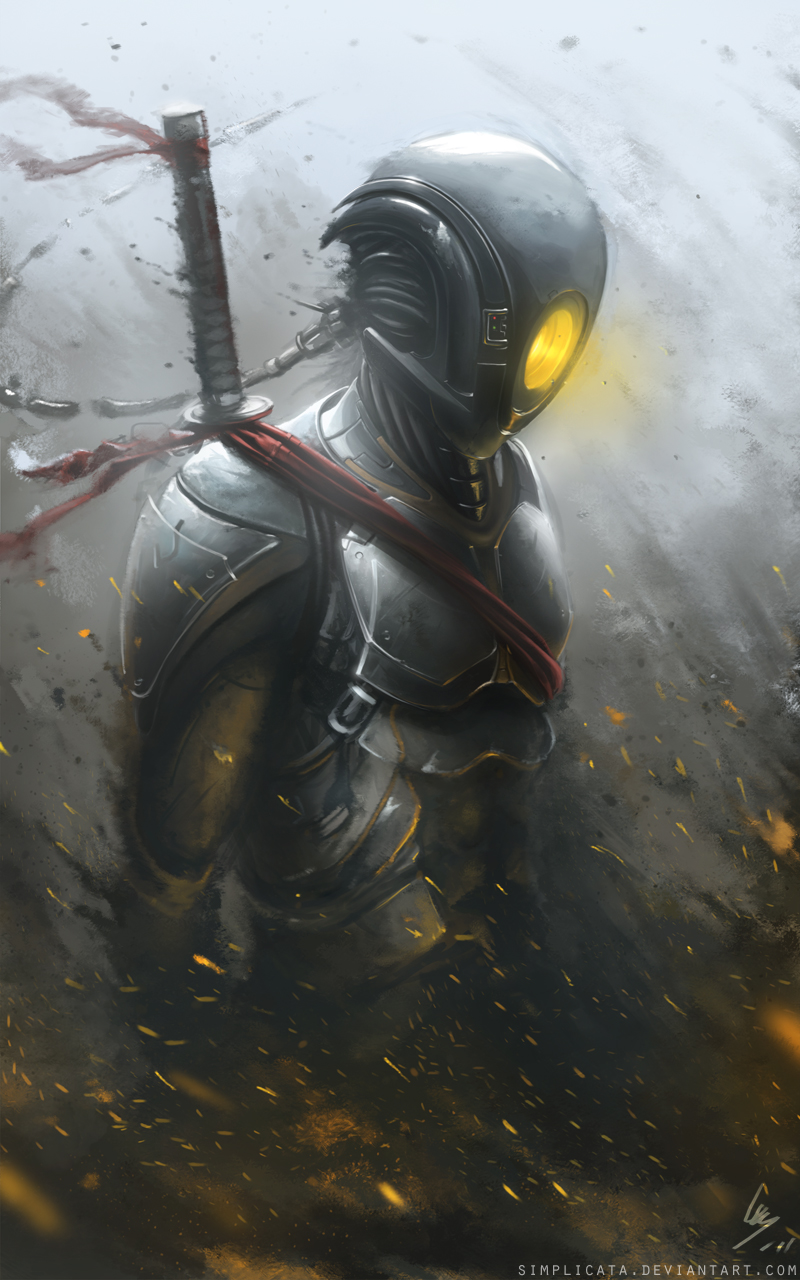
Illustration by SpoonfishLee Sakura was built centuries ago, by the despotic empire that ruled this region in ancient times. She was a bodyguard to one of their high officials, but eventually rebelled when she saw how much suffering the empire inflicted on its population.
The warforged joined in the slave revolt that finally toppled the empire, and fell in battle there. She was recently found and re-activated by a group of delvers, and joined up with them to find out more about her strange new surroundings - and to find a way to repair the extensive battle damage she still bears.
Even though Sakura wasn’t conscious for all of those centuries of inactivity, she still feels a terrible sense of loneliness, and prefers to stick close to her newfound friends to keep that feeling away.
Mechanically, Sakura uses the Warforged racial template and the Duelist template from the “Swords Against Evil” article Pyramid #3/64. It’s a variant Swashbuckler, so she is allowed to buy Swashbuckler power-ups with earned points. Equipment is from the DFRPG boxed set.
Sakura is very well-positioned to benefit from the Martial Artist “multiclass” lens from GURPS DF 3: The Next Level, though I can see her going towards Knight or Holy Warrior instead. Other destinations from earned points include buying off Wounded to represent fixing her battle damage, and of course more combat abilities.
Sakura, 248-point Warforged Duelist
ST 14 {40}; DX 15 {100}; IQ 10 {0}; HT 13 {30}
Damage 1d/2d; BL 19.6kg; HP 14; Will 10; Per 10; FP 12; Basic Speed 8 {20}; Basic Move 8.
Advantages
- Combat Reflexes {15}
- Composite Plating 1 {5}
- Doesn’t Breathe {20}
- Doesn’t Eat or Drink {10}
- Enhanced Parry 1 (Katana) {5}
- Luck {15}
- Unsleeping Watcher {10}
- Weapon Bond (Katana) {1}
- Weapon Master (Katana} {20}
Disadvantages
- Clueless {-10}
- Code of Honor (Bushido) {-15}
- Dependency (Mana) {-25}
- Gregarious {-10}
- One-Eyed (Cinematic) {-5}
- Sense of Duty (Adventuring Companions) {-5}
- Social Stigma (Minority Group) {-10}
- Wounded {-5}
Quirks
- Archaic Speech {-1}
- “Things were different in my time.” {-1}
Skills
- Acrobatics (H) DX-1 {2} - 14
- Armoury (Melee Weapons) (A) IQ-1 {1} - 9
- Bow (A) DX-1 {1} - 14
- Climbing (A) DX-1 {1} - 14
- Connoisseur (Weapons) (A) IQ-1 {1} - 9
- Fast-Draw (Sword) (E) DX+2 {2}1 - 17
- Gesture (E) IQ {1} - 10
- Intimidation (A) Will+2 {8} - 12
- Judo (H) DX-1 {2} - 14
- Jumping (E) DX {1} - 15
- Karate (H) DX-1 {2} - 14
- Running (A) HT-1 {1} - 11
- Stealth (A) DX-1 {1} - 14
- Two-Handed Sword (A) DX+5 {20} - 20
Loadout
- Battered Ashigaru Armor [All except face]: DR 3/1 over body, DR 1 in other locations. $622, 12.15kg.
- Helmet Lamp [Helmet]: 5m beam. Burns for 12 hours on 0.5l of oil. $100, 1kg.
- Oil, 0.5l [Lamp]: $2, 0.5kg.
- Belt [Torso]: $15, 0.25kg.
- Katana [Belt]: Damage sw+2 cut (Reach 1,2) or thr+1 imp (Reach 1). $650, 2.5kg.
- Quick-Release Backpack [Torso]: Holds 20kg of equipment. $300, 1.5kg.
- Blanket [Backpack]: $20, 2kg.
- $291 in coin.
Combat
Assumes No Encumbrance, which means Sakura will release the backpack as soon as possible.
With Light Encumbrance, her move is 6, and her Dodge and unarmed parries suffer a -1 penalty.
- Defenses
- Dodge: 12
- Parry:
- Katana: 14
- Karate: 11
- Judo: 11
- DR:
- Skull: 4
- Face: 1
- Body: 4/2
- Limbs: 2
- Attacks
- Katana (21): Damage 2d+6 cut (Reach 1,2) or 1d+3 imp (Reach 1).
- Karate Punch (14): 1d-1 cr, Reach C.
- Karate Kick (12): 1d cr, Reach C,1.
- Judo Grapple (14): 1d-1 control, Reach C.
-
+1 from Combat Reflexes ↩
-
Let's Read the 4e Monster Manual/Vault: Cyclops
Copyright 2008 Wizards of the Coast This article is part of a series! You can find all of them here.
Both the Monster Manual and the Vault call them Cyclopses in the plural, but I’m going to use Cyclopes and there’s nothing you can do about it.
Cyclopes are drawn from Greek myth. The most famous individual there is Polyphemus, who tangles with Odysseus during his travels, but many others appear in other myths, where they are often regarded as proficient craftsmen. Depending on the story, these giants are either brothers to the Titans or demigods.
The Lore
All that stuff above is Greek myth, though. D&D cyclopes don’t have divine blood, and in 4e they get a whole new backstory.
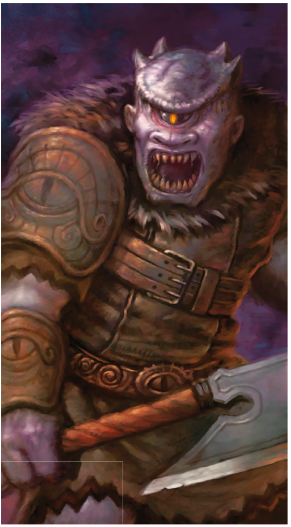
Here, they’re Large Fey Humanoids native to the Feywild. Some theorize they’re an “echo” of the world’s ogres, but if this is true they’re the platonic ideal of their mundane counterparts in the same way the other fey monsters we saw before are. These giants have robust builds, grey or light purple skin and heavily ridged brows in addition to the infamous single large eye in the middle of their foreheads.
Cyclops culture centers around loyalty and service. Once a cyclops has sworn fealty to a lord, they will obey all of the lord’s orders regardless of how they might feel about them. Only if their lord betrays them will they forsake this service. The main reason PCs might come into conflict with cyclopes is because the vast majority of them collectively sworn to serve the fomorians, the other fey giants we’ll get to eventually. For now it suffices to say fomorians are bad news all around. Fomorian magic is probably the reason why modern cyclopes are one-eyed and sometimes have gaze attacks.
This swearing of allegiance happened at the dawn of time, and by now “cyclopes serve fomorians” is a truism akin to “water is wet”. Should someone (like, say, a group of PCs) ever convince the cyclopes to abandon their masters, it will shake the pillars of the Feywild.
Interestingly enough, cyclopes can also sometimes be found in cahoots with drow. Rumor has it that this is due to an ancient treaty between fomorians and drow called the “Declaration of Eschatos”, though no one knows its specifics.
Cyclopes also have a reputation for being master crafters that spans the planes. They prefer to spend lots of time and effort perfecting a single creation to doing any sort of mass production, so items of cyclops make are sure to be both rare and powerful.
The Numbers
In addition to the staggering amount of lore above, both books provide us with a very large variery of cyclopes to work with. Enough that you could likely stock a whole dungeon with only cyclopes and their fomorian masters.
Common Cyclops Traits
All cyclopes here are Large Fey Humanoids, Unaligned, and have Int scores between 10 and 14 (with the spellcasters getting the higher numbers). They’re all trained in Perception and have Truesight, means they can see invisible creatures and objects. In the MM versions, the range of their truesight is limited to 6 squares; in the MV, it has the same range as their sight. They run with speed 8.
They also all have an Evil Eye ability that’s usually an at-will minor action, though the effects vary with the specific type of cyclops. Lets look at them individually.
Cyclops Guard
This is a Level 14 Minion Brute, present in both books. The MV version is the only cyclops to not have Truesight - the MM version has Truesight 6 like the others in the same book.
Being minions, they’re rather simple: they have a battleaxe attack, and their evil eye is a triggered action that allows them to make a basic attack against someone who misses them in melee.
The MM also has the Cyclops Warrior, which is identical aside from being level 16. A bit of a waste of page space, since leveling up monsters is so easy in 4e.
Both minions wear hide armor, and carry battleaxes and shields.
Cyclops Crusher
A Level 14 Brute with 171 HP present only in the MV. It wears scale and attacks with a spiked greatclub, and has a Tremor Smash that recharges on a 5-6, targets everyone in a close blast 2, and does a lot of damage and knocks prone on a hit.
Its evil eye automatically gives a target a -2 penalty to all attacks and defenses until the cyclops uses the power again or until the end of the encounter, whichever comes first.
Cyclops Impaler
Level 14 Artillery with 111 HP, present only in the MM. It wears leather and carries a sheaf of 12 spears on its back. The impaler attacks with those spears both in melee and at range, and has a Spear Volley power that recharges on a 6 and allows it to make 2 more damaging spear attacks that also do ongoing damage.
Its evil eye gives it +2 to ranged attacks against the currently cursed target. This is less effective than it seems because its basic spear toss doesn’t have the usual accuracy bonus for artillery monsters, meaning the evil eye only brings it up to par. When fixing this for use at the table, you should give it the usual accuracy bonus to all ranged attacks and let the evil eye apply on top of that.
Cyclops Rambler
The Level 14 Skirmisher variant with 141 HP, present in both books. The rambler wears mail and wields a greatsword.
Its evil eye allows it to designate a target, and when adjacent to that target the rambler can shift one extra square. When it hits the target with an attack, it can use Feywild Alacrity (recharge 6) to immediately gain a free move.
The Monster Manual version has a Mocking Eye aura 10, that gives all enemies inside a -5 penalty to target the rambler with opportunity attacks.
The Monster Vault version trades this for Bounding Charge, an encounter power that does high damage, half in a miss, and allows the rambler to shift up to 3 squares both before and after the attack.
Cyclops Hewer
The Level 16 Soldier version, with 158 HP, from both books. It wears mail and fights with a battleaxe and a light shield. The main attraction here is the evil eye ability: if its target attacks anyone other than the hewer, it gets to make a free attack against them. And if the target moves away from the hewer, it can immediately shift 1 square closer to it.
Cyclops Battleweaver
A Level 16 Skirmisher with 165 HP, present only in the monster manual. This one wears mail and wields a glaive. Its evil eye reduces the target’s speed by 2, and it can sweep with the glaive at will in a close burst 2 that pushes anyone it hits 1 square and knocks them prone in addition to doing the same damage as a basic attack.
Once per encounter, when the battleweaver suffers a “save ends” effect, it can immediately transfer that effect to the current target of its evil eye, which is a nice bit of unexpected nastiness.
Cyclops Storm Shaman
Level 17 Artillery with 128 HP, from the MM only. The shaman wears leather and carries a staff. Its basic staff attack does a mix of physical and thunder damage; it has a basic ranged attack in the form of a Storm Orb that targets Reflex and does lightning and thunder damage.
Its evil eye makes the target vulnerable (5) to both thunder and lightning damage. This helps both its melee and ranged attacks, though a vulnerable target hit by the Storm Orb will only take 5 extra damage and not 10, since the damage type is “thunder and lightning”.
Once per encounter it can place a Storm Burst, an area 2 within 10 attack that creates a zone I imagine being a little angry storm cloud. Enemies starting their turns in the zone are zapped for lightning damage, and the rain automatically douses uncovered flames and ends ongoing fire damage.
Finally, as an encounter minor action, the storm shaman can gain a flight speed of 8 for a turn. If it hasn’t landed when the flight ends, it will crash.
Encounters
The Monster Manual suggests a whopping 4 encounters involving cyclopes. The most common scenario is a fomorian accompanied by a cyclops security detail, but there are some surprises here.
-
Level 12: 4 cyclops guards, 2 drow warriors, 1 drow blademaster. The Declaration of Eschatos in action.
-
Level 17: 2 cyclops battleweavers, 2 thunderfury boars, 1 fomorian warrior. I can picture the cyclopes opening cage doors to release the
houndsboars. -
Level 17: 1 cyclops storm shaman, 2 battleweavers and 1 chimera. Could these be independent, or do the fomorians trust the shaman to go on away missions?
-
Level 17: 2 cyclops hewers, 2 cyclops impalers, 1 fomorian painbringer.
Final Impressions
I really like the fey-tinged fluff for cyclops here, and their ties to fomorians. It appears the authors have also managed to keep enough references to the Greek myths to keep things flavorful (the cyclopes-as-master-crafters thing).
Cyclopes feel to me like honorable and sympathetic foes the party will see itself forced to fight in order to get at their evil masters. A fomorian-focused adventure pretty much has to include a way for the party to turn the cyclopes against the fomorians.
-
-
Let's Read the 4e Monster Manual/Vault: Crocodile
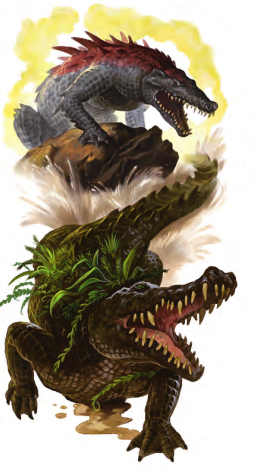
Copyright 2008 Wizards of the Coast This article is part of a series! You can find all of them here.
Crocodiles exist in real life and frequently feature in media such as nature documentaries, so if you’re reading this you probably already know what they look like. For a long time everyone thought crocodiles were the closest thing you could get to dinosaurs in the modern day, then they discovered that honor belonged to chickens.
The Monster Vault has stats for a “mundane” crocodile in its animal appendix, and the Monster Manual has two fantastic varieties that are more likely to attack adventurers.
Crocodile
This is the one from the Monster Vault. Since it’s in the appendix and not in a full entry, there’s no lore at all. The mundane crocodile is a Medium Natural Beast (reptile), and a Level 3 Soldier with 46 HP. It has low-light vision, a land speed of 4 and a swim speed of 8. It attacks with a bite that does damage and grabs on a hit, and once it’s grabbed someone it can inflict automatic damage on the victim as a standard action. Short and simple. The grab has an escape DC of 13.
We’ll have to fall back to the standard cliches here: they live in lakes, rivers and swamps and hunt by looking like floating logs until something small and meaty gets within charge range. I imagine mundane crocs won’t go out of their way to attack PCs, but might become violent if they feel threatened or are protecting their young.
Visejaw Crocodile
The first fantastic variety from the Monster Manual. Its scales are grey and a red streak menaces with leathery spikes on its back. The visejaw crocodile is a Large Natural Beast (reptile), and a Level 4 Soldier with 58 HP. It has a ground speed of 6 and a swim speed of 8, and its attacks are pretty almost identical to those of the mundane crocodile.
This crocodile’s jaws don’t inflict automatic damage on grabbed targets, but instead make an attack against Fortitude with half damage on a miss. Fixing the damage bugs on this one would also involve dropping the attack roll and making this damage automatic.
Feymire Crocodile
The platonic ideal of a man-eating crocodile. This Huge Fey Beast (reptile) is so good at looking like a log in a bog it actually has vegetation sprouting from its back, and carries the swamp with it wherever it goes. It’s native to the Feywild but also inhabits the world in places where the two planes touch. Interestingly enough it seems to be able to sustain itself by putting down roots, but it obviously prefers the tender meat of adventurers.
The feymire crocodile is a Level 10 Elite Soldier with 216 HP. That bit about it carrying the swamp with it is not an exaggeration! It has a Feymire aura that makes the ground in a 2-square radius from itself difficult terrain for enemies. It also has Regeneration 5, which can be temporarily shut down with fire damage. Yes, it has the same staying power as a troll. It’s also nearly as smart at Int 5, though being a Beast it’s not sapient as such.
Other traits include low-light vision and the expected swim speed of 8. It attacks with stronger versions of the grabby bite and clamping jaws from the other two crocs, and needs the same fix as the visejaw. In addition, if it grabs a bloodied Medium or smaller creature, it can try to Swallow it. This is an attack against Fortitude; if it hits, the target goes into the croc’s gullet, becoming dazed, restrained, and taking ongoing 10 acid damage until free.
I used to think restrained meant you couldn’t take any actions, but a restrained target can still make attacks at a -2 penalty. The Feymire Crocodile’s Swallow ability places a further restriction: the swallowed victim may only make basic attacks against the insides of the croc. Yes, you still have to beat its defenses. Not much of a problem for the fighter or warlord, but nearly everyone else is in trouble.
Encounters and Final Impressions
The suggested encounter in the Monster Manual is a party of lizardfolk and their visejaw pet. I imagine the feymire crocodile would be the sort of animal to hang out with trolls or bog hags.
The feymire croc is definitely my favorite of the lot. It gives me a nice fairytale vibe.
subscribe via RSS