Posts
-
Let's Read the 4e Monster Manual/Vault: Colossus
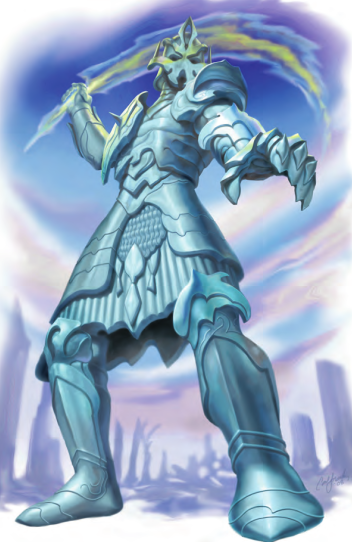
Copyright 2008 Wizards of the Coast This article is part of a series! You can find all of them here.
One of the most famous D&D “monster ladders” is the one composed of golems: humanoid constructs built to do the bidding of powerful spellcasters. They’re generally inspired by mythology, with the name for the category being taken from the legend of the Golem of Prague.
Due to the vagaries of alphabetical ordering, the first “golem” our reading of the Monster Manual hits is the one standing on the very top rung of that ladder: the Colossus.
Obviously inspired by the Colossus of Rhodes, who was said to animate when its city was threatened by invasion, colossi are enormous animated statues, often made in the image of a god or another mighty entity. Like their smaller relatives, they exist to obey their creators. Of course, not just anyone can create one of these babies - it requires an epic ritual most commonly known to entities such as demon lords and divine exarchs.
The name of the single stat block given to us by the Monster Manual hammers the point home: it presents us with the Godforged Colossus. There are no colossi on the Monster Vault.
The Godforged Colossus is a Huge Immortal Animate (construct). That’s smaller than I thought it would be, but then again so was the Colossus of Rhodes. Constructs are not affected by effects that specifically target living creatures. They also don’t sleep, breathe or eat, and are immune to disease and poison.
This specific construct is a Level 29 Elite Brute with 662 HP. In addition to the standard construct immunities listed on its stat block, it’s also immune to fear and has Resist 30 to both psychic and force damage. It strides across the land at speed 10. As a golem-adjacent creature, it’s Unaligned, doesn’t speak, and has Int 4.
As its basic attack the Godforged Colossus wields a weapon made of pure force. It does an amount of force damage that’s surprisingly close to that it should be even without the math fix. A hit also triggers a relatively inaccurate secondary attack against Will, doing another bit of psychic damage and stunning the target for a turn on a hit. I feel this is a bit of unecessary complication; to fix it, add the damage of the secondary attack into that of the primary and make the whole lot “force and psychic”. I don’t think anyone who isn’t another colossus resists those two simultaneously. You could leave the secondary attack for the stun effect, or replace it with the push from the Defensive Strike (below).
The monster’s other standard actions are as follows: it can attack at a range of 20 with a Force Missile, which targets Reflex, does force damage, and pushes 5 squares on a hit. Once per encounter it can unleash the Voice of the Demiurge, which targets the Will of all enemies within a Close Burst 10 (!), doing respectable psychic damage and stunning for a turn on a hit.
Finally, as a reaction whenever someone moves adjacent to it, it can use a Defensive Strike that recharges on 5-6. On a hit it does all the damage of the basic attack (some force, some psychic) and allows a secondary attack against Fortitude that on a hit pushes the target 5 squares, knocks them prone, and dazes (save ends).
No specific mention is made of the material used to build this colossus, though judging by the resistances I’d say it’s actually made of pure force tinted with the thoughts of the god who built it.
Encounters
The book says a colossus might be a city’s greatest guardian, the idol of a god that animates to punish defilers, or a pair of great sculptures acting as guardians of another creature’s lair.
The first one is our old buddy Rhodes; the second brings to mind that demon statue from the cover of the 1e PHB; and the third is surely the sphinxes from the Neverending Story. The last boss from Shadow of the Colossus (the Tower) also fits here.
The first example encounter is level 28, a godforged colossus and 4 dragonborn champions. Tiamat or Bahamut… or maybe both, with equal teams fighting each other! Does the level 23 party dare to interfere?
The second is level 29, 1 colossus, 3 sorrowsworn reapers, and 2 shadowraven swarms. Woe be unto those who trespass upon the fane of the Raven Queen.
Final Impressions
I’m a fan of colossi, particularly of those whose shadow you can stand under. They make me wish D&D in general had more giant-climbing rules.
-
Pathfinder Iconics in Dungeon Fantasy: Lirianne
This is a bonus article in a series! You can find the rest of them here.
The concept of firearms is a bit thorny in D&D and adjacent games. Some people like the concept, others feel it doesn’t fit the “medieval” idiom for mechanical or flavor reasons.
Pathfinder tries to address this by moving everything gun-related to its own class: the Gunslinger, which came out in its Ultimate Combat supplement. The presence or absence of that class in a campaign acts as a proxy for the presence or absence of guns1.
Dungeon Fantasy ended up going along a similar route - while it leaves guns out of its equipment list entirely in DF1 and DF: Adventurers, it ended up publishing the Musketeer professional template in Pyramid #3/36, along with a goodly amount of setting-appropriate guns.
With the material from that issue, we have what we need to stat up the star of this post: Lirianne the Gunslinger! Here she is:
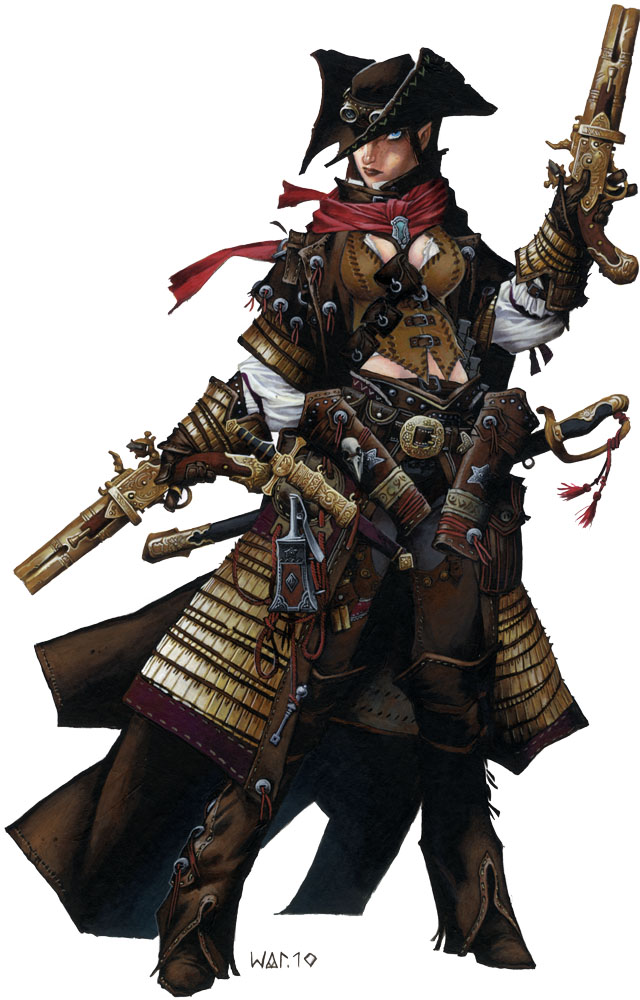
By Wayne Reynolds, Copyright 2012 Paizo Publishing Like all of Wayne Reynold’s Iconics, this design is a bit busy, but I like the tricorne hat. Looking at her bio here and her stats here, we can learn the following:
-
Lirianne comes from the city-state of Alkenstar in the Mana Wastes, a region whose ambient magic takes the form of deadly storms that produce mutated abominations. This hostile environment forced its people to innovate, advancing their technology to the level where black-powder guns are common.
-
She was the middle child of three, their father a marshal and their mother an elf who left while they were young (because for a Pathfinder elf, ten years and three children is a “fling”). She spent much of her childhood devouring pulpy tales of adventure and dreaming of starring her own.
-
Growing up to follow in her father’s footsteps, Lirianne got caught in a mana storm and teleported thousands of miles north to the mostly-medieval continent of Avistan - where all those pulpy tales took place. Now she travels as a wandering do-gooder, in no particular hurry to return home.
-
Lirianne wields two single-shot pistols, which she can load quite quickly due to Pathfinder’s generous rules for such. Her class abilities allow her to perform quite a few tricks with these guns.
The GURPS version below uses the Musketeer professional template and the guns from Pyramid #3/36, plus some of the perks from GURPS Gun Fu referenced in that article. Her armor is from DF: Adventurers. I’m also using the Alternate Guns Specialties from Pyramid #3/65.
While her pistol’s base reload time is 20 seconds, she manages to get it down to 3 by using paper cartridges (which halve reload time) and by having 3 levels of Quick-Reload (which cut that further by 75% to a minimum of 3). That’s the fastest she can get by the book, but I wouldn’t be averse to allowing a fourth level of Quick-Reload to reduce that time to 1 second, and have her follow the same “quick-firing” rule bow Scouts follow.
Alternatively, you could introduce more modern guns (like revolvers or lever action rifles) that would allow for a higher rate of fire. Those would make for some fine loot!
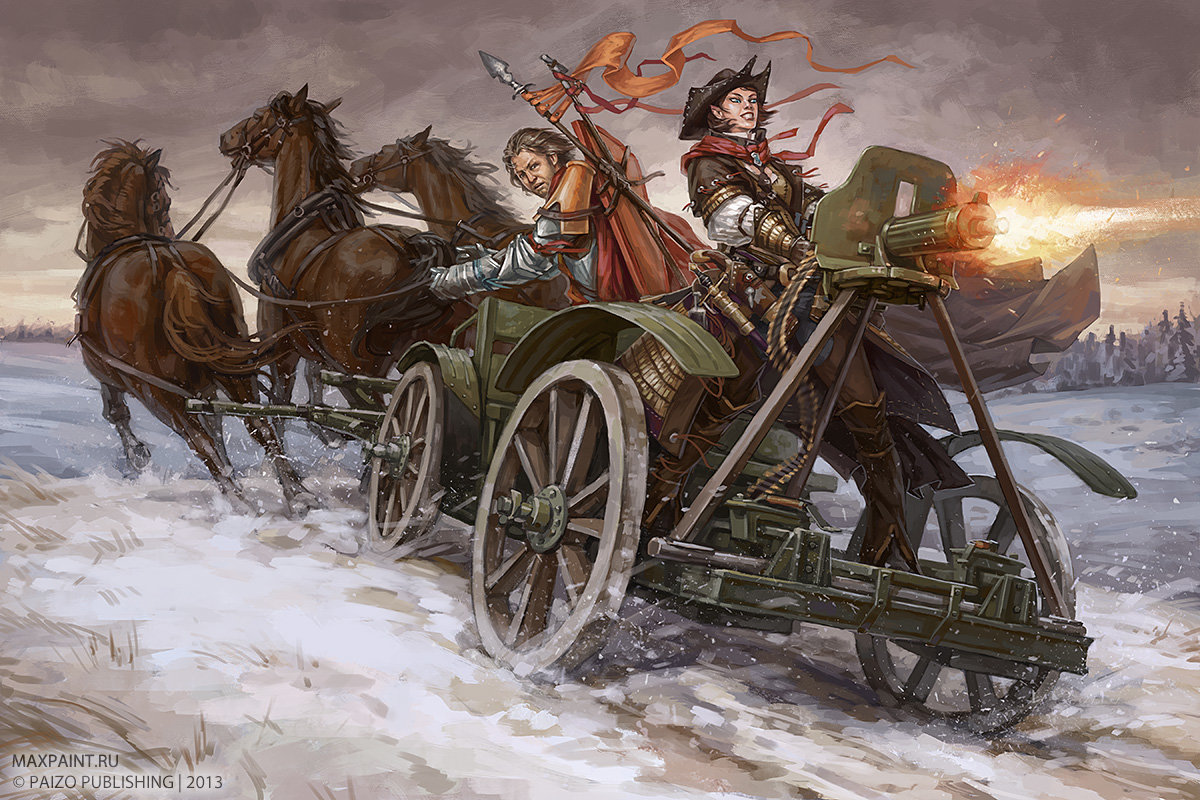
Fine loot indeed! (by Ekaterina Burmak) An Expedition to the Barrier Peaks-like mix of fantasy and ultra-tech would be extra-awesome for her since the full Gunslinger advantage would allow her to shoot sci-fi rayguns as well as she does black powder pistols.
Other highlights include Lirianne’s relatively high Acrobatics skill (good for acrobatic dodges and daring movement), and the other perks which allow her to shoot a gun in each hand without having to drop either for reloading or doing almost anything else. She is a bit deficient in social skills, so that might be something to shore up later with earned points. Other good destinations for earned points are more Guns (Pistol) and Acrobatics, as well as gun perks and the Behind the Back power-up.
Lirianne, 249-point Half-Elf Musketeer
ST 13 {30}; DX 15 {100}; IQ 10 {0}; HT 13 {30}
Damage 1d/2d-1; Basic Lift 16.9kg; Will 10; Per 12 {10}; FP 13; Basic Speed 7.00 {5}; Basic Move 7.
Advantages
- Akimbo (Pistol) {1}
- Combat Reflexes {15}
- Daredevil {15}
- Enhanced Dodge 1 {15}
- Fastest Gun in the West (1) {1}
- Gunslinger {25}
- Magery 0 {5}
- Off-Hand Weapon Training (Pistol) {1}
- Quick Reload (Black Powder Weapons) 3 {3}
Disadvantages
- Charitable (12) {-15}
- Code of Honor (Musketeer’s ) {-10}
- Curious (12) {-5}
- Overconfidence (12) {-5}
- Social Stigma (Half-Breed) {-5}
- Weirdness Magnet {-15}
Skills
- Acrobatics (H) DX {4} - 15
- Armory (Small Arms) (A) IQ-1 {2} - 10
- Broadsword (A) DX+1 {4} - 16
- Carousing (E) HT+1 {2} - 14
- Climbing (A) DX {2} - 15
- Fast-Draw (Ammo) (E) DX+1 {1}2 - 17
- Fast-Draw (Pistol) (E) DX+1 {1}2 - 17
- First Aid (E) IQ {1} - 10
- Guns (Longarm) (E) DX+1 {0}3 - 16
- Guns (Pistol) (E) DX+5 {16} - 20
- Hiking (A) HT {2} - 13
- Leadership (A) IQ {2} - 10
- Observation (A) Per {2} - 12
- Riding (Horse) (A) DX-1 {1} - 14
- Scrounging (E) Per {1} - 12
- Stealth (A) DX-1 {1} - 14
- Survival (Plains) (A) Per-1 {1} - 11
- Swimming (E) HT {1} - 13
- Throwing (A) DX {2} - 15
- Wrestling (A) DX+A {2} - 15
Loadout
- Pistol x2 [Torso]: From Pyramid #3/36. $400, 3kg.
- Small Pouch [Torso]: Holds 1.5kg. $10, 0.1kg.
- Powder and Shot, 100 shots [Pouch]: Paper cartridges. From Pyramid #3/36. $50, 0.5kg.
- Broadsword [Torso]: Damage thr+1 imp or sw+1 cut, Reach 1. $600, 1.5kg.
- Light Leather Suit [Head, Torso, Limbs]: Riding leathers and a jaunty tricorne hat. DR 1. $150, 9kg.
- Backpack, Small [Torso]: Holds 20kg of gear. $60, 3kg.
- Wineskin [Backpack]: Holds 4L of liquid. $10, 0.13kg.
- Blanket [Backpack]: $20, 2kg.
- Rope, 3/8” (10m) [Backpack]: Supports 150kg. $5, 0.75kg.
- $195 in coin.
Combat
With backpack: Light Encumbrance, Move 4.
Without backpack: No Encumbrance.
Defenses assume No Encumbrance.
- Defenses
- Dodge: 12
- Parry (Sword): 12
- DR: 1
- Attacks
- Pistol (20): Acc 1, Damage 2d-1 pi+, Range 75/450, RoF 1, Shots 1 (3); Bulk -3, Rcl 2.
- Broadsword (16): 2d cut or 1d+1 imp, Reach 1.
-
-
Let's Read the 4e Monster Manual/Vault: Chuul
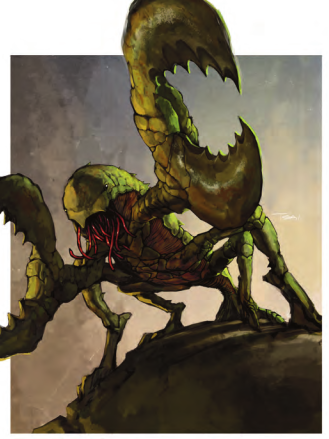
Copyright 2008 Wizards of the Coast This article is part of a series! You can find all of them here.
Chuuls are large lobster-like beings with yellowish shells, a semi-upright posture, and a mass of little red tentacles dangling from their faces. They’re a mainstain of the Underdark in every edition they appear in, including this one. They didn’t appear on the Monster Vault, but later on they got a Monster Vault-style update in Dungeon #192, so we’ll be looking at that as well.
Chuuls are Aberrant Magical Beasts (aquatic). We saw the aquatic keyword already, back when we read about aboleths, but I don’t think I explained it. Aquatic creatures suffer no penalties for operating underwater and usually have a swim speed. They also get bonuses when fighting non-aquatic enemies underwater.
The Lore
As magical beasts, chuuls are sapient. They’re not very smart, with Int 4, but they’re conversant in Deep Speech. They lurk in underwater lakes, still pools and other sufficiently large bodies of stagnant water, and emerge to snatch prey with their huge claws. Chuuls don’t care if that prey is sapient, and will eat every single part of their bodies except for the brain, whose taste the creatures dislike. Predictably, this makes them good neighbors to mind flayers, who will use a chuul pool as a dumping ground for brainless bodies.
The Dungeon article adds a bit more lore. Chuuls live in small groups called pods, in bodies of still water large enough to support them. They’ll happily use rivers and seas for long-distance travels, but there’s nothing like an underground lake or still swamp to settle down and raise your kids. These creatures only have two ambitions in life: to be left alone and to eat people. When the first one is frustrated, it means they’re about to satisfy the second.
Chuuls reproduce by laying sacs of slimy yellow eggs, which they protect fiercely. Sometimes they’ll attach these sacs to the bottom of ships or riverboats as a way to help the species propagate further.
As chuuls grow older, they grow bigger and sometimes develop psychic powers. They also mutate very easily, which makes them a preferred subject for mind flayer experimentation, and might give even wild chuuls a few extra interesting traits. Finally, they all share a kind of racial memory. An individual will remember its previous generation very clearly and have a dimmer recollection of the ones that came before. One memory from the dawn of time remains very strong, however: hate humans. Kill them. Devour them.
The Numbers
In both the Monster Manual and the Dungeon article, we get the same two varieties of this monster:
The classic Chuul is a Level 10 Soldier with 109 HP. It’s Large, has darkvision and both a walking and a swimming speed of 6. Its basic attack is a claw whose damage is exactly half of what it should be for its level, but that’s surprisingly okay here because the chuul can make 2 claw attacks per turn despite not being Elite. These do extra damage against immobilized targets.
If both attacks hit the same target, the Chuul will make a attack against the victim’s Fortitude using its face tentacles. This does no damage, but immobilizes on a hit. The tentacles also figure in the Tentacle Net ability, a passive which automatically immobilizes anyone hit by the chuul’s opportunity attacks.
The chuul’s ambush predator tactics make it seem like a lurker, but I guess it doesn’t try to hide again after first emerging, though it prefers to stick to the water. The Dungeon/Monster Vault version has better claw damage, but is still largely the same.
Next we have the Chuul Juggernaut, a Level 23 Elite Soldier with 434 HP that’s either very old or was experimented on by mind flayers. It’s Huge, has ground and swim speeds of 7 and also psychic powers! Psychic Lure is a ranged 10 attack against Will that does psychic damage and pulls the target 5 squares on a hit. The Juggernaut otherwise fights like the classic model, but is much less shy about leaving the water. We’re back to having to fix its damage: as an elite it’s supposed to make two full-damage attacks and not two half-damage ones. This damage fix is exactly what the Dungeon version does, being otherwise identical.
Encounters
The first is level 10, 2 chuuls, a feymire crocodile, and a bog hag. Just to show you these things also live on the surface and associate with people that are not mind flayers.
The second is level 23, a chuul juggernaut and three blood fiends. I got nothing on this one.
Final Impressions
The chuul lore in the MM didn’t exactly spark joy, y’know? The additions from the update make them more interesting in that front. Mechanically they’re solid opposition, as evidenced by the fact that the update didn’t do more than increase their damage a bit.
-
Ravenloft, or How I Started GMing GURPS Iron Gods
In the last post on this subject, I talked about how I accidentally hijacked a D&D 5th Edition game and turned it into a GURPS Dungeon Fantasy game using the old-school Ravenloft module for AD&D. Today, I’ll tell you about how Ravenloft claimed yet another party of ill-fated adventurers.
I don’t think the group actually realized how close they were to winning. It was almost entirely a psychological defeat. The place was scary and unknown, the random encounters hard, and they spent the first couple of sessions treating it like a Diablo dungeon (“run in as fast as possible and kill everything that moves!”). After that, they became overly cautious, retreating to the chapel every couple of fights to spend the night and let those healing penalties fade.
They’d inevitably wake up to a random encounter. No, undead can’t enter the chapel, but those two rust monsters I rolled up that one time sure could! They didn’t wreck any equipment, but they scared the players just the same.
This became the usual pattern of our sessions, and if it kept up the group would end up allowing the monsters to slowly grind them to death. I told them as much, and cautioned them to explore the castle in a more directed and organized manner if they wanted to win.
That led to a rather fruitful session where they moved with purpose and reached the room where Strahd’s maid lived. She pleaded for help and offered to lead them to a stash of treasure in exchange for help in escaping the castle. The PCs agreed.
She led them up the stairs, staying towards the back of the group for safety. When they reached the “treasure room”, the maid sprouted claws and fangs and backstabbed the party, because of course she was a vampire and the treasure was fake.
They managed to defeat the vampire maid without suffering too much damage, and it turned out that all of this happened right in front of the door to the throne room, where I6’s tarot reading told me Strahd himself could be found.
So there they were, mostly unhurt, with a cleric and a paladin in the party, in possession of both the Icon of Ravenloft and the Sunsword, literally at Strahd’s doorstep. What did the PCs do? They ran away! The rest of the session was them finding their way to the outside, still at the second floor, levitating over the walls and making it back to Barovia.
We ended the session there, and we wouldn’t get to play another. One of the players outright told me Ravenloft was too hard and he wanted something else, so I offered to switch to Iron Gods the next session with a fresh batch of characters. No one else complained or offered a dissenting opinion, so I guess they agreed. Ravenloft had claimed another party, not by killing them but by breaking their spirits.
I’m pretty sure it was Ravenloft, too, as opposed to shitty GMing on my part. The Iron Gods game is still ongoing and the players look forward to each session, so I must be doing something right.
When I next write about this, we’ll see how that Iron Gods game started.
-
Let's Read the 4e Monster Manual/Vault: Choker
Copyright 2008 Wizards of the Coast This article is part of a series! You can find all of them here.
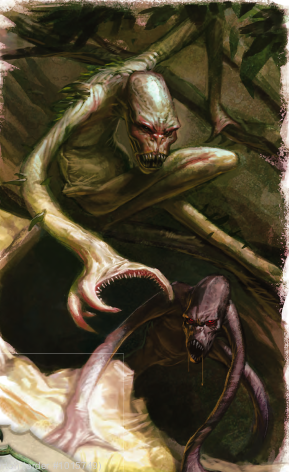
Chokers are humanoid creatures with somewhat elongated heads and very long rubbery arms ending in hands whose palms seem lined with sharp barbs. To better choke you with, obviously. They’re only listed in the Monster Manual, but they do get an update in Dungeon Magazine issue 196. This update is part of a series of articles that are considered “missing pages from the Monster Vault”, so I’ll cover them here as well.
The Lore
The MM doesn’t offer much in the way of choker lore, but the Dungeon article remedies that nicely.
Chokers love the Underdark but may be found in other favorable environments closer to the surface, particularly near sapient settlements. You see, they prefer hunting sapient prey, because in addition to being good eatin’ they often carry the shiny baubles and jewels which these creatures love to collect and occasionally fondle. Their arms are so flexible because their internal structure is composed of many knobby cartilage joints.
Chokers typically live and hunt alone, because they’re so antisocial they see even other chokers as prey. They gots shinies and meat on them just like anybody else, precious. These creatures are however just smart enough to accept shiny bribes in exchange for not eating someone, and sometimes drow or other underground dwellers can hire them on that basis. Drow in particular don’t like to do it very often, because they find chokers too unpredictable.
The Numbers
We have two varieties of choker statted up here, both Unaligned and possessed of Int 6. I suppose this could mean not every choker the party meets is a bandit, but I don’t think I ever saw any published friendly chokers.
Cavern Choker (Monster Manual)
This is a Small Natural Humanoid and a Level 4 Lurker with 42 HP. It has darkvision, a ground speed of 6, and a climb speed of 6 with spider climb.
Its basic (and main) attack is the Tentacle Claw. Its Reach 2 is impressive for a Small creature, and in addition to doing damage it also automatically grabs the target on a hit. Grabs in 4e prevent the victim from moving, but not from performing other actions. They can use an action to attempt to escape the grab. For monsters without a listed escape DC, such as these chokers, the test is either the victims Acrobatics vs. the monster’s Reflex, or Athletics vs. the monster’s Fortitude. In this specific case the target takes a -4 penalty to the roll to escape.
Some monsters have specific things they can do to grabbed victims. For example, the cavern choker can use its standard action to choke a grabbed victim, an attack which deals the same damage as the claw but targets Fortitude and has a better chance of landing. When the choker is targeted by an attack against its AC or Reflex, it can use an immediate interrupt to interpose the grabbed victim, causing the attack to target them instead. This doesn’t work if the attack comes from the victim itself, obviously.
The choker also has a Chameleon Hide, which it can activate as a minor action to gain concealment for a turn. It can’t use this while grabbing someone, but it’s useful for it to retreat using its considerable Stealth.
The tactics write themselves - the choker will lurk on a ceiling and grab someone when they pass by, while its less sneaky buddies distract the rest of the party.
Cavern Choker (Dungeon)
The Cavern Choker from Dungeon remains a level 4 lurker with 42 HP. The main change from the MM is a significant upgrade to its Chameleon Skin, which now gives full concealment and is always on as long as the choker doesn’t have anyone grabbed.
The Choke attack is gone - now the Tentacle Claw does 10 ongoing damage to grabbed targets until they escape. Escape attempts now have an explicit DC of 21, which is about the same as you’d get under the old rules. Body Shield has had its text changed and clarified. It’s still an interrupt that redirects an attack by someone else to the grabbed victim, but now it only recharges when the choker hits with Tentacle Claw. This means that the monster can only use it once after it grabs a target, making “grab, release on your next turn, grab again” preferable to holding on until the target dies.
Feygrove Choker (Monster Manual)
This Medium Fey Humanoid is a Level 12 Lurker with 91 HP. A different species, or the platonic ideal of the mundane choker? In any case its abilities are quite similar. It has Reach 3 and can grab up to 2 targets simultaneously. When it has 2 grabbed creatures it can choke them both at once; it can use either creature as a shield, but not against attacks made by either grabbed creature.
As an extra surprise, it can use a power named Vine Fetter, which animates nearby vegetation in an Area Burst 3 within 10 squares. It targets the Reflex of enemies in the area and restrains them (save ends) on a hit. This recharges on a 6 and will very likely be the opening move in a fight.
Feygrove Choker (Dungeon)
The exact same set of changes also applies to the Feygrove Choker, which remains a Level 12 Lurker with 91 HP. It can still grab two people instead of just one, so it has more opportunities to use Body Shield. The damage fixes also have much more of an impact on it, since it’s a higher-level monster.
Sample Encounter and Final Impressions
The sample encounter is level 4: a pair of cavern chokers employed by a small hobgoblin war party.
MM Chokers get a “meh” from me. I didn’t find them that exciting. I guess they’re the sort of gimmicky Gygaxian monster you’d expect to find alongside cloakers and piercers, but I didn’t find them appealing outside of that.
I like the additional lore from the Dungeon article, though it definitiely makes it clear that chokers are more monsters than people. The stat updates are welcome too. I’d normally just apply a damage fix to the MM stat blocks and call it a day, but these come with some interesting changes like the boost to Chameleon Skin.
subscribe via RSS