Posts
-
Let's Read the 4e Monster Manual/Vault: Evistro
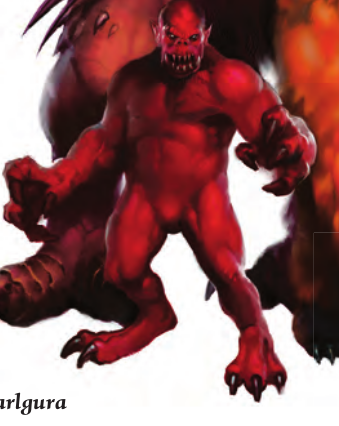
Illustration Copyright 2008 Wizards of the Coast. This is part of a series! Go here to see the other entries.
Evistros are also known as “Carnage Demons”, and they’re all about the carnage. These man-sized demons have red skin, needle-like teeth, digitigrade legs and large black claws on both their hands and feet. In other words, they look pretty much like two-armed Blood Fiends. While 4e Blood Fiends aren’t technically demons, I think the above description already provides sufficient justification for a GM to make them so, should they be so inclined. Evistros are only on the Monster Manual.
Anyway, when left to their own devices these things gather in huge hordes and rampage through whatever plane they happen to be in. Cultists and evil wizards find it easy to summon them into the world, but have a much harder time controlling them or getting them to do anything other than rampaging. Particularly inept summoners are often the first victims of their summoned evistros.
Carnage Demons are Medium Elemental Magical Beasts, and Level 6 Brutes with 90 HP. This means they are likely some of the first demons a PC party will run into during their careers. They charge at you with Speed 6, and have variable resistance 10 (1/encounter). They can’t see in the dark at all, so you have that going for you if you meet one in a dark alley.
Their basic attack is a claw, and they also have a slightly weaker bite they can use as a minor action on a bloodied target. They also have a passive ability called Carnage: if the demon has an ally adjacent to its target, it gains +1 on the attack roll. The bonus becomes +3 if that ally is also a carnage demon.
As it happens with a lot of monsters in this book, the evistro’s tactics write themselves: these demons always come in bands; they charge all at once, focus on a single target, and tear it to pieces. Rinse (in blood) and repeat forever. Quite fitting for an Int 5 demon.
The two suggested encounters are both level 6. The first is 3 evistros and 2 gnolls, which makes sense because their temperaments match perfectly. The second is 4 evistros and one harpy, which is a bit more puzzling. Is the harpy a demonologist?
I was totally unimpressed by these things when I started reading the monster entry, but now that I’m through I think they’re kinda cool as an introduction to demon opponents. They just need the standard damage fix and you’re good to go.
At higher levels, you can make them into minions and have dozens of the things swarming all around the battlefield as the party tries to fight their more powerful demon bosses.
-
Let's Read the 4e Monster Manual/Vault: Barlgura
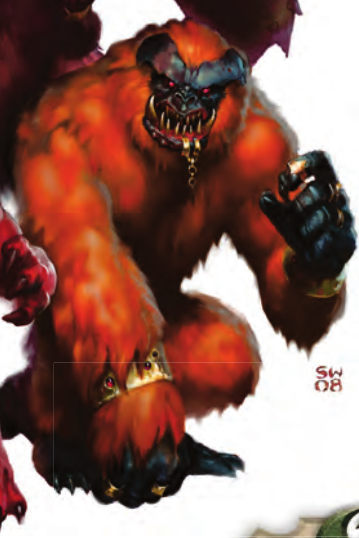
Illustration Copyright 2008 Wizards of the Coast. This is part of a series! Go here to see the other entries.
We continue our tour of the Abyss with the Barlgura, which looks basically like a demonic orangutan with wicked claws and fangs. I guess these have been part of D&D for a while, but my first contact with them in published material was the excellent adventure Heathen, from Dungeon 155, which (spoilers!) featured a solo version of the barlgura as the ultimate villain.
The lore for them is a bit sparse, but we do get a bit saying they’re favored by Demogorgon and their presence can be a sign that a cult of that demon lord is active in the area.
These are only on the Monster Manual: the Demon entry on the vault concerns itself strictly with Paragon-or-higher-tier opposition.
The barlgura is a Large Elemental Beast (demon), though I believe it was mistyped and should be a Magical Beast since it’s sapient. It’s still not very smart, at Int 6. Anyway, it’s a Level 8 Brute with 108 HP.
Balrguras have low-light vision and variable resistance 10 (1/encounter). They have ground and climb speeds of 8. They attack with a slam that’s kinda weak by itself, but since they can make two of those despite not being elite their damage lines up with the expected for their level. When bloodied, it lets out a Savage Howl as a free action, giving itself and any allies within 5 squares +2 to all attacks for a turn.
This is not a complicated monster: it will charge ahead and try to pummel the closest victim with its simian fists.
We get two suggested encounters for them:
-
Level 9, 1 barlgura and a mixed party of 7 gnolls.
-
Level 11, 4 barlguras, 2 minotaur warriors, and 1 minotaur cabalist.
So despite being favored by Demogorgon, they can also be found along cultists of Yeenoghu and Baphomet. What are you gonna do, tell the 10-foot orangutan from the Abyss it can’t do that?
Final Impressions
I would probably not have given these apes a second thought if it hadn’t been for Heathen. If you’re looking for a positive example of early 4e adventure writing, you can’t go wrong with that one. It can easily be turned into a mini-campaign, and is certainly leagues above Keep on the Shadowfell.
-
-
Let's Read the 4e Monster Manual/Vault: Balor
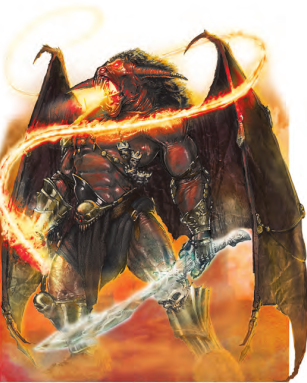
Illustration Copyright 2008 Wizards of the Coast. This is part of a series! Go here to see the other entries.
The Monster Manual lists demons in alphabetic order, and the Vault lists them by level. Since we’re using the Monster Manual as our guide here, let’s examine them alphabetically. Doing this means our first demon is the one right at the top of their “monster ladder”: the Balor.
Let’s be real here: Balors are Balrogs. They were even named Balrogs back in the oldest days of D&D, before the Tolkien estate complained. They look like towering red-skinned humanoids with horrible fanged and horned horse heads, shaggy black manes, and bat wings. They wield huge flaming swords and whips. So yeah, Balrogs.
Here Balors command large hordes of lesser demons, who all fear being torn apart by them. Balors often answer directly to the demon lords in turn, though some of them stake out some territory of their own to rule as princelings, answering to no one. You can sometimes find balors bound against their will to ancient places in the deepest reaches of the natural world, just waiting for some fool of a Tûk to wake them up.
Since we have a whole post just for them, let’s discuss the MM and MV versions separately!
Balor (Monster Manual)
The Balor is a Huge Elemental Humanoid (demon). Anything with the “demon” keyword is officially a demon, and also doesn’t need to sleep. It’s also a Level 27 Elite Brute with 624 HP and higher defenses than its role and level would indicate. In combat they like to focus on a single opponent to the exclusion of all else - yes, they’ll trip your defender’s mark punishment like no one else, but they can take it. These demons very rarely retreat. So if you were wondering why the PCs would ever need access to their own colossus ally, here’s your answer.
Balors have truesight 6, are immune to fear, have Resist 40 fire and Resist 20 variable (3/encounter). That last bit means the balor can change what element that resistence 20 applies to as a free action up to 3 times per encounter. Variable resistance is a demon signature trait in 4e, and I prefer it over having to memorize that long list of resistances and immunities from previous editions. It also prevents PCs from just loading up with sonic damage and ignoring all of that as well.
It also has a Flaming Body: an aura 2 that does 10 fire damage to any enemy that starts its turn inside it. When the balor is bloodied, the aura’s size increases to 3 and the damage increases to 20.
The balor walks with Speed 8 and flies with Speed 12 (clumsy). It would have some trouble taking off midair if Gandalf threw it off a bridge.
Balors fight with a sword made of lightning (range 3) and a whip made of fire (range 5). The sword is its basic attack and does lightning damage with the High Crit property. The whip targets Reflex and does both instant and ongoing fire damage. The monster can attack with both in a single standard action, and the “tactics” section says it will use its action point to attack again as soon as it hits the same target with both weapons. Both of them suffer from the usual math bugs.
As a free action the balor can call upon its Demonic Accuracy, which allows it to reroll a missed attack with a +5 bonus to hit. When it dies, it explodes, subjecting everyone in a close burst 10 to an attack against Reflex that does a somewhat underwhelming 7d10 fire damage, half on a miss.
As you’d expect, Balors are Chaotic Evil. They speak Abyssal and Common and are trained in Perception, Bluff, Insight and Intimidate. Their Int is 12, which is pretty good but not “mastermind” level. Just goes to show you brawn is more valuable than brains when it comes to rising through the ranks of the Abyss, such as they are.
Balor (Monster Vault)
The Monster Vault balor is also a Huge Elemental Humanoid (demon) and a Level 27 Elite Brute. Its defenses are in line with its role and level, and it has 622 HP.
While the MV Balor maintains the Flaming Body aura, all of its other passive traits are pretty different. It replaces truesight 6 with blindsight 6 and darkvision, which are more useful when you think about it. Its fire resistance is down to 20, but it keeps the variable resistance to other elements. This is now listed among its Triggered Actions, at the end of the stat block, which tripped me up for a second.
The damage of its Death Burst actually went down, from 7d10 to 6d10, but it more than makes up for this with the damage of its other attacks. The sword went from 2d10+10 to 6d10+11 while still being High Critical. That’s 7d10+71 lightning damage on a critical! The whip underwent a more modest increase (3d8+5 to 2d10+10), but its ongoing damage also went up from 5 to 15. The MV Balor can still attack with both weapons using a single standard action.
It also gains a new attack named Beheading Blade, an encounter power that recharges when it’s bloodied. It’s an attack with the sword that does around 30% more lightning damage than the basic version, crits on 15-20, and is also High Critical. Yikes!
Final Impressions
The Balor definitely looks like something that was on the level of a demigod before it was corrupted by evil. I remember that balors in previous editions had tons of spell-like abilities that ended up being its main way of fighting, but it feels like 4e did a good job of making them impressive physical threats like they’re supposed to be.
The Monster Vault update is hands-down the best of the two, so you should definitely use that if you have both books. It’s actually punching a bit above its (already impressive) weight class in terms of damage.
Both versions even have somewhat decent ability to counter ranged attackers, since their own attacks have a very long reach. Plus nothing prevents it from bringing in some artillery support.
I notice these 4e stat blocks lack the infamous ability to summon other demons, which is understandable because accounting for it when building encounters was a big hassle. If you want the flavor of it, though, you can simply build an encounter with a balor and several other demons and describe the others as being summoned when the fight starts.
Speaking of encounters, the sample one in the MM is level 26: one balor, 1 thunderblast cyclone elemental, and 2 efreet pyresingers. It’s likely these two efreet wizards have managed to bind a balor, because I can’t really see the relationship going the other way.
-
Let's Read the 4e Monster Manual/Vault: Demon
Strap yourselves in, because we’re in for a huuuge multi-entry. So huge, in fact, that this post is just an introduction to it, and each individual demon will get their own.
To understand the what 4e demons are like, we have to talk a bit about the cosmology of D&D 4th Edition, which is significantly different than that of previous editions.
Fourth Edition’s cosmology has been nicknamed the World Axis, because it’s more, well, vertical than the wheel-shaped Great Wheel of earlier editions. You have the World at the center, with its fey and shadow echoes to either side. You have the Astral Sea above, and the Elemental Chaos below. We’re focusing on that last one here.
The concept of the Elemental Chaos is that you take all the elemental planes which used to be separate and make them the same place. It’s the natural home of both traditional elementals and what used to be called “quasi-“ and “para-“ elementals back in the AD&D days. It’s also the home of the Primordials, titanic elemental beings who came into existence at the dawn of time and decided to create the world just for kicks. They would eventually get a bit tired of it, and begin thinking of destroying the whole thing and building something else.
The gods came into existence in a similar way up there in the Astral Sea, and when they saw the world they quite liked it. They went to war with the Primordials to stop them from unmaking the world - angels and archons, which we already saw, were the rank-and-file soldiers in this Dawn War.
Now, legend has it that long before even the Dawn War, there was this god named Tharizdun. He saw the other gods and thought it would be swell if he was lord over them all. He roamed to the ends of the universe looking for a way to do that, and somewhere out there he found a tiny shard of ultimate evil. Tharizdun wasn’t a nice fellow even before touching the shard, but after he did that he was completely corrupted.
So he took the shard to the deepest part of the Elemental Chaos and planted it there like a seed. This seed sprouted and swallowed everything around it like an expanding black hole. Everything and everyone in there was completely corrupted. Tharizdun tried to lead an army of corrupted elementals out of that cyst of evil to conquer, well, everything, but the other gods banded together to stop him and seal him up in a place only they knew. They couldn’t destroy the cyst, though, so it remained.
This cyst is the Abyss. The corrupted elementals are Demons. Demons don’t belong in the cosmology the way elementals or even Primordials do. Demons are wrong.
Demons don’t want wealth or power. They have no use for the souls of mortals and don’t care about corrupting them. Demons only want to destroy as much as possible before they themselves are destroyed and reborn in the Abyss to do it again. They only organize through intimidation and brute force, with stronger demons bullying weaker ones into servitude. Visually, they’re all terrifying monsters. The one whose looks are closest to those of a person has six arms and and the lower body of a snake.
The strongest demons are the Demon Princes, primordials who were caught in the Abyss when it formed and were corrupted. They include a lot of the classic “usual suspects” of D&D: Orcus, Demogorgon, Baphomet… There’s also Lolth, a goddess who became kind of an honorary archdemon after she moved into a region of the Abyss called the Demonweb Pits. It’s quite likely the influence of the Seed of Evil has corrupted her as much as it did Tharizdun.
Demon Prince-level baddies get their own separate entries: the Demon entry is for the non-unique monsters beneath them, which can still be quite badass themselves. The next posts will cover these.
The Monster Vault has several demons that don’t show up in the Monster Manual. That’s because these particular demons show up in the Monster Manual 2 and 3! They are: the abyssal eviscerator, the babau and the dretch. Since they do show up on the Monster Vault, I’ll talk about them using information from those later Manuals after I’m done with the MM demons.
-
Let's Read the 4e Monster Manual/Vault: Death Knight
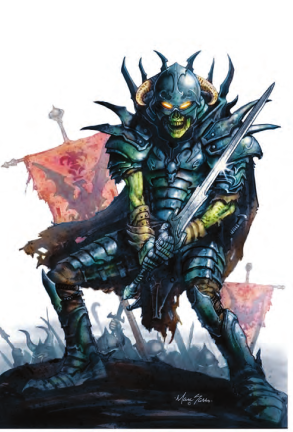
Illustration Copyright 2008 Wizards of the Coast. At last we come to another iconic D&D monster! If you’re following VoidDrifter’s RPG.net thread on the Dragon Magazine monster articles, you can read about the history of Death Knights in the game here. The article was published before the Monster Manual came out, so here we finally get to see what 4e Death Knights look like.
They exist in both the Monster Manual and the Monster Vault.
The Lore
Death Knights share some similarities with liches, in that they’re people who became undead through a profane ritual so they could live forever. The main difference here is that they were great warriors instead of potent spellcasters. The ritual is also a bit different: instead of binding their soul to a phylactery, it binds it to their favored weapon, which becomes known as their Soul Weapon.
Death Knights retain the memories and abilities they had in life, but the ritual distorts their personality into something much nastier than it used to be. Not that they were all that nice to begin with, of course - becoming a Death Knight is a choice and the ritual itself is an extremely evil act. Still, it’s common for their to retain a twisted version of whatever code of honor they followed before. Maybe a Death Knight will wax poetic about how it fell from grace while it guts you.
You can expect them to always be superlative combatants and have great skill at leading troops. Even nonsapient skeletons become more dangerous under the command of a Death Knight.
If you manage to disarm them of their soul weapon, they become dazed and weakened, though anyone else who holds the weapon suffers the same effects. Destroying the weapon is useless - the knight can restore it with a touch. There’s no shortcut to destroying a Death Knight: you have to defeat them in combat. When they fall their soul weapons lose their special properties.
The ritual for turning someone into a death knight comes from Orcus himself. The agents of Orcus seek out legendary warriors who are reaching the end of their lives and tempt them with immortality. Others seek the ritual of their own volition.
The Numbers
“Death Knight” is actually a monster template, the first we’ve ran into here. The way 4e templates work is that they make a regular monster Elite and add a suite of thematic powers. You can technically add two templates together to make a Solo as well, with a few modifications to the process.
The detailed rules for adding HP and defenses from the template to a monster are a bit awkward. In practice, you’re better off making an Elite or Solo monster from scratch with the traits from the templates you want. We get two example Death Knights here, both of which have MM and MV versions.
Death Knight (Human Fighter)
Called just a “Death Knight” by the Monster Vault, this dapper fellow is a Level 17 Elite Soldier. The MM version has 264 HP, but the MV one has 324. In both cases it has darkvision, Resist 10 necrotic, and Vulnerable 10 Radiant, and moves with Speed 5 due to its heavy armor.
Power-wise, there’s quite a bit of ground to cover, so we’ll list things in the MV order, by action type.
The Death Knight has a passive trait called Marshal Undead, which gives any undead allies of level 17 or less within 10 squares of the knight a +2 to all attacks.
It attacks with its Soulsword, which in the MM does a mix of physical and necrotic damage plus extra necrotic damage on a hit. In the MV, it does a whole bunch of necrotic damage and marks the target for a turn even on a miss.
It can also use the sword to perform a Containing Strike, which is like the basic attack above but allows the knight to make a free attack against the target if they try to shift until the end of the next turn. The MM version is single-target, the MV version can target 1 or 2 creatures, making this the monster’s basic Elite multiattack ability.
Oncer per encounter it can use Warrior’s Challenge, which I believe is a Fighter power. It does encounter-power-level damage, pushes the target 2 squares, and marks every enemy within 2 squares of the target at the end of the push.
Finally, on a recharge 5-6, it can unleash Unholy Flames in a Close Burst 2, which does a heap of necrotic damage to enemies and gives 2d6 extra fire damage to the attacks of any undead allies for a turn.
The MM Death Knight also has a Second Wind it can use once per encounter to recover 66 HP. So that’s why tie MM version has less HP!
The Death Knight can punish marked targets like a fighter.
The MV version has one other triggered action: Implacable, which lets it make an immediate save against being marked, slowed, dazed, immobilized, or stunned. This means all of those effects have only a 40% chance of actually landing unless the party can try to apply them multiple times in a turn.
This monster works really well as the commander of an undead unit, and the suggested encounter features just that: Level 16, a death knight, 2 abyssal ghouls, and 2 sword wraiths. Perhaps these were the knight’s old subordinates, made into undead servitors as part of the ritual that transformed it.
Death Knight Blackguard
This MV-only variant is a Level 18 Elite Skirmisher with 338 HP. It mainly shows the advantage of dropping the somewhat rigid structure of templates and making your own monsters from scratch using them as guidelines.
It has the same darkvision and resistances as the classic Death Knight above, and exchanges Marshal Undead with Slayer of the Living, an Aura 3 that slides any enemy who ends its turn in the aura 3 squares. A handy tool for drawing in the squishies while keeping the defenders away.
Its basic attack is still the Soulsword, which here allows the knight to shift 2 squares before or after the attack instead of marking. It can use this attack twice in a turn, against different enemies.
It can also choose to do an at-will Overpowering Attack against 1 or 2 enemies, which slides them instead of shifting the knight.
The Blackguard possesses an Abyssal Blast encounter power that targets Reflex and does a heap of fire and necrotic damage to enemies in a Close Burst 5, or half damage on a miss.
As a minor action, it can use Chilling Glare to make one enemy within 5 squares automatically grant combat advantage for a turn.
And finally, the Blackguard is just as Implacable as the MV Death Knight.
Yeah, keeping any sort of formation while one of these is on the field is a hopeless endeavor. It becomes even more dangerous when paired with a classic death knight and a few other lesser undead, preferably ones that do nasty things if they get combat advantage, which it can give out freely.
Death Knight (Dragonborn Paladin)
This MM-only variant is a Level 25 Elite Soldier with 373 HP (466 if you add the Second Wind). It has darkvision, Resist 15 necrotic, and Vulnerable 15 radiant.
This Death Knight combines many of the powers of the classic model (which come from the template) with a few paladin-like attacks. This means it has the same Marhsal Undead aura and Unholy Flames burst. Being an MM-only monster it lacks Implacable.
Aside from the basic soulsword attack, it can use the Valiant Strike at-will power that gives it an extra +1 to the attack roll per adjacent enemy. It also has a Terrifying Smite encounter power that does extra damage, pushes the target 5 squares and prevents it from moving closer to the knight for a turn.
Its mark power is the paladin’s Divine Challenge, which lasts until the knight marks someone else and does a bit of automatic necrotic damage to targets that flout the mark.
This death knight features in the second suggested encounter of the Monster Manual entry, which is level 24 and has it accompanied by a fell wyvern, a great flameskull and a bunch of abyssal ghoul minions. It’s something you can expect when raiding Orcus’s neighborhood in the Abyss.
I can see why they fixed the paladin’s mark in Divine Power, and why they dropped much of the fiddly bits for adding templates. Not having any multiattack ability makes it a little less effective than an elite monster of its level should be. The lack of Implacable is also keenly felt. This is a bit disappointing since we’re probably looking at someone who had a direct hand in the fall of Arkhosia.
subscribe via RSS