Posts
-
GURPS X-COM: Second Research Phase
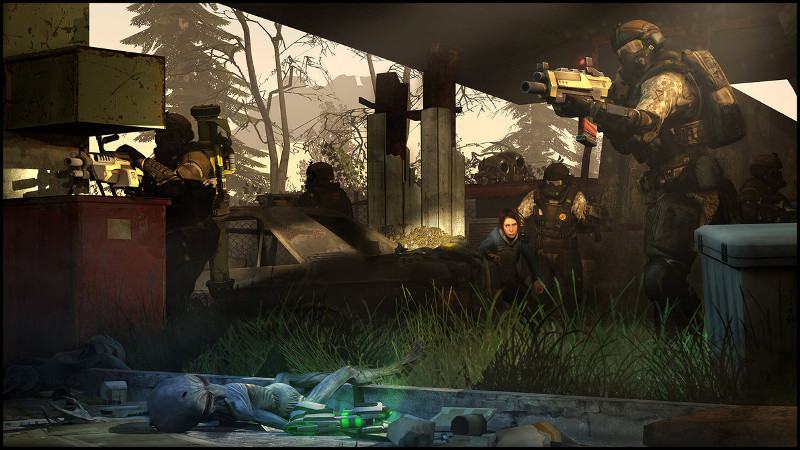
Illustration by AntiMingebag on DeviantArt The intrepid soldiers of my X-COM campaign have just completed their second field op and returned alive but not unharmed. They discovered and explored a huge Forest of Woe in southeastern Brazil, met a new and more dangerous type of enemy, and brought back what seems to be an alien defector.
At this point I once again invited the players to step out of character for a while, and we entered the game’s second strategic/research phase. The bonus event they got this time was a debriefing of the alien refugee, because Sokolov was their head scientist. Had it been one of the others, this would have been a normal research choice and would cost points.
Bonus Event: The Refugee
The alien is around 1.5m tall, and quite skinny. Its body is covered in a dark purple, chitinous carapace, over which it wears clothes. It has four arms and two legs, and moves in a somewhat discomforting and “twitchy” fashion. Its seems to wear a mask, as there is a clear seam between its face and the rest of its head, but this “mask” is soft and warm and almost human-like, and moves like it was a natural face. It’s a strong royal blue in color. The alien’s eyes are yellow with black pupils, and it has a very pronounced nose. This being does not have a gender as humans conceive of the concept.
As a genderless alien who wants to come and meet us, it was inevitable that the refugee would receive the code-name of Ziggy (from David Bowie’s Ziggy Stardust). Despite Dr. Vahlen’s strenuous protests, Dr. Sokolov elected to debrief X-COM’s new guest by personally interviewing Ziggy, since it was capable of communicating in English.
Ziggy’s use of grammar was quite peculiar, and it refused to use the pronoun “I”. Sokolov soon found out the movements of its mouth didn’t match what it seemed to be saying, and recordings of the interview only showed it speaking the same alien language the PCs had heard over their comms multiple times. As a result, the interviews were all transcribed the old-fashioned way, using the services of a stenographer.
Ziggy gave X-COM some basic organizational information on their opposition: they were made up of multiple alien species, some from previously conquered worlds and some engineered for war. The leaders of this force called themselves the Ebon Masters, and arrived on Earth through “gates”. The trees were part of a weaponized, artificial ecosystem it called “The Moon Flower”. Ziggy had been only a civilian clerk in the employ of the Masters, so he wasn’t able to provide much in the way of specific strategic detail.
Ziggy also referred to something called “The One Power” several times, and said none of the species previously conquered by the Masters had such an advanced mastery of it. Figuring that misunderstanding out quickly revealed that the advanced alien technology on display so far was, in fact, magic, and that humans were totally ignorant of it. Ziggy became as fascinated by this revelation as Sokolov was about the existence of magic.
Like the rest of the alien Masters, Ziggy’s look and culture are a mashup of the original Ethereals from X-COM and the devils from the excellent Kill Six Billion Demons comic. It’s the equivalent of a Blue Devil, so low-ranked but quite intelligent. Ziggy also has a conscience, which makes it nearly unique among its species.
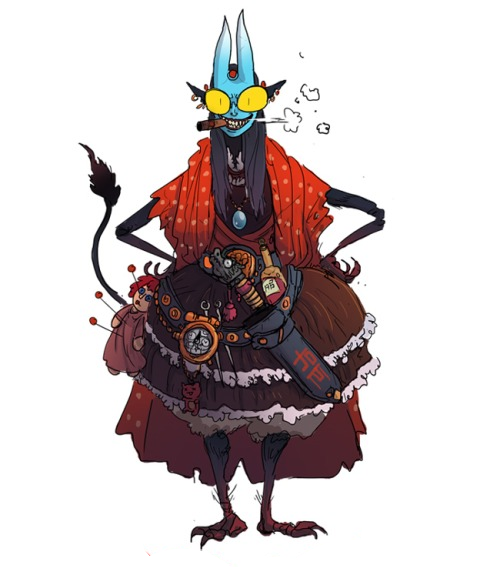
A blue devil from the Kill Six Billion Demons comic. The whole “friendly alien helps X-COM” idea sprung from a My Little Pony fanfic, of all places. That story is here if you’re curious, and though it becomes a bit muddled later on its premise was interesting enough that I decided to recycle it with a more campaign-appropriate alien.
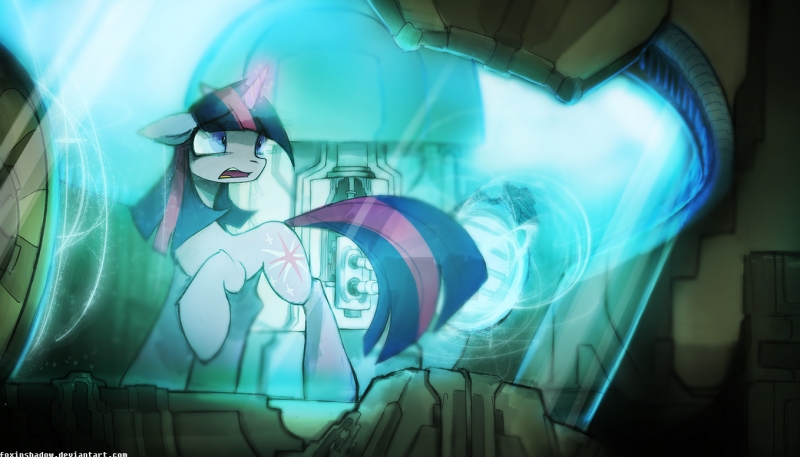
Also I didn't have the heart to replicate this scene. Research Options
This time, the players had 2 research points to allocate. Their options were the following, with the ones in italics being new:
Cutting-Edge Research
- Advanced Medkit (this was Vahlen’s “free” project”) 0/1
- Personal-scale combat drones (this was Shen’s “free” project) 0/1
- Project Stardust (Employ Ziggy as part of the research staff and harness the One Power) 0/2
Alien Artifacts
- Pinnochio (Puppet of Ruin) corpse 0/1
- Rosie (Bakegumo) corpse 0/1
- Alien guns 0/1
- Alien swords 0/1 -Alien Explosives (from grenades/RPG rounds) 0/1
- Black Trees (Study those substantial Black Tree pieces) 0/1
- Red Dust (It’s sprinkled over every alien body and artifact, as you’ve discovered earlier) 0/1
The group discussed this for a while. Two new players had joined the group at this time, and they provided their input as well. In the end, Project Stardust won out. It was the equivalent of researching psionics in the computer games, and it was even more vital here than in the original material.
The One Power: Setting Information
What Ziggy called “The One Power” is the ability to cause direct changes to physical reality by visualizing them in extreme detail and willing them into existence. It’s called that by the Ebon Masters because they never before had encountered a civilization that managed to achieve more than a medieval level of technology without resorting to it.
Ziggy’s description of the theoretical underpinnings of the One Power match a lot of human occult lore, sharing several similarities with Kabbalah and Pythagorean numerology among other sources. Manifesting a given effect requires modeling it through an equation in the alien numerological system, and then repeatedly solving it in one’s mind. Using it in practice requires more than an active imagination and skill at mathematics, however!
Medical scans show Ziggy’s body is permeated by an extensive network of circuit-like metallic filaments, made from the same materials detected in the tree fragments. These are naturally occurring in every species capable of using the One Power, according to the alien. These “circuits” act as a conduit for it, and take on some of the work of processing those mental equations.
Once X-COM’s scientists and engineers figured out the basics of how all of that works, they realized it wasn’t much different from modeling a physical process in software. With this knowledge in hand, they were able to separate the steps of building the necessary model (“compilation”) and running its simulation enough times to manifest the effect (“execution”). Sokolov didn’t like calling these things “spells”, so he named them “metatronic loops” to make the whole thing sound more scientific.
The One Power: Game Mechanics
Behind the scenes, the One Power as used by the aliens is basically Ritual Path Magic from GURPS Monster Hunters 1: Champions and GURPS Thaumathology: Ritual Path Magic. The main break from those supplements is that the aliens are able to use it to create permanent items and constructs, which is where all the “TL 4+n” stuff comes from.
The bit about naturally occurring “magic circuits” is swiped from the Fate franchise; their game effect here is to allow a character to buy Magery (Ritual Path) and Ritual Adept. Humans in this game lack these circuits and so can’t use “classic” RPM at all. However, this discovery allows them to build similar circuits into computers, giving them access to the Technomagic variant from GURPS Monster Hunters 5: Applied Xenology.
The immediate game effect of this discovery was to add a new item to the group’s master equipment list: the Metatronic Device, a hardened, custom-made PDA that could store one metatronic loop in its memory and run it at the tap of an icon. The thing’s processor would burn out after the effect ended, but it would be possible to carry several of them into the field. The first loop available was one that completely protected everyone in a given radius from the Hostage Effect (AKA psychic numbness) for up to 6 hours.
Players can also elect to learn ritual magic paths from now on - once they do, they’ll be able to develop their own loops using the top-of-the-line setup at X-COM HQ and take them into the field using the PDAs. For now they’re limited to what the NPC scientists can make.
Another, less visible effect of the discovery was to give X-COM access to the magical side of every other discovery they made through research! This is why researching the One Power was so vital - every possible countermeasure for the Dreams of Ruin involves a healthy dose of magic, particularly the higher-end ones. They couldn’t arrive at any of those solutions without this knowledge.
Once the choice was made and the effects explained, I took a little time to come up with their next mission. In the next update to this series, we’ll begin covering Operation SNAKE OIL.
-
Let's Read Hell's Rebels: In Hell's Bright Shadow, Part 2

Welcome to another installment of “Let’s Read Hell’s Rebels!” You can find links to the whole series in its project page. This time we’ll go through Part 2 of its first adventure. It’s titled “Rebuilding the Ravens”.
As always, we’ll be taking a look at how our hypotethical party consisting of Valeros, Lem, Merisiel and Kyra would fare here as GURPS Dungeon Fantasy delvers.
“Adventure Path” style modules have a reputation for being extremely railroady. Part 1 certainly lives up to that, since it consists of a series of tightly scripted scenes and two back-to-back dungeons where the PCs have no real alternative other than delve right in.
In Part 2, however, we leave the rails behind for a bit! It starts by stating that the PCs plus Rexus and Laria are the group best-positioned to offer organized opposition to Barzilai Thrune in the whole of Kintargo. It goes to show how thorough the guy was in killing everyone else, I guess, since right now our heroes have a snowball’s chance in Hell of taking him down. Before they can have a shot at The Barzilai, they need to expand the newborn Silver Ravens into a proper rebel army and consolidate support for their position.
The PCs are expected to engage with the custom rebellion rules at this point, which means this part of the adventure will play out over multiple weeks of game time and will largely consist of PC-initiated actions and their consequences as they focus on recruiting agents and gaining supporters. The book lists several special events and missions that will happen or become available while the PCs do this. By the end of the first adventure, the Silver Ravens should become a substantial movement with broad support among the oppressed of Kintargo, and should be ready to move out of Laria’s basement and into a more permanent base.
A Spy Among Us
The events mostly concern Blosodriette, the imp the party has unwittingly brought from the Fair Fortune Livery along with the documents they recovered there. She will hang around the hideout either invisible or transformed into a rat or spider. Her goal is to be set free without being banished back to Hell, and she begins sabotaging the rebels in an attempt to either convince the PCs to let her go or to attract attention from outside allies who can free her.
The GM is free to come up with clues and setbacks caused by the imp. Events in the book go from structural sabotage to mind-controlling an otherwise innocent NPC into betraying the group to the dottari. The PCs can thwart her in several ways: finding the contract and ripping it up will send the imp back to Hell, as will spotting the invisible devil and defeating her in combat. If a PC happens to belong to the Sarini noble lineage, they can actually command Blosodriette and turn her to their service, since the contract binds her to that lineage.
It’s probably best if these events are interspersed with the special missions the book describes later, and/or with the normal turns of the rebellion management mini-game. Solving each one gives the party a XP award, as does defeating the imp. Of course, the party might end up finding the imp quite soon, and all of this will be moot if they already dealt with her back at the Livery. Defeating the devil early awards the party XP for any events that hadn’t occurred yet; the party was successful in preventing them, after all.
There’s another unrelated event here that provides a bit of foreshadowing about the Rose of Kintargo, an NPC who appears in the second adventure. Foreshadowing is all this is, but I suppose it’s possible for a frustrated party to link this to the imp’s sabotage instead. It’s something to watch out for.
Conversion Notes
Blosodriette should be built as a Wizard with the Shapeshifting, Suggestion and False Memory spells, plus any pre-requisites and other spells the GM deems suitably annoying (like summoning swarms of rats). In her natural form, she’s SM -3. Her advantages include Flight (Winged) and switchable Invisibility as an advantage rather than as a spell, since she can keep it up for a very long time. Her disadvantages include Sadism and an Obsession with being freed from her contract, as well as any vulnerabilities common to demons and devils in your game.
Missions
These are “special missions” which occur outside the rebellion management rules. They’re numbered, but can happen in any order as decided by the PCs.
Mission 1: Decode the Documents
Decoding the documents requires skills with Linguistics and fluency in Celestial, Elven and Strix. Rexus has all of this and will take 7 weeks to do the job by himself, but PCs who also meet the prerequisites can try to help shorten this time. Finishing the job in 4 weeks or less is worth bonus XP, and regardless of the time it takes the party will get a permanent bonus to all Silver Raven organization stats from the tactical information contained in there. They’ll also learn a lot about the history of the original group.
Since this is a long-running thing, the PCs can obviously engage in other activities or missions while it goes on.
Mission 2: Investigate the Fires
A lot of places connected to dissident characters and organizations burned down in the Night of Ashes, and the PCs can look into those fires if they are so inclined. The only site that will yield something of value are the ruins of the Silver Star, Shensen’s shop, which has a hidden stash of potions and scrolls which wasn’t damaged by the fire. More substantial clues as to what happened at these locations will be found elsewhere.
Mission 3: Prisoners of Salt
Freeing the high-profile prisoners from Kintargo Castle might be more than what the group can handle at this point, but that’s not the only place where prisoners are being held. A group of rogues and mercenaries friendly to Laria is being held prisoner at the Salix Salt Works, and they would make a good addition to the Silver Ravens. They’re guarded by a group of thugs hired by Thrune.
The book provides a keyed map of the area, but this will be mostly just a big brawl. There’s a total of eight CCG Thugs led by a dwarf fighter named Kessrin, but only half of the group is on guard duty at any one time, with the other half asleep in an outbuilding. Our hypothetical party should have no trouble at all moping the floor with these doofuses, particularly if they strike at night. Rescuing the prisoners allows the PCs to recruit them to the Ravens.
Conversion Notes
We already discussed the CCG Thugs in Part 1. Kessrin should be built as a well-armored dwarf Squire with a few extra points of ST, Overconfidence, and the Throwing skill. He wields a mace and shield, and has a couple of alchemical grenades. The original uses Tanglefoot Bags, but the GM might want to employ something more devious like poisons or sleep potions.
Mission 4: Murders In the Nursery
Remember how I talked about Golarion having more horror elements than your typical D&D setting? We’ll get to see some of them here.
You see, tieflings face a lot of racial prejudice in Cheliax, even in Kintargo. I find this a bit surprising in a nation that generally considers everything devil-related to be just swell. Perhaps the justification for this is in a setting book I don’t have. Most of Kintargo’s tieflings live in a decrepit slum nicknamed “The Devil’s Nursery”, and the harassment they face when they try to move out makes it very difficult for them to do so.
Thrune made their lives even worse by not only imprisoning the most effective advocate for their civil rights during the Night of Ashes, but having a witch in his employ conduct an horrific ritual in the Nursery that summoned a pack of eight tooth fairies (the Hellboy kind, not the children’s story kind). The fey roam around the slums every few days, killing people and taking their teeth. It’s causing a panic that may erupt into a riot if nothing is done about it. If the PCs help here, they’ll earn many supporters from among Kintargo’s downtrodden.
This mission is a meaty investigative scenario - all the PCs know at the start is that people are getting killed in the slums. This might require interviewing reluctant witnesses, examining a body before the locals can cremate it, or even having one of the PCs act as bait for the killers by wandering the streets alone at night.
The fairies fight to the death once they’re cornered in their lair, which is also where the PCs can find the remains of the ritual that summoned the fairies here, which include the body of a child. Treating it with respect and solving the case earns them extra supporters in the coming weeks.
Conversion Notes
A GM who wants to really focus on the investigation here might break out the rules from GURPS Monster Hunters, which cover the “identify the monster and find it” part pretty well. Social skills would be useful for interviewing witnesses, Diagnosis for examining the bodies, and Hidden Lore (Faeries) to idenfity the culprits and their weaknesses.
Pathfinder Tooth Fairies are pixy-sized fey (SM -6) who wield magical pliers that attack like SM 0 magical knives and give them the ability to pull out someone’s teeth mid-fight. They also have a paralytic bite, and explode into nauseating glitter when they die. The eight fairies in this encounter can give a party who relies exclusively on physical attacks some unexpected trouble!
As for our party, this would mostly be Lem’s and Meririel’s show until they managed to confront the fairies, in my estimation. Fighting them might be tricky unless Lem can get off a Mass Daze or Mass Sleep spell, or Kyra can set them on fire.
Mission 5: Crackdown at Clenchjaw’s
Clenchjaw’s was a fairly unremarkable bar until recently. Now it’s becoming a hotbed of anti-government sentment as well as the stage for huge, nightly brawls. Its owner used to keep a lid on this stuff, but he’s been passing out early each night for some weird reason. PCs can get involved here while looking for recruits.
PCs who look hang around the bar long enough will eventually find out the cause of the increased chaos is Vendalfek, a fairy dragon! He moved here after the other bar he lived in was burned in the Night of Ashes, and has been using his illusion powers to make Clenchjaw’s rowdier to stave off his boredom. This in turn attracted more dissidents to the place.
Vendalfek can be convinced to stop his shenanigans peacefully, and some skilled diplomacy might convince him to join the rebellion as a special ally. Outright invinting him to live on their base will have the same result. Failing to resolve the situation will eventually cause the bar to be raided, which will cost the Ravens some supporters.
Conversion Notes
Vendalfek should be based on the Shoulder Dragon template on p. 27 of GURPS Dungeon Fantasy 5: Allies, with the addition of some spellcasting ability focused on illusion. He makes a good spy, being basically a less powerful but also less ethically questionable version of Blosodriette the imp.
Mission 6: An Unsanctioned Excruciation
This section goes on a bit about “excruciations”, which are public torture and humilation sessions the Chelish government likes to punish its dissidents and criminals with. Barzilai’s preferred method is “doghousing”, in which the victim is forced to share a space with two large angry dogs for days and choose between fighting them for food or starving. No official excruciations are scheduled during this adventure, but the ever punchable members of the Chelish Citizen’s Group have decided to perform a few of their own.
This is an event that should happen once the Silver Ravens have gained a fair bit of notoriety. The CCG captures a friendly NPC who isn’t a member of the Ravens, perhaps someone who helped the PCs during Mission 4 or 5, and stages a doghousing in Aria Park. The PCs should get wind of this fairly quickly once it happens, since it’s not exactly a discreet event. It’s up to them whether and when to stage a rescue, but waiting too long will obviously prove lethal for the victim.
Fighting the four CCG thugs and their two big angry dogs would be a literal walk in the part for our brave delvers. Doing so in a public fashion increases the Ravens’ notoriety, but I personally think it’s worth it. The dottari show up a few minutes after a fight breaks out, but by them the party will be long gone.
Mission 7: Threat of the Red Jills
The Red Jills are a small but violent gang of thieves who are taking advantage of the current chaos to prey on the citizens of Kintargo. They leave the dottari and the CCG alone, so Thrune lets them keep operating to keep the population afraid. As such, making them stop will benefit the Ravens.
Recruiting the Jills as allies isn’t possible: they’re led by Scarplume, a strix with a particularly fierce hatred of humans. Tracking the Jills down to their abandoned orphanage hideout will lead to a big fight.
Conversion Notes
Once again the investigation rules from Action or Monster Hunters would do a good job here! Streetwise and Area Knowledge (Kintargo) would be particularly important for finding the hideout.
Strix are winged humanoids, and their stats should be basically like a human’s aside from the Flight (Winged) advantage. Scarplume is a sorcerer whose spell list can be summed up as “All The Fire”, which means she can be statted up as either a Fire Elementalist or a DF Sorcerer with lots of burning Innate Attacks. She has Intolerance (Humans) and a host of other sociopathic disadvantages. The rest of the Jills should be built using the Cutpurse or Skirmisher templates from DF 15, and should all be non-human.
Conclusion
That’s it for part 2 of the book! Part 3 contains a substantial dungeon delve, but doesn’t necessarily happen after all of the events here: the timing for that is entirely up to the PCs, so they might end up having to deal with the stuff here even into the second adventure.
-
My Alternatives to GURPS
It seems my last post on this subject caught more attention than usual! I got a significant number of comments on Google Plus and Facebook. I honestly wouldn’t have thought people would be this interested in my opinions. So let’s elaborate on this a bit more, shall we?
In that post I mentioned that the first system I tend to think of when I visualize a game in my head is GURPS about 90% of the time. In the other 10%, something else comes to mind. And in some part of the first 90%, there may come a time where I decide GURPS is not the best fit either. Why do I end up thinking that, and what systems I prefer at these times?
The Why
Much of my reasoning has been explained in the previous post on this subject: sometimes the setting assumptions just don’t mesh well with GURPS in terms of their preferred level of exactness, internal consistency, or sheer scale. The rest of the time I come to this conclusion is because I know of a system that can handle what I see as that particular setting’s “essence” better than GURPS. Usually it’s a mix of the two.
With enough work I could probably modify GURPS into something that can handle these cases. However, I feel that there’s a point where it’s simpler and easier to use another system whose design and default assumptions already match what I’m going for.
Note that this doesn’t have anything to do with the level of “crunch” in a system! It’s more about the specific feelings I want to evoke in actual play than about the complexity of the rules.
Here’s some examples from fiction and other media that I feel fit the criteria above:
-
By the end of Tengen Toppa Gurren Lagann, you have the protagonists piloting a universe-sized robot who uses galaxies as throwing weapons. How to even begin modeling that?
-
The joke at the core of Andrew Hussie’s Problem Sleuth is that the exact game mechanics of the stuff you do don’t matter one bit and trying to properly understand them leads only to madness. This remains an ever-present theme in his subsequent story, Homestuck, as well. Despite the jokes some people like to make, GURPS works in precisely the opposite way.
-
An Overwatch campaign that sought to capture the feel of the original’s gameplay would need a fight between a non-superhuman shirtless dude with an improvised shotgun and someone wearing the best powered armor German engineering can build to be an even match. GURPS can’t easily handle that level of ludonarrative dissonance.
-
Everything in the entirely non-violent and pastoral Flying Witch happens at a scale where you could sit down and figure everyone’s DX scores and encumbrance levels, but that would feel like it’s missing the point of what the show is really about.
The What
So what do I usually go for, when I decide GURPS wouldn’t be a good fit? Let’s look at my usual alternatives in rough alphabetical order:
Dungeons & Dragons 4th Edition
This is my favorite edition of Dungeons & Dragons; Quite possibly the only edition I actually like. People like to denigrate it as being too “video-gamey”, but I find its combat system and the power system that supports it to be immensely fun in a very specific way.
You see, D&D 4 combat does feel like a video-game to me, but not like the MMOs its detractors usually compare it to. No, to me it feels like a grid- and turn- based tactical RPG in the vein of Final Fantasy Tactics, Fire Emblem or Disgaea. I love that sort of game to bits, and my fond memories of playing them stretch back into my pre-teen years. Having an ruleset that allows me to run something like that on the tabletop is basically a dream come true.
Its encounter and monster design system is easy to use and produces remarkably consistent results. Monster stats in D&D 4 are mostly independent from the in-setting description for those monsters. Everything is based on level - the equipment a monster of a certain level wears and even its basic attributes are mostly there for color, and can even be safely omitted from the stat block itself. This makes reskinning monsters to fit your specific scenario a simple matter of changing your description and maybe switching out a minor power in the stat block.
I use D&D 4th Edition when I want to experience the feel of its grid-based combat, and when I want a high level of separation between a character’s game stats and their in-setting description. That last reason is why I would use this system for a “gameplay first” adaptation of Overwatch. In a “setting first” adaptation I would still go with GURPS (and Roadhog vs. Reinhardt wouldn’t be an even match).
Exalted 3rd Edition
I love Exalted’s setting! I didn’t love the second edition all that much, but the third won me back.
While I could take this game’s excellent setting and run it as a high-powered “fantasy supers” GURPS game, I find the original rules have a certain, well, charm to them. So unless I have a very strong reason not to, when I run Exalted I use the Exalted 3rd edition rules. I would probably go for a system conversion before I used the second edition, though.
Chuubo’s Marvelous Wish Granting Engine
Chuubo’s is a system as rigorously designed as GURPS, but with a diametrically opposite focus. While GURPS is all about the mechanical actions and physical results of character actions, Chuubo’s is all about the intention and the emotions behind these actions.
This makes it well-suited for pastoral, non-violent games inspired by material such as Flying Witch. Games where how an action makes you feel is more important than whether it is successful, and where the climax of the story consists of witnessing something wonderful rather than overcoming a conflict.
The system also has support for other genres as well, and a large selection of miraculous powers that truly feel miraculous. It generally excels at running games where the metaphysics of the setting matter far more than its physics (such as one based on Homestuck). Its narrative-based XP mechanics are also quite interesting!
Another system that has very good support for non-violent pastoral games is Golden Sky Stories. Unlike Chuubo’s, it works at a more prosaic level and doesn’t try to support other genres, but it’s pretty good at what it does.
Wushu
FATE seems to be all the rage these days when it comes to relatively-rules-light, narrative-driven games, but Wushu is the game that captured my heart in that area. Its first iterations were dedicated to emulating kung-fu movies, but it eventually became a generic, action-oriented system that reaches that status by not caring about the physical details of character actions. Its very light rules mostly concern themselves with ensuring the group maintains a coherent narrative, and use that narrative as a means to gather the dice players roll for actual tests.
This makes it perfect for games where the exact “physics” of the world take a backseat to the spectacle of the story. Gurren Lagann is the perfect example of such a setting, and it would also work wonderfully for Problem Sleuth’s “nonsensical adventure game” paradigm since players would be able to make up stupid mechanics on the spot as part of their narration.
What About You?
This is pretty much the list of all of my go-to systems. What are yours? What specific things draw you to these games?
-
-
Dragon's Dogma Bestiary: Golems
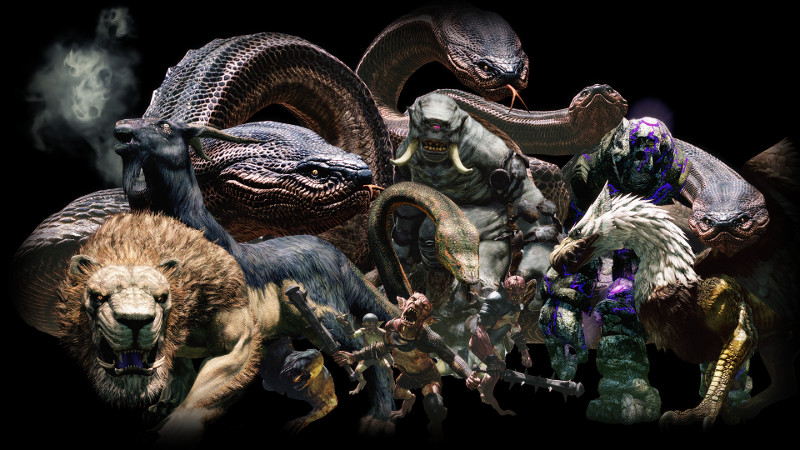
Copyright 2012 Capcom. This is an entry in the Dragon’s Dogma bestiary. The remaining entries along with the full adaptation can be found here.
As in other fantasy settings, golems are animated statues created by magicians to fulfill a certain mission, usually to guard some important place. In Gransys, the secret of their creation has been lost to the ages, but there are still a fair number of dormant golems still extant. Sages speculate their creators belonged to the same culture that worshipped the elemental deities whose shrines still survive underground. This speculation comes mostly from observing the designs of both the ruins and the golems and concluding their builders liked to think big.
However, none of the golems found so far were even near the elemental shrine ruins. They slumber out in the wild, looking like boulders until an unwary intruder crosses some unseen boundary. Perhaps the truth is that the golems are even older than the shrines, and the places they have been set to guard have long since crumbled to dust.
Advanced Stone Golem
GURPS Dungeon Fantasy 2: Dungeons contains stats for a stone golem on p. 26. As that book says, those stats represent a basic model. At SM+1, this type of golem can comfortably fit in most dungeons and might indeed be guarding some deep chamber in an elemental shrine.
The “advanced” stone golems found on the wild are quite a bit larger and more dangerous, and have the ability to shoot coruscating energy beams from their foreheads at foes they can’t reach with their powerful fists.
ST 50; DX 11; IQ 8; HT 14;
SM +3; Dodge 8; DR 15;
HP 90; Will 8; Per 8; FP 11
Basic Speed 5.50; Move 6;
- Punch (16): 5d+1 cr. Reach C-2.
- Grab (16): Grapples at ST 51.
- Brilliant Lance (14): 3d burning; Acc 3; Range 10/100; RoF 1.
Traits: Automaton; Cannot Learn; Doesn’t Breathe; Doesn’t Eat or Drink; Doesn’t Sleep; Fragile (Unnatural); High Pain Threshold; Immunity to Metabolic Hazards; Indomitable; Injury Tolerance (Homogenous, No Blood); Pressure Support 3; Reprogrammable; Unfazeable; Unhealing (Total); Vacuum Support.
Class: Construct.
Notes: See below for additional weaknesses.
Fighting the Golem
As a six meter tall, six-ton stone statue the advanced golem has the sort of HP and DR that puts it well outside the range of most personal weapons. Despite its relatively low IQ and Will, it’s not very succeptible to mind-affecting magic either. Fighting it directly would require siege engines or apocalyptic magic. Fortunately, there’s a better way!
Since it requires much more magical energy than the basic golem described in DF 2, this advanced model is powered by 1d+1 Powerstones encrusted in its surface (roll a random hit location for each one). Each can be targeted at a penalty equal to that of the hit location it’s in plus an additional -1, and despite being as Homogenous as the golem has a “mere” HP 10 and DR 0. Reducing the stone to 0 HP cracks it and makes it worthless as a power source. Destroying all of them deactivates the golem.
Of course, parties who stumble upon a golem can also just run away and leave the zone it’s guarding. They will never pursue anyone or fire their beams past that boundary. Even if the golem is on the way to something you need, you can retreat and come back prepared to face it later on.
Golems are always alone - they kill anything else that enters their protected area.
Golem Variants
Iron Golem: Some places were apparently deemed too important to be guarded by mere stone golems. They have faded away to nothing just the same, leaving their immortal guardians watching over empty stretches of bog or meadow.
Not only do iron golems have double the HP and DR, their 2d+2 power sources are located outside their bodies, placed along the boundary of their guarded area. These special talismans are as resistant to time as the golem itself, but have a mere DR 0 and HP 5 each. The problem is finding them while the golem attacks - destroying an iron golem is the ultimate exercise in Extreme Archaeology.
-
To GURPS or Not To GURPS
I’m sure many people have posted their takes on this over the years. In a continuing attempt to procrastrinate on finishing the Dragon’s Dogma bestiary, I decided to post mine.
My History with GURPS
GURPS has always been one of my favorite systems ever since I first heard of it somewhere during the early Nineties. Back then, GURPS 3rd Edition was one of the Big Three systems in Brazil, mostly because it was one of the three systems that had been translated by this one publisher who had a strategy of buying All The Licenses from US companies. The other two were AD&D 2nd Edition and Vampire: The Masquerade, at the time also in its second edition.
Of those three, I went with GURPS, mostly by a process of elimination. Buying only one core book was way cheaper than buying three, and I wasn’t a fan of vampires as player characters. I read and enjoyed the book, but didn’t actually use it in play very much. I mostly played Tagmar, which is a fantasy system that should be pretty much unknown to anyone outside of Brazil, and later on a bit of Shadowrun 2nd edition (and my relationship with that one deserves an article of its own).
After ‘96 or so, when my English skills had improved considerably and I had moved to a bigger city with a proper FLGS, I began to discover the joy of GURPS supplements. Some of them had been translated to Portuguese, but the ones I found myself drawn to only had English versions. I still have and cherish my physical copies of Russia, Callahan’s Crosstime Saloon, the first Discworld, and consider my relative recent finding of a used GURPS Goblins to be a major stroke of luck. Even though I still didn’t play much GURPS, the books were a joy to read.
I bought the GURPS 4th Edition corebooks when they came out in 2005, in English. By then the Brazilian edition of the game had been languishing for a while, publishing-wise: aside from those first few translated sourcebooks, all we had were some locally-produced historical games based on GURPS Lite, and even those were fading out of print by the time Fourth Edition rolled around.
I liked the new core rules quite a lot, and kept buying print books as they came out until I switched to PDF for good. These days, GURPS is pretty much my absolute favorite system, though ironically that doesn’t seem to be an opinion shared with any of my fellow face-to-face players. But they’ve all moved into board games anyway, so they don’t count here.
Now, every time I watch or read some particularly interesting piece of media I try to think what it would look like adapted to some RPG system. And pretty much the first system I always try to fit in there is GURPS. 90% of the times the result looks pretty good, at least for a 15-minute purely mental effort, but sometimes I find it’s not the best system for the job.
When To GURPS
GURPS excells at representing settings and stories where the specific details of the actions you take are important and have mechanical weight. This usually means relatively grounded and internally consistent settings, though not necessarily realistic ones. Most action movies fit here, as does a whole lot of science fiction and quite a few martial arts stories.
Fantasy does, too, as long it has the traits above. IMHO, GURPS does low-to-mid-level D&D a lot better than most actual editions of D&D. If you want “I wait until the armored ogre lifts his arm to attack and stab his armpit with my spear” to actually mean something mechanically, GURPS is your system!
I would use GURPS for a game inspired in say, the Killjoys science fiction series, the Crouching Tiger, Hidden Dragon movie, the My Hero Academia comic, or the Valkyria Chronicles video-game. I have used GURPS for games inspired on X-COM and plain old Dungeon Fantasy, and wrote a fairly complete Dragon’s Dogma adaptation.
In a more general note, GURPS also thrives when your group has a little time to prepare for the game - choose which subset of the rules to use, create characters, that sort of thing. The more of that the GM does themselves the less experience with the system their players will need to have.
When Not to GURPS
Now, the other 10% of times, I find GURPS wouldn’t be the best fit for the show/book/video-game in question. These works usually have the opposite traits from the ones I listed above: action details are much less important than their effects, and their settings tend to lack one of “grounded” or “consistent”. Often they lack both! This doesn’t imply they’re bad works, just that they have a different focus.
GURPS bases all of its numbers in real-world measurements. Powers have ranges in yards or meters, an attack’s damage is based on the force behind it, and so on. Therefore, it has trouble modeling stories where characters have fuzzily-defined skills and powers. If your character’s specific capabilities are defined more by the needs of the story rather than by anything measurable in-world, it would be best to use a system that supports this.
The sort of science fiction that has characters switch bodies a lot is also hard to model in GURPS, whose rules assume its characters will usually not undergo this sort of drastic change so often.
And if you don’t have much time to prepare for a game, the best system for it will inevitably be whatever your players are more familiar with! At least where I live, that’s unlikely to be GURPS.
What about you?
What have you used GURPS successfully for? If that game fit into my “When Not to GURPS” description, what did you do to make it work well? Please leave a comment!
subscribe via RSS