Posts
-
Let's Read Hell's Rebels: Meet the NPCs of Part 1

Welcome to another installment of “Let’s Read Hell’s Rebels!” You can find links to the whole series in its project page. This time we’ll take a more detailed look into the friendly NPCs the group has met by the end of Part 1. Let’s look at them in order of appearance and discuss how we should convert them to GURPS.
Rexus Victocora
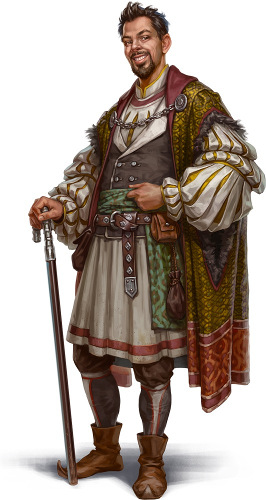
Rexus. Copyright 2016 Paizo. The heir and sole survivor of what was possibly Kintargo’s nicest noble family. His parents belonged to the Sacred Order of Archivists ever since before he was born, and after a youth spent looking for a cause Rexus had finally decided to join them upon returning home from his studies abroad. Instead he found his home in flames with everyone who was inside dead, and regretfully fled into the night. He’s having some trouble adjusting to life as a destitute outcast, not just because he misses the luxury of a noble lifestyle but because his he has what sounds like a chronic respiratory disease that demands regular treatment with expensive alchemical drugs.
With the death of his parents, Rexus is more determined than ever to see Kintargo free, both from Thrune’s government and from Chelish rule in general. However, he will not compromise his principles to do it, and will leave a rebellion that turns too bloody or exclusionary.
An interesting bit: Rexus is transgender! This will probably never come up in play or be noticeable to the PCs (this is a world with well-developed polymorph magic), but it’s nice to see it on the page nevertheless.
Conversion Notes
Rexus’ original stats have him as a Neutral Good Human Aristocrat 2/Sorcerer 1. Despite being higher-level than the PCs to start, he’s more of a support character whose main function is to translate some important documents the party finds in Part 1 of the adventure. His low Constitution score and mostly noncombat spell selection make him unsuitable for adventuring.
The best way to stat Rexus up in GURPS Dungeon Fantasy would be to make him a Scholar (from DF 4) with the necessary linguistic and research skills to fulfill his dramatic role, and perhaps a few Knowledge spells to round him out. His poor health might be represented by lower than average HT and/or disadvantages such as Very Unfit and Chronic Pain, perhaps with a Mitigator to represent those alchemical treatments. He would still provide valuable skills, but wouldn’t be someone you would want to take with you to the front lines.
After Rexus has fulfilled his function in Adventure 1, the GM is entirely free to run him as they see fit. His permanence in the rebellion depends entirely on how well the PCs treat him and how well their own morals match his. Our hypotethical party shouldn’t have a problem in this area, which means he would continue to lend them his vital scholarly skills. I mean, who else would you task with translating those encrypted Celestial writings? Merisiel?
PCs who get along specially well with Rexus could purchase him as an Ally, in which case the GM might want to stat him up so he’s a bit more survivable in the field. Buying him as a Contact would be sort of redundant, however, since as a member of the resistance he’s already always around and has a defined skillset.
Laria Longroad
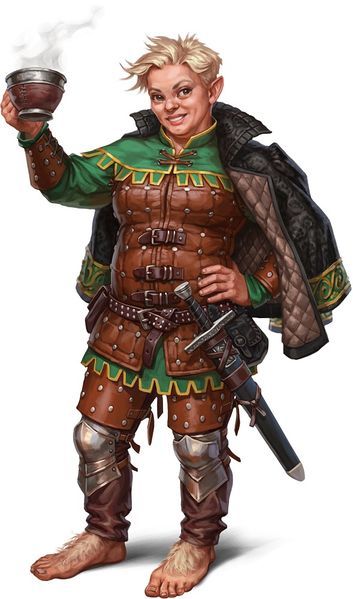
Laria. Copyright 2016 Paizo. Laria is a halfling, and was born a slave in Cheliax. Her owners were unusually cruel even by Chelish slave-holder standards, and when one of them killed her parents and brother she beat the guy to death with her bare hands and escaped to join the Bellflower Network. A few years later she ended up as a coordinator for them in Kintargo while running a very well-regarded coffee-house as a front. She worked not just with Bellflower agents but with smugglers, criminals, and rebels of all sorts - anyone working to undermine Chelish rule in Kintargo.
Needless to say, Barzilai’s rise to power has left her without an much of a network to coordinate. She’s been keeping her head down but by the time the PCs meet her has grown conviced something must be done to improve the situation. Where Rexus is idealistic, Laria is cynical: she wants a free Kintargo as much as he does, but is less picky about which methods are acceptable to reach that outcome.
Laria provides the PCs with a temporary hideout in Adventure 1, and if they treat her well can continue to give them logistical support and access to a network of smugglers.
Conversion Notes
Laria’s original stats have her as a Chaotic Good Halfling Brawler 2/Rogue 1. Brawlers are kinda like monks, only they replace the philosophy and chi powers with the fighter’s large amount of bonus feats and with the ability to switch them around mid-fight.
Despite this, Laria’s main contribution to the cause are her social skills and her useful position in both polite society and the underworld. Therefore, it makes sense to stat her up in GURPS Dungeon Fantasy using the Agent template from DF 15, with plenty of Savoir-Faire, Current Affairs (Kintargo), Streetwise and Contacts. The lower-point template would prevent her from overshadowing Lem from our hypothetical party, and those points would go into areas where an active DF PC might be reluctant to invest in. For actual parties who lack a bard or other specialist “social” character the GM can bump her up to a full 250 points of halfling crime boss.
As with Rexus, Laria could make an interesting Ally for a PC who gets along with her especially well, particularly if that PC’s party lacks strong social skills. As she is not a formal member of the Silver Ravens and has her own operation going on, it could also make sense to acquire her as a Contact. Laria can also be the “face” of a larger Contact Group representing her own network of smugglers.
-
GURPS X-COM: The Arsenal of Ruin, Part 2
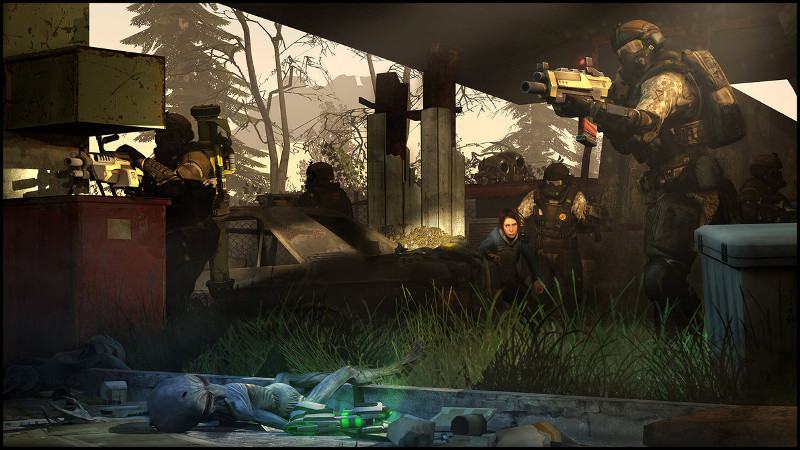
Illustration by AntiMingebag on DeviantArt In their second field-op, our brave X-COM squad saw new enemies with new equipment, so it’s time to update the Arsenal of Ruin! This post will focus on the gear carried by the Elite Puppets, also known as White Masks.
White Mask Gear
White Masks are elite Puppets of Ruin in service to the Ebon Masters. Like their “lesser” brethren, they are borne as fruit from the Trees of Ruin, but they only appear in the heart of the woods where the Trees of Woe are older. At the stage where our campaign stopped, there were still no trees old enough to drop elite puppets, so the ones the party met are all “imported” from off-world.
In the original Dreams of Ruin material, elite puppets carried TL 8 military equipment equivalent to that of a first-world military soldier: automatic assault rifles and more modern rocket launchers. For this campaign, they had to step up their game, as that sort of gear is starting equipment for my PCs.
Like the equipment carried by normal puppets, all of this gear is produced by the trees themselves along with the puppet that wears it. The only “custom” addition by the Ebon Masters here is painting the masks on their armors white to denote rank within their organization. This equipment is meant to be more advanced than anything carried by modern Earth infantry, but it’s still considered somewhat cheap and low-end by the aliens.
Puppet Assault Rifle
Compared to the standard-issue puppet rifle seen in Part 1, this bullpup design fires a lighter 7mm round at a much higher rate of fire. It has an electrothermal-chemical (ETC) action and uses the High-Cyclic Controlled Bursts rule from High-Tech, p. 83.
This weapon also has an integral underbarrel grenade launcher that fires 25mm rounds with greater force and accuracy than its TL 8 counterparts.
The Puppet Assault Rifle lacks any targetting electronics, as the puppet’s supernatural senses fill the same role. It is otherwise extremely reliable and easy to operate, being able to work for years in adverse conditions without regular maintenance. It is operated with Guns (Longarm), or with Guns (Rifle) and Guns (Grenade Launcher) under the standard rules.
TL Weapon Damage Acc Range Weight RoF Shots ST Bulk Rcl 9 Puppet Assault Rifle 7d pi 4 1100/4500 3.5/0.5 9# 50+1(3) 9 -4 1 Grenade Launcher 4d pi++ or as grenade 4 360/2200 – 1 3(3) – – 1
The weapon is usually loaded with standard ammunition (in table), but it’s perfectly capable of firing APDS (9d(2) pi-) or APEP (7d(3) pi-) rounds. Both would ruin the day of those players who think their vests-with-plates make them immune to puppet weaponry. Even without armor-piercing ammo, they’re still smart enough to aim for the arms and legs if they notice center-of-mass shots don’t result in an immediate kill.The grenade launcher is usually loaded with TL9 HE or thermobaric warheads (Ultra-Tech p. 153 and 155), though the Ebon Masters can certainly issue crueler and/or higher-TL loads to their servants if the mission calls for it.
White Mask Armor
The White Mask Armor suit covers the torso and head in rigid plates of the same composite material used to make puppet swords. The neck and limbs are covered in a mesh of ultra-tech ballistic fibers equivalent to Reflex armor (from Ultra-Tech). All of this material is colored a dull gray, except for the helmet plates, which are white.
The suit is sealed, chemically-coated and contamination-proof, but does not feature ports for air tanks or even a visor, as its intended wearers have no need for such things. In fact, it can’t even be removed from the puppet wearing it without being cut open.
The White Mask Armor provides DR 30 to the torso, groin and head. It provides DR 20 against cutting and piercing damage and DR 10 against all other damage types to the limbs and neck. While DR 30 is a little less than the DR 35 provided by a TL 8 assault vest with trauma plates, this DR is not semi-ablative like that of the plates, and is more than enough to stop rounds from an X-COM issue assault rifle. The full suit is also about a bit lighter than the starting “heavy armor” package for PCs and provides more DR to all non-torso locations.
TL Name Location DR Weight 9 White Mask Armor torso, groin, head 30 15kg arms, legs, neck 20/10 Using White Mask Gear
Each Elite Puppet wears a White Mask Armor suit, and carries a Puppet Assault Rifle with 4 reloads for the rifle and 2 for the grenade launcher. They also each carry a sword and a couple of hand grenades, and may carry a Puppet RPG or extra rounds for one carried by a squadmate. These items are described in Part 1.
These weapons also fall within the “second tier” of my tech tree. Researching these weapons would have allowed X-COM to make similar versions for themselves, which would have the advantage of not being tainted by spores. They never did get a “researchable” White Mask corpse, but if they had they could have obtained a version of their armor that’s actually fit for human use. Having access to at least this much would enable the PCs to better stand up to the sort of alien that would show up later on, as their successes mounted.
-
GURPS X-COM: DARK JUDAS Analysis
Illustration by AntiMingebag on DeviantArt As promised in the last post, this one will contain the spoilers and fight analysis for Operation DARK JUDAS. For the rest of the Actual Play, take a look at its project page.
The first encounter on Part 1 didn’t show any new enemies, but did introduce players to the fact that the trees drop puppets when threatened. This time they were quite a bit better at staying out of melee range, and the puppets were undone by their own overconfidence despite being able to do some damage.
There’s no shocking revelations in the “Puppet Theater” fight in Part 2 either, aside from the fact that puppet theater is a thing. As I said in that part, I messed up by not having additional battle-ready puppets show up when the PCs grenaded the tree.
Things get a lot more interesting when we get into the firefight on Part 3. There was a lot of new stuff packed into it! The players didn’t manage to figure out much before they left, but I’m laying it all out here.
The downed alien craft was a small vimana, which is why it looked like a house. It was originally piloted by the alien the PCs rescued, who had defected from the Ebon Masters (the alien faction using the forest as a weapon). Despite their exotic looks, these magic-powered vimanas have more or less the same capabilities as the UFOs in the original games.
The two factions having a firefight over the vimana and its pilot had found the crash site just like X-COM did and were converging on it with the goal of taking everything they could. The people occupying the vimana itself were indeed humans, something the PCs would have noticed if they had managed to approach them a bit more. That doesn’t mean they were friendly! This was the first on-screen appearance of X-ALT. They likely wouldn’t have fired at the PCs right away, but would take their help and backstab them later.
The group firing at them from the ruined building were Elite Puppets in direct service to the Ebon Masters. This explains the white masks. Elite Puppets in the original rules have somewhere between 5 and 7 hit dice as opposed to the 3 of the rank-and-file, and these were similarly improved over their GURPS counterparts, making them better in a fight than all but the most badass human action heroes. On top of that, they had some pretty beefy TL 9 gear, including armor that made them basically immune to assault rifle fire from the PCs.
The PC’s biggest mistake here was sticking too close to that black tree by the container, since its emissions allowed the puppets to spot them. Puppets can see through cover, particularly when they have the trees spotting for them, so once they noticed the players they only took distance penalties to attack. Retreating was a wise decision!
It would have been nice to play out the extended fight/chase scene as the PCs retreated through the woods back to where they had stashed the puppet RPG, but I didn’t think there would be a fun way to do it over a forum, so I abstracted it out with a contest of Tactics and simply narrated the outcome. The PCs won by a small margin, so they managed to get the puppets in place for Choi’s shot (which I did roll as an attack). That was the only real way to harm the enemies they had left, as they had already spent all their frag grenades on earlier encounters and those wouldn’t guarantee a kill either.
All in all, the PCs did about as well here as could be expected. I really wish we could have played out the White Mask encounter in more detail, but such is the way of play-by-forum games.
-
Let's Read Hell's Rebels: In Hell's Bright Shadow, Part 1
In my last post, I went over the Player’s Guide and provided some GURPS conversion notes. Today we’ll look at the actual scenes of the first adventure in the Path, In Hell’s Bright Shadow. Seriously, what does that name even mean?
Part 1: Fledglings of Silver
The goal of this part is to get the PCs on track to restoring the Silver Ravens. It begins with a protest!
The Aria Park Protest
As the story begins, the PCs find themselves in Aria Park, so named because it’s right next to the Kintargo Opera House. Paracount Thrune is catching a show inside the Opera House while a huge crowd protests outside, watched by his guards. Thrune has been in power for a couple of weeks, and in that time he’s issued seven odd proclamations that generally make city life inconvenient.
The player’s guide to Hell’s Rebels describes many possible reasons for why the PCs would be here. Two of the most interesting ones are looking for a famous performer who recently disappeared and looking for a contact who has information about the Silver Ravens secret society, which was rumored to defend Kintargo from outside threats in the past. They could also simply be here to participate in the protest, people-watch, or simply tag along a friend with a stronger reason to be there.
Of our four Iconic PCs, I imagine Lem would be the one most interested in getting in contact with a resistance movement and looking for info on the legendary Silver Ravens. Kyra might be concerned about the fate of Shensen, a half-elf singer who was very outspoken both about her faith in Sarenrae and against the evil of House Thrune. She is currently missing. Merisiel would definitely be here to riot and pickpocket people, and aimless Valeros would just tag along, likely to keep Merisiel out of trouble. The rules in the Player’s Guide actually give out skill bonuses for each different motive and further bonuses depending on different background traits chosen by the PCs. In GURPS, I feel none of that is necessary, since the system already has a good skill system. The GM should instead guide the players to buy some social and subterfuge-related skills with their points, as they would be important throughout the campaign.
This is a big, chaotic gathering: you have quite a few people protesting against Thrune for several different reasons, some loyalists protesting for him, and a handful of yahoos who just want the riot to start already. There’s several actions the PCs can take here, which include looking for that mysterious contact, suppressing one or more factions, organizing the protest, or simply picking people’s pockets. Suppressing the loyalists or yahoos will bring benefits later on. The PCs also get XP for performing successful actions - this seems to be a common thing here, as the adventure path is very particular about getting them to the appropriate levels for each scene.
The Eighth Proclamation
After a few hours of this, The Barzilai makes an appearance, and makes his eighth proclamation. The previous seven were things like banning mint and embroidered clothing, or bounties for live dogs. This one forbids all ship captains not born on Kintargo from leaving their ships and setting foot on the city under pain of torture. The stated reason for it is that Barzilai has the best brain and noticed his subjects have been angry about out-of-towners nosing in on their business. So he’s going to solve the problem, bigly, with a ban.
This absurd proclamation starts a riot, which is what Thrune actually wants. Why? He simply feels like watching his guards and loyalists beat up some protesters.
As soon as the riot starts, someone throws a handful of manure at Barzilai, and while that missile misses its mark it causes him to spill some wine on his fancy robes. This sends him into a rage, and he orders his main bodyguard Nox and the dottari under her command to move in and start killing people. At the same time, the off-brand Brown Shirts of the Chelish Citizen’s Group that were infiltrated in the crowd draw their clubs and begin attacking the protesters as well.
The players must fight a gang of four CCG thugs to start with, and they get to witness Nox’s powers of regeneration as she shrugs off a dagger to the throat in a “cutscene”. I guess the idea here is that the party should get away as soon as possible. The thugs are basically shclubs with clubs who shouldn’t pose too much of a problem, but sticking around for too long attracts a pair of the stronger and better-armed dottari. Finally Nox comes in with a pet hellhound and a squad of 12 dottari guards. That last bit would be a clear sign that the four 1st-level characters must run away - the crowd certainly does! If they still stick around, the hellhound focuses on them.
GURPS Conversion Notes
There’s two ways to go about this here. GMs who want to be true to the fiction could give the Chelish Citizen’s Group thugs average stats, clubs, and a couple of points in Shortsword, while using the 62-point Guard template from GURPS Dungeon Fantasy 15 with decent gear for the dottari.
Those who want to make things more challenging for their delvers should go with the Guard template for the thugs, perhaps upgrading them to light armor and small maces. The guards would be built using the 125-point Squire or Brute templates. This is also closer to what the Pathfinder version does with the stats for these people.
Nox should be built at least on a 250-point Knight template with special powers added on, and the Hell Hound can be built using the guidelines on this post from the Dragon’s Dogma bestiary.
In either case, a party of four 250-point delvers would have far less trouble dealing with the riff-raff than the 1st-level Pathfinder PCs. If they’re smart and lucky they could even beat the final pack of 12 guards plus Nox and her hellhound right here! Kyra does know Resist Fire…
The GM might want to increase the number of dottari to a realistic level, since 12-14 of them wouldn’t be able to contain a riot of thousands anyway. Or they could keep the numbers as they are and deal with the changes an complete victory here would bring to the story.
A New Friend In Need
In any case, after the party leaves the site of the riot, they hear sounds of fighting from a nearby alley. There, five CCG thugs are in the process of beating a man to death. Since this man happens to be the contact one of the PCs is looking for, it’s in their interest to crush the thugs and save the man. Unlike the thugs in the riot, these ones fight to the death, but they should still be manageable. There’s an extra XP reward for succeeding in helping Rexus, too.
Their victim is Rexus Victocora, the young scion of the nicest noble family in Kintargo, who of course was disappeared and had their house burned down in the Night of Ashes. He survived because he was out of the house at the time. Rexus has either taken an interest in the PCs during the protest or was the one who called them here in the first place with promises of information on the Silver Ravens. After going somewhere private, he tells them the story above, and how he plans to fight back against Thrune’s takeover but needs help.
Our hypotethical party would readily accept the request, and yours should too. I mean, they’ve been telling you to make that sort of character since the Player’s Guide.
Anyway, once the PCs are on board, Rexus reveals his parents left him a letter in which they confessed to be members of the Sacred Order of Archivists, a secret society dedicating to uncovering and preserving the true history of Kintargo, as opposed to the heavily redacted official version. The letter also tells of how they feel the Silver Ravens must fly again if the city is to stand any chance against this new oppression, and says that the Fair Fortune Livery is rumored to be one of their ancient safehouses. Rexus needs help investigating the place because he’s not exactly adventurer material. By way of compensation, he offers most of the rest of the stuff his parents left him, which include some money and valuables, a silver dagger, and a set of bracers of armor +1. He keeps the letter and a mythril key, which will be important later.
The Fair Fortune Livery
Thus begins the first official “dungeon delve” of this adventure! This place used to be a slaughterhouse-turned-stable and conceal a minor Silver Raven safehouse, but has been abandoned for quite a while. Rexus wants to come along and help investigate despite not being a combatant, but will accept it if the PCs tell him to sit this one out instead. Bringing him along turns this into something of an escort quest, and is worth a little bit of extra XP at the end.
The delve begins in the livery’s the ground level. It’s mostly empty and in ruins. Some locked doors and a small pack of feral dogs are the main obstacles here. Once the dogs are dealth with the grimples (small, annoying, evil fey beings) from the basement come up and begin to play poltergeist. In any case, it shouldn’t be hard for the PCs to find the trapdoor going down.
Next comes the basement, which was mostly used when the livery was a slaughterhouse. What 1st-level adventure is complete without a basement full of rats? Also here is the grimple nest, where the PCs finally have a chance to get rid of the pests and pillage their treasure (which includes a cloak of resistance +1).
The hideout proper is situated in some old city ruins accessible from the basement. The main problem with them is that the ancient Silver Ravens unwittingly brought a devil’s contract here when they plundered a cache of government documents, and the imp bound to it has been trying to find a way to leave the place for 80 years. One of those attempts summoned two lemure devils who now spend their time mindlessly wallowing in a polluted cistern. It’s a good thing the PCs have that silver dagger with them, because lemures are resistant to everything else. They are otherwise not terribly dangerous, but serve as a warning that things down here are Not Right.
There’s three boxes in here full of loot: the first has some interesting armor and weapons including a silver morningstar, which means this delve is an example of that annoying trope where the weapon to kill a monster is in a box behind the monster. The second box is locked and contains a bunch of spell scrolls and the hundreds of pages of documents that are the actual goal of the quest. And the third has six figurines of wondrous power in the shape of silver ravens. They’re useful for secure communication and are in fact the origin of the group’s name. The party could also sell them off for a fat load of cash, something the adventure begs the GM to prevent.
The afore-mentioned imp, named Blosodriette, is also here - her contract is somewhere inside the second box. She limits herself to watching invisibly and hoping someone takes the box away so she can go along. It’s possible a canny party might spot and confront her here - if they don’t she’ll cause trouble later on.
GURPS Conversion Notes
Rats and dogs already have stats for GURPS! Grimples are SM -3 or -4 fairies with minor telekinetic abilities and the ability to cast the Grease spell, which should make a fight against them look more like a bad comedy movie than actual combat. Lemures aren’t exactly fearsome combatants, but they should have plenty of DR against non-silver weapons. Even so, this will be a walk in the park for 250-point delvers.
The Long Roads Coffee House
After the party retrieves the documents, Rexus takes then to the Long Roads Coffee House to meet Laria Longroad, the proprietor. This halfling is a member of the Bellflower Network, which is Kintargo’s equivalent of the Underground Railroad.
Laria is quite happy to support the PCs in their rebellious efforts, not the least because her extensive network of contacts and informants is mostly gone now (Thrune hates abolitionists). In fact while she would be glad to let them crash in the secret hideout underneath the coffee house, she doesn’t even have control of that. A smuggler buddy of hers went in there to stash a cargo of contraband silks and never came out. It’s been days. If the PCs want a temporary home base, they’ll need to do some cleaning.
The hideout occupies the coffee house’s basement and those of the two abandoned houses to either side of it. It has bunk rooms, a large storeroom, and a dock leading into an underground river. There’s an albino alligator chilling in the river, but it’s not the main source of trouble here.
You see, Mr. Smuggler Buddy didn’t just bring a shipment of cloth here, he also brought a group of tengu sisters on the run from the law back in Varisia. The plan was to hand them off to another smuggler who would take them the rest of the way to their destination, but the Night of Ashes put an end to that. When the guy told the sisters they were on their own, they beat him unconscious, and then one of them got a little too enthusiastic and killed him. Now they’re holed up down here, in the dark, despairing about what to do.
Pathfinder tengu are basically raven-people. The sisters aren’t automatically hostile, but getting in their good graces will take some doing. There’s four of them, plus Chough, the “enthusiastic” sister, who is actually an adopted dire corby and basically responsible for all the trouble the rest have gone through. Dire corbies look kinda like tengu, but are a lot stronger and less psychologically stable. The lead sister, Korva, has recently decided Chough needs to be put down. It’s actually quite possible the party will run into a murderous Chough before they meet Korva, so that’s one thing taken care of, I guess.
Particularly diplomatic parties can convince the sisters to stick around and join the Silver Ravens, becoming a “special unit” under the rebellion management rules in the Player’s Guide. If they can’t manage that, they can still let them leave without a fight as long as they don’t try to pin Mr. Smuggler’s death on them. PCs get XP for dealing with them whether there’s combat or not, and a little bonus for telling Laria about her buddy’s fate.
Once the sisters are dealt with one way or the other, the party gains the use of this hideout as a temporary base while they set out to rebuild the Silver Ravens. We’ll take a look at how that goes in the next installment.
GURPS Conversion Notes
Korva should be a 250-point stabby Thief not too different from Merisiel. Her sisters are 125-point Cutpurses, with Chough probably being a monstrous Barbarian who fights with Talons and a Sharp Beak and has serious Berserk and Bloodlust issues. Give her some natural DR, extra HP and perhaps one or two levels of Extra Attack if you want her to stand up to the whole party by herself.
-
Dragon's Dogma Bestiary: Gryphons and Cockatrices
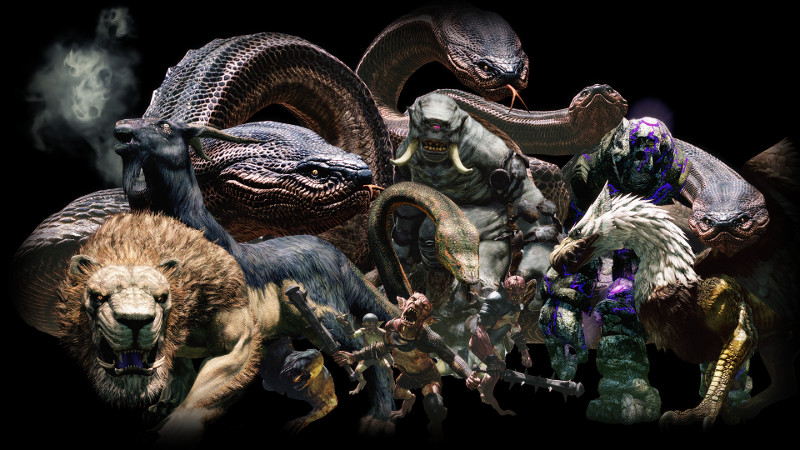
Copyright 2012 Capcom. This is an entry in the Dragon’s Dogma bestiary. The remaining entries along with the full adaptation can be found here.
Gryphons are considered a symbol of strength and victory in Gransys, much like in the real world. These creatures used to be considered mythical, but the coming of the Dragon has proved otherwise. One such beast has taken roost in the ancient ruins of Bluemoon Tower, and ranges as far as Gran Soren in its search for prey, devastating herds of cattle and attacking unwary caravans. There might be others.
The Basic Set actually has stats for a gryphon in page B461, but those would only suit a smaller than average individual in this setting. The gryphon of Bluemoon Tower is much larger, and able to carry a grown person away with ease. It’s also clever enough to fly away if it thinks itself overmatched, so hunting it has proven particularly difficult. Ending its threat would mean undertaking an expedition to Bluemoon Tower and facing the many dangers therein.
ST 25; DX 14; IQ 5; HT 13
Dodge 11; DR 3 (Tough Skin); SM +3
Will 14; Per 14; HP 24; FP 20
Speed 7.5; Move 7 (ground); 14 (air).
- Beak (15): 2d+2 pi+. Reach C, 1. Parried as a weapon.
- Talons x2 (15): 2d+1 cutting. Reach C-2. May grapple at skill-15. Parried as a weapon.
- Flyby Attack (-): The Gryphon can perform a Move and Attack maneuver to swoop down, strike with its talons, and fly back up, covering a distance equal to its Air Move in total. The attacks are made at no penalty. The talon attack can be a grapple instead, which if successful means the gryphon carries the victim with it.
Traits: Acute Vision 5; Combat Reflexes; Extra Attack 2 (claw/claw/beak); Flight (Winged); Penetrating Voice; Quadruped; Restricted Diet (Fresh Meat);
Skills: Brawling-15; Stealth-15; Wrestling-15;
Class: Hybrid.
Notes: Can retreat up in combat for a +4 to Dodge.
Gryphon Variants
Cockatrice
Unlike the small variant presented in GURPS Dungeon Fantasy Monsters 3, the Gransys cockatrice is a huge creature that looks like a gryphon from far away. Upon closer inspection, one can see its avian half resembles more a turkey or buzzard than an eagle, with black feathers and fur.
In addition to possessing the same natural weapons as a gryphon, the cockatrice can spew a cloud of noxious gas that turns any who breathe it to stone! And unlike the gryphon, it will never run from a fight.
Use the same stats as for a gryphon, but add the following attack:
- Petrifying Breath (16 vs. HT): Covers an area 5m in diameter in front of the cockatrice. Any who fail the listed resistance roll are turned to stone as per the Flesh to Stone spell. Can be used once every 10 seconds.
subscribe via RSS