Posts
-
So I've watched a bit of Critical Role...
…and I gather it’s kind of a big deal. There’s quite a few “Actual Play” streams following the same format, and I’ve seen a few posts by different people commenting on how it brought a large influx of new players to the RPG hobby in general and to D&D in particular.
The tone of these posts has varied. A couple were all about how the show sets somewhat unrealistic expectations on new players because the cast and game are so awesome. One, by a genuine scion of the Old School, went the other way and lamented that the hobby was truly damned if Critical Role is what Kids These Days consider a good game1.
I guess I’m somewhere in the middle? I’ve been at this long enough to know every group is going to have its own style, and I’ve been burned by enough flame wars to accept that a given style isn’t bad because it’s different from mine.
For example, I’ve come to accept that uncut videos of 5-hour game sessions aren’t my preferred medium for following other people’s games. Give me a well-written and well-summarized text report any day of the week! Still, the videos I did watch did provide me with at least one take-away I can use in my own games: do the voices!
Sure, the Critical Role group is entirely composed of trained voice actors, but even if you’re not one of them you can still add a little something to every NPC. Perhaps a simple but distinctive mannerism, or a slight change in pitch. Tiny changes that anyone can do and which might be enough to make your characters more memorable. I used to do that a lot more in the past, and now that I see how effective it can be for people on the receiving end I’m going to start doing it again.
If you’re a player, then you can do the same for your own PC. At the very least it will help others to know when you’re speaking in and out of character.
Watching the videos themselves is kinda fun: you can see that this is a well-oiled group that has been playing for a while. They obviously enjoy each other’s company and are very much into the game. Watching them in action sometimes kinda makes me want to join the group, impossible though it might be. I don’t often get to be a player.
I get why people say it feels railroaded, though I don’t necessarily agree with them. You’re watching a full game happen but have neither any input on how it develops, nor any access to the GM’s notes. There’s no real way to know how much material2 goes unused, nor how much is created between sessions or improvised on the spot in response to player’s decisions.
Of course, my inner grognard can’t help but notice that while Matt Mercer is very skilled, he does have a different style from mine. I can’t help but think there are a few things I would do differently if I was in his position.
The first is that when a PC attacks an enemy he describes everything himself, from the PC’s actions to the monster’s reaction. The only exception seems to be when a PC takes down a boss. Years of playing Exalted have hardwired me to always let players describe their own actions, thankyouverymuch.
The second is that he interprets every hit in combat as resulting in physical wounds, which leads to some quite gory descriptions at times. Sometimes I actually start to pity some of the high-HP monsters they fight. I like systems such as GURPS or Dragon Heresy because they make a clearer distinction about what’s a wound and what isn’t.
There’s a third thing, but you didn’t pass your Perception check for this paragraph so you don’t see it.
In the end I guess I’ll probably resort to things like this recap site when I want to keep up with the Critical Role campaign. It’s not quite the same thing, but it does the job of conveying what happened in a session a lot faster.
-
Let's Read Hell's Rebels: Turn of the Torrent, Part III

Welcome back to Let’s Read Hell’s Rebels! This post will cover Part 3 of the second adventure, Turn of the Torrent. Part 2 had the PCs help out Octavio Sabinus rescue his captured men, in addition to performing several other missions that improved the standing of the Ravens in the eyes of the population and rewarded them with favors from other groups.
Following the format of the first adventure, in Part 3 we get back to a big ol’ dungeon raid. There’s not much direct opposition to Thrune here, but successfully clearing this place out will secure a bigger hideout for the Ravens, increasing the organization’s maximum power.
Part 3: Lucky Bones
The dungeon in question lies beneath the ruins of a gambling hall called the Lucky Bones. Thirty years ago, the Torrent Knights found out was a front for gang of thieves named the Grey Spiders. The Spiders worshipped Norgorber1 and were into a whole lot of bad stuff, from drug running to kidnapping to slavery.
The gang assassinated the leader of the Order in an attempt to keep them at bay, but it backfired. The Knights raided the hideout and took the Grey Spiders down. Afterwards the Torrent’s new leader sealed the place up without further investigating it, an unorthodox decision. Turns out he and a few cronies intended to go back to the place at a later time and take all of the Spiders’ loot for themselves. They were found out and arrested for corruption before they could act on this plan, but the Order never unsealed the Lucky Bones out of shame for the whole episode. The casino has long become a ruin, but the complex beneath it remains sealed to this day.
Lictor Octavio will share this story with the PCs if they get on his good side by completing the rescue mission without causing too much chaos.
Lucky Bones: Overview
The dungeon beneath the Lucky Bones is quite large and complicated when compared to the Fantasmagorium in Adventure 1. Pathfinder’s writing style is verbose and so am I, so I’ll take a page from Gygax’s manual of style and make an effort to condense things as much as possible here. It will still take multiple posts to cover the whole dungeon, but I hope you’ll end up with a fairly complete idea of what lies inside.
Before describing the dungeon itself, the book gives us some background on the three former leaders of the Spiders: a tiefling sorcerer named Baccus, a halfling rogue named Lorelu, and a wererat cleric named Hei-Fen. The first two died during the raid, while Hei-Fen managed to escape to the neighboring city of Vyre. She still lives there and will make an appearance as a villain in the next adventure.
The Lucky Bones consists of a surface building and two basements. The surface level holds nothing of interest. The upper basement actually consists of two “sub-levels”, separated by the Torrent seal. One is currently occupied by a cult of Mahatallah2 made up of changelings (who in Golarion are the children of hags and mortals, and not the shapeshifting people from Eberron). The other is behind the seal and haunted by the restless spirits of the people who died there.
The lower basement is completely submerged. Its current occupants are a team of skum sent by an aboleth necromancer to spy on the city. They have several sort-of-tamed underwater monsters helping them out, and have captured a squad of sea elf rangers who came here to search for their missing ally Shensen3. There’s a magical pump in here that can be reactivated to drain most of the water, but doing so requires clearing the dungeon first. In other words: yay, underwater adventure!
The PCs could learn about the Lucky Bones as soon as they complete the rescue mission from Part 2, which means Part 3 could happen concurrently with the other Part 2 missions.
But before they go there, they might get ambushed!
A Drunk in the Slums
The leader of that changeling cult happens to be Luculla Gens, a regular of the Tooth and Nail tavern whom the PCs might have already met (she’s described in the same section that describes the tavern). Luculla frequents the place to fish for information and is likely to overhear any plans the party discusses in the tavern’s common room. If she overhears Octavio talking about the Lucky Bones or otherwise comes to think the PCs are a threat to her, she will send an assassin after them.
The assassin is a Faceless Stalker named Maglap. Faceless Stalkers are like doppelgangers but stronger, with good grappling skills and a blood-draining attack they can use on people they’ve grappled. Maglap will approach the PCs looking like a drunken sailor and use the element of surprise to attack. Interrogating the stalker is only possible with some form of magical compulsion. He knows a few details about the cultist-occupied parts of the dungeon and about Luculla’s true identity.
Learning about her early gives the party a XP bonus. Maglap also offers an alternative way for PCs to learn about the Lucky Bones if they manage to alienate Octavio.
Lucky Bones: Surface
The surface level of the Lucky Bones has nothing interesting in it. PCs can find a trail through the rubble with an easy perception roll, leading to a fireplace. That fireplace contains a secret passage that requires a very hard Perception check to find, though hearing the story of the raid from Octavio (or interrogating Maglap) gives a big enough bonus to make it easy. The passage leads into a sort of basement anteroom (C1) that’s filled with disgusting trash and guarded by three teenage
mutant ninjaothyugs. A trapped and locked door leads from here into the hideout proper.Lucky Bones: Cultist Hideout
The Cultist Hideout occupies the southern half of the level 1 map. Ceilings here are 8 feet high on average. The walls drip with moisture, and the doors are all swollen with it. They no longer lock, and opening or closing them requires a Strength test. The changelings just leave them open all the time.
This level is also completely riddled with secret doors, which are in much better condition. Spotting them from the concealed side is almost impossible, so the cultists don’t know most of them exist. They mostly link rooms that can be reached by more obvious paths, and will become a lot more useful when the PCs take over the place and have to defend it.
There is pretty much no way to explore this place stealthily. The “brutal raid” approach is preferred, and the enemies here should certainly react as if that’s what the PCs are doing.
C2. Living Quarters: Accessible from C1. Four cultists are lounging around and will immediately attack the PCs when they get here from C1. They’ll attempt to capture the PCs alive using wands of hold person and nets, and when one of them falls the rest will use potions of invisibility to run towards the temple in C8 and warn their mistress. Six other cultists are currently offsite - if the PCs retreat before clearing the hideout, those six will be recalled as reinforcements and they’ll barricade the door to C1.
C3. Maglap’s Quarters: Accessible from C2. Pile of rags on the floor, lots of clothing (for disguises) hung on the walls. Among them is a cloak of the manta ray. If the party didn’t meet Maglap before, he will be here and will help the cultists on C2 in case of a fight.
C4. Pit Trap: Accessible from C2. A 20-foot deep pit lined with shards of broken glass. The pit is open and obvious but the ledges around it will swing down 6 seconds after anyone steps on them, dropping victims into the pit. Hidden switches in the hallways to either side can be used to deactivate trap if found. A secret passage leads to the bottom of the pit in C13.
C5. Guard Post: Accessible from C4. Elgadazum (advanced bearded devil) is bound to guard this place and is bored out of his beard. The devil will strike up a conversation with any PCs until they either attack him or try to open the door to C6 (from which muffled knocks and cries can be heard). Elgadazum warns Luculla telepathically when a fight starts and teleports to her when severely injured.
C6. Cell: Accessible from C5. Two frightened teen boys await sacrifice here. Secret passage leads to C8. Rescuing the prisoners brings a XP reward and enhances popular support for the Ravens. Luculla and bodyguards will arrive here through the secret passage to move the prisoners to C9 30-60 seconds after Elgadazum runs away from C5, so the boss fight might happen in this cramped 10-by-15-foot room if the PCs linger here. Fun(TM)!
C7. Sealed Door: Accessible from C4. Huge iron door, locked with a complex mechanical lock and an arcane ward. Leads to the Haunted Opium Den, which we’ll discuss next post.
C8. Temple to Norgorber: Accessible from C4. Pillars, sacrificial altar, walls covered in creepy prayers. Luculla and two cultists work to rededicate this temple to Mahatallah. They will be joined by any survivors from the previous rooms for a last stand. If the party bypassed Elgadazum, he’ll likely teleport here after the fight has started.
C9. Luculla’s Chambers: Accessible from C8. Glyph of warding trap on threshold. Cot with furs and feather mattress, desk full of books and scrolls. On the desk are also a basin made from a gold-plated skull and filled with unholy water, and a statuette of Mahatallah with a secret compartment containing a scroll of raise dead. The statuette also has some monetary value. If Luculla managed to move the prisoners without running into the PCs, they’re also here.
Notes On Opposition and Treasure
Each cultist is a Cleric 1/Rogue 2. They wear leather, fight with nets and their claws, and know a few minor healing and defensive spells. More dangerous are their magic items: each carries a wand of hold person with 10 charges and a potion of invisibility. For a GURPS conversion, you could start with the Skirmisher template and add the necessary Power Investiture and cleric spells, along with Sharp Claws and likely a bit more Striking ST.
Elgadazum is a by-the-book Bearded Devil, with increased attributes. Generic Universal Eggplant has a version of that monster here, though it should probably be further beefed up for Dungeon Fantasy.
Luculla is a level 7 cleric, wearing +1 protective gear (armor, ring of protection, cloak of resistance). She has a bunch of healing potions and a scroll of glyph of warding, which means she’ll set a trap if she knows the PCs are coming. She also wears a mundane but valuable ceremonial mask (which might be a power item in DF). Luculla is quite weak in melee, but her spell loadout includes summon monster IV along with a bunch of curses and healing spells. For Dungeon Fantasy, start with the Wizard template, replace Magery with Clerical Investment/Power Investiture and layer on as many curse-like spells as you can fit.
Closing Thoughts
Pathfinder characters are supposed to be about level 6 when they get here, and depending on how large the boss fight is they might need that scroll of raise dead right away. Dungeon Fantasy delvers are less likely to need it, though by now the fights should be getting challenging for them as well.
Clearing the hideout in one run still leaves the six changeling cultists who weren’t there. The book doesn’t really say what happens to them. The way I see it, the most likely outcome is that the surviving cultists eventually figure out what happened and run away. They’ll either not be a problem anymore on this adventure, or might end up linking with other infernal-themed opposition further down the line. It’s not like there will be a lack of such groups in this adventure path.
-
Where I Read the 4e Monster Manual: Angels
This article is part of a series! Go here to see the other entries.
In a substantial change from monsters bearing the same name the past, Fourth Edition angels have winged humanoid upper bodies (with “feminine or masculine features”), and their lower bodies trail off into flowing energy. Many believe they were created by the gods, but the truth is they arose from the stuff of the Astral Sea when that plane first came into existence. If this process was started by the gods, it was entirely unconscious.
When the gods went to war against the Primordials, the angels pledged their service to the deities that most closely matched their individual beliefs. You see, Angels are a rather diverse lot, with a listed alignment of “Any”. So yeah, Tiamat and Gruumsh have evil angels on their payroll. You can even find angels working as mercenaries, serving people whose causes they find agreeable and who can meet their price.
Angels are the first MM monster to also show up on the Monster Vault, where the lore was changed to make then mostly mercenaries who only ocasionally join up with specific gods in a more definitive manner. Here they’re Unaligned and make being as generic as possible in looks and personality a point of pride. Personally, I prefer the Monster Manual version with additional embelishments you can see in Final Impressions, below.
Angels are usually paragon-tier, and are more involved in the world (and more likely to meet PCs) than deities or exarchs. They have quite a few signature abilities:
- Flight (obviously!)
- Immunity to fear
- Resist 10 Radiant
- Angelic Presence: all attacks against the angel take a -2 penalty while it’s not bloodied.
Below are the four angels we get in the Monster Manual, all of which reappear in the Monster Vault.
Angel of Battle
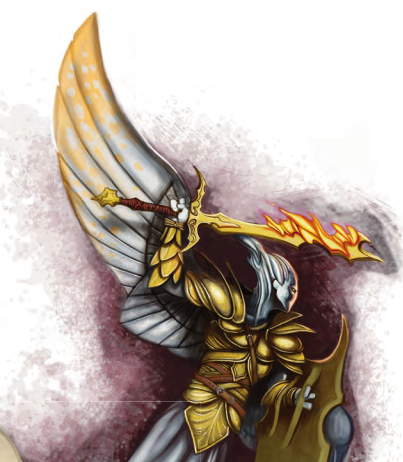
Copyright 2008 Wizards of the Coast Angels of Battle are military leaders. They most commonly lead angels of valor (below) into battle, but sometimes also lead mortal forces. When gods send angels of battle to deal with a situation, they’re not interested in dialogue. It looks like it’s made of flowing silver, with metallic wings.
The Angel of Battle is a Level 15 Skirmisher Leader. It has 148 HP, with a slighly weaker Reflex and a slighter stronger Will than what is average for their level. It’s pretty fast, with a ground speed of 8 and a flight speed of 12.
Its basic attack is with a falchion. It’ll mostly use that through Mobile Melee Attack, which allows it to move half its speed (so, up to 6 squares) and attack at any point in the movement without provoking attacks of opportunity for moving away. Hitting with an attack allows it to mark the target as a Chosen Foe, which means it will grant combat advantage to everyone until the end of the angel’s next turn. In an emergency, the angel can forcefully eject the metal feathers of its wings in a Storm of Blades, which does high damage in a Close Burst 3 and cuts its fly speed down to 2 until the end of the fight.
The Monster Vault version is almost identical, with the only difference aside from the fixed damage being that the effect of Chosen Foe was rolled up into the description of the falchion attack.
So here you have an opponent who keeps flying around just outside of melee reach and swooping down to harass the PCs and mark priority targets for its buddies to attack. It pairs well with enemies that exploit from Combat Advantage.
The sample encounter is level 15, an all-angel party with an Angel of Battle leading two Angels of Protection and 8 Angel of Valor minions. I guess they could be part of the guard contingent for an evil god’s temple, or maybe a hit squad sent by an evil god against a level 12 or 13 party the god sees as an obstacle to their plans.
Angel of Protection
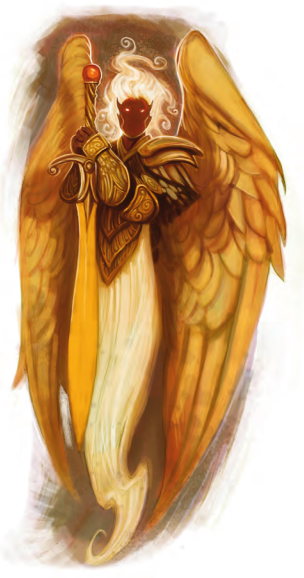
Copyright 2008 Wizards of the Coast These are basically Angelic Knights Templar, serving as bodyguards for important faithful and protecting temples. It has fluffy feathered wings and wears golden plate.
They’re level 14 Soldiers, with 141 HP. Their Reflex and Will are a couple of points below average, and it’s a bit slower than the Angel of Battle with “speed 6, fly 8”. In addition to the standard Angelic Presence, it has the Angelic Shield aura, which makes the 5 squares around it difficult terrain for enemies if the angel’s ward is also inside the aura and Angelic Presence is active.
What’s this about the angel’s ward? Yeah, an Angel of Protection can designate another creature as its ward as a standard action. Wards that remain within 5 squares of the angel get a +2 to AC and take only half damage from all attacks, with the angel taking the other half. The angel itself fights with a greatsword that does added radiant damage.
A given creature can only be the ward of one angel at a time, so encounter groups with more than one of these angels should probably either contain multiple “principals”, or you could set up a sort of “bodyguard chain”, with one angel protecting the principal, the second one protecting the first, and so on. They’d want spread out a bit in this case, to cover more of the battlefield in difficult terrain.
The Monster Vault version is almost identical aside from the fixed math. The damage from its attack is also entirely radiant now.
The sample encounter is level 14 and has two Angels of Protection, an Eidolon and 3 dragonborn raiders. Clearly these people are serving Tiamat.
Angel of Valor
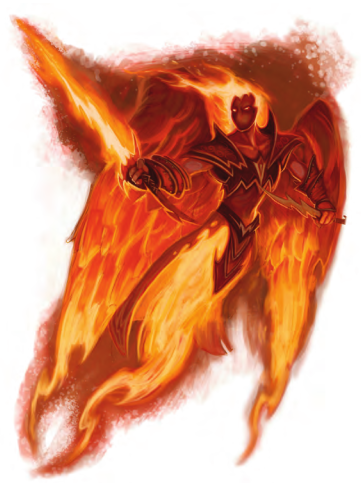
Copyright 2008 Wizards of the Coast The rank and file of
Thronethe Astral Sea. Individually they’re the weakest of all the angels, but there are “vast armies” of them. When a powerful cleric needs numbers to get the job done, they summon a bunch of these. One might also be sent to reward the follower of a god for meritorious deeds, either by delivering a magic item or with 10 days of service. Angels of valor are made of fire!We get several stat blocks for them. The first one is for a Level 8 Soldier, who is likely to be the first angelic opposition the party finds in the campaign. It has 88 HP, and Resist 10 Fire in addition to the usual radiant resistance. They have a flight speed of 9.
It dual-wields a longsword and a dagger, and can attack with both on the same turn. While bloodied, it can light its weapons on fire for a turn, during which they deal fire damage instead of physical and target Reflex instead of AC. This makes me think the angel is dipping its blades in its own blood, which is a lot more Metal than I expected to see in this entry. It can also call lightning from the heavens on its own position once per encounter, hitting everything on a Close Burst 1 with mild lightning damage and dazing them for a turn (the angel itself suffers no damage, of course).
The other stat blocks are Minions of varying levels: 11, 16 and 21, wielding greatswords. Nothing too terribly exciting about them on their own, but it does tell me that angels of valor have a role to play all through an angel-heavy campaign. The Monster Vault has only 16 Minion Soldier version, which I think is a bit of a loss.
There are two suggested encounters here. The first is level 8, with two regular angels of valor in the company of a doppelganger assassin and a pair of shadar-kai. Servants of the Raven Queen, perhaps?
The other is level 11, with 4 angel minions, two basilisks and a bunch of snake cultists. Zehir worshippers, clearly.
Another interesting use for them with late Heroic tier groups would be to flip the script and have a PC’s deity reward them with the temporary services of an Angel of Valor.
Angel of Vengeance
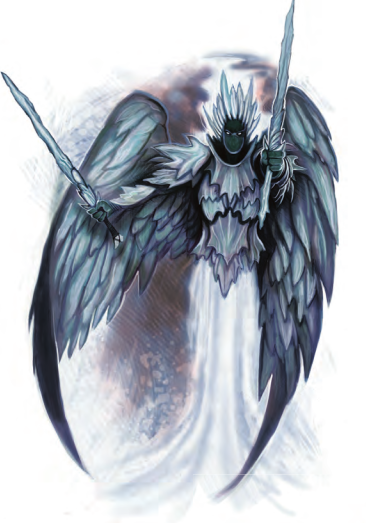
Copyright 2008 Wizards of the Coast Here’s an interesting factoid about paladins and clerics in Fourth Edition: they no longer lose their powers if they abandon their deity’s service. The gods need a different way to punish these prodigal sons, and that’s where Angels of Vengeance come in. In addition to punishing those who have angered the gods they serve, they’re sometimes sent to test those servants who are in danger of falling (and to immediately punish them when they do).
Towering creatures of cold fire (they’re Large), Angels of Vengeance are Level 19 Elite Brutes. They have 446 HP and Resist 15 Fire, Cold and Radiant. With a speed of “8, fly 12”, you will likely not be able to outrun them. It trades away the usual Angelic Presence for a Cloak of Vengeance, which in addition to the attack penalty causes 1d8 fire and 1d8 cold damage to anyone who attacks the angel. Not a lot at these levels, but it’s automatic and can add up over time.
These angels wield paired longswords that do almost as much damage as they should under the new math, which is remarkable. This damage is a mix of physical, fire and cold. Being an elite, the angel can make two longsword attacks per turn.
The most interesting power here is certainly Sign of Vengenace, a minor action encounter power with a range of “sight”. Once the angel has placed the Sign on a target, it can teleport right next to it as a move action until the end of the encounter. So the first sign you’ve angered an Angel of Vengeance is when it teleports into your back line from atop a mountain several kilometers away. A mobile striker’s worst nightmare.
When the angel is bloodied, it turns into a pillar of cold fire for a turn. The resulting explosion causes fire and cold damage in a Close Burst 2, and makes the angel immune to damage while it lasts.
The Monster Vault version is pretty much identical aside from the fixed damage notation. All of its attack damage is now “cold and fire”, and the Cloak of vengeance causes a flat 10 cold and fire damage instead of 1d8 each. If you
The suggested encounter is level 19 and consistes of two of these bad boys teleporting into your back line while a squad of Angels of Valor rushes forward to engage. That’s how Vecna tells you how he really feels about your party.
Final Impressions
Fourth Edition angels are very different from their Third Edition counterparts, and sparked early skirmishes in the edition wars when they were released as preview material. Them not being universally Good was a major break from tradition, and the new “humanoid silhouette” look was not a hit.
While I’m a fan of the new cosmology myself, I confess 4e angels never sounded very exciting to me until I began this Let’s Read. When I first read these books, “Angels == Good” was still a firmly entrenched notion in my mind due to the traditional Christian depiction of them, so I was hesitant to use them as enemies.
My opinion has been completely turned around these days thanks to reading the marvelous Kill Six Billion Demons webcomic. Its badass kung fu angels give me an excellent frame of reference for the ones in the Monster manual, particularly because they have all sorts of different moral outlooks while still remaining badass kung fu angels. The Angel of Vengeance here is reminds me very strongly of them, since it also has that “barely contained nuclear explosion inside a physical shell” vibe.
So if you want 4e angels to feel less generic, K6BD can be an excellent source of inspiration. Perhaps the servants of each deity organize themselves in knightly orders, each following a different code. Membership in such an order alters the angel’s physical shell in specific ways: maybe an angel of Pelor looks like the luminous silhouettes here, but one serving Bane or Tiamat looks more like a K6BD Thorn Knight. Then you have those unaligned mercenaries, and I can easily imagine “Reach Heaven Through Violence” being one of their central tenets.
-
Where I Read the 4e Monster Manual: Abominations
This article is part of a series! Go here to see the other entries.
Here’s our first multi-entry, and it’s epic. Abominations as a category were introduced in the Epic Level Handbook for 3.0, where they were described as the abandoned creations of the gods. This is still true here, with the added bit that some of them were created as living weapons for the battle between gods and primordials.
Unlike the previous entry on Aboleths, this one is more of a grab-bag, with several epic monsters that don’t have much in common with each other beyond “is a horror from the dawn of time”. None of them are in the Monster Vault. Let’s take then one by one.
Astral Stalker
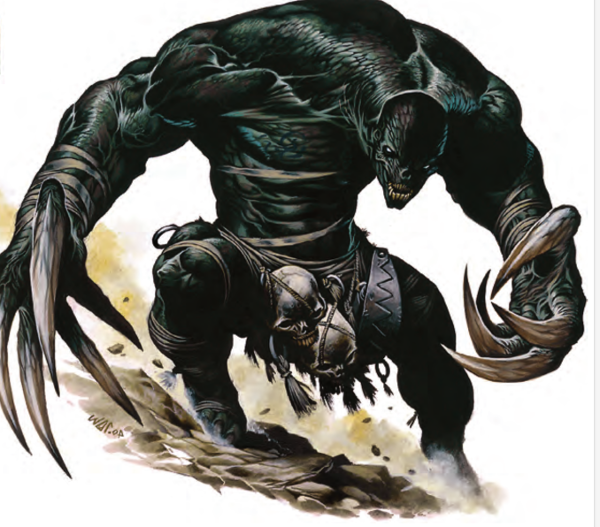
Copyright 2008 Wizards of the Coast The illustration is of a big muscular humanoid with jet-black scaly skin, a skull-like face, and huge claws. It wears a loincloth made out of skulls, so you know he’s Metal. I think they’re originally from some Forgotten Realms book, but I’m not sure.
Here, Astral Stalkers were living weapons created by the gods to fight the primordials. Given they’re Evil, covered in scales and have lots of assassin-themed abilities, I’m placing the blame squarely on Zehir’s shoulders. Abandoned after the war, enough of them survived to form a stable population. They live in small communities in the Astral Sea.
Stalker culture centers on hunting. A village is led by the stalker who has the most impressive hunting trophies, and they love testing themselves against worthy foes. They like to hunt alone but will join up in pairs or larger groups to go after particularly impressive quarries, and might sell their services to other beings.
The Stalker is a Medium immortal humanoid, and a Level 22 Elite Lurker. It can become invisible at will and has a Stealth of +24, meaning that even the designated party radar probably has a less than even chance of detecting it before it strikes. Its opening attack will likely be a bone dart ejected from its throat, which does somewhat anemic damage but will progressively numb the victim: Slowed, moving on to Immobilized and Stunned with failed saves. It will follow this up with claw attacks (two on a slowed or immobilized target, one otherwise) that might each get a sneak attack bonus, and that mark the target as the stalker’s quarry. The Stalker can have one quarry at a time, and always knows exactly where its quarry is even across planes. The only way to stop being a stalker’s quarry is if the stalker kills you or chooses someone else to hunt.
Skill-wise, they’re trained in both Stealth and Perception (Perception doesn’t appear in the skill list, but the +5 training bonus is at the top of their stat block). This makes them good at tracking even before they mark someone as their quarry.
The quarry-related abilities are interesting, and make the Astral Stalker one of the only monsters with powers that span more than a single fight. I can picture a Stalker or two ambushing the party, fighting for a few rounds, marking one or two PCs as quarries and then running away. Then they comes back to harass them all throught the adventure, forcing the PCs to figure out a way to stop them from running.
A good twist on the default stalker story might be to have the party enter a tense alliance with an Astral Stalker to hunt a villain down across the planes. Once the deal is done, the creature might acknowledge the badassitude of the PCs by choosing them as its next target…
The suggested encounter is level 22, and features a stalker that has joined up with a party of epic-level devils. If your party has pissed Hell off in past adventures, this fight would be a good “welcome to epic tier!” event.
As statted, the stalker’s attacks don’t seem to do all that much damage for an epic creature, so it could use some updated math. However, those darts are at-will and Stunned is Serious Business! A Stunned character can do nothing except hope for a successful save. I think D&D 4 players hate this even more than death itself. As an Elite monster the Stalker is also in need of a way to perform two attacks per turn, so my recommendation here would be to make the darts a minor action.
Atropal
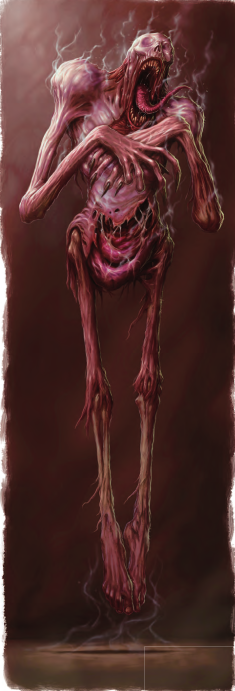
Copyright 2008 Wizards of the Coast Back when I first read the Epic Level Handbook, the description of the Atropal was the first thing that made me go “whoa!”. Their origin here remains exactly the same as it was back then: they’re stillborn gods, scorned by life but still posessing enough power to raise as undead.
The MM uses “unfinished” instead of “stillborn”, and the illustration looks a lot less like a baby than the one in the ELH, which I suppose is understandable. It’s still quite horrific, though. Being Large marks it as the corpse of something not human.
3.x Atropals were quite complex, with lots of spell-like abilities. Here they are Level 28 Elite Brutes who are completely immune to necrotic and poison damage, but Vulnerable 10 to radiant. So it’s not the wizard they must fear, but the cleric. They have 638 HP, and their weak defense is Reflex.
Atropals project a wide-ranging aura that heals undead and damages living creatures caught in it every turn. Getting hit with radiant damage cancels it, but they can start it up again with a minor action. Their basic melee attack is a touch that targets Reflex, with a rider that eliminates the target’s necrotic resistance and gives them a -2 penalty to attacks. Its other attack is the Atropos Burst, which does a bunch of necrotic damage to anyone inside the aura, eats a healing surge, and gives the atropal 1 action point if it hits anyone. Its use it limited, but it recharges every time someone is reduced to 0hp in the aura. For extra Fun(TM), have it fight the PCs in an area containing innocent bystanders or cute woodland creatures that can double as burst fuel.
Oh, and these things move with a fly speed of 9, so they can happily go over your defenders to hit the squishies from above. One can depopulate a city in no time at all just by zooming around and spamming Atropos Burst to kill anything their aura doesn’t.
You’ll rarely fight a lone atropal, of course. They attract other high-level undead. The sample encounter has them being followed by a party of sorrowsworn, which doesn’t really work because sorrowsworn aren’t undead and so will take damage from its aura. I recommend adding one or two epic liches and assorted minions instead.
Blood Fiend

Copyright 2008 Wizards of the Coast It appears that in previous editions blood fiends where what you got when you turned a demon into a vampire. That origin appears to be mostly gone, as they’re not undead here.
Blood Fiends are Medium elemental humanoids and thus native to the Elemental Chaos, but contrary to their name are not demons either. You wouldn’t be able to tell just from looking, though. They’re Chaotic Evil, feed on blood and love hunting for food and sport. They hunt in packs and sometimes associate with other powerful elemental creatures (but not with demons!).
It’s not spelled out, but I would guess that in Fourth Edition these guys were created by the primordials to fight the gods, placing them in direct conflict with the Astral Stalkers. I wonder if they keep hunting each other to this day. It would also make sense to say that, as uncorrupted primordial creations, they dislike demons.
Blood Fiends are Level 23 Soldiers and look like four-armed, hairless gorillas with sharp teeth and claws. They attack with their claws and with an immobilizing gaze attack. If they have combat advantage, they can instead attack with a blood-draining bite that counts as a grab and causes ongoing damage and heals the fiend until the target can escape.
I find them to be kinda bland, except for the fact that they have an Int of 22. This is at odds with pretty much anything else in their stat block, and gives you an opening to play them like sophisticated murder sages. Their only trained skill is Intimidate, which doesn’t mean they can’t do anything else, just that intimidation is their “thing”.
The suggested encounter has three of them working as hired muscle for a pair of efreeti.
Phane
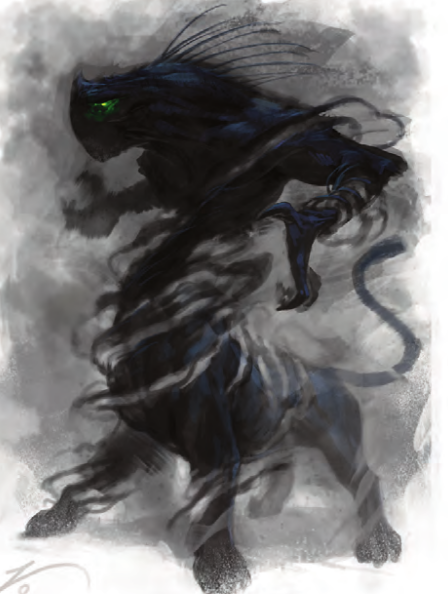
Copyright 2008 Wizards of the Coast I also remember seeing these guys from the Epic Level Handbook, which said they came from either the distant past of the distant future, and were so far from their time of origin that they don’t know how to return any more. While there’s no mention of this background here, it kinda makes sense as the reason why they were included under Abominations - they’re horrors from the edge of time, but which edge is something not even the phanes know.
Phanes are Large immortal magical beasts who live in the Astral Sea but prowl the entire cosmos on the hunt for prey, “walking between moments”. They’re described as liking to spread chaos for its own sake, but are Unaligned and have Int 28, so I guess it should be possible to have peaceful interactions with one. At least until it decides its best shot at returning home is to start a chain of events that leads to a specific future and starts with the death of the PCs.
They’re level 26 Elite Controllers who fight like skirmishers and are all about manipulating time. Their claw attacks target Reflex and both slow the target and allow the phane to shift 4 squares either before or after the attack, so they can play keep-away. Their ranged attack is a Wizening Ray, which targets fortitude and both slows and weakens, with the weakening effect lasting longer. This is explained as artificially aging the target, who looks old and decrepit until they manage to save against all the effects. Phanes also have a Wizening Storm that’s a close burst 1 and seems to age the targets even more (Stunned, with an aftereffect of Dazed and Weakened). They can also automatically cancel a negative effect placed on them per round, through timey-wimey shenanigans.
Phanes are insubstantial, so they take half damage from pretty much anything even before they weaken the PCs. They run and fly very fast, too. Their preferred tactics are playing keep-away and shooting Wizening Rays at the party, so I guess the Wizening Storm is kept in reserve as a nasty surprise in case the PCs manage to get close to them. Man, fighitng these guys must be so annyoing.
The proposed encounter joins a phane with a pair of sorrowsworn and two dread wraiths, the other insubstantial monster that can weaken. I think that’s a tad excessive.
While the provided stat block doesn’t give them any ability to move between planes at will, that’s totally something they should be able to do outside of combat. The same goes for Astral Stalkers, I think.
Tarrasque
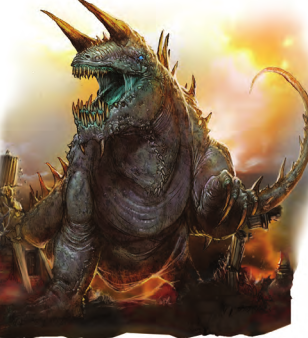
Copyright 2008 Wizards of the Coast This beastie needs no introduction! Present since the days of AD&D, it’s always been presented as kind of the ultimate test of player badassitude, even though it was kinda underwhelming in D&D 3.x.
In 4e the Tarrasque was created by the primordials to destroy the works of the gods, and it’s inexorably bound to the world. I picture its creation being something much like a planetary-scale version of Exalted’s Great Curse, uttered by the defeated Primordials just before they were imprisoned.
The Tarrasque sleeps at the planet’s core and wakes up every once in a while to feed and wreck shit. It’s a Gargantuan Elemental Magical Beast, and a Level 30 Solo Brute, suitable for either the final battle in a campaign or the one just before it (with the final battle being against a primordial or equivalent).
Defensively, it’s immune to charm and fear and has resist 10 to all damage, which is quite rare. It also has an Earthbinding Aura that extends out to maximum longbow range in all directions, and limits flight to an altitude that places it within the beast’s reach. It’s speed is 8 (so, pretty fast), and it also has similar climb and burrow speeds. Yes, it can swim in the ground like it was water to take cover from an all-ranged party and come up from underneath them.
Offensively, its attacks ignore all resistances. Its basic attack is a bite that also causes 15 ongoing damage. While unbloodied, it can use Fury of the Tarrasque, which allows it to make a bite attack and either rend for triple bite damage plus a 1-turn -5 penalty to AC, or to perform a tail slap that throws targets far away and knocks them prone. If bloodied, this is replaced by a frenzy that gives it a bite attack against anyone in a close burst 3. Finally, it can use a standard action to move its speed and trample anyone in its way. As a Solo, it has two action points.
Reducing the Tarrasque to 0 HP (from its initial total of 1412) will simply make it quit the fight and burrow back to the center of the planet to sleep it off. Killing the beast for good involves somehow removing it from the world before fighting it.
This Tarrasque seems to have covered the weakness of its 3.x predecessor pretty well, but it suffers quite a bit from the early Monster Manual math bugs. The damage from its attacks is less than half of what it should be, so be sure to apply the math fixes before throwing it at your party.
Final Impressions
My feelings towards this entry are as much of a mixed bag as the entries themselves. Since I’m not aware of the Astral Stalker’s past incarnations, I have no particular emotional attachment to it, but it seems reasonably cool.
I know of the Atropal and the Phane from the Epic Level Handbook, and from that I see these incarnations of them keep the general flavor of the originals while being effective threats. They could have used a little more lore elaboration, which I guess is true of most monsters in the MM.
The Phane might be a bit too effective, though. Insubstantial plus at-will Weakening attacks is a recipe for a long and drawn-out fight, since it essentially quarters the party’s damage output. Having it team up with wraiths compounds the problem since, as we’ll eventually see, they follow the same formula.
The Blood Fiend failed to wow me. Even with its unexpectedly high Int score it’s still kinda bland, and so easy to confuse with a demon I might as well use a demon instead of it. The “demonic vampire” angle is a little better, so if I had to them I’d probably bring that back.
I’ve always found the Tarrasque cool, and the new “ḱaiju sleeping in the center of the world” bit is awesome. It stats really showcase the problem with too-low monster damage of these early 4e monster books, though, so it becomes a lot less threatening than it’s supposed to be unless you fix it.
-
Let's Read the 4e Monster Manual/Vault: More Aboleths
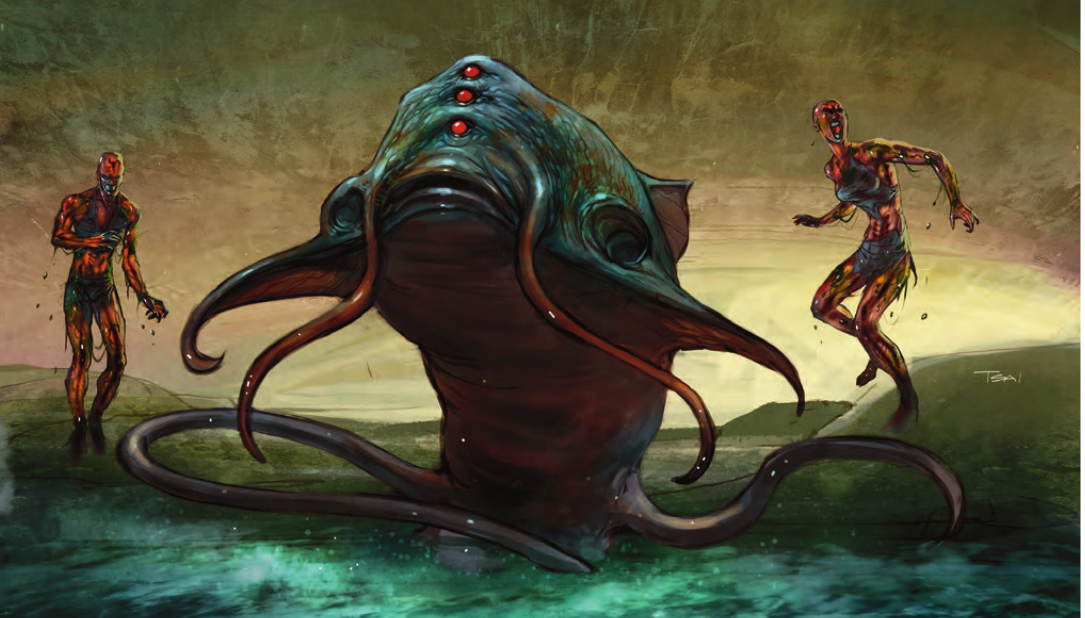
Copyright 2008 Wizards of the Coast This article is part of a series! Go here to see the other entries.
If you’re following this series mostly through Octopus Carnival, you might not know I’m posting it on the RPG.net forums as well. The Aboleth entry sparked some discussion over there, and someone told me there were a few more aboleths detailed in Dungeon Magazine 170. Since I have that issue with me, I took a small detour to talk about those aboleths before moving on to the next Monster Manual entry.
City of Aboleths was published in Dungeon 170, which came out in September 2009. Despite the grandiose name, it’s not actually a adventure, just a pair of combat encounters and a skill challenge. Written by Bruce R. Cordell, it’s a tie-in for a Forgotten Realms novel, also by Cordell.
The Lore
Yes, there’s more aboleth lore here. There’s the classic bit about each aboleth containing the racial memory of its whole lineage, which is always welcome. They don’t die of old age and never stop growing, which is nifty.
Then there’s a bit about how they’re all p-zombies without a sense of self, and another about there being a city called Xxiphu which is the oldest aboleth settlement filled with all sorts of special “superior” aboleth and ruled by the oldest aboleth ever. Both of these I’m willing to discard as being novel tie-in dross.
The Numbers
The new monsters from this adventure are all those special “superior” aboleths from the novel. All except the hatchlings have a fly speed of 8 in addition to their land and swim speeds, and instead of the plain old Mucus Haze each gets a specialized “haze” aura. The increased damage their tentacles do to dazed targets has been separated into an ability called Mind Bore, which deals psychic damage when the aboleth hits a dazed or dominated target with a tentacle. These are the new monsters:
First we have the Aboleth Hatchling, a Small level 16 Minion Skirmisher. It appears aboleths are born with Int 15 and an evil alignment, due to the weight of all those memories. Their tentacle attack does increased damage to dazed targets, as usual, and their haze is an Aura 1 that causes a cumulative -2 penalty to saves against daze or domination. Yes, if you’re surrounded by 4 hatchlings you get a -8 penalty to your saves.
The Aboleth Suffocator is a level 16 lurker with 124 HP. Its tentacles daze, and it has a recharge 3-6 psychic blast called a Brain Lash that also does ongoing 5 psychic damage. When damaged, it turns into a pillar of slime which can’t attack, counts as insubstantial and can shift its full speed. The suffocator can end this as a free action, so it’s useful for repositioning. Its mucus aura gives enemies caught in it a -2 penalty to defenses and saving throws. Fight a suffocator and a bunch of hatchlings and you’re going to dang well stay dazed.
The Aboleth Perceptor is a level 17 soldier with 168 HP. Its mucus aura allows it to ignore all concealment and partial cover when attacking anyone in the aura. The tactics text says the aura also works for its allies, but the stat block disagrees with that. The perceptor’s tentacles pull the target 3 squares and mark it, and it also has an Eye of Madness ranged psychic attack (recharge 5-6) that dazes and marks. Anyone who flouts the mark gets punished by a psychic blast that also makes them vulnerable to further psychic damage. Lastly, the perceptor can shift 5 squares to chase marked targets, as a move action (recharge 5-6).
The Aboleth Behemoth is a Huge level 19 Elite Controller with 362 HP. Its mucus haze works as usual and gives enemies in it a further -2 penalty to saves against daze and domination while the behemoth is bloodied. It makes 2 or 3 tentacles attack per turn, each of which grabs and dazes on a hit. Twice per fight it can whip its tentacles around to hit everyone on a close burst 3 and slide them 3 squares. Its Mind Bore deals ongoing 10 psychic damage instead of just increasing the damage of a single attack by that amount. It also has threatening reach, allowing it to make opportunity attacks against people up to 3 squares away. It fights much like its less special cousin, the Lasher, only it takes up more space.
And lastly, we have the Aboleth Master, which doesn’t appear in the provided encounters and is probably meant to be the “Eldest” aboleth everyone in the novel is so intent on killing. It’s a level 22 Elite Controller with 418 HP. Its haze makes enemies take a -2 penalty to Will against charm and psychic attacks, and pretty much all of its attacks are psychic. It has the Overseer’s Dominate, and Enslave, and can command dominated targets to use any power against their friends, not just at-will ones like usual. Its Mind Bore does ongoing damage, and it has a couple of neat tricks it can use as minor actions. Body Puppet is a ranged attack that does psychic damage and slides the target 5 squares, but ironically it targets Fortitude and so doesn’t benefit from the master’s own aura. Mind Snap does target will, and also dazes.
Fun fact: all new aboleth here have a lower Int than the ones from the Monster Manual. Even the epic Master has an Int of 22, smaller than the 23 of its supposedly “inferior” brethren. The Behemoth has a 5.
Final Impressions
These monsters bring increased variety to an all-aboleth dungeon, but there’s an air of “these are from my novel so they’re extra-special” that bothers me a little. Giving all aboleths a fly speed would be worth it just to see the look on the player’s faces, though. The complementary haze auras thing could also work well.
Still, there are a few weird things here, mostly the stuff that penalizes saves. I’ve yet to see that anywhere else. There’s also the perceptor’s aura doing one thing in the stat block and another in the description, and the master’s aura not helping one of its own powers.
The two provided encounters are level 18, and take place in an “egg cyst”, a cave lined with aboleth eggs and their hibernating guardians. The article recommends adding it as a “side chamber” in a larger Underdark-themed adventure.
The first encounter happens as the party enters the cyst and consists of the classic combo of 2 Aboleth Lashers and 1 Aboleth Slime Mage, only this time they have an entourage of 15 Aboleth Hatchlngs. The second one happens after they cross a stream in the middle of the egg cyst, which wakes up 2 Suffocators, one Behemoth and one Overseer from hibernation. If the PCs wade in the stream while fighitng the first group, it will trigger the second, making them fight against two encounters at once. I’ve had that happen with other monsters in my own adventures, and it was always loads of fun… for me!
subscribe via RSS