Posts
-
Let's Read the Monster Manual/Vault: Banshrae
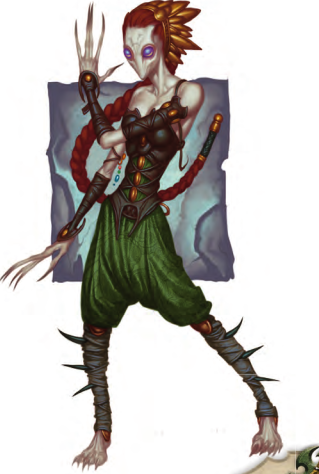
Copyright 2008 Wizards of the Coast This is another entry in my Let’s Read of the Monster Manual and Monster Vault for D&D Fourth Edition. You can see the rest of them here.
A Banshrae is a Medium fey humanoid that looks like the love child of an elf and a praying mantis. Tall and rail-thin, they have alabaster skin, long clawed fingers and triangular mouthless faces with insectile eyes. They’re originally from Third Edition’s Monster Manual V, and here they’re only on the Monster Manual.
The Lore
Banshraes are Unaligned, and the ones we see in this entry have an Int of 14 and a Charisma of 20. Nevertheless, the text repeatedly describes them as cold, sinister and egotistical, with a tendency to view other sapients as sources of amusement or loot rather than as people. The nicest among them are pranking tricksters, and the bad apples are sadistic serial killers. I guess you don’t need to officially swear allegiance to the cosmic principle of Evil to be an asshole.
Having no mouth, banshraes communicate via telepathy. I guess they either don’t need food at all or feed on someting like ambient magic. One interesting factoid is that banshraes love singing and the sound of wind instruments, despite having no way to sing or play themselves. Stories speak of people who managed to avoid being pranked/murdered by a banshrae by singing or playing tunes to it.
The Numbers
Banshraes have speed 8 and low-light vision. Their other signature trait is actually a piece of signature gear: a blowgun and darts, which they can use despite having no mouth. I picture them doing a fancy palm strike on one end of the blowgun to fire a dart out of the other.
The Banshrae Dartswarmer is level 11 artillery with 89 HP, who fights unarmed in melee but whose specialty is firing poisoned blowgun darts that do damage, daze and inflict a penalty to attacks. Every so often (recharge 3-6) then can go “full auto” and fire a dart flurry with the same effect at anyone in a close blast 5. That basically hits the entire PC party unless they’re very spread out.
The Banshrae Warrior is a level 12 skirmisher with 121 HP who can also use a blowgun but who focuses on its praying mantis kung-fu. It can shift 1 square as a minor action after hitting with a melee attack, and it has two of those: a basic slam, and the Staggering Palm. Staggering Palm does damage and stuns the target for a turn, but only recharges after the banshrae uses Mantid Dance.
Mantid Dance is a move action, and lasts a turn. While in effect, it gives the banshrae warrior +2 to all defenses (okay) and makes all ranged attacks automatically miss it (jeepers creepers!). Oh, and they do increased damage if they move far enough during their turn. Having good defenders and solid melee strikers is a must when fighting these fey.
The suggested encounter is level 12: 2 dartswarmers, 1 warrior, 1 ettin spirit-talker and 1 iron gorgon (of the bull-looking kind). I’m guessing these aren’t the “nice” banshraes.
Final Impressions
I don’t think I’m entirely sold on the “heartless serial killer” presentation, but the mechanics inspire me to do a Five Venoms kung-fu storyline with a banshrae dojo as the villains. You could also tone the serial killer thing down and present them as more cruel pranksters who aren’t necessarily out for blood.
-
Kickstarter: The Citadel at Nordvorn
Doug Cole of Gaming Ballistic is at it again with a Kickstarter campaign for The Citadel at Nordvorn, a mini-setting for the Dungeon Fantasy Roleplaying Game and GURPS Dungeon Fantasy. For reasons of my own I won’t be contributing to this one myself, but I will definitely buy it once it’s out.
So please go ahead and back this thing so that I can eventually buy it :)!
-
Manual & Vault: Balhannoth
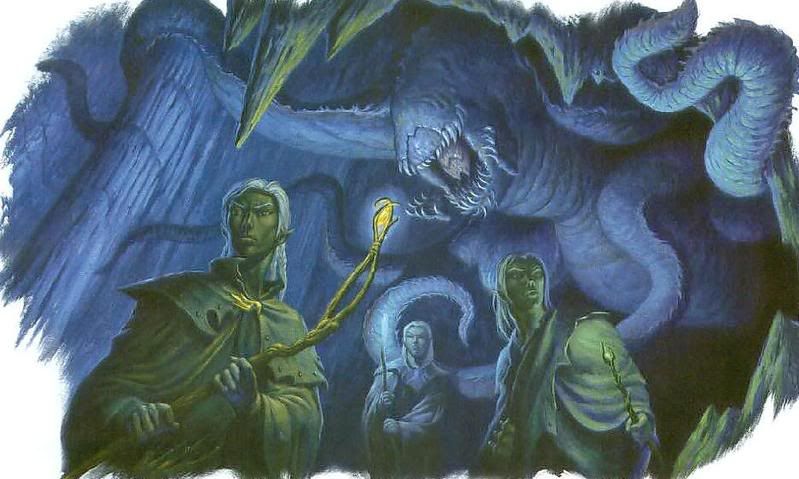
This picture is from 3.5! Copyright 2006 Wizards of the Coast. The first of the Bs! The Balhannoth is a Large Aberrant Magical Beast (blind). “Blind” here is a keyword with some rules attached: blind creatures cannot be blinded (obviously!) and are immune to gaze attacks and other effects that rely on sight. They rely on special senses such as blindsight or tremorsense, but can’t make Perception checks beyond the range of these senses. I’d interpret that to mean they can’t make visual Perception checks.
A level 13 elite lurker, the Balhannoth has a slug-like body that menaces with spikes, five clawed tentacles, and a huge eyeless maw for a face. I’m told they first appeared in the Monster Manual IV for 3.5, but this is my first personal contact with them. They’re only on the Monster Manual and have no Vault version.
The Lore
There isn’t much here. Balhannoths are indiscriminate ambush predators who live in the Underdark. Barely sapient at Int 3, they understand Deep Speech and are Chaotic Evil. Balhannoths might tail their chosen prey for hours, waiting for the best moment to strike.
The evil worm-things rarely associate with others of their own species (except perhaps to reproduce), but sometimes they can be trained to obey commands by other sapients. Telepathic creatures have an easier time of it and can “tame” captured adults. Non-telepathic trainers must train a balhannoth from birth if they are to have any hope of success.
In short, they’re pretty much tailor-made mind flayer pets, and would likely be used like guard dogs and advance forces during a raid. The flayers get the brains, the balhannoths get the rest.
The Numbers
Being blind, balhannoths are immune to gaze attacks and illusions and have Blindsight 10 from ESP. They’re relatively slow at Speed 4, but with spider climb they can pretty much move in three dimensions inside the Underdark. Their main mode of movement, though, is the Reality Shift, a type of teleportation that twists the surrounding space and has a 10 square range.
When balhannoths teleport, anyone standing next to them at the point of departure is dazed, and anyone next to them at the point of arrival grants combat advantage for a turn. They attack with tentacles, and can whip those tentacles around to hit everyone on a Close Burst 3 around them and slide anyone their hit freely within this area of effect. They also do increased damage against targets granting CA and can become invisible at will.
So yeah, this is how they hunt. They’ll sense you through walls using blindsense, teleport to the middle of the party while invisible, and use Tentacle Whip to hurt everyone and ruin your marching order. Then they’ll teleport away and do it again.
The suggested encounters are level 13: 1 balhannoth and 3 grimlock berserkers, or 1 balhannoth and four kuo-toa. The first are likely all servants of a mind flayer, the others had to train their pet ninja slug the hard way.
Final Impression
There’s not much there lore-wise, but I found the mechanics pretty cool. The concept of a teleporting ninja slug has a certain something to it. Level them up to 17 and they’d make good aboleth pets too.
-
Where I Read the 4e Monster Manual: Azer
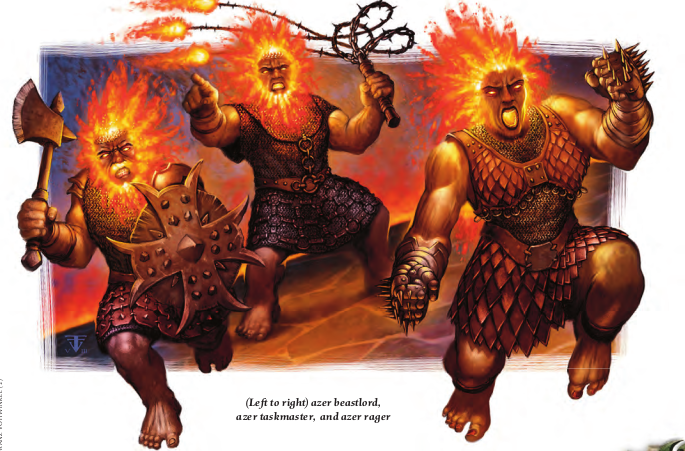
Copyright 2008 Wizards of the Coast To close out the As, we have another classic, the Azer. I remember them from D&D 3.5 as basically dwarves that are on fire. Here we get a tiny bit more background tying them to the Fourth edition cosmology.
The Lore
Way back at the dawn of time, dwarves were all slaves to the giants. Eventually they rebelled against their masters and escaped into the world, where they would proceed to build their own civilization. Well, most of them did.
Those that stayed behind were mutated by fire giants and transformed into azer. Some of those broke free later, but some remain enslaved as laborers and guards. So if you’re raiding the castle of the fire giant king, you’re going to run into troops of azer before you start seeing giants. They’re Unaligned and about as intelligent as regular dwarves, so you might be able to negotiate with them and foment rebellion.
Azer don’t have a Monster Vault counterpart.
The Numbers
As inhabitants of the Elemental Chaos, 4e Azer are paragon-tier opponents. We get several stat blocks for them here. The signature Azer traits are Resist Fire 30 and Warding Flame: each enemy that starts their turn adjacent to 2 or more azer takes 5 fire damage. They are not particularly vulnerable to cold.
The Azer Warrior is a Level 17 Minion, useful for padding out encounters involving fire giants or azer regulars. They attack with warhammers that do fire damage and a tiny bit of ongoing fire damage.
The Azer Foot Soldier is a regular version of the warrior, a Level 14 Soldier with 141 HP. his equipment and attack (singular) are pretty much identical to the Warrior’s, aside from having normal rolled damage for their level.
The Azer Rager is a totally metal Level 15 Brute who has 181 HP. She attacks with gauntlets that menace with spikes of fire (and cause ongoing fire damage). When bloodied, she can call upon Chains of Flame, which cause fire damage in a Close Burst 5 around her and immobilize enemies who were already on fire from other attacks.
The Azer Taskmaster is a Level 17 Controller (Leader) attacks with a scourge that menaces with spikes of fire (and does a mix of physical and fire damage). Once per turn it can cause a nearby enemy who just took fire damage from any source to also take ongoing fire damage. This guy is probably an exception to the negotiation bit - he likely gets special privileges in exchange for keeping the other azer in line.
The Azer Beastlord is a Level 17 Soldier (Leader) or, in other words, a hellhound wrangler. His basic attack is a battleaxe that mixes physical and fire damage, and marks on a hit. The real attraction here are his other powers, though. He can make an allied elemental beast recharge one of its encounter or daily powers as an at-will minor action, and once per encounter he can hand out a free attack to every allied elemental beast who can see him and is flanking an enemy.
The suggested encounters are:
-
Level 14: One pair of azer footsoldiers and one pair of salamanders. These poor sods escaped the fire giants only to be enslaved by salamanders.
-
Level 15: 6 warriors, 2 ragers, and one immolith demon. These poor sods have it even worse.
-
Level 17: One taskmaster, one beastlord, 8 warriors and 1 firebred hellhound. These could be free azer! You should totally swap the warriors for another 2 hellhounds.
Final Impressions
Dwarves on fire! The foot soldier is a bag of HP with a single melee attack, so it’s quite boring on its own. The others are a bit more interesting, though I feel like the taskmaster should have a ranged attack of some sort. In fact, the azer lineup in this book is very lacking in ranged firepower, so they need some external artillery support. They also suffer from the classic “fire monster in a fire dungeon” problem, where any smart party will prepare themselves to resist much of their damage.
The most fun of the lot is definitely the Beastlord, particularly when associated with a pack of hellhounds or even other, non-fire elemental beasts.
If your previous exposure to Azer was the low-level stat block in the 3.x monster manual, seeing them as mid-to-late paragon tier creatures might be a bit jarring. Their abilities are simple enough that you could comfortably reduce their level by 10 or so to make them appropriate for heroic tier games without changing what they do in combat.
-
-
Where I Read the 4e Monster Manual: Archons
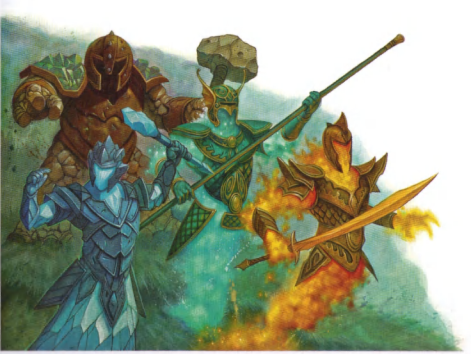
Copyright 2010 Wizards of the Coast Like Angels, Archons in 4e are significantly different from the monsters bearing the same name in earlier editions. In most of those they used to be Lawful Good angels, but here they are elemental creatures who made up the bulk of the Primordial armies during their war with the gods.
Back at the start of the Dawn War, the Primordials primarily used giants and titanic elemental beasts against the gods. These were powerful but few in number, and so effectiveness against the countless angels and exarchs of the divine host was limited. Eventually the Primordials would learn to forge archons from “raw” elementals, putting both sides on a more even footing.
Archons are militaristic and well-versed in tactics despite being Chaotic Evil, which can easily be explained by two important traits of 4e’s alignment system: 1) “chaos” here means ruin instead of randomness and 2) Chaotic Evil is the alignment of Team Primordial, and these beings are definitely still on Team Primordial. These days they can be found serving as muscle for a variety of similarly-disposed elemental beings, or protecting sites of importance to the imprisoned primordials.
Like Angels, Archons are paragon-tier monsters. The Monster Manual presents fire and ice archons, but also says there are a bunch of other types. Earth and Air are obvious, but you also have more “exotic” types like Slime, Storm, and Crystal. A typical archon force is composed of a jumble of different archon types, though without strong leadership they’re prone to infighting.
The Monster Vault text further stresses their leadership skill and tactical prowess, and pictures them as less prone to infighting than what the Monster Manual said. It contains four Archon stat blocks: Earth, Fire, Water and Ice.
Archons generally look like humanoids sculpted out of their element, wearing fancy (and spiky) military gear.
Fire Archons
Fire Archons are quite fast at Speed 8, are immune to disease and poison, and have Resist 30 Fire. That last bit means you can theoretically pull a Dark Schneider on them and prove your awesomeness by killing them with fire. Also of note is the fact that none of them are particularly vulnerable to cold.
Fire Archon Emberguard
This dude is a Level 12 Brute clad in plate and wielding a greataxe. They have 151 HP and somewhat subpar non-armor defenses. They have an aura that causes fire damage to anyone adjacent to them. Their attacks appear to suffer from some editorial issues, as they’re even less accurate they than should be by the early monster math. In any case, they have a basic axe strike that does a combination of physical and fire damage with the High Crit property, and a Recharge 3-6 version that also causes ongoing fire damage.
I addition to fixing their accuracy and damage, I’d suggest just adding the ongoing fire damage to their basic melee attack.
Fire Archon Blazesteel
These Level 19 Soldiers are the shock troopers of the primordial armies, and can also be found working for efreets and fire titans. They have 182 HP, and their Will is substantially weaker than their other defenses. Blazesteels (weird name) fight with flaming scimitars that deal physical and fire damage and mark enemies they hit. They don’t have any powers that exploit the mark, but they do get to make two attacks and deal extra fire damage against enemies that grant them combat advantage. This means they do well in a team that includes skirmishers who are good at flanking.
Oh, and they blow up once bloodied and once again when dead, catching everyone in a Close Burst 2 in the ensuing conflagration and dealing ongoing fire damage.
Fire Archon Ash Disciple
The ash disciple is a Level 20 Artillery archon, who is a bit odd in that all its ranged attacks are encounter powers. There’s a Rain of Fire that deals ongoing damage (or half damage on a miss); a Flame Wave that pushes and deals 10 ongoing fire damage; and a Cinder Burst that blinds. It’s only at-will ability is a funky teleport that makes it appear out of a nearby fire creature (like another fire archon).
Once its encounter powers are gone, the ash disciple will have to join the melee with its weak fists, and be content in the knowledge that it will blow up when it dies with an explosion similar to its Cinder Burst. This will happen fairly fast, because as an artillery monster the flame disciple has only 150 HP.
I’d strongly consider adding an at-will single-target ranged attack to this monster.
Monster Vault Fire Archon
Being the sole fire archon in the Monster Vault, it doesn’t have a fancy name. It’s a level 13 skirmisher with 130HP and only Resist 20 fire, which leads me to think we can lower the resistance of the MM archons to that level. Also unlike the MM archons, this one is vulnerable to cold: taking cold damage prevents it from shifting for a turn.
It attacks with a scimitar that does fire damage, can shift up to half its speed as a move action, and has a Blaze Step encounter power where it shifts its whole speed and leaves a trail of fire on the ground. This trail deals 10 fire damage to whoever crosses it and lasts until the end of the fight.
I like this one. A simple monster that feels fiery and skirmisher-y.
Ice Archons
Like fire archons, but with ice. Speed 6 with ice walk, immune to disease and poison, and with Resist 30 to cold.
Ice Archon Hailscourge
A plate-clad icy ninja who hops around throwing ice shuriken. Level 16 artillery. It can throw two of those shuriken on its turn, or it can conjure a Recharge 5-6 hailstorm that has a variable area burst radius and does half damage on a miss. If a PC tries to tag it with a ranged, close, or area attack it can summon an ice shield once per encounter that will negate 20 damage from that attack.
Simple but interesting. The only thing preventing it from being cool are the usual math issues and the archon-specific editing problems. Be sure to correct for those if you want to use it.
Ice Archon Rimehammer
A level 19 Soldier who fights like a Brute. His huge ice maul slows on a hit, and deals extra damage to slowed targets. Its most soldierly trait is an aura that freees the ground around it and makes it difficult terrain to enemies.
I feel the rimehammer would work best as a brute, since its arsenal is pretty similar to that of the Aboleth Lasher, who is a brute. In fact I’d say the rimehammer is less dangerous than the lasher, despite being 2 levels higher.
Ice Archon Frostshaper
Like Elsa, but evil. A Level 20 Controller (Leader), it has a large aura that gives Regeneration 10 to any cold creature inside and turns the ground into difficult terrain for enemies. Its basic melee attack is an ice blade that does cold damage, and it throws ice javelins that slow for a turn. It also has an Icy Burst area attack that slows on a hit but still does half damage on a hit, and recharges whenever the frostshaper hits with a melee attack.
This suggests its strategy should be to mostly fight in melee and use bursts to interfere with more distant fighting.
Monster Vault Ice Archon
This level 13 soldier has 135 HP, a cold resistance of only 20, and takes a -2 penalty to all defenses for a turn when hit with fire damage. It attacks with an mace that does cold damage on a hit and applies a mark to everyone within 2 squares whether it hits or not. If a marked enemy tries to flout the mark (i.e, make an attack that doesn’t include the archon as a target) it gets smacked with an attack that does cold damage and weakens.
Now that’s a proper soldier monster.
Other Monster Vault Archons
Earth Archon
This level 12 brute has 149 HP, earth walk, tremorsense, and is immune to petrification in addition to the usual disease and poison. If it takes thunder damage, it’s slowed for a turn.
It attacks with a stone warhamer for Brute damage, and has a powerful Avalanche charge that does more damage and knocks the target prone even on a miss. This last one recharges once it’s bloodied.
Water Archon
A level 14 controller with 140 HP, a swim speed, and 20 acid resistance. It’s slowed for a turn if it takes cold damage.
Its staff slows the target for a turn on a hit, and it also has an at-will Whirlpool power that can hit everyone on a Close Burst 3 and slide them up to 3 squares. It’s an hilarious way to mess up the party’s carefully orchestrated formation.
Archon Encounters
There’s only one Monster Manual section with suggested encounters for all archons. The general theme is “pair fire archons with other fire monsters” and “pair ice archons with other ice monsters”.
I say it might be more interesting to mix up the elements, and have a mixed-archon force face the PCs. That way it will be harder for them to protect against all the types of elemental damage involved. The Monster Vault bears this out with its presentation of a multi-element sentai team of similar levels. There are no “suggested encounter” sections in the MV, but it’s obvious you’re supposed to meet all four of its archons together.
Final Impressions
I find archons to be serviceable minions of the Primordials in concept, but the Monster Manual batch seems to suffer from issues beyond those that can be explained by early monster math. All of their attacks are too inaccurate, and they generally work in a somewhat odd manner (like the ash disciple lacking an at-will ranged attack). I’m guessing these were some of the first monsters written for Fourth Edition.
Comparing the archons from both books side by side makes the MM ones seem particularly janky, since the Monster Vault gives us a well-oiled elemental sentai team where each archon has a very simple stat block that nevertheless showcases what its role is supposed to be all about.
The one thing I prefer in the MM archons is their lack of vulnerability to their opposiing element. It makes sense that they wouldn’t be vulnerable to each other if they’re meant to work together, and it lets you spring a little “gotcha” moment on PCs who think they’re clever for thinking fire pokemon are weak against ice.
subscribe via RSS