Posts
-
Where I Read the 4e Monster Manual/Vault: Aboleth
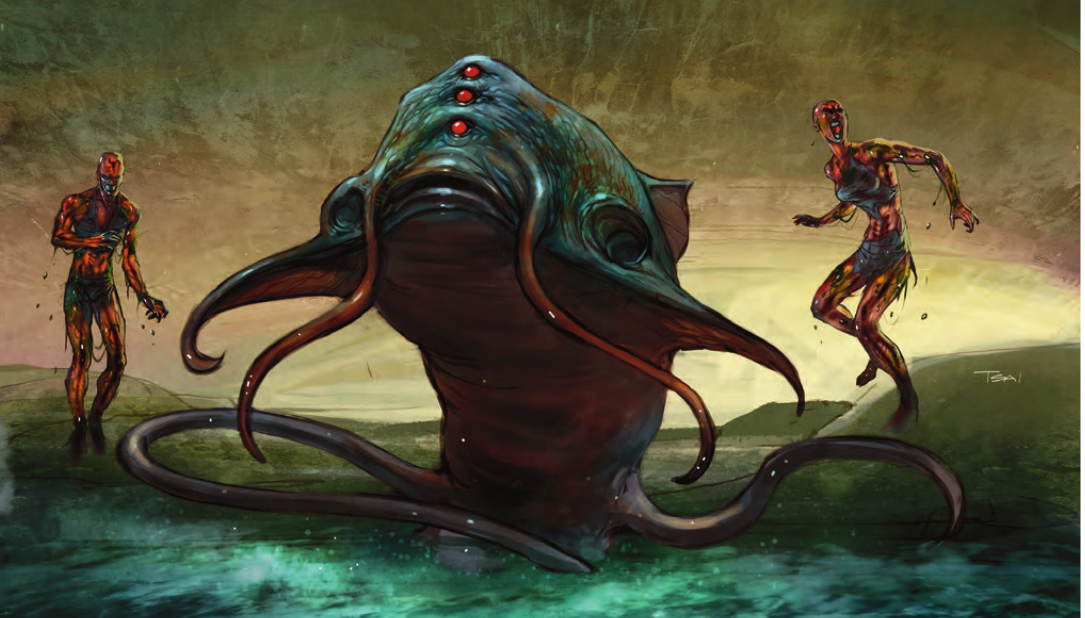
Copyright 2008 Wizards of the Coast This article is part of a series! Go here to see the other entries.
Our first monster is the Aboleth, everyone’s favorite fishy masterminds. Background information on them here is a bit sparse if compared to previous editions, though this was remedied later in 4e’s lifetime. They’re only on the Monster Manual.
The Lore
The book says Aboleths are hulking amphibious creatures that originally hail from the Far Realm, but now live in the Underdark, swimming its lightless depths and creeping through its tunnels while leaving a slimy trail. Sometimes they make their lairs closer to the surface, though. Aboleths are telepathic and may live together as broods, attended by willing Kuo-Toa servants or by slimy servitors created through a ritual from humanoid victims.
Peeking at the stats we can see all aboleths are Evil and highly intelligent (Int 23), so they retain their story roles as fishy masterminds. The two new things here, as far as I know, are making them amphibious and explicitly linking them to the Far Realm. The amphibious thing is really welcome in actual play, since it gives the GM lots more options for evil plans they can enact, and for how the PCs can confront them.
The Far Realm thing is interesting because it provides us with a link between aboleths and the other pseudo-Lovecraftian monsters in this edition. Basically, anyone with the aberrant origin in 4e has some tie to the Far Realm.
Future books for 4e would elaborate on the Aboleths a bit more - they’re actually survivors from a previous universe, escaping its destruction by hiding in the Far Realm and then migrating to the current world after it was created. I like that a lot! If you combine that with the “ancestral memory” thing they had in previous editions, this means they have access to staggeringly ancient and eldritch secrets. “Why yes, I just sold a copy of Summon Azatoth to this dapper gentleman that came in here just before you. Why am I packing my bags? No reason, really.”
The Numbers
We get three aboleth stat blocks here. While they’re pretty different from each other, they all share a few signature traits.
First, all of them have a swim speed of 10 and a land speed of 5. That means they’re as fast on land as a dwarf or an armored man! They attacks work just as well in and out of the water, of course.
Second, they all have an ability called Mucus Haze, an Aura 5 which makes enemies treat the affected area as difficult terrain. Aboleths aren’t just slimy, their slime is this almost sentient thing that pollutes the air and clings to any who dare oppose them, slowing them down.
And third, their basic melee attacks (tentacles!) all cause increased damage against Dazed targets. We’ll see how each aboleth variant exploits this.
Our first monster in this entry is the Aboleth Lasher, a level 17 Brute. Defensively it has 200hp and average AC for its level and role (29), but his other defenses are lower than I would expect (27/25/25). Its tentacle attack does Brute-level damage and Dazes, and it gets to make two against targets that grant it combat advantage. A simple and direct creature with a simple and direct strategy: charge someone and keep tentacling them until they die. Bonus points if that someone is the wizard or another equivalent squishy. “Simple and direct” doesn’t mean “dumb”, though. The Lasher has Int 23, so even he is qualified to be a sinister mastermind and to fight smart. And as a Regular monster, he won’t be alone.
The Aboleth Slime Mage is the Level 17 Artillery variant. It has better defenses (AC 31, others 28/28/29), but only 128 HP to its name. This one is going to open up with a Slime Burst that selectively targets enemies in an Area Burst 4, which pretty much means “all the PCs”. It does okay damage and immobilizes with a Slow after-effect. Then it’s going to use an at-will Dominate on the PC with the lowest Will defense, and proceed to chuck Slime Orbs (that damage and Slow) at the squishies (or anyone who managed to dodge the opening salvo). It can only dominate one PC at once, but there’s a good chance someone will be dominated at any one time. Anyone who attempts to engage the slime mage in melee has to get through the Mucus Haze while slowed, so good luck with that. If they do manage it, they will only have to contend with the mage’s lackluster tentacles, and will be able to make opportunity attacks if it tries to use any of its other powers.
Finally we have the Aboleth Overseer, a Level 18 Elite Controller (Leader). Its defenses are the expected for its level, with Reflex being a little weaker. Its Psychic Slime attack will likely catch the whole party in its area of effect and Daze everyone it hits so the Lasher (above) can start doing increased damage from the start. Fortunately, it can be used at most twice per fight. It has the same Dominate attack as the Slime Mage, but it can follow that up with Enslave, dealing obscene psychic damage to a dominated creature and making the domination permanent if it reduces the victim to 0 HP. It can also make itself and one ally temporarily invisible once per encounter, so it pairs well with a lurker. Its tentacle attack does okay damage and Dazes as well.
Now, Enslave is a bit confusing. Does the victim get some HP back when its enslaved, or do they just drop as normal? I’m inclined to go with the first option, giving them a healing surge’s worth so they can keep being a nuisance in the fight. In any case, the “permanent” domination ends if the rest of the party manages to kill the Overseer. Should the Overseer manage to escape along with the enslaved victim, it can use a special ritual convert them into an Aboleth Servitor, which is actually for-reals permanent.
Aboleth Servitors are humanoids whose skin has been turned into transparent slime. They have a swim speed and breathe underwater, but suffer greatly if they get too far away from their aboleth master. The average servitor is a Level 16 Minion, but I imagine the GM could custom-build a “named” Regular or Elite minion for those times when the aboleths manage to make off with an enslaved PC. You can also make any other appropriate monster into a servitor by giving it a swim speed and the Aboleth Devotion trait from the minion (and possibly increasing its level to somewhere around 16 if it’s lower).
Suggested encounters are a level 17 composed of 1 Slime Mage and 2 Lashers alongside a troop of Kuo-Toa minion guards, or a level 18 composed of 1 overseer with 8 minion servitors plus a Nabassu Gargoyle and a Savage Minotaur, which I guess would be those custom-built servitors I conjectured about.
These are “Final Battle” material for a level 13 or 14 party, or the sort of patrol a level 17-19 party might expect when raiding the fortress of a large aboleth brood.
Final Impressions
I never gave aboleths much thought before, but these are quite nifty! I think it helps a lot that they can go on land now. Your players might not find then as nifty as I do, though, since they’re quite liberal with distributing the Dazed condition. 4e players hate Dazed and Stunned, since they sharply limit their actions during combat and can be actually harder to get rid of than being at 0hp or less. Domination is a bit worse, because you’re both Dazed and playing for the other team.
Aside from being highly intelligent, all the aboleths presented here are trained in Arcana, Dungeoneering and Insight, so you can still have a scenario where the party needs to negotiate for an aboleth’s services as a sage. Dungeoneering in 4e also includes knowledge about aberrant creatures, so it’s also a good proxy for knowledge about the Far Realm.
-
Let's Read: The 4e Monster Manual and Monster Vault At the Same Time!
Lately it seems “Let’s Read” threads of various D&D books are becoming quite popular over on RPG.net, so I though I would get in on the action, starting with the first Monster Manual for Fourth Edition. And after thinking about it for a while longer, I became convinced that you can’t discuss the first Monster Manual anymore without also looking at the Monster Vault.
Fourth Edition is one of my favorite editions of D&D1, even though it doesn’t get much love from the general public these days. So I’m going to write these posts assuming that the reader doesn’t have a lot of familiarity with that edition. This means we’ll start with a basic explanation of Fourth Edition’s philosophy on monsters.
One of 4e’s design goals, particularly in its early days, was a focus on gameable content. That means that every monster in the Monster Manual has to be something you can potentially fight. As a result, there are no harmless “fantasy wildlife” entries here, and almost no “always Good” monsters. In fact, some creatures that used to be “Always Good” in previous editions have been made more morally flexible, to increase the chance that Good-aligned adventurers might come into conflict with one. Harmless or always-Good creatures still exist, of course, but the thinking here is that if it’s not something you’re going to fight, it doesn’t need a full stat block. This is one of the things that got edition warriors in a tizzy, but I kinda liked it.
The space saved from this is used to present you with several different stat blocks for each entry. There is no “generic kobold”, for example, but rather a mix of them built for different purposes so that you can design all-kobold encounters with interesting tactical situations. They’ll still all feel like kobolds, though, because all of them are going to have a few “signature” traits that are common to all kobolds.
This brings up another major “philosophical” difference between this edition and others, in that you’re pretty much never expected to fight any given monster by itself. The CR system from Third and Fifth kinda leads you to think that way2, but here it’s a little easier to keep in mind that an “encounter” is a group of monsters with complementary abilities. Combat is a team sport!
Having said all that, I should point out a few bugs in the system that will be particularly relevant for this Let’s Read. Fourth Edition’s monster design system3 was a little miscalibrated up until the release of the Monster Manual 3. The main issue is that monster damage was too low, particularly for high-level monsters. Elites and Solos also had defenses that were a bit too high, which could extend combats past the point where they stopped being fun. Since we’re reading the very first Monster Manual, every single monster is going to have this problem, so I’m not going to mention it in each individual entry.
That’s where the Monster Vault comes in. It was released a couple of years after the first MM, as part of the D&D Essentials line4, and it basically updated all the most popular monsters from the early books to the new math. Presentation-wise, it featured improved stat-blocks that were easier to read at a glance along with larger and better-organized lore entries for each monster. The idea here was that if you were starting out with the Essentials books, you could get the Vault and skip the older monster books, and if you already had those you could buy the Vault as an update.
I’m going to read both of them in parallel! Whenever a monster features in both books, I’ll compare them and talk about the differences. Otherwise, I’m just going to discuss the monster as presented, but will kinda assume you’re going to apply the necessary fixes if you use any MM-only monster.
By the way, this is a list of quick fixes you can make to bring early monsters more or less in line with the “new monster math”:
-
Add +1/2 level to all of their rolled damage (so a level 10 or 11 monster would get +5 damage to all of its attacks).
-
Add +2 to all attacks for Brutes.
-
Reduce all defenses for Elite and Solo monsters by 2.
The first fix is courtesy of this Blog of Holding post, which also presents another, unofficial fix proposed by players who still think the resulting combats are too long: reduce base monster HP by 3 times the monster’s level. So a level 10 regular would have 30 fewer HP, an elite 60 fewer, and a solo 120 fewer.
And that’s all for the introduction. Tune in next time for our first baddie, the venerable Aboleth!
-
My favorite edition of D&D, as I’ve written before, is GURPS Dungeon Fantasy. ↩
-
Though obviously it allows you to design encounters against larger groups. It’s just less intuitive about it. ↩
-
I feel it’s the best monster building system out of all editions of D&D. I would be glad to elaborate on this on a separate post. ↩
-
Essentials was almost, but not entirely unlike a “D&D 4.5”. All of its books are still compatible with the originals, but follow some different design principles. ↩
-
-
New-School Turn Undead
Turn Undead was the iconic ability of old-school D&D clerics, moreso than spellcasting. They could do it at will right from level one. It started fairly effective at turning skeletons and rapidly grew in effectiveness, affecting more powerful types of undead and eventually destroying the less powerful ones instead of just making them run away.
In Dungeon Fantasy, True Faith with Turning shares most of these traits. It doesn’t let you destroy undead, but it still makes it a lot easier for the rest of the party to finish the job. Particularly if they have ranged or high-Reach melee weapons!
After several editions of evolutionary pressure, D&D Turn Undead became quite different. In most “modern” editions it was renamed to something like “Channel Divinity” or “Channel Positive Energy”. It could only be used a few times a day and had several possible effects. When used for its original purpose, it caused damage to undead instead of turning them. The effectively turned it into a secondary ability, taking a backseat to spellcasting.
This “new-school” form of Turn Undead might look something like this in Dungeon Fantasy:
Channel Divinity (18/27/36 points)
Pre-requisite: Power Investiture (Holy) or Holy Might 1+.
You channel the powers of your deity into a blast of glorious light that emanates from your body and causes terrible burn to evil undead caught in its radius!
Using this ability requires a Concentrate maneuver and costs 2 FP. It affects any foes who would also be vulnerable to standard Turning, out to a distance of 4 meters/yards from you. Roll a Quick Contest of Will with each such target. You have a bonus to this contest equal to your Power Investiture (plus +1 or +2 for an exceptional holy symbol) and a penalty equal to the distance between you and the enemy in meters/yards. A monster’s Resistance to Good applies a bonus to its Will. Any foe who loses this contest takes 2d, 3d or 4d of burning damage (depending on the level of this ability). This damage bypasses all DR and affects insubstantial undead!
Statistics: This is Burning Attack 2d, 3d or 4d with the following modifiers: Area Effect, 4m, +100%; Affects Insubstantial +20%; Malediction 1, +50%; Affects only Truly Evil Undead, -50%; Costs Fatigue, 2FP, -10%; Emanation, -20%; PM: Holy -10%.
Design Notes
This power is basically just an area version of the Smite ability from Monster Hunters. The Accessibility limitation that restricts the target it affects is a little different, but I gave it the same value because it doesn’t change the size of the affected group all that much.
It makes clerics a lot more dangerous against undead in close combat, and gives Holy Warriors a good area attack option against such foes. Taking this instead of traditional Turning sacrifices some tactical flexibility in exchange for increased damage potential. It suits firebrand clerics of sun deities and the like. Of course, there’s nothing preventing a suffciently powerful character from eventually acquiring both!
Channel Divinity does not make [Smite Evil][1] redundant, since the valid targets for both abilities are slightly different. Smite Evil could affect demons, for example, but would do nothing against mindless undead. It can’t be combined with Smite Evil.
-
I Shall Smite Thee! Smite Evil in Dungeon Fantasy
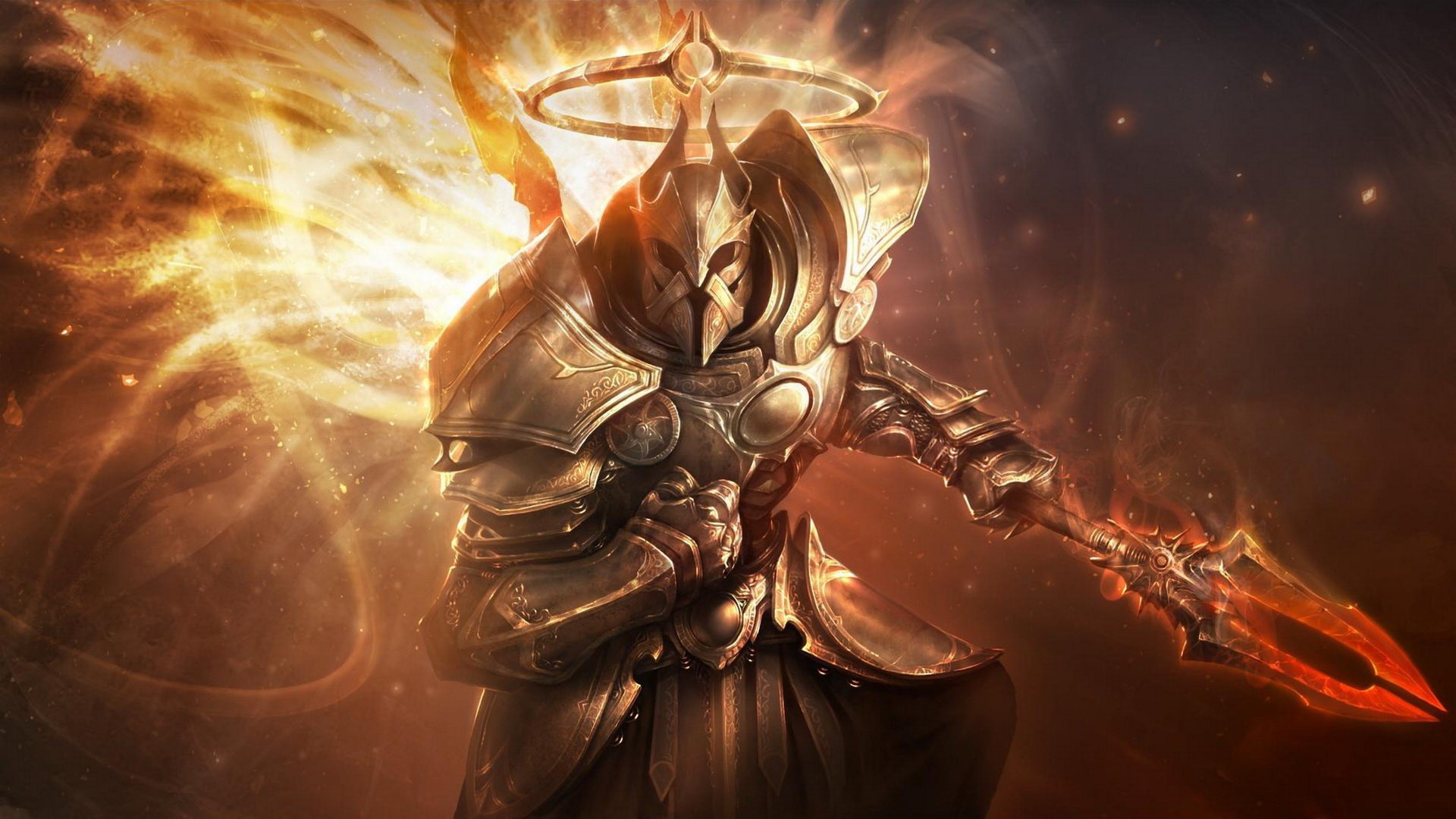
More love for Holy Warriors! (image source) Almost all of the classic Paladin abilities from D&D have a clear analogue in the list of powers available to Holy Warriors in either version of Dungeon Fantasy.
With one exception.
Smite Evil (5 points/level)
Pre-Requisite: Holy Might or Power Investiture (Holy) 1+.
You can empower your blows with the very wrath of the heavens! Channeling raw Holy Might in this way can be tiring, but it can also be just the thing to bring down a powerful servant of Evil.
You can buy as many levels in Smite Evil as you have levels in Holy Might. You can declare you’re using it before you attack an enemy with your fists or with a weapon. For each FP you pay (up to your level in this ability) your attack will cause an extra 1d of follow-up burning damage to the enemy if it hits!
This damage is effective against insubstantial targets, even if your normal weapon attacks aren’t. On the other hand, it only affects Truly Evil foes. Smiting anyone else just wastes the FP, but at least you’ll know immediately why it didn’t work. Detect Evil is a very useful companion to this ability!
Statistics Each level is Burning Attack 1d (Follow-Up, Universal +50%; Affects Insubstantial +20%; Variable +5%; Only against Truly Evil targets -50%, Costs Fatigue, Variable, 1 FP/die, -15%, PM: Holy, -10%) {5}.
Design Notes
Smite Evil is the most popular ability of D&D Paladins. It’s present in all editions of the game, though its implementation differs substantially from one to the other.
The ability as presented above is somewhere between the 3.5 and Fifth Edition versions. Like the one in 3.5, it enhances a single attack and its use is a waste if the target is not evil or if the attack misses. Like the one in 5th edition, its use is limited by the same resource you would use to cast spells. As a Holy Warrior, you have to put some thought on when you use Smite Evil, but the cost of a missed attack can be recovered with a few minutes’ rest.
The “Only against Truly Evil targets” limitation is inspired by a similar limitation in the Smite power found on GURPS Monster Hunters 1: Champions. It includes a bunch of undead and demons, as well as a few other monsters, but also excludes a lot of common opponents, so I feel that’s a fair value. Damage from Smite Evil counts as holy, so if you have a Truly Evil monster who is also extra-vulnerable to holy attacks, this will make them dead very fast.
The variable fatigue cost limitation was calculated according to the guidelines in GURPS Power-Ups 8: Limitations, and Universal Follow-Up is from its sister volume on Enhancements.
If you want your holy warriors to smite evil at will, removing the variable FP cost would bring the ability’s cost to something like 6 points/level and make it a lot more devastating against evil monsters, particularly at higher levels. Allowing it to affect anyone would make it cost around 8 points/level, but would potentially step on the Knight’s toes. Doing both would bring the cost up to around 9 points/level.
Alternate Smites
Higher Purpose works as a lower-intensity at-will smite in the vein of some D&D 4 powers, since it gives bonuses to attack and damage against demons and/or undead. Heroic Feats is a bit like Pathfinder’s version, giving you bonuses for a limited amount of time instead of affecting one attack.
By the way, the Smite power from Monster Hunters would itself be a nice Holy Might power for those characters who rely more on their strenght of will than on their muscles. In Dungeon Fantasy it would cost 10 points/level and be similarly limited by your level of Holy Might or Power investiture, and only affect Truly Evil monsters.
All of these abilities can coexist peacefully in the same campaign, or even in the same character with enough points. Smite Evil stacks with both Higher Purpose and Heroic Feats, but not with Smite from Monster Hunters due to the way Universal Follow-Up works.
-
My Dungeon Fantasy House Style: Characters
Illustration by Bill Sienkiewicz Back when I statted up the Pathfinder Iconics for both versions of Dungeon Fantasy, I decided to work under a set of restrictions to make those characters more “by the book”. The idea was that anyone who had either GURPS DF or the DFRPG boxed set could pick the appropriate version and start playing.
Were I making those characters solely for my own use, however, I would have done a few things differently. Like everyone else, I have a particular “house style” shaped by my personal preferences. And like everyone else who owns both versions of DF, I have a particular way of picking which version of the rules to use for any given situation.
I plan to discuss those preferences in this article, for a simple reason: I want to post more characters in this blog, and I want to make them according to my own preferences. It’s useful for the reader to understand what those are!
Character Templates
Any professional template from the main GURPS Dungeon Fantasy line or the DFRPG box set are allowed. Pick whatever version you like best! You can also use any templates published in Octopus Carnival. Templates from other sources are subject to my review on a case by case basis, provided I have access to the source in question.
The same goes for racial templates. In fitting with my stated policy on this post, however, I consider attribute adjustments and traits with a “cultural” origin to be mere suggestions and not part of the template. If you want your dwarf to be a hard-headed greedy grump, take those as individual disadvantages.
Traits and Powers
Most traits and powers that exist in both versions of Dungeon Fantasy are identical in both, but when that’s not the case I generally go with the cooler or cheaper version. “Resistant to X” is the one that comes to mind here. I prefer the DFRPG version because it’s slightly cheaper and more granular than the default GURPS one.
If a power only exists in one version of the game, you’re obviously still allowed to get it no matter where you took your template from. DFRPG bards can learn Alarum, and DFRPG druids can have animal companions.
Spells
I’ll be honest, my mastery of the GURPS Magic system leaves something to be desired when compared to my knowledge of its other rules. I’m a fan of fighters, what can I say? For this reason, DFRPG: Spells is the baseline magic book for any campaign of mine. The spells in there are already pre-selected and pre-edited for a Dungeon Fantasy campaign. Spells not present in that book will be allowed on a case-by-case basis.
Equipment
The “canonical” weapons list for my campaigns is the one from Low-Tech, though the one in DFRPG: Adventurers will do as a substitute in a pinch. As far as I know, it just has less weapons. Weapon modifiers are the ones in DFRPG: Adventurers. The “canonical” armor list is the one from DFRPG: Adventurers. The Basic Set one feels outdated, and Low-Tech’s hit location rules are too complex for me.
I haven’t had to deal with characters of wildly differing sizes yet, but I’m tempted to use the scaling rules in vanilla DF when that happens. Just for armor, though. For weapons, just pick an appropriate stat line for a smaller weapon and wield it with the skill that feels right. For example, a pixie knight might wield various knives with Broadsword, Two-Handed Sword or Polearm depending on size.
Other gear should generally be taken from the DFRPG list, though I gather it’s similar enough to most GURPS sources that you can take something from Low-Tech or the Basic Set if you really want it.
The Tech Level is 4, when that matters. The availability of guns is decided on a per-campaign basis.
Side Note: Iconics in the House Style
If I were to stat up the Pathfinder Iconics in my “house” style, they’d mostly follow the DFRPG templates, but freely borrow from the GURPS DF line for powers. Kyra would get her fire spells, Lem would get his bard song, Lini her pet leopard, Sajan his kopesh, and even Valeros his Dual-Weapon Attack. I guess the exceptions would be Amiri and Merisiel, as I find their DFRPG selves all-around better than the original.
I’m not going back and statting these bozos up a third time, though. I leave that as an exercise for the reader.
subscribe via RSS