Posts
-
Let's Read the 4e Monster Manual/Vault: Battlebriar
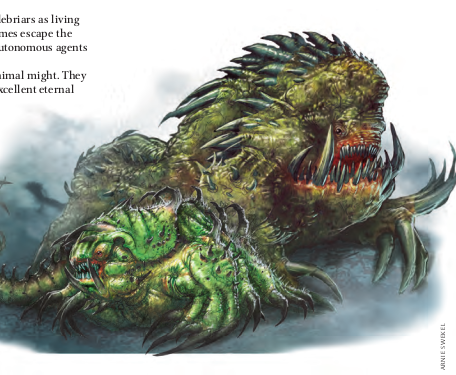
Warthorn (left) and Earthrager (right). Copyright 2008 Wizards of the Coast Today’s monster is the Battlebriar, a plant creature that’s entirely new to me. It exists only on the Monster Manual.
The Lore
Battlebriars are weaponized biotech! These plant monsters were created to serve as living siege engines. A direct quote from the book: “They can destroy massed formations of lesser troops, storm defended embankments, or bring down fortifications.”
Being plants, these living engines of destruction are surprisingly low-maintenance. As long as a battlebriar has access to water, fertile soil and sunlight, it can live forever. This makes them good guardians in addition to being siege weapons. Fey creatures like to use them to guard their strongholds. Other battlebriar users include Hill Giants, which I found quite interesting. Sometimes they also escape their masters and go live in the wild.
Battlebriars are Unaligned and have Int 3, so PCs are most likely to fight them when going against their masters. A wild battlebriar will likely leave the PCs alone if they don’t provoke it, though of course they might have no alternative if it’s blocking their goal.
The Numbers
We’re given two stat blocks for these things.
The Warthorn Battlebriar is a Large natural animate (plant), and a Level 14 Controller with 141 HP and a ground speed of 6. It has an aura of Grasping Thorns, with a 2-square radius, that makes its area difficult terrain for enemies and deals 5 damage to any that start their turns there. This thing has dozens of branches constantly flailing around!
Aside from a reach 2 claw as a basic attack, it can also fire thorns from those branches in a close burst 2. This targets Reflex, dealing damage an slowing targets for a turn. Furthermore, its claw attacks pull victims towards the monster. Getting away from this thing is quite hard: you’re slowed, in difficult terrain, and when you manage to get away it pulls you back. It also has threatening Reach, and so can make opportunity out to its full reach of 2 squares.
Its big brother is the Earthrager Battlebriar, a Huge elemental animate (plant). It’s a Level 28 Elite Brute with 634 HP, a ground speed of 8 and a burrow speed of 6. It’s made out of vines rather than thorny brambles, so its 3-square aura pulls enemies towards it. It’s the Reach 3 claws that do the slowing. It also has threatening reach, and it can trample - that last bit is how it attacks several characters at once.
It resembles the Tarrasque in its tactics when on the offensive. When used as a guardian, it burrows and uses tremorsense to detect intruders, erupting below them to fight.
The suggested encounter is level 14, a Warthorn being used as a weapon by a party of 2 cyclopes and 3 hill giants.
Final Impressions
Living siege engines are always cool, and these are nicely thematic for fey or elemental Earth-themed opposition. I liked them. Like every other MM monster, they need the damage fix, but other than that I see no fault with them. I like that their abilities match their in-world roles. The warthorn is your infantry killer, and the Earthrager with its burrowing and trampling ability makes short work of castles and walls.
The Earthrager is the sort of weapon a mortal or fey army would round up to fight the Tarrasque… or, since it’s elemental, it might itself be a prototype or herald for the Big T.
-
Let's Read Hell's Rebels: Part 2, Part 3, Part 2

Welcome back to Let’s Read Hell’s Rebels! On our last installment, the PCs explored the underground base under the ruins of the Lucky Bones casino and cleared out a nest of diabolic cultists, but all of that only covered half of the first level of the dungeon. Here we’ll go through the other half.
Lucky Bones: Haunted Opium Den
The Haunted Opium Den occupies the northern half of the level 1 map. It shares the same basic traits: 8-foot tall walls, pervading moisture, swollen and stuck doors. The main difference is all the doors here are closed, there’s no illumination, the temperature is just above freezing, and the mournful moans of lost souls echo through the hallways. In other words, it’s obviously haunted.
The party can access this sub-level through the door on C7, which as mentioned before is protected by a complex lock and an arcane ward. PCs with the right spells and skills just might be able to get through it on their own. Otherwise Octavio can hook them up with an NPC spellcaster to break the seal once the cultists are cleared. “Lucky” PCs might also find a secret passage in the hideout that leads to the bottom of a pit in this region, right into a faceful of yellow mold.
Our opposition here consists entirely of undead haunting the places where they died or guardian creatures bound by sorcery. Since no one leaves their assigned rooms, there’s much less pressure to finish this area in one go than there is for the hideout. Two of the encounters (Lorelu and the wretchghosts) can even be avoided if all the party wants is to make a beeline to level 2, but all the undead in this area must be dealt with eventually before the complex becomes usable as a base.
Here’s the room key:
C10. Private Rooms: Accessible from C7. Fancy furniture rotted by time and moisture. Each contains a valuable hookah still in good condition.
C11. High-Stakes Hall: Accessible from C7. Large card table with several seats. The corpse and ghost of Guildmaster Lorelu are here. The ghost will invite the PCs for a few “friendly” games of Odds and Evens. See below for details on this.
C12. Opium Den: Accessible from C7. Squat columns, claustrophobic curtained alcoves. Three wretchghosts (see below) haunt this room and attack the living on sight. Their corpses lie here and are loaded with fancy jewelry.
C13. Infested Pit: Accessible from C7. An obvious, 20-foot deep pit. Rotten rope-and-pulley device across it will crumble if anyone tries to use it to cross. Narrow ledge on south side allows passage with an easy Acrobatics check (DX in GURPS). Northern ledge looks similar but hinges down like the ones in C4 to drop people into the pit. The bottom of the pit contains the skeleton of a giant snake and a whole lot of yellow mold. It also has a secret passage leading to C4. PCs coming in from the other side of this passage for the first time will also be exposed to the mold.
C14. The Watcher In The Walls: Accessible from C13. Floor tiled in odd patterns of red, green, blue and yellow tiles. A bound advanced xorn waits in the walls and will attack anyone who tries to cross the room without stepping on tiles of only one color (Lorelu can reveal this information). Yellow tiles contain secret compartments (single Perception/Observation test to notice them all) full of stolen money and jewelry. The corpses of two opium den clients killed by the xorn contain yet more jewelry.
C15: Master’s Office: Accessible from C14. Large conference table, filing cabinets lining the walls, moldy portraits of all three guildmasters. A bunch of coins and a dagger of venom are on the table. The files contain a lot of obsolete ledgers, a bunch of deeds for property in Vyre that will be useful in the next adventure, and a poem with a circled passage that will be useful in C16.
C16. Smuggler’s Well: Accessible from C14. Heavy battle damage on walls, old skeletons belonging to Grey Spiders and Torrent Knights. Six ghasts lie amid the inert skeletons. There’s a big well in the center, capped by a heavy stone slab decorated with a xenopterid statue with gemstone eyes (looks like a man in a trenchcoat from a distance). Pressing the eyes in the sequence circled in the poem found on C15 causes the stone to slide and open the way to level 2. The wrong sequence or any attempt to destroy the capstone summon a fiendish xenopterid that attacks the party. Only one such beast can be summoned at at time, but this keeps happening until the party gets the sequence right or manages to fully destroy the stone. Treasure includes scattered coins, jewelry worn by the ghasts, a +1 mithral short sword and a vest of escape amid the bones.
Opposition Notes
Lorelu
If the PCs win a round against the halfling ghost, she answers a question from them. If she wins, the gets to drain a bit of the opponent’s life. The rules for Odds and Evens are at the start of the adventure book, initially presented as a harmless game you can play back at the Tooth and Nail. I think I glossed over it when describing that tavern, but it’s a nifty bit of foreshadowing when you know what it’s for.
Lorelu remembers little of her life but has fairly good knowledge of the dungeon’s layout, traps, and current events - even stuff from the second level. Her answers are true but somewhat cryptic, and if she doesn’t know the answer to a question “I have no idea” is valid as far as the game is concerned. The life drain she employs on a loser causes damage to a random ability score.
The list of things that will make the halfling flip out and attack the party is quite long: disturbing her remains, displaying symbols of the Order of the Torrent, winning more than eight games, getting caught cheating, and of course picking a fight.
Lorelu is a classic D&D ghost, meaning she’s insubstantial, has a monstrously damaging spectral touch, can drain life as described above, and layers all of that on top of the abilities she had in life as a level 6 rogue. Yes, the spectral touch can be used for sneak attacks. Fortunately for the party, she will not pursue them beyond the door and “resets” to a friendly attitude when they go back in. The one way to destroy her for good is to expose her bones to sunlight. If the PCs think to ask her about that, she will let them take her remains to the surface and will no longer attack.
Wretchghosts
Wretchghosts are a new monster described in this book. As you might expect, they’re the ghosts of people who died from withdrawal. They’re associated with a specific drug (opium in this case), and their touch can get people addicted to it. They have bonuses against people addicted to the same drug as themselves, but these people can also bypass their insubstantiality and resistances.
On the one hand, these former customers of the opium den were nobles and rich merchants, so their corpses have plenty of jewelry. On the other, a few of the PCs are likely addicted to opium after the fight ends.
No mention whatsoever is made of special ways to get rid of this condition, so I guess it has to be cured the old-fashioned way. The ghosts can also use some spell-like abilities conceptually associated with opium, and go berserk when in the presence of the drug. You can have wretchghosts associated with other substances too, by switching their spell-like abilities.
The “you’re now addicted” bit could really suck in GURPS, since Addiction there is a significant disadvantage and getting rid of it involves spending quite a few earned character points. Kinder GMs might wish to make it follow standard Affliction rules and have it only last for a few minutes of cold-turkey agony, or make it “permanent” but curable by Remove Curse.
Other Opposition
Ghouls have official stats on Pyramid #3/108. Increase their attributes a bit if you want to be strict about them being ghasts. They’re the last of the trapped customers to die here, having reached the battle site and resorted to cannibalizing the corpses before they finally starved.
Xenopterids are Pathfinder’s version of the Moth Man legend. Man-sized bugs who look like people in trenchcoats from a distance, with sharp claws and a natural talent for grappling. They claw, they bite, they have venom, they drain blood, they have tough shells.
Final Thoughts
Pathfinder doesn’t always manage to straddle the line between atmospheric and tasteless, but I think it managed it here.
The Lorelu encounter is practically combat-free for a perceptive party. That’s a lot more than I expected from the game that uses “attacks on sight and fights to the death” unironically. As for the other monsters, I particularly liked the wretchghosts. It’s fun to come up with new varieties of them for all the weird fantasy drugs in your world.
Hitting the Haunted Opium Den early might not be a good idea even for parties who can get through the door on their own - they’ll need to conserve their resources for the boss fight at the Cultist Hideout.
-
Where I read the 4e Monster Manual/Vault: Bat
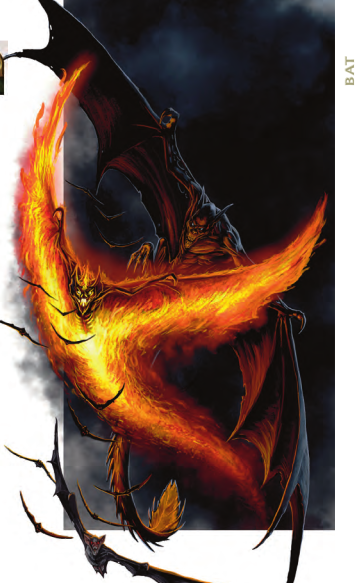
Copyright 2008 Wizards of the Coast Bats are tiny nocturnal mammals who feed on fruit and insects… but those aren’t the bats we’re talking about here. These bats are proper monsters.
The Lore
We get two different bat species here. Both are Medium, meaning they’re the size of an adult human and have enough wingspan to get that bulk airborne.
Fire bats are Elemental Beasts (fire), which are native to the Elemental Chaos but spread to the world through natural passages between the two planes and took root here. In much the same way cats migrated to Australia on ships and became a danger to the ecosystem, I guess.
Shadowunter bats are apparently native to the world. They’re descended from normal bats who happened to live in places where necromantic energies from the Shadowfell leaked through, and those energies mutated them.
Both types of monstrous bat have Int 2 and are Unaligned. They take well to domestication, and so might be found as pets and guard animals for people or intelligent monsters, particularly those that share origins with them. In fact, the Fire Bat lore entry specifically mentions azer, which gives credence to my theory that the azer used to be Heroic-tier opponents who got upgraded to Paragon at the last minute.
The Numbers
Organizing monsters alphabetically by name means Bats are actually the first real Heroic-tier creatures we’ve run across in the book. Angels had an Heroic-tier variant but it was kind of a footnote among a bunch of more powerful individuals.
Shadowunter Bats are Level 3 Lurkers that have 38 HP and fight as skirmishers. They’re quite clumsy on the ground, but fly with speed 8. It appears they attack with a wickedly barbed tail, which has a bonus to attack and does extra damage in dim light or darkness. They can use it in a Flyby Attack, moving their speed and making a tail attack at any point (and not provoking opportunity attacks when moving away).
Hm… if one or more of these attack the party, I’d expect them to do so in an area that’s entirely shrouded in dim light or darkness. You’d think that this would allow them to get the bonus damage all the time, but PCs are likely to be carrying their own bright light sources in these places. So they’re going after the rogue who’s scouting ahead without a light source. If domesticated, their owners should probably employ some trick to neutralize the party’s lights.
Fire Bats are Level 3 Skirmishers with 60 HP and 10 fire resistance. They fly as fast as shadowunters, and are as clumsy on the ground. Being bats that are on fire, their attack is a touch that does fire damage and ongoing fire damage. Their version of the flyby attack allows them to shift 4 squares and make an attack against anyone they touch on the way.
The sample encounter is level 3, a party of goblins and their two shadowhunter bat pets.
Final Impressions
Functional opposition for when your party ventures into bat country. I think the fire bats work a little better, since the shadowunter’s bonus damage is too fiddly. Changing it so that they only need to start their turn in dim light or darkness to get the bonus would make them work better.
Since they’re only level 3 regulars, the math bug doesn’t affect them all that much.
-
Dungeon Fantasy RPG's Second Kickstarter
Steve Jackson has another kickstarter for DFRPG going! While the main goal for this one is the creation of a second monster book for the game, they’ve also bundled in the costs of reprinting the wonderful physical box set for the original game.
You see, they’re using this particular campaign as a way to gauge player interest in GURPS. If it funds successfully, they’ll commit to doing “big” books for the GURPS as a whole in the future. If it doesn’t, then support will continue only in the form of small PDF supplements, one or two a month.
By the look of things, the project will fund, but only just. So if like GURPS and haven’t thought about pledging to it yet, go to the campaign page and do it! For only US$10 you’ll get the PDF of the new book, and there are pricier options for people who want physical copies or other books as well.
Even if you don’t play DFRPG specifically, you’ll still get some mileage out of a bestiary, which is the sort of book people always complain is missing from GURPS. And if you do play it, then what you have is a win-win situation right there.
If you have no idea what GURPS Dungeon Fantasy is all about (unlikely, if you’re reading this blog), you can see this excellent post with no less than 31 reasons why it’s awesome.
The PDF of the game itself is available at Warehouse 23 for US$40 (you have to choose PDF in the format dropdown there). Forty American dollars might sound like a lot, especially if you’re reading this in Brazil, but this is actually less than the price of a single D&D core book. And it gives you a full fantasy game that’s better than D&D (yes, I went there)!
-
Let's Read the 4e Monster Manual/Vault: Basilisk
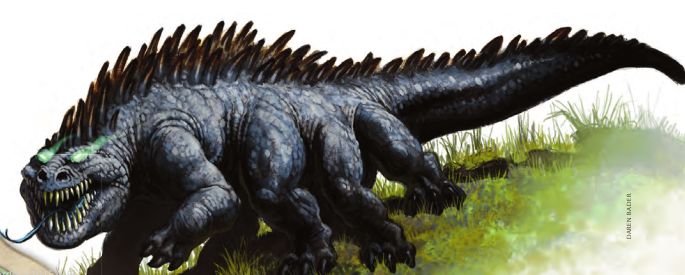
Copyright 2008 Wizards of the Coast Basilisks are another traditional D&D monster that’s been around since at least the days of Basic. Here they’re Large natural beasts, in the form of beefy grey eight-legged lizards with copious spines running down their backs. Basilisks appear in both the Monster Manual and the Monster Vault.
The Lore
The Monster Manual is surprisingly spare on basilisk lore. It says here they’re strangely evolved drakes that use their deadly gazes to hunt for food. The same gaze makes them highly feared. It is possible to tame and train them, though, like other members of the drake family.
The Monster Vault is a lot more poetic about it. Most people know very little about basilisks because most civilians who meet one don’t survive to tell the tale. The beast isn’t malicious and doesn’t actively seek out sapient prey, but it will literally kill you as soon as it looks at you. If a settlement begins to have trouble with people going into the woods and disappearing, it could be because a basilisk made its lair nearby.
Well, that’s nice and atmospheric and all, but this is D&D. “People have been going missing in the woods” doesn’t really narrow it down at all. There are dozens of monsters that could be responsible for it.
Anyway, there are several separate varieties of basilisk, each with a different (but still unpleasant) gaze. Some are solitary, some are pack hunters. They’re a rare case of a fantastic animal that originated in the world and managed to spread to the Feywild, so you can find them there as well.
People who manage to tame a basilisk usually employ it as a guard animal in an area where no other allies are present. Well, no allies that are not expendable or immune to the gaze. Common basilisk tamers include demons, who keep them as pets or use them as muscle in incursions to the world.
The Numbers
The signature trait of all basilisks is of course the gaze, which is an area attack whose effect varies by specific monster.
The Venom-Eye Basilisk is level 10 artillery and has 87 HP and Speed 6. It’s AC is surprisingly tough for a monster of its role and level (27 in the MM, 24 in the MV), and its Fortitude is only slightly less beefy. Its other defenses are average.
Its bite is relatively weak, and its gaze does poison damage plus ongoing 5 poison damage on a hit. Anyone taking ongoing damage from this gaze also causes 2 poison damage to anyone next to them. Hit or miss, the gaze attack also causes targets to take a -2 penalty to their attacks for a turn.
The MM version is completely immune to poison, while the MV version has poison resistance 5. I get the idea behind the immunity - they want the basilisk to be immune to its own gaze, which is vital if you want to make them pack hunters. I think that’s still supposed to be the case in the MV versions, but you could still hit it with different poisons and have those be effective if they’re strong enough.
The Stone-Eye Basilisk is the classic model, called only a Basilisk in the Monster Vault. The MM version is a level 12 soldier and the MV version a level 12 controller. Both have 126 HP and similar traits aside from that.
This basilisk is of course immune to petrification, and has a Baleful Gaze that slows for a turn anyone within 5 squares that attacks the basilisk. That’s automatic, no attack roll involved. Closing your eyes won’t prevent this either, since it happens when it sees you. The actual gaze attack is a close blast 3, and it sets off a chain reaction: Slowed -> Immobilized -> Petrified, with the condition worsening on each failed save. I believe this model of gradually worsening conditions was one of 4e’s big mechanical innovations. In previous edition, attacks like these would just be save-or-die; now you have time to panic.
The basilisk also has a strong bite, which the lore specifically notes makes it capable of eating creatures petrified by its gaze.
These first two are actually two versions of the basilisk legend! In some stories it would turn you to stone, in others it just kills you.
The Monster Vault has two additional basilisk varietals: the wilt-eye is a level 11 controller with 117 HP, with a gentler gaze that gives you a penalty to your attacks and knocks you out on the first failed save.
And then there’s the Abyssal Basilisk who is a Chaotic Evil elemental beast instead of natural and unaligned. This is the one demons raise in the Abyss. It’s level 13 artillery, and its gaze drives one mad with horror. The chain goes: 10 ongoing psychic damage -> make a basic attack against your closest ally -> 10 ongoing psychic damage and you’re dominated.
The suggested encounters in the MM are a level 11 against 2 venom-eyes and 2 mezzodemons, and a level 12 against 2 stone-eyes, a fey choker, and a dryad witch. The mezzodemons aren’t bothered by the poison gaze, but the fey duo are not immune to petrification, so they should watch their positioning.
Final Impressions
What can I say? It’s a classic for a reason, and even the MV didn’t see fit to change its workings other than fixing the damage). I did like the addition of the wilt-eye basilisk - that’s an encounter a commoner could actually survive! I mean, if basilisks behave like normal wild animals, then they’re rarely people-eaters. They’d be killing people either by accident (can’t stop the gaze) or in self-defense. A wilt-eye would just knock the commoner out and leave.
That goes for the natural versions, of course. The Abyssal one has been turned into a standard attack-on-sight-fight-to-the-death monster by the hard work of generations of demon breeders.
subscribe via RSS