Posts
-
Let's Read the 4e Monster Manual/Vault: Gibbering Beast
This article is part of a series! Click here to see the other entries.
Gibbering beasts used to be several different monster entries that originally appeared throughout AD&D and 3.x in different places. Here they were quite sensibly collected together. They appear only on the Monster Manual, but received an MV-style update in Dungeon #192, so we’ll look at them there too.
The Lore
A gibbering beast is a slimy, amorphous, oozelike creature covered in eyes and mouths. And eyes with mouths. And mouths with eyes. And eyes inside mouths. And is that a bunch of teeth just kinda sprouting from that quivering protuberance?
They crawl or float around, looking every which way with their eyes and constantly spouting nonsense from their mouths, which they also use to attack and eat other creatures. The nonsense can be just as dangerous as the bites, as it warps the minds of those who hear it and makes them easy prey for the beast.
The lesser varieties of gibbering beast spontaneously generate when something dies in places touched by the influence of the Far Realm, which causes the corpse’s face to detach and become a newborn beast. Over time they can grow and become both smarter and more powerful. Sometimes the strongest varieties travel directly from the Far Realm to the world, bent on enacting some insane scheme of their own.
The Numbers
Gibbering beasts are Aberrant Magical Beasts, and they all have All-Around Vision and Darkvision. Creatures with All-Around Vision can’t be flanked, which makes it a lot harder to get combat advantage against them.
Their other signature trait is their incessant Gibbering, a free action that happens at the start of their turns: Close Burst 5 vs. Will, a hit dazes the targets for a turn. Deafened creatures are immune to this.
All Gibbering Beasts are Unaligned, which is very appropriate for truly alien aberrant entities.
Gibbering Mouther
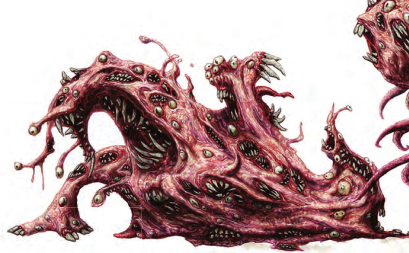
Copyright 2008 Wizards of the Coast The weakest and most classic among these entries, the gibbering mouther is Medium and a Level 10 Controller with 110 HP. It moves at speed 5 on land, and can swim at the same speed. Its mere presence warps the space around it, which works as an Aura 3 that acts as difficult terrain against enemies.
The mouther’s basic attack is a bite that deals physical damage and ongoing 5 acid damage (save ends). Its Gibbering works as described above, and opens the way for Gibbering Feast (Close Burst 5), a power which causes unnatural mouths to appear on any dazed creatures in the area and perform a basic bite attack against them. Now that’s an aberrant creature! “Your left hand grows a mouth and tries to eat your face” is top-notch horror imagery.
Gibbering mouthers have Int 4, and are sapient enough to work with other aberrant or even non-aberrant creatures if they see advantage in doing so. The Dungeon update is identical aside from the fixed damage numbers and the lack of the Gibbering Feast’s colorful description.
Gibbering Abomination
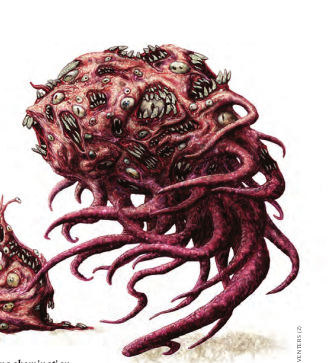
Copyright 2008 Wizards of the Coast A bigger mouther. It’s still Medium, but it’s a Level 18 Controller with 168 HP. It’s faster and trades some buoyancy for flight, with a land speed of 6 and a flight speed of 4 (hover, maximum altitude 1).
Its Unnatural Utterances work as an Aura 5 that inflicts a -2 attack penalty on any enemies caught within. They periodically increase in intensity to perform the standard Gibbering attack.
The abomination’s basic attack is a Reach 2 Tentacle that does immediate physical and ongoing psychic damage (save ends). It can also stare at you really hard with the Eye of Despair (Ranged 10 vs. Will; Recharge 3-6), which does psychic damage and immobilizes (save ends).
The gibbering abomination does extra “sneak attack” damage against creatures it has combat advantage against, but it sadly lacks an extra-creepy ability like Gibbering Feast. It does have Int 11, meaning it will make more complex (though no less insane) plans than the mouther. The Dungeon update simply fixes its damage totals.
Gibbering Orb
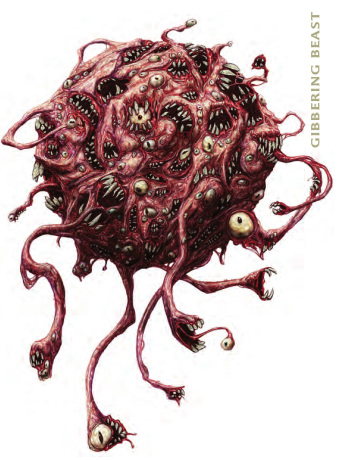
Copyright 2008 Wizards of the Coast This Huge Level 27 Solo Controller has 1230 HP and has arrived directly from the Far Realm to do Cthulhu-knows-what. With its Int 17, it’s capable of hatching elaborate schemes. Given that it has a whole suite of eye rays, it might give you an idea of what beholders were like before migrating to the world and being mutated by the trip. It flies at speed 8 (hover).
The orb’s Merciless Eyes work like an Aura 5; anyone who starts their turn inside and visible gets targetted by a random eye ray.
The orb’s basic bite attack does damage and causes the mouth that made it to detach and automatically attack the target again at the start of the orb’s subsequent turns! This lasts until the mouth misses with an attack, at which point it falls off and rots.
The Gibbering works as for the other monsters, but is a Close Burst 10.
The orb can also spend its standard action to make two different eye ray attacks in addition to any automatic ones from Merciless Eyes. The orb can choose which rays it uses when it does this, from the following selection:
- Mindcarving: Ranged 10 vs. Will; psychic damage and daze (save ends).
- Fleshtearing: Ranged 10 vs. Fort; necrotic damage and ongoing necrotic damage (save ends).
- Bonewarping: Ranged 10 vs. Fort; physical damage and weakness (save ends).
- Bloodfeasting: Ranged 10 vs. Reflex; physical damage and ongoing physical damave (save ends).
- Farsending: Ranged 10 vs. Reflex; transported to the Far Realm for a turn; on return, takes psychic damage and suffers a -5 penalty to attacks until the end of the encounter.
- Souleating: Ranged 10 vs. Will; slows (save ends); worsens to immobilization on first failed save; target dies on second failed save.
That’s a pretty fearsome selection, and the names do a lot to evoke that body horror feeling. It’s less varied than the rays available to a Beholder Eye Tyrant, but every ray does damage, there’s two different ongoing damage effects that can stack with each other and a daze to catch people the Gibbering misses.
The farsending ray is also pretty brutal, since it instantly removes a character from play for the whole next turn and saddles then with a long-lasting attack penalty. Not quite as bad as death, but worse than a stun effect. And of course there’s a gradual death effect.
Gibbering Orbs are boss battle material for a level 23 or 24 party, and with a bit of leveling could be promoted to the “campaign end boss” role as one of those Outer Gods that orbit Azathoth or the equivalent.
The Dungeon update reduces their HP to 984, and the radius of its Gibbering to the standard 5 squares. It also fixes its damage, increasing it considerably.
Sample Encounters
Gibbering beasts go well with any other aberrant or aberrant-adjacent creature (like cultists and such). Even the gibbering mouther knows the value of cooperation, and they certainly might be bullied into service by more powerful monsters.
Unlike the other, lesser beasts, gibbering orbs prefer to work alone and don’t seek out alliances. However, their presence generates spontaneous phenomena and attracts creatures that end up effectively acting as its heralds and harbingers.
The sample encounters in the book are:
-
Level 10: 2 gibbering mouthers, 1 foulspawn seer, 2 foulspawn berserkers, and 1 chuul.
-
Level 18: 1 gibbering abomination, 2 nabassu gargoyles, 1 aboleth lasher and 2 kuo-toa guards.
Final Impressions
One constant theme in the comments I’ve been getting in these entries are that few of the aberrant monsters seen so far seem worthy of that origin, being far less alien than what someone would expect from the Far Realm.
I feel that if there’s one family of monsters worthy of the “Aberrant” title, it’s the gibbering beasts. The Gibbering Orb is awesome in that role, and the “basic” Gibbering Mouther is actually better at evoking horror than the abomination, with its “your body grows mouths and tries to eat itself” attack.
-
Let's Read the 4e Monster Manual/Vault: Storm Giants
Copyright 2008 Wizards of the Coast This article is part of a series! Click here to see the other entries.
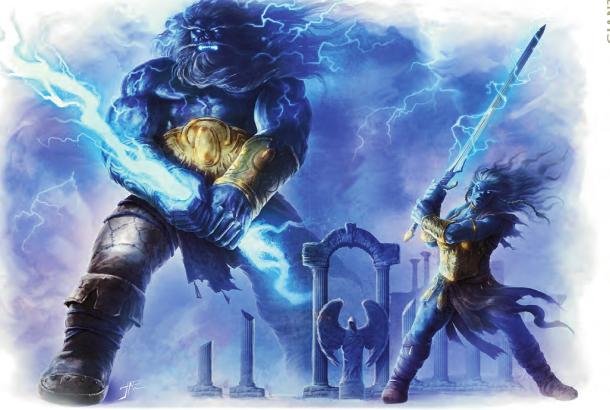
Storm giants are another classic giant type, present since at least the days of AD&D. In Fourth Edition they seem to have been merged with cloud giants, which used to be quite close in power to them and differed mostly on alignment. Both seem to have been inspired by the giant from Jack and the Beanstalk. They’re present only in the MM.
The Lore
Back at the dawn of time, storm titans and giants were the favored servants of the primordials, and were given command over the rest of their kind. In the present day there’s no unified giant society for them to rule, but storm giants are still closer to what they were at the height of their power than the other giants. They’re as much at home underwater or flying through the sky as they are on land.
I imagine that, unlike the other classic giants, these don’t usually raid or invade nearby mortal settlements. The domains of a storm giant would already be well-established and be located very far away from any “mundane” locations. That’s not to say they’re pleasant places for anyone but the giants themselves, at least not necessarily.
Storm giants build (or command their servants to build) marvelous castles in places mortals can’t usually reach, like the bottom of the sea or islands floating above the clouds. They might settle for the top of a tall mountain if they want to slum it. In these lordly palaces they keep all sorts of fantastical treasures.
When storm giants feel a need to make war, they summon enormous storms upon which their armies ride to battle. These are known as Harbinger Storms, and are likely one of the most sure omens that whoever they rain upon is fucked.
The Numbers
Storm giants and titans are Large and Huge Elemental Humanoids, respectively. They have the Aquatic and Giant keywords. They have resistance to lightning and thunder, along with both swim and fly speeds. They also have command of lightning and storms, being surrounded by mini-storms in combat.
These giants are quite sophisticated and intelligent, having a typical Int of 14. The ones presented here are Evil as befits the beanstalk giant, though you could certainly make a case for less nasty individuals in your stories.
Storm Giant
This is a Level 24 Controller with 228 HP. Its elemental resistances are set to 15; it runs and swims at speed 8, and flies at speed 10. In combat it surrounds itself with a small storm that acts as an Aura 2, inflicting 10 lightning and thunder damage to anyone caught inside, and preventing them from flying unless they’re other storm giants/titans.
The storm giant wields a Crackling Greatsword in combat (Reach 2 vs. AC) which does a mix of physical and lightning damage. The giant can sweep the sword in a wide arc (Close Burst 2 vs. AC; Recharge 6), damaging everyone it hits. It can also hurl thunderbolts (Ranged 10 vs. Reflex) for lightning and thunder damage. In addition to doing damage, they also push the target 3 squares and daze them (save ends) on a hit.
Finally, it can temporarily intensify its storm aura into a burst of Howling Winds (Close Burst 4 vs. Fortidude; Recharge 5-6) which does thunder damage, pushes 4 squares, and knocks prone on a hit. On a miss, this still does half damage and pushes 1 square.
Storm Titan
The Storm Titan is a Level 27 Elite Controller with 506 HP, and is basically a beefed-up storm giant in all respects. Its Huge in size, with the same movement speeds and modes. Its resistances are doubled to 30 as is the radius of its storm aura.
The titan has exact the same attacks as the giant, with melee Reach 3 where appropriate and increased accuracy and damage based on level. As an elite monster it can also perform two greatsword attacks per action.
Sample Encounter and Final Impressions
The MM gives us one sample encounter: Level 27, 1 storm titan, 1 thunderblast cyclone elemental, 2 storm gorgons. You can likely expect similarly themed elementals and blue dragons to make up the retinues of other storm giants and titans.
I like them, particularly due to the Jack and the Beanstalk associations. I don’t mind losing cloud giants in the conversion to 4e. It seems fitting that the giant you find atop the cloud is the one that wants to grind your bones for seasoning, not invite you to dinner. And if you really want to you could bring the good sky giants back using these same stats.
I also don’t mind that the storm giant and titan share similar abilities - conceptually, their set is fairly solid. The main problem here is that both suffer from the fairly severe form of the damage bug that afflicts epic-level creatures. You should definitely fix that before using them in your adventures.
-
Let's Read the 4e Monster Manual/Vault: Death Giants
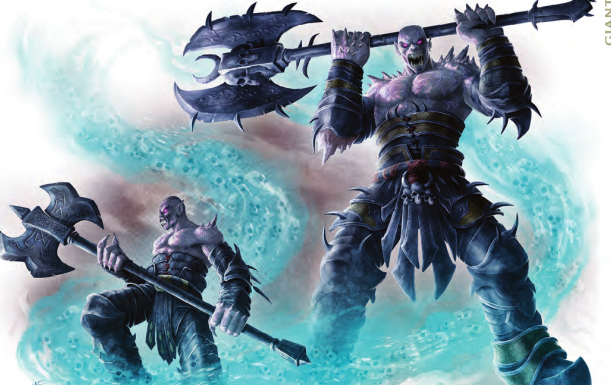
Copyright 2008 Wizards of the Coast This article is part of a series! Click here to see the other entries.
Death Giants are a 3.x creation, first appearing in one of that edition’s Monster Manual 2 or 3. For 4e, they get a new backstory. They appear only on the Monster Manual.
The Lore
Back at the dawn of creation when the titans were exploring the world, some of them found their way to the Shadowfell and liked the place so much they moved there permanently along with their giant children and allowed the energies of the place to permeate their beings. And that’s how the first death titans and giants came to be.
These giants have entirely abandoned their elemental nature and their allegiance to the primordials, and are now fully creatures of the Shadowfell. They’re probably also the world’s biggest fans of death metal. Though they stick mostly to their native plane, they will sometimes live in the world in places like graveyards and necropoli where the wall between the two planes is thin.
Death giants derive their power and sustenance from the souls of living creatures. They don’t need to consume souls very often, but they still enjoy hunting for sport and most of them are surrounded by a shroud of trapped, wailing spirits waiting their turn to be lunch.
They’re fairly intelligent, but my impression is they’re not too fond of banding together in large groups. They frequently associate with undead or with necromantic cults that like performing sacrifices. The latter provide a steady source of nutrition, since a death giant doesn’t need to personally kill someone to trap their soul - the victim just has to die near the giant.
The Numbers
Death giants and titans are Large and Huge Shadow Humanoids with the Giant keyword. They have Darkvision, resistance to necrotic damage, and an Aura 5 that captures the soul of anyone who dies in range. They can spend these captured souls to power some of their abilities. Their typical Int score is 12, making them the smartest giants we’ve seen so far, and their alignment is Evil.
We get two stat blocks here, one for the giant and one for the titan, but you can use the guidelines above to make your own.
Death Giant
This is a Level 22 Brute with 255 HP. It has Resist 15 Necrotic and a speed of 7. It wears mail and wields a greataxe.
The greataxe is Reach 2 and does physical damage with he High Crit property, suffering from the damage bug. The giant’s most distinctive powers come from its soul shroud.
Anyone who dies within 5 squares of a death giant adds one soul shard to its shroud. No detail on whether this “shard” is a whole soul or a literal shard of one. If it’s the latter, then a single death might add shards to multiple giants if their auras overlap.
In any case, you can assume a death giant starts the fight with 4 shards in its shroud unless your story demands otherwise. It can consume one shard to heal 20 HP, or spend it to power a Soulfire Burst (Close Burst 1 vs. Reflex) that does necrotic damage and could really use a damage fix. If the giant’s shroud ever runs out of shards, it takes a -2 penalty to its attacks until it can add more.
Since a being has to die to add a shard to the giant’s shroud, I think it’s one of those monsters that has an incentive to finish off downed PCs. It also pairs really well with minions, and you might also want to add some minion-like innocent victims in your battlefield that the PCs would have an extra incentive to protect.
Death Titan
This is a Level 25 Elite Brute with 574 HP. Its aura works the same as that of the death giant, and also inflicts a -2 penalty to the attacks of any enemies within. Its necrotic resistance is 30, and its speed is 8.
Death titans wear plate and fight with Huge greataxes, which are Reach 3 and have the High Crit property. They can attack twice per action with these axes.
The death titan’s soul shroud works the same way as that of the giant, but the titan doesn’t need to wait for people to die around it! It has an ability called Soul Devourer (Ranged 5 vs. Fortitude), which takes a bite off the soul of an enemy, causing it to lose a healing surge and adding one soul shard to the titan’s shroud. An excellent power to use from a distance while the titan’s buddies engage in melee.
Sample Encounter and Final Impressions
The sample encounter in the MM is level 24: 1 death titan, 2 death giants, 1 voidsoul specter and 1 deathpriest hierophant.
IIRC, the deathpriest hierophant is tied to Orcus, the demon lord of undeath (we’ll get to him in time). So perhaps you could say that in your campaign, death giants were originally created by the primordial who became Orcus, and that their transformation happened at the same time as that of their master.
-
Let's Read the 4e Monster Manual/Vault: Fire Giants
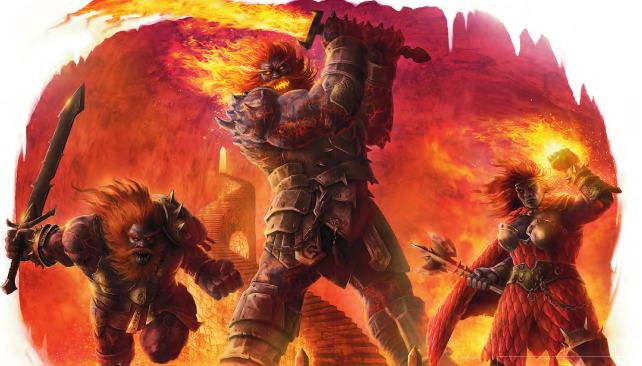
Copyright 2008 Wizards of the Coast This article is part of a series! Click here to see the other entries.
Fire giants make up the final members of the “Against the Giants” trio. Like their frosty cousins they’re inspired by Norse mythology, but their D&D incarnation is a lot less viking-ish. They’re present on both books.
The Lore
Fire giants have legendary reputations as builders and metalworkers, which makes sense since every object usable by a fire giant has to be made of heat-resistant metal or stone. They live in castles and fortified cities build around (and atop, and under) active volcanoes or other sources of heat and magma.
These giants pine more strongly for their ancient glory days than most of their kin, and engage in active empire-building instead of settling for simple raiding. They make ample use of slaves, chief among which are the azer descended from dwarves that didn’t manage to break free from them. They’ll enslave other peoples just as readily though.
While still members of Team Primordial fire giants are typically Evil, probably reflecting their more organized approach to life.
The Numbers
Fire giants are Large Elemental Humanoids with the Giant keyword, and their titan bosses are Huge. They have 15 resistance resistance to fire, with titans being more resistant. Like other giants their land speed is 8. Both fire giants and titans have a typical Int score of 10.
They’re stronger than frost giants, but not by much. You can consider both types to be evenly matched.
Fire Giant Flamecrusher (MV)
This is a Level 17 Brute with 204 HP and all common traits outlined above. It fights with a Searing Maul (Melee 2 vs. AC) that does a big chunk of fire damage, and which can also be used in an Overhead Smash (Melee 2 vs. AC) that does about the same damage and knocks the target prone.
Once bloodied, the flamecrusher gains the ability to flip out and deal a series of Battering Blows to everyone around him (Close Burst 2 vs. AC), which do more damage than the basic attack and push targets 2 squares. This is an encounter power, but it recharges if the giant misses every target with it.
Fire Giant (Both)
The basic model is a Level 18 Soldier with 174 HP and all fire giant traits. It wears giant-sized mail and fights with a Searing Greatsword that does fire damage and marks for a turn on a hit. It can also sweep it in a wide arc (Close Blast 2 vs. AC), dealing the same damage as the basic attack and marking anyone it hits for a turn.
The MM version is nearly identical. Aside from suffering from the damage bug, it can also throw Iron Javelins (Ranged 15/30 vs. AC), which do physical damage and slow for a turn when they hit. Apparently fire giants are too sophisticated to throw mere rocks. Personally, I’d add this attack to the MV version too.
Fire Giant Forgecaller (Both)
The spellcaster of the family, it’s Level 18 Artillery with 136 HP and training in Perception. The Forgecaller fights in melee with a Smoldering Mace (Melee 2 vs. AC) that does fire damage, and uses All The Fire to fight at range.
This can take the form of a single-target Pillar of Flame (Ranged 20 vs. Reflex) that does more fire damage than the mace, or an area-effect Flame Burst (Area 2 within 10 vs. Reflex; Recharge 6) which does both immediate and ongoing fire damage (save ends), half of both on a miss.
Fire Titan (Both)
The fire titan is a Level 21 Elite Soldier with 398 HP. The MM version has 30 Fire Resistance, and the MV version upgrades that to complete immunity. Its speed is 8. Like other titans, it’s mostly made up of its totemic element, with magma skin and bonfire hair.
The titan fights with a Fiery Greatsword (Melee 3 vs. AC) which does a big glob of fire damage, pushes 2 squares on a hit, and marks for a turn. It can make two of these basic attacks per action.
It can also attack at range by hurling gobs of lava (Ranged 20 vs. Reflex; recharge 5-6), which do fire damage, immobilize for a turn, and cause flying targets to fall. On a miss they still do half damage and immobilize for a turn. The MM version explicitly states this requires a source of lava, something which the MV version omits. Considering the places where you’re likely to find a fire titan, a source of lava should always be available! If it’s not, I suppose it can just spit on its hand and throw that.
Finally the titan can project a Burning Wave (Close Burst 5 vs. Reflex), presumably by flexing. This does immediate and ongoing fire damage to everyone it hits. The MM version does half the immediate damage on a miss.
Sample Encounters
We have two on the MM:
-
Level 17: 2 fire giants, 1 forgecaller, 1 azer beastlord, and 2 firebred hell hounds.
-
Level 22: 1 fire titan, 2 fire giants, 2 fire archon ash disciples, and 1 phoenix.
Other creatures you’re likely to find in encounter group with fire giants would include elementals with at least some fire in their composition, and red dragons.
Final Impressions
Fire giants are mechanically simpler than I expected, which I guess is a theme for all the classic giants. They deal fire damage almost exclusively, so you might want to change that if the party has very strong fire protection. I’d probably give the basic fire giant a way to punish people who ignore its marks, as I feel the -2 penalty for attacking other enemies isn’t enough deterrence at these levels.
-
-
Let's Read the 4e Monster Manual/Vault: Frost Giants
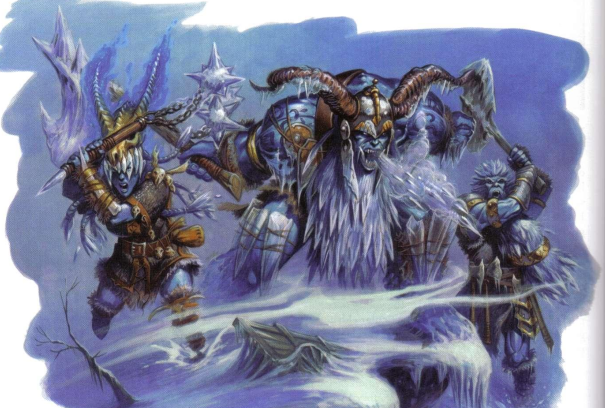
Copyright 2009 Wizards of the Coast This article is part of a series! Click here to see the other entries.
Frost giants are based on the Jotuns of nordic folklore, and these roots translate into them being the most viking-like of all D&D giants. They’ve been a part of the game since its beginnings. Frost giants appear on the Monster Vault but not on the Monster Manual - they would appear on the MM2. We’ll skip ahead a bit and look at the stat blocks from both the MV and the MM2.
The Lore
Frost giants live atop permafrost-coated mountains or at extremely high latitudes (normally referred to as the Frigid North but there’s no reason it couldn’t be the Icy South in your world). They carve their holds and fortresses out of the ice, and their rulers are known as jarls.
Frost giant culture is all about bravery and martial prowess, so when food in the surrounding area begins growing scarce, or when the itch for a fight just becomes too strong, their warriors gather and go out raiding for plunder, slaves, and glory. When they return, the skalds sing of their bravery and of how much loot they got. Much like historical vikings, frost giants are assholes.
As members of Team Primordial who love raiding and looting, they are typically Chaotic Evil.
The Numbers
Frost giants are significantly stronger than hill giants, enough that a party that’s going through a 4e version of Against the Giants might have a bit of trouble when they first get to them. In earlier editions, Stone Giants stood between Hill and Frost - this is still true here, but stone giants appear only on the MM2 and so we’ll look at them much later.
Frost giants are Large Elemental Humanoids with the Cold and Giant keywords. Frost titans are similar, but Huge. They all move at Speed 8 with Ice Walk, which means they ignore terrain penalties from ice and snow. Frost giants have Resist 15 Cold, and the titan is completely immune. They are not particularly vulnerable to fire. They have a typical Int score of 10.
Their other signature trait is Icebound Footing, which allows them to ignore a number of squares of forced movement (2 for giants, 4 for the titan) and make a saving throw to avoid being knocked prone. This is essentially a more powerful version of the trait PC dwarves get.
Frost Giant (Both)
The basic model is a Level 17 Brute with 201 HP and all standard frost giant traits. You can expect most individuals you face to use this stat block.
Its basic attack is an Icy Greataxe (Melee 2 vs. AC) that does quite a bit of cold damage and has High Critical, meaning it does a lot more damage on a critical hit. It can also empower this axe with even more cold magic for a Chilling Strike (recharge 5-6), which does more damage than a non-critical basic attack and inflicts Vulnerable 10 Cold on the target (save ends).
The MM2 version still suffers from the damage bug, and has a couple more abilities: Dying Swipe allows it to make one last basic attack when it dies, and it can throw Icy Handaxes (Ranged 5/10 vs. AC) if melee isn’t an option for some reason. These have probably been removed from the MV version because of the next entry.
Frost Giant Marauder (MV)
The fast, wiry cousin of the basic frost giant is a Level 17 Skirmisher with 168 HP and all common frost giant traits. It trades the big axe for a brace of 8 hand axes, which it can throw or dual-wield.
Indeed, the marauder’s basic attack can be either Melee 2 or Ranged 10, both vs. AC. It does a bit of cold damage and allows the giant to shift 2 squares as an effect.
It can also employ a Twin Strike at will, performing two basic attacks and shifting 2 squares between them. This replaces the “shift 2 squares” effect, as I understand it.
Once per encounter the marauder can perform a Hurling Charge, throwing two handaxes and then charging one of the targets of those throws.
Frost Giant Ice Shaper (MM2)
This spellcaster is a Level 19 Controller (Leader) with 182 HP and all common frost giant traits. Its magic likely involves a lot of runes.
The ice shaper fights in melee with a Freezing Flail (Melee 2 vs. AC) that does cold damage, and at range with Freezing Bolts (Ranged 20 vs. Reflex) which do cold damage and immobilize. As a minor action it can use Ice Slide (Ranged 10 vs. Fortitude) to slide someone 3 squares without doing damage.
Its “special” spells are Wall of Frost (Area Wall 12 within 10), which does what it says on the tin: it fills up 12 contiguous squares with a semi-solid frost barrier that provides some concealment, counts as difficult terrain, and does 5 damage to people who start their turn adjacent to the wall or 15 to those who enter it. This lasts for a turn but the giant can spend minor actions to sustain it. It’s also Recharge 6, which means it might be able to cast it more than once in the battle.
The other spell is Ice Armor (recharge 5-6) which grants one ally within 10 squares Resist 10 to all damage for a turn.
Frost Titan (Both)
The Frost Titan is a Level 20 Elite Brute with 466 HP, and is literally made of ice. As such, it’s completely immune to cold and its Icebound Footing trait prevents up to 4 squares of forced movement. The MV version has a weakness to fire, gaining -2 AC for a turn when it takes fire damage. The MM2 has no such weakness.
The frost titan’s breath is cold enough that it works as an Aura 2, turning every square in range into difficult terrain and causing 5 cold damage to enemies that start their turn inside.
The Titan fights with an Icy Greataxe (Melee 3 vs. AC), which does both immediate and ongoing cold damage (save ends), and has High Critical. It can focus its icy breath once per encounter (Close Blast 5 vs. Reflex), which does cold damage, ongoing cold damage (save ends), and immobilizes for a turn. A miss does half damage.
As a minor action it can use a Cold-Blooded Kick (Melee 3 vs. Reflex), which is actually a bit stronger than the axe, pushes the target 2 squares, and knocks it prone. Fortunately it doesn’t have High Critical or ongoing damage.
When the Frost Titan is reduced to 0 HP, it can make one last axe strike.
The MM2 version can also fling ice bolts (Ranged 20 vs. Fortitude; recharge 5-6) against one or two creatures which do cold damage and slow (save ends) on a hit.
Sample Encounters
The MM2 has two encounters:
-
Level 19: 2 basic frost giants, 1 ice shaper, 1 remorhaz.
-
Level 21: 2 frost titans, 2 ice archon frostshapers, 1 ice archon rimehammer.
That gives you a general idea of the things that partner with frost giants and titans: big monsters who live in the same cold places as them, and ice archons or other primordial forces.
They would likely not be very friendly with the likes of ice devils, demons, or winter fae. This gives you some ready-to-go rival factions to use in your cold dungeons if you like that.
Final Impressions
I imagine people complained that frost giants weren’t present in the first MM, since they’re an important part of the classic D&D bestiary. These ones seem like suitably fearsome opponents, though. Cold-damage brutes that can make you vulnerable to cold as a basic infantry unit? Yikes!
The MV versions are generally superior because of their damage fixes and more focused stat blocks, but the ice shaper fills a nice niche that seems to be missing from the MV stat blocks.
-
subscribe via RSS