Posts
-
Let's Read the 4e Monster Manual/Vault: Earth Giants
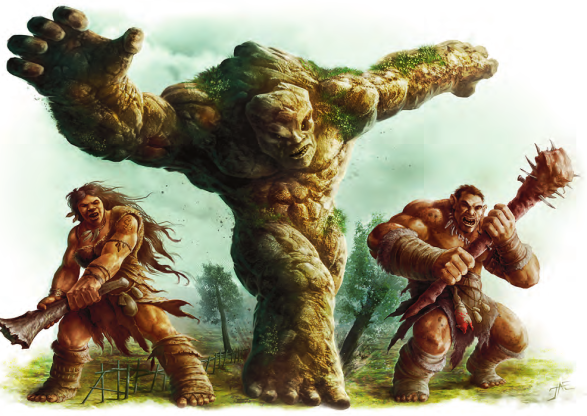
Copyright 2008 Wizards of the Coast This article is part of a series! Click here to see the other entries.
The “Earth Giants” designation is new to 4th edition, but the monsters that make up most of them are not. In other words, this is going to be a post about Hill Giants. They’ve been in D&D since the start and are present in both books in this edition.
The Lore
Like all of the other giant categories, the “Earth Giant” designation covers the Titans aligned with the element of Earth and the giant servitors they created. While both are technically among the weakest of their kind, they can still pose an existential threat to most kingdoms of Medium-or-smaller humanoids if they manage to organize, and even a small group is a serious threat.
The Titans are very obviously creatures of Earth, resembling humanoid mountains made out of earth and rock. While they created several types of giant, the most common variety is known as the Hill Giant from its preferred environment.
Hill Giants are so much more aligned to the world than to the Elemental Chaos that they resemble big people. Big, dumb, violent people. I believe hill giants are inspired by the giants you see in some fairy tales, of the kind that walks in from somewhere and begins eating people’s goats until some clever tailor comes in and kills them through trickery.
While D&D hill giants aren’t much smarter than the ones in the fairy tales, they’re quite a bit harder to defeat, particularly because they’re only alone if you’re lucky. Hill giant communities are villages built out of mud and logs, and may feature a chief that decided to copy the sophisticated ways of their tiny neighbors, style themselves a king or queen, and begin demanding tribute.
Hill giants fight with Stone Age weapons, which are still quite deadly due to their size and the strength of their wielders. They also have excellent throwing arms and are able to hurl boulders with more accuracy than a catapult. They are Chaotic Evil on account of being on Team Primordial, but if it’s possible for a Friendly Giant who is Unaligned or Good to exist at all, they’re probably from this branch of the family.
The Numbers
Hill Giants are Large Natural Humanoids with the Earth and Giant keywords. They have a typical Int score of 7, making them stupid but still capable of tactics and coordination. Earth Titans are Huge Elemental Humanoids with the same keywords and a typical Int of 10.
Hill Giant (Both)
The classic model is a Level 13 Brute with 159 HP. Its long legs give it a land Speed of 8. The versions from both books are identical, with the only difference being that the MV one has updated damage totals.
Hill giants attack with a club, which might be something like a tree trunk. Once per encounter they can make a Sweeping Club attack, which allows them to attack two targets, push then 2 squares, and knock them prone in addition to doing club damage.
They can also hurl rocks out to Range 10, which does a bit less damage than the club but is still respectable. Ammunition comes from the landscape, and if no handy boulders are available the giant still carries around 5 of them in its satchel.
Hill Giant Hunter (MV)
This giant is Level 13 Artillery with 109 HP. A bit more sophisticated than its basic cousin, it fights with javelins that it uses in melee or as ranged weapons (Range 20). I imagine these are sculpted from smaller trees, though the wooden palisade of your typical human village would also provide plenty of ammunition in a pinch.
The hunter is still a hill giant, so it also throws rocks out to Range 20 for about double the damage of a javelin, an attack that recharges on a 5-6. Its loadout is about 6 javelins and 4 rocks, though as mentioned before the surrounding landscape can provide additional ammo if needed.
Hill Giant Earth Shaman (MV)
This earthbending spellcaster is a Level 13 Controller (Leader) with 131 HP. All if its attacks are some form of magic.
Its basic melee attack is the Earthgrip Slam (Melee 2 vs. AC), which does damage and restrains for a turn on a hit. Once per encounter it can cast Earthen Chains (Ranged 10 vs. Reflex), which does a little bit of damage, stuns (save ends), and pulls the target to the ground if it was flying. The first time one of the giant’s allies hits the stunned target, it heals 15 HP.
It also has another spell named Earth Wave (recharge 5-6; Close Blast 5 vs. Fortitude; enemies only). On a hit, this does a bit of damage and pushes targets 2 squares. As an effect, it automatically knocks all targets prone, and allows every ally in the blast to shift up to 3 squares and make a basic melee attack. Just the thing to use when leading a pack of those hill giant brutes.
Earth Titan (Both)
Earth Titans have nearly identical stats in both books, the main difference being their damage (which has been increased in the MV). They’re Level 16 Elite Brutes with 384 HP.
An earth titan’s basic melee attack is a powerful Reach 3 Slam, and it can make two of those as a standard action. It can also hurl rocks out to Range 20, which do damage and daze (save ends) on a hit. Once per encounter it can stomp really hard and use Earth Shock (Close Burst 2 vs. Fortitude), which does damage and stuns for a turn on a hit, and does half damage with no riders on a miss.
Sample Encounters
The MM gives us two:
-
Level 13: 3 hill giants and 1 displacer beast packlord. The displacer beast is the smartest of the bunch!
-
Level 17: 1 Earth Titan, 2 Hill Giants, 2 War Trolls, and 4 Ogre Bludgeoneers (minions). This looks like what might await the Level 13 party at the end of the Steading of the Hill Giant (or Earth Titan) Chief.
Final Impressions
Hill Giants are suitable opponents for early Paragon heroes, and yet their attacks are simple enough that you could run several of them without too much mental effort. Their pair well with galeb duhrs (which they still enslave), or with other paragon-tier creatures that might inhabit their preferred hills, mountains and canyons. That does potentially include dragons!
The MV gives us enough stat blocks that we can build a large variety of encounter groups made up entirely (or mostly) of hill giants, which is perfect for the GM who wants to adapt the first Against the Giants adventure to 4e.
-
-
Let's Read the 4e Monster Manual/Vault: Giants
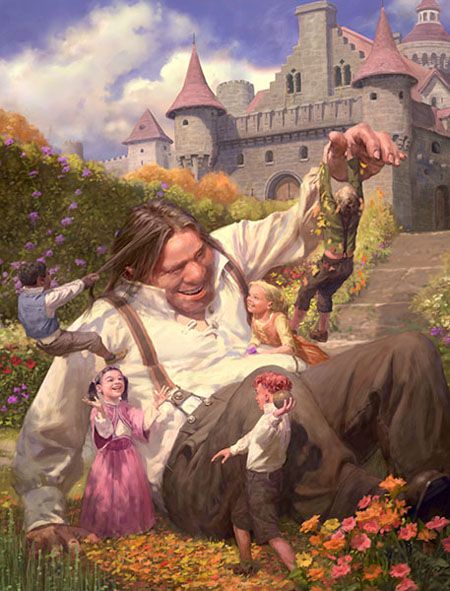
Definitely not a D&D illustration This article is part of a series! Click here to see the other entries.
Giants are present in D&D since the beginning, making up one of the games most famous “monster ladders”. How famous? It got a whole module trilogy to itself, named Against the Giants, which got reprised and homaged in several editions after its debut on AD&D 1st Edition. You could have named the game Gaols & Giants without changing anything else, and no one would find it odd that they’re in the title.
As you’d expect from monsters with such an exalted pedigree, they are present in both books. Between both of them we have no less than six giant types, each with multiple stat blocks, so I’m going to give a general overview of giant-kind in this post and cover each type in its own installment.
On the Origin of Giants
Giants in 4e all share a common origin: they were among the first beings created by the primordials, stepping out into the newly-created world before it had even cooled from the forge. Their purpose in life was to assist their masters in exploring and shaping this new creation. This means they could dispute the efreets’ claims of being the firsborn children of the Primordials, if they cared to.
Well, if you want to get technical about it, the beings created directly by the primordials are Titans. They they embody the qualities of the Elemental Chaos to such a degree that their bodies are made of elemental matter instead of that gross meat stuff. The Titans went about their mission for a while, but eventually found out that the world was too large for them to do it efficiently. So they created servitors of their own to help them in turn.
These servitors are the Giants proper. They’re smaller than their titanic progenitors, and made of flesh and bone because they’re more closely aligned with the world than with the Elemental Chaos. (From this point on, I’m using capital-G Giants to mean both titans and giants).
In the course of their mission, the Giants multiplied and spread throughout the world and the planes, and when the Primordials retreated from the world they inherited it, and created one of its first empires. It was around this time that the creations of the gods began to appear, and the Giants were already there to enslave them. Most notable among these slaves were the dwarves, children of Moradin, whose entire population endured a centuries-long period of cruel servitude.
When the Dawn War started, the titans and giants sided with the primordials. Though there weren’t many of them, their immense individual power gave them victory in many battles, filling their castles with pillaged loot. Attrition from the long war took its toll even on these mighty beings, though, allowing the sudden dwarven rebellion to succeed and deal the final blow to their empire.
Today’s giants are still sore about their downfall. They dream of casting down the gods and rebuilding what they had, but they never managed to organize enough to pull it off in all the intervening millenia. Today they live in scattered and isolated communities, who fight each other as much as they terrorize the surrounding small ‘uns. The causes for all this infighting are a bit opaque and convoluted. They probably stretch back long enough that those Viking tales of multi-decade feuds sound quaint to a giant.
Giant Stat Overview
The most famous giant and titan signature trait is that they’re really big! Giants are on the larger end of Large, and Titans cross over into Huge. All of them have the Giant keyword as well, and though most giants have the Elemental origin due to the story above, there are some interesting exceptions. Each giant type has further signature traits that will be discussed in their own posts.
Level-wise, they range from early Paragon to late Epic tier. Within that range, giants are usually regulars, with Titans being both Elite and a few levels stronger than their corresponding giants.
Between the Monster Manual and the Monster Vault, we get the following giant types, arranged from weakest to strongest: Earth, Ice, Fire, Death and Storm. Each type presents one or more giant stat blocks and one Titan.
That first category includes Hill Giants - Stone giants also exist and fall under Earth, but don’t appear in the first Monster Manual or on the Vault.
The first three rungs of this ladder comprise the Against the Giants set, which means those modules could make a fine Paragon-tier campaign for 4e.
-
Let's Read the 4e Monster Manual/Vault: Ghoul
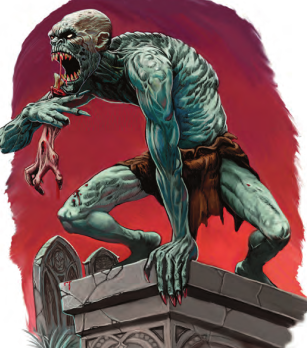
Copyright 2008 Wizards of the Coast This article is part of a series! Click here to see the other entries.
Ghouls have been in D&D since the beginning, which makes them an example of two classic D&D practices: arranging monsters in a power ladder, and making every synonym of a word into a different monster.
They were a step up from zombies in the undead power ladder, and since the word “zombie” in D&D applied to slow shamblers, the faster and more voracious “Romero Zombies” got called Ghouls. Here, they’re present in both books.
The Lore
When someone who practices cannibalism dies, they rise as a ghoul. Ghouls can also be created through necromantic rituals, like zombies or skeletons. In previous editions someone killed by a ghoul would also rise as one - while that can certainly still be the case here, it’s not encoded in their combat stat blocks.
A ghoul doesn’t retain any of the memories or personality it had in life, and is driven by an insatiable hunger for sapient flesh. It’s still sapient itself, and potentially very smart! The ones we get in this entry range from Int 10 to Int 19.
Many ghouls turn to religion, surprisingly. The patron of ghouls is Dorensain, an exarch of Orcus who has a domain in the Abyss known as the White Kingdom because it’s made entirely of bones. Dorensain’s castle is made out of the hollowed-out, petrified body of a still-living primordial, and from there he grants blessings upon his most favored ghouls. These Abyssal Ghouls make up the bulk of his Court of Teeth, and sometimes go out into the world or the other planes to do his bidding.
Ghouls are typically Chaotic Evil.
The Numbers
“Standard” ghouls are Medium Natural Humanoids with the Undead keyword. Abyssal ghouls are Elemental instead. They all have darkvision, are immune to disease and poison, and have Resist 10 Necrotic. They’re also pretty fast, with a land speed of 8 and a climb speed of 4. Most of them also have some ability to immobilize the people they attack, but that takes a different form for each ghoul.
And speaking of “different”, the stat blocks are different enough between books that I’m going to deal with them separately.
Ghoul (MM)
The classic model is a Level 5 Soldier with 63 HP and all standard ghoul traits plus Vulnerable 5 Radiant. It’s also one of the nastier surprises in the MM, similar to needlefang drake swarms.
You see, the ghoul’s basic attack is a claw that immobilizes (save ends) on a hit. Its other attack is a bite that can only be used on an immobilized, stunned or unconscious target, does roughly double the damage of a claw, and stuns (save ends).
Soldiers in the first Monster Manual have an extra +2 to hit when compared to other roles; and while the ghoul’s bite has a slightly lower attack bonus than the claw, that will be frequently offset by combat advantage (either from being stunned/unconscious, or from flanking). So ghouls will hit very often with attacks that carry potentially crippling riders.
This means that a level 5 party coming up against an equal number of ghouls is in for a genuine Romero Zombie experience as they get swarmed, immobilized by claws, paralyzed by bites, and eaten. Don’t be that party. Don’t get into melee with ghouls.
Ghoul (MV)
The MV ghoul is surprisingly similar, remaining a Level 5 Soldier with the same HP and common traits. The radiant vulnerability is replaced by Weakened Paralysis, a trait that allows a creature immobilized or stunned by the ghoul to roll an extra save whenever the monster takes radiant damage.
The ghoul’s claws lose the extra soldier attack bonus, which was removed by the new math. Both it and the bite had their damage increased, however, and retain their riders.
The end result is a monster that’s still dangerous in melee, but will hit less often and give any party with a divine character in it a lot more chances to save against its paralytic attacks. Use this one and ignore the MM version.
Ravenous Ghoul (MV)
This one is closer to a classic Romero Zombie than to the classic ghoul we saw above. It doesn’t paralyze, it just runs at you and tears you apart.
The Ravenous Ghoul is a Level 5 Brute with 76 HP and all common ghoul traits, including Vulnerable 5 Radiant. It’s a bit dumber than the classic model, at Int 8.
Its basic attack is a claw that does level-appropriate Brute damage, and it also has a Ravenous Bite on Recharge 5-6 that’s a bit stronger and does ongoing damage (save ends).
Horde Ghoul (MM)
This Level 13 Minion Brute represents a classic ghoul when met by more powerful adventurers. It shares all common ghoul traits except for the radiant vulnerability, which doesn’t make sense in a minion. Its single attack is a claw that does a bit of damage and immobilizes (save ends).
As the name implies, they should come in hordes!
Abyssal Ghoul (MM)
The favored servants of Dorensain, and likely equivalent to ghasts in previous editions. They’re Level 16 Skirmishers with 156 HP and all common ghoul traits, including the radiant vulnerability.
Abyssal ghouls are surrounded by a Sepuchral Stench (Aura 3), which inflicts a -2 penalty to the defenses of anyone caught in its area. They attack with a bite that damages and immobilizes on a hit (save ends), and deals extra damage to targets who are already immobilized/stunned/unconscious.
When killed, the abyssal ghoul explodes in a cloud of Dead Blood, dealing an automatic 10 necrotic damage to every enemy in a Close Burst 1.
Unlike classical ghouls, they lack the ability to stun their victims, and so are actually a bit less dangerous after accounting for the level difference. Immobilized victims can fight back just fine, they just can’t move to another square.
Abyssal Ghoul (MV)
The MV version of the Abyssal Ghoul is a bit stronger and skirmisher-er. It trades the radiant vulnerability for a trait called Hindering Light, which prevents it from shifting for a turn when it takes radiant damage.
Its bite damage was fixed while keeping the immobilization rider, and it now allows the ghoul to shift 3 squares as an effect, which accounts for the “skirmisher-er” part.
Abyssal Ghoul Devourer (MV)
This Level 16 Lurker has 118 HP and all common ghoul traits. It’s Vulnerable 5 to Radiant damage and projects the same stench as the standard abyssal ghoul.
Its basic attack is a Grasping Claw, which on a hit does a little damage and grabs the target (escape DC 22). The ghoul can grab up to two victims that way, and while it’s grabbing somebody it will only take half damage from any attack, redirecting the other half to the victim. What should you do when it has two victims? I’m leaning towards chosing one at random to take half the damage.
The claw’s weak damage is more than made up by Devour, an attack the ghoul can use on one of its grabbed victims. A hit does a chunk of immediate damage plus ongoing damage (save ends). A miss does half damage and half the ongoing damage of a hit. In either case the ghoul releases the victim.
To top it off, the ghoul can pull its grabbed victims along with it when it moves, without provoking opportunity attacks from the victims. So it’s going to carry the unfortunates off to a more protected spot before it uses Devour on them.
Abyssal Ghoul Hungerer (Both)
A Level 18 Minion Soldier, and basically a stronger version of the Horde Ghoul. It lacks the stench aura but keeps Dead Blood, which does a bit more damage on the MV version than in the MM one. Pop them from a distance.
There’s also an Abyssal Ghoul Myrmidon in the MM which is just a Level 23 version of the hungerer, and as such I’m not giving it its own header.
Sample Encounters
We get four, spanning the entire level range.
-
Level 5: 2 ghouls, 2 boneshard skeletons, 1 wraith. Oh joy!
-
Level 14: 5 horde ghouls, 3 stirge swarms, 1 lich. Mastermind and pets, basically.
-
Level 16: 3 abyssal ghouls and 1 human death knight. Perhaps the ghouls were its squires in life.
-
Level 21: 5 abyssal ghoul myrmidons, 1 larva mage, 1 death giant. That Kyuss guy sure gets around.
Final Impressions
If you’re playing D&D, you gotta have ghouls. The MV assortment is the superior one, so use that if possible.
-
-
Let's Read the 4e Monster Manual/Vault: Ghost
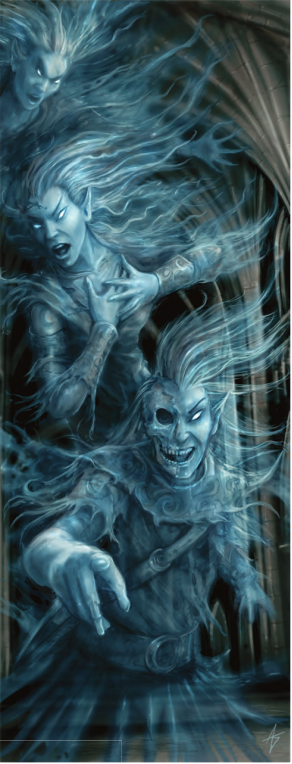
Copyright 2008 Wizards of the Coast This article is part of a series! Click here to see the other entries.
D&D is famous for making every synonym of a word into an entirely separate monster, and nowhere is this more obvious than with incorporeal undead. Previous editions had wraiths, specters, phantoms, haunts and ghosts be entirely different monsters, and getting them mixed up was likely the cause of death for quite a few PCs.
The decision to allow multiple stat blocks in the same monster entry has consolidated things a bit, but not entirely (wraiths and specters are still their own thing, for example). Ghosts appear only in the Monster Manual.
The Lore
As you would expect, ghosts are the spirits of sapient creatures that died with unfinished business that caused them to linger in the world. They look like, well, ghostly versions of their appearance in life, and if their deaths were violent they might still bear the wounds that killed them. That’s not always true, though: some ghosts look angelic or horrific regardless of their causes of death, and some can change appearance to suit their current mood.
Ghosts are almost always near where they died. They usually keep most of their memories and personalities, but the trauma of death or the long years of haunting might change them.
Getting rid of a ghost might be as simple as defeating it in combat, but some of them are so bound to the world that they reform after a day or so. In these cases, the only way to make the ghost go away is to finish whatever business is keeping it chained to the mortal plane. Fortunately, these are usually the ghosts most willing to talk things out, asking the PCs for help with their affairs or at least providing some hints of how to solve them during their mad ramblings.
The Numbers
The signature traits of ghosts are obvious: they’re immune to disease and poison, insubstantial, have phasing, and fly with hover capability. All ghosts statted up here have Speed 6, but if you’re turning a faster creature into a ghost I’d let it keep the higher value.
“Insubstantial” has a very specific meaning in the 4e ruleset: insubstantial creatures take half damage from all sources. This damage is halved after all other modifiers are applied, including any resistances and vulnerabilities. While this means everyone can do some damage to an insubstantial creature, it also means that no damage type is inherently more effective against it either! Individual might still have additional traits that make certain damage types ignore their insubstantiality or turn them temporarily substantial.
“Phasing” means the creature ignores difficult terrain and can move through solid surfaces, though it must always end its movement in an unoccupied space. It’s separate from insubstantiality because a monster can have one but not the other.
Ghosts have both, and together with the flight speed this means they have full 3D movement and can come at you from any direction at all. Their attacks also never target AC, to represent the fact that they phase through armor.
Phantom Warrior
Soldiers who died in battle, still fighting their wars or performing their patrols. They’re Level 4 Soldiers with 40 HP and all common ghost traits. They attack with a Phantom Sword (Melee 1 vs. Reflex) that does necrotic damage and marks for a turn. Their military training manifests as the Phantom Tactics ability, giving them combat advantage against target that has another phantom warrior adjacent to it.
A simple and workable soldier monster. All it needs is a damage fix for its sword, which does roughly half the damage it should do due to that “naturalistic design” thing.
Trap Haunt
The ghost of someone killed by a trap, who believes feeding others to the trap is the only way for it to move on. This Level 8 Lurker has 52 HP and all common ghost traits. It’s bound to the trap that killed it, and is always found close to it.
The haunt’s Grave Touch (Melee 1 vs. Fortitude) does a pitiful 2d6 necrotic damage and should probably be fixed. The real danger here is its Ghostly Possession (Melee 1 vs. Will), though. A hit dominates the target (save ends) and removes the haunt from the map while this effect lasts. The haunt will use this to walk the possessed target into the trap that killed it.
The Trap Haunt can’t voluntarily move more than 20 squares away from said trap. If pushed beyond this range, it becomes weakened until it goes back.
Wailing Ghost (Banshee)
This one used to be a separate monster, and specifically the ghost of an elf. It’s now under the Ghost entry, and can be of any species. Traditionally, banshees appear to people who are about to die, which in D&D means they’ll be looking to murder a specific party member. It’s a level 12 controller with 91 HP and all common ghost traits.
The banshee’s basic attack is a Spirit Touch (Melee 1 vs. Reflex) that does necrotic damage, like most other ghosts. The real standout here is the Terrifying Shriek (Close Burst 5 vs. Will; Recharge 5-6) which does psychic damage, pushes the targets 3 squares, and immobilizes them (save ends).
They can also display Death’s Visage to one unlucky soul (usually the one they’re trying to kill). This is a Ranged 5 attack vs. Will, which does psychic damage and inflicts a -2 penalty to all the target’s defenses (save ends).
Being a controller means the banshee can hold its own in melee combat, but it’s rarely going to bother. It will phase through walls and floors to keep away from the party, returning to shriek at them when the power recharges and to attack its chosen target with Death’s Visage once it’s immobile.
As a level 12 monster, the banshee is severely hampered by the twin flaws of the damage bug and naturalistic design. All of its attacks do pathetic damage, which should be fixed ASAP if you plan to use one in your game.
Tormenting Ghost
This is probably the monster most in line with the classic Ghost from previous editions, which was among the most terrifying undead. It’s a Level 21 Controller with 152 HP, and the only ghost with an actively Evil alignment (even the banshee is Unaligned). It also has all common ghost traits.
Its basic attack is a Spirit Touch (Melee 1 vs. Reflex) that really needs its damage fixed. It can use the same Ghostly Possession as the Trap Haunt, and release a Burst of Terror that’s pretty much an up-gunned version of the banshee’s wail: Close Burst 5 vs Will, targets take necrotic damage, are pushed 5 squares, dazed and immobilized (save ends both).
It can also create a zone of Ghostly Terrain by filling it up with spectral wisps and creepy whispers (Area Burst 1 within 10). Targets caught inside the zone are immobilized (save ends). Each zone lasts until the end of the encounter and the ghost can create them at will!
Finally, it can shift 3 squares as a reaction to being missed with a melee attack, which makes it hard to pin down.
If you fix the damage of its attacks, the Tormenting Ghost becomes a pretty good epic-level enemy. Having more than one of them ensures the entire combat area will be ghostly terrain before long, allowing the ghosts and their artillery buddies to shoot the immobilized PCs at their leisure. These are epic level PCs and you shouldn’t go easy on them!
Sample Encounters
We get three encounters here:
-
Level 4: 4 phantom warriors and a specter. And here was thinking the wraith was the only synonym monster that kept its entry.
-
Level 8: 2 trap haunts, 2 flameskulls, and a flame jet trap. I guess these flameskulls aren’t the friendly type.
-
Level 22: 2 tormenting ghosts, 1 larva mage, and 3 rot harbingers. “Larva Mage” is the generic name for the Spawn of Kyuss, which means this group is serious bad news.
Final Impressions
I like ghosts conceptually - they’re classics for a reason. Mechanically, though, these stat blocks leave a lot to be desired, as they seem to do much less damage than could be explained even by the standard damage bug.
Maybe it has something to do with them being insubstantial? After all, this makes them last twice as long in a fight as their HP would indicate. None of them have any additional traits that make them especially vulnerable to a specific type of damage, so their insubstantiality applies to everything. By the time the Monster Vault had been published, insubstantial monsters took full damage from force attacks, so you could say this applies to the MM ghosts as well.
-
-
Let's Read the 4e Monster Manual/Vault: Gargoyle
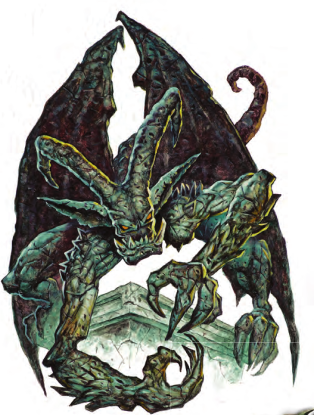
Copyright 2008 Wizards of the Coast This article is part of a series! Click here to see the other entries.
Gargoyles are based on sculptures found in many medieval buildings (particularly churches). If I recall correctly, these statues depict horrible beasts and are said to act as a sort of spiritual scarecrow, frightening demons away. They’re usually known as grotesques, with gargoyle being a specific type of grotesque that has a waterspout running through it to channel rainwater. It’s “gargling”, you see.
D&D gargoyles are a classic monster, part of the game since its beginnings. So classic, in fact, that the real surprise here is when the demonic-looking statues aren’t gargoyles in disguise. They appear in both books.
The Lore
Despite appearances, gargoyles aren’t animated statues, but living semi-organic creatures who originated in the Elemental Chaos and spread to the world long ago. As you’d expect, they’re ambush predators, and they’re also both sapient and inclined to cruelty and sadism. They’re fond of “playing” with their prey before eating it and don’t care if it’s sapient itself.
Nevertheless, they can form cooperative relationships with other earth creatures, and are sometimes employed by evil summoners or demon cultitsts who bind them with magic. Gargoyles aren’t demons, but they look demonic enough and are easier to bind!
The Monster Vault makes an interesting inversion by saying that in the world of D&D, the gargoyle’s reputation for cruelty has turned its image into a sign of warning to intruders. This means that people in the setting have a reason to sculpt gargoyles into their buildings! Ironically, the monsters end up gravitating to these places since they provide such convenient camouflage.
The Numbers
As creatures of earth, gargoyles have Tremorsense 10 and an immunity to petrification. They’re not immune to poison because they’re still semi-organic. Gargoyles move pretty fast, with a ground speed of 6 and a flight speed of 8. No hover capability, but they also can attack from the air with no penalties. Gargoyles also have darkvision.
They’re all Medium Elemental Humanoids (Earth).
Gargoyle (Both)
The classic model is a Level 9 Lurker with 77 HP. It attacks with a claw that suffers from the damage bug, and can use it as part of a Flyby Attack that allows it to fly its speed without drawing opportunity attacks and make a claw attack at any point in the movement. A hit here also knocks the target prone.
As expected the gargoyle can also assume a Stone Form, which gives it Resist 25 to all damage and Regeneration 3. In this form, it can only perceive its surroundings via tremorsense, and can take no other actions other than to revert to normal. Reverting is a minor action, meaning it can attack on the same turn it does so.
The creature doesn’t do any additional damage from attacking from hiding, meaning it’s another one of those MM lurkers who should have been a skirmisher.
The MV version is a proper lurker: though its basic attack does the same damage, it now has a +20 bonus on its next damage roll after leaving Stone Form. It also only has Tremorsense while in Stone Form, and its Flyby Attack ability (renamed to Swoop Attack) only allows an attack at the end of the movement.
Instead of regenerating, the MV gargoyle gains 5 temporary HP at the start of its turn. I don’t think this stacks, so it will never get rid of all its damage during the fight. This is in line with late 4e’s policy of never giving its monsters much in the way of healing abilities.
Gargoyle Rake (MV)
This is a Level 5 Lurker with 52 HP that is essentially identical to its level 9 cousin, above. Its level-based stats are smaller, of course. Also, damage resistance while in stone form is only 20, and the damage bonus is +15.
Gargoyle Rock Hurler (MV)
This one throws rocks! It’s Level 11 Artillery with 87 HP. The basic claw attack is okay, and it can hurl rocks either one at a time (Ranged 20 vs. AC) or in a volley (Area Bust 1 Within 10 vs. AC; half damage on a miss).
The rock hurler can’t create its own ammunition, but it’s likely to be found in a place with plenty of loose stone lying around anyway.
It can’t turn into a statue completely, but its stony hide gives it Resist 10 to damage from ranged attacks originating from more than 5 squares away.
Nabassu Gargoyle (Both)
While still not classed as a demon, this Level 18 Lurker is a lot closer to being one than its weaker cousins. It has 131 HP and all standard gargoyle traits.
Its abilities are a basic claw, a non-basic bite that does a bit more damage, and a stronger version of Stone Form. Instead of getting a bonus to its next damage roll when leaving Stone Form, the nabassu gargoyle automatically does a chunk of fire and necrotic damage to every enemy within 3 squares of it.
While in stone form it also emits a Bloodfire curse (aura 3) that deals 10 fire and necrotic damage to any enemy that ends its turn in range. When this happens, the monster gains 10 temporary HP.
A useful note: “10 fire and necrotic damage” means 10 damage of the “fire and necrotic” type, not “10 fire and 10 necrotic”. This means you resist it with the lower of your fire and necrotic resistance - if you have Resist 15 to fire but 0 to necrotic, you take the full 10 damage.
The Monster Manual version is a bit clunkier. Its Stone Form functions exactly like that of the MM classic model, and its bite heals it for half its rolled damage on a hit. Bloodfire is an Aura 2 that does 5 damage and weakens enemies who already are taking ongoing damage, and only works out of Stone Form.
Just use the MV version, it’s better.
Sample Encounter and Final Impressions
The sample encounter from the MM is level 9: 3 gargoyles, 2 galeb duhr earthbreakers, and 1 gibbering mouther. It’s essentially another version of the similar galeb duhr/gargoyle/bullete encounter we already saw, with a different interloper.
The Monster Vault gargoyles are generally superior to the MM ones when it comes to mechanics, and you lose nothing by ignoring the Monster Manual on this one. Lore-wise, I feel gargoyles are one of those monsters so classic that you almost have to feature them in your campaign at some point. The big subversion here would be a campaign where every statue was exactly what it seemed.
subscribe via RSS