Posts
-
Let's Read the 4e Monster Manual/Vault: Goblinoinds
In Fourth Edition, “Goblin” is a noun that names both an entire set of related species, and the runty jerks that are at least 50% likely to be your group’s first adversaries. I like this ambiguity as a setting element, but since I apparently already have problems being clear enough in these posts I’ll use the older “Goblinoids” noun for the whole set.
“Goblinoids” is a word from older editions that is used to refer to goblins and all related humanoid species. Orcs used to be a part of this clade back in the AD&D days, but became their own thing from 3e onwards. 4e just uses “Goblins” as the catch-all term, encompassing actual goblins, hobgoblins, and bugbears.
These three species used to make up a good chunk of the Humanoid Power Ladder back in old D&D, and have been part of the game since its inception. As expected, they appear both in the Monster Manual and the Vault.
We find ourselves into yet another novel situation that wouldn’t really be relevant when using the book normally. Goblinoid lore is fairly compact and unified, but there are tons and tons of statblocks covering these three species across two books. So what I’ll do here is cover all of their lore in this post, and go over the stat blocks one species at a time in the next few posts.
The Lore
All Goblinoids share some common characteristics: large pointed ears, prominent sharp teeth, skin that comes in several tones of yellow, green or red, and dark hair. I imagine the several types are about as closely related as the several types of elf. The MV says they can interbreed, with children taking after one of the parents.
Goblinoids are one of the many peoples in the Points of Light setting to have had a mighty empire in the past. This Goblin Empire was particularly successful, dominating the world and extending to the Feywild. Its chief deity was Bane, the Evil god of war and military conquest. Hobgoblins ran the show, and some sages speculate goblins and bugbears were created through genetic engineering to fulfill specific roles in their society. They also had an uncanny ability to tame all sorts of wild beasts and press them into service, a skill retained by present-day goblinoids.
Little concrete information is known about this empire. We can be fairly sure it fell due to internecine strife, with some tales saying this strife was instigated by the fey. Like many past world rulers, the goblinoids never recovered, a pattern which spells grim tidings for the humans of Nerath.
While many former empire-builders live integrated with current “civilized” society, goblinoids seem to have been driven from it. Either they were such cruel overlords that no one wanted to have them around, or it happened through some unfortunate historical development in the intervening centuries.
Present-day goblinoid culture is militaristic and xenophobic, still worshipping Bane as their main deity alongside his exarchs Maglubyet and Hruggek. The three subspecies mostly live apart from each other and have their own style of doing things, but they really come into their own once they begin working together.
Small and ill-tempered, Goblins favor hidden villages where most inhabitants live in a communal space and only the leaders get private quarters. They prefer to build them close to “civilized” trade routes and settlements, as most of their economy is based on raiding. They’re the most prolific beast tamers among their kin. Goblin wolf riders are a classic, but they have no trouble using whatever is available in their local environment, such as giant spiders in the Underdark and plant creatures in the Feywild.
Bugbears tend to live among other goblinoids or roam in small bands. Despite their great size and strength, they’re quite agile and sneaky. When living among goblins, they’ll take charge of their weaker cousins through bullying and intimidation, but will fall in line when commanded by hobgoblins. In any case, they hate excessive talk and prever to go straight for the violent option as soon as possible.
Hobgoblins are the most sophisticated members of the family, and the ones who most fervently wish a return to their glory days. They have preserved a lot of the military discipline and techniques from their fallen empire and are quite adept at organizing themselves and other goblinoids into frighteningly effective fighting forces. When this happens, Bugbears and Goblins go right back to their original niches of shock troops and scouts (respectively), with hobgoblins making up the rank and file and the top brass.
Every once in a while, a charismatic hobgoblin general will manage to unite a large goblinoid army and march upon “civilization” bent on total conquest. In the past, these were driven back by whatever incumbent empire was there, but now there is none.
The language of the Monster Manual gives me a bit of pause. They use the word “tribal” a lot, along with some terms that allude to vermin when describing “actual” goblins. This is about par of the course for D&D when you look at previous editions, of course, but after that horrible Goblin Slayer anime I’m hesitant to accept this portrayal. The MV steps back from this a bit. Goblinoids are still a menace there, but the language is more similar to what I used in this post.
The bit about the ancient and mighty Goblin Empire seems somewhat inspired by Eberron, whose goblinoids have such an empire in their pasts and are actually on the verge of seeing it restored through political unification and recognized as a modern-day nation in Khorvaire. Khorvaire’s human cities even have goblin populations living peacefully in them!
5e would double down on the “goblins are evil” idea and make them into basically Nazis, with Maglubyet as their main god.
-
Let's Read the 4e Monster Manual/Vault: Gnome
Copyright 2008 Wizards of the Coast This article is part of a series! Click here to see the other entries.
Gnomes were introduced as a playable race in the days of AD&D, where they had a niche as the nonhuman illusionists and were otherwise slightly smaller dwarves. The removal of class and level restrictions in 3.x turned them into one of the least popular race choices in the game in my experience. If you wanted to play a short angry person you played a dwarf; if you wanted a short cute person you played a halfling; and if you wanted a non-human wizard you played an elf.
This might have been one of the factors that kept them out of the PHB when 4e was released, replaced by tieflings. They would eventually appear on the PHB 2, but until then the only gnome stats we got were in the first Monster Manual.
This switch was announced in one of the funniest pieces of D&D marketing ever before the PHB had been even published, which had the unfortunate side effect of turning every edition warrior into a campaigner for gnome rights until the publication of the PHB 2.
Gnomes appear both in the MM and in the MV. Interestingly, if you’re going Essentials-only gnomes once again drop from the list of playable races and appear only in the monster book.
The Lore
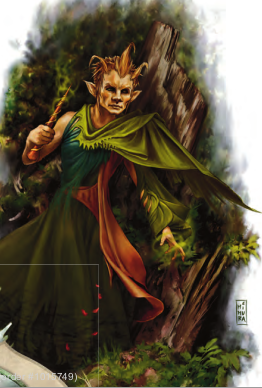
Gnomes don’t exist, or so they would have you believe. This diminutive fey people endured a long period of slavery at the hands of the fomorians, but were able to escape with the (unwitting, according to some legends) help of the eladrin. They kinda compete with eladrin for the title of “most fey playable race”, as a matter of fact.
Since that remote past, they’ve spread all over the Feywild and the world, though few know it. Gnome culture values cunning and discretion, since it developed in a hostile environment full of much larger creatures bent on hunting them. Gnome communities are extremely well-hidden, even when they’re located within large human cities. In that case, gnomes might build their homes between the walls of neighboring buildings or under their floors, wainscot-fantasy style.
Their interpersonal relations are similarly camouflaged. The typical gnome is suspicious of strangers and very slow to trust, but hides that behind a mask of pleasantness and even frivolity. In the worst case, this suspicion can sour into paranoia and lead a gnome down the path of evil. Some of them even work as spies and assassins for the fomorians.
A large percentage of gnomes train in magic, becoming wizards or warlocks and focusing on illusions. Even a gnome untrained in magic can turn invisible.
The Numbers
Gnomes are Small Fey Humanoids with a typical speed of 5 and low-light vision. They have two signature traits: Fade Away is an encounter power that allows them to turn invisible for a turn or until they attack, and Reactive Stealth allows them to make a Stealth check to become hidden when they roll initiative, if they have any degree of cover or concealment at that point. The MV gnomes frequently trade those for improved powers along the same line.
All the gnomes we see in these books are Unaligned, as is traditional for PC or PC-adjacent peoples. They could be used as enemies or allies depending on the story. Let’s look at them in order of level.
Gnome Skulk (MM)
This Level 2 Lurker has 34 HP and all common traits, including both powers. It wields a war pick and a hand crossbow, and wears leather.
The basic pick attack has the High Crit property, and the skulk deals an extra 1d6 damage on any attack where it has combat advantage. If it attacks from hiding and misses, the gnome skulk remains hidden.
Your basic rogue-type, with a few additional tricks that give it the ability to keep hidden for longer.
Gnome Arcanist (MM)
One of those magically-trained gnomes. This is a Level 3 Controller with 46 HP and all common traits including the two powers. It projects a 5-square Aura of Illusion that grants concealment to itself and all allies within. The arcanist wields a pitifully weak dagger as a basic attack and relies on ranged spells for actual fighting.
Its main ranged attack is a Scintillating Bolt (Ranged 10 vs. Fortitude) which does radiant damage and dazes (save ends). As a minor action it can also fire off a Startling Glamor (Ranged 10 vs. Will) that does no damage and slides the target 1 square. It can also cast Illusory Terrain (Close Burst 5 vs. Will), which does no damage and slows all enemies in the area.
In addition to the already-mentioned gnome racial powers, the arcanist also borrows the Eladrin’s Fey Step.
Despite its low damage potential, the arcanist is still quite dangerous when paired with other monsters that can fill that function. It has an at-will daze!
Gnome Spy (MV)
Basically a more powerful version of the MM Skulk, this gnome is a Level 5 Lurker with 51 HP, trained Perception, and all common gnome traits including the two powers. It is, in fact the last gnome in this post to have those powers at all.
The spy fights with a short sword in melee, and throws daggers out to Range 10. Both do extra damage if the gnome is invisible to the target when it attacks.
Aside from the reactive Fade Away power, the gnome spy can also turn invisible for a turn or until it attacks as a standard action.
Gnome Illusionist (MV)
A more powerful gnome wizard, this one is Level 6 Artillery with 57 HP and all common traits except for the powers. It’s also trained in Bluff and Stealth.
The illusionist’s weapon is a Gnarled Staff that’s nothing special in melee, but likely acts as an implement for its spells. Bedazzle (Area Burst 1 within 10 vs. Will) is an at-will attack that does radiant damage and makes targets grant combat advantage (save ends); See Me Not (Close Blast 3 vs. Will; recharge 5-6) does psychic damage and makes the gnome invisible to the targets (save ends).
As a move-action encounter power the illusionist can use There, Not There, a spell that teleports it 5 squares and creates two illusory doubles within 5 squares of the destination. These last until the original attacks or until they are destroyed - they have 1 HP and the same defenses as the original. The illusionist can use its actions to have them do anything it could, except use powers.
As an at-will minor action the illusionist can disguise itself and 2 allies within 5 squares as any Small or Medium creature. Seeing through the illusion requires an opposed Insight check against the gnome’s Bluff.
Gnome Assassin (MV)
This is a Level 7 Skirmisher with 78 HP and all common traits except for the powers. It wears leather and wields paired katars.
The katars are its basic attack, and do extra damage if the assassin attacks out of Shade Form. Shade Form, in turn, is an encounter power that recharges when the assassin is bloodied. It lasts for a turn or until it attacks. While this power is active, the assassin is insubstantial, has Vulnerable 5 Radiant, and can make Stealth checks to become hidden if it has any cover or concealment.
In addition to all this, the assassin can use Shadow Step as an at-will move action, using its enemies’ shadows as portals. It teleports 3 squares to another shadow and sheds any mark applied to it. It must start and end the teleport adjacent to another creature, since it’s using their shadows for this.
You better keep your squishies far away from your defenders when fighting gnome assassins (and hope they don’t appear near your squishies).
Gnome Entropist (MV)
Our final gnome is another spellcaster, Level 8 Artillery with 71 HP and all common traits except the powers.
Despite being a blasty mage, the Entropist is still skilled at illusion. Its Illusory Defenses give it a +2 bonus against ranged attacks, and it upgrades the standard Fade Away power to Disappearing Act, which lasts for a turn and doesn’t end when the gnome attacks.
The entropist fights in melee with a Touch of Chaos that does acid damage, and at range with an Entropic Arc (Ranged 10 vs. Reflex) that does physical damage and prevents the target from taking immediate and opportunity actions for a turn. Perfect to let a fellow skirmisher pop free from the PC fighter.
Its “special” attack is Chaos Flare (Area Burst 1 within 15 vs. Will) which affects only enemies and recharges if it misses all targets. A hit does physical damage and blinds (save ends).
Sample Encounter and Final Impressions
The sample encounter in the MM is level 3: 2 arcanists, 2 iron defenders (low-level constructs) and a pseudodragon. They’re likely a guard patrol for one of those hidden settlements, which is likely to be quite awkward for the humans whose basement houses the main gate.
I like 4e’s take on gnomes as secretive fey tricksters, as it gives them a distinctive flavor. It borrows a bit from Eberron, whose gnome nation of Zilargo is the best at the great game of spying and intrigue in a setting already rife with it. Pathfinder apparently went in a similar direction with its gnomes as well, though theirs are less sneaky and more whimsical. This version of gnomes survives in 5e as the “Forest Gnome” subrace.
-
Let's Read the 4e Monster Manual/Vault: Gnoll
Copyright 2008 Wizards of the Coast This article is part of a series! Click here to see the other entries.
Gnolls have been in the game since the beginning or close to it, when they fit in the Humanoid Power Ladder right above hobgoblins and before bugbears. In 4e, they are present in both books.
The Lore
Once the Humanoid Power Ladder got dismantled, just being “the 2 HD humanoid” no longer cut it as the gnoll identity. And in Fourth Edition, they are now widely known as the Least Reasonable Humanoids.
You see, the vast majority of these hyena-faced people your group ends up fighting will be worshippers of the demon lord Yeenoghu, whose teachings can be summed up as “kill and eat everything you see”. Gnoll bands are nomadic and roam around fulfilling that mandate. They never build permanent structures, and even their gear is mostly taken from those they killed. Sometimes they take slaves, but those slaves never last long. Mostly they just kill and eat people. In short, they’re the closest you can get to a demon while still having the natural origin. You can frequently find actual demons in their midst, either summoned by their priests or sent by Yeenoghu to boss them around. Their warriors carry all sorts of demonic boons into battle as well.
No one else cooperates with gnolls. If you try they’ll eat you, and if you’re strong enough to prevent them from eating you, you don’t need their help in the first place.
There was a Dragon article with presented playable gnolls who were members of a dissident faction that rejected demon worship. They are fierce and honorable hunters, most often Good or Unaligned, and a lot more likely to cooperate with others. I liked them a lot and I’m sad they never showed up again after that one article.
The gnolls we’ll be looking at there are the usual “fanatical demon worshipper” variety.
The Numbers
Gnolls are Medium Natural Humanoids and typically Chaotic Evil. The gnoll mechanical schtick is that they punch above their weight class. They get a +2 bonus to damage when bloodied, and their signature trait is Pack Attack, which gives a further +5 damage bonus if their target has two or more of the attacker’s allies next to it. Their land speed is 8, making it very hard for innocent civilians to escape from them. And they have low-light vision, to better chase you in the dark.
Unfortunately their MM incarnations suffer from the same “naturalistic design” variant of the damage bug we saw with foulspawn. It’s less egregious due to their lower level, but it does mean that a bloodied gnoll benefiting from Pack Attack juuust manages to hit the average damage expected by the new math.
The Monster Vault variants behave like they’re supposed to, with their basic damage hitting the expected average and the add-ons applying on top of that. Don’t let them surround you!
There’s little overlap between the stat blocks in both books, which leaves us with a lot of gnolls to look at. Fortunately most of them are fairly simple. Let’s mix them all and look at them by level.
Gnoll Huntmaster (Both)
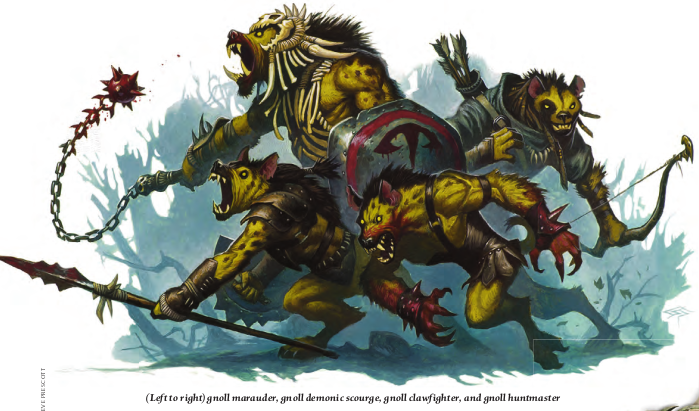
Huntmasters are level 5 artillery with 50 HP and all common gnoll traits. They fight in melee with a handaxe, and at range with a longbow. Other than their damage numbers, the two statblocks are identical.
The common traits are the entirety of huntmaster’s special tricks, which are actually respectable since Pack Attack works with the longbow. The gnoll itself doesn’t have to be adjacent to the target, only its allies!
Deathpledged Gnoll (MV)
This Level 5 Brute has 75 HP and all common gnoll traits. It fights with a spear, and generally wants to engage someone and stand its ground to both do damage and give its buddies the benefit of Pack Attack.
This gnoll is “deathpledged” because when it first hits 0 HP, it goes berserk! It regains 5 HP, gains Resist 15 All, and 1 action point! At the end of its next turn, though, it drops dead. This means it’s going to use that last turn to attack twice if you don’t manage to kill it first. This power is named Claws of Yeenoghu.
Gnoll Claw Fighter (MM)
This Level 6 Skirmisher has 70 HP and likes to tear people apart with its bare hands.
Its basic melee attack is a single claw strike, and it can make two of those when it charges. It can also perform a Mobile Melee Attack that allows it to make a claw strike and move a total of 4 squares at any point in the action, without provoking opportunity attacks when moving away from the target of the attack.
This gives us a pretty obvious routine: charge one turn, attack and move away on the next. Fix the damage of the gnoll’s claws if you plan on using it, though, it’s really low as printed.
Gnoll Marauder (MM)
This Level 6 Brute has 84 HP and all common gnoll traits. It fights with a spear, which makes me think it was an earlier version of the Deathpledged Gnoll above.
Instead of the Claws of Yeenoghu power, the marauder has Quick Bite, which allows it to make a free-action bite attack against a bloodied enemy it just hit with the spear. This does a bit less damage than the spear, but it’s pretty good for a bonus attack.
Gnoll Blood Caller (MV)
Our first spellcaster is a Level 6 Soldier with 70 HP and all common gnoll traits.
The blood caller fights with its claws, which mark for a turn as an effect. It can follow that up with Blood Call (Close Burst 5 vs. Will), which targets every enemy marked by the gnoll. A hit does psychic damage and pulls the target up to 3 squares. The gnoll itself can shift 3 squares as an effect, too.
Once the gnoll is bloodied it can use Blood Frenzy as a 1/round minor action. This automatically deals a bit of damage to every enemy in a Close Burst 1 and marks them for a turn. And now you know why Blood Call is an area effect.
This is another monster that will make up the frontline in a gnoll encounter to provide Pack Attack bonuses, and it has a few tricks to pull the PCs into more favorable positions for that.
Fang of Yeenoghu (MV)
This Level 7 Skirmisher (Leader) has 77 HP and all common gnoll traits. It’s another one of those caster-types.
The Fang of Yeenoghu wields a Cudgel of Bloody Teeth in combat, whose blows also deal ongoing damage (save ends). Its other melee attack is a Relentless Push: the gnoll can shift 2 squares before the attack, which does a bit less damage than the basic cudgel blow and pushes the target 1 square. After this, one of the gnoll’s allies within 5 squares can shift 1 square as a free action. I think this is the most complicated gnoll power I’ve seen so far.
Its final technique is Howl of the Demon (Close Burst 5; Recharge 6), which allows every ally in the burst to make a free melee basic attack.
It looks like the Fang’s main concern in a fight will be to position the PCs and its allies so that all of them benefit from Pack Attack, and then let loose the Howl.
Gnoll Gorger (MV)
This most psychotic of gnolls is a Level 7 Brute with 96 HP and all common gnoll traits. Its only attack is a bite that does Brute-tier damage, and as a minor action it can Gorge, which means it takes a bite out of an ally. This deals 5 damage to the ally and heals the gorger for 5 HP.
That’s some real horrific imagery right there.
Demon-Eye Gnoll (MV)
This level 7 Lurker has 62 HP and all common traits. Plus, the Abyss leaks out of its eyes.
This gnoll fights with a Reach 2 glaive, which does extra damage if the target can’t see it. It has a Stare into the Abyss power (Close Burst 3 vs. Will) that dazes and makes the gnoll invisible to the targets for a turn.
Once bloodied, the Abyss starts leaking through the gnoll’s wounds too, functioning as an Aura 3 that deals psychic damage to those enemies caught within and forces them to make a melee basic attack against an ally if they’re dazed.
Gnoll Demonic Scourge (MM)
This Level 8 Brute (Leader) has 106 HP and all common traits. It projects an aura of command that gives a +1 attack bonus to allies within 5 squares, or +2 if the demonic scourge is bloodied.
It wields a heavy flail in combat, which can knock its targets prone if they’re bloodied. And when it bloodies someone with the flail, an ally can make a free melee basic attack against the target. Once per encounter, the gnoll can grant this free attack to 2 allies instead of 1.
Gnoll Far Fang (MV)
This Level 8 Artillery menace has 68 HP and is mostly an up-leveled version of the huntmaster. It has one extra trick: a volley of Hungry Arrows (Area Burst 2 Within 10 vs. AC; Encounter) which does longbow damage plus ongoing damage (save ends).
Gnoll Pack Lord (MV)
A Level 8 Controller (Leader) with 90 HP, this seems like a more complex version of the demonic scourge above. It’s also pretty much a lazy warlord.
Its basic flail attack is nothing special, but it can cast a Demonic Frenzy charm (Ranged 10 vs. Will) that does no damage, but dazes for a turn as an effect. On a hit, it also inflicts a -2 attack penalty and forces the target to make 2 basic attacks against targets of the gnoll’s choice.
It can also use a power called Feed on the Weak (Area Burst 1 within 5 vs. Will), which does no damage but causes the target to grant combat advantage for a turn and allows an ally in the burst to make an attack as a free action.
As a minor action, it can use a Pack Cackle (Close Burst 5; recharge 5-6) to allow its allies to shift 2 squares as a free action.
Gnoll Demon Spawn (MV)
Our final gnoll is a Level 9 Brute with 120 HP, who is Large but still a Natural Humanoid despite that demonic ancestry. An upgraded version of the Gorger, it fights with its claws and can take a bite out of its enemies to heal itself. This is a minor action, and requires an attack roll since no PC is just going to stand there and let it happen.
Sample Encounters and Final Impressions
I’m not going to detail the MM encounters here, as this post is already too long. You can guess what they look like: groups of assorted gnolls, with the occasional pack of hyenas and evistro demons thrown in. As I said above, no one else can work with these maniacs.
When it comes to humanoids and other “sapient, natural” opposition, I don’t mind if the specific group the PCs are fighting is villainous. However it does bother me a bit when the game seems to say every single member of the species is similarly evil. That solitary Dragon article could have opened the way for a setting where your typical gnoll is a person and not necessarily hostile, with the ones you fight being those individuals who chose an evil path (much like the game treats humans). Instead, it was never officially built upon and in fact 5e went in the other direction and made gnolls into basically another type of demon.
Anyway, these stat blocks make for mechanically interesting enemies and we have enough of them to build entire dungeons with nothing but gnolls as the opposition. Do grab that Dragon article if you can, I remember the playable version was also quite good.
-
Let's Read the 4e Monster Manual/Vault: Githzerai
Copyright 2008 Wizards of the Coast This article is part of a series! Click here to see the other entries.
Githzerai were introduced into the game right alongside githyanki. They’re the other side of the gith coin, the ninjas opposing the pirates. In the books we’re covering, they only appear in the Monster Manual, but would also feature as a playable character option in the Player’s Handbook 3.
The Lore
Githzerai are an austere and contemplative people who follow a philosophy that espouses discipline and mastery of the self. It might seem weird that they chose to make their home in the Elemental Chaos, but they see withstanding the turbulent nature of that plane as an important step on the road to enlightenment.
Githzerai live in monasteries spread through the Elemental Chaos, where they dedicate themselves to studying a martial arts style with a strong psionic component. They use these arts to both defend themselves and to hunt down their enemies - mainly mind flayers, which they understandably still hate.
Unlike the githyanki, the githzerai aren’t out to conquer the multiverse. They’ll usually keep to themselves unless someone makes an effort to rile them up. Like any other people they can produce their share of villains and heroes, though.
The largest known githzerai settlement is Zerthladun, a large city with many open fields and markets. It’s one of the few famous spots of order and tranquility in the Elemental Chaos and probably one of the nicest given that the list includes the City of Brass.
The Numbers
As far as 4e is concerned, githzerai were monks before it was cool. Speculation about what the Monk class was going to be like started almost as soon as the first PHB hit the shelves. A lot of players speculated about a “Ki” power source, and IIRC the designers themselves began thinking in those terms, but they soon realized writing up Orientalism as a power source was a bad move.
In the end, monks became psionic strikers and were published in the PHB 3 alongside playable githzerai. I imagine the stat blocks we’re about to see might have inspired that decision to some degree.
As far as common traits go, githzerai are Medium Natural Humanoids, and are faster on their feet than githyanki at Speed 7. They have a power named Iron Mind, which allows them to gain +2 defense against an attack as an interrupt once per encounter. This will be used to turn an attack that hit by 2 or less into a miss.
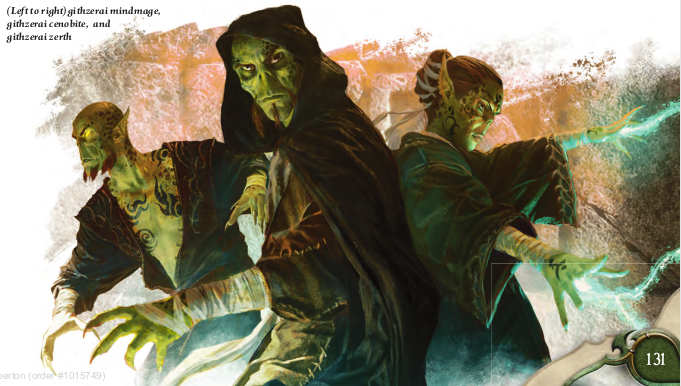
Githzerai Cenobite
Cenobites are Level 11 Soldiers with 108 HP, representing the typical martial artists PCs might meet. Rather than the mobile skirmishers you’d expect monks to be, they’re the kind of fighter who stands their ground and chases the foe down.
They fight unarmed, and their fists are supposed to cause level-appropriate damage. Instead of a basic strike they can use an at-will Stunning Fist, which does a little less damage than the strike but stuns for a turn.
When an enemy shifts away using a movement mode the cenobite also has (i.e, feet), the cenobite can shift to remain adjacent to them. That means a flying or teleporting enemy is safe from this.
Their final technique is Trace Chance (Ranged 5; Recharge 6), which hits automatically and causes the next melee attack made against the target to get a +5 to-hit bonus and be turned into a critical if it connects. Note that this attack doesn’t have to be from the cenobite!
Githzerai Zerth
The counterparth to the githyanki gish, this represents an individual who balances martial and psychic training. It’s a Level 13 Elite Controller with 248 HP.
Like the cenobite above, the zerth fights unarmed, with the same basic strike and Trace Chance abilities. Its main ranged attack is Inner Spark (Ranged 5 vs. Reflex), which does lignthning damage and teleports the target 5 squares to an unnocupied space of the zerth’s choosing.
Further teleport shenanigans are possible with Reorder Chaos (Ranged sight vs. Fortitude), which targets up to 4 creatures and swaps their positions as the zerth sees fit.
Once per encounter the zerth can let loose with Psychic Fists (Close Burst 5 vs. Will; enemies only) for some psychic damage. And in addition to Iron Mind, it also has a technique named Avenging Wind that triggers as an interrupt when the zerth is targeted with a ranged attack. This redirects the attack to another creature of its choice within 5 squares, and allows the zerth to teleport up to 10 squares to become adjacent to the attacker.
In addition to fixing the zerth’s damage, I’d probably also give it the ability to punch twice in an action, since it’s an elite.
Githzerai Mindmage
Mindmages put more emphasis on their mental training, though they can still punch hard. They’re level 14 Artillery with 105 HP.
As mentioned above, their basic melee attack is an unarmed strike. Their main ranged attack is the Mindstrike (Ranged 20 vs. Reflex), which does psychic damage and dazes (save ends). Its other options include a Concussion Orb (Area Burst 2 within 10 vs. Fortitude) that does physical damage and knocks prone, and a series of Elemental Bolts (Ranged 10 vs. Reflex). Those allow up to 3 attacks against different targets each of which can do one of fire, lightning, cold or acid damage at the mindmage’s choice.
Concussion Orb is an encounter power and Elemental Bolts is daily. I don’t think that makes much difference for a monster, honestly.
Sample Encounters and Final Impressions
We have two:
-
Level 12: 3 cenobites, a guardian naga, and a firelasher elemental. I’m sure there’s an interesting story about this one.
-
Level 14: 1 mindmage, 1 zerth, and 4 cenobites. Ninja death squad!
I really like these guys. They contrast with githyanki in an interesting way, being approachable in a way their estranged siblings aren’t. I think it would also be really cool for them to be the originators of the monk’s mystical traditions in the setting.
5e would make them more morally ambiguous, saying they don’t mind let innocents come to harm if it allows them to strike at the mind flayers or githyanki, but I like them best as an Unaligned people that can produce heroic PCs or dastardly villains in the same vein as the humans or elves. “Neutral” shouldn’t mean you do equal amounts of good and evil.
-
-
Let's Read the 4e Monster Manual/Vault: Githyanki
Copyright 2008 Wizards of the Coast This article is part of a series! Click here to see the other entries.
Githyanki are another one of those D&D monsters who surpass the “classic” and hit the “iconic”. They originally appeared in the AD&D 1st Edition Fiend Folio, and were the creation of Charles Stross, who today is an award-winning science fiction author. Here, they’re present in both books.
Judging by the other RPG.net Let’s Reads that are running at the same time as this one, it seems like 3.x would spill a lot of ink creating other weird extraplanar people in an attempt to make the “next githyanki”, mostly without success. 5e would instead attempt to add new lore to them, with what I feel are mixed results.
The Lore
A very long time ago, or possibly a very long time in the future, the mind flayers had a huge empire. This empire was built on the back of slaves. More specifically, it was built on the back of the gith, a species broadly similar to humanity.
The gith eventually rose up and gained their freedom by using the tools of their tentacly oppressors: psychic powers! Once they didn’t have a common enemy to unite against, the internal tensions of the gith began building up and eventually exploded. The resulting conflict divided the gith into two people with radically different philosophies: the xenophobic and militaristic githyanki, and the contemplative and isolationist githzerai. We’ll focus on the first here.
The githyanki migrated en masse to the Astral Sea and built their capital city of Tu’narath on the corpse of a dead god. From there their astral ships sail on piratical voyages, to juicy targets in the Astral Sea, the world, and perhaps beyond.
Each ship captain has full discretion on which targets to pick and on how to run their ship, but all ultimately answer to their lich queen Vlaakith, the supreme ruler of the githyanki. A githyanki attack might be a simple raid, but it might also be part of a more complex plan of their queen.
Aside from piracy, those astral ships also seek to find more of those gigantic astral entity corpses and other such debris on which to build more cities and expand their empire.
The preferred combat style of the githyanki mixes swordplay and psychic powers. They wield psionically enchanted silver blades and use telekinesis to perform impossible leaps and to attack at range with energy blasts. Their initial publication back in the 1st Edition days probably did a lot to popularize this “sword & spell warrior” archetype, which is often nicknamed “gish” in reference to them and is represented by the swordmage class in 4e.
Githyanki sometimes associate with red dragons, likely because both respect martial prowess and have a hankerin’ for plundered treasure.
The Numbers
Despite living in the Astral Sea, githyanki are Medium Natural Humanoids since they originated in the world. Their usual speed is 6 but armor may reduce that, as for PCs.
All githyanki combatants wield a silver sword of some sort, which usually does psychic damage. They can also perform a Telekinetic Leap as a move action once per encounter, allowing themselves or an ally within 10 squares to fly 5 squares.
Their other psychic powers vary with each individual stat block. The MM versions also have a +2 to saves against charm effects (meaning “powers with the Charm keyword”), which is absent from the MV version.
Githyanki Warrior (Both)
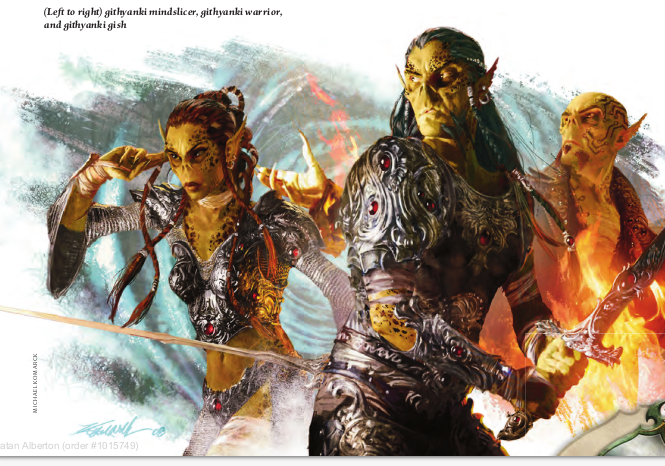
The basic model is a Level 12 Soldier with 118 HP, who wears plate and wields a silver greatsword. Warriors likely make up the bulk of the crew on those pirate ships, which would explain why they’re such a terror. The MV version is the best of the two, so we’ĺl start with that and note the differences later.
That silver greatsword does psychic damage on a hit, and does bonus damage against immobilized targets. As an effect, these basic attacks apply a double-strenght mark against the target for a turn. This means the target gets a -4 penalty to attack enemies other than the marking warrior instead of the usual -2. I believe these are the only monsters to do so.
Warriors can also use a Telekinetic Grasp (Ranged 5 vs. Fortitude; recharge 5-6) against Medium or smaller targets, doing no damage but immobilizing them (save ends). Multiple warriors will know to split the tasks of immobilizing the PCs and hitting them with the sword for that damage bonus.
The MV version is similar, but doesn’t mark with its attacks and the sword does physical damage (the bonus damage is still psychic).
Githyanki Mindslicer (Both)
This one focuses more on its powers than on its sword. It’s level 13 Artillery with 98 HP. Again we start with the better MV version and note the differences later.
The mindslicer’s weapon of choice is a silver longsword, which does psychic damage as usual. It has two ranged options. Mindslice (Ranged 10 vs. Will) does psychic damage at range. The Psychic Barrage (Area Burst 1 within 20 vs. Will; Recharge 6) spreads that over a wider area and adds a couple of nasty riders: ongoing psychic damage and an inability to use daily or encounter powers (save ends both).
Githyanki Raider (MV)
This lightly-armored combatant is a Level 13 Skirmisher with 126 HP. Its silver longsword deals psychic damage as usual, and it can shift 2 squares as an effect when it attacks with the blade.
Once per encounter the raider can Slash and Dash, making an attack against one creature, shifting up to its speed, and attacking another target. Each of those does double the damage of a basic attack, half on a miss. As a move action, it can shift up to 2 squares.
Githyanki Legionnaire (MV)
A Level 13 Minion Soldier which makes me thing I was wrong when I said the Warrior above made up the bulk of their crews. This is basically a Minion version of the warrior, down to its power selection and bonus damage against immobilized targets.
Githyanki Gish (MM)
This amusingly named fellow is a Level 15 Elite Skirmisher that might represent a ship captain or officer. It has 226 HP, wears mail and wields a silver longsword.
The basic attack is nothing special, dealing psychic damage with no riders. The gish can make two of those per action. It can also shoot Force Bolts (Ranged 10 vs. Reflex; recharge 6) for a bit of ranged force damage. Once per encounter it can fire off a Storm of Stars, performing four attacks (Ranged 5 vs. AC) and dealing fire damage on those it hits.
The usual Telekinetic Leap is replaced by Astral Stride, an at-will move action that allows the gish to teleport 6 squares and gain both insubstantial and phasing for a turn. Yikes, I can see why this one didn’t make it into the MV. It’s a bit too annoyingly hard to pin down.
Sample Encounters
The MM gives us three:
-
Level 12: 3 githyanki warriors and 2 redspawn firebelchers. Add them to the list of people who do dragonspawn ranching.
-
Level 13: 4 warriors and 2 mindslicers. Your standard pirate squad.
-
Level 15: 3 warriors, 1 mindslicer, 1 gish and 1 nightmare. A captain and their bodyguards plus a mount.
Replacing the nightmare in that third one with an adult red dragon turns it into a level 19 encounter. Using a reskinned chimera instead makes it level 17. Y’know, just in case you want to have some fun with your players.
Final Impressions
Githyanki are pirates who fight like Jedi, which makes them awesome in my book! A campaign centered on planar travel is well-served by their addition. Even if that’s not a major theme, a sudden githyanki raid can make a nice random encounter, or an unwelcome complication for an otherwise unrelated crisis.
-
subscribe via RSS