Posts
-
Let's Read the 4e Monster Manual 2: Dimensional Marauder
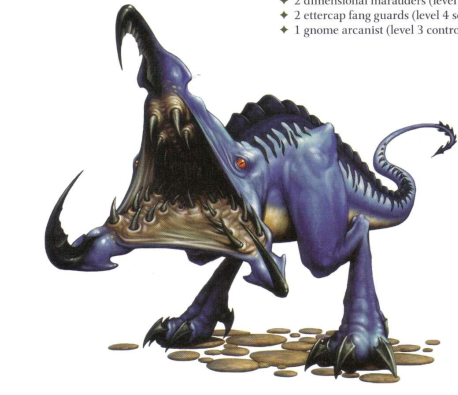
Copyright 2009 Wizards of the Coast This post is part of a series! Go here to see the other entries.
Dimensional marauders are a 3.x creation. I definitely remember that image, though I don’t remember if they had a different name back then. It was probably something like “Ethereal Marauder”, but 4e doesn’t have an ethereal plane anymore.
The Lore
These creatures are plane-hopping predators who travel the planes and the world in search of easy prey. And that’s all the book has to say about them.
Let’s allow ourselves to speculate a bit. Dimensional marauders “travel the planes”, and I guess that means they don’t have a fixed territory and follow sources of food instead. If you look at their stat block you’ll see their level is a lot lower than that of almost any creature they’re likely to find in the planes. This means they’re opportunistic, looking for creatures that have already been weakened by some other hazard or who are busy fighting someone else. Then they jump in and take a bite. If the meal is still kicking, they might run away, otherwise they stay and finish it off.
Evolutionary pressure has given then a rudimentary sapience, which aids them in evaluating the strength of potential prey. It also often leads marauders to the conclusion that the easiest prey can be found in the world, near population centers filled with juicy non-combatants whom they might even be able to beat in a fair fight. Not that they’ll fight fair.
The Numbers
Dimensional Marauders are Medium Aberrant Magical Beasts, and Level 4 Lurkers with 45 HP. They have low-light vision, a ground speed of 7 and a teleport speed of 3.
Their basic attack is a bite with that cool triangular jaw. They can also use their standard action to assume a Planephase Form, partially shifting to some other plane. This gives them the Insubstantial and Phasing qualities for a turn, or until they miss with an attack. They can also sustain this with a minor action, but it ends immediately when they take psychic damage.
While in this state, the marauder can use a Reality Warp attack (melee 1 vs. Reflex), which does light physical damage, teleports the target 3 squares, and teleports the marauder itself to a square adjacent to the target. It will use this to isolate its chosen victim.
If the marauder is hit by a melee attack, it can use Planar Evasion (recharge 4-6) as a reaction, teleporting 3 squares.
I see them mostly staying in planephase form and using Reality Warp to isolate a PC, which they’ll begin biting for more damage once they’re far away. The book tactics start them out entirely physical and has them planephase after hit for the first time in combat, but there’s no reason for them not to planephase before the fight even starts.
Sample Encounter and Final Impressions
Sometimes, a group of sapients will convince a marauder to work with them. Mostly, though, they just opportunistically jump into ongoing fights to take a bite out of whoever seems weakest.
The sample encounter could represent either of these situations. It’s level 3, with 2 marauders, 2 ettercap fang guards, and 1 gnome arcanist.
I think the illustration is very cool and memorable, but I only found the creature itself interesting because of all the aprocryphal lore I came up with in this post. Mechanically, I almost think it would work better as a Controller, since its abilities are more about knocking PCs out of position than dealing increased damage. If you give it some bonus sneak attack damage, it does work as a Lurker.
-
Let's Read the 4e Monster Manual 2: Devils, Part 2
This is part of a series! Go here to see the other entries.
Continuing our slog through the Devils entry, let’s look at the next batch.
Infernal Armor Animus
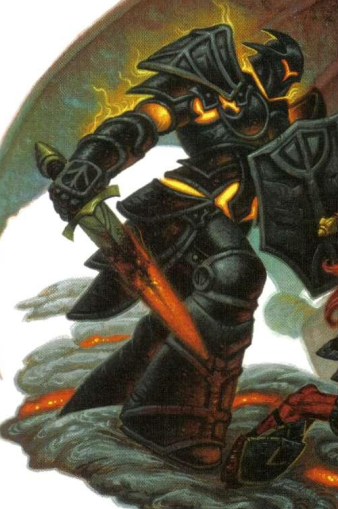
Copyright 2009 Wizards of the Coast We’ve talked a lot about devils always trying to acquire souls by hook or by crook, but what do they use them for? Here we have a concrete example of one of the many products in Hell’s catalogs.
These monsters are made by binding the soul of a mortal within a suit of infernal armor, which is animated by the process. The animated armor has its own mind - the soul is just the power source. The animus understands Common and Supernal, and at Int 8 it’s smart enough to understand the orders of its infernal masters. When it’s destroyed in combat, it releases the trapped soul, which will usually be consumed by a nearby devil for a quick performance boost.
The Numbers
Animi are Medium Elemental Animates with the Devil and Undead keywords - the only non-humanoid devils in the MM2. They’re also Level 3 Minion Soldiers, which means they appear in the “bargain bin” section of the catalog and will be found fairly early in a zero-to-hero campaign with devils as the main antagonists. They have darkvision, Resist Fire 5, and a ground speed of 6.
These things project a Bloodlust aura (2) that gives nonminion devils within a +1 to damage rolls. Multiple auras are cumulative, so I imagine animi keep a tight formation around their boss.
They wield shields and shortswords in combat, and the sword attack is nothing special. When they’re destroyed, Essence Transference triggers and heals the nearest non-minion devil within 15 squares for 15 HP.
Sample Encounter and Impressions
The sample encounter is Level 5: 8 animi, 2 spined devils, 1 tiefling heretic.
Look at that healing value for Essence Transference! This tells me infernal animi aren’t used as dumb muscle - that’s the job of legion devils. Instead they’re ambulatory snacks just waiting for the PCs to unwrap them and feed them to their master. They might be able to get a hit or two in before that happens, but that’s just a bonus. Kill them before damaging their masters.
Misfortune Devil
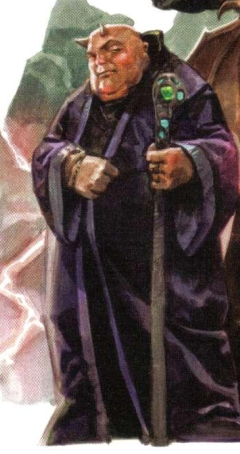
Copyright 2009 Wizards of the Coast Valued members of the acquisitions department, misfortune devils collect souls by tempting mortals into taking ever-larger risks, which ultimately culminate in the mortal dying and the devil owning their soul. It helps that they know a lot of probability-warping magic to speed the process along.
I imagine that there are many strategically-placed tomes out in the world that teach a ritual to summon one of these and describe it as a “wise advisor” who will always have the summoner’s best interest at heart. Satisfaction guaranteed (and never mind the fine print)!
Misfortune devils can also choose prospective victims on their own inititive. If the victim in question is someone who knows better than to listen to a devil, they can use innocuous-looking underlings to make contact, or disguise themselves with magic rituals. And finally, they can also be attached as support spellcasters to a unit of devils out on some mission of a more military nature.
The Numbers
These Medium devils are Level 15 Artillery with 115 HP. They have darkvision and truesight 10, ground and fly speeds of 6, and interestingly enough no elemental resistances.
They attack at range with a Ray of Distortion (ranged 20 vs. Reflex), which does high physical damage - unusual for an at-will attack. The catch is that the target of this attack can choose to take only 5 damage instead, and have the original damage re-rolled and applied to their ally with the most HP. How close-knit is your party, really?
If an enemy manages to get close, they can fight back with a Lucky Maneuver (melee 1 vs. Will; basic) that does light psychic damage and allows the misfortune devil to teleport 4 squares. If someone does manage to hit them with a melee or ranged attack, they ran react with Roll the Bones (interrupt; encounter) to have the attack target another creature of their choice that’s within 5 squares.
Sample Encounter and Impressions
The sample encounter is one of those “attached to a unit” situations: Level 13, 2 erinyes, 5 legion devils, and 2 misfortune devils. Almost identical to the one listed for erinyes, only it’s misfortune instead of chain devils following along.
These creatures are surprisingly fun, and might cause some intra-party friction among the PCs. With the interrupt ability it’s clear that it’s the misfortune devil causing a friendly fire incident, but the Ray of Distortion requires a conscious decision by the first target to work its special magic. Do you want to betray your beefy friend in order to avoid pain? C’mon, do it! What’s the worst thing that could happen?
Shocktroop Devil
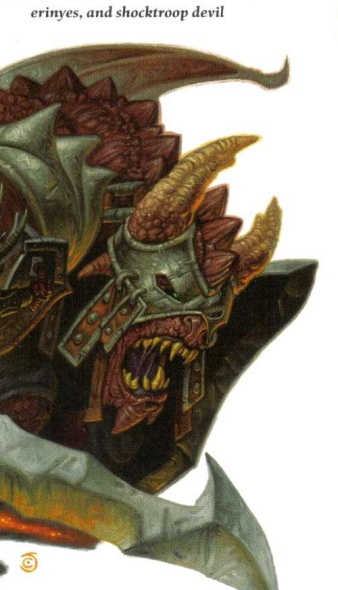
Copyright 2009 Wizards of the Coast For when a phalanx of bearded devils just isn’t shock-troop enough for the job. These Large winged devils perform a function a lot like that of mortal cavalry: units of them charge into enemy lines to break up tough formations, cause havoc, and slay as many as they can.
Shocktroop devils fly really fast and can’t be dismounted since they don’t have mounts, but much like mortal cavalry they can end up losing momentum if they stay mired in the melee for too long. If that happens they’ll attempt to retreat, and will be back to fight once they’ve recovered.
The Numbers
These are Level 16 Soldiers with 155 HP. They have darkvision, a ground speed of 6, and a fly speed of 8. They lack any elemental resistances, which I think must be an error of some sort. I’d expect them to have 15 or 20 fire resistance. They wear plate and wield a sword and shield.
In any case, they’re protected by Asmodeus’s Shield, a passive trait that gives them +2 to all defenses against divine powers while they’re unbloodied, and a -2 penalty to the same while bloodied. “Divine powers” means anything that’s not a basic weapon attack from any of the classes with the divine power source: clerics, paladins, avengers, invokers… I’d say it also covers any attacks by angels and the like.
Their basic attack is a sword and shield combination which, as a basic attack, can be used in a charge. It deals physical damage and triggers a secondary attack vs. Fortitude. A hit on that one pushes the target 2 squares and dazes them for a turn.
Once in the fray, they can increase their rythm and perform a Shocktroop Attack, which allows them to make three Sword and Shield attacks in a single action, each against a different target. This encounter power recharges whenever the shocktroop devil has full HP, which means they can use this every turn until they’re damaged.
Sample Encounter and Impressions
The sample encounter is level 16: 1 bone devil, 1 misfortune devil, and 3 shocktroop devils. A command squad of sorts.
I’ll admit, the basic concept behind shocktroop devils seemed so bland when I first read through this book that I never took a good look at its stat block until now. It turns out they can be a lot of fun, and the designers managed to really capture that “cavalry” feeling with them.
The recharge condition on Shocktroop Attack means these monsters are more dangerous when deployed in groups as part of an encounter. The natural instinct of 4e players to focus-fire on a single monster at a time will work against them here, because it might keep the shocktroops they ignore at full HP for longer, allowing them to attack lots and lots and lots of times.
For extra Fun(TM), add a unit of leveled-up Infernal Armor Animi to your shock-troop devil vanguard.
Withering Devil
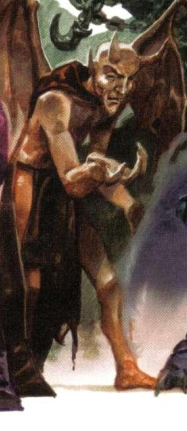
Copyright 2009 Wizards of the Coast Like Misfortune Devils, Withering Devils are soul collectors and members of the acquisitions department. However, they use a different strategy: their powers bend mortal minds towards apathy and depression, eroding their ability to care for their fellow sapients or for much of anything else.
In combat this translates into spells that slow enemies down and make them less effective, but these fiends are much more dangerous on a narrative scale. They can cause entire societies to succumb to plague, famine, and strife by targetting the people whose job was to prevent this and turning them into lazy shadows of their former selves. “Just open the economy up already, fighting this plague is too hard, I’m sure everything will work out”.
Though their natural appearance is horrible, they are adept at disguising themselves as mortals, either with magic or with heavy cloaks in dark rooms.
The Numbers
These Medium devils are Level 14 Controllers with 138 HP. They have Darkvision, Resist Fire 15, and a ground speed of 6. The illustration gives them wings but they don’t fly, presumably because it’s too much of a bother.
Withering devils project an Aura of Weariness (3) that weakens all enemies inside. Their basic melee attack is with the Staff of Weariness, which has no funky riders despite the awesome name. At range they shoot Draining Rays (ranged 20 vs. Reflex) that do psychic damage and immobilize for a turn. As a minor action they can use a Gaze of Apathy (ranged 10 vs. Will; recharge 5-6) which does no damage but slows (save ends).
Sample Encounters and Impressions
Wow, I bet these things are really annoying to fight if positioned just behind a line of beefy front-liners so that their weakness aura affects the PCs.
The sample encounters do just that, either using bearded and legion devils as the front-line, or attaching the devil to a mixed-party of yuan-ti.
Conclusion
That’s it for the devils in this book, but we’re not out of the D’s yet.
-
Let's Read the 4e Monster Manual 2: Devils, Part 01
This is part of a series! Go here to see the other entries.
This book includes a whole bunch of demons, and it was inevitable that it was also going to include a whole bunch of devils. Their base lore remains unchanged from what it was in my original introduction in the Monster Manual Let’s Read, so I recommend re-reading that article.
This entry includes a whole bunch of devils that are new to 4th edition, though some of them also appeared in earlier editions. As I mention in the original intro, devils tend to be more “humanoid” in appearance and use weapons to fight. I’m also really fond of making jokes about devils being corporate employees and/or fascists, so get ready for those.
Mechanically, all devils have the Immortal origin, and the Devil keyword. Nearly all of the ones we’ll look at in this book are Humanoids, with one exception who is an Animate. All of the devils in the first MM had really high fire resistance, and some of the ones here do as well, but a surprising number of them lacks resistances entirely. They all still have darkvision, but their remaining traits vary a lot per stat block.
As usual, I’ll cover enough individual monsters to hit the size limit I’ve set on each post, and will have as many parts as it takes to cover the entire “Devil” entry.
Assassin Devil
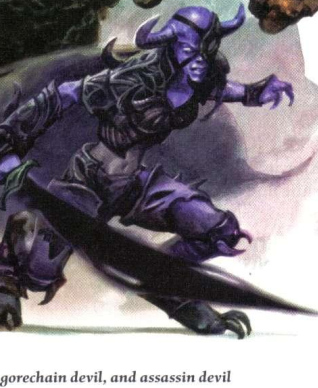
Copyright 2009 Wizards of the Coast As every servant of Asmodeus knows, you can’t make it in this economy without a little murder. Assassin devils are specialized service providers that cater to that particular need of successful businessmen everywhere. Their magic allows them to manipulate shadows to hide themselves and to kill.
That “service provider” crack isn’t just a joke: assassin devils are always found assisting the plots of some other infernal muckety-muck, never masterminding their own. The hidden truth is that many of them report directly to Asmodeus, snitching on those same plots to keep the CEO abreast of what his scheming underlings are up to. If the underlings in question discover this, they rarely make public accusations or reprisals, and instead try to feed the assassin misinformation to make themselves look good in the eyes of the boss.
The Numbers
Assassin Devils are Medium Level 24 Lurkers with 167 HP. They have darkvision and Resist 25 Fire, as well as an amazing ground speed of 12. They wear light armor and fight with shadows.
They can use magic to form a Shadow Sword which does necrotic damage and ongoing 5 physical damage (save ends). It also deals a lot of extra necrotic damage against targets granting combat advantage to the assassin.
Assassin devils can wrap themselves in a Shadow Cloak that makes them invisible until they make an attack, or they can cast those same shadows as a Shadow Net (Area Burst 2 Within 10 vs. Reflex) that restrains all it hits and inflicts 10 ongoing necrotic damage. These abilities can’t be used at the same time. The Cloak recharges when the devil uses the Net, and vice-versa.
Sample Encounter and Impressions
This seems like the type of devil PCs from the world would rarely see because they’re almost always employed in the internecine struggles of Hell itself. The book notes they like to work alone, but if circumstances mandate a team they prefer to partner up with strong soldier-types like war devils who are good at keeping the enemy distracted and setting up flanks.
The sample encounter is level 22 and has 2 assassins, a high-level human diabolist, and 2 war devils.
Erinyes
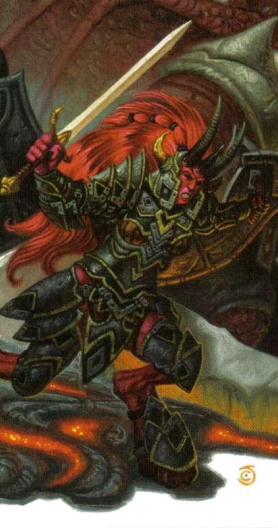
Copyright 2009 Wizards of the Coast Erinyes are inspired by the Furies of Greek myth, and have been in the game since at least 1st Edition. I think it was 3.x that tried to present them as devilish counterparts to succubi (who were demons in that edition), but 4e leans more into the “Fury” aspect.
In Fourth Edition, Erinyes act as arbiters and enforcers of infernal law, which of course also implies they’re pretty good in a fight because this is Hell we’re talking about. Their skills with sword and shield are so renowned that certain mortal warriors have been known to sell their souls in order to train under them. This implies there’s an official erinyes school of arms with their own signature style, and maybe its own trademark enforcement arm.
In battle, Erinyes are elite infantry of the sort that gets deployed to untangle tricky situations and inspire the rank and file around them to fight harder. They’re more or less equivalent to fighty warlords. They can also be found leading hunting parties whose purpose is to find those who skipped out on infernal contracts and drag them to Hell.
The Numbers
Erinyes are Medium Level 13 Soldiers with the Leader keyword and 131 HP. They’re clad in high-quality infernal plate (which is a lot more than they wore in other editions), and wield a shield and a bastard sword. Their speed is 5, and they mostly fight using showy but lethal martial techniques.
They’re very good at holding the line due to the Devastating Opportunist trait, which gives them a +3 bonus to opportunity attacks and allows them to shift 1 square if they hit with such an attack.
Their basic attack is a Compelling Strike that does standard physical damage and allows one ally within 5 squares to gain 8 temporary HP. They can also use the Flitting Blade technique to make attacks dealing light physical damage against up to three different targets, at-will.
When first bloodied, they can use Bloody Spiral (close burst 1 vs. Reflex) as a reaction. This does a tiny bit of physical damage and knocks prone on a hit, and if two or more enemies are knocked down it bestows 10 temporary HP to every ally within 5 squares.
Sample Encounter and Impressions
The sample encounter is level 12 and has 3 erinyes, 2 chain devils and 5 legion devil hellguards. It’s likely one of those hunting parties.
I think I like these new erinyes a lot more than I did the “naked winged woman, but a devil” that I remember them being in 3e.
Gorechain Devil
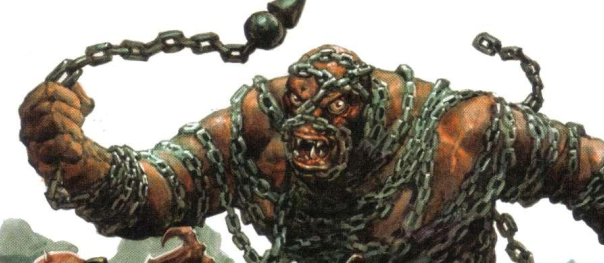
Copyright 2009 Wizards of the Coast Like a chain devil, but bigger. Where standard chain devils are jailers, gorechain devils are more like bounty hunters. They’re named like this because their chains are often encrusted in gore.
Their fighting style is a lot less acrobatic than that of their smaller counterparts, but they turn out to have a lot more mental control over their chains. So much, in fact, that they can use those chains to manipulate ensnared victims and make them into puppets. They’re also a lot smarter than they look.
The Numbers
These Large devils are Level 12 Elite Brutes with 298 HP. They have resist 10 fire but seem to lack darkvision. Their speed is 5.
The Grasping Chains of a gorechain devil act as an aura (3) that forces enemies to make a DC 21 Athletics or Acrobatics check if they attempt to leave its bounds. Their basic Gorechain Strike is reach 3, and the Gorechain Flail ability (recharge 6) allows them to make one of these attacks against every target in range with a single action.
Gorechain Takeover (reach 3 vs. Fortitude; recharge 5-6) does about the same damage as the basic strike, and also dominates (save ends). The domination also ends if the target is more than 3 squares away from the devil when the target’s turn starts. A lucky enough series of recharge rolls could see multiple PCs dominated in this way.
The tactics here are clear: bring all the PCs in for a group hug, and never let them get away.
Sample Encounter and Impressions
The sample encounter is Level 12 and has two of these, a skeletal tomb guardian, and a skull lord. I imagine they might also take part in those erinyes-led debtor-hunting parties.
I like that the look of gorechain devils is a bit deceptive at first. A PC who sees one of these things might expect a big dumb brute, but they can fight smart and the Takeover power will come as a surprise.
It’s not quite enough to make me like them as enemies, since I’m not really that fond of kytons either, but that’s on me and not on this stat block.
-
Let's Read the 4e Monster Manual 2: Deva
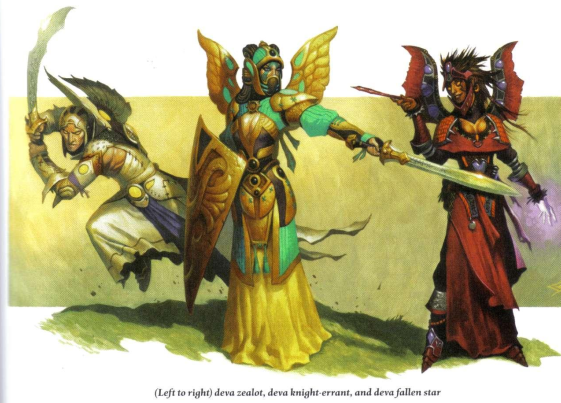
Copyright 2009 Wizards of the Coast This is part of a series! Go here to see the other entries.
The word “Deva” used to refer to Lawful Good angels in earlier editions, but now it means something different. Deva as presented here are new to Fourth Edition, and first appeared as a playable option in the Player’s Handbook 2. They occupy the same dramatic role as aasimar did in earlier editions, but in my opinion are much cooler.
The Lore
In ancient times, a group of good angels decided they liked the world so much that they would become a part of it. So they assumed mortal form, and the resulting creatures became known as devas. They have lived countless lives since then, and still carry some memories of the deep past with them.
A deva begins life by materializing from thin air, fully grown and capable of both speech and motion on the level of any other adult sapient humanoid. More, actually, since they also appear with the skills necessary to defend themselves and others. Few newborns can claim that! Newly-incarnated Deva have vague memories of their past lives and retain their basic personality, but their slate is otherwise clean.
It’s no wonder then that a very high percentage of devas end up following adventuring careers, or otherwise dedicate themselves to fighting evil. They’re not all members of divine classes, but those are quite common given their usual temperament. In the end, though, they’re folk like everyone else. It’s quite possible for some deva to settle for a peaceful life instead, or to go down less-righteous paths.
When a deva dies, be it from natural or violent causes, they disappear and immediately reincarnate at a random place in the world, clean slates once more, ready to begin life anew.
A deva who turns to evil will reincarnate as a rakshasa on their next life. Rakshasa have perfect recall when they reincarnate, so this might seem like a good deal to a deva who has grown too attached to its present identity. However, even they revile this fate, so they would rather avoid death altogether than to undergo the transformation.
Given their perfect recall, it’s possible every rakshasa remembers being a deva. I’d say that should a rakshasa redeem itself and become good (or at least non-evil) once more, it will return to being a deva in its next life.
Deva fashion for all genders tends towards flowing robes, sometimes with revealing chest “windows”. Their armor tends to be designed to go over those robes. Armored or not, their outfits usually include back or shoulder decorations resembling wings.
The Numbers
Deva are Medium Immortal Humanoids, have tier-dependent resistance to both radiant and necrotic damage, and a +1 to all defenses against bloodied creatures. Their signature ability is Memory of a Thousand Lifetimes, a free-action encounter power that allows them to add +1d6 to an attack roll, skill test or ability test they just made. This represents memories and flashes of insight from the deva’s previous lives, and could end up turning a failure into a success.
PC Devas have the same abilities, though their resistances are a bit more granular and they also have the customary attribute and skill bonuses.
Deva Knight-Errant
This deva travels the world acting as a champion of holy causes. It’s the first monster I find in this book who is explicitly Good in alignment, and described as most likely to serve the role of an ally to the PCs. Still, a party entirely composed of shady fucks might find themselves at the wrong end of the knight-errant.
The knight is a Level 11 Soldier with 111 HP and all standard Deva traits. Their resistances are set to 10. Being paladin-types, they wear full plate and wield a sword, a shield, and a holy symbol. Their speed is 5 due to the heavy armor.
Knights fight with a mixture swordplay and divine magic. The Inner Radiance trait allows them to switch the damage type of any of their attacks to Radiant, and to accept a -2 attack penalty to make the attack deal an extra 4 radiant damage.
The knight’s broadsword marks for a turn on a hit, and they can perform a Rejuvenating Strike with it that heals the knight for half the damage dealt. It recharges whenever the knight hits with a normal sword attack. This will become substantially more powerful once you fix their damage.
There’s a couple of pure-magic abilities as well: Martyr’s Cry (close burst 3 vs. Will; recharge 6) deals psychic damage and marks all targets hit (save ends). Health Transfer (minor action; encounter) transfers up to 25 damage and a condition from an ally within 10 squares to the knight.
Knight-Errants are well set-up to be allied NPCs, with those support and marking abilities. The self-healing strike is important to give them some longer-term staying power when riding with the party, as most healing abilities that depend on healing surges are less effective on them.
Deva Zealot
The zealot opposes evil, well, zealously. They’re a lot less nice in their judgment and methods than the knight, and thus Unaligned. They wear leather or other light armor, and wield falchions. Their resistances are set to 10. Their speed is 6. If they were PCs, they’d be Avengers.
The falchion his a high-crit weapon and deals some bonus radiant damage. It’s their main attack, and all their other abilities support it. Skirmish works as usual, adding more bonus damage when they move at least 4 squares in that turn. Dazzling Soul (minor; recharge 4-6) makes the zealot shine so brightly it gains concealment and emits bright light in a 6-square radius and dim light out to 12 squares. Path of Virtue (encounter) allows them to shift their speed and make one falchion attack against each enemy in reach during the move.
Last but not least, Radiant Retribution is a at-will free action that triggers when the zealot takes damage from an attack, and deals half that amount as radiant damage to the attacker. I think this means it will trigger against every attack made on the deva - if it was a reaction or interrupt, it would only happen once per round.
Deva Fallen Star
A deva who went bad and is all set to become a rakshasa on their next incarnation, though ideally they don’t want to die at all. They’re Level 26 Artillery with 188 HP. Their resistances are set to 15. Using a rod as an implement, if they were PCs they’d likely be a warlock.
The fallen star will likely open the fight with a Soul Scourge spell (area burst 2 within 15 vs. Will), a fireball-sized blast that deals immediate radiant damage and ongoing 15 necrotic damage (save ends). This recharges when it’s first bloodied. Until then it will use a Forgetting Ray (ranged 20 vs. Reflex) which does psychic damage and restricts the target to using only at-will attacks (save ends).
When hit by an attack, the fallen star can use Fateful Transposition (ranged 10 vs. Will) as an interrupt, targeting an enemy. A hit allows it to switch places with that enemy, making it take half the triggering attack’s damage. The deva still takes the other half.
The fallen start’s basic melee attack is the Rebuking Rod, which does psychic and radiant damage and triggers a secondary attack vs. Fortitude: if that one hits, the fallen star gains total concealment against the target (save ends).
The fallen star’s research into evil magic has allowed it to trade the usual Memory of a Thousand Lifetimes power for Fate Manipulation. This can add 1d8 to their rolls or remove 1d8 from an enemy’s roll, and it recharges once the fallen star is first bloodied.
And finally, we have the ability that confirms this deva “fell” because it wanted out of the circle of reincarnation: Vile Rebirth. When the deva is reduced to 0 HP by non-necrotic damage, it doesn’t die. Instead, it remains at 0 HP until its next turn, when regains 25 HP and acquires the undead keyword. In other words, it becomes something close to a newly-minted lich! This power recharges, but the “non-necrotic” bit becomes “non-radiant”. In other words, you have to either kill it with necrotic damage the first time around, or with radiant damage after it becomes undead. If you don’t, it keeps coming back.
I’d say that if Vile Rebirth triggers and the falen star escapes, you can use it as a lich in subsequent encounters. And if it dies “for real”, it’s rakshasa time, though in that case it would take longer to return to the campaign if it makes an appearance at all.
Sample Encounters
The book admits most PC parties are unlikely to find themselves facing a knight-errant or even a zealot, so the sample encounter is Level 27 and features a pair of fallen stars along with 2 efreet karadjins and 2 efreet pyresingers. So it looks like the deva have joined the ranks of nobility at the City of Brass.
I really like Deva! Aasimar from previous editions just had a celestial somewhere in the family tree, Deva have a cool backstory on par with the one that was given to tieflings. One thing I find particularly cool about the stat blocks from this entry is that they could represent the trajectory (and tragic fall) of a single individual over three lifetimes.
-
Let's Read the 4e Monster Vault 2: Demons, Part 04
Copyright 2009 Wizards of the Coast This is part of a series! Go here to see the other entries.
This is the last post covering the “Demons” entry in the Monster Manual 2, and it features a lone demon: the Yochlol, who has been in the game since at least AD&D 1st Edition.
The Lore
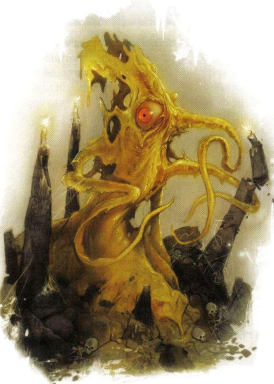
Yochlols are the handmaidens of Lolth, being some of her most favored servants. This a fact which those not initiated in Her mysteries will find baffling because yochlols don’t resemble spiders in any way. In their natural form these demons look like pillars of snot with a baleful red eye embedded near the top. They can also take the shape of beautiful drow women.
Yochlols might be assigned by their mistress to assist mortal priests that have also earned her favor, but they mainly works as spies. They’re so good at passing for mortal drow that they can remain undetected for years at a time and attain positions of great power in their society. I’ll write more about the implications of this in the Impressions section.
The existence of yochlols is one more point in favor of my pet theory that Lolth is actually a demon lord.
The Numbers
We get a single stat block here, named Yochlol Tempter, which I guess is representative of most of them.
Yochlols are Medium Elemental Humanoids with the Demon and Shapechanger keywords. They’re Level 17 Controllers with 158 HP. Despite being demons, they lack Variable Resistance and have Resist 10 Poison instead. They have darkvision, a ground speed of 6, and a climb speed of 8 with Spider Climb.
Yochlols have two sets of attack powers, one for when they’re in demon form, the other for when they’re in drow form. They can switch forms with a minor action, but I guess an infiltrated yochlol will stick to drow form to avoid blowing its cover. Once that happens, though, it will change shape as often as it needs to assemble the best combos it can.
In demon form, the Tempter fights with its Reach 2 Tentacles. A basic tentacle attack is quite weak, but the demon can make four of them with its Amorphous Flurry. If two or more flurry attacks hit the same target, that target takes a -4 penalty to Will (save ends).
At range, it can project a Maddening Web (area burst 2 within 10 vs. Reflex). It does no immediate damage, but immobilizes and deals 5 ongoing damage (save ends). It recharges on a 4-6, but only while the yochlol is bloodied. So it’s less of a web and more of flung ball of runny snot.
In drow form, this demon’s attacks are all what you would expect out of a priestess of Lolth: a spider touch in melee that also deals ongoing 10 poison damage (save ends); a venom bolt (ranged 10 vs. Reflex) that deals physical and ongoing 5 poison damage (save ends); and a minor-action Seductive Glare which despite the horrible name is a slow-acting mind control spell (ranged 10 vs. Will). On a hit the target is dazed (save ends); the first failed save worsens that to Stunned, and the second to Dominated. In all cases a successful save ends the effect.
Sample Encounters
The sample encounter is level 16 and as you would expect involves a lot of drow: 2 arachnomancers, 1 blademaster and a priest, accompanied by 2 yochlol tempters. Your call as to whether the drow know about the demons or not.
Final Impressions
Mechanically, I find yochlols quite interesting with their two forms that have complimentary powers. A lone yochlol can set up some interesting combos by itself, by using Amorphous Flurry to weaken someone’s Will and then the mind control attack in the next round. If you have two of them, they can do that a lot faster.
I remember seeing complains in Let’s Reads for older editions about how these demons don’t seem to have much to do with Lolth thematically speaking. After all, spiders are officially Her Thing and yochlols are not spiders. And despite them being described as the ultimate shape-shifting spies, they can only turn into drow, so they can’t be used to spy on the drow’s enemies.
The bits of lore here help make sense of all that. Lolth is also the goddess of lies, and treachery is among her commandments. How much do you think such a deity would trust their followers? No, Yochlols aren’t made to spy on the enemies of the drow. They’re made to spy on the drow. Their un-spider-like nature gives Lolth some plausible deniability. It is, perhaps, a hint that these demons are the product of another side of Lolth’s personality, one rarely known to her worshippers. Because despite all the dedication the drow people lavishes on her, Lolth doesn’t trust them.
That’s kinda tragic, for both the Drow and for Lolth.
subscribe via RSS