Posts
-
Let's Read the 4e Monster Manual 2: Demons, Part 3
This is part of a series! Go here to see the other entries.
We continue looking at the many monsters in the Demons entry of the Monster Manual 2.
Nycademon
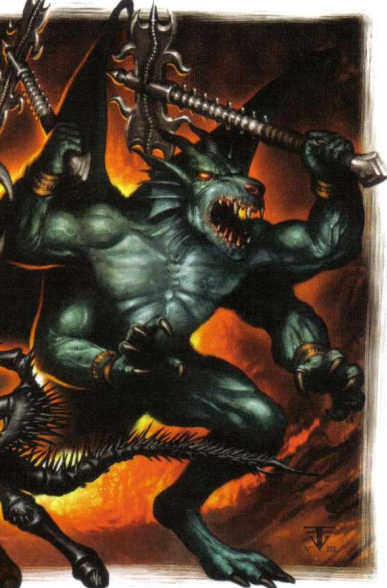
Copyright 2009 Wizards of the Coast I’m pretty sure these winged, four-armed creatures used to be classified as Yugoloths in previous editions, where their name was written as “Nycadaemon”. Yugoloths, or daemons, were the Neutral Evil Fiends, created because the writers of AD&D decided every alignment needed its own representative outsider. Fourth Edition uses a different cosmology and a different alignment system, so its authors elected to turn daemons into demons.
Nycademons spend their days flying over the open expanses of the Abyss in search of creatures to snatch and drop from a great height, which they think is hella funny. This has given them the nickname of “sky demons”. They place great value in physical strength, and so have a tendency to underestimate beings whose power is less obvious (“Do you even lift, bro?”). They’re also hesitant to attack someone who seems big and strong, for the same reason.
Like many former daemons, nycademons have a mercenary temperament and will work for anyone who pays them. These contracts tend to be short-lived though, as their superiority complex tends to infuriate most allies. All that flexing can get annoying really fast.
The Numbers
Nycademons are Large Elemental Humanoids (demons) and Level 22 Skirmishers with 210 HP. They have Variable Resistance 20 (2/encounter), as well as ground and fly speeds of 6. The one in this book fights with a pair of greataxes it wields one-handed, leaving it with two free hands to snatch victims.
Its Wicked Axe attacks are Reach 2 and High-Crit, and also cause ongoing 5 damage (save ends). Wicked Edges allows it to make two such attacks in one action, putting its damage near where it should be even without the math fix.
Instead of axing someone, the nycademon can Snatch them (Reach 2 vs. Fortitude). It can fly 6 squares before or after making the attack, which does no damage but grabs the target. The Strong Flyer trait exempts it from the usual obstacles to moving a grabbed target, so it can travel its full speed with the grabbed victim without needing to make additional tests to do so.
All of these traits lend themselves well to the “snatch and drop” tactics described in the lore. Grab someone, fly up for a few rounds while attacking them with the axes, drop them for a bunch of d10s of fall damage.
The sample encounter has three nycademons, a goristro and a rot harbinger. It’s Level 21, and likely affiliated with Orcus.
Impressions
While mechanically simple, I kinda like the whole “snatch and drop” thing. It’s also fun to imagine these creatures as condescending gym bros.
Pod Demons
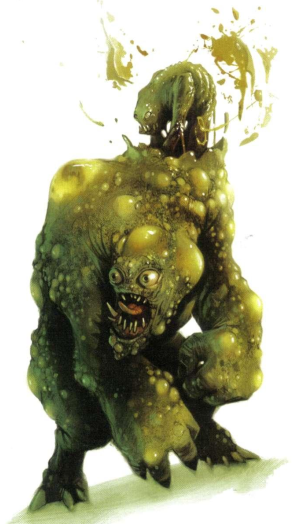
Copyright 2009 Wizards of the Coast Particularly disgusting examples of demonkind, these slimy creatures can spawn miniatures of themselves from their blistered bodies, using them to corner and terrorize their victims.
The spawn have no mind of their own, being extensions of the demon’s main body. In fact, the pod demon can transfer its conscience to a podling, causing it to grow to full size while the original body shrinks.
These creatures have some connection to the mysterious Chained God (AKA Tharizdun, but no one in-setting rememebers that name). Some of them wrap themselves in chains to show their allegiance.
The Numbers
Pod Demons are Large Elemental Humanoids (demons), and Level 15 Elite Artillery with 176 HP. They have darkvision and Variable Resistance 15 (2/encounter). Their ground speed is 8.
They fight by using their half-formed spawn as ammo. They can either throw a spawn so it explodes on impact using Fling Podspawn (area burst 1 within 10 vs. Reflex), or squeeze it to spray nearby enemies with Spew Podspawn (close blast 3 vs. Reflex). In either case, targets take acid damage on a hit.
Fully formed podspawn constantly pop free of the parent body: one appears within 2 squares of the original at the start of its turn as long as there are fewer than 4 podspawn in play. The parent can also force them out with Generate Podspawn (close burst 2 vs. Reflex), which does poison damage and fills unoccupied squares with enough podspawn to reach the limit of 4.
As a move action the pod demon can Transfer Essence, effectively swapping positions with a podspawn within 10 squares. As a minor action it can use Detonate Minion (ranged 10), causing a podspawn in range to explode and deal a bit of automatic poison damage to adjacent creatures.
If forced into melee, they attack with a weak Claw that also does ongoing poison damage (save ends).
I’m guessing that if you have multiple pod demons in play, each of them will be able to have its own set of four minions.
The podspawn themselves also have a little stat block. They’re Level 15 Minion Skirmishers whose resistances always match the parent’s, and who attack with a corroding slime that’s slightly stronger than the parent’s claw. Their dangerous proximity trait gives them combat advantage against any adjacent enemy, no flanking required.
The sample encounter is level 16: 1 immolith, 1 pod demon, 4 podspawn and 2 red slaads.
Runespiral Demon
These turtle-beetle things have complex patterns of arcane runes etched into their shells, which channel arcane energies from deeper within the Abyss. The specimens depicted here turn this energy into lightning, but there are others with variant runic patterns that use other elements.
Runespiral demons are sapient, but they don’t have hands and are nowhere near smart enough to be good at arcane magic. The runes are either natural or etched by some unseen patron. In combat, they rely on the magic of these runes to attack at range.
The Numbers
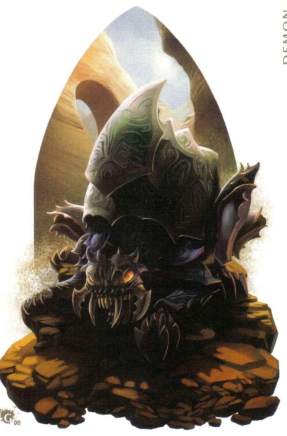
Copyright 2009 Wizards of the Coast We actually get two varieties here: common Runespiral Demons are Small Elemental Magical Beasts, and Level 5 Artillery with 51 HP. Arctide Runespiral Demons are Large, and Level 12 Artillery with 97 HP. They have Variable Resistances of 10 and 15 respectively, and a ground speed of 7. Their attacks are almost identical.
They can attack distant opponents with either a Focused Strike (ranged 10 vs. Reflex) that does standard lightning damage, or a Lightning Burst (Area Burst 2 Within 10 vs. Reflex), which does bit less lightning damage as a baseline, but has that damage increase by 1 for each creature caught in the blast. That’s creature, not enemy: allies caught in the blast will increase its damage, but will also be damaged by it since it’s not a selective burst. The Arctide Demon’s burst is also Charged: it does all of the above and additionally gives allies damaged by it a +1 bonus to their next recharge rolls.
When an enemy moves adjacent to one of these demons they release an Arcane Arc (melee 1 vs. Reflex) as an interrupt, dealing lightning damage. In melee they’ll bite for very little physical damage, and when bloodied they release a Bloodied Shock (close burst 1 vs. Reflex) that deals lightning damage and dazes.
The sample encounter has 2 basic runespiral remons, 2 evistros, and the human hexer who summoned them all.
Impressions
More demon artillery support. They have some mechanical weaknesses: all of their good attacks deal the same type of damage and target the same defense. Some GMs might want to pull a Gygax and say that runespiral demons with other elements look identical save for their different runes and that it takes an Arcana test to distinguish them.
Rupture Demon
These demonic amoeboids are the least spawn of Juiblex, and they act as abyssal scavengers, following more powerful demons around and eating the remains of their kills. When they die their own remains can infest those more powerful demons and make them even stronger. Does that serve some plan of Juiblex? No one knows.
The Numbers
Rupture Demons are Level 5 Minion Soldiers, with low-light vision, a ground speed of 6 and a climb speed of 3 with Spider Climb. They lack any elemental resistance.
They can attack directly with a Slimy Extrusion for minor physical damage, or they can use an Enveloping Embrace. This hits automatically, does no damage and restrains the target (save ends). It also kills the demon, presumably because it has to rupture to envelop someone.
When a rupture demon dies, either due to an attack or from using the Embrace, it explodes into a mass of ichor and pseudopods that latches onto another demon within 5 squares. This infestation heals 5 HP and gives it a +2 damage bonus. Multiple infestations stack, up to a maximum of +10 damage. For this to work the infested demon must be level 10 or less.
The sample encounter has 1 Black Pudding, 1 Evistro, and 6 rupture demons. An interesting contrast, because the pudding is going to split into smaller enemies and the rupture demons will join with the Evistro as the fight goes on.
Impressions
I like their concept! The level limitation is a bit strange. Presumably you could have higher level minions that could affect more powerful demons. In that case you should make sure they’re still a few levels behind the “real” opposition, since you want them to die fast and provide that damage bonus.
End of Part 3
There’s one more to go, with the last remaining demon.
-
Let's Read the 4e Monster Manual 2: Demons, Part 2
This is part of a series! Go here to see the other entries.
Continuing with the “Demon” entry of the Monster Manual 2, let’s look at a few more abyssal greeblies.
Gnaw Demon
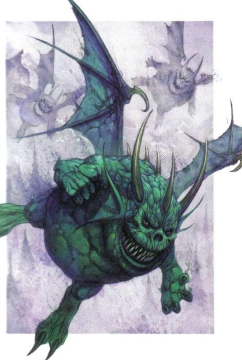
Copyright 2009 Wizards of the Coast These round boys live to eat. Their hunger is insatiable and they’re always gnawing on and eating everything around them. That sentence is quite literal too: they can eat anything, so they eat everything, all the time. Being demons, of course, they prefer living flesh above all else.
Despite this, gnaw demons are also quite cowardly and will run away if they see they’ve bitten off more than they can chew. Tracking them down isn’t too difficult, though, since they’ll soon become distracted by some other weak-looking target.
Gnaw demons can teleport, but it’s apparently a reflex not under their conscious control. Though they’ll likely avoid the thick of the fight at first, the smell of blood drives them into a frenzy.
The Numbers
Gnaw Demons are Small Elemental Humanoids, and Level 5 Skirmishers with 66 HP. They have Darkvision and are slow and blobby with a ground speed of 3 and a flight speed of 5 (clumsy). They have Variable Resistance 10 (1/encounter).
In combat they’re all about biting, since they’re pretty much trying to eat you. Their Ankle Biter aura (1) inflicts a -2 penalty to the speed of any enemy caught inside. Their basic attack is the obvious bite, which deals extra damage to bloodied enemies.
That reflexive teleport is modeled with two different abilities: Hungry Teleport (move action) allows the demon to teleport 10 squares into a square adjacent to a bloodied enemy. Pain-Induced Teleport (free action when first bloodied) is an unrestricted 10-square teleport, which it will likely use to flee.
Impressions
I kinda like these critters. They’re more flavorful than evistros (which smoulder with generic rage), though they also pair really well with them or other front-liners that can get the enemy bloodied so they can teleport in.
The sample encounter is Level 6 and has three of these spherical terrors accompanying a pair of gnolls.
Kazrith
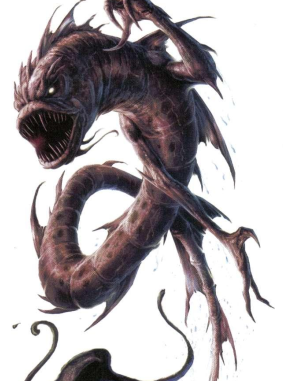
Copyright 2009 Wizards of the Coast Kazriths are barracuda-like aquatic demons that prowl the watery bodies of the abyss and might be summoned to do so elsewhere. Despite their preference for water they’re also perfectly capable of operating on land, so you don’t have to build an underwater dungeon in order to use them.
Though sapient, kazriths prefer to act as ambush predators, burying themselves in the ground and jumping out to attack anything that looks like it would be fun to kill. Their pores secrete strong acid, which helps both with the burrowing and with the killing.
They burrow as fast as they can run and leave stable tunnels behind, which means all bodies of water in kazrith territory are linked by networks of flooded tunnels. So if you do want to make an underwater dungeon, you have the perfect excuse.
The Numbers
Kazriths are Medium Elemental Magical Beasts with the Demon and Water keywords. Note that they don’t have Aquatic, so they don’t gain that +2 attack bonus when fighting underwater. They’re Level 20 Lurkers with 146 HP, an immunity to acid, and Variable Resistance 20 (2/encounter). They have a ground speed of 6, a burrow speed of 6 with Tunneling, and a swim speed of 8.
Their basic attack is a bite that also deals 5 ongoing acid damage (save ends). They can also burrow back into the ground while spraying acid behind them: this Acidic Retreat (recharge 5-6) is a close burst 2 vs. Refles, deals light physical damage, and 10 ongoing acid damage (save ends). It also allow the demon to burrow its speed as an effect.
When bloodied, its Acidic Seepage increases, causing it to gain +4 burrow speed and deal 10 acid damage to enemies that start their turn adjacent to the kazrith. Its Slippery trait allows it to make extra saves against the immobilized, slowed and restrained conditions at the start of its turn.
Fighting a kazrith is like playing a corrosive game of whack-a-mole, as it will keep burrowing back and popping up to bite you, and it’s hard to pin down.
Sample Encounters and Impressions
The sample encounter is Level 18 and features an Evil Party of aboleths, their minion servitors, and a pair of kazriths.
Kazriths sound like something that should logically exist, but by themselves they don’t really stoke my imagination. They do make decent additions to adventures featuring varied demons as opposition, and they work well with Aboleths.
Needle Demon
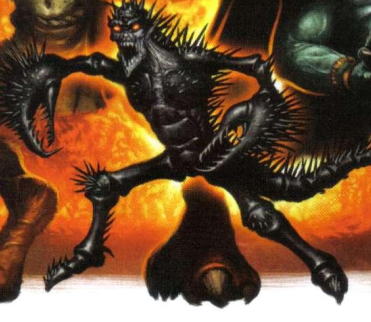
Copyright 2009 Wizards of the Coast These prickly assholes love seeing former friends and allies turn on each other with murderous intent, particularly when they were the ones who instigated it. They’re much smarter than they look and often end up as advisors to more powerful villains, sometimes even as the power behind the throne. However, their lust for infighting often gets the better of them, so these deceptions never last long and cause terrible damage when they collapse.
The Numbers
Needle demons are Medium Elemental Humanoids (demons), and Level 12 Controllers with 123 HP. They have darkvision and Variable Resistance 15 (2/encounter). They run with speed 6.
They fight with their pincers and spiked tail. The claw attack is pretty standard, and Claws of Betrayal allows them to attack twice with them. If both attacks hit the same target, that target takes 10 ongoing damage (save ends). The Tail is a reaction attack that does light physical damage and is triggered by an enemy moving to a square adjacent to the demon.
Their most thematic power is Rage of the Betrayed (close blast 5 vs. Will; enemies only; recharge 6), which does no damage but dominates (save ends). Yes, it’s a mass dominate. It works by convincing the affected target that their allies have betrayed them, so I guess the demon is going to use it to make the PCs focus on fighting each other instead of itself.
The sample encounters have them working alongside gnolls and drow, but repeat that it never takes long for them to turn on their own allies.
Impressions
Simple, but quite effective due to that mass dominate. I’m guessing you could use a recurring needle demon NPC as a source of lots of drama, having it appear somewhere in every villainous group the PCs oppose only to always run away.
Neldrazu
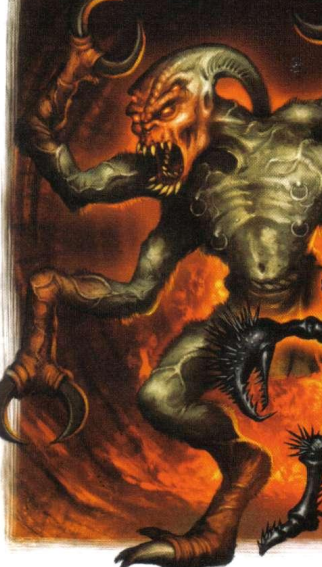
Copyright 2009 Wizards of the Coast These demons are into kidnapping, for which they use their four hooked claws. During a battle they like to hide around the edges and jump out to snatch an enemy and drag it either to an isolated spot or into the midst of the neldrazu’s allies. They’re often summoned by slavers who don’t mind if the goods are slightly damaged.
The Numbers
Neldrazu are Large Elemental Humanoids (demons) and Level 8 Lurkers with 71 HP. They have darkvision and Variable Resistance 10 (1/encounter). They have a ground speed of 8 and a climb speed of 6 with Spider Climb.
Their basic attack is a standard Claw, but when only one enemy is within 5 squares of the neldrazu they can really stretch and use Flaying Claws, which do double damage plus ongoing 5 damage (save ends). This means they’ll lurk until they can catch a PC alone, and then move in with this attack.
After using Flaying Claws, a neldrazu will likely follow it up with Abduct (recharge 5-6), a move action attack that targets Reflex and can only be used against enemies. It does no damage, but teleports the target 10 squares to a place of the demon’s choice on a hit. The demon teleports 10 squares right after this, either adjacent to the target on a hit, or to anywhere it chooses on a miss.
I think the best way to use this is to drop an enemy right in the middle of the neldrazu’s allies. If a lurker isolates itself with a PC, things tend to go poorly for the lurker.
Impressions
The Monster Manual 3 and later on the Monster Vault would include the Babau, a level 13 Skirmisher demon that’s quite similar, and which we covered here. At the time I remember poo-pooing the babau’s abduction tactics because I assumed it would always take the victim to an isolated place, but now I see it can also take them to its allies instead.
Compared to the babau, the neldrazu is a better team player, since it can abduct more often in a fight. Its special attack is quite situational, but it can be used before the abduction, which means it doesn’t have to choose between isolating a victim and bringing it to its allies.
End of Part 2
There’s at least one more post’s worth of demons to cover.
-
Let's Read the 4e Monster Manual 2: Demons, part 1
This is part of a series! Go [here][1] to see the other entries.
You thought getting out of the Abyss was going to be easy? Right after finishing all nine pages of Demogorgon’s entry, it’s time to proceed to eleven more pages of assorted demons. Each individual demon entry comes with a bit of lore and a sample encounter group, so it’s better for me to do “Lore” and “Numbers” subsections for each of them instead of the other way around. Since each individual entry seems fairly simple, I’ll keep adding them to this post until I hit my “usual” post size, and split it into subsequent parts as needed.
First, though, we get a small paragraph of extra Abyss lore. It says demons are among the oldest creatures in the universe, which places the creation of the Abyss waaaaay back at the literal dawn of time. At first there were only a few of them: the book implies these were the original demon lords (or “demon princes”, as written), who initially served the Chained God and had orders to bring the universe under his heel.
I guess they were either the primordials caught in the “blast” that created the Abyss, or the first ones to enter the place. Plus Dagon, who was already there. Anyway, as the corruption of the Abyss spread, it infected other elemental creatures and turned them into the types of “lesser” demon we know today.
Abyssal Eviscerator
These creatures made it to the Monster Vault, and I covered them here. My impression of them hasn’t changed.
Abyssal Rotfiend
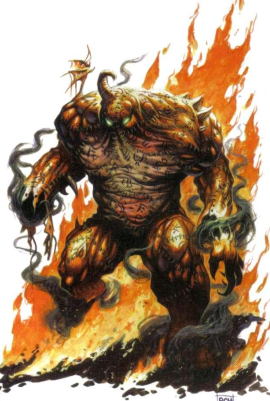
Copyright 2009 Wizards of the Coast An abyssal rotfiend is what you get when you take the undead spirit of an evil creature and stuff it inside a meat puppet made of stitched-together bits of demons and devils. The spirit is usually a demon soul, but any evil creature will do in a pinch. With that description you’d think they’re mindless, but they’re actually quite intelligent.
As undead demons, rotfiends are an Orcus specialty. Many inhabit the halls of his fortress of Everlost, put there as a defense against teleporting enemies. Despite their hulking appearance they rely more on damaging mind magic than on brute force.
The Numbers
Rotfiends are Large Elemental Humanoids (demons) and Level 26 Controllers with 245 HP. They have Truesight, ground and fly speeds of 6, and a whole bunch of resistances! They’re immune to fear, have Resist Fire 20, Resist Necrotic 10, and Variable Resistance 20 (3/encounter). They are surrounded by Abyssal Fields (aura 5) that prevent anyone inside from teleporting.
They’re attacks are all related to madness and body horror. The basic attack is Skullsplitter (melee 2 vs. Reflex), which does psychic damage and is stronger against unbloodied targets. Conjure Abscess (ranged 10 vs. Fortitude) also does psychic damage, and does a bit of delayed damage if the target moves more than 2 squares in its next turn. If the rotfiend is bloodied, that delayed damage happens when the target moves 1 or more squares.
Finally, Floating Despair (area burst 2 within 10; encounter) creates a zone of miasma that last for a turn but can be sustained and moved with a minor action. Anyone caught inside takes 10 psychic damage and grants combat advantage to the rotfiend.
The sample encounter is Level 24 and has a rotfiend, a glabrezu, and a marilith. Due to the math bug its damage is low enough that I think a lot of PCs will just take the extra hit from the abscess instead of limiting their movement. If you fix that, though, the rotfiend becomes a better controller.
Impressions
“Ghosts clothed in dead demon flesh” is a nice, creepy concept, though I think they lack a bit of mechanical oomph. After increasing their damage, I’d probably tag them with the Leader keyword and make the Floating Despair zone make victims grant combat advantage to any enemy, not just that single rotfiend.
Bebilith
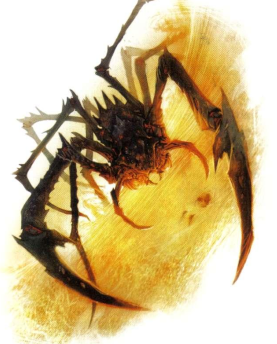
Copyright 2009 Wizards of the Coast Look, let’s face the truth here: Lolth is a demon lord. She’s Chaotic Evil, lives in the Abyss, and has lineages of demons aspected to her. It’s likely the only reason she’s classified as a “Goddess” is that she was one before in the same way Graz’zt was a devil. And maybe due to Drow publicity campaigns.
Bebiliths are one of those Lolth-aspected demon lineages. They’re huge spiderlike monsters, whose forms diverge from a spider’s only in ways that make them scarier. Sapient but not very smart, they prowl the Demonweb Pits and other planes eternally hunting and killing for the joy of it. Drow often use them as heavy summoned muscle, which is the largest role their limited intellect allows them to play in drow intrigue. They’re what your typical drow queen is going to call up when she’s ready to start an open war.
Bebiliths are super-fast, have wicked claws, venomous bites, and shoot webs that are on fire. They’re near the top of the spider-monster hierarchy, of which Lolth is the undisputed leader.
The Numbers
These are Huge Elemental Magical Beasts (demons) and Level 18 Solo Brutes with 696 HP. They have darkvision and Tremorsense 20, and are surrounded by a Spectral Death Web (aura 3). Enemies caught inside that lose all their resistances for a turn when they’re hit by an attack. It doesn’t have to be an attack by the bebilith!
They have ridiculous ground and climb speeds of 12, obviously with Spider Climb. They also don’t roll initiative: their Dangersense makes them act at initiatives 20 and 10, with a full set of actions in each of these turns. Additionally, their Hunter’s Reflexes (reaction; recharge 5-6) allow them to shift 4 squares when someone moves adjacent to them.
Their basic attack is a Reaving Claw (melee 3 vs. AC) which does damage and inflicts a cumulative -1 AC penalty on the target, which clears at the end of the encounter. Flashing Claws allows bebiliths to make this attack twice in the same action, against different targets. There’s also a Venomous Bite (melee 1 vs. AC; recharge 6) which does more or less the same damage as a claw plus ongoing poison damage (save ends).
The Flaming Web (close blast 5 vs. Reflex; recharge 5-6) does fire damage, slows, and does ongoing fire damage (save ends both). The first failed save causes the ongoing damage to increase and worsens the “slowed” condition to “restrained” (save still ends both).
The sample encounter is level 20, and has a Bebilith, 3 drider shadowspinners, and 1 drow priest. The demon is this team’s heavy, but the others can be dangerous too, particularly against a level 15-16 party.
Impressions
I have “fond” memories of bebiliths because one of them featured prominently in Hordes of the Underdark (the epic-level campaign in Neverwinter Nights). Though they’re mostly “even giant-er” spiders, I like the mechanical “feel” on this version. It has plenty of options.
Bloodseep Demon
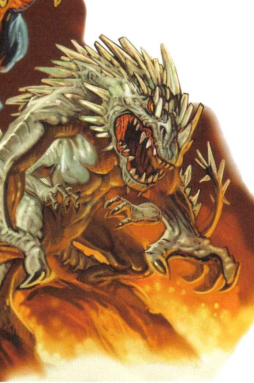
Copyright 2009 Wizards of the Coast These things are covered in thin, translucid skin that constantly cracks and weeps poisonous blood. They coat their claws in this foulness and spray it at their victims. They’re also clever enough to use it in subtler ways, tainting the food supplies of their intended targets in order to weaken them for the final attack.
The Numbers
Bloodseep demons are Medium Elemental Humanoids (demons) and Level 7 Skirmishers with the Leader keyword and 79 HP. They have darkvision, a ground speed of 7 and a teleport speed of 3. Their Variable Resistance is 10 (1/encounter), and they project a Weeping Poison aura (2) that deals 5 poison damage to enemies caught inside. If the demon is bloodied the aura also heals any demons inside for 5 HP at the start of their turns.
Their claws also do ongoing poison damage (save ends), and once per encounter they can squeeze out a Poison Blast (close blast 5 vs. Fortitude) which does light poison damage. Demons caught in the blast instead heal the rolled amount of HP.
Their final trick is the Poison Portal Strike (recharge 4-6), which allows them to teleport 5 squares, attack someone with a claw, and teleport another 5 squares. If used well this can cause some havoc in the party’s back line and force some defenders to turn away from the front.
The sample encounter is level 7 and has one of these, 2 barlguras and 2 evistros.
Impressions
“Bloodseep demon” is a horrible name, but the actual monster seems a bit more interesting than I thought at first.
Dretch
The lowest of the low, dretches were covered in this post of the Monster Manual/Vault Let’s Read.
End of Part 1
That’s about it for this post. I estimate it will take two more of about the same size to go through all this book’s demons.
-
De-monk-ifying Dungeon Fantasy
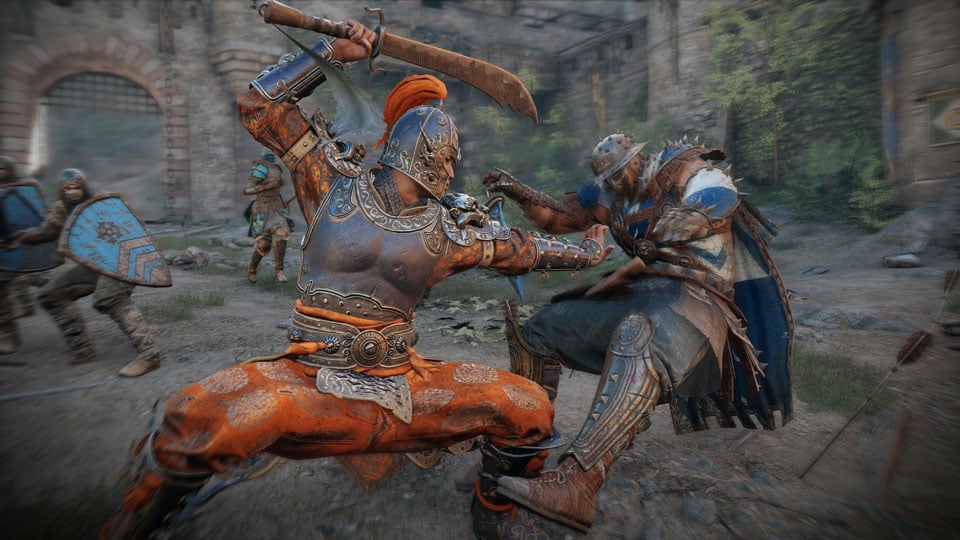
Is this guy a Martial Artist? A Swashbuckler? A Knight? Yes. Dungeon Fantasy has the Swashbuckler template. Swashbucklers are physical combatants who prioritize mobility and precision over heavy armor and brute strength. They use a specialized set of weapons, are obsessed with improving their skill, and strive to learn secret techniques of legendary reputation and effectiveness.
Dungeon Fantasy also has the Martial Artist template. Martial artists are physical combatants who prioritize mobility and precision over heavy armor and brute strength. They use a specialized set of weapons, are obsessed with improving their skill, and strive to learn secret techniques of legendary reputation and effectiveness.
Yes, those descriptions use most of the same words. When you look at these two professional templates from a large enough distance, they really are two takes on the same concept. They could, in theory, be represented by the same template. The reason Martial Artist is a separate archetype in Dungeon Fantasy is because Monk is a separate class in D&D.
And the reason Monk is a separate class in D&D, as far as I can tell, is because of a particular set of media cliches that have surrounded the words “martial arts” in a lot of media contemporary with earlier editions of D&D. I guess you could call it a form of orientalism1.
In some of these media sources, “martial arts” are this mysterious and exotic secret from the mysterious and exotic East, much more sophisticated than the crude flailings of Western barbarians. Knowing it makes you more “enlightened” and gives you superpowers.
In others, they’re this fancy dance for pansies that’s totally ineffective in a “true” fight, because a Real Man knows he just has to punch the other guy. The Real Man in this scenario is of course always a man, and always Western too.
D&D monks were originally based on this character named Remo Williams, the protagonist of the Destroyer series of novels. These novels came out in the 70s, and they were very much in the “exotic secret that gives you superpowers” camp. Williams learned a fictional martial art from an exotic foreign master and proceeded to use it to defeat a string of (usually Asian) bad guys. D&D writers applied a “shaolin” veneer to the class in later editions but many monk abilities are still based on stuff Williams did in the novels.
GURPS replicated this in Dungeon Fantasy because it tries to replicate D&D, but its “default” approach to martial arts turns out to be a lot better in my opinion. It has a supplement named GURPS Martial Arts that treats historical styles from all over the world with the same level of respect. The message contained in its rules seems to be that these styles are all different expressions of the same thing2. How good an individual combatant is matters a lot more than where his techniques come from. I really liked that when I first read it, and I’ve only grown to like it more over the years. It kinda bothers me to see a game that still treats the subject in that older “Destroyer” way.
Every character who practices a fighting style and trains to improve their skill at it is a martial artist by definition, no matter where that fighting style comes from. Whether that training gives you superpowers has always been more of a genre or campaign “setting” than something that should be assigned to individual character types.
In the case of the dungeon fantasy genre, that particular setting is obviously stuck on “yes”. Every PC can perform impossible feats of badassery, that has been a given since the very beginning3. Someone who comes from a culture that talks about things in terms of Chi will likely describe any such character as possessing “strong chi”. Someone who doesn’t will just describe them as being really good at fighting. This in no way changes the fundamentals of how their abilities work.
So here’s what I’m going to do in my campaigns from now on.
Demonkified Dungeon Fantasy
Chi Mastery no longer exists as a specific power. There is no Chi Talent, and all its component abilities lose the power modifier along with the associated discounts and drawbacks.
If you only have access to the DFRPG, do this instead: if a former Chi ability is described as “working like” another trait, you can buy that trait instead. For example, Tough Skin instead of Dragon Skin, and Striking ST instead of Mantis Strike. For abilities that have no parallel… keep the same cost, it’s simpler. In all cases you no longer get a bonus for Chi Talent, but you also no longer need Disciplines of Faith: Chi Rituals to keep them either.
The Swashbuckler and Martial Artist become related templates. A Swashbuckler gains access to the Martial Artist’s abilities and power-ups, and vice-versa. Characters of each template might still look and behave very differently on a role-playing level, but there isn’t any fundamental difference in their mechanics any more. The 30 points that would go to Chi Talent in the Martial Artist template are instead avaialble to be spent on any template advantages or skills. And there you go!
If you’re also using Streamlined Mastery, this means that a PC built using the Martial Artist template could start off with True Master and Iron Limbs for the same cost as the official Trained By a Master and Chi Talent 2 advantages.
What about Knights?
Everything I said about monks and swashbucklers in my introduction applies equally well to Knights and the other “fighty” templates. However, I still want to keep it as a separate template because it’s good to still have some guidance when building characters!
“Combatant who prefers strength and heavy gear” is different enough from “combatant who prefers precision and speed” to remain a useful distinction. I’d still allow some judicious cross-aisle shopping for traits that make sense for a specific PC.
Heck, combining this with some form of Agnostic Dungeon Fantasy (where either no spellcaster is a priest or they all are) would leave us very close to ditching templates entirely, or at least having a collection of “classes” that’s much closer to that of the oldest of old D&Ds: “warrior” and “magic user”. Maybe I’ll try that some day.
What About the Path?
One of the side-boxes in the Dungeon Fantasy Companion 2 introduces the notion of The Path, an alternate progression scheme that a Martial Artist PC can opt into at character creation. Basically, it makes your Chi Talent levels limit how many levels you can have in certain traits. As a result those limits are lower to start with, but with enough time and points they can end up much higher.
I think The Path is more appropriate for a campaign that does the reverse of what I’m trying to do here, where everyone uses chi mechanics. I’ll leave it out of my games for now and maybe write about it at a future date.
-
Though of course I’m not an expert on the subject and will gladly defer to people who are. ↩
-
Yes, Bruce Lee said this, and yes, the book does talk about him with great admiration. ↩
-
Don’t even try to bring the Guy at the Gym fallacy into this. The guy at the gym will never have 200 HP or be able to fight 50 goblins without breaking a sweat. ↩
-
-
Let's Read the 4e Monster Manual 2: Demogorgon (Part 3)
This article is part of a series! Click here to see the other entries.
This is the third and final post covering the huge Demogorgon entry in the Monster Manual 2. As you might have guessed from what was said back in part 1, it covers not one but two multiversal big shots: the titular Demogorgon and his buddy Dagon.
Demogorgon
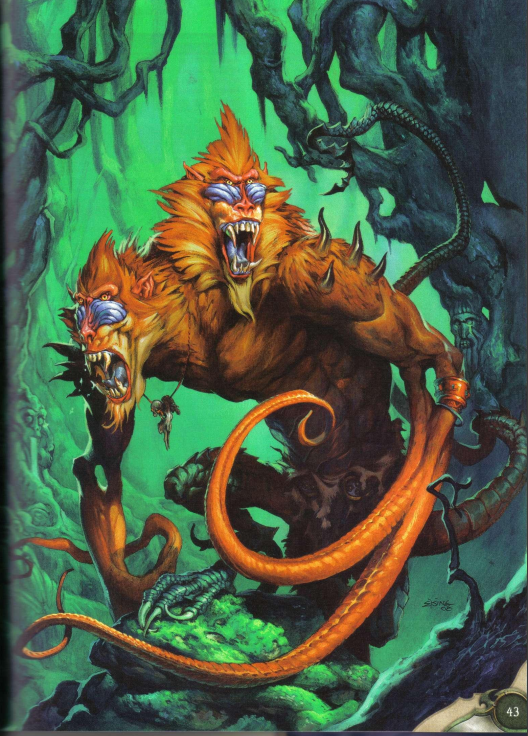
Art by Jesper Ejsing. Copyright 2009 Wizards of the Coast. Demogorgon has existed in D&D since at least the days of AD&D 1st Edition. As I might have mentioned his name got really popular due to the Stranger Things TV show, though I understand the monster there is a different creature from the two-headed mandrill found in the actual game.
The Lore
Demogorgon claims the title of Prince of Demons, which is quite the bold claim even among demon lords. His personality and motivations make him the demon lord’s demon lord. He’s not obsessed with a specific aspect of evil, like Orcus is with undeath. He’s not overly committed to a single modus operandi like Graz’zt is with his sexy manipulations. He doesn’t limit his influence to a single people like Yeenoghu does with gnolls or Baphomet with minotaurs.
No, Demogorgon’s goals are to become the most powerful thing in the multiverse and destroy anyone who causes him anger or jealousy (i.e, almost everyone). His wordly cults, as we saw, are focused on wanton destruction and have this theme of outward madness that hides powerful mysteries. He and his agents are also quite capable of deception and will use that to achieve their goals just as readily. You can find servants of Demogorgon anywhere in the universe, and they can belong to any people. His domain in the Abyss is covered in tropical jungle but also includes seas and vast brine flats, and he is at home in all of these environments.
Demogorgon’s main enemies are Orcus and Graz’zt, but though these other two are very powerful, Demogorgon is more. The books emphasize that he has never lost a fight - that duel with the god Amoth that nearly split him in two? He won that one, killed Amoth, killed Storralk right after it, and then got better. Though to Amoth’s credit, he was the only entity to ever scar the demon lord: he used to only have one head before the duel, and that remained split afterwards, healing into the current two heads.
Each of Demogorgon’s heads has its own name, mind and personality: Aameul is the one that prefers deception, and Hethradiah is the one that prefers destruction. They detest each other and their plans are frequently at odds, which is probably the main obstacle preventing the demon lord from conquering the universe. Still, sometimes those competing plans end up synergizing into something that advances his goals.
This split nature is reflected all the way down his cult hierarchies. The layout of his temples is split down the middle with each half dedicated to one of the heads. The most powerful cults are led by pairs of twins, each dedicated to a head. And as we already say even individual cultists have a “dual nature” thing going on, starting fights as cold and calculating combatants and devolving into frothing berserkers when they’re wounded.
The most powerful among his cultists might know the ritual to summon an Aspect of Demogorgon, a living echo of his power. Like the Aspects of Orcus, they share the personality and a fraction of the power of their originator, but their existence is independent. An aspect doesn’t know what the original is thinking, and vice-versa. They’re a bit like avatars from previous editions.
The Numbers
Demogorgon himself is a Garguantuan Elemental Humanoid and a Level 34 Solo Controller with the Aquatic and Demon keywords. This is literally the highest-level monster we saw so far in the entire Let’s Read - Orcus, the former holder of the title, was level 33. His HP total is 1260.
He has trained Perception and Darkvision, Variable Resistance 30 switchable 3x/encounter, ground and swim speeds of 8, and a teleport speed of 10. Remember, a teleport speed means he can teleport at will.
He also has the two traits previously seen on ettins. Double Actions means he rolls initiative twice at the start of combat, once for each head, and takes two full turns each round. His immediate actions refresh before each action. You have to specify which turn belongs to which head, though - that head can’t use the other’s special power. Dual Brain allows him to automatically save against the Dazed and Stunned conditions and against any charm effects at the end of one of his turns.
In combat, Demogorgon fights with his copious tentacles and with psychic powers: the basic attack is a Tentacle Strike (Reach 5 vs. AC), but he has many more interesting options.
Tentacle Blast (Close Blast 5 vs. Fortitude) does almost the same damage and deals ongoing 15 damage (save ends). If it hits a target that was already taking ongoing damage, that damage is increased by 5. Forked Tail (Ranged 5 vs. Reflex) deals necrotic damage and weakens (save ends).
Those are the physical attacks; now for the magic ones!
Any enemy who starts their turn within 10 squares of Demogorgon is subject to the Gaze of Abyssal Might (vs. Will; free action), which dazes until the end of the target’s turn. He can let his enemies take a peek inside his minds with Dual Aspects of Demogorgon (close blast 10 vs. Will; recharge 6) which deals heavy psychic damage and knocks the targets unconscious (save ends) on a hit. That’s a potential TPK right there.
As mentioned before, each head has a special power that can be used in its assigned turn. These are minor actions, so they’ll happen alongside one of the other attacks. They’re both Close Blast 5 vs. Will. Aameul’s Gaze does psychic damage and dazes (save ends). If the target was already dazed, for example by the Gaze of Abyssal Might, they are dominated instead (save ends). Hethradiah’s Gaze does a bit less psychic damage but forces the target to use an at-will attack power against a target of Demogorgon’s choice.
Running away from all this is also quite hard: Inescapable Grasp is a Ranged 50 power that targets Will and teleports the target to a square within tentacle reach of Demogorgon.
We also get a stat block for the Aspect of Demogorgon, which is very similar but smaller in all ways. It’s “only” Huge, and a Level 25 Elite Controller with 476 HP. It uses Forked Tail as its basic attack and replaces the named gazes with a Dominating Glare that deals psychic damage and dominates. It has all the other attacks, including the Double Actions and Dual Brain traits.
Dagon
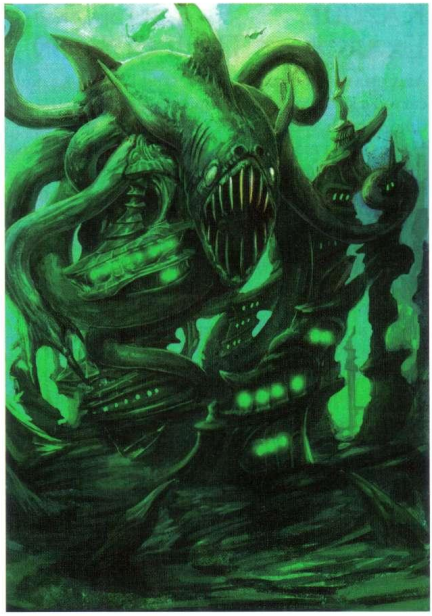
Copyright 2009 Wizards of the Coast. Dagon is inspired by the Lovecraftian entity of the same name, but is not quite the same creature. He’s been in the game since the days of AD&D.
The Lore
The first primordials who entered the Abyss shortly after it had formed found Dagon already lurking in its depths. He is the first and most ancient Demon Lord. His presence poses a disturbing question: did Tharizdun create the Abyss, or merely open a passage to it?
(I think this gets answered in the Demonomicon, but it’s still cool even if left as a mystery).
Dagon is remarkably secretive for a demon lord, and he sits on an endless trove of blasphemous knowledge and terrible cosmic secrets. He allied himself with Demogorgon shortly after the latter became a demon lord, and the two have cooperated ever since. Their cults often work together, and though Dagon’s cultists are a minority in these joint efforts, access to their master’s knowledge makes them very effective leaders.
Dagon shares some of his knowledge with Demogorgon to further both of their goals, but ever since the the “split” he has taken to whispering different bits of lore to each head, which ends up making Aameul and Hethradiah antagonize each other even more.
The Numbers
Dagon is a Gargantuan Elemental Magical Beast with the Aquatic and Demon keywords, and a Level 32 Solo Soldier with 1184 HP. He has the usual Darkvision and Variable Resistance (10, 3x/encounter). His ground speed is only 4, which doesn’t matter because you’re definitely fighting him underwater. He also has swim and teleport speeds of 8. Dagon also has an Eye of the Abyss aura (10) that pulls any enemies who start their turns inside 5 squares.
Dagon might begin the fight at range, using his control over Abyssal Tides to attack the PCs. This is an Area Burst 3 within 20 vs. Reflex, doing force damage and immobilizing the targets on a hit (save ends). As an effect, Dagon can also teleport 5 squares.
Once the PCs are in reach, it’s Tentacle Town. Dagon can uses his tentacles either for a basic Tentacle Strike (Reach 5 vs. AC) or a Tentacle Blast (Close Blast 5 vs. AC), both of which damage and slide the targets 2 squares on a hit. They also act on their own with Grasping Tentacles (Reach 5 vs. AC), an interrupt that triggers when an enemy in reach attacks Dagon. This does a little less damage than the basic attack and grabs the target. The escape DC is something like 44 or 46 depending on the skill you use, which will be tricky for a non-specialist even if they’re level 30. And of course these Reach 5 tentacles have Threatening Reach as well.
It’s not all tentacles either! Dagon’s repertoire includes a hefty dose of pure madness. Doom Drone (close burst 10 vs. Will; minor action; recharge 5-6) targets enemies and does psychic damage. It also pulls them 5 squares and stuns them on a hit (save ends). Form of Madness is similar but slides and dazes instead of pulling and stunning. If several enemies manage to get in close Dagon can use Claws of the Abyss (close burst 1 vs. Reflex) to deal heavy physical damage with his non-tentacle appendages. Note he can use the claws and both mental attacks in a turn.
The tactics paragraph makes a reference to a power named Wrath of the Deep, though that’s not in the stat block. One of them is wrong. In either case Dagon’s goal should be to keep all the PCs, particularly the squishies, well inside the tentacled killing zone surrounding him.
Sample Encounters and Final Impressions
Of the big bosses, only Demogorgon features in a sample encounter here: Level 35, him and two balors.
These two make nice final bosses for an epic campaign, though probably not at the same time. Demogorgon’s Dual Brain gives him a decent amount of control resistance. Dagon is a bit less strong in that area, but both of them can output an incredible amount of control themselves.
I imagine that a campaign that ends with the defeat of Demogorgon is one where Dagon never shows up in person at all - he’d be too clever to stick around in that case. The reverse is harder to predict. Demogorgon values the alliance but is probably too selfish to try and help Dagon if a party of epic demigods knocks at his briny door. He might however, try to exact revenge on them later, so he could end up being the “final final” boss in a Dagon-focused campaign. Or perhaps he does things on a long enough timescale that he ends up being the boss of the next campaign.
subscribe via RSS