Posts
-
Let's Read the 4e Monster Manual 2: Dragon, Copper
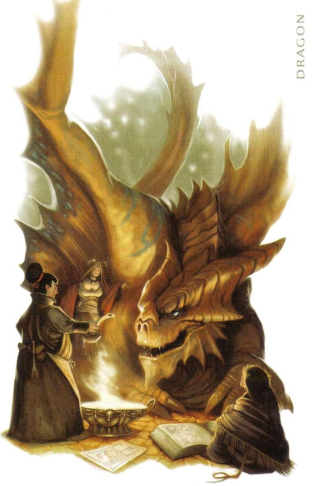
Copyright 2009 Wizards of the Coast This is part of a series! Go here to see the other entries.
Copper dragons are part of the classic set and have been in the game at least since the AD&D 1st Edition Monster Manual. Here, they are the only remaining members of the “sorta orange-ish metal trio”, which used to feature bronze and brass dragons as well.
The Lore
Copper dragons are highly sociable creatures, but they’re also among the greediest metallic dragons. They’re not likely to resort to outright robbery like your typical red dragon, but they’re almost always looking for a way to profit from their interactions with others. PCs can usually walk up to a copper dragon and ask it for information or instruction. The dragon will be most happy to give it to them… for a price.
Copper dragons are quite protective of their hoards. They like to make their lairs in rocky terrain like hilly badlands or mountains, which they can easily patrol from the air but which restrict the mobility of land-bound intruders. If they see the need to fight, they’ll do so by harassing their enemies with highly mobile aerial attacks over an extended period of time. They breathe acid, and prefer to recruit allies that can keep up with their high mobility.
I really like it that the illustrations for copper dragons give then verdigris streaks.
The Numbers
Copper dragons are Unaligned, Natural Magical Beasts with the Dragon Keyword. We get stat blocks for the usual four age categories.
Their size starts at Large when young, and increases to Huge at Elder. They never reach Gargantuan size, which I guess means they’re a bit smaller than the others in general. They have trained Perception, Darkvision, and Acid Resistance that starts at 15 when Young and increases by 5 per age category. Their speed is quite high, starting at 8 (fly 12) and reaching 10 (fly 14) at Elder and older. They also have Overland Flight 15.
Young Copper Dragon
Young copper dragons are Level 6 Solo Skirmishers with 296 HP. Their bite allows them to shift 2 squares both before and after the attack, and deals a mix of physical and acid damage. Their claws are a simple basic attack, but Double Attack allows them to claw twice and then shift 2 squares. Looks like choosing between a bite and a double attack is a meaningful tactical decision!
The dragon’s most frequent attack is likely to be a Flyby Attack, where it flies its speed and makes a melee basic attack at any point during the movement. This does not provoke opportunity attacks from the target of the attack. The bite is the clear best choice here, since it’s stronger and has built-in shifts which I think would happen even in the midst of the Flyby Attack.
The Breath Weapon (close blast 5 vs. Reflex; recharge 5-6) does acid damage and slows (save ends). Bloodied Breath and Frightful Presence are also here and work as described in earlier posts.
And finally, Cutwing Step is a reaction that triggers when someone moves to a position that flanks the dragon. It’s an attack vs. AC that does light physical damage and allows the dragon to shift 2 squares.
Adult Copper Dragon
Adult Copper Dragons are Level 13 Solo Skirmishers with 528 HP. They have all the abilities of a young specimen with correspondingly bigger numbers. All attacks that allowed shifts other than the bite have the shift amount increased to 3.
They also add a new passive trait: Unfettered Wings allows them to roll saves against the Immobilized, Slowrd and Restrained conditions at the start of their turns in addition to the normal end-of-turn rolls.
Elder and Ancient Copper Dragons
The Elder grows to size Huge as previously mentioned, and is a Level 20 Solo Skirmisher with 760 HP. It has bigger numbers than the Adult due to its higher level, but its suite of abilities is otherwise identical.
The Ancient is a Level 27 Solo Skirmisher with an even 1000 HP. It has all of the Elder’s abilities, and its Flyby Attack upgrades to a Double Flyby Attack, which allows it to attack two different targets during its strafing run.
Sample Encounters and Final Impressions
The sample encounters are against all-skimmisher teams. There’s a Level 8 one with a young copper dragon and 3 hippogriffs, and a level 14 one with an adult and 2 dragonborn raiders.
Copper dragons are really flexible in the dramatic roles they can occupy even when you stick to their written description. It all depends on which part of the “sociable but greedy” stereotype you want to emphasize. I also like that most of their illustrations in this book have their coppery hides shot through with veins of verdigris.
-
Let's Read the 4e Monster Manual 2: Dragon, Adamantine
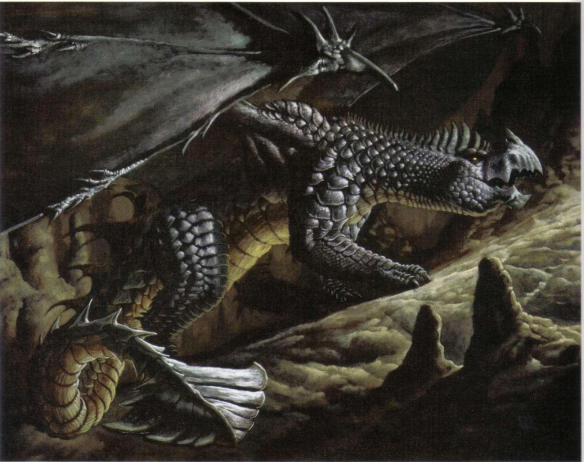
Copyright 2009 Wizards of the Coast This is part of a series! Go here to see the other entries.
Adamantine dragons are the first metallics we’ll cover. I finally found a wiki with publication histories for monsters, so I can say that that they first appeared in a Monstrous Compendium for AD&D 2nd Edition, and in a Dragon article for 3.x. This means they had a minor presence in the game until their first proper Monster Manual appearance here.
The Lore
Adamantine dragons like to lair in huge underground caverns, and can be found in any sort of climate. They consider everyone else living in their claimed territory to be their subjects, from whom they demand loyalty, respect, and tribute. The flip-side of this is that adamantine dragons feel a genuine sense of noblesse oblige towards these subjects, and will protect them with all their might.
Their claws and fangs are made of their titular metal, so their attacks slice through armor as if it wasn’t there. Their roars are powerful, and their breath weapon is a focused sonic attack. In combat, they’re cool-headed and tactical. If alone, they try to isolate weaker foes and focus fire on them. If accompanied by allies, they’ll charge to the front line and attract the brunt of enemy attacks to allow their allies more opportunities to damage the opposition.
The Numbers
As usual, we get stat blocks representing four age categories: Young, Adult, Elder, and Ancient. All are Natural Magical Beasts with the Dragon keyword. All stat blocks are Unaligned.
Adamantine dragons start at size Large, growing to Huge at Elder and Gargantuan at Ancient. They have trained Perception, Darkvision, and Thunder Resistance that starts at 15 and goes up by 5 on each subsequent age category. Their ground speed starts at 6 and rises to 8 on Adult and older. Their flight speed starts at 8 and rises to 10 on Adult and 12 on Ancient. They also have Overland Flight 15, which is the speed you use when calculating how much distance they cover over extended times.
Young Adamantine Dragon
This is a Level 7 Solo Soldier with 332 HP and the traits described above. Its basic attacks are a bite and a claw, both of which target Reflex instead of AC because they’re adamantine. The bite is a little stronger, Double Attack allows the dragon to claw twice in a single action.
Their Breath Weapon (close blast 5 vs. Fortitude; recharge 5-6) does thunder damage and knocks the targets prone on a hit. It replaces the usual “half damage on a miss” with a much more interesting Effect: at the start of the dragon’s next turn, it gives a thunderous roar that deals automatic thunder damage to everyone in a close burst 3.
Bloodied Breath and Frightful Presence are here, and they work as outlined in the intro.
Wing Buffet (melee 2 vs. Fortitude) is a reaction that triggers when an enemy enters or leaves an adjacent square. On a hit it deals light physical damage and knocks prone. This is better than a standard opportunity attack because it also triggers on a shift or other forms or movement.
Adult Adamantine Dragon
Adults are Level 14 Solo Soldiers with 564 HP. Their numbers are of course all larger, but they are almost identical to young dragons in what they can do.
There have been a few additions: the bite now also inflicts ongoing damage (save ends), and Double Attack is replaced by Draconic Fury, which allows them to make three claw attacks and bite a different target in a single action.
Elder Adamantine Dragon
Elders are Level 21 Solo Soldiers with 796 HP. They have everything adults have, with a few additions:
Their Draconic Fury gains another claw attack, for a total of four claws and a bite. They also gain a new attack named Painful Resonance (Ranged 20 vs. Fortitude; minor action; recharge 6) that inflicts ongoing thunder damage and dazes (save ends). Since this is a minor action, it can be used in the same turn as Draconic Fury.
Ancient Adamantine Dragon
Ancients are Level 28 Solo Soldiers with 1020 HP. This puts makes them a match for a pair of primordial colossi. They have everything elders have, plus their melee reach increases to 4 and the area of their Breath Weapon’s follow-up roar increases to 5.
They also gain a new trait named Bloodied Resilience, which gives them Resist 10 to all damage while they are bloodied.
Sample Encounters and Final Impressions
The book doesn’t even pretend you’re going to fight these solos by themselves, though that of course is an option depending on what you want. Since adamantine dragons place themselves in the front line, they favor allies who can benefit from the distraction to rain ranged damage or control upon the enemy, or give the PCs the run-around and hit their squishies. And they’re going to think of party composition in these terms, since they’re tacticians.
The sample encounter is level 15, an adult adamantine dragon and 2 banshrae warriors.
-
Let's Read the 4e Monster Manual 2: Dragons
Woohoo, more dragons. The first Monster Manual (and the Vault) focused on chromatic dragons, which are the classic draconic opponents, and now the second one talks about the metallics.
The earliest metallic dragons were the Golds, who appeared alongside the chromatic set in AD&D 1st Edition and might have been around even earlier than that. Here, we’re going to look at a slightly different set. This is an introductory post, with the next handful of them each covering a different “color” of dragon.
The Lore
In editions past, metallic dragons used to be various shades of Good, something which settings like Dragonlance really leaned into. Things are a bit more complex here.
Metallics still venerate Bahamut in his role as the Platinum Dragon. They’re more likely to interact peacefully with PCs and other sapients, but they can still be quite full of themselves and are very protective of their territory and treasure. If they perceive someone as a threat, they won’t hesitate to crush that someone. And just like you can have friendly chromatics, you can also have villainous metallics.
In either case they tend to have a scholarly temperament. They prefer lairs that have some cultural or academic significance in addition to the usual requirements of isolation and defensibility and their treasure hoards are curated like museum collections. The typical metallic dragon loves engaging in learned discourse, and has a keen ability to sense lies. They deal very harshly with people who try to fool or, gods forbid, steal from them.
Like all dragons they see very few other creatures as their peers, but will allow a group of “lessers” to gather around themselves. They tend to see these as students and wards, instead of slaves and worshippers. A metallic dragon is not going to set itself up as a god, but as a university professor.
This entry has five dragon types: Adamantine, Copper, Gold, Iron and Silver. From what I gather, Adamantine and Iron dragons made it into the main metallic lineup in 4e to replace bronze and brass dragons, which weren’t distinct enough from Copper dragons at a glance. I think I agree with that reasoning. While I’m sure these dragons have their own mechanical distinctions, I sure can’t recall what they were just from looking at their names.
The Numbers
As usual for dragons, the ones we get here are all solos, and each has several stat blocks representing different age categories: Young, Adult, Elder and Ancient. Young dragons only have the most basic versions of their powers, and both improve them and gain new ones as they age. Their mechanical design is closer to that of the first Monster Manual than to the one from the Vault.
All dragons have darkvision, resistance to the same element they breathe, and both combat and overland flight speeds. All of them get a different Breath Weapon, as well as the Bloodied Breath trait and the Frightful Presence attack.
Bloodied Breath works as usual: when the dragon is first bloodied, its breath weapon recharges and it uses it immediately as a free action. Frightful Presence is a Close Burst 10 vs. Will encounter power that does no damage but stuns for a turn and has a -2 attack penalty (save ends) as an after-effect.
We’ll begin discussing the dragon types individually in the next few posts.
-
Let's Read the 4e Monster Manual 2: Djinn
This is part of a series! Go here to see the other entries.
Djinns are inspired by the same real world Arabic folklore that inspired efreets, and they’ve been in the game since at least BECMI.
The Lore
Djinns are some of the most ancient sapient elementals, on par with efreets (which we saw in the first Monster Manual/Vault Let’s Read). They’re aspected to Air, and in the book’s own words, are “Ingenious Engineers of the Fabulous”.
Back in the day, the djinn built entire civilizations in the Elemental Chaos. Theirs were shining palaces filled with treasure beyond mortal comprehension, and great gleaming cities built on mobile floating platforms.
When the Dawn War came, the djinns chose to side with the primordials, which I suppose they saw as the pragmatic choice. After all, their own empire was outside the world, and the stronger primordials looked like they had a better chance of winning. In the end, though, they chose wrong.
The gods scattered the djinns as punishment for their deeds in the war, and imprisoned many of them in objects such as rings, lamps, or other artifacts. The ones that remained free had their powers severely reduced. Over the ages a lot of those artifacts and a lot of djinn relics made their way to other planes and to the world.
So yeah, it’s totally possible for a PC to find the proverbial magic lamp. It’s up to the GM whether the magic that binds the djinn inside forces it to serve the bearer, though. If it does, then these relics are super-powerful! Even if the djinn can’t grant wishes like in the stories, it’s still an epic-level creature full of magic powers.
The djinns who remained free, and those who freed themselves over the ages, mostly busy themselves with roaming the planes looking for the remains of their ancient civilization, with the goal of rebuilding it. I would guess they had some success in that, but that it’s still nowhere up to its former heights of glory.
The djinns presented here are all Unaligned, which implies that as a people they are mostly interested in picking up the pieces of their civilization than in going a-conquering or enslaving others. They can still get into conflict with PCs who (knowingly or not) keep those pieces from returning to their original owners. Hold on to that lamp for too long and its inhabitant’s friends will show up at your door with some very pointed questions. I can’t say they’d be wrong to do so.
The Numbers
Djinns are Large Elemental Humanoids with the Air keyword. They have Blindsight 10, an immunity to disease and poison, Resist 15 Thunder, a ground speed of 6 and a flight speed of 8. The least intelligent djinn in this entry nas an Int of 19, so the ingenious engineers are also geniuses. Their level range covers the early-to-mid Epic tier, making them only slightly weaker than efreets.
Most djinn powers have an air or storm theme, but they vary per stat block.
Djinn Thunderer
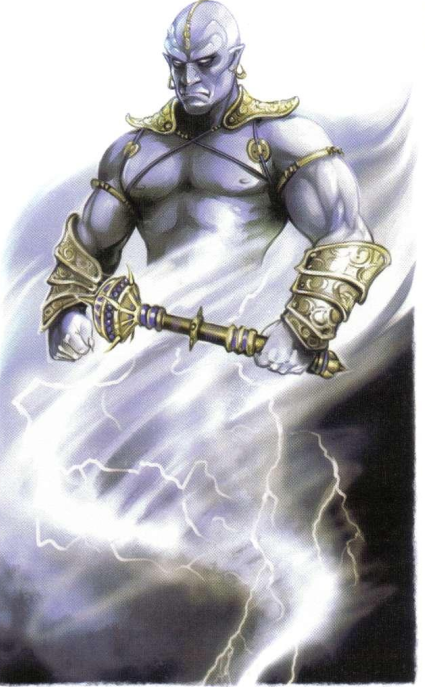
Copyright 2009 Wizards of the Coast Thunderers are Level 20 Artillery with 146 HP and all djinn traits. They wield jeweled scepters and strong air magic in combat.
The Scepter mostly acts as an implement, but can be used as a Reach 2 basic melee attack in a pinch. Their main ranged attack is a Thunderburst (area burst 2 within 20 vs. Fortitude), which does thunder damage and dazes for a turn. Once per encounter they can use Imperious Thunder, which targets Reflex and which has the same area and damage but instead of dazing causes 10 ongoing thunder damage (save ends) even when it misses.
The thunderer can avoid getting boxed in with Zephyr Step (minor; recharge 6), which allows it to teleport 20 squares. If it takes damage from a critical hit, it will respond with Rage of Storms (close burst 2 vs. Reflex; free action, encounter). This does high thunder damage, pushes hit targets 5 squares, and gives the djinn 1 action point as an effect, which it can use normally later on.
Djinn Windbow
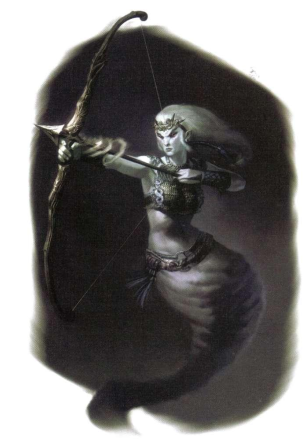
Copyright 2009 Wizards of the Coast Windbows are Level 22 Skirmishers with 204 HP and all standard djinn traits. They wield bows that fire arrows made out of wind, and this might lead PCs to think they’re artillery. However, they’re equally good at melee and ranged combat.
Their basic ranged attack is the Windbow (Ranged 10/20), and their basic melee attack the Slash of Thunder. Both do about the same amount of damage, which is thunder for the Slash and physical for the bow.
The djinn can cause one of their arrows to turn into a Brutal Zephyr (Ranged 30 vs. Reflex), which does thunder damage and is a bit stronger than the usual attack. If this misses, the windbow gets to choose a different target within 10 squares of the original one and re-roll the attack against them.
If damaged by a critical hit they can use Blowback, which works exactly like the Thunderer’s Rage of Storms.
Djinn Stormsword
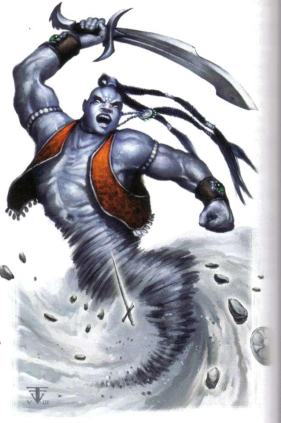
Copyright 2009 Wizards of the Coast Stormswords fight with scimitars and train to form whirlwinds that pull enemies towards their blades. They’re Level 24 Soldiers with 222 HP and all standard djinn traits, plus Resist 15 Lightning.
Their Scimitars are Reach 2, high-crit weapons that mark for a turn on a hit. Their printed critical damage is 9d10+33, and it would be even higher with a math fix. They can also use a technique named Whirlwind Dervish (close burst 2 vs. AC; encounter) which does heavy thunder and lightning damage and recharges when they’re critically hit.
Stormswords can drag targets into range with Come To Me (Ranged 5 vs. Fortitude; minor action), which does no damage but pulls the targets 5 squares. They can sometimes intensify that into a Spinning Vortex (Ranged 5 vs. Reflex; recharge 6), which does heavy cold and thunder damage, and immobilizes (save ends).
Djinn Skylord
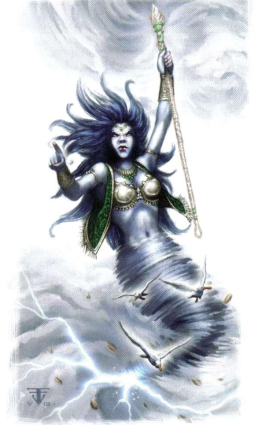
Copyright 2009 Wizards of the Coast Skylords are djinn spell-casters, specializing in sky- and weather-themed magic. They’re Level 25 Controllers with the Leader keyword and 236 HP along with all standard djinn traits.
Their main weapon/implement is the Storm Staff (reach 2 vs. AC), which does physical damage and allows the djinn to shift 2 squares or make an extra recharge roll for Storm Shout. This, in turn, is a Close Blast 5 vs. Will that does heavy thunder damage, pushes 3 squares, and knocks prone. It recharges on a 5-6.
The skylord’s main ranged attack is Mystic Hail (ranged 20 vs. Will), which does psychic damage and makes the target grant combat advantage to the djinn. This lasts until the target spends a standard action clearing their head, which is a heavier cost than having to roll a save. This works as a nice setup for Sandstorm (Close Burst 5 vs. Will), which does heavy physical damage and creates a zone. Allies inside the zone gain concealment, and enemies starting their turns inside are dazed for a turn. This can be sustained with a minor action. And finally, the djinn can also use a minor action (1/round) to use Elemental Command (ranged 10), which always hits, does no damage, and slides the target 1 square.
Sample Encounters and Final Impressions
Djinns are said to mostly hang out with their own kind, and the two sample encounters (level 22 and 26) bear this out. They’re assorted djinn parties, likely journeying after relics of their old empire. The first one has a couple of rimefire griffon pets, the second has 2 storm gorgons.
Djinns are cool, and I like that they’re presented as not necessarily hostile. Unlike in previous edition they’re not in an eternal war against the efreets, though I imagine they don’t often have friendly interactions all that often either. It might also be interesting to take a page from Middle Eastern folklore here and say that many djinn in the present are devout worshippers of the gods.
-
Let's Read the 4e Monster Manual 2: Direguard
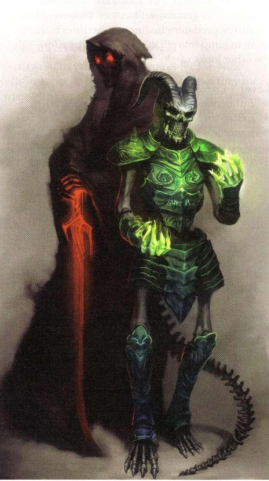
Copyright 2009 Wizards of the Coast This post is part of a series! Go here to see the other entries.
I had never heard of direguards before, but some quick googling tells me they first appeared in the Forgotten Realms Campaign Setting for AD&D 2nd Edition.
The Lore
A direguard is a skeletal undead created by a specific ritual often known by liches and death knights. The ritual requires willing subjects, who retain their minds, combat skills, and powers. This comes at a price, however: in the book’s own words, they must “meet a quota of killing”, or they’ll be destroyed. I don’t know if this is a one time thing or if it’s more like “kill X people every month”. And of course they’re bound to the will of their creator.
Their FR lore is all tangled up with the whole Bane/Cyric situation.
The Numbers
Direguards are Medium Natural Humanoids with the Undead keyword. They have darkvision and truesight 10, and are immune to disease and poison. The rest of their traits varies per stat block.
Direguard Deathbringer
Deathbringers are Level 8 Elite Artillery with the Leader keyword and 134 HP. They have a ground speed of 7 and project a Command Aura (4) that grants a +2 attack bonus to all allies inside. They can also issue a Vile Command (close blast 3; recharge 5-6) that allows all affected allies to shift 2 squares and make a basic attack as a free action.
They fire Force Blasts (Ranged 15 vs. Reflex) that do force damage and push the target 3 squares. On a miss, they do no damage but slow the target for a turn. Frightful Force (recharge 4-6) allows them to fire three such blasts against different targets in a single action.
If forced into melee, the deathbringer’s Blazing Bone Claws do force damage as well. And when they’re first bloodied, they summon some Force Armor around themselves that grants a +4 bonus to AC and Reflex until they’re hit by an attack.
I’d say deathbringers are at home just behind the front line, or further back along with a cluster of artillery enemies with ranged basic attacks.
Direguard Assassin
Assassins are Level 11 Skirmishers with 111 HP. They’re made of shadow as much as they are made of bone, and fight with swords made of force magic. Their ground speed is 8.
That Force Blade deals force damage, as expected, and once per encounter they can fling Dire Blades to do the same amount of damage in a Close Burst 1. Mobile Assault gives them a +2 attack bonus if they move at least 4 squares before attacking, and Mist Walk allows them to shift 2 squares and gain Insubstantial and Phasing for a turn when missed by a melee attack.
Final Impressions
There are no sample encounters here! I guess they could only spare one page for direguards, so there was no room.
I don’t care for the FR bits of their lore, but Deathbringers work nicely as commanders of mindless undead, and Assassins are good elite troops for someone like a skull lord to order around.
subscribe via RSS