Posts
-
Let's Read the 4e Monster Manual 2: Hawk
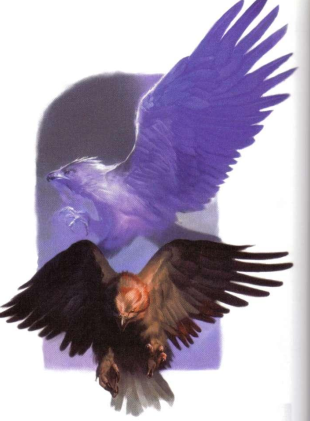
Copyright 2009 Wizards of the Coast Hawks are real world animals, and though they are birds of prey they’re fairly small and don’t usually attack people. For these reasons, 4e doesn’t consider them “monster material”, and this entry focuses on supernatural hawks that can pose a bigger threat to adventurers.
Blood Hawks
As Small Natural Beasts, Blood Hawks are bloody enormous for hawks. They’re also a lot more aggressive than usual, and their claws deal wounds that bleed profusely. This, and their reddish coloration, gives them their name.
A blood hawk is a Level 1 Skirmisher with 27 HP. It has a flight speed of 6, and a ground speed of only 2 (and it’s Clumsy while walking). Its basic attack is a Claw Rake that deals standard physical damage and inflicts 2 ongoing damage (save ends). This ongoing damage raises to 5 if the hawk is bloodied.
The blood hawk can also make Flyby Attacks at will. This follows the standard rules seen in other monsters: it flies its speed, makes a basic attack at any point, and doesn’t provoke opportunity attacks when moving away from the target.
Frost Hawk
A Small Elemental Beast native to certain ice-aspected regions of the Elemental Chaos, the Frost Hawk can also be found in mountaintops and other cold places of the world. It’s a Level 7 Skirmisher with 80 HP, making it a lot more formidable than any mundane hawk. Its flight speed is 8, and its ground speed a clumsy 2. It has Resist Cold 10.
The hawk’s Ice Talons serve as its basic attack, dealing a mix of physical and cold damage. It has the same Flyby Attack as the blood hawk, and it adds a couple elemental powers to its arsenal. Freezing Screech is a Close Blast 3 vs. Fortitude that deals cold damage and slows (save ends). Shattering Strike is a passive trait that make all its attacks deal extra damage against slowed targets.
So a frost hawk is going to start a fight with the Screech, and will then focus its flyby attacks on one of the targets it managed to slow. It pairs really well with controllers and other monsters with the ability to slow enemies.
Sample Encounters and Final Impressions
In addition to being found in the wild, hawks might also be found in the service of many sapients. Falconry is a real-world sport with roots in the Middle Ages, so of course it’s extensively practiced in the medieval-ish setting of 4e. The sample encounters are:
-
Level 2: 3 blood hawks, 2 bloodseeker drakes, 2 elf archers. A hunting party going after dangerous game?
-
Level 6: 2 frost hawks, 1 orc bloodrager, 1 orc eye of gruumsh. Orcs also know falconry.
I don’t think these supernatural hawks would make for an exciting encounter by themselves, but the falconry angle has promise. Lots of enemies become 20% cooler if you give them a badass hawk friend.
-
-
Let's Read the 4e Monster Manual 2: Half-Orc
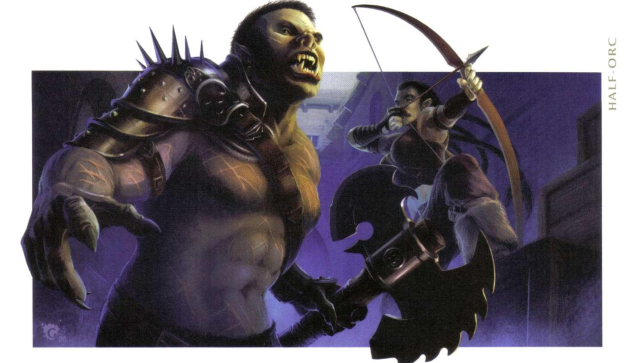
Copyright 2009 Wizards of the Coast Half-Orcs have been in the game since the days of AD&D, where they appeared as a playable option in the Player’s Handbook. Historically, they were one of the first “edgy” options for players, but they’ve always been a bit controversial and surrounded by Unfortunate Implications. The main one being that most versions of them implied that there was only one very unpleasant way in which an orc and a human could have a child.
In more recent years, several different solutions to this have been proposed. Some remove half-orcs from the game, others say they’re full orcs and that’s what a full orc looks like. Fourth Edition went with a third common option, which is to diversify the origins of half-orcs.
They appear as a playable option in the PHB 2, and have their NPC/enemy-style entries here.
The Lore
Half-Orcs as a people tend to combine the daring and ambition of humans with the strength and ferocity of orcs. Their build and features are orcish, but their hair and skin tones resemble those of humans rather than the greens and blues this edition uses for orcs.
Half-orcs are as numerous as any other people without “half-“ in their name. They have their own communities and cultures, and also live in more cosmopolitan settlements along with other sapients. You could play a half-orc who has neither humans nor orcs anywhere in their family tree, or at least none in living memory. In fact, they’ve been around in this state for so long that no one knows their true origins.
There are several competing theories. A more mythical version says that they arose when Gruumsh lost his eye and his spilled blood hit the world. Another myth says Kord created them by copying the best elements from his two favorite species. Others say they started out as a super-soldier experiment by an evil wizard, or when human and orc barbarian tribes joined in alliance in ancient times. Another still says they were engineered by the ancient goblin empire to act as orc wranglers.
And of course, you can still have a half-orc who’s the product of a happy marriage between a human and an orc. If you really want to you could also make a half-orc PC with the classic “Unfortunate” origin, but now it’s no longer exclusive to them. If you really want to play an edgy character, there are better options around these days.
Another thing that has been removed this edition is the “caught between two worlds, hated by both” cliche that used to plague both half-elves and half-orcs. And to that I say good riddance.
The Numbers
NPC Half-Orcs have the same signature traits as their playable version: low-light vision, a +2 bonus to speed when charging, and the Furious Assault encounter power. This can be used as a free action right after the half-orc hits an enemy, and increases the damage of the attack by 1d10. It’s a bit better than the PC version, which only increases it by 1d8.
Half-Orc Hunter
A ranger-type who really likes to jump into melee combat, fighting in a reckless manner. Wearing light armor, they carry a battleaxe and a longbow into combat.
The axe and the bow are basic attacks, and Evasive Chop allows the hunter to shift 1 square before making an axe attack. Draw First Blood is a passive trait that increases their damage against any enemy who hasn’t yet taken damage in this fight. Combining it with Furious Assault makes for a good “alpha strike”.
Half-Orc Death Mage
The death mage is more of a priest-type, serving an exarch of Gruumsh named Yurtrus. Yurtrus presides over disease, misery, and death, so their magic follows the same themes. Death Mages are always Evil, unlike the others here who are presented as Unaligned. They wear robes and carry quarterstaffs that work more as implements than as weapons.
Though they can attack with that staff, their main melee attack is a rotting touch that targets Fortitude and does both immediate and ongoing necrotic damage (save ends). The touch also strips any necrotic resistance or immunity the target might have! This opens it up to necrotic attacks from others, and allows that ongoing damage to have an effect. Saving against the damage also ends this condition.
At range, they can shoot Bolts of Putrescence vs. Reflex that deal physical damage and inflict a -5 penalty to all the target’s defenses for a turn. Their area attack is a Swarm of Flies that deals physical damage and creates a zone over the affected area. Anyone caught inside takes damage from fly bites, and has their visibility restricted to 3 squares. The death mage can move the zone 2 squares as a minor action.
The death mage has the racial Furious Assault power, and it’s worth remembering that it can enhance any attack, not just physical ones. Its final power is Death Mark, which automatically deals heavy physical damage to whoever reduces the mage to 0 HP.
Half-Orc Scarthane
Scarthanes are veteran warriors that eschew armor and proudly display the tapestry of scars covering their skin. The more wounded they are, the more dangerous they become, and either ferocity or blood magic allows them to keep fighting even through all those wounds.
A Scarthane is a Level 7 Brute with 96 HP, wielding a greataxe and fighting unarmored. The axe is a High-Crit weapon, and they’re limited to basic attacks and Furious Assault at first.
When the scarthane hits a bloodied target, Blood for Blood makes the attack deal +1d6 damage and heals them for 5 HP.
Once the scarthane becomes bloodied, Wounded Retaliation allows them to make a basic attack against whoever bloodied them. They also gain Bloodfury Attack, an axe attack that lacks the High-Crit property but deals more base damage and heals the scarthane for 10 HP when it hits. This does stack with Blood for Blood!
Sample Encounters and Final Impressions
Half-orcs can be found among humans, orcs, or other creatures that associate with them. They can easily be reskinned by replacing their signature traits with those of the target species.
The sample encounters are:
-
Level 6: 2 half-orc hunters, 1 human hexer, 4 human berserkers. A barbarian hunting party.
-
Level 9: 4 scarthanes, 1 orc chieftain, 1 orc eye of Gruumsh. The scarthanes make an excellent honor guard.
-
-
Let's Read the 4e Monster Manual 2: Half-Elf
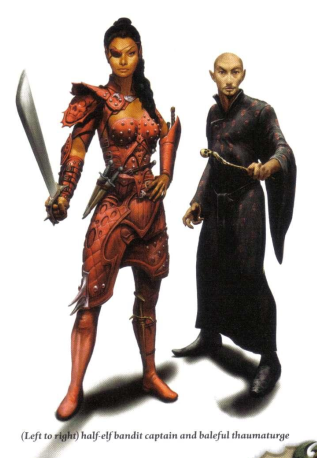
Copyright 2009 Wizards of the Coast Half-elves have been a part of D&D since races were first separated from classes back in AD&D 1st Edition. I guess they might have been inspired by Elrond from Lord of the Rings, who was said to be a half-elf. They appeared as a playable option right in the first PHB, but they’re only getting their monster/NPC entries here.
The Lore
I’m happy to report that Fourth Edition half-elves no longer follow the tired and somewhat problematic “outsiders to both parent cultures” narrative from previous editions! In fact, everyone likes them!
You see, half-elves aren’t just an “average” of their two parents. Yes, they’re sturdier than elves and pointier than humans, but they also have a lot of traits that are uniquely their own. Chief among those is a noticeable facility with social interaction and cultural adaptability.
Half-elves whose parents are a human and an elf can spend their early years in either of the two cultures, depending on their specific family circumstances. Their names and mannerisms tend to be taken from that culture. You can also have all-half-elf cultures and communities whose human and elven ancestors are several generations behind them. In all cases it’s very common for individuals to journey abroad for a while out of a sense of curiosity and wanderlust, and they tend to fit in well in any place where they linger for a while.
Of course, “Nice” doesn’t necessarily mean “Good”, and you can also find villainous half-elves who become bandit leaders or fall in with dark forces. They’re technically better-suited to be infernal warlocks than tieflings, given their stat adjustments.
The Numbers
We get three stat blocks here, more suitable for use as opposition than as allies, though they could also fill that role in a more morally ambiguous adventure.
Half-elves are Medium Natural humanoids, with a native speed of 6 and low-light vision. Everything else about their stat blocks comes from training.
Half-Elf Bandit Captain
This could be a murderous marauder or a Robin Hood figure. They’re a level 6 Skirmisher with the Leader keyword and 69 HP. They wear light armor, wield a sword, and carry a bunch of throwing daggers.
The sword is a basic melee attack that allows the captain to shift 1 square on a hit. Their basic ranged attack is a thrown dagger. A maneuver named Slash and Dash (recharge 4+) allows them to make a sword attack, shift 2 squares and throw a dagger. Their leaderly move is named Triggering Slash (recharge 5+), a sword attack that on a hit allows an ally to shift 1 square and make a melee basic attack of their own.
Half-Elf Con Artist
This is a Level 7 Controller with 77 HP. Whether they’re a lovable rogue or a dastardly deceiver depends on which side of the con you’re on. The con artist goes unarmored and clad in fine clothes, with a dagger hidden somewhere for protection. They’re trained in all the skills you’d expect them to have: Stealth, Bluff, Thievery, and Insight.
That dagger isn’t anything special, but it deals extra sneak attack damage if the con artist has combat advantage against the target. Their real weapon is manipulation, though. This is implemented as a trio of charm powers that target Will. It’s up to you whether they’re actual magic or just the con artist being very sly and convincing.
Deceptive Maneuver is an at-will melee power that causes the target to make a melee basic attack against an ally of the half-elf’s choice. The classic “getting between two enemies to make them hit each other”.
Silver Deception (ranged 10; recharge 5+) does no damage, but dominates the target until the end of the con artist’s next turn.
And Pathetic Appeal is an encounter power that targets every enemy in a close burst 5 and, on a hit, prevents them from attacking the con artist until they pass a save. If the con artist makes an attack roll against an affected target, they get an immediate extra save against this effect. “I’ve seen the error of my ways, honest!”
To close things out, Grifter’s Flight is another encounter power that allows the con artist to shift 6 squares and make an unpenalized Stealth check at the end
Half-Elf Baleful Thaumaturge
An epic-level evil wizard for all of your epic-level evil wizard needs. The stat block itself is Unaligned, so you could also use it to represent a wizard that’s merely edgy. No reason it has to be a half-elf either, the stats could apply to any Medium sapient. Their magic has a “blood and teeth” theme, which gives you a hint as to what kind of entity they learned it from.
The thaumaturge is Level 24 Artillery with 169 HP. They go unarmored, and wield a wand as an implement. Their basic melee attack is an Infernal Slam that targets Will. A hit damages the target, pushes it 3 squares, and allows the thaumaturge to teleport 3 squares. Their basic ranged attack is a Soul Bite spell (ranged 10 vs. Reflex) that does physical damage and gives the thaumaturge 10 temporary HP on a hit.
The “bitey” theme continues with their two special attacks. Wall of Shadow Teeth (recharge 5+) creates wall 2 squares high and 8 squares long within 10 squares of the caster. This wall bites, attacking anyone adjacent to it. A hit deals necrotic damage and immobilizes the target (save ends). It lasts for a turn but can be sustained with minor actions.
Mouths of Hell (close blast 5 vs. Will; encounter) deals heavy psychic damage and also gives the thaumaturge 10 temporary HP. This creates a zone of ghostly maws that lasts until the end of the encounter, deals 15 psychic damage to anyone caught inside, and gives the caster 5 temporary HP when it damages someone in this way.
The thaumaturge can also spend 5 temporary HP if it has them to teleport 8 squares as a minor action, with a spell called Bloody Step.
Sample Encounters and Final Impressions
There isn’t much of a theme to the half-elves in this entry, but I guess that’s the point. They’re as varied as humanity. Each individual entry has their own thing going.
The two sample encounters we get are a Level 7 one with a bandit captain leading a gang of humans and halflings, and a Level 25 one with an epic lich and its entourage of 2 thaumaturges and 2 slaughterstone hammerers.
-
Let's Read the 4e Monster Manual 2: Gray Render
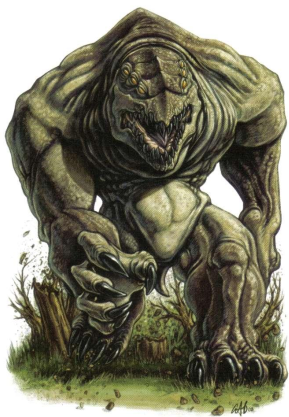
Copyright 2009 Wizards of the Coast Here we see something of a rarity in this series: a monster whose 4e incarnation I find strictly worse than its previous ones.
The Lore
Gray Renders first appeared in 3e, where they were these big, clawed, carnivorous brutes with an oddly endearing trait: they would sometimes imprint on another creature and basically dedicate their lives to protect it and take care of it. This creature could be a sapient, or even a PC if the GM was feeling cute.
Fourth Edition gray renders lose the imprinting, and replace it with a constant urge to destroy and feed. Some sages theorize they’re somehow tied to the metaphysical concept of entropy despite being natural beasts, since they seem particularly fond of targetting sapient settlements.
I don’t like this change because, as you might have surmised by now, I’m not fond of always-hostile, attacks-on-sight-and-fights-to-the-death monsters. I literally never saw anyone mention grey renders online without also mentioning and praising the imprinting. Remove that and you’re left with something that’s virtually indistinguishable from, say, a goristro demon.
The Numbers
Gray Renders are Large Natural Humanoids with a Chaotic Evil alignment and Int 2. They’re Level 19 Elite Brutes with 452 HP and blindsight, who fight using claws, bites, and sheer brutality. In other words, almost like slightly smaller, slightly dumber goristros with blindsight. They have Speed 8.
Their basic attack is a Reach 2 Claw that also grabs on a hit. They can make two claw attacks per action, and if both hit the same target they also inflict ongoing damage on account of the rending. They can use a grabbed victim as a club, inflicting more damage than the claw, pushing the target of the attack 4 squares from the impact, and dealing half the rolled damage to the “weapon”. Or they can bite the grabbed victim for massive damage, with a Daze rider.
While bloodied, their claw attack also knocks a target prone on a hit.
Sample Encounters and Final Impressions
Gray renders are said to be too destructive to cooperate with anyone, but some predators and scavengers have taken to following them from safe distance to exploit their rampages. So we get these encounter groups:
-
Level 18: 1 gray render, 1 bodak skulk, 2 guulvorgs. Opportunistic followers can be sapient too.
-
Level 20: 1 dire bullette, 1 gray render, 3 nabassu gargoyles. The gargoyles are watching the kaiju battle and waiting to feast on the loser’s remains.
The stat block is cool, but the lore is “meh” at best. Reskin this into a demon and/or add the imprinting back to make it more interesting.
-
-
Let's Read the 4e Monster Manual 2: Goliath
I think Goliaths first appeared in the Races of Stone supplement for 3.5. In Fourth Edition, their first appearance was as a playable option in the PHB 2. They get their corresponding “monster” entry here, with a couple of stat blocks suitable for use as opposition or NPC allies.
They’re one of the many playable peoples designed to give players a “taste” of being a cool fantasy monster without being unbalanced. Eladrin arguably do it for Sidhe; dragonborn do it for dragons; tieflings for fiends; deva for angels. Goliaths do it for giants.
The Lore
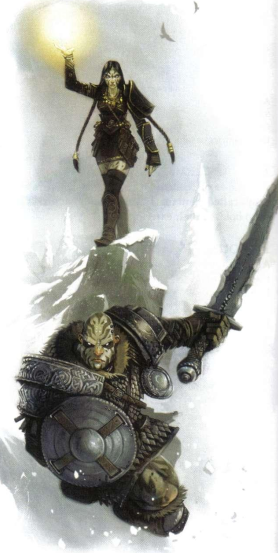
Copyright 2009 Wizards of the Coast The typical goliath is stated to be between 7 and 8 feet tall, so whether they’re on the large side of Medium or the small side of Large is a matter of opinion. The book’s opinion is that they’re Medium, since that allows them to be playable. Their skin is gray or brown, and speckled with coin-sized bony growths that look like rocks.
Goliaths have existed since shortly after the Primordials created the world, which might mean they’re a kind of byproduct of the creation of the Giants in the same way the origin of the Dragonborn is tied to that of dragons. Goliaths don’t care enough about that to make myths about it, though.
All throughout their history they’ve preferred to keep to a nomadic existence in the more mountainous areas of the world, so there isn’t much about them in other people’s records either. While it’s fairly common for individual goliaths to travel the “lowlands” as adventurers or explorers, they haven’t engaged in any grand diplomacy or empire-building as a people.
Culturally, goliaths place a lot of value in individual skill and prowess, and this makes them very competitive. Their communities probably have all sorts of tournaments and contests in their calendars. Individual goliaths tend to turn everything into a contest, even if only in the privacy of their own minds - they keep score and constantly compare themselves both to their companions and to their own past performance. That battle where Legolas and Gimli compare their kill counts? That’s every fight where a goliath is involved. This does have the downside of making them get a bit depressive when they fail to measure up to their own standards.
I suspect Kord is a very popular deity among goliaths, and they also often worship the primal spirits.
The Numbers
As far as the rules are concerned, Goliaths are Medium Natural Humanoids. They have a natural speed of 6, and human-equivalent senses. Their signature ability is Stone’s Endurance, a minor-action encounter power which gives them some resistance to all damage for a turn. The value of this resistance is 5/tier (5 at heroic, 10 at paragon, 15 at epic).
Goliath Sunspeaker
This is more of a primal priest of the sun spirits than a cleric of Pelor, focused on burning people with sun-powered lasers. Sunspeakers are Level 7 Artillery with 64 HP, wearing light armor and using an orb as an implement.
Their melee basic attack is the Sunspeaker’s Hand, which targets Reflex and deals light radiant damage. Solar Sphere does the same at Range 20 with better damage.
Less often, the sunspeaker can use Solar Rays (recharge 4+) against up to 2 targets within Range 10. This deals light radiant or fire damage, as well as ongoing damage of the type chosen (save ends). This allows them to potentially stack two sources of ongoing damage on someone with the same power.
If cornered, the sunspeaker can use Flaring Leap (move action; encounter) to jump 3 squares and then move its remaining speed. This jet-powered jump causes a fire in the sunspeaker’s starting space, which deals damage to adjacent enemies or to those foolish enough to enter the flaming square. The fire lasts for a turn and can be sustained with minor actions.
Finally, it can use a big area attack named Call Down The Sun once per encounter, which is a bit weaker than Solar Sphere but targets a lot of people and does half damage on a miss.
Goliath Guardian
A more straightforward but no less powerful martial type. The guardian is a Level 9 Soldier with 96 HP. It’s heavily armored by still has speed 6, wielding a bastard sword and a light shield.
Its basic sword attack marks for a turn, and if the target is prone it’s also prevented from getting up for the same amount of time. The guardian knocks people prone with Ram’s Charge (recharge 5+), a maneuver that deals light physical damage and has a long list of riders: it pushes the target 2 squares, knocks it prone, and allows the goliath to make a free sword attack against the target. As the name says, it can be used as part of a charge.
Finally, Warrior’s Leap is a passive that allows the guardian to jump without provoking opportunity attacks. It still uses the standard jump rules (and it’s high Athletics score) for that.
Guardians are awesome in moutainous terrain that’s full of cliffs. Even if their targets aren’t thrown overboard, they’ll still stay on the ground for quite a while, granting advantage to the guardian and any sneak-attacking skirmisher buddies.
Sample Encounters and Final Impressions
Goliaths often team up with similarly-inclined mountain-dwellers, which can include dwarves, galeb duhrs, or goblins. I suppose that might include stone giants as well, if you level your goliaths up a bit. The sample encounter is level 9, and includes a galeb duhr rock-caller, 3 goliath guardians, and 1 sunspeaker.
I like goliaths, they fill a very specific “huge person” niche. These two stat blocks are interesting from a mechanics standpoint as well.
subscribe via RSS