Posts
-
Let's Read the 4e Monster Manual 2: Krenshar
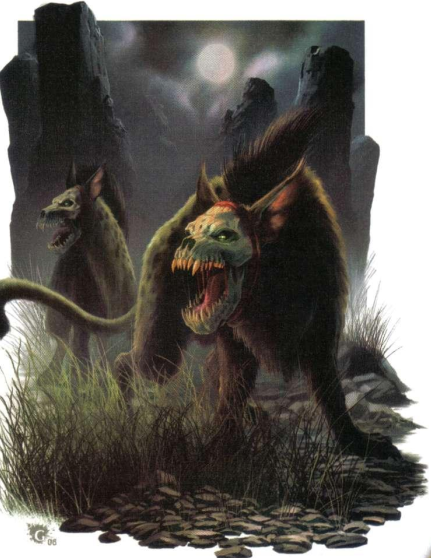
Copyright 2009 Wizards of the Coast I first saw a krenshar in the 3e Monster Manual, though it’s possible they originated a bit earlier than that.
The Lore
Krenshars are large carnivorous felines somewhat similar in size and behavior to lions. They live in groups called prides, and use teamwork to hunt. Some individuals within the pride grow to a larger size than the rest and possess a pattern of blood red spots on their fur. These seem to have a higher social position within the pride, and focus on protecting it from threats rather than on everyday hunting.
The thing that makes krenshars fantastical is their ability to peel back the skin on their faces and expose their skulls in order to intimidate their enemies and frighten their prey.
While I agree a krenshar’s display must be quite a striking sight, your typical PC is likely to have met quite a few things that are scarier than that even if they’re relatively low level. This leads me to believe their threat display might be augmented by natural fear magic, since it’s meant to be effective even against adventurers.
Gnolls, hobgoblins and humans frequently try to domesticate krenshars for all the usual reasons. This is a difficult process because it’s hard to suppress their threat display, so lots of trainers end up paralyzed by fear and killed.
The Numbers
We’re given two krenshar stat blocks here. Both are Medium Natural Beasts with a land speed of 8 and low-light vision. They also have two signature abilities:
Their Fearsome Visage is an aura (5) that inflicts a -2 penalty to saves against fear effects to all enemies caught inside. Unnerving Skull is a minor action usable once per round. It’s a close burst 5 that targets the Will of one enemy and inflicts a -2 attack penalty on a hit (save ends). This is a fear power, so it’s enhanced by the aura.
Krenshar
The basic model is a Level 4 Controller with 55 HP and all standard traits. Its basic attack is a hooking swipe that damages and knocks prone on a hit. It can combine its threat display with a roar to perform the Roaring Skull attack, a Close Blast 5 that targets Will and dazes (save ends). A target who is already dazed is instead weakened for the duration of the daze, so there’s benefit in several krenshars roaring at once. This recharges on a 5+, so it will likely happen more than once in the fight.
Krenshar Blood Slayer
The red-spotted variety, focusing more on physical power than on scary roars. It’s a Level 5 Brute with 75 HP and all standard traits. Its basic attack is a claw that is somewhat weak, but can be used twice per action. If both attacks hit, the target is grabbed and the slayer can bite it. Bites hit automatically and do double the damage of a claw strike.
Sample Encounters and Final Impressions
I guess your typical krenshar pack will include a mix of blood slayers and standard krenshars. The krenshars open up with a “volley” of Roaring Skull attacks, and then the blood slayers focus on grabbing dazed/weakened individuals and biting them to death. Grabbing a squishy is always a good move, but it’s also worth their while to try it with the defenders, since their bites don’t care about AC.
The sample encounters are a pair of deathpledged gnolls wrangling a pack of krenshars (level 5), and a human slaver with a pair of javelin dancer goons and a trio of blood slayers (level 6).
-
Let's Read the 4e Monster Vault 2: Kenku
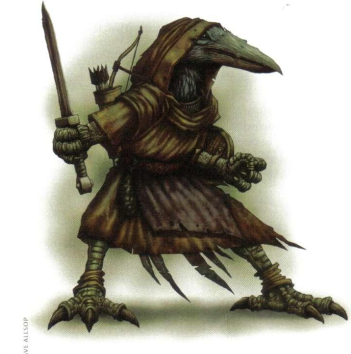
Copyright 2009 Wizards of the Coast Kenku are raven-people, humanoid and human-sized but covered in feathers and with raven heads. They organize themselves into clan-like groups called flocks. Your typical kenku flock is tightly knit but very distrustful of outsiders, including kenku from other flocks. Each flock follows no laws but their own. Despite this, most of them live on or near major cities, and engage in a variety of illegal activities to survive.
So yeah. Crime birbs.
Kenku criminals tend to prefer non-violent activities such as grifts and cons, where their natural ability to mimic sounds and voices comes in handy. They can still fight pretty well if forced to. And despite the stereotyping they’re typically Unaligned, which means it’s definitely possible to find nicer individuals and flocks out there. Rural kenku can easily fill the same “isolationist but ultimately nice” role as cliche elven villages, and an urban flock could be predominantly performers or even a legitimate company for a nice change of pace.
The Numbers
Kenku are Medium Natural Humanoids. They have low-light vision, a ground speed of 6, and no innate flight speed despite being birds. They possess two interesting signature abilities.
Flock Effect makes them good at teamwork: they gain a +3 attack bonus when flanking and grant a +3 when using Aid Another, instead of the usual +2 to both activities.
Mimicry allows them to mimic any sound or voice. You have to win an opposed roll of your Insight vs. their Bluff to realize the sound is fake. Not all kenku in this entry are trained in Bluff, but the sneakier ones are.
Their levels are all in the early-to-mid Heroic tier, which in my mind means they’d be about as common as elves or halflings. They get playable stats at the end of this book, but I’m not sure if they ever got a full writeup later on.
Kenku Ruffian
Your typical crime-birb-on-the-street is a Level 3 Minion Skirmisher. They only have a basic club attack and the universal signature abilities, so they’re pretty much civilians despite the name “Ruffian”. If forced to fight they rely on numbers to hold the line while one or two of them go get help.
Kenku Warrior
Formally trained in a mobile fighting style, the warrior uses paired daggers and moves in a seemingly random pattern about the battlefield. Warriors are Level 3 Skirmishers with 44 HP.
Their daggers can be used as melee or ranged attacks (they carry 6). The Fluttering Attack maneuver allows them to shift 4 squares and make a dagger attack during the movement, and Combat Advantage gives them a damage bonus. They also have the universal traits, so combat advantage is even better for them and they have an easy time acquiring it.
Kenku Ringleader
Ringleaders lead small gangs of kenku in heists or raids, though they have enough sense to sound a retreat if guards or rivals show up in force. They’re Level 4 Soldiers with the Leader tag and 54 HP. They’re trained in Bluff and and Intimidate.
They use a spiked chain in melee and a sling at range. The chain attack is Reach 2 and marks on a hit. They Press the Attack maneuver is a chain strike that targets a marked enemy, does the usual damage, and knocks them prone on a hit.
They have the two standard kenku traits, and they can use Flock Reaction (minor; recharge 4+) to allow every ally in a close burst 3 to shift 1 square. Perfect for allowing them to disengage and retreat, or finish setting up a flanking maneuver.
Kenku Sneak
The first actual rogue in the crime birb entry, Sneaks are Level 4 Lurkers with 42 HP. They have a higher than usual speed of 7, and they fight with daggers both in melee and at range. They’re trained in Bluff, Stealth, and Thievery.
As the name implies, the Sneak engages with 4e’s Stealth rules, which dictate when someone can make a Stealth check to become “hidden” during combat and how fast they can move while hidden. I think that by default your speed is limited to 2 in that case - move faster and you’re detected.
Kenku sneaks have an advantage here in that they can move at speed 4 while hidden. Their Disappear into the Flock trait allows them to make those Stealth checks while they have cover from other kenkus, Hidden Strike gives them a hefty chunk of extra damage if they attack from hiding, and Sniper allows them to remain hidden if they miss with a ranged attack.
The tactics outlined by these traits are nifty. A sneak will always appear accompanied by a number of warriors or a huge band of ruffians. They’ll hide among the crowd and move it with, throwing daggers at the squishier PCs for big damage from a safe distance.
Kenku Wing Mage
Though kenku are flightless, it seems they have a magic tradition that seeks to correct that injustice. Wing mages practice this tradition, and as a result they know a lot of air and force magic as well. They’re Level 5 Artillery with 50 HP. Wielding daggers as weapons and implements, wing mages fight with spells that create wind and summon flocks of crows made of pure force.
Those force crows can be used in the Murder of Crows at-will attack (Ranged 20 vs. Reflex) which does force damage and makes the target grant combat advantage to the wing mage (save ends). They can also be used in the Death Flock encounter power (area burst 1 within 20 vs. Reflex) which does force damage and dazes (save ends).
Their main keep-away spell is Hurricane Blast (close burst 3 vs. Fortitude; recharge 5+), which does force damage and slides targets 3 squares. And finally, Wings of the Flock (minor; encounter) gives them a flight speed of 6 until the end of the encounter.
The wing mage is going to take off as soon as the fight starts, and will rain force crows upon the PCs from a safe elevation. Most ranged magic has a range smaller than 20, so the party better have some archers with them.
Kenku Assassin
Either an actual killer-for-hire or an elite combatant. Assassins love poison and unlike most other kenku they rarely surrender. They’re Level 5 Elite Skirmishers with 126 HP. They fight with envenomed daggers and a shortbow with envenomed arrows, both of which slow the enemy on a hit (save ends).
They have the same Fluttering Attack as the warriors, and when attacked they can use Gouging Talons as a reaction to hit back. If surrounded, Feather Burst (close burst 2; encounter) can automatically blind every enemy in the area for a turn, allowing them to escape.
Assassins prefer to stay at range, but once in melee they fight much like warriors. Their “elite extra attack” is a reaction, so they have an incentive to stay in the thick of it. Two of them, or one of them plus a squad of warriors, makes for an interesting encounter where no one stands still. They also go well with monsters that can exploit the “slowed” status, since they cause that at will.
Sample Encounters and Final Impressions
We have quite a few kenku encounters here, showcasing the sort of monster they keep as pets and the sort of allies they make into honorary flock members.
-
Level 2: 2 kenku warriors, 2 bloodseeker drakes, 1 pseudodragon. Hunters… or bounty hunters.
-
Level 3: 1 kenku ringleader, 8 ruffians, and 2 warriors. The whole gang’s here!
-
Level 4: 1 human berserker, 1 ringleader, 6 ruffians, 2 sneaks. Another gang, this one with an adopted member.
-
Level 5: 1 half-elf bandit captain, 2 human berserkers, 1 kenku assassin, 1 kenku wing mage. And this one works the other way around.
I like these kenku, though as usual I’d make their description as dastardly criminals less universal than the book seems to imply. A setting where they’re as common as the more traditional haflings and elves would be a cool place.
-
-
Let's Read the 4e Monster Manual 2: Hydra
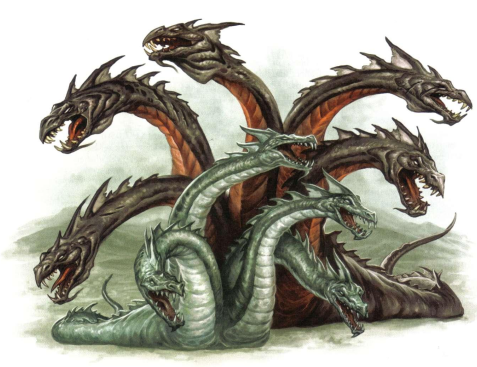
Copyright 2009 Wizards of the Coast Hydras made their 4e debut in the first Monster Manual, and here we get a few more of them. Their basic lore remains the same and you can check it out on the original post I made on the subject.
The hydras on this entry have several passive traits in common: Threatening Reach allows them to make opportunity attacks out to their full melee reach, instead of only against adjacent enemies. Many-Headed makes it resistant to being dazed on stunning. These conditions only disable one of its heads for a turn. And Regenerating Heads causes the hydra to lose a head at 75%, 50%, and 25%, regrowing two others at the start of its next turn.
The number of heads an hyda has is important because of Hydra Fury, an at-will power that allows them to make a bite attack for each active head they have. The effect of an individual bite, and the starting number of heads, vary per hydra.
Mechanically, MM2 hydras are kind halfway between the ones we saw on the first Monster Manual, and the ones from the Monster Vault. Most of their mechanics still work like in the MM1, but Regenerating Heads debuts here and reappears in a slightly weaker form in the Monster Vault. With the MV version you can prevent head regrowth by dealing fire or acid damage to the hydra before the start of its next turn, but nothing can stop it in this version.
These hydras are also lacking the Darkvision and Swim Speed of their relatives from the other two books, though they still have trained Perception and All-Around Vision that prevents them from being flanked.
Razor Hydra
This species of hydra is covered in gleaming metal scales and has extra-sharp serrated teeth. It’s drawn to the scent of blood in much the same way a shark is, and one head bites a victim the others get into a frenzy. Because of this, it’s also known as the Blood Hydra. They are Large Natural Beasts, and Level 16 Solo Brutes with 640 HP and a ground speed of 7. They start with four heads, gaining extras at 480, 320, and 160.
A razor hydra’s bite has Reach 2 and inflicts stackable ongoing physical damage. A healthy target would take ongoing 5 damage (save ends), but if the target was already taking ongoing physical1 damage, then that damage would increase by 5 instead.
A poor sod on the receiving end of a razor hydra’s Fury attack would have ongoing 20 damage (save ends) to deal with, assuming all four bites hit. A single save will clear it all, but if that save fails and the hydra bites again, the total will increase even further. There’s no cap!
The Blood Frenzy trait makes it so the hydra gains a +2 bonus to attack targets who are bloodied, or who are taking ongoing physical damage. That’s one more incentive for it to focus fire on a single PC.
Once the hydra drops to 0 HP, its Ferocity allows it to make one last Hydra Fury attack. At this point it will have seven heads, for a potential 7d8+28 damage plus 35 ongoing damage against a single PC.
Heroslayer Hydra
This interestingly-named hydra occupies the same narrative niche as the one Hercules faced in his labors. As a Huge Natural Beast and a Level 20 Solo Brute, it’s likely the most powerful hydra in the natural world, and is stronger than any PC who isn’t an actual demi-god or equivalent. There are stronger specimens, but you have to travel to the Elemental Chaos to find them.
Heroslayer hydras have 776 HP and five heads at the start of the fight, gaining new ones at 582, 388, and 194. Its bites are Reach 3 and have no riders, though its Hydra Fury deals 10 extra damage to any target hit by two or more bites. Rampage allows it to bite every target in reach and inflict 10 ongoing damage to every target it hits. It recharges whenever the hydra suffers a critical hit.
The titular Heroslayer trait is a big “Fuck You” to defenders everywhere: while the hydra is marked, it gains a +2 bonus to attack and a +5 bonus to damage against the creature that marked it. Yes, this applies to every individual bite in a Fury combo.
So here we have a hydra with a decent incentive to spread its bites around until a defender marks it, when it will instead focus exclusively on the defender until they’re good and dead.
Chaos Hydra
This is one of those stronger species native to the Elemental Chaos. Chaos Hydras start out with only two heads, but their bites are very strong and infused with deadly elemental energies. The new heads it grows when wounded also gain new random elemental abilities.
The Chaos Hydra is a Huge Elemental Beast and a Level 22 Solo Brute with 848 HP. It has two Reach 3 basic bite attacks, one for each head: Frostfire Bite deals fire and cold damage, and Storm Bite deals lightning and thunder damage.
Whenever the hydra grows a new head (at 636, 424, and 212 HP), it gains a new bite attack chosen by a d4 roll. It can gain multiple copies of the same attack. Its Hydra Fury allows it to bite with the two original attacks and any new ones it might have gained.
The four additional bites deal less base damage but have “save ends” riders. They are: Crushing Maw, which slows and deals ongoing 10 damage; Mind bite, which dazes; Paralyzing Fang, which immobilizes and inflicts a -2 penalty to all defenses; and Venom Tooth, which inflicts ongoing 10 poison damage.
Thematically this hydra is all over the place, but that’s the point. It’s hard for PCs to protect themselves from everything it can do.
Sample Encounters and Final Impressions
Hydras are solitary, so you will usually only find one of them at a time. However, they’re also frequently followed by opportunistic scavengers who feed on the remains of their meals and who might be impatient enough to give them a bit of help with killing those meals. Examples given are carrion crawlers and shardstorm vortex elementals.
Occasionally, a powerful character might be able to capture a hydra for use as a guardian. The example encounter given is for this scenario, with a razor hydra and its minotaur cabalist master.
Hydras are cool, particularly those with the regenerating heads mechanic. However, I think they should be used sparingly to prevent the novelty from wearing off.
-
I say “physical”, but the strictly correct term would be “untyped”. Untyped damage is almost always dealt by physical attacks, but you could have magic powers that also did it. It’s written like “1d8+5 damage” or “ongoing 5 damage” instead of “1d8+5 fire damage” or “ongoing 5 fire damage”. Very few monsters resist it, but none are particularly vulnerable to it. ↩
-
-
Let's Read the 4e Monster Manual/Vault: Human
As we saw in the Monster Manual Let’s Read, Fourth Edition makes the usual D&D human description a little more specific. They’re the mortal people without a patron deity, which makes their outlooks on life very varied and leaves extra room in their hearts that can be filled with extreme dedication to any number of causes. Therefore, humans can produce some of the world’s greatest heroes as well as its most depraved villains.
This MM2 entry brings us a huge grab bag of human stat blocks. Most of them are the usual Unaligned people that can be repurposed as either allies or enemies, but a few are Evil or Chaotic Evil and meant to always be used as threats.
Numbers-wise, they have absolutely no common traits beyond being Medium Natural Humanoids with a ground speed of 6. You can easily take a human stat block and make it into a member of another species by adding the relevant signature ability to them (Goblin Tactics, Elven Accuracy, Savage Demise, Fey Step…).
Human Cavalier
An armored knight that fights with lance and sword. It’s highly recommended that you give them a mount when building your encounters, though they can give a good account of themselves on foot as well. Horses and griffons are the most common cavalier mounts.
The Cavalier is a Level 7 Soldier (Leader) with 78 HP. Their basic attack is a sword strike that damages and marks on a hit, and they can exploit the mark with two different interrupt abilities. Champion’s Retort is at-will and allows the knight to make a slightly weaker attack against a marked enemy who decides to ignore the mark. Hasty Parry is an encounter power that forces the enemy to target the knight instead, and gives the knight a +3 AC bonus against that attack.
When mounted, the knight can also attack with a Lance that damages and knocks prone on a hit. The text doesn’t say it can be used as part of a charge, but it really should have this ability.
Human Diabolist
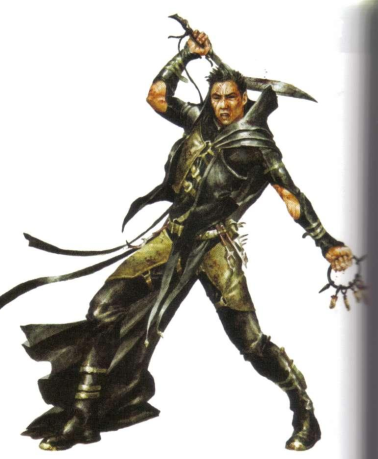
Copyright 2009 Wizards of the Coast A warlock-type who’s in tight with the forces of Hell, and wields fire-and-brimstone themed magic to achieve their Evil ends.
The diabolist is Level 20 Artillery with 147 HP, powerful enough to be encountered alongside groups of high-end devils. Their main weapon and implement is a kukri that does a mix of physical and fire damage. Like all attacks in this book it needs a damage boost, but make sure its roll is still a fistful of d6s because this attack has the Brutal property. This means you re-roll any dice that show a 1 until they show something else.
Their attack magic is all about Darkfire, in an “at-will single-target” and “area encounter power” versions. It does fire and necrotic damage, and the area version also does ongoing fire and necrotic damage (save ends).
For enemies who get a bit closer, the diabolist can use a Sulfurous Flash attack that deals fire damage and gives the caster concealment against the target until the end of the caster’s next turn. If attacked, the diabolist can use Infernal Deflection (recharge 5+) as an interrupt to take half damage from the attack and deal an automatic 15 fire damage to the attacker.
All of these attacks can be enhanced by Hell Blight, a minor action that automatically makes an enemy in sight “blighted”. If a blighted enemy takes fire damage from the diabolist, they can’t recover HP until the end of the diabolist’s next turn. The blight ends when the fight does, or when the diabolist blights someone else. This makes focusing their fire on a sincle PC at a time a very effective tactic.
Finally, the Life From Fire passive trait gives the diabolist 10 temporary HP whenever they take fire damage from any source.
Human Dire Beast Hunter
Someone has to protect all those scattered villages if no PCs are around to help! This hunter is Level 9 Artillery with 76 HP, wielding a spear, a crossbow with poisoned bolts, and a net.
The net is a Ranged 3 attack that does no damage and restrains (save ends). The crossbow has good range and its bolts have an ongoing poison damage (save ends) rider. The spear is there for emergencies, because its best to hunt dire beasts from a distance.
The hunter is not meant to be alone. It should be encountered either as part of a sizable NPC hunting party, or attached to the PCs as an ally for a particularly tough hunt.
Human Dread Assassin
An epic-level assassin armed with a dreadful sword and with spells of poison and darkness. The perfect person for the job when that job is to kill a king or emperor. Though they’re unaligned, their clientele is unlikely to be very nice.
The assassin is a Level 22 Lurker with 161 HP and a speed of 7. Their Zealot’s Scimitar is a High-Crit weapon that also deals ongoing poison and necrotic damage (save ends). They can use a power named Cloak of Zeal as a move action to shift 3 squares and gain concealment until the end of their next turn.
While the assassin has cover or concealment, they can use Deadly Blade (recharge 5+) as a minor action to make is so their next attack has combat advantage and deals 5d6 extra damage on a hit. And finally, Assassin’s Determination triggers when they’re bloodied and either immediately recharges Deadly Blade or (if it’s charged already) heals them for 20 HP.
I guess the idea is that this is a deadly foe that will never stop trying to kill you until they succeed, but you should really boost their damage for that to be true. Also, since they’re regulars you should expect these epic ninjas to team up with either other assassins, or with some distracting heavies.
Human Gladiator
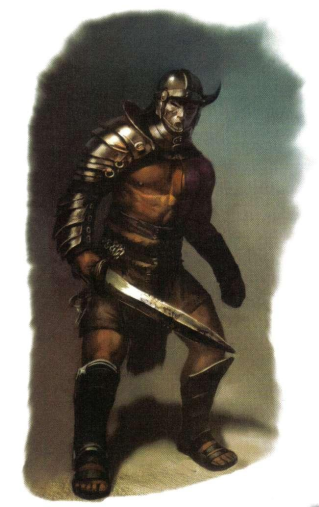
Copyright 2009 Wizards of the Coast This gladiator is described by the book as a “consumate athlete”, which isn’t really the term I’d use to refer to someone forced to fight in deathmatches for the amusement of a bloodthirsty crowd. Still, some of them might end up becomming bloodsport celebrities, and this one is powerful enough to fit that role.
This particular individual is a Level 14 Elite Soldier with 276 HP, so we’re either looking at a Spartacus in the making or at the reigning champion of the arena that must be taken down before the revolt can start. He wears armor equivalent to scale and carries a light shield and a gladius.
The gladiator has a Fighting Focus aura (1) that marks enemies who start their turns inside, lasting until the start of their next turns. It’s a lot like the Essential Knight’s Defender Aura, with a bit more stickiness.
That gladius can be used to make melee basic attacks, and in a Gladius Display that attacks a Close Burst 1 and does the same damage. This is supplemented by a variety of dirty tricks. They’re all minor actions, and though none of them do damage they inflict a variety of conditions.
Knock to the Dirt is an encounter power that targets Fortitude and knocks prone; Sand in the Eyes is another encounter power that targets fortitude, and causes blindness (save ends). Well-Placed Kick is recharge 5+, targets Reflex, and both slows and dazes the target (save ends). I bet it targets the… knee. Yeah, that’d do it.
That’s the sort of fighting style that’d mark you as a heel in wrestling, but since the gladiator fights in actual life or death matches I’d say it’s just good sense.
Human Hexer
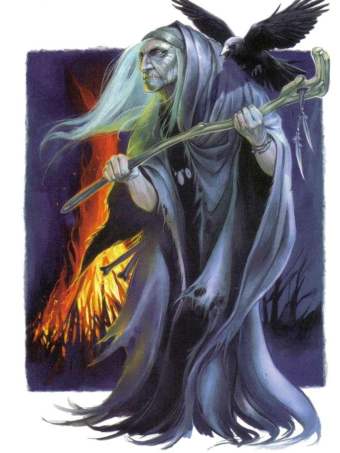
Copyright 2009 Wizards of the Coast Perfect for playing the part of a sinister witch or a seer whose dire prophecies go unheard. The hexer is a Level 7 Controller with 77 HP, wearing robes and wielding a staff.
The hexer is extremely weak in terms of damage, and is meant to be used alongside monsters who are better in that area. They have some interesting control options, though.
Their only melee attack is a weak bonk with the staff, but insted of bothering with it they’re going to stay away and open up with Hex, a minor action that targets all enemies in a Close Burst 10. That’s guaranteed to cover all PCs unless one of them is a sniper ranger or something. It’s an attack against Will, and a hit means the target is hexed. Hexed targets have a -2 penalty to damage the hexer, and become valid targets for the hexer’s other spells.
One of them is Capricious Earth (encounter), a big area burst that targets Will, does a bit of damage, slides targets 3 squares, and knocks them prone.
The other one is Beast Curse (recharge 4+), a ranged spell that targets Fortitude and turns the target into a Tiny creature until the end of the hexer’s next turn. While in this state the target cannot use powers. Yes, this does include basic attacks, so your Slayer won’t turn into a surprisingly deadly frog.
Human Insane Noble
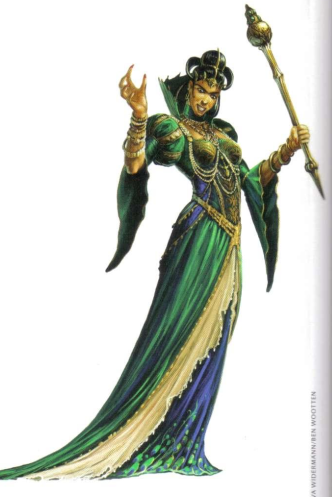
Copyright 2009 Wizards of the Coast Not to be confused with the standard Human Noble, shown later. The picture is pretty much a caricature of Carlota Joaquina, a historical figure who was rather unpleasant but not epic-level.
The Insane Noble wears finery and wields a scepter, but as a Level 23 Elite Skirmisher it doesn’t need much more than that to ruin your day. Sheer Madness makes them immune to opportunity attacks. The scepter is a basic attack, and Flurry of Madness allows the noble to shift 6 squares and make a scepter attack against every enemy they pass by during the shift. These traits and abilities combine to make them a combatant that never stands still, scuttling about the battlefield with alarming alacrity.
When the noble is first bloodied, Ignoble Fury triggers and lets them bonk everyone in a Close Burst 1 with a scepter attack that also knocks targets prone on a hit.
Human Javelin Dancer
A specialized martial artist, lightly armored and wielding a spear for close combat and a brace of javelins for range. Their Skirmisher trait allows them to do increased damage if they move at least 4 squares before attacking, and Adept Retreat makes them not grant combat advantage when running. “Running” is something everyone can do, greatly increasing their Move at the cost of granting combat advantage. That’s what the dancer ignores.
In addition to basic attacks with the spear or a thrown javelin, the dancer can also make a Mobile Attack at will, shifting 3 squares and attacking with the spear.
Human Knife Fighter
Knife fighters are rogue-types that are much more focused on acrobatic stabbing than on other types of crime, which makes them quite similar to PC rogues when you think about it. They also do well in the role of a knife-focused martial artist, or the classic super-dangerous lieutenant for a criminal gang whose actual boss isn’t a fighter.
This knife fighter is a Level 7 Elite Skirmisher with 162 HP. They go unarmored (which doesn’t affect their defenses, since they’re all based on level), and are equipped with a dagger and a net.
The net is probably a typo, since none of the fighter’s abilities use it, but the knife is a Wounding Dagger with an ongoing damage rider and the High-Crit property. It can also be used in an attack named Dance of the Knife, where the knife fighter makes two dagger attacks and shifts 2 squares between them.
All of these attacks deal extra damage when they have combat advantage, and they can also use Peerless Tumbler (recharge 5+) to shift 4 squares while ignoring difficult terrain.
Very skirmishery, and goes very well with a pack of soldier monsters with marking and punishing abilities.
Human Mystagogue
A divine spellcaster who delves into divine mysteries few mortals can understand. Their magic focuses a lot on mind- and perception-affecting effects.
Mystagogues are Level 20 Controllers with the Leader keyword and 188 HP. They wear robes and carry a holy symbol - all of their attacks are magic.
The basic melee attack is Mystery’s Touch (vs. Reflex), which deals psychic damage and inflicts a -2 penalty to attack the mystagogue until the end if their next turn. At range they use Bend Perception (ranged 20 vs. Will), which deals psychic damage, slows, and inflicts a -2 penalty to all attacks and saves until the end of the mystagogue’s next turn.
Their special attack is Awestrike (close burst 5 vs will), which does the same damage as Bend Perception to all it hits, and also slides the targets 6 squares and dazes them (save ends). The mystagogue also chooses one ally in the area to slide 6 squares and heal for 10 HP.
Finally, the mystagogue can use a Veil of Inscrutability as a reaction to being hit by a melee or ranged attack. This allows them to shift 2 squares and gain a +2 bonus to AC and Reflex for a turn.
As opposition, mystagogues pair well with enemies who can exploit combat advantage or (save ends) effects.
Human Noble
Not to be confused with the Insane Noble from a few entries ago. This type of noble can still be pretty horrible, but not the “epic-level scuttling nightmare” kind of horrible. They’re Level 5 Controllers with the Leader keyword and 60 HP.
The Noble wears mail and wields a longsword and a light shield. Their sword strikes are nothing special, and their actual superpower is ordering people around. It’s very much meant to be encountered alongside its bodyguard detail, which will be made up of more competent fighters. In other words, this is the NPC version of the Lazy Warlord.
The noble is Protected by their allies, and gains a +2 to all defenses when adjacent to at least one of them. Appoint Champion is an at-will order that allows an ally to make a basic attack and shift 1 square before or after it. Inspirational Authority is an encounter power that allows one of those allies to use any of their attacks as a free action.
The noble can also order enemies around. Urge Hesitation is an attack against Will that, on a hit, prevents the target from using a standard action in its next turn.
Human Pirate
Yarrr! Pirates are Level 9 Skirmishers with 95 HP, armed with cutlasses. They’re pretty fast, with a Speed of 7 and a Rigging Monkey ability that gives them a climb speed of 7 for a turn once per encounter.
Their basic attack is a Cutlass strike with no additional riders, but they’re extra-good at flanking: Scurvy Dog’s Flank gives them an extra +1 to hit and +2d6 bonus damage to all attacks against a flanked target. This stacks with combat advantage for a total of +3 to hit.
Their tactics section says they like to stay near the water or near the edge of the boat if this is a boarding action, but I see no reason for this.
Human Pirate Captain
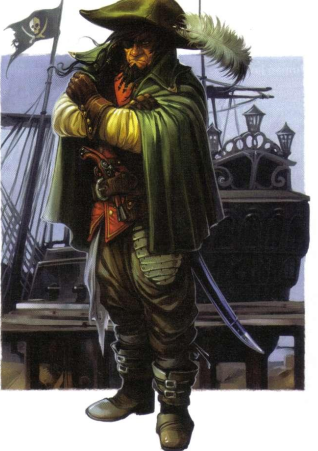
Copyright 2009 Wizards of the Coast Double Yarrr! The captain is a Level 10 Soldier with the Leader keyword and 104 HP. It’s clearly meant to be used alongside a bunch of Pirates and perhaps a small horde of minions.
Their Cutlass attacks have a slow (save ends) rider, and they have the same Rigging Monkey and Scurvy Dog’s Flank abilities as the rest of the crew. Captains complement their swordplay with occasional bouts of Vicious Mockery (minor action; recharge 6+). This doesn’t require an attack roll and causes a nearby enemy to provoke an opportunity attack from one of the captain’s allies. When first bloodied, they shout out a Call to Arms that allows all allies within 10 squares to make a basic melee attack or shift 3 squares as a free action.
Human Slaver
One of the few explicitly Evil stat blocks in this entry, the slaver is an unpleasant villain that fights with a mace and a scourge. Their focus is on immobilizing enemies for capture, and on inflicting pain. They’re level 8 Brutes with 102 HP.
Their basic attack is Thump and Lash, which deals damage and inflicts a -2 attack penalty for a turn. They can also use the scourge to perform a Slaver’s Tangle maneuver (recharge 4+) that does all of the above and also immobilizes for a turn.
Slavers are meant to be use as part of larger capture teams featuring one or more of them plus an assortment of other goons.
Final Impressions
Between the first Monster Manual, the Vault, and the MM2, you have enough human stat blocks that you can include one or more of them in any encounter that demands sapient humanoid opposition. The PCs themselves are proof that humans work well with members of any other sapient species that share their individual goals.
These “generic” stat blocks also work as seasoning for more specialized groups, like cultists. It might surprise the PCs a bit if the guy holding the sacrificial dagger is an elite knife-fighter instead of a squishy caster, for example.
-
Let's Read the 4e Monster Manual 2: Homunculus
Copyright 2009 Wizards of the Coast The first Monster Manual included an Homunculus entry. The MM2 has a few more, which we’ll look at now.
As mentioned in the original post, homunculi are relatively simple constructs distantly related to golems, the model rocket to the golem’s Saturn V. They’re much weaker but also much simpler to make, and their construction includes some programming shortcuts that make them good at being guards. There are specific shortcuts to guard an object, a creature, or an area. Homunculi are quite intelligent and clever when fulfilling the tasks they were designed for, but are not good for anything else.
In this entry we meet two new homunculus models.
Stonefist Defender
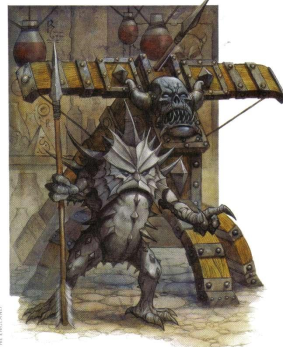
This Small, spiky animated statue is built to act as a bodyguard and combat buddy to a living creature. Its programming makes it very good a coordinating with its “client” during a fight. I imagine a society with plenty of access to magic would build mass quantities of them for use as “combat drones”, supplementing infantry or scouts.
The defender is a Level 2 Skirmisher with 38 HP. It has darkvision, runs at a nice speed of 8, and is immune to disease and poison. It’s surprisingly acrobatic: it can Tumble as an at-will move action to shift 3 squares instead of the usual 1.
The defender’s only attack is a Spiked Fist that’s pretty average on its own, but gains all sorts of situational bonuses when the creature fights according to its programming: by using its high mobility to flank enemies engaged with its “client”. It has a +2 bonus to hit enemies adjacent to the client, and gains +1d6 bonus damage when flanking those enemies.
Arbalester
Arbalesters are animated ballistas! They can move around using wheels or legs, and reload themselves. They’re used as mobile turrets, and can be ordered to watch over a specific area. That same magic-rich society that makes defenders could have arbalesters helping defend fortresses or following patrols around as mobile artillery pieces.
Arbalesters are Level 4 Artillery with 43 HP. They move around at Speed 6, and have the standard traits of darkvision and immunity to disease and poison. They’ll attack with improvised slams if pressed into melee, but their Bolts are of course a much better option. They can temporarily increase their rate of fire to make a Double Shot (recharge 4+), firing bolts at two targets within 5 squares of each other.
They can be set to Guard an Area 5 squares on a side. If any enemy is within this area when the arbalester starts its turn, Double Shot recharges automatically. Their use as defensive turrets is obvious, but they can also be used offensively if transported within range of enemy positions and ordered to “guard” those positions. This will cause them to rain bolts upon those areas until no enemies remain.
Sample Encounters and Final Impressions
Our sample encounter is Level 3: 3 stonefist defenders, 1 arbalester, and a dwarf hammerer. This is obviously a military squad from that magic-rich civ - an organic officer, and his drone complement.
Thinking of these two homunculus models as military drones makes them seem quite interesting as opposition.
subscribe via RSS