Posts
-
Let's Read the 4e Monster Manual 2: Golem
Golems showed up in the first MM and were iconic enough to later make it to the Monster Vault. I covered those here, and you can check that same post to see their basic lore. The Monster Manual 2 brings us yet more golems, which share the same basic lore.
As before, golems are Natural Animates with the Construct keyword. They’re immune to disease, poison, and sleep. They have darkvision, and though their ground speed tends to be high they cannot shift. Most are Large, but one of the examples here is Huge.
Bone Golem
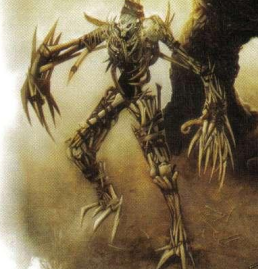
Copyright 2009 Wizards of the Coast Bone golems are made from the skeletons of several creatures, whose bones are sharpened and fitted together to form the construct’s body. Despite being made of bones and beloved of necromancers, it’s a construct animated through elemental magic and not an undead monster. Throw this one into an encounter that does have undead skeletons in it, and it should be good to surprise your PCs a bit.
Bone Golems are Level 12 Elite Brutes with 302 HP. It’s so spiky the pointy bits count as a Bone Spikes aura (1) that deals 5 damage to any enemy that enters it. The pointy bits also justify the Osseous Retaliation trait, which deals a bit of automatic damage to anyone who hits the golem with an opportunity attack.
This construct fights with Reach 2 Bone Spurs, and can attack twice per action with them. It can also fire a Bone Volley (burst 3 vs. Reflex, recharge 6+) that deals heavy physical damage and dazes (save ends).
When the golem is destroyed Bone Death allows it to make one last attack. If Bone Spurs is charged then it uses that, otherwise it makes a basic bone spur attack.
Chain Golem
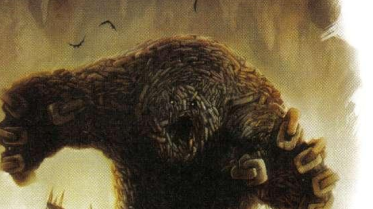
Copyright 2009 Wizards of the Coast These Huge golems are modeled after chain devils, and are often tasked to guard prisons and Actual Dungeons instead of the usual tombs or treasure vaults. As you might have guessed, their fighting style is very grapple-intensive.
Chain Golems are Level 22 Elite Soldiers with 418 HP, a speed of 8, and all standard golem traits. Their Entangling Chains act as an aura (3) that slows everyone caught inside.
Their basic attack is a Reach 3 Chain that does physical damage and pulls the target 2 squares. Chain Smash is their double attack power, allowing it to attack two different targets in one action. While they’re bloodied, Berserk Attack allows them to make a chain strike against anyone who damages them as a reaction.
All that and we didn’t even use the grappling rules yet! We have to do that for Chain Grab, though. This at-will attack is a Close Burst 2 that does the same damage as the basic strike, pulls targets 1 square, and grabs them. The escape DC is 32 or 35 depending on the skill you use. The golem can move away from the grabbed victims without ending the grab because chains. Once it finishes moving it can either slide the victims next to itself or let them go.
So your typical chain golem will try to keep the whole party grabbed while it smacks them around with its chains. PCs who aren’t grabbed will still be slowed, and the golem’s strikes will pull them back if they try to run away. Staying far away and using ranged attacks is a good tactic against them, but that speed of 8 will make keeping away a real chore.
Clay Golem
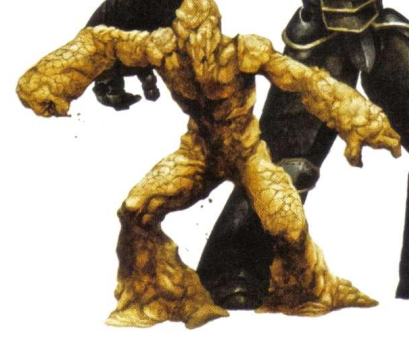
Copyright 2009 Wizards of the Coast Clay Golems were one of the original golem types described in the first entries back in AD&D or in the nebulous times before it. They were originally inspired by the legend of the golem of Prague, and so were the only golem that required divine magic to make (all the others were arcane).
In Fourth Edition, eidolons are used to represent divine constructs, so clay golems have the same arcane/elemental origin as the other types. They have a somewhat “runny” appearance, but are surprisingly fast and retain a slightly less harsh version of the ability to inflict unhealing wounds that they had in previous incarnations.
Stat-wise, they’re Level 15 Elite Brutes with 368 HP, Large size, a speed of 6, and all common golem traits. Their basic attack is a Reach 2 Slam that does heavy physical damage and curses the target, making it unable to regain HP. This is a (save ends) condition, but it’s still quite dangerous, since it makes wounds inflicted by all enemies unhealing, not just the golem’s. Clay Smash allows it to slam two different targets in one action, and they have the same Berserk Attack reaction as the chain golem above.
Their Hasty Reaction passive trait allows them to roll initiative twice and take the highest result, and Unstoppable is a move-action encounter power that allows them to move 8 squares and pass through enemy spaces. They draw opportunity attacks when doing this, but reduce their damage by 10. This isn’t worded like a resistance, so I guess powers that bypass or reduce resistances don’t work against it.
Iron Golem
These made it into the MV, so we already covered them. The MM2 has two versions, the Level 20 one that we saw, and a Level 26 “Iron Golem Juggernaut” that’s basically the same aside from being size Huge and having bigger numbers.
Sample Encounters and Final Impressions
Each kind of golem presented here gets a sample encounter. I guess there was something of an editing snafu here, because most golems have their encounter listed right after their stats, but the one for chain golems is all by its lonesome in an “Encounter Groups” section at the end of the overall entry. I guess it must be there because it has two golem types in it.
-
Level 13: 1 bone golem, 4 horde ghouls (minions), 1 human wizard lich. So that’s the kind of caster who makes bone golems.
-
Level 15: 1 clay golem, 1 shadar-kai gloom lord, 2 shadow snakes. A Zehiri operation, if you still want to associate clay golems with clerics.
-
Level 21: 1 chain golem, 1 dark naga, 1 iron golem. Someone really wanted this place guarded.
-
Level 24: 1 iron golem juggernaut, 1 storm gorgon, 1 djinn skylord. A noble, his pet, and his mechanical manservant.
There’s a point past which adding more golem types feels a bit redundant. There are also so many non-golem constructs out there that I almost think “golem” should be a singular monster type with very specific characteristics, rather than a whole family of them. Otherwise it would be best to do away with the term entirely.
-
-
Let's Read the 4e Monster Manual 2: Goblin
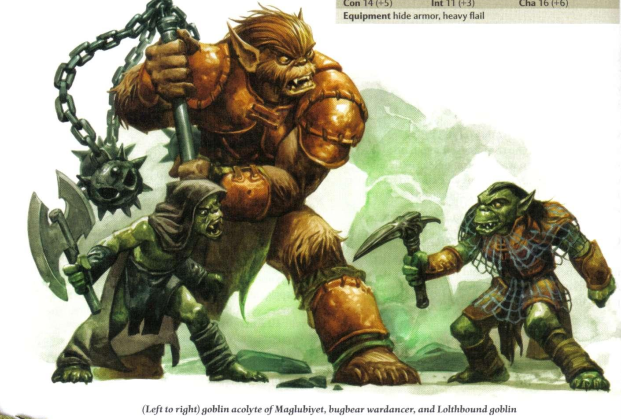
Copyright 2009 Wizards of the Coast D&D Fourth Edition uses “Goblins” to describe a set of closely related species of humanoids: actual goblins, hobgoblins, and bugbears. They’re a very traditional component of the game and we looked at lots of them in the MM1/Monster Vault Let’s Read. The post covering their basic lore is here.
Since the first Manual covered them so well, the second brings us a small number of more specialized stat blocks for them.
Bugbear Wardancer
Wardancers are specialized martial artists. Their weapon of choice is a two-handed heavy flail, which they swing in wide arcs while moving through enemy forces in the battlefield. The end result looks something like a dance, thus the name. There’s a religious element to the art: there are different schools organized around the worship of different exarchs of Bane, who compete among each other to see whose war dance is the best.
The wardancer presented here is a Level 6 Skirmisher with 70 HP, low-light vision, and Speed 7. Its basic attack is a Flail Dance that does physical damage and has a lot of stacked riders: it pushes the target 2 square and knocks it prone, and also allows the bugbear to shift 1 square. Yes, this is an at-will basic attack.
The wardancer also has a couple of special attacks. Flail Barrier (recharge 5+) does a bit of automatic damage in a burst 2 around the bugbear, and makes it take half damage from weapon attacks until the end of its next turn. Flail Assault (close burst 2 vs Reflex; encounter) does a bit more damage and knocks those it hits prone.
All the wardancer’s attacks deal extra damage if it has combat advantage against the target.
Goblin Acolyte of Maglubyet
Another martial artist, this one a goblin from a sect devoted to Maglubyet. In previous editions (and again on 5th), Maglubyet is the main goblinoid deity, but here he’s one of Bane’s Exarchs. His acolytes seek to make themselves in his image.
The Acolyte is a Level 1 Controller with 29 HP, Speed 6, and low-light vision. They wield a battleaxe in combat, and back it up with a bit of divine magic.
Acolytes are surrounded by a Life Scourge aura (2) that prevents enemies inside from recovering hit points. Their basic attack is a Slashing Shroud that consists of an axe strike that also makes the acolyte invisible to the target until the end if the acolyte’s next turn. A good option against PC defenders.
They can attack at range with the Hand of Maglubyet (ranged 10 vs. Fortitude), a telekinetic attack that deals force damage and either slides the target 3 squares or immobilizes it for a turn. Maglubyet’s Fists (recharge 5+) allows them to use this attack twice in a single action. So as far as martial artists go, this is one of those annoying hadouken spammers.
The acolyte also has the standard Goblin Tactics power that allows it to shift 1 square as a reaction when missed by a melee attack. This is what you would change if you were making acolytes of other species.
Lolthbound Goblin
Goblins are generally big on Bane worship, but that’s not universal among them. This is a goblin whose people have been slaves to the drow for generations. Their training, and even their physiology, have some important differences from your usual goblins. They’re clearly meant to be encountered alongside drow, though for that to work out you’ll need to make those drow lower level or the goblin higher level.
As written, the Lolthbound Goblin is a Level 3 Soldier with 45 HP. They have speed 6, and replace the usual low-light vision with full darkvision. They wear light armor and fight with a war pick.
When Lolthbound Goblins are within 5 squares of a drow, they gain a +2 bonus to all their attacks and defenses. That pick is a high-crit weapon and marks targets for a turn on a hit. Once per encounter they can use a Stinging Blow that deals poison damage and instead of marking increases any ongoing poison damage the target is taking by 5. This synergizes with the poisoned weapons drow so often carry.
Also once per encounter they can use a Lolthbound Shriek (close blast 5 vs. Fortitude), which deals light thunder damage to anyone in the area who is not a drow or spider.
Aside from the usual Goblin Tactics reaction, they also have Drow Protector, an interrupt where the goblin throws himself in front of a drow that’s just been targetted by an attack, becoming the target instead.
Lolthbound Goblin Slave
This is a Level 12 Minion Skirmisher version of the lolthbound goblin above, which makes it appropriate for use with drow without the need for level adjustments. They’re also armed with war picks, and add a hand crossbow to their loadout.
Their basic melee attack is a Stinging Pick, which works just like the Stinging Blow from the regular version. Their basic crossbow attack deals a bit more damage if they’ve moved 3 or more squares before making it.
They also gain the attack and defense bonus from being near drow, and have Goblin Tactics.
Hobgoblin Fleshcarver
This is the hobgoblin specialized martial artist. Unlike the bugbear and goblin examples, fleshcarvers don’t seem to have a religious component to their training. It’s all about hard work and crafting your own custom-fitted weapons. Their weapons of choice are a polearm and a set of poisoned throwing darts, whose poison is harvested from serpents they hunt as part of their training. Fleshcarvers never refuse a challenge to combat, though they’re smart enough to not let such a challenge distract them in the middle of an ongoing battle.
Fleshcarvers are Level 6 Elite Controllers with 146 HP. They have Speed 6 and low-light vision, wear heavy armor, and are armed with the afore-mentioned specialized weapons.
Their stance and movements act as an aura (2) named Fleshcarver’s Trap, dealing 5 damage to any enemy inside the first time they move during their turn. Their glaive is reach 2 and is used both for basic attacks and for an at-will Glaive Flurry that targets all enemies in a close burst 2, does more damage than the basic attack, and slides targets 2 squares.
At range they can throw those Toxic Darts to do a bit of poison damage and slow the target (save ends). If the target was already slowed, it’s immobilized instead. When they’re hit by a melee attack, they can use their reaction to shift 2 squares and make a dart attack. And finally, fleshcarvers have the same Hobgoblin Resilience and Phalanx Soldier powers from MM1 hobgoblins.
These hobgoblins are more effective when lots of enemies are in reach, but the selective targetting on their area attack means they engage all those enemies while fighting in formation for that sweet defense bonus from Phanlanx Soldier.
Sample Encounters
These new goblinoid specialists can be inserted into any goblin encounter, and being goblins themselves also work well with any of their typically allied creatures. These are the encounters we get on the book:
-
Level 1: 1 goblin acolyte, 3 goblin warriors, 1 Lolthbound Goblin. It’s likely the whole group are drow slaves, with the LBG being their leader. The level math works out, but the LBG’s drow-related skills are wasted here.
-
Level 6: 2 bugbear wardancers, 2 bugbear warriors, 1 barghest battle lord. A warlord and their bodyguards.
-
Level 6: 1 fleshcarver, 3 hobgoblin soldiers, 2 dire wolves. A patrol with a little extra kick to it.
-
Level 13: 4 lolthbound goblin slaves, 1 drow priest, 2 blade spiders, 2 drow warriors. Lots of poison being thrown around on this one, which makes the minions more dangerous than their level would indicate.
Final Impressions
I like these new additions, because their stat blocks are interesting and their associated lore fleshes goblin culture out a bit more. I like that they’re complex enough to have multiple martial styles.
-
-
Let's Read the 4e Monster Manual 2: Gnome
Gnomes were introduced in the first Monster Manual, and you can see the post I did on them here. By the time the MM2 came out, they were already available as a playable option in the Player’s Handbook 2.
We get three new gnome stat blocks in this entry, but one of them (the Gnome Entropist) also appeared in the Monster Vault and so was covered in the original post. We’ll cover the other two here.
Gnome Mistwalker
Gnome Mistwalkers are like the triple-classed fighter/illusionist/thieves of yore. They’re skilled at illusion magic and melee combat, using those to ambush their targets. This sort of training is common among gnome brigands, who build elaborately disguised hideouts and strike at merchants passing along nearby trade routes.
Mistwalkers are Level 5 Lurkers with 51 HP and all standard gnome traits (including the Fade Away and Reactive Stealth powers described in the original post). They wear light armor and wield picks in combat.
The picks have the High-Crit property, and they deal extra damage to targets granting them combat advantage. Mistwalker’s Strike (recharge 4+) allows them to become invisible until the end of their next turn, shift 2 squares, and make a pick attack in that order. This means the attack will always benefit from the extra damage, and won’t disrupt the invisibility.
In addition to the two standard powers, they have a third defensive ability in the form of Blur of Movement, a reaction that allows them to teleport 1 square when hit by an enemy.
Gnome Entropist
Their mechanics were covered in the original post, but here we get a bit of extra lore on them. Entropists are magicians whose power flows from the Elemental Chaos. This tends to interfere with their natural link to the Feywild, so they’re not usually the most stable of gnomes.
Gnome Wolverine
This gnome is the best at what it does, and what it does ain’t pretty, bub. And that’s pretty much all you need to know to understand this short berserker.
Wolverine is a Level 9 Skirmisher with 95 HP, lightly armored and wielding an axe. His natural speed of 5 becomes 7 on a charge, and he has a +3 to AC against opportunity attacks plus the standard gnome powers.
That axe can be used for basic strikes and for an Unbalancing Swipe that does the same damage, slides the target 2 squares on a hit and knocks then prone on a critical. When the Wolverine drops an enemy to 0 HP, Vicious Fury allows him to shift 5 squares and gain a +3 bonus to damage rolls until the end of his next turn. Once per encounter, and once again after being bloodied, Wolverine can use a Shrieking Strike that’s much stronger than the basic attack and does a bit of splash damage to an enemy adjacent to the target. Hit or miss, it grants Wolverine a +3 bonus to all defenses until the end of his next turn. This can be used as part of a charge.
Despite my joking, this Wolverine doesn’t regenerate.
Sample Encounters and Final Impressions
We have two sample encounters:
-
Level 8: 1 entropist, 2 wolverines, 2 spriggan giantsouls.
-
Level 10: 3 entropists, 2 phase spiders, 1 satyr piper, and 1 will-o’-wisp.
All seem to be the sort of gnome who’s up to no good, since they include the dodgier sort of fey (spriggans/redcaps and the wisp).
I like 4e gnomes, so I liked seeing more of them. The wolverine is particularly fun, because it goes so hard against type.
-
-
Let's Read the 4e Monster Manual 2: Gnolls
The absolutely best thing about the Monster Manual 2 gnolls is that I don’t have to talk about them! It turns out I’ve already covered them all in the MM1/Monster Vault gnoll post. The Deathpledged Gnoll, Fang of Yeenoghu, and Gnoll Gorger that appeared in the Monster Vault all had their first appearances here in the MM2. Just read the original article for everything you need to know about 4e gnolls.
-
Let's Read the 4e Monster Manual 2: Giants
The first Monster Manual and the Monster Vault contained plenty of giants, whose lore in 4e is pretty awesome. I covered their basic lore here, and also had individual posts for hill, frost, fire, death and storm giants.
The Monster Manual 2 added more giants, and it’s actually where Frost Giants made their first appearance in this edition. We already covered them in the corresponding post linked above. In this one, we’ll cover the two other varieties introduced in the same entry: Eldritch and Stone giants. The latter are old standbys, and I had never heard of the former until now. If they existed in a previous edition, it was in one of the more out-of-the-way supplements or Dragon articles for 3e.
Eldritch Giants
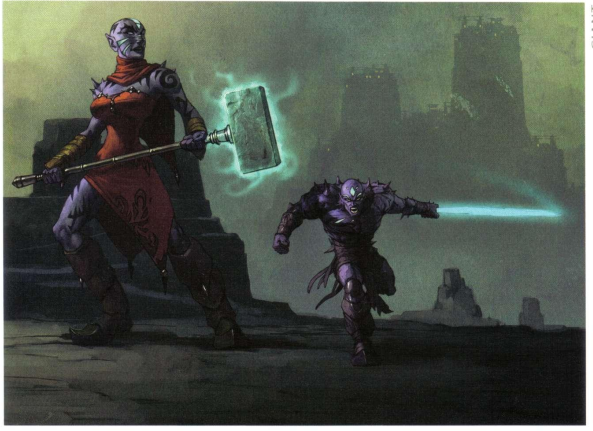
Copyright 2009 Wizards of the Coast As mentioned in the basic lore post, the primordials made the first Giants from the same elements they used in the world, to help them shape and understand it. Well, it turns out raw magic is as much a basic building block of the world as the more classical elements of earth, fire, air, and water. Therefore, it got its own Giant type.
Eldritch giants were among the most powerful creations of the Primordials, and they helped a lot with shaping the flow of magical energies in the still-cooling world. Today their power is much diminished from what it was at the dawn of time, and most of them dedicate their lives to accumulating magical power and knowledge in hopes of returning to those lofty heights.
Both eldritch giants and titans are still well-versed in magic. They know how to form weapons out of pure force, and they tattoo their bodies with symbols that allow them to absorb the magic of others and teleport at will. They live near sources of arcane power, and jealously hoard knowledge and artifacts. Eldritch giant social hierarchy is based on how much power individuals managed to accumulate - Eldritch Titans tend to be at the top. An individual eldritch giant or titan might have more abilities than what is depicted in the “typical” stat blocks of this entry, and they’ll certainly have access to lots and lots of magic rituals.
Most interactions between mortals and eldritch giants as written here are likely to be hostile, since the giants don’t have much reason to be friendly. They love binding and enslaving other creatures with magic, though, so they might be encountered alongside powerful elementals, slaads, and other such creatures. A more reasonable group of them would make valuable allies against powerful incorporeal enemies, though, since they specialize in force magic.
Eldritch Giant
“Standard” eldritch giants are Large Fey Humanoids with the “giant” keyword, and Level 18 Skirmishers with 171 HP. They have low-light vision, 10 force resistance, and a +5 bonus to saves vs. charm effects. Their ground speed is 8 and they also have a teleport speed of 6.
These giants fight in melee with Reach 2 Eldritch Blades that target Reflex and deal force damage, and at range with Range 20 Force Missiles that do the same. Being so large, they can also use Sweeping Sword attacks to target everyone in a Close Blast 2 instead of a single victim, and they can do that even when charging.
As a minor action, they can deploy an Eldritch Field (close blast 5; recharge 5+) that counts as difficult terrain and makes enemies inside take extra damage from the their attacks. Also as a minor action, they can use Consume Magic to absorb a magic zone created by a PC. This requires them to hit the caster’s Will with an attack, and if they succeed their own attacks get a big damage boost until the end of their next turn.
Eldritch Titan
Eldritch Titans are Huge, and Level 21 Elite Skirmishers with 394 HP. They have the same passive traits as their smaller cousins.
Their Reach 3 Eldritch Hammers deal more damage, and they can make two attacks per action, even on a charge. Their ranged force attack is also stronger and pushes the target 5 squares on a hit.
Once per encounter they can cast a Force Hammer that damages everyone on a close blast 3, pushes then 3 squares and knocks them prone. On a miss the targets still take half damage and are pushed. They have the same Consume Magic and Eldritch Field abilities as eldritch giants.
Stone Giants
The other type of classic earth giant, Stone Giants are among the most reasonable people among all giantkind. They usually don’t care about raiding or conquest, and just want to be left alone in their mountain homes. Discrete and contemplative sorts, they can stay immobile for years while lost in thought, and are surprisingly adept at hiding themselves in their home terrain.
Someone passing throug stone giant territory might never spot them at all, and ill-intentioned travelers might find themselves ambushed before they can do any harm. The exception to all of this is when the giants are feeling rowdy and want to have some fun: their favorite game is basically dodgeball with enormous boulders, and when they’re in the middle of it they don’t usually pay attention to any smaller creatures who might be in the path of those boulders.
Stone giants are one of the few Giants who are actually on friendly terms with communities of galeb duhrs and azers. They have a long and proud tradition of stone carving, and their magic is based on carved runes. It’s possible the dwarves originally learned their own rune-magic from stone giants, though modern dwarf scholars dispute this notion.
Friendly giants of other types, unable to stand their generally unpleasant societies, often move in with stone giants. Conversely, evil stone giants tend to move out of their ancestral homes and throw their lot with their more villainous relatives.
Stone Giant
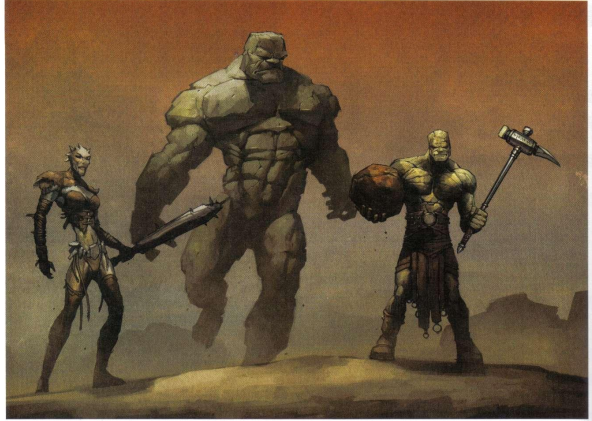
Copyright 2009 Wizards of the Coast Stone Giants are Large Elemental Humanoids with the Earth and Giant keywords. They’re Level 14 Soldiers with 140 HP, immune to petrification, and have a ground speed of 8 with Earth Walk. This lets them ignore difficult terrain with a “geological” origin.
They use giant-sized stone greatclubs. As usual for soldiers, their basic attacks mark on a hit and they can make opportunity attacks marked creatures in reach that move or shift. They can also make a Staggering Sweep that works like an area attack, pushes targets 2 squares, and marks them. At range, they can hurl rocks like you’d expect out of an old-school giant.
While they’re unbloodied, they can use Stone Bones as an interrupt when hit by an attack, gaining 5 resistance do its damage.
Stone Giant Runecarver
This spellcaster is a Level 16 Controller with 155 HP and the Leader keyword. Their magic is partly about slowing and immobilizing enemies, and partly about doing unpleasant things to enemies suffering from those conditions.
They fight in melee with Enruned Picks, which are High-Crit weapons and have a slow (save ends) rider. Grasping Stone ensures that any enemy slowed by the giant is also immobilized for a turn.
Magic-wise, their Rune of Thundering Echo (recharge 5+) deals thunder damage over an area and inflicts ongoing thunder damage (save ends) on targets who are slowed or immobilized. The Rune of Stony Sleep (recharge 6+) affects a similar area, deals physical damage and slows (save ends). After the first failed save, slowed enemies become petrified instead (save still ends). That rune also creates a zone within its affected area that inflicts a -2 penalty against saves vs. slowness or immobilization effects.
“Save ends” petrification might not sound so bad, but runecarvers also have a Hardened Focus aura (5) that makes all petrified enemies inside lose any damage resistance they have and gain Vulnerable 5 to all damage. An evil runecarver is a good counter to a group of PCs who thought a fight against frost or fire giants was going to be easy just because they packed the right elemental resistances.
Stone Titan
Stone Titans are basically Stone Giants Plus, being Huge in size and Level 18 Elite Soldiers with 348 HP. They fight unarmed and throw rocks, but there are some important differences.
First, their marking ability is a Slipstone Distortion aura (1) that marks any enemy who starts their turn inside. Their slams deal extra damage to marked enemies, and they can make opportunity attacks against marked enemies like stone giants can.
Second, they can use an Avalanche Stomp (encounter) to attack everyone in a Close Burst 3, with a hit doing heavy damage and causing the very earth to grab the targets. The escape DC is 28, and the giant doesn’t need to spend actions to sustain the grab. A miss still does half damage.
And third, they can “charge” a thrown rock and turn it into a Quakestone (recharge 5+), making it into an area attack that does light damage, knocks prone, and dazes (save ends) on a hit. A miss does half damage and knocks prone without the daze.
Final Impressions
Eldritch giants have a somewhat unusual name and appearance when compared to the traditional types, but they’re a lot closer to them than it seems at first. I guess calling them “Force Giants” would have been a little too on the nose, but this is basically what they are. They use Force attacks in the same way a frost giant would use Cold, or a fire giant would use Fire. Their fighting style is similar, aside from the “I eat magic!” thing.
Stone giants on the other hand are one of the traditional types that have been there since the beginning. I’m happy to see them here because your average stone giant fits the “Earth Giant” mold a lot more readily than a hill giant, who’s just a big human-looking person. I also like that the book doesn’t consider all of them evil, and even mentioned that they partner up with non-evil individuals of the other giant types. I often ponder how to make sapient monsters less evil and hostile when I discuss them, so it’s nice to see an entry that does that as written.
subscribe via RSS