Posts
-
Let's Read the 4e Monster Manual 2: Mammoth
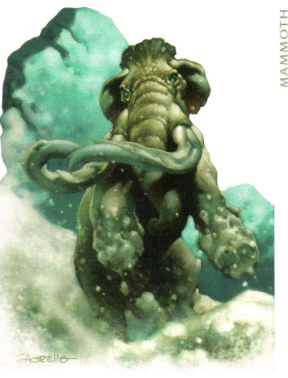
Copyright 2009 Wizards of the Coast Cribbing from paleonthology is one of the classic ways to add interesting monsters to your D&D world. Dinosaurs are the obvious choice, but there’s also a bunch of post-dinosaur megafauna that can be slotted in with no problem at all. Among that set, mammoths are some of the most famous.
Looks like the Monster Manual 2 only had one page to dedicate to them, though, so it decided to skip mundane mammoths altogether and give us a fantastical variety.
Nyfellar Mammoth
These creatures are native to Nyfell, the same frozen realm in the Elemental Chaos from which frost giants originally came. They’re partially made of ice, and subsist on a combination of organic food and ice, so they thrive in the most inhospitable frozen hells.
Frost giants have long ago tamed Nyfellar mammoths for use as mounts, and were responsible for bringing them to the world, where they can still be seen filling that role. I imagine it’s also possible to find wild specimens.
Nyfellar Mammoths are Huge Elemental Beasts with the Mount keyword, and Level 17 Brutes with 202 HP. They have Resist Cold 10 and a respectable ground speed of 8 with Ice Walk, which allows them to ignore “icy” difficult terrain.
They also possess the same Icebound Footing trait that’s common among frost giants, reducing any forced movement inflicted on them by 2 squares, and getting a free save to avoid being knocked prone. They fight with their tusks and big feet in combat.
The tusks are Reach 2 and can either gore as a basic attack or perform a Tusk Toss (recharge 4+) that targets Fortitude, does a little less damage and slides the target 5 squares. At the end of the slide the target falls from a height of 30 feet on the destination square, so it really is a toss. The fall does damage (and can be mitigated) according to the standard rules for falling.
The feet can stamp, a Reach 1 attack that targets fortitude, does about same damage as a gore, and knocks prone. The mammoth can also execute a Blizzard Trample maneuver to move 8 squares, go through enemy spaces, and stamp each of those enemies. This recharges when the mammoth is bloodied, or when it takes cold damage.
If used as a mount, the mammoth can employ a Bitterwind Charge, which allows it to use a Tusk Toss or a Blizzard Trample when charging. Yeah, it moves 8 squares then tramples for another 8 in a single standard action. After this special attack concludes, the rider gets to make a free melee basic attack.
Sample Encounters and Final Impressions
The sample encounter is a level 17 frost giant patrol, with 2 giants riding nyfellar mammoths and accompanied by a rimefire griffon acting as a spotter. The book notes that giants like to play badminton with PCs by readying actions to attack victims of Tusk Toss as they fly by.
These ice mammoths are pretty cool, and I can see why they preferred to include them over the mundane variety. They have a good synergy with frost giants, which also debut in this book.
You could pretty easily derive a mundane mammoth from the nyfellar stat block, making it level 10-13 and removing some of the more blatant elemental abilities. Maybe they could be used as hill giant or ogre mounts then.
-
Nordlond Bestiary Kickstarter!
Gaming Ballistic is about to launch a campaign for the Nordlond Bestiary, and you can go to this page to click a button and be notified of when that happens. Everyone always says GURPS really needs a good bestiary. Well, here’s one!
Contributing to Kickstarter campaigns is a bit hard for me, as my bank dislikes it and tries to cancel my credit card whenever I do it. But if that’s not a problem for you, by all means click that button. I’ll be here waiting for the book’s final launch to buy myself a copy in the traditional way :).
-
Let's Read the 4e Monster Manual 2: Lycanthrope
The first Monster Manual had a Lycanthrope entry containing wererats and werewolves. Here in the second one we get stats for more types, as well as a bit of additional lore.
The Lore
I’ve covered a lot of the basic lore of lycanthropes in the [original article][2], so please read that. This entry adds a couple of other tidbits. The first one says that a lycanthrope’s natural form is the “beast-person” one. The other says that lycanthropes are Melora’s creations, and that the reason they’re affected by silver and the full moon is because of an ancient feud between Melora and Sehanine.
4e lycanthropes aren’t really forced to change in the full moon, so that’s not a big deal, but silver can shut down their regeneration. Like in the first MM, all the stat blocks we get here have “Evil” in their alignment, though there’s no real lore reason for all of lycanthropes to be evil.
The Numbers
Lycanthropes are natural humanoids, and the two we see here are Large. Obviously, they have the Shapechanger keyword. They have low light vision and a ground speed of 6 in either humanoid form or 8 in animal form. Switching forms is a minor action for them, giving them plenty of flexibility in a fight. They have regeneration, which shuts down for a turn when they’re wounded by silver weapons.
Victims damaged by a lycanthrope’s natural attacks while it’s in animal form are exposed to a disease specified alongside their stat block.
Wereboar
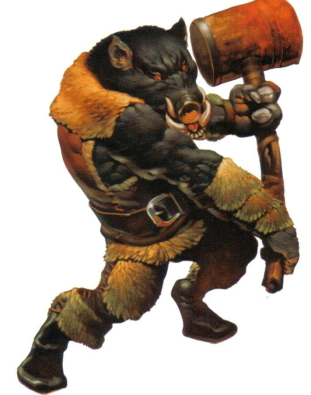
Copyright 2009 Wizards of the Coast Wereboars are described as brutish and easily angered. Some of them like to hang out in places where a fight is likely to break out, such as in rowdy taverns and underground fight clubs. They love to fight in their animal form, and getting wounded only makes them angrier.
The stat block presented here is a Level 6 Brute with 61 HP and all traits listed above. Its regeneration is 5. He fights with a maul in human form and gores with his tusks in boar form. The tusks also inflict ongoing damage and transmit moontusk fever, the wereboar disease.
When bloodied, the wereboar gains a +2 to all defenses and doubles the amount of ongoing damage its tusks deal. And when it hits 0 HP, it can make one last basic attack before dying.
Moontusk fever is a level 6 disease with an “Improve” DC of 17 and a “maintain” DC of 12, and it fucks you up while you’re bloodied. Stage 1 inflicts a -2 penalty so taves while the victim is bloodied. Stage 2 limits them to one save at the end of their turn even if they’re affected by multiple save-ends effects. And the final stage gives you 5e disadvantage on that single save.
The disease isn’t directly lethal, but it’s a major inconvenience given how common saves are in this game. I imagine the actual level of the disease and its DCs should be equal to the level of the wereboar, if you’re changing them.
Weretiger
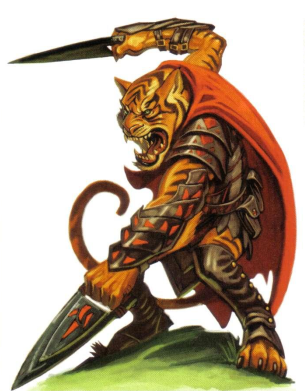
Copyright 2009 Wizards of the Coast Weretigers are a marked contrast to their porcine relatives, being much sneakier and more opportunistic than them in a fight. If they become convinced they need to fight, they’ll stalk their adversary and strike in the most opportune moment. Their fighting style is highly mobile and cautious in any of their forms.
Weretigers are Level 11 Elite Skirmishers with 172 HP and Regeneration 10. They fight with paired katars in humanoid form, and with bites in tiger form. The katars are high-crit weapons and do more damage, but the bite transmits a disease called moon rage.
The weretiger can pounce when it charges, dealing more damage than a basic attack and knocking the target prone on a hit. Feline Fury allows it to make two basic attacks with a shift between them, and Slashing Recoil allows them to make a free basic attack when someone misses them in melee.
While this lycanthrope is stronger in humanoid form, there’s still some incentive to bite the PCs and expose as many of them as possible to moon rage. This is a disease that turns the victim’s hands into tiger paws! At stage 1 the partial change inflicts a -2 penalty on all attacks. At Stage 2 they gain a Strength-based claw attack that deals 1d6+STR bonus damage, but can no longer hold any weapons or implements. And at the final stage their mind is saddled with predatory instincts that prevent them from switching targets in combat until their current target is dead. At level 11, the Improve DC is 21 and the Maintain DC is 16.
Werewolf Lord
This is a bigger, stronger, smarter werewolf, usually found leading a whole clan of lycanthropes. They’re also known as “pack lords”. They’re mostly werewolves with bigger numbers, but they also have some useful leadership powers.
The lord is a Level 13 Elite Brute with 264 HP and Regeneration 10. They project a Blood Moon aura (5) that gives allies inside +2 to attacks and +5 to damage against bloodied targets. They fight with a falchion in humanoid form and with bites in wolf form.
The sword is a High-Crit weapon, and the bite transmits an enhnaced form of moon frenzy. Canine Fury allows them to make 2 basic attacks per action, and Speed of the Wolf allows them to shift 6 squares and bite when in wolf form. Finally, Savage Howl grants 15 temporary HP to every ally within 10 squares and allows them to make free bite attacks if they have any to make.
Greater Moon Frenzy is pretty much werewolf rabies, attacking the nervous system. Stage 1 is a -2 penalty to Will. Stage 2 has the victim make a save at the end of each turn to retain control of their actions. A failure means they must attack a random target within 5 squares or move in a random direction if there are no targets available. Stage 3 removes the save: the victim must attack the closest creature in sight or move in random directions until it finds any. As presented the disease is level 13, with an Improve DC of 23 and a Maintain DC of 18.
Sample Encounters and Final Impressions
I like that the lycanthrope diseases for the wereboar and weretiger are more inconvenient than lethal. A common complaint about 4e diseases is that they’re not very dangerous once the party gets access to the Remove Affliction ritual, which can happen from level 6 onwards. This is true, but curing afflictions can still spend time, money, and healing surges that would be useful elsewhere.
By having somewhat less dangerous diseases, wereboars and tigers paradoxically incentivize players to put up with them for a little longer and try to recover from them using the standard disease rules. So what if your saves suck when you’re bloodied? Just don’t get bloodied until you can return to town and recover!
We get three sample encounters:
-
Level 7: A human hexer, 2 half-orc hunters, and 2 wereboars. It’s either a big brawl in progress, or a group of rowdies looking to start one.
-
Level 12: An eladrin bladesinger, a will-o’-wisp, and 2 weretigers. Fey of a dark disposition who enjoy playing boogeymen and waylaying travelers.
-
Level 13: A werewolf lord, 3 standard werewolves, and 2 worgs. A powered-up version of the typical werewolf-led bandit gang.
-
-
Let's Read the 4e Monster Manual 2: Lizardfolk
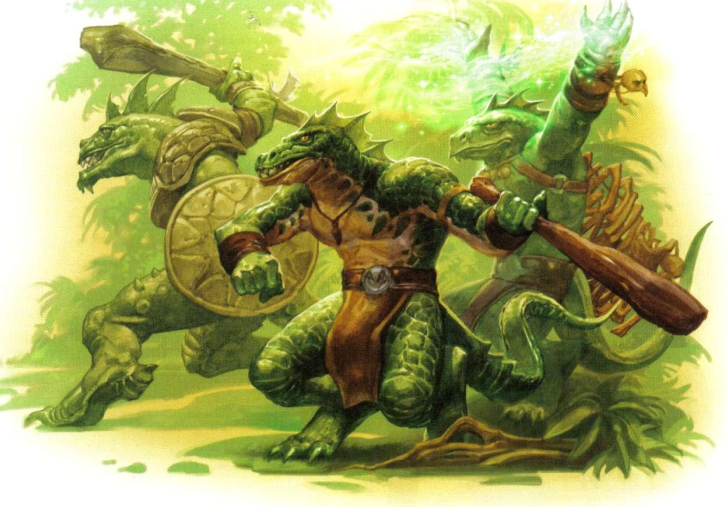
Copyright 2009 Wizards of the Coast We already looked at lizardfolk during our reading of the first Monster Manual and the Monster Vault. As we saw before, there are several different ethnicities of lizardfolk. The first MM had the human-sized “greenscales” and the larger “blackscales”. The Vault also contained a “poisonscale” type, which turns out to have debuted here in the MM2.
Poisonscale lizardfolk have a smaller and slighter build than greenscales, though they’re still Medium. To make up for their lack of brute strength, they developed a kind of internal alchemy: by eating certain specific plants, they can sweat poison. They usually apply this poison to their weapons, but some poisonscales like to apply it directly to their enemies by wrestling with them.
The lore in this entry is more focused on the individual stat blocks than on overall lizardfolk culture, so presumably everything that was said in the first Monster Manual still applies here. The stat blocks themselves are different enough from what we got in the MV to be worth discussing.
All lizardfolk in this entry are Medium Natural Humanoids with the Swamp Walk ability, allowing them to ignore swampy difficult terrain. They also usually do something poison-related, though the specifics vary per stat block.
Poisonscale Magus
These spellcasters specialize in toxic magic. They occupy positions as honored advisers in poisonscale communities, but this power and respect comes at a cost. Their own magic poisons them, and shortens their lives.
Magi are Level 2 Artillery with 32 HP and speed 6, carrying daggers into battle for use as implements and in emergencies. All of their spells target Fortitude, so they’re a threat to your squishies.
In a fight a magus is likely to open up with a Poison Barrage (encounter) an area burst attack that deals poison damage and inflicts Vulnerable 5 Poison on thise it hits (save ends). A miss does half damage and inflicts the vulnerability for a turn.
Then they’ll target individual vulnerable enemies with Poison Blood, a ranged spell that deals immediate and ongoing poison damage (save ends). As a minor action it can also use Corrupt Poison, a ranged spell that slides someone suffering from ongoing poison damage 3 squares and slows them (save ends).
There are enough interesting interactions here that the magus works more like a fragile Controller than as Artillery.
Poisonscale Slitherer
This represents your typical poisonscale warrior. Their slight build makes them a bit cowardly, but they have good teamwork and their somewhat oversized tails make them very stable.
Slitherers are Level 2 Soldiers with 36 HP and speed 5. They carry spears for melee combat, and javelins for fighting at range. They prefer that last one because it’s safer, and because their javelins are poisoned! This manifests as a secondary attack against Fortitude, which does about double the damage of the initial hit.
Their ironically named slitherer bravery trait gives them a +2 attack bonus when adjacent to at least one ally, and slitherer stability makes them immune to knockdowns and forced movement. That’s surprisingly powerful for a level 2 soldier, and makes them an excellent wizard counter-measure.
Poisonscale Savage
This warrior doesn’t bother with fiddly stuff like poisoning weapons or personal hygiene. It slaps enemies with its tail to cover them in poisoned sweat, and them clubs them to death while they’re weakened.
The savage is a Level 2 Brute with 45 HP and speed 6. It will probably start the fight with the single javelin it carries, which damages and inflicts ongoing poison damage because it’s all sweaty. After that it attacks with a greatclub, and can slap with its tail as a minor action. The tail does no damage, but inflicts ongoing 5 poison damage on a hit (save ends).
Poisonscale Collector
Collectors are responsible for gathering the special plants that allow poisonscales to produce their poison. This means they’re also trained herbalists and alchemists. They’re Level 3 Lurkers with 36 HP and speed 6.
Collectors are armed with Daggers, which do physical and ongoing poison damage. Once an enemy is taking ongoing poison damage from this or any other source, the collector can do several unpleasant things to them.
First of all, the Poison Strike passive trait gives them a +2 damage bonus against poisoned targets. Blinding Poison is a spell that targets a poisoned creature’s Fortitude, dealing damage and blinding them on a hit (save ends). And End Strike is a stab that targets someone who can’t see the collector and does a bunch of physical damage.
So this is one of those lurkers who can do something harmful to the PCs every turn, though it takes a bit longer to activate its ultimate attack. That process can be sped up if it has additional buddies who can inflict ongoing poison damage.
Poisonscale Myrmidon
A veteran warrior, fighting in a more disciplined manner with a club and a shield. It’s a Level 3 Soldier with 47 HP and speed 6. Its only attack is a club that damages and marks on a hit, but it also has the collector’s Poison Strike trait.
Myrmidons can’t poison enemies themselves, so they rely on the support of other allies who can. They’re good to pad the ranks of an all-poisonscale force, though you’re probably better off using lizardfolk from the other books if you have a mixed force or want more interesting mechanics.
Final Impressions
The poison theming here is interesting, and several of these stat blocks don’t get repeated in the Vault, so it’s worth it to update them. As long as you avoid the extra-xenophobic lore in the Vault, its stat blocks are good.
-
Thoughts on LANCER Against the Giants
I remember reading a few play reports about a campaign titled “Mecha Against the Giants” a few years ago. It was run by Mark Langsdorf, using GURPS as a rule system, and it was vaguely inspired by the Against the Giants modules for AD&D.
One of these days, I really want to run something like that using LANCER. As of this writing I definitely don’t have the bandwidth for it, but I just thought it would be nice to write it down.
LANCER: Against the Giants
Armies of Giants invade, out of nowhere and for seemingly no reason!
Their relentless assaults threaten to destroy “smallfolk” civilization!
The realm’s bravest heroes have fallen against their foe’s overwhelming strength and numbers!
Desperate, the King’s wizards and priests spend the last of their power in a rituat. It purpose: to summon someone, anyone from across the vastness of existance that has the power to stop the destruction!
They succeed in bringing the 2021st Union Auxiliary Squadron. Your squadron.
Mount up, Lancer, and end this war!
Fight off attacking giants and their pet giant monsters!
Discover the mystery behind these invasions!
Find a way to end this war that doesn’t involve genocide, because we’re better than Gygax!
And finally, at the end of it all…
ATTACK AND DETHRONE LOLTH.
subscribe via RSS