Posts
-
Are Mecha Silly?
Recently I saw someone start a thread on the RPG.net forum, with the title “Why are mecha silly?”. The person in question was of the opinion that not only were mecha not silly, they were plausible, and went on to list reasons they thought so.
Of course, all of those were swiftly debunked by posters, but I think the thread kinda got away from the main point after a while. So I thought I’d write a bit about this subject here.
The thread’s title had a bit of an unfortunate framing, because it started from the premise that mecha are silly even though its opening poster didn’t think so. A better question to ask might be “Are Mecha Silly?”
My answer is somewhat nuanced, but it can still be summed up as “No”. Giant robots are definitely cinematic, but they’re not inherently sillier than any other cinematic trope. It’s all about the context.
I’m using “mech” and “mecha” here to mean a humanoid (or at least legged) piloted machine that’s used in about the same role as an armored fighting vehicle or tank. Non-combat versions are usually used as heavy construction equipment.
These are some of the traditional excuses for mecha: Legs make them able to handle any terrain type better than wheels or threads. A humanoid form makes them more agile and versatile than traditional vehicles. Something about the specific technology used to build them makes them better weapons than traditional vehicles (this last one varies per setting).
None of these would hold up under scrutiny under a strictly realistic setting. While some people are building smaller autonomous robots and experimenting with load-bearing skeletons, building a giant mech is still far beyond us and the general consensus on that seems to be that it’s not worth the effort. Better to work at improving the specialized vehicles we know than worrying about leg movement and the ground pressure exerted by two giant metal feet.
As you get more cinematic mecha become a better fit. An “action movie setting” that makes you accept some people do the impossible because they’re just that badass shouldn’t have a lot of trouble selling the idea that sometimes tanks have legs. Full Metal Panic in its more serious moments is a good example of this. The show itself is silly most of the time, but the robot fights are trated in a more serious cinematic manner.
Science fictional settings have more leeway than contemporary ones, because the same classical excuses are still valid and it’s easier to assume that the practical engineering concerns have been solved in the future. A lot of the Gundam shows are in this territory, as are many other similar franchises.
And that’s just the shows that even bother to offer up excuses! You see, there are two main “sub-genres” of mecha shows. The ones that bother to think about excuses and to insert their mecha into a wider military context are called “Real Robot” shows. The original Mobile Suit Gundam back in 1979 was the first of these.
The other side of the coin are “Super Robot” shows, who don’t even bother with that. Sometimes a 12-year old kid just inherits a fifteen story tall robot from his dad, and flies that robot out of the secret hangar at the bottom of his swimming pool to fight space monsters. Super Robot shows date from the early seventies, and their overall aesthetic is closer to that of a gold or silver age supers story than “proper” science fiction. They require the same kind of suspension of disbelief. If you can accept Superman, you can accept Mazinger Z.
Whether Real or Super, no type of mecha is inherently silly as long as you place it in the type of story it was meant to go in. Just like any other cinematic trope.
-
Let's Read the 4e Monster Manual/Vault: Stirge
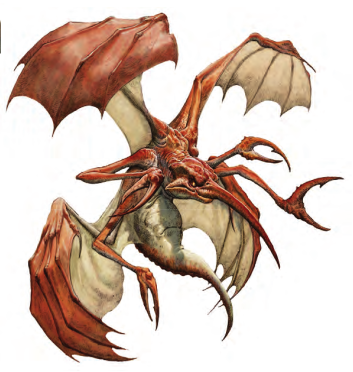
Copyright 2008 Wizards of the Coast This article is part of a series! Click here to see the other entries.
Stirges have been in the game at least since the days of Basic. Here, they are both in the Monster Manual and in the Vault.
The Lore
Stirges are another example of dangerous fantasy wildlife in the implied Fourth Edition setting. Looking like a cross between a large bat and a mosquito, these things feed on blood and will attack any nearby creature in search of it when hungry. While a mosquito can be dangerous because it transmits diseases, a stirge is large enough for the blood loss it causes to be worrying. A flock of them could exsanguinate an adult human in minutes.
Like bats, they nest in dark places and tend to hunt at night. They’re a common enough threat that anti-stirge measures are a part of every culture. Ship crews, for example, spread unpleasant-smelling unguents in their cargo holds to prevent stirges from nesting there. Sheperds and ranchers absolutely hate them and have their own set of measures.
Any dark dungeon might be home to a flock of stirges, making them one of the many dangers adventurers must always be wary of. A large enough flock can threaten even seasoned veterans!
Since they’re considered vermin by the people of the world, they also have all the same sinister associations worms and rats and such get. Particularly gross necromancers love filling the body cavities of a large, bloated zombie with a flock of stirges, which burst out when their carrier is slain. Optionally the stirges might be zombies as well.
The Numbers
Stirges are Small Natural Beasts, which does mean they might get as big as three feet across (halfling-sized!). They have darkvision, a flight speed of 6 with Hover, and a pathetic ground speed of 2. Their main attack is always a “bite” with their blood-sucking proboscis-beak thing, but the exact mechanics of that vary per stat block.
Stirge (Both)
The basic model is a Level 1 Lurker with 22 HP and the common traits above. The bite is its only attack. It does damage and grabs the target (escape DC 12). While the target is grabbed, it takes 5 ongoing damage from the blood-sucking. While the stirge is grabeed, it gains +5 to AC and Reflex.
The MM version has an extremely weak bite even for a level 1 monster (1d4 damage), but the MV updates that to be in line with the new math (1d4+5).
While a single stirge is not a big threat to a full party, it’s terrifying to a civilian! Non-combatants are likely minions, and if not they’re unlikely to have much more than 10 or 15 HP. A stirge like the above could be nesting in any given dark hole near the poor schmuck’s farm, and could kill them in one bite and maybe a round or two of blood-sucking. The civilian is also more likely to meet the stirge than a goblin or the like, and of course it will never be just one stirge.
Stirge Suckerling (MV)
A young stirge that’s already quite hungry. It’s a Level 5 Minion Lurker, which means it comes in hordes.
Their only attack is the usual bite, which does a bit of damage and initiates a grab (escape DC 15). While the grab persists, the suckerling can only make bite attacks against the grabbed target, but those hit automatically. The target also takes ongoing damage equal to the number of suckerlings attached to it, so be sure to make them gang up on the squishies. Now there’s a nice mental image for you.
Death Husk Stirge (MV)
An undead stirge used as filling for a Bloated Zombie Surprise. It’s a Small Natural Animate (undead), and a Level 6 Skirmisher with 71 HP. It has darkvision, an immunity to poison, and 10 resistance to necrotic damage. It has the usual stirge ground speed of 2 and flight speed of 6, but if it’s hit by radiant damage it loses the ability to fly for a turn (and falls if it was in the air).
Death husk stirges won’t stick to you, but they’ll still suck your blood. The Rotted Blood attack (close blast 3 vs. Fortitude) allows them to spit the blood stored inside their purulent intestines, dealing necrotic damage and blinding those it hits for a turn. Undead in the blast can shift 2 squares as a free action. This is an encounter power, but hitting someone with the basic bite attack allows the stirge to recharge it.
As a move action, they can use Nimble Wing to fly 4 squares without provoking opportunity attacks. When they hit 0 HP, they burst and those purulent intestines produce a cloud of Necrotic Miasma (close burst 2 vs. Fortitude), which deals a bit of necrotic damage and weakens for a turn.
Dire Stirge (Both)
Indeed, like every bit of natural fauna in the setting, stirges have a dire version. They’re larger, but not quite large enough to go up a size category. They are however a lot meaner, being level 7 Lurkers with 60 HP.
Aside from the usual increased numbers due to being higher level, dire stirges do 10 ongoing damage while attached and have an escape DC of 16. They are otherwise mechanically identical to the level 1 variety.
Stirge Suckerling Swarm (MV)
For when you have so many suckerlings in play it becomes impractical to track them individually. This swarm is a Level 10 Brute with 128 HP, and counts as a Medium Natural Beast. It has a ground speed of 2 and a flight speed of 6.
This has the usual swarm traits. Its aura (1) makes anyone caught inside begin taking 5 ongoing damage (save ends). If the victim is already taking untyped ongoing damage, that damage increases by 5, with no stated limit. It’s a nice way to model an incresing number of tiny stirges attaching themselves to the victim.
Its Swarm of Suckerlings basic attack deals good damage and ongoing 5 damage (save ends), so it can step up the aura’s timetable a bit.
When an adjacent enemy moves away from the swarm, it can use Hungry Flight as an immediate reaction, flying up to its speed so it’s adjacent to the target again. This does not provoke opportunity attacks!
Stirge Swarm (Monster Manual)
What you get when those suckerlings grow up. This swarm is a Medium, Level 12 Brute with 141 HP. Being a MM monster, it’s a bit simpler. Aside from the usual swarm traits, it has a basic attack that deals ongoing damage (save ends), and an aura that allows it to make basic attacks against anyone caught inside as free actions.
You’re probably better off leveling up the suckerling swarm.
Sample Encounters and Final Impressions
You can’t really tame stirges, since they’ll attack anything that has blood, but sometimes kobolds and goblins use captured stirges as traps. Trigger the trap, release the swarm! They can also be encountered as indiscriminate opportunists, or in coincidental cooperation with things they won’t feed on.
The sample encounters provide two such examples of this: the first is 2 dire stirges and 3 bloodweb spider swarms, the second 3 stirge swarms and a flesh golem.
The “Large zombie minion full of undead stirges” setup has been hinted at above, as well. For Maximum Carnage you could add the undead traits to a stirge swarm stat block to get a swarm of death husk stirges.
I usually wouldn’t be very enthusiastic about stirges, but now I kinda want to use the Zombie Surprise at least once.
-
Let's Read the 4e Monster Manual/Vault: Sphinx
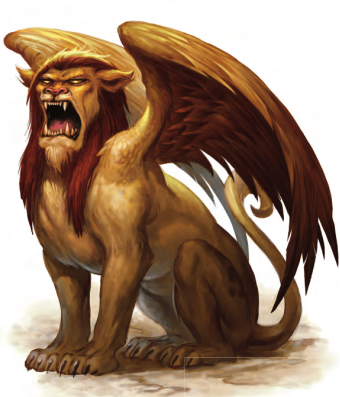
Mufasa is having a bad day. Copyright 2008 Wizards of the Coast This article is part of a series! Click here to see the other entries.
Sphinxes are inspired by Greek and Egyptian mythology and have been in the game at least since BECMI. Here, they are only on the Monster Manual.
The Lore
A sphinx is a holy guardian created in antiquity to protect a sacred place like a tomb, temple, or shrine. In this task they can be found alone or in pairs, and sometimes they also command other, lesser guardians. The ritual that creates them is rare and powerful, binding an angelic spirit to the body of a celestial lion.
Why would someone create a sphinx instead of a golem? There’s the matter of style, of course. Golems would be preferred by a certain type of arcane caster, while sphinxes feel like something a deity would allow its greatest servants to make. There are also practical advantages: sphinxes are both sapient and quite smart, so they can follow the intended spirit of their orders, and better distinguish between people who are allowed to be there and people they should eat.
One way they do this is through the sphinx’s challenge, where they try to ascertain if someone has a right to be at the guarded location or not. Riddles are a classic, but a sphinx can also ask for proof of ancestry, the solution to an ethical or theological puzzle, or even just a specific password. The sphinx is bound to let someone who passes the test proceed unmolested, though it’s still going to attack if the visitors try to damage or rob the guarded location.
That’s all the book has to say about sphinxes, but I think we can speculate a bit as well. Unlike most of other “guardian creatures” we saw so far, sphinxes are neither constructs nor undead, yet the text implies they’re just as capable of guarding their designed site for eternity. So I think it’s fair to say that they are immune to age, hunger, thirst and possibly even sleep, at least when performing their mission.
While the books emphasize the role of sphinxes as the guardians of “ancient” and “forgotten” places, I think it’s also quite possible for them guard places that are neither. Maybe the Pelorite cathedral or the big Temple-Library of Ioun have a pair of sphinxes posted at their front entrance, even though they’re built right in the middle of major population centers. Sphinxes are perfect for this because they’re intelligent, and so they’re not going to attack innocent visitors by mistake like a golem would.
A good sphinx might be hamstrung by overly specific or ethically questionable bindings, though, so you could also have a scenario where a party carefully helps the creature to free itself from its duties without triggering a fight.
The Numbers
There’s only one stat block, so we’ll get right on it. Sphinxes are Large Immortal Magical Beasts, and Level 16 Elite Soldiers with 304 HP. They have trained Perception, Darkvision, plus a ground speed of 6, a flight speed of 8 (clumsy) and Overland Flight 10.
Their signature trait is the Sphinx’s Challenge, which gives us mechanics for the concept described in the lore section: the sphinx will pose an out of combat challenge to any potential intruders, and it can take whatever form the GM thinks is appropriate. If the challenged party refuses to answer, or gets the answer wrong, the sphinx will gain 1 extra action point and a +2 to attack, damage, and defenses in the ensuing combat. Note that attacking the sphinx before it can make its challenge counts as a refusal to answer! I think the only case where the party can fight a sphinx without these bonuses is if they pass the challenge and are later caught robbing the guarded place.
In combat, this sphinx is a straightforward physical threat. It attacks with claws, it can pounce to make a charge and knock the target prone on a hit, and it has a frightful roar (close burst 10 vs. will) which gives victims a -2 penalty to defense (save ends). It can also use a Second Wind once per encounter, which works like the PC version: the sphinx heals 75 HP and gains +2 to all defenses for a turn.
It’s of course possible for the sphinx to know all sorts of rituals, and for the GM to create custom sphinxes with the common traits above and a more magical selection of combat abilities.
Sample Encounters and Final Impressions
The sample encounter is level 15: 1 sphinx, 1 battle guardian, and 2 helmed horrors. Indeed, a sphinx is smart enough that it could be given command of those guardian constructs and employ them in interesting ways.
I like the concept of sphinxes, and I kinda want to run an adventure where the sphinxes at the Temple-Library of Ioun are upstanding members of their community and know everyone in the city by name.
-
Let's Read the 4e Monster Manual/Vault: Specter
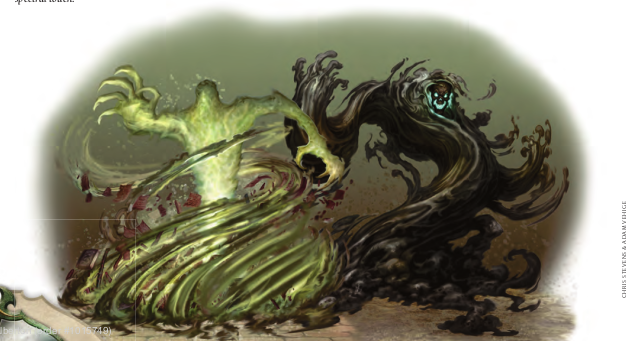
Copyright 2008 Wizards of the Coast This article is part of a series! Click here to see the other entries.
Specters have been in the game since the beginning, and here they’re only on the Monster Manual.
The Lore
When I talked about ghosts, I mentioned that every single synonym for that word used to be its own entirely separate type of incorporeal undead, and that 4e consolidated that a bit but not entirely. Specters are one of the undead that retained their own entry.
Specters are incorporeal undead that can form “naturally” when an evil murderer or other equally depraved villain dies. Unlike a ghost, they don’t retain any memory of their life, and aren’t bound to a particular location. However, they’re just as evil as they always were, and their new hatred of the living ensures they keep looking for people to kill.
Specters tend to cling to other equally malevolent undead, and will sometimes ally with evil living beings if that would ensure a steady supply of victims.
The Numbers
Specters are Medium Shadow Humanoid with the Undead keyword. They have darkvision as well as both the insubstantial and phasing traits. If you’re using Monster Vault-era rules this means they take half damage from everything but force attacks, but when specters were published they took half damage from all sources. Their HP is a bit lower than their level would indicate, so being insubstantial doesn’t make fights last that much longer.
As undead, they’re immune to disease and poison and have some degree of necrotic resistance and radiant vulnerability. They have no ground speed, but they fly, and it’s not like you can force a specter to land.
Specter
The basic model is a Level 4 Lurker with 30 HP and all the traits mentioned above. It flies at speed 6, has 10 necrotic resistance, and 5 radiant vulnerability.
The specter has a Spectral Chill aura (1), which inflicts a -2 penalty to all enemy defenses. It attacks with a Spectral Touch that targets Reflex and does necrotic damage. It can also unleash a Spectral Barrage (close burst 2 vs. Will) which does psychic damage and knocks prone. This is likely some sort of scary illusion.
As a standard action, the specter can become invisible until it attacks or is hit by an attack. It will likely alternate between attacking from invisibility, and retreating while invisible.
Voidsoul Specter
This is either the specter of someone really evil, or a basic model that has grown bloated through years of post-mortem murder. It’s a Level 23 Lurker with 115 HP. Its necrotic resistance increases to 30, and its radiant vulnerability to 10.
Spectral Touch works the same with bigger numbers. The Spectral Chill aura is stronger, dealing 10 cold damage to enemies caught inside in addition to inflicting the same -2 defense penalty. Its special attack is Life Siphon (Close Blast 5 vs. Fortitude; encounter) which deals necrotic damage and makes the specter heal 5 HP for every target damaged by it. Finally, its invisibility works the same but becomes a 1/round minor action instead of a standard one.
Sample Encounters and Final Impressions
The sample encounter has a basic specter, a deathlock wight, and a bunch of zombies and skeletons.
Specters feel to me like one of those monsters that should have been rolled into the “Ghost” entry. They don’t have much to distinguish them from ghosts or from wraiths (the other surviving synomym). I’d guess that’s why they didn’t make the Monster Vault.
-
Let's Read the 4e Monster Manual/Vault: Sorrowsworn
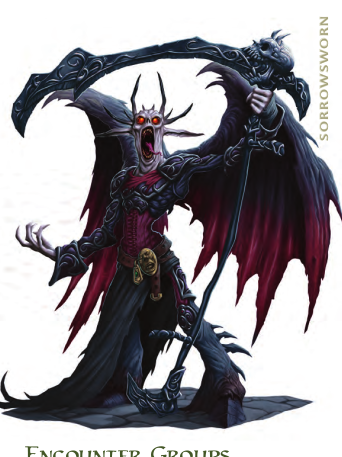
Copyright 2008 Wizards of the Coast This article is part of a series! Click here to see the other entries.
I believe Sorrowsworn started out as a type of Forgotten Realms demon in 2e, but now they’re something different. They’re only on the Monster Manual.
The Lore
Sorrowsworn resemble undead demons in appearance, though they’re neither demons nor undead. Rather, they’re a sort of living avatar of death. Does that sound contradictory to you? Deep mysteries tend to be like that.
You see, they’re not a natural species. Most are divine servitors of the Raven Queen, transformed into their current state by her powers. Some were mortals particularly attuned to death and its related concepts who managed to ascend on their own.
Both types were often shadar-kai in their mortal lives. Becoming sorrowsworn is seen by them as a glorious ascension, since it makes them not only ageless but also more goth than anything mortal.
Sorrowsworn feed on grief, and so tend to hang out at the sites of great catastrophes or conflicts. Those who serve the Raven Queen are also tasked with hunting down beings who have cheated death. This doesn’t mean people who were the subject of Raise Dead - rather, it’s people who have found a way to stick around beyond their appointed time. Most often they’re some sort of undead like vampires, liches or nightwalkers, but I guess someone who hunts phoenixes and regularly huffs their powdered feathers would fit as well.
Sorrowsworn lairs are bleak caves and pits whose walls are covered in tiny alcoves containing trophies from their past victims. These are arranged in tableaus that each tell a more depressing story than the last. Flocks of shadowravens (sinister half-spirit birds) hang out in these lairs, and swarm to attack intruders. These swarms also often fly out with their sorrowsworn masters, acting as heralds and allies to them in combat.
Their greatest enemies are the Nightwalkers, since they are anathema to all of the Raven Queen’s precepts. Death Giants are also frequent foes. Of course, despite their opposition to undeath they’re not really that nice themselves, and have their own stuff going on when they’re not on holy missions for the Raven Queen. That means they can easily end up fighting your PCs even when none of them are guilty of cheating death.
As sorrowsworn like to fight with scythes, I figure the symbol of death in 4e’s implied setting isn’t a robed skeleton, but a sorrowsworn. At least when it’s not an image of the Raven Queen.
The Numbers
Sorrowsworn are Medium Shadow Humanoids and have Darkvision. Their signature trait is Bleak Visage, a fear effect which inflicts a -2 penalty on melee and ranged attacks targetting them (close and area attacks are unaffected).
They use scythes in combat and their powers are a blend of teleportation and psychic attacks. They don’t have any elemental resistances of vulnerabilities, which is interesting.
Sorrowsworn Soulripper
This Level 25 Skirmisher has 236 HP and a land speed of 10. Unlike most of its colleagues, it fights unarmed, with claws that do a mix of physical and psychic damage, and deal extra damage when it has combat advantage.
It will often Flutter and Strike (recharge 5-6), which allows it to teleport 10 squares and make an attack with combat advantage at the arrival point. Sorrow’s Rush is an encounter power that allows it to move 10 squares and attack up to three different targets along the movement path.
Sorrowsworn Reaper
A Level 27 Soldier with 254 HP, this is likely the one that replaces the robed skeleton as the D&D setting’s “grim reaper” figure. It runs and climbs at speed 8, with Spider Climb.
It wields Sorrow’s Scythe, which does psychic damage and marks for a turn. It can also use a Reaping Blow (recharge 6), which is stronger and heals the reaper for 60 HP if it reduces the target to 0.
Sorrowsworn Deathlord
This Level 28 Lurker (Leader) has 204 HP. It’s surrounded by an aura (1) of Mournful Whispers that daze any enemies caught inside for a turn. It runs at speed 8, flies at speed 10, and has phasing.
Its Dark Scythe deals necrotic and psychic damage, and weakens for a turn. It can also Reap and Fade (recharge 3-6), which allows it to make an attack, teleport 10 squares, and become insubtantial for a turn in that order.
This is a lurker that inverts the usual routine! Instead of attacking every other turn, it can only be attacked every other turn, assuming it takes care to phase into a wall, floor, or ceiling after it attacks. So it moves in, attacks, and is exposed until its next action, when it attacks and moves away. Reap and Fade makes it even harder to pin down, as it can move in and use the ability to attack and immediately move away again.
Shadowraven Swarm
A shadowraven swarm counts as a Medium Shadow Beast with the Swarm keyword. It’s a Level 27 Brute with 296 HP. It has a land speed of 2 and a flight speed of 12, and all the standard swarm traits: a Swarm Attack aura, half damage from single target attacks, and 10 extra damage from area ones.
Its basic attack is a Swam of Talons that does a mix of physical and necrotic damage. Once bloodied, it can use the Murder’s Wrath encounter power, allowing it to fly 6 squares, move through other creatures’s squares, and make a basic attack against anyone whose square it moves through.
Sample Encounters and Final Impressions
Sorrowsworn tend to group with each other, with deathlords running the show and the others following their orders. They’re often accompanied by shadowraven swarms, and ride fell wyverns.
One of the sample encounters here also has them alongside the epic-level dragonborn deathknight, which hints that not all of them hate undead.
Sorrowsworn fill the same niche as rot harbingers: as regulars, they’re supposed to be the basic building block for encounters in a late Epic adventure focusing on their patron. I feel they work a lot better, though, as they have more interesting maneuvers in their stat blocks. They also don’t rely exclusively on necrotic damage, so it’s harder to get protection against their attacks.
I guess this explains why Orcus isn’t likely to usurp the Raven Queen anytime soon!
You can still use sorrowsworn in a campaign where the PCs aren’t likely to oppose the Raven Queen. There might very well be renegade sorrowsworn out there, and you could also reskin them and make them undead to use as better rot harbingers in a campaign focused on opposing Orcus.
subscribe via RSS