Posts
-
How I Started Role-Playing
Lich van Winkle has a post in his blog where asks people how they started role-playing. I figured I’d answer that here!
Before I start, it’s worth noting that I’m Brazilian, so my story is going to be a bit different than that of most people reading this blog. I also grew up in the state of Mato Grosso, which in the 80’s and 90’s meant “far out in the boonies” as far as RPGs were concerned. Most of my acquisitions happened during trips to visit family in Curitiba, a bigger city in another state.
-
The year you began, and with which role-playing game
-
Did you figure it out alone, or were you introduced by a lone but experienced GM, or by joining a preexisting group?
My first contact with the concept of role-playing games actually happened through Choose Your Own Adventure books. Y’know, those books that had a couple hundred numbered sections and directed you to different numbers based on your decisions. There were a bunch of those in my school library, which was a small miracle since that library only had like four bookshelves. This was 1991 or so, which means I was 9.
Later on I’d convince my parents to buy me similar books - my first Fighting Fantasy titles, in their Brazilian editions. These were more complex, with an actual character sheet and die rolling. I remember this book from some other series, where you played Robin Hood, and which had a combat system complex enough to rival AD&D.
My first actual RPG experience was around 1994, with a version of Basic D&D that was translated by a company named Grow, and packaged as a board game. I think it might have been a boxed set as well in the US - it was the one with Zanzer Tem’s dungeon on it, and had rules for PCs of up to level 5.
Shortly after that I got into GMing, and my games of choice were Tagmar (a Brazilian-made fantasy game) and later a very badly translated Shadowrun 2nd Edition. I also got familiar with GURPS and Storyteller at around this time, though I didn’t play them regularly. In 1996 I went on a one-month student exchange trip to the UK, and came back with a backpack full of Shadowrun supplements in English.
- What was your first group like? Was it private among friends, in a game store, or in a club? Were they older, younger than you? Did their style of play shape the way you played later?
The group was my brother and a couple of other friends. Almost everyone was around the same age as me (except for my brother, who was a bit younger). We usually played at my home, and I’d say my style of play shaped theirs more than the other way around, since I was always the GM.
I think I was the only one out of that bunch who kept being a part of the hobby once we split, though. Dunno if that speaks well or badly of my GMing skills.
- Your favorite role-playing game. (Was it the game you started with?)
It’s GURPS, and it’s not the one I started with. Lately I’ve also taken a
huge liking to Lancer.
- Anything else you want to share reflecting the impact of how you started on how you play(ed).
Despite being from a different country and having ready access to a very small pool of games when compared to someone from the US, my experience bears some striking similarities with Lich van Winkle’s in that D&D was a very small part of my formative experience. I remember finding its many arbitrary limitations very confining, so I spent most of my time in other games that didn’t have them. Though some of those limitations have been removed, a lot of them still remain in the game’s latest edition.
-
-
Let's Read the 4e Monster Manual/Vault: Tiefling
This article is part of a series! Click here to see the other entries.
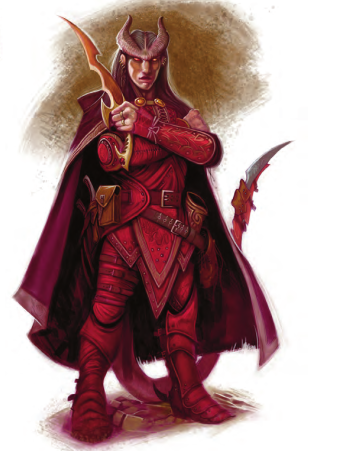
Tieflings rose to prominence during 2e, and were added as a playable option right in the Fourth Edition PHB, though they’re a little different from their previous incarnations here. As opposition, they’re featured in both the Monster Manual and the Monster Vault.
The Lore
As I mentioned in other entries, Nerath is only the latest empire to fall in the long story of the 4e setting. One of the many others that preceded it was the human empire of Bael Turath, which fought for supremacy with the dragonborn realm of Arkhosia a long time ago.
There came a time when Bael Turath was engulfed in turmoil, both because of that war and because of its own decadence. In a desperate bid to retain control, its leadership made sinister pacts with the forces of Hell. This worked for a time, but it only delayed the final fall of the empire. Things turn ugly when both the human nobles and the devils tried to break their side of the bargain. In the end, both Bael Turath and Arkhosia met their end.
One of the effects of that diabolic compact was that the humans of Bael Turath had their bodies infused with infernal power, transforming them into the tieflings we know today. This transformation is hereditary and it persisted even after the compact was broken and the empire fell. Today tiefling communities are spread all over the world, either mixed in with larger multi-species settlements or in small enclaves of their own, similar to dragonborn.
In addition to their distinctive looks, they retain a tiny bit of infernal power. Both these things give them a bad reputation among other sapients, but the truth is that modern tieflings are no more disposed to evil than any other people. A tiefling could be a great champion of good just as they could choose to embrace their bad rep and become evil diabolists.
Tiefling looks are a lot more uniform here than they used to be in previous editions: red skin, prominent horns, solid red orbs for eyes, and a thick muscular tail. They look like a less extreme version of a legion devil (which is hairless with clawed hands and hooves for feet in addition to the other traits).
The Numbers
Tieflings are Medium Natural Humanoids, and all of them have low-light vision and some degree of fire resistance. The MM stat blocks also have the same Infernal Wrath power tiefling PCs get. This is a minor action encounter power that gives them a +1 attack bonus and a damage bonus against someone who just hit them. It’s a “revenge” booster, essentially. Like PCs, they also get +1 to hit bloodied targets.
Each book gives us two tiefling stat blocks. As is the case for all playable humanoids, they can be of any alignment and could be used as allies or enemies. However, all of them seem to lean into their infernal heritage at least a bit, so even the good ones will have the same air of ambiguity around them as the party’s infernal warlock.
Tiefling Fury (Monster Vault)
This is a duelist type, and a Level 5 Soldier with 63 HP. Its speed is 6, and it has all common tiefling traits with 10 fire resistance.
The fury fights with a longsword whose attacks mark for a turn, and if a marked enemy shift it can use a Tail Trip (melee 1 vs. Reflex) as an interrupt to knock them prone and make a free longsword attack against them. If an enemy hits the fury, it can use a Defiant Curse as a free action to mark them for a turn.
Tiefling Heretic (Monster Manual)
An infernal warlock. It’s Level 6 Artillery with 60 HP, all common MM traits, and a fire resistance of 11.
The heretic fights with a dagger in melee, and with bolts of Balefire at range that deal immediate and ongoing fire damage (save ends). Once per encounter it can conjure a Serpent Curse on a target (ranged 10 vs. will), causing illusory snakes to appear and deal both immediate and ongoing psychic damage.
When hit by a melee attack, the heretic can use Cloak of Escape as an at-will reaction to teleport 5 squares. It also has Infernal Wrath.
Tiefling Darkblade (Monster Manual)
An assassin-type, and a Level 7 Lurker with 64 HP and fire resistance 12. Darkblades fight with poisoned shortswords that allow a secondary attack against Fortitude on a hit, doing ongoing poison damage (save ends). They can use Cloak of Lurking (move action; recharge 6) to teleport 5 squares and become invisible.
It seems they don’t have any powers that allow them to do increased damage when attacking from hiding or with CA, so they’re in effect slightly weaker skirmishers.
Tiefling Occultist (Monster Vault)
Another infernal warlock! This one is a Level 8 Controller with 87 HP and fire resistance 10.
Occultists fight in melee with a Hell Rod that does immediate and ongoing fire damage (save ends). They attack at range with Soul Fire (area burst 1 within 10 vs. Reflex), which does no immediate damage. Instead it does 10 ongoing fire damage (save ends), and deals 10 psychic damage to the target if it moves closer to the occultist on the target’s next action.
As a move action it can use Baleful Teleport (ranged 10 vs. Will) to teleport a target 10 squares and teleport itself to the square the target just left.
If an enemy hits the occultist, it can use Fiery Transposition to deal 5 fire damage to all enemies in a close burst 3, and swap places with the enemy that hit it.
Sample Encounters And Final Impressions
The sample encounter goes all in on the hellish imagery: 1 heretic, 1 darkblade, 2 cambion hellswords, and a succubus.
I like tieflings, though more as a playable race than as an enemy. The enemy stat blocks work well enough, however, and could also represent human warlocks or other similar baddies.
-
Let's Read the 4e Monster Manual/Vault: Treant
This article is part of a series! Click here to see the other entries.
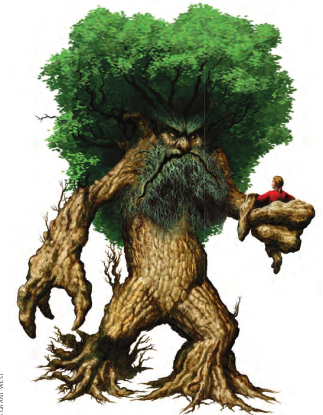
Treants are inspired by Tolkien’s ents and have been in the game since at least the days of BECMI, and likely earlier. Here, they are both in the Monster Manual and in the Vault.
The Lore
Treants are indeed very similar to the ents we see in The Lord of the Rings: they’re sapient tree-like creatures who live in primeval forests. The main difference between them (especially in 4e) is that treants are a lot quicker to arrive at decisions, and a lot angrier with trespassers.
Treants love the forests where they live, and act as their guardians. They spend much of their extremely long lives in a dormant/meditative state in which they’re pretty much indistinguishable from normal trees. In this state, they can feel the general state of the surrounding forest and its creatures, and know when it’s in distress. When that happens, they rise to defend it.
Though treants love their forest and its creatures, they hold no particular regard for any outsiders. They’ll be friendly towards those who demonstrate the proper respect for the wild, and violent towards anyone who has the temerity to chop down trees or otherwise despoil their territory.
The Monster Vault goes a little further here, saying that treants view civilization in much the same way “civilized” people view the untamed wild: a source of danger best removed. Their prefer nature in its wildest and most unspoiled state, and will work to protect their territories even from natural disasters like floods or fires caused by lightning. They’ll ally with anyone who shares their values and opposes their enemies. They’re also very easy to anger (particularly when they feel they’ve been betrayed) and very hard to placate.
A treant’s most frequent allies are dryads, who share their general disposition. Eladrin and other fey are often allies as well, though in this case both sides tend to view each other more warily. You could even have a treant protecting the lair of an orc tribe, as long as the orcs focus their destruction outside of the treant’s domain.
The Numbers
Treants are Huge Fey Magical Beasts with the Plant keyword. They have low-light vision, Forest Walk, and a Wooden Body trait that makes them take ongoing 5 fire damage (save ends) whenever an attack deals immediate fire damage to them. The trait only gets a name in the Monster Vault, but is also present in the MM versions. If the attack in question already does ongoing fire damage, I guess this trait doesn’t stack with it.
Treants fight using a combination of their great strength with primal magic that grants them a measure of control over their surroundings. They’re fairly smart at Int 14, and though grumpy and aggressive they’re Unaligned.
Bramblewood Treant (Monster Vault)
Unlike the other treants, this one is “only” Large. It could be a younger specimen, or a different species that inhabits forests with smaller trees. It’s a Level 10 Soldier with 108 HP and all common treant traits. It has speed 8 and a Bramble Branches aura (2) that turns the covered area into difficult terrain.
The bramblewood treant attacks with Reach 2 slams that mark the target for a turn, and can throw stones (Ranged 20 vs. AC) for some ranged damage. If an enemy within 2 squares moves, the treant can use Entangling Branches (melee 2 vs. Reflex) as an interrupt and grab them with an escape DC of 18.
This treant is at the right level to pal around with most dryads, some of the eladrin, or the banshrae.
Treant (Both)
The basic model is Huge, and a Level 16 Elite Controller with 316 HP and all common traits. Its land speed is 8, and it projects a Grasping Roots aura (3) that makes the covered area difficult terrain for nonflying enemies.
It fights with powerful slams, and can use an Earthshaking Stomp (close burst 2 vs. Fortitude) to do a bunch of damage and knock enemies prone. In the Monster Manual this is an encounter power, and in the Monster Vault it recharges if the attack misses every target.
The treant’s other trick is Awaken Forest (area burst 3 within 10 vs. AC), which causes the vegetation in the area (trees included) to animate and attack enemies within. In the MM this is an encounter power that creates a zone which can be sustained with minor actions, and which makes new attacks against enemies inside whenever the treant sustains it.
In the MV, it’s a simple at-will standard action attack, and it creates a zone of difficult terrain that lasts either until the end of the encounter, or until the treant uses this power again.
The Monster Vault version of the treant is by far the better one, since it has updated damage values and is also a better controller. Other than “use fire”, there isn’t much you can do to get the upper hand over it, since it can make solid attacks and impair movement both in melee and at range. Treants pair really well with other creatures that have the Forest Walk ability.
Treant Grove Guardian (Monster Vault)
I guess this is the sort of creature you can find guarding a powerful druid’s home base. It’s a Level 18 Brute with 212 HP and all common treant traits. Its speed is 8.
Grove guardians are all about physical combat. Their basic attack is a Reach 3 Sweeping Slam that can target one or two creatures, damaging and knocking them prone on a hit. Once per encounter they can perform a maneuver called Stump Stomp, in which they move their speed, can enter other creature’s spaces, and make a sweeping slam attack against each creature whose space they enter.
Blackroot Treant (Both)
This is an undead treant. You know those haunted forests where the trees seem to have evil faces? These guys are those trees. Unlike living treants they’re actively Evil, and actually a bit smarter at Int 16.
Blackroot treants are Huge Level 19 Elite Soldiers with 368 HP and all common treant traits. They have Speed 6 and the Undead keyword in addition to being Plants. They project a Killing Roots aura (2) which does 10 necrotic damage to enemies caught inside.
Their Reach 3 slams also do ongoing necrotic damage (save ends), and mark the target for a turn. They have Double Attack, and so can use two of those per action. As a minor action they can use Entangling Roots (melee 4 vs. Reflex) to knock someone prone and restrain them.
The Monster Manual version is a less powerful, since it lacks Double Attack, its slams don’t mark, and the effect of Entangling Roots ceases if the treant gets more than 4 squares away from the target. Always use the MV version if possible. Used well, they can keep most of the party locked down tight, since they can use Entangling Roots 1-3 times per turn and have no limit to the number of people they can keep restrained.
Sample Encounters and Final Impressions
The MM sample encounter is level 19 and all about that haunted forest vibe: 1 blackroot treant, 2 slaughter wights, and 2 sword wraiths.
I like treants, even though this iteration of them is a bit more aggressive than I would like. Mechanically speaking, the MV versions are clearly superior to the MM originals, and you should use them whenever possible.
-
Let's Read the 4e Monster Manual/Vault: Swordwing
This article is part of a series! Click here to see the other entries.
Swordwings are a 4e original, I believe. They’re only on the Monster Manual, though I think they get some extra lore in a Dragon article.
The Lore
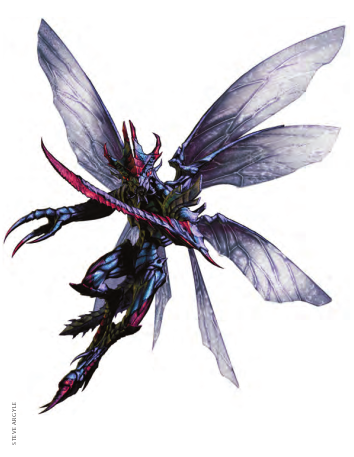
Swordwings are a species of humanoid arthropod who lives in the deep Underdark. Their name comes from their wings and from the fact that one of their arms is shaped like a sword and can be used as such. They’re sapient, and their alien culture is focused on building and displaying collections. Of what? It varies!
Every individual swordwing has its own preferences. Some are specialized in a single type of object, while others are more eclectic and keep several different collections. The book says typical examples are collections of skulls, weapons, gems, magic items, eggs, or victims’ hearts. A swordwing’s collection is what defines it as an individual, and I guess the quality of that collection might also act as a measure of status in their society. This implies that every swordwing is a connoisseur and an expert curator in its chosen field.
Swordwings build nesting spires using the same biological processes a wasp would use: chew the surrounding material and transform it into a paper-like substance, which gets molded into the final structure. Each home in these spires is a small museum of its inhabitant’s collection.
These creatures fly out of their nests in groups to find more items suitable for display, and as you might expect they don’t much care for the feelings of those items’ current owners. Sometimes, they’ll ally with other denizens of the Deep Underdark who don’t own anything they collect but can help them increase their hoards in exchange for certain favors.
As I remember, these monsters were responsible for starting one of the battles in the Edition War, since they were showcased in an article as an example of the sort of all-new monster you would see in the new edition to better support epic play. Detractors complained a lot about how swordwings made no sense because any world where these things lived would end in short order.
To a point, that’s true - any epic monster that gets loose in the sort of setting one imagines for a low-level game can theoretically turn into an unstoppable, apocalyptic menace. However, this is supposed to be the game whose settings have a place for epic creatures. And for Swordwings, that’s the deep Underdark, where they get to pal around with eye tyrants, gibbering orbs, and alien gods from the Far Realm. Preventing these fine folks from invading the surface is the type of thing an epic campaign is supposed to be about.
The Numbers
Swordwings are Aberrant Humanoids, and prove that the Aberrant origin isn’t always about tentacles. Sometimes it’s about sword arms!
Swordwings are Evil and communicate using Deep Speech. They have a ground speed of 6 and a dragonfly-like air speed of 10 with Hover. They have low-light vision, and their main attack is of course the armblade, tough different stat blocks do different things with it. There’s two of those.
Swordwing
The basic model is Medium, and a Level 25 Soldier with 234 HP. Its armblade is a Reach 2 high-crit weapon and gains a +2 to attack bloodied targets. It also marks the target for a turn, and benefits from a couple of passive traits that increase its damage in certain situations.
One of them is Sudden Strike, which allows the swordwing to attack an adjacent enemy that shifts as an interrupt, with a damage bonus. Thanks to Vicious Opportunist, the swordwing also gains the same damage bonus on opportunity attacks.
These critters are awesome at fighting in a square formation two bugs deep, where both rows can attack. They’re also good in a wedge formation, since they’re so effective at punishing enemies who try to slide around them. Both of these are better in tight quarters - wide open spaces might make then susceptible to ranged attacks, though they can close the gap really fast.
Give them some artillery and controller allies who can stand behind that tight formation, and the PCs should sweat a bit. If the heroes have lots of area attacks at their disposal, basic swordwings are also really effective in a looser skirmish formation, since each individual can exert some control over its immediate area.
Crownwing
This Large specimen is likely a high-status individual. It could be because of simple genetics, though I think it’s more interesting if they mutate as their collections grow fancier and more prestigious. Their average Int is 18 instead of the basic model’s 10, and they have more skill training. It’s plausible they know and can use magic rituals.
Crownwings are Level 26 Skirmishers with the Leader tag and 238 HP. Their armblade is still a Reach 2 high-crit weapon, and this time it does bonus damage against flanked targets. They can make the standard Flyby Attack maneuver where they fly their speed without drawing opportunity attacks and make an armblade strike at any point.
Their leadery skill is the Mark of Death (ranged 10, encounter), which always hits and grants allies a +2 to attack and +10 to damage against the target. This lasts until the end of the fight, which suits an encounter power.
Crownwings are a perfect complement for a troop of basic swordwings, and they also work really well in command of a gaggle of minions, who suddenly become a lot more dangerous against a PC afflicted by the Mark of Death. Multiple crownwings can mark multiple PCs and switch targets so they’re always hitting someone who gives them a damage bonus. Smart PCs should try pin these things down ASAP, and either attack from range or keep switching back to avoid the bonus.
Sample Encounters and Final Impressions
There’s two sample encounters:
-
Level 25: 4 swordwings and 1 crownwing. Your basic patrol or raiding squad.
-
Level 29: 3 swordwings and a gibbering orb. Boss-and-bodyguards, with the guards acting as a nice force multiplier.
It might be my bias towards 4e speaking, but I really like swordwings. They fulfill a needed role of “high-level regulars”, and their collecting obsession makes them more than just “Orcs, but Epic”. It also helps that they can fly.
-
-
Let's Read the 4e Monster Manual/Vault: Spider
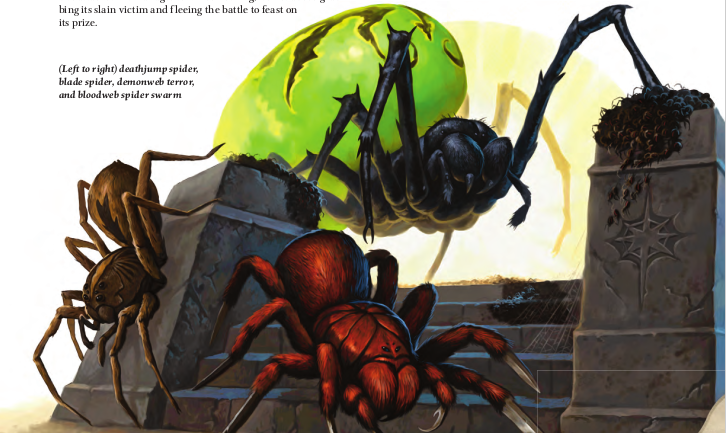
Copyright 2008 Wizards of the Coast This article is part of a series! Click here to see the other entries.
Spiders have been in the game since the beginning. Here, they’re present in both the Monster Manual and in the Monster Vault’s animal appendix.
The Lore
While some real-world spiders can have a pretty dangerous bite, they’re not really suitable as a combat encounter. The books concern themselves with monstrous giant spiders instead.
There are many species of monstrous spider in D&D and they’re everywhere. Deserts, forests, caverns (“surface” or Underdark), ruins, anywhere a tiny spider would like can be home to a monstrous variety as well. The vast majority of them are simply natural creatures, but some are the blessed of Lolth and enjoy her divine gifts.
Predictably, drow love spiders and frequently train them or control them through magic to serve in all the same capacities someone on the surface would use a dog, horse, or drake for. Kobolds and goblins might also employ them if they’re part of the locally available fauna.
The Numbers
All spiders shown here, with one exception, are Natural Beasts with the Spider keyword. That keyword is important because, among other things, drow tend to have lots of powers that buff spider allies.
The individual stat blocks vary a lot, but all have some level of Tremorsense, and a climb speed equal to their ground speed with the Spider Climb tag (obviously). Their basic attack is always a bite and almost always has some sort of venom effect associated with it.
All of the Monster Vault spiders have Web Walk, which allows them to ignore web-based difficult terrain. While this isn’t explicitly listed in the Monster Manual entries it would be fair to assume all of them have it too.
Spider Swarm (MV)
The least monstrous of the bunch, this is a lot of normal-sized aggressive spiders acting as a swarm monster. The swarm is a Level 3 Soldier with 44 HP, tremorsense 5 and a speed of 6, along with the usual swarm resistances and vulnerabilities.
Its Swarm Attack aura (1) slows enemies caught inside instead of granting extra attacks. They attack with a Swarm of Fangs that targets Reflex because they get inside your armor. It has an ongoing poison damage rider (save ends).
Deathjump Spider (Both)
These Medium spiders are Level 4 Skirmishers with 55 HP. They have tremorsense 5, resist poison 5, and a speed of 6. Though they have Web Walk, they’re not big spinners themselves, and hunt by jumping on their prey.
The stats for the spider’s bite are a bit wonky in the MM version: compared to what the updated math says, their attacks are woefully inaccurate and abnormally strong. The MV version fixes this. In both cases, the rider is ongoing poison damage (save ends).
The deathjump spider’s special attack is Death From Above, in which the spider shifts up to 6 squares by jumping and makes a bite attack at the end. If that hits, the target is also knocked prone. The MM version also does increased base damage.
It can also make a Prodigious Leap as a move-action encounter power, which allows it to shift 10 squares. So this spider could initiate combat by jumping at the party’s wizard from a full 16 squares away!
The MM gives it another trait, Soft Fall, allowing it to ignore the first 30 feet of height of any fall. This is absent from the MV version, probably because they thought it was a bit too finicky.
Bloodweb Spider Swarm
A more powerful version of the MV swarm, these spiders have been brought together and are controlled by magic. Without orders, they’ll default to attacking the nearest living creature until it dies before moving on to the next victim.
This swarm counts as a Level 7 Soldier with 80 HP. It otherwise works just like the level 3 swarm, except that it’s slower at speed 4 and its aura does grant free basic attacks.
Doomspinner Spider (MV)
This chunky Large spider does spin elaborate webs to catch prey with. It’s a Level 7 Controller with 82 HP, Tremorsense 10, Resist Poison 5, and speed 6.
Their bite also has an ongoing poison damage rider, which increases if the target of the bite is restrained, immobilized, stunned, or unconscious. Its special attack is Web Casting (area burst 1 within 5 vs. Reflex), which does no damage but restrains everyone it hits. The area of the burst becomes difficult terrain until the end of the encounter.
As a minor action the doomspinner can also shoot a strand of webbing at someone, in an attack named Drawn to Doom (Ranged 5 vs. Fortitude), which does no damage but pulls the target 4 squares.
Though doomspinners can restrain enemies by themselves, they also pair really well with other monsters that can inflict the conditions that increase the effectiveness of their venom. “Multiple doomspinners” is the obvious setup, but there are plenty of other options.
Blade Spider (MM)
These Large spiders have two blade-like front legs, and attack with them instead of biting. They live in the Underdark and are popular drow pets, having the Mount keyword.
Blade spiders are Level 10 Brutes with 130 HP, tremorsense 10, and speed 6. Unlike most of their relatives, they have no resistance to poison. Their basic attack is a Claw with a rider that does ongoing poison damage and weakens (save ends both). They can make double attacks with that.
When used as mounts, they can make combined attacks, which means they attack with a claw as a free action when their rider makes an attack.
Cave Spider (MV)
These Medium spiders likely behave as a scaled-up swarm, with their size and numbers being such that you can track them individually. They’re level 12 Minion Skirmishers with tremorsense 5, resist poison 10 and speed 6.
Their bite does the usual fixed minion damage, with additional poison damage on top if the target is immobilized, restrained, stunned or unconscious. They can also use a Tethering Web (ranged 10 vs. Reflex) as a minor action to immobilize someone for a turn.
Combine a small horde of these with a leveled-up doomspinner or three, and your PCs are going to have a bad time.
Demonweb Terror (MM)
Native to the Demonweb Pits, these are the true blessed of Lolth. They’re Huge Elemental Beasts with the Spider keyword. All the other spiders in this entry are simple Unaligned animals with Int 1, but terrors have Int 8 and are Chaotic Evil. You can try to talk to them if you know Abyssal, but that will do you no good.
Demonweb Terrors are Level 14 Elite Controllers with 296 HP, tremorsense 10, and a speed of 6. Interestingly, they have no poison resistance, though perhaps they should.
Their bite carries a venom that does ongoing poison damage and slows (save ends). As a 1/round minor action they can shoot a web (ranged 10 vs. Reflex) that does no damage and immobilizes (save ends). After they’re first bloodied, they can use the Poison Spray encounter power (close blast 5 vs. Fortitude) that has the same effects as the bite’s rider over the whole area.
These feel a tiny bit underpowered - they were likely only made Elite to pad out their HP. However, they likely work well when accompanied by other monsters who can capitalize on the immobilization and slowness they inflict.
Sample Encounters and Final Impressions
The MM gives us 2 sample encounters:
-
Level 11: 2 blade spiders, 2 bloodweb spider swarms, 1 drow blademaster.
-
Level 15: 1 demonweb terror, 1 drow arachnomancer, 2 drider fanglords and 3 drow warriors.
As you can see, the book goes all-in on the whole Lolth connection. Any encounter with drow is likely to involve spiders. And while the lower-level spiders will likely be found as dungeon wildlife, the more powerful ones will very often be accompanied by drow as well.
I think giant spiders are a classic dungeon denizen, and work well when used in moderation. Of course, drow are known for despising the concept of moderation when it comes to arachnids.
-
subscribe via RSS