Posts
-
Let's Read the 4e Monster Manual/Vault: Snake
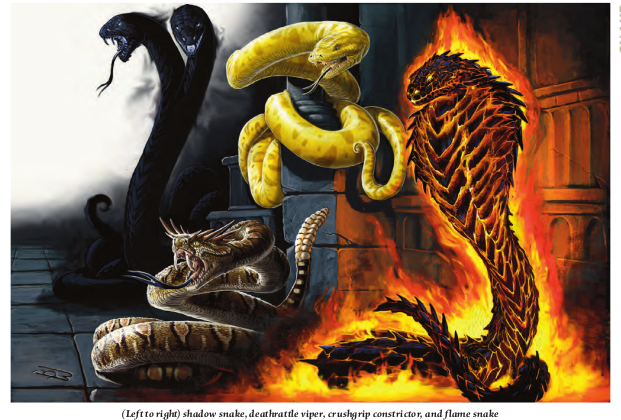
Copyright 2008 Wizards of the Coast This article is part of a series! Click here to see the other entries.
Snakes have been in the game since the beginning. They are present both in the Monster Manual and in the animal appendix of the Monster Vault.
The Lore
Snakes are real world animals, but there’s a huge body of legend surrounding them in practically every culture. D&D seems to be partial to the Western depiction of snakes as treacherous and deadly, since it has Zehir as one of its evil gods.
Still, this entry focuses on monstrous snakes. The mundane varieties likely behave pretty much as they do in the real world, with a lot of them being harmless and the dangerous ones only attacking if they feel threatened.
Though monstrous snakes are large and aggressive enough to actively hunt people, most are still merely dangerous animals. A rare few might be blessed by Zehir, though, which makes them sapient, evil, and more powerful.
Between the two books we have quite a lot of different snake stat blocks.
The Numbers
Snakes are so varied that they have little in common that I can discuss here. They’re all beasts, they all have the Reptile keyword, and they all bite. That’s it.
Spitting Cobra (Monster Vault)
The closest you’ll get to a real snake here. Spitting Cobras are Small Natural Beasts, and Level 5 Minion Soldiers. Their bite does poison damage and marks for a turn, and their Blinding Spittle (ranged 5 vs. Reflex; recharge 4+) does the same damage and blinds (save ends).
I could see an eccentric kobold artificer firing these out of a cannon, or a priest of Zehir summoning them out of thin air.
Deathrattle Viper (Both)
Pretty much a dire rattlesnake. It inhabits forests, jungles, and caves, though they wouldn’t look out of place in a desert either. These vipers are Medium Natural Beasts, and Level 5 Brutes with 75 HP. They have low-light vision, and resist 10 poison. Their land speed is 4, and they also have a climb speed of 4.
Their bony tails produce a magically enhanced Death Rattle that acts as an aura (2) which inflicts a -2 attack penalty to all enemies inside. This is a fear effect.
Their bite allows a secondary attack vs. Fortitude on a hit, which delivers their venom in the form of immediate and ongoing poison damage (save ends).
Deathrattle Vipers also appear in the Monster Vault, and are identical aside from their updated bite damage. Their low speed makes running away from them a feasible tactic even for someone in heavy armor, so they should be paired with other monsters that make this more difficult.
Crushgrip Constrictor (Both)
This is what you’d get if all the shit they say about boas and anacondas was true. They’re found in jungles, marshes, and underground. Constrictors are Large Natural Beasts and Level 9 Soldiers with 96 HP. They have land, climb and swim speeds of 6. They’re the other snake that exists in both books.
Their bite does damage and grabs on a hit, as the snake quickly coils around the target. The escape DC 25 for Athletics and 22 for Acrobatics in the MM, and a gentler 17 in the MV.
Against a grabbed target they can Constrict, which targets Fortitude, does a nice chunk of physical damage, and dazes for a turn.
No explicit mention is made of how many targets the snake can have grabbed. If you’re being relatively realistic, it should be just one. Larger or more supernatural versions might be able to coil around multiple unfortunates.
Flame Snake (Monster Manual)
A snake from the Elemental Chaos. Not much is written about its origins, so it could be a case of parallel evolution or one of those rare instances where creatures from the world migrated to the other planes and adapted to them. As fire elementals, they can be summoned and controlled by magic.
Flame Snakes are Medium Elemental Beasts with the Fire and Reptile keywords. They’re Level 9 Artillery with 74 HP and Resist Fire 20. They have a speed of 6, but can’t climb or swim. They also can’t see in the dark, though it’s reasonable to say their incandescent bodies would shed light.
Their bite does a mix of physical and fire damage, and they can Spit Fire (Ranged 10 vs. Reflex), doing both immediate and ongoing fire damage (save ends).
Shadow Snake (Monster Manual)
The blessed of Zehir, these two-headed monsters are made of solid shadow and are venerated by Yuan-ti. They’re level 16 Skirmishers with 158 HP. They slither at speed 7 and have a climb speed of 7. Their Int is 4: they’re not exactly sapient, but are very cunning, and also Evil.
Their bites do physical and ongoing poison damage (save ends), and they can make Double Attacks because of the two heads. Once per encounter they can make a Shifting Shadowstrike, shifting their speed (7) and biting two different targets as they do so.
Also once per encounter, they can Vanish Into the Night, which makes them insubstantial, gives them phasing, and makes them invisible in dim light. All of this lasts for a turn and makes for an excellent “escape hatch” when the fight starts to go badly. I imagine shadow snakes very rarely fight to the death - they’d be smart enough to cut and run.
Sample Encounters and Final Impressions
The Monster Manual seems to think reptiles gotta stick together, so it has a bunch of encounters that feature snakes alongside level-appropriate sapient reptiles that act as their handlers:
-
Death rattlers and lizardfolk
-
Constrictors and snaketongue cultists (which aren’t reptiles, exactly, but are close enough).
-
Flame Snakes and troglodytes.
-
Shadow Snakes and yuan-ti.
I imagine you could use death rattlers as “minibosses” in low-level adventures featuring kobolds, as well.
These snakes don’t exactly rock my world, but I feel they’re still a good addition to the game.
-
-
Let's Read the 4e Monster Manual/Vault: Slaads
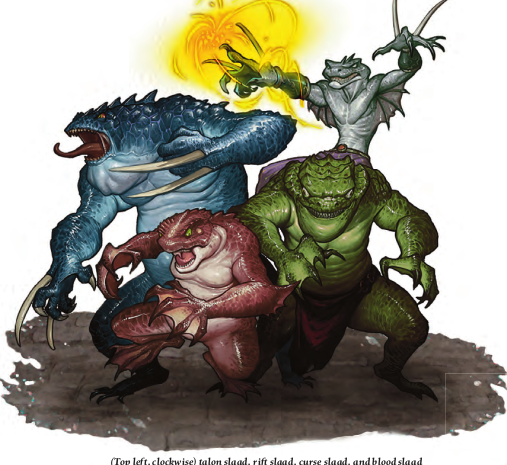
Copyright 2008 Wizards of the Coast This article is part of a series! Click here to see the other entries.
Slaads show up in the AD&D 2nd Edition Monster Manual (though they might have appeared earlier in a supplement for 1e). In Fourth Edition, they are only on the Monster Manual.
The Lore
Slaads are froggy-looking monsters who inhabit the Elemental Chaos and whose psychology can be summed up as “LOL, so random”. Their grip on reality, both mental and physical, is very tenuous. Your typical Slaad makes the Mad Hatter look quite centered, and any relationship between what it says to you and what’s actually happening tends to be coincidental. Not that most people get a chance to talk to them - most of their interactions with other beings are violent.
The main reason everyone hates them, though, is that they reproduce by sinking their ovopositor claws into people and injecting them with eggs, which hatch explosively in a few days to produce a “tadpole” the size of a large dog. That tadpole, in turn, takes another handful of days to grow into an adult. In true slaad fashion, the sub-type of the new individual is random and has no relation to the sub-type of its parent. Having a slaad egg implanted in you is treated as a disease called Chaos Phage by the rules.
Slaads were Chaotic Neutral in the old alignment system and 3e in particular made a big deal out of saying they were an expression of “pure chaos untainted by morality”. The distinction between that and Chaotic Evil turned out to be largely academic, though, so in 4e’s alignment system all slaads are Chaotic Evil. They’re not out for omniversal destruction like demons are, but “fuck shit up for shits and giggles” fits both their usual MO and the description of Chaotic Evil.
There’s a bit in Secrets of the Plane Below about how slaads used to be both more protean and mentally stable back in Olden Times, but a couple of particularly powerful slaads broke their metaphysics to ensure they would remain at the top of the heap. That’s why they all look like humanoid frogs, and why they are color-coded for your convenience despite being “the most chaotic” creatures.
The Numbers
Most Slaads are Medium Elemental Humanoids. They have low-light vision, a land speed of 6, and a variable teleport speed. They’re also immune to Chaos Phage, just to underscore that they need to infect non-slaads to reproduce.
Every slaad has a basic claw attack that does damage as normal for the monster and triggers a secondary attack vs. Fortitude on a hit. If the secondary attack hits, the victim is infected with Chaos Phage. Other attacks and powers vary with the type of slaad.
Chaos Phage is a nasty level 16 disease, with an Improve DC of 25 and a Maintain DC of 20. Stage 1 has no visible symptoms, but there’s a slaad egg inside you now. Stage 2 inflicts a -2 penalty to Will and makes you go berserk while bloodied, forcing you to always attack the closest living creature (ally or enemy). Stage 3 is death as a slad tadpole rips you open and crawls out.
Slaad Tadpole
Tadpoles are Small, which means they’re the size of a large dog or a halfling. They’re Level 5 Lurkers with 44 HP, and are more interested in running and growing up than in fighting. They have a weak bite that makes them insubstantial for a turn when it hits, and they can shift 2 squares as an interrupt when attacked in melee.
Tadpoles are suitable for use in an heroic-tier adventure where the goal is to prevent them from growing into adult slaads.
Grey Slaad
Also known as Rift Slaads, these used to be among the most powerful in their ladder, but have been somewhat demoted. They’re Level 13 Skirmishers with 128 HP, a teleport speed of 4, and all common slaad traits.
Rift slaads mostly fight with their claws, and back them up with space-bending defensive powers. Once per encounter they can Induce Planar Instability (Close Burst 3 vs. Will), which does a little damage, slides the targets 3 squares, and knocks them prone. When they’re hit with an attack that causes a condition (like slowed, dazed, and so on), they can use Condition Transfer as an interrupt to make the condition affect someone else instead. This counts as a Ranged 5 attack vs. the Fortitude of the chosen target.
When they’re first bloodied, rift slaads cause a Planar Flux that teleports them 8 squares and turns them insubstantial for a turn.
Red Slaad
Also know as Blood Slaads, these are straightforward bruiser types. They’re Level 15 Soldiers with 146 HP and all common slaad traits. Their land speed is 8, and their teleport speed 4. They have a second basic attack in the form of a bite that does a bit more damage than the claws but doesn’t inject any eggs.
Their main special technique is the Leaping Pounce (recharge 5-6) which allows them to shift 4 squares and make two claw attacks against 1 or 2 enemies. If any of them hit, the target is marked for a turn. This is the only way they have to mark enemies.
Once per encounter a blood slaad can produce a Horrid Croak (close blast 5 vs. Fortitude) that does no damage but immobilizes its targets for a turn on a hit.
Blue Slaad
Also known as Talon Slaads, they’re notable for having Wolverine-like bone claws sprouting from their hands. Talon Slaads are Level 17 Brutes with 200 HP. Their teleport speed is 2.
Their big talons transmit the Chaos Phage as usual, and can also be used to fling victims willy-nilly. This is a bit weaker than the basic attack but slides the target 2 squares and knocks it prone on a hit.
Once it’s bloodied, the talon slaad gains access to Ravager’s Fury (close burst 2 vs. AC; encounter), an attack that gives it 20 temporary HP if it hits anyone.
Green Slaad
Also known as Curse Slaads, they’re the brains of the family with Int 15 where the others have 9 or 11. A curse slaad is a Level 18 Controller with 173 HP. It’s teleport speed is 6, equal to its normal movement, so it has no reason to walk anywhere.
Aside from the usual claws, they can shoot Chaos Bolts as a ranged basic attack vs. Will, which do untyped damage and daze for a turn. Occasionally they can use Transpose Target (Ranged 10 vs. Reflex; recharge 6) to do some damage and teleport a target 10 squares to somewhere it can see. And once per encounter it can use a Croak of Chaos (close burst 4 vs. Fortitude) to do damage over an area and slide the targets 4 squares, rearranging most of the battlefield.
Green Slaads were also the most “wizardly” of the bunch, so they could very well know all sorts of weird rituals and non-combat magic.
Black Slaads
When your run-of-the-chaotic-mill slaad gets infected by the energies of the Abyss, you get one of these. Also known as Void Slaads, they lose the ability to reproduce but gain all sorts of entropy-based powers and a more active malevolence than that of their lesser kin. A lot of their attacks are energy-based or infused, but since that energy is pure entropy their damage is untyped.
Void Slaads are Level 20 Skirmishers with 191 HP. They’re Large, immune to all disease (not just Chaos Phage) and insubstantial. They run at speed 6 and teleport at speed 3. They retain their standard low-light vision.
A void slaad’s Claws don’t lay eggs. Instead, in addition to their standard damage they do 10 ongoing damage (save ends). Each failed save eats a healing surge in addition to prolonging the damage! Perhaps they implant miniature black holes instead of eggs.
They attack at range with Rays of Entropy (ranged 20 vs. Reflex), which damage and surround the target with an entropic shroud (save ends). While the shroud is active, the target takes extra damage from all attacks that hit it!
When a void slaad dies, it explodes into a Zone of Obivion (close burst 2 vs. Reflex) that damages everything in its area. It persists until the end of the encounter, blocking line of sight and dealing the same damage as the initial attack to everything that enters it.
Sample Encounters and Final Impressions
Most slaad encounters are slaad-only, but sometimes they’ll ally themselves with other creatures for some mysterious reason. The sample MM encounters present two such situations:
-
Level 15: 2 gray slaads, 2 red slaads, and a destrachan far voice.
-
Level 19: 1 black slaad, 2 rockfire dreadnoughts, a fire giant forgecaller, and 2 firebred hellhounds.
I kinda like these guys, and I like that they’re Chaotic Evil in 4e. I never bought that story about how they’re some pure manifestation of Chaotic Neutral even though most of what they do is kill people and lay eggs in their chest cavities, not necessarily in that order.
-
-
Let's Read the 4e Monster Manual/Vault: Skull Lord
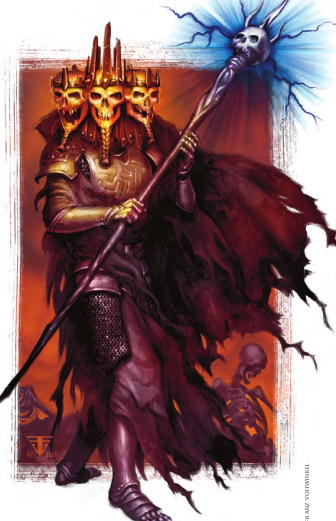
Copyright 2008 Wizards of the Coast This article is part of a series! Click here to see the other entries.
I had never read of skull lords before reading about them here, but they have a very 3e vibe to them so likely originated there. They are only on the Monster Manual.
The Lore
Despite the imposing name and the very Metal illustration, skull lords are made to be lieutenants. They’re created by powerful necromancers or liches to command their hordes of lesser undead, so they always answer to some higher power.
The book doesn’t get into much more detail than that, but it seems to me like skull lords are created undead similar to skeletons. They were never alive and the bones are just raw materials for their creation. Unlike common skeletons, they’re sapient and quite intelligent.
The first skull lords in recorded history emerged from the ruins of the Black Tower of Vumerion. Vumerion was a “legendary human necromancer” who apparently had his career cut short by a band of intrepid adventurers, and those skull lords might have been part of his contingency plans. They roam the land looking for a way to bring their dread master back to the world.
The ritual for making skull lords eventually made its way out of those tower ruins, too, so you might find these monsters working for anyone with the stomach to make them.
Each of those three skulls anchors a different set of magic powers, and all three must be destroyed to destroy the monster itself.
The Numbers
Skull Lords are Medium Natural Humanoids with the Undead keyword, and Level 10 Artillery with a paltry 40 HP. This is not a typo, and you’ll see why soon. They have darkvision, a speed of 6, and the standard undead resistances (immunity to disease and poison, necrotic resistance, radiant vulnerability).
Skull lords project an aura (2) named Master of The Grave, which grants Regeneration 5 and a +2 bonus to saves to any undead allies inside. The aura is anchored to the Skull of Death’s Command, below, so if that’s destroyed it stops.
The skull lord’s basic attack is a Bone Staff that does a mix of physical and necrotic damage, but the three skulls are the main event. Each has an attack power that can be used as a minor action once per round, meaning the skull lord can use all of them in its turn if it doesn’t move.
The Skull of Bonechilling Fear (ranged 10 vs. Will) does a bit of cold damage and pushes 5 squares on a hit as it makes the target run away.
The Skull of Whithering Flame (ranged 10 vs. Fortitude) does fire and necrotic damage.
And the Skull of Death’s Command (Ranged 10) restores a destroyed undead minion within range. This an instance where I think the word “minion” isn’t being used as a game term, since the text also mentions the minion has “full normal hit points” when restored. So yeah, what this does is bring back an undead creature under the skull lord’s command as long as it’s level is at most the skull lord’s +2 (12 by default). The creature appears in the square where it was destroyed and stands up as a free action. It has full HP and can act normally when its next action rolls around. This is an at-will power, just like the others.
One additional effect of these Triple Skulls is that when the lord hits 0 HP, a random skull is destroyed and it instantly heals back to full. It loses the powers associated with the destroyed skull but is otherwise able to keep acting normally. This is why it only has 40 HP - it’s a multi-stage monster whose HP total is 120.
Sample Encounters and Final Impressions
The sample encounters are nothing surprising:
-
Level 10: 2 skull lords and 3 skeletal tomb guardians.
-
Level 12: 1 skull lord, 1 vampire lord, 2 zombie hulks, 9 vampire spawn bloodhunters.
Note that in both cases the skull lords could restore any of the other monsters in these encounters. If the PCs don’t learn to destroy the skull lords first, they’re gonna have a bad time.
I like these things! They look badass and can be quite dangerous.
-
-
Let's Read the 4e Monster Manual/Vault: Skeleton
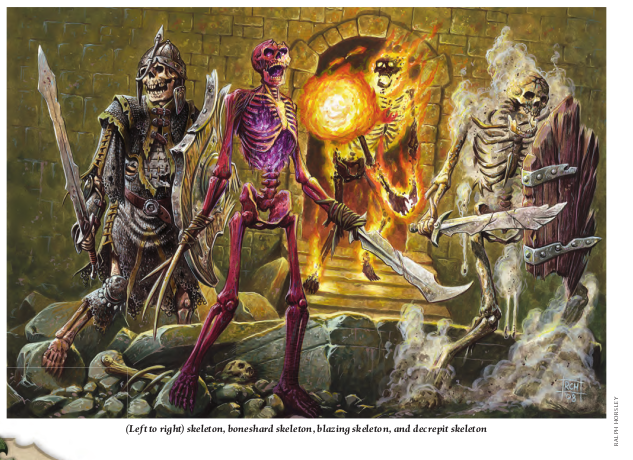
Copyright 2008 Wizards of the Coast This article is part of a series! Click here to see the other entries.
Skeletons have been in the game since the beginning, when they were the first step on the Undead Power Ladder. In this edition, they’re on both the Monster Manual and the Vault.
The Lore
Skeletons are the true iconic undead of the fantasy genre. Vampires and zombies get the spotlight in a lot of other media, but from Harryhausen movies to the Diablo franchise, if it’s a fantasy story about fighting monsters, it has to have skeletons in it somewhere. D&D took inspiration from the former and went on to inspire the latter, so it has plenty of skeletons as well.
D&D skeletons are likely to be among the first undead faced by a party of adventurers. Unlike their more powerful and exotic relatives, they almost never arise naturally, and their existence as undead is completely disconnected from who they might have been in life. They’re just bones animated by necrotic energy.
The Monster Vault goes all-in on the flowery gothic prose when describing them, discoursing about how even inanimate skeletons are viewed by the living as symbols of death. You might be able to read something of the person’s life in the scars of their bones, but that only serves as an even stronger reminder that they’re gone (“alas Yorick, I knew thee well…”).
Skeletons behave much like stupider golems, going by the MV’s description. They’re just smart enough to understand their master’s orders, which they follow tirelessly and to the letter. Their animating force doesn’t possess much in the way of cunning, so even if it can fight well a skeleton might still fall for relatively simple ruses, or be unable to identify obvious signs of danger.
It is much easier to animate a skeleton than to create a golem, which indicates that all that gothic prose actually has a point. If I’m allowed to speculate until the end of this paragraph, I’d say necromantic magic leans heavily on that association to give a skeleton its motion and its rudimentary mind. As a result, it is by its very nature somewhat transgressive, and the proper mindset to use it likely includes active disrespect for the boundaries between life and death, which isn’t something you need to create a construct.
While the most common use for skeletons is as minions of some necromancer bent on conquest, they can also be ordered to perform simple physical tasks. A noble who wanted to appear particularly edgy could have his carriage pulled by skeletal horses. A society who wanted to look edgy could have all sorts of “automatic” gates, bridges and dungeon traps powered by skeletal labor.
The Monster Manual mentions in passing that skeletons might arise naturally in an area heavily suffused with necrotic energy. That’s likely a rare exception, and even then it’s an event that has nothing to do with who the skeletons used to be or how they died. If a rift to Thanatos opened in a cemetery containing only good people who died happy and without any unfinished business, their bones would still rise. Such skeletons simply attack anything living they come across and stay still otherwise.
The Numbers
Skeletons are Medium Natural Animates with the Undead keyword. They have darkvision, immunity to disease and poison, 10 resistance to necrotic damage and vulnerable 5 to radiant damage. Their base land speed is 6. Despite being nearly mindless at Int 3, they usually fight with weapons.
All skeletons we get in both books have levels in the Heroic tier, and are apparently assumed to be human skeletons. You could easily make more powerful skeletons with higher resistances if you wanted, of course, as well as skeletons originating from creatures of different sizes (like a Large giant skeleton or a swarm of Small goblin bones).
Decrepit Skeleton (Both)
A skeleton so old it’s begun to crumble, this is a Level 1 Minion Skirmisher. It fights with a longsword in melee and a shortbow at range and has no special attacks at all and no traits aside from the common ones listed above.
They should appear in similar numbers and use similar tactics to all those fragile archer skeletons from Diablo.
Skeleton (MM)
The basic model is a Level 3 Soldier with 45 HP, wearing mail and wielding a sword and shield. Its longsword attacks mark for a turn, and it has a Speed of the Dead trait which gives it +2 to attack and +1d6 to damage when making opportunity attacks.
A pretty straightforward soldier-type, like it probably was in life.
Blazing Skeleton (Both)
A skeleton that is on fire. It’s Level 5 Artillery with 53 HP. It has resist fire 10 on top of its other resistances, and projects a Fiery Aura (1) which does 5 damage to enemies caught inside. It fights in melee with its blazing claws, and throws flame orbs at range. The claws do physical damage and ongoing fire damage (save ends), while the orbs do both immediate and ongoing fire damage (save ends).
Boneshard Skeleton (MM)
A shattered skeleton held together by magic, it’s a Level 5 Brute with 77 HP. It wields a scimitar in combat, which is a high-crit weapon that does a mix of physical and necrotic damage. It can attack at range by flinging its shards, also doing those same types of damage. Once when it’s bloodied, and once when it’s destroyed, this skeleton detonates a Boneshard Burst (close burst 3 vs. Reflex) that does necrotic damage.
Skeletal Legionary (MV)
A minion version of the basic armored MM skeleton. A Level 7 Minion Soldier, it uses a sword in close combat and throws javelins at range, both of which mark the target for a turn on a hit. It has no other special abilities.
These sound perfect for that undead Roman legion you never knew you wanted to use.
Skeletal Tomb Guardian (Both)
This four-armed monster isn’t a random corpse given motion, but something specifically constructed so it could be animated. It’s a Level 10 Brute with 126 HP, and wields a scimitar in each of its four hands.
Each scimitar is kinda weak on its own, but the guardian’s basic twin scimitars attack allows it to use two of them, and its Cascade of Steel attack allows it to attack with all four. Sudden Strike allows to make a Twin Scimitars attack against an adjacent enemy that shifts, as an interrupt.
All of the scimitars are high-crit weapons, so if the guardian rolls really well its damage output goes up considerably.
Sample Encounters and Final Impressions
We get two encounters in the MM:
-
Level 3: 1 hobgoblin warcaster, 2 hobgoblin guards, 2 skeletons.
-
Level 5: 1 tiefling darkblade, 2 blazing skeletons, 2 boneshard skeletons.
As we can see, any enemy group that includes a spellcaster of some sort could very well include a complement of skeleton auxiliaries. We also have enough variety in their stat blocks to have plenty of all-skeleton encounters for all your ancient crypt needs.
I like skeletons, and as I said I think the game wouldn’t feel like a proper fantasy RPG (let alone D&D) without them.
-
-
Let's Read the 4e Monster Manual/Vault: Shifter
Copyright 2008 Wizards of the Coast This article is part of a series! Click here to see the other entries.
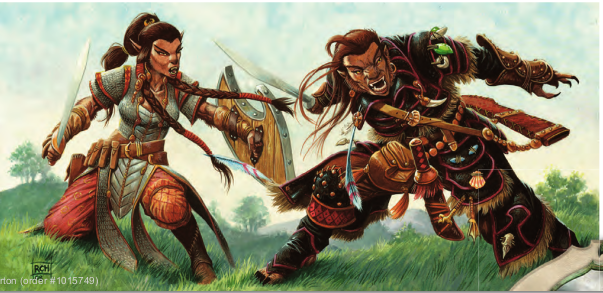
Shifters first appeared as a playable option in 3e’s Eberron Campaign Setting, and would return to that role when the 4e version of Eberron was released. Their first appearance in this edition was as an entry in the Monster Manual.
The Lore
We already mentioned shifters while looking at lycanthropes: they are the children of a lycanthrope and a human parent. They usually look like humans with pointy ears and extra hair, but when threatened can “shift” into a more bestial mode, growing fangs, claws, and yet more hair. This is not as extensive as a lycanthrope’s transformation - a shifter in “beast mode” is still recognizable as the same person. The exact characteristics of that transformation depend on the type of lycanthrope whose lineage the shifter belongs to.
In the 4e implied setting, shifters can be found living among humans or other humanoid creatures. Some are wild enough at heart that they prefer to hang out with lycanthropes and their attending animal packs. Shifters also breed true, so the child of two shifters will be themselves a shifter.
Like most species who are playable character options, shifters have no species-wide disposition for good or evil. Some are heroes, some are villains, and it all depends on the individual.
Shifters are sometimes called “weretouched”, and they tend to be drawn towards worship of nature gods or primal spirits.
The Numbers
Shifters are Medium Natural Humanoids, with the “shifter” keyword/subtype. They have low-light vision and a natural speed of 6, and their signature trait is Shifting.
While bloodied, a shifter can use a minor action to shift, becoming more bestial in appearance and gaining a few bonuses. There are two different types of shifting in this book, giving different bonuses: Razorclaw shifters gain +2 speed and +1 to AC and Reflex; Longtooth shifters gain +2 to damage rolls and regeneration 2 while bloodied.
All other abilities they might have come from training. You could take stat blocks for humans and other humanoids and make them into shifters by swapping their original signature traits with either form of Shifting.
Both stat blocks below are Unaligned, and could be used either as foes or allies.
Longtooth Hunter
More of a bounty hunter, really. This Level 6 Soldier has 71 HP, wears mail, and fights with a longsword and shield. It has speed 5 due to the armor.
Its basic longsword attacks also mark for a turn. Once per encounter, it can use a Hamstring maneuver, which allows it to make a basic attack and a secondary attack vs. Reflex on a hit: if that hits, the target is slowed (save ends).
When an adjacent enemy shifts, the hunter can shift to follow it as a reaction. Note the small-s: this is the good old one-square move, not a transformation.
When bloodied, the hunter Shifts with a capital S and gains the Longtooth bonuses.
Razorclaw Stalker
This Level 7 Skirmisher has 79 HP and Speed 6. It wears leather and wields a short sword.
The sword is used for basic attacks and for ripostes, which allow the stalker to make a basic attack as a free action against anyone who hits it with an opportunity attack. The stalker also has the Skirmish trait, which gives it a damage bonus if it has moved at least 4 squares from its initial position before attacking.
When bloodied, it can transform and gain the Razorclaw bonuses.
Sample Encounters and Final Impressions
There’s one sample encounter: Level 6, 2 longtooth hunters, 1 werewolf, and 2 dire wolves. A nice happy family.
While the stat blocks in this entry are nothing spectacular, they work. Lore-wise I like shifters a lot, particularly on Eberron.
subscribe via RSS