Posts
-
Building a Spaceplane: A GURPS Spaceships Exercise

Fictional ESA spaceplane. Illustration by Maciej Rebisz. I’ve been reading about Kerbal Space Program recently, and it made me want to try my hand at designing some GURPS spaceships.
One of the terms that often gets thrown about when talking about near-future space tech is “Single Stage to Orbit”, or SSTO. This would be a vehicle that can go from ground to orbit all by itself, without needing any detachable boosters. In the real world, a lot of plans for building one of these have been conceived and dropped, but we don’t have a real example yet.
How close does GURPS Spaceships think we are to such a thing?
In this post I’ll try to design a spaceplane, a popular type of theoretical SSTO craft. The basic idea is that they take off and fly to the upper atmosphere using air-breathing engines, and only then activate their rockets to reach orbit. After completing their mission, they can re-enter atmosphere and land by gliding. Spaceplanes are an attractive concept because they can use a lot less fuel to reach orbit, are fully reusable, and easier to maintain. Plus they tend to look really cool.
Mission Statement and Design Options
For this attempt, we’re going to assume a realistic TL8 setting (“present-day technology”), giving us access to TL7 and 8 items from the book. I’ll arbitrarily assign it SM +8, making it a 1000 ton craft.
Therefore, our craft is SM +8, TL8, streamlined, and winged. It must take off from the ground on Earth and reach orbital velocity without the aid of external boosters or detachable stages, while carrying a multi-ton payload in its cargo hold.
This means it must have a total delta-V exceeding 5.6 miles per second after all the calculations are done1. We get a bonus 0.3 mps if we launch eastwards from the equator, but having the craft reach the number on its own would allow it to launch from anywhere in the planet.
Fixed Systems
The design options above lock down 3 of the 20 systems we have available:
- We need 1 armor system because we’re streamlined.
- We need a control room (1 system).
- We need a cargo bay (1 system).
For our purposes in this post it doesn’t matter what the armor is made of, but we might as well use Metallic Laminate since we’re designing a “cutting edge” craft. The remaining 17 systems will be split among engines and fuel tanks.
At our TL, we have two engine options: the Chemical Rocket and the Jet Engine. They both help, but use different fuel sources. Adding jet engines means we need to figure out their top airspeed and subtract that from the necessary delta-V to reach orbit. Rocket delta-V is purely a function of how many tanks we dedicate to rocket fuel.
Attempt 1: Mixing Rockets and Jet Engines.
My first draft had the following configuration for our 17 “free” systems:
- 2 Jet Engines
- 1 Chemical Rocket Engine
- 14 Fuel Tanks (13 for rocket fuel, 1 for jet fuel).
The jet fuel allowed us to run the jets for half an hour, which was more than enough to reach maximum speed and altitude. They lowered our target to 4.63 mps, but that’s not enough. Combining the rules for chemical rockets and fuel tanks, our rocket had 3.12 mps of delta-V available to it.
This might be good for a fancy passenger plane for people with money to burn, but not for a SSTO vehicle.
Attempt 2: Rocket Plane
What if we build an all-rocket engine assembly?
- 1 Chemical Rocket Engine
- 16 fuel tanks (all rocket fuel)
Adding up the delta-V for this version is easier, and we do end up with more of it, but it’s still not enough. We get 4.8 out of 5.6 mps. So close, yet so far.
What this configuration gives us is a reusable launch-assist vehicle can get its 50-ton payload almost to orbital speeds. The payload itself would need to be another vehicle that could provide the remaining 0.8 mps of delta-V itself, and perhaps include a bit more for maneuvers once in orbit. The LAV can spend all of its own fuel and glide down.
Attempt 3: Cheating with Optional Rules.
We’ve run up against one of the harsh realities of the Spaceships design rules. Using only TL7-8 chemical rockets, you simply can’t make an orbit-capable vehicle with less than 17 fuel tanks. A traditional disposable rocket can be modeled with 1 chemical rocket system, 17 fuel tanks, and an upper stage with an SM 2 smaller than the rocket itself. This upper stage has the armor needed by a streamlined craft, and the discarded lower stage burns up on re-entry. Our spaceplane faces some trouble because it needs to include that armor system itself, leaving us 1 fuel tank short.
The only way we can make it work is by pulling in an optional rule from GURPS Spaceships 7 p. 4: Smaller Systems. By shrinking both our cargo bay and control room to SM +7, we decrease our cargo capacity to 15 tons, decrease our Handling/SR in by 1, and add 1.33 fuel tanks to our all-rocket spaceplane. That gets us 6.05 mps of delta-V, enough to launch from anywhere on the planet and still leave us some reserves for maneuvers and corrections. It carries less than the equivalent disposable rocket but is fully reusable, able to land by gliding even with an empty fuel tank.
We leave the armor system at the same size because it’s meant to serve as a heat shield on re-entry, so it’s probably placed in the central hull.
Conclusion

A X-33 and a VentureStar craft. NASA, public domain, via Wikimedia Commons. The thing we just designed is remarkably similar to the Lockheed-Martin VentureStar, at least if the stats in the Wikipedia article are to be believed. This is a project for a SSTO spaceplane whose most famous product is the X-33 prototype, a scaled-down version of the final design intended to test some of its technologies.
VentureStar was supposed to be a lot simpler to maintain than the space shuttle, and was intended to be available for sale to private companies and not just to NASA, kick-starting a wave of private space exploration. The project was cancelled in 2001 because its fuel tanks were too hard to manufacture using the technology of the time. Ironically, better manufacturing techniques were discovered a few years later.
Aside from having to contend with the “harsh truth” of the design rules we already mentioned, our spaceplane also illustrates what seems to be a constraint plaguing real-world designers: separate air-breathing and rocket engines are inefficient. Go rocket-only or get you an engine that can do both.
Its final stats are: dST/dHP 70; Air Hnd/SR +2/3; Space Hnd/SR -3/3; Move 3G/6.05mps; LWt. 1000; Load 15.3; SM+8; Occ 3; dDR 0/2/0. The Space handling is terrible, but workable when the mission is “get up, release the payload, get down”.
Our spaceplane costs $8.8M according to the design rules. Of course, that’s its price if it was mass-produced and commercially available. The rather more bespoke space program manufacturing model means it could cost up to 100 times more. It runs on liquid hydrogen/liquid oxygen rocket fuel, a full load of which costs $693,200.
The LAV version has better handling and stability (+3/4 in air and -2/4 in space) and costs about $40K less to fuel, and can deliver a bigger payload as long as that payload has some delta-V of its own. But it’s not a spaceplane, so nyeh.
-
I like using a proper measurement system, but all of the book’s formulas are in miles, so I’ll have to use that to avoid getting confused during the design process. ↩
-
Let's Read the 4e Monster Manual/Vault: Traits Appendix
This article is part of a series! Click here to see the other entries.
Before I close the curtain on this Let’s Read, there’s one more thing to discuss. I had forgotten it was there at all! Back when the Monster Manual had just been published, though, I remember thinking it was a big deal.
We’ve been talking about the animal appendix on the Monster Vault, but the Monster Manual also has an appendix. This one is filled with stats for using several of the book’s entries as playable characters!
Some of them are for characters from that were traditionally considered “monster races”, others are for races that had been popular in previous editions but didn’t fit into the Player’s Handbook. The full list is:
- Bugbear
- Doppelganger
- Drow
- Githyanki
- Githzerai
- Gnoll
- Gnome
- Goblin
- Hobgoblin
- Kobold
- Minotaur
- Orc
- Shadar-kai
- Shifter (Longtooth and Razorclaw)
- Warforged
Each one has more or less the same information as a basic racial stat block from the PHB: Average height and weight, ability score bonuses, size speed, vision modes, starting languages, skill bonuses and a racial power.
The reason I forgot this appendix even existed is because it slowly became less relevant as more 4e material was published.
Even at the start the appendix races were already a little bit behind mechanically, since the ones from the PHB had a handful of extra racial feats each and these didn’t. The gap widened as further player option books came out with yet more feats and stuff like racial paragon paths. And finally, several of the appendix races would have more complete versions published in future books, rendering the appendix version obsolete.
-
Doppelgangers, Shifters and Warforged would appear in the Eberron Player’s Guide.
-
Gnomes would appear in the PHB2. Half-Orcs too, which you could just reskin into full orcs.
-
Githzerai and Minotaurs would appear in the PHB 3.
-
Drow would appear in the Forgotten Realms Player’s Guide and then in Heroes of the Forgotten Kingdoms.
That’s almost all of them, isn’t it? Gnolls and Shadar-kai would get articles in Dragon or Dungeon, but they still ended up with less support overall. At some point in the edition the ability score bonuses also went from “+2 to these two fixed scores” to “+2 to one fixed score and +2 to one of these other two scores”, and some of the races here never did get that third option. Still, this appendix was pretty useful before all of this extra material came out.
And this slightly maudlin post finally finishes our Let’s Read of the first Monster Manual! I hope you enjoyed it. I plan on doing the other two and the other Vault, and hopefully I’ll take less time to post those in their entirety.
-
Let's Read the 4e Monster Manual/Vault: Zombie
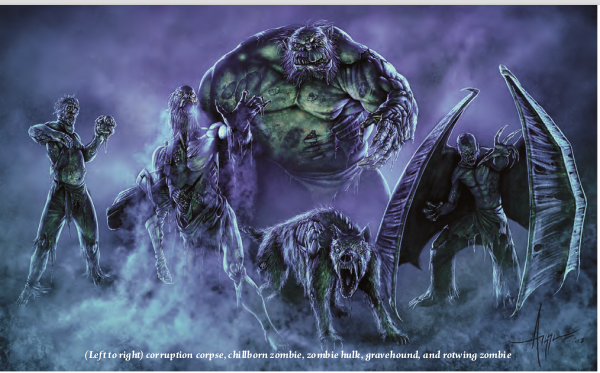
Copyright 2008 Wizards of the Coast This article is part of a series! Click here to see the other entries.
This is it. The final entry in the Monster Manual, the only Z monster, and the penultimate post in this particular Let’s Read. Zombies have of course been in the game since the very beginning. Here they are present both in the Monster Manual and the Monster Vault.
The Lore
You know what they’re like: rotting corpses who slowly shamble around and attack the living. They’re one of those monsters who made it into D&D from popular culture and are extremely popular outside of the game (like vampires, or dragons). There’s a whole lot of different zombie versions out there, and it seems the game has made an effort to incorporate most of them.
Like skeletons, zombies are often created through a necromantic ritual that creates an animus and nails it to a dead body. They might also be spontaneously created when an area is bathed in necrotic emanations, or when some sort of divine curse falls over it, which is more common with zombies than with skeletons.
The main difference, of course, is that zombies are still fleshy. That flesh remembers, however poorly, what it’s like to be alive. A zombie’s dead heart still pumps its rotten blood. Its lungs still wheeze, and its guts still hunger. Left to their own devices, zombies will seek the warmth of the living and try to eat their flesh, moving on to new victims when the current one gets cold. Zombies who have a master will follow that master’s orders, but they’re not smart enough to do anything complex.
Though the typical image of a zombie is that of an animated human corpse, that’s not necessarily true! Anything that had a pulse in life can be animated as a zombie, by ritual or accident.
D&D zombies are not “contagious”, but you can still have a zombie apocalypse when a sudden influx of necrotic energy into a region causes every corpse within to rise as a zombie. And if the infusion is constant, then people killed by these zombies would rise as well.
The Numbers
Zombies are Natural Animates with the Undead keyword. Their size is the same as the original creature, usually Medium or Large. Monster Manual zombies have necrotic resistance and radiant vulnerability like all other undead, but the Vault ones aren’t so fancy and have neither. Most are fairly slow, with a Speed of 4, but there are exceptions. They all have Darkvision.
The two signature traits for Monster Vault zombies are Zombie Weakness and Deathless Hunger. The first one causes any critical hit to reduce the zombie to 0 HP instantly (“Boom! Headshot!”). The other triggers when they’re reduced to 0 HP: roll a d20, and if the result is 15 or more, the zombie remains at 1 HP instead. This means they’re both unusually fragile and unusually tough. Several MM zombies have similar traits, but they’re less universal.
Grasping Zombie (Monster Vault)
This Medium Level 1 Brute has 33 HP and all the standard traits. It attacks with Slams that do extra damage against grabbed targets and can instead try to grab someone with Zombie Grasp (melee 1 vs. Reflex) which does no damage but grabs the creature (escape DC 12).
They naturally lend themselves to classic zombie horde tactics, surrounding victims, grabbing and beating them up/biting them into chunks.
Zombie (Monster Manual)
This is basically a Level 2 version of the Grasping Zombie, with 40 HP. Its defenses are actually a bit lower, but the escape DC for the grab is higher because victims have a -5 penalty to escape it.
Zombie Rotter (Monster Manual)
A level 3 minion brute with a single slam attack, Speed 4, and none of the special traits listed above. Pretty simple. Make sure to use literal hordes of them.
The monster Vault instead has Zombie Shamblers, which are level 5 minions and have Deathless Hunger, making them tougher than usual.
Gravehound (Monster Manual)
A zombie dog! It’s Medium and unlike its humanoid counterparts it can run at Speed 8. Its bite also deals ongoing necrotic damage (save ends), and knocks Medium or smaller targets prone. It has Zombie Weakness, and when it hits 0 HP it makes one last bite attack as a free action.
Corruption Corpse (Monster Manual)
A regenerating Medium zombie who uses this fact to rip out chunks of itself and throw them at victims. It’s Level 4 Artillery with 46 HP. Its Grave Stench acts as an aura (1) that inflicts a -5 penalty to all attacks, discouraging enemies from getting into melee range. Its regeneration turns off for a turn if the zombie takes radiant damage.
Though the corpse’s slams are weak, its thrown motes of corruption (ranged 10 vs. reflex) do decent necrotic damage and weaken (save ends). When killed, it explodes in a close burst 1 vs. Fortitude, dealing necrotic damage to all in the area.
Hulking Zombie (Monster Vault)
This Large Level 4 Brute with 70 HP was clearly an ogre in life. Its slams are Reach 2 and do extra damage to prone or grabbed targets. Its Zombie Rush allows it to charge (with its speed of 4) and make an attack against Fortitude that does the same damage as a slam and knocks prone.
Zombie Hulk (Monster Manual)
Pretty much the same monster, only this one is Level 8 with 88 HP because MM ogres are level 8. In place of Zombie Rush it has Zombie Smash, a recharge 6 melee attack that does a lot of damage and knocks prone. Zombie Hulk Smash, get it?
Instead of Deathless Hunger it has the much more dangerous Rise Again, which triggers automatically when the zombie hits 0 HP and makes it get back up with 44 HP at the start of its next turn.
Rotwing Zombie (Monster Manual)
A flying zombie, either because it was a flying creature in life or because some maniac stitched wings to it. It’s still speed 4 both in the ground and in the air, so don’t expect fancy maneuvers here.
Still, it does have a little trick: its slams do extra damage when used as part of a flying charge.
Flesh-Crazed Zombie (Monster Vault)
AKA a “Romero Zombie”, which kinda steps in the ghoul’s toes. This one is a Level 4 Skirmisher with 55 HP and all standard zombie traits. Its speed is 6, or 8 when charging. Flesh-Crazed Charge ensures its charges don’t provoke opportunity attacks.
These zombies fight with clubs, which do extra damage on a charge. If they can’t charge, they’ll bite, which actually does more damage and dazes for a turn.
Chillborn Zombie (Monster Manual)
The corpse of someone who died in the cold. It’s a Level 6 Soldier with 71 HP, and exudes a Chillborn Aura (2) which does 5 cold damage per turn to those caught inside. Multiple chillborn auras stack. This zombie also has Resist Cold 10.
Hey, given enough of these they might end up damaging each other with their auras! I don’t think this was the intention, so you can just say they’re immune to each other’s auras.
Their slams immobilize for a turn and inflict ongoing cold damage (save ends). When they die, Death Burst causes them to explode and deal cold damage in a Close Burst 1 (vs. Fortitude). Ice Reaper makes either of these attacks deal extra cold damage to immobilized targets.
Sample Encounters and Final Impressions
I consider zombies to be an important part of the dungeon fantasy genre, which includes D&D. They’re not an exclusive monster or anything, but they’re inevitably one of the first undead any party is going to face. The variety shown here is interesting: though the MV stat blocks are a little better mechanically, they’re also a lot more conventional in appearance and concept. “Normal zombie”, “big zombie”, “fast zombie”. You should absolutely make an effort to spring the more exotic varieties on your players if possible.
What about possible encounters? Any two-bit necromancer can animate a zombie or ten, so they’re a good fit for any encounter or adventure that might include one of those. Surprisingly they also work well with other non-sapient creatures, as long as neither would eat the other and the living critters aren’t bothered by the smell. The sample MM encounters bear this out:
-
Level 4: 3 standard zombies, 4 rotters, 4 kruthik hatchlings, and 2 wererats.
-
Level 8: 2 hulks, 2 rot scarab swarms, 1 oni night haunter.
Both encounters clearly include monsters who could be considered necromancers, but I suppose the kruthiks and the scarabs could be found alongside zombies even without a sapient to handle them. And of course, other undead work fine as zombie buddies.
-
-
Let's Read The 4e Monster Manual/Vault: Yuan-Ti
Copyright 2008 Wizards of the Coast This article is part of a series! Click here to see the other entries.
Yuan-ti have been in the game since AD&D 1st Edition. Here, they are both in the Monster Manual and in the Vault.
The Lore
Yuan-ti lore has gotten more and more elaborate since their first appearance, and by Fourth Edition it’s quite something. The Monster Vault has a doozy of an origin story for them.
Back when the world was young, and the gods were still creating the mortals that would inhabit it, the snake god Zehir found out he couldn’t make his own mortals. So, being sort of treacherous asshole you’d expect a D&D snake god to be, he decided to steal some.
To that end, he seduced Avandra and tried to convince her to teach him how to reshape mortals created by other gods. Being in love, Avandra accepted. Not being a fool, she attached an extra condition to this power: Zehir could only use it if the god that presided over the mortals in question gave him explicit permission.
Of course, Zehir was a lot more of an asshole than Avandra suspected. When the Dawn War was over, and the other gods were all weakened from all the fighting, Zehir murdered the god of humanity. And now he had a whole mortal species to mess with at will, no permission required.
Zehir took many humans and changed them into creatures whose shape pleased him. These became the yuan-ti, his chosen people. They, in turn, built the mighty empire of Zannad, which ruled over the whole world. From what I can piece together from the other entries, the time of Zannad was after the fall of the giants but before the rise of pretty much anyone else. Depending on how you classify giants, you could even call Zannad the first mortal empire.
Eventually the surviving gods regained their strength and slapped Zehir around until he relinquished his control over humanity. Though they argued for a while over who would take custody of their souls after this, they never managed to come to an agreement. And this is why the humans of today have the potential to be both the most virtuous and the most corrupt of mortals: by default, their souls belong to no god.
Slavery was the foundation upon which Zannad was built, and it fell when its innumerable slaves successfully rebelled against their masters. The yuan-ti of today are descended from those who survived Zannad’s fall, and in their minds there is no greater aspiration than to rebuild their former empire in all its cruel glory. The way the book describes it, they have a much better chance of achieving this goal than the giants.
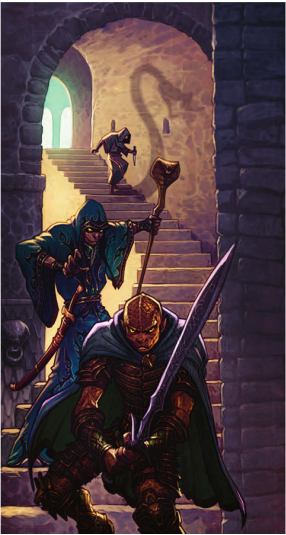
Copyright 2008 Wizards of the Coast Throughout most of the world, the yuan-ti live in secret amid the other mortal peoples and conspire to take over their power structures. They head secret cults of Zehir and bestow minor reptilian transformations upon their human lackeys as rewards for loyalty. These people are known as “snaketongue cultists”. Some get inducted and transformed because they’re the sort of people who agrees perfectly with Zehir’s philosophies. Others get kidnapped and transformed first, and then convinced they must serve the god that “marked” them.
Yuan-ti conspiracies are many and varied, and in a lot of places people don’t even know they exist at all. In other places, they already got to the point where they can rule openly, such as in Zahnshahan, the Slithering City. These serpentine city-states engage in trade and diplomacy much like any other mortal realm, but their ultimate goal is always the subjugation of their neighbors.
The Numbers
Most Yuan-ti are Medium Natural Humanoids with the Reptile keyword. They have Resist Poison 10, and a natural speed of 7. All of their other abilities are the product of training, so they vary a lot per stat block. These start at mid-Paragon tier and go up from there, so by the time the PCs meet yuan-ti in person they’ve likely worked their way through the bottom rungs of their conspiracy pyramid.
Snaketongue cultists are Medium Natural Humanoids, more specifically humans. Their minor mutations aren’t enough to give them the Reptile keyword or any special powers beyond what they get from training. Like their masters they rely both on their skill at arms and on any snake-and-poison-themed magic they might have gained through arcane study or devotion to Zehir.
Cultists are more or less equivalent to the near-human “purebloods” of earlier editions, and I guess that name was dropped because it was confusing (“why is the least snaky variety named like that?”). 5e would adopt the name again and make yuan-ti backstory even more elaborate in order to justify it.
The Monster Vault mentions the existence of snaketongue cultists but doesn’t have stat blocks for any, though of course any human stat block can be used with a few tweaks.
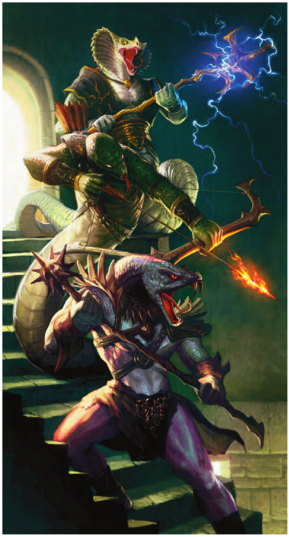
Yuan-ti Malison Sharp-Eye (Both)
“Malison” is what the most common variety of yuan-ti is called. They’re pretty much your standard Serpent People. Some have legs, some have snake bodies, but all are equally mobile.
Sharp-eyes are Level 13 Artillery with 98 HP. They wield a scimitar in melee and a longbow at range, and they ideally want to stay far away from the opposition because their Chameleon Defense gives them partial concealment from enemies more than 3 squares away.
The arrows from the longbow are envemomed - a hit with them triggers a secondary attack vs. Fortitude, which does ongoing poison damage and dazes (save ends).
Yuan-ti Malison Stalker (Monster Vault)
Stalkers are Level 13 Skirmishers with 126 HP. They wield morningstars with interesting riders: a hit prohobits the target from marking anyone for a turn, and does ongoing poison damage (save ends).
They can also throw poisoned daggers (Ranged 10 vs. AC) which do a bit less physical damage but also have an ongoing poison damage rider (save ends). Their at-will slither strike allows them to end any mark currently on them, shift 4 squares and make a dagger or morningstar attack at any point along the movement.
Looks like stalkers are effective at shutting down a PC defender’s ability to, well, defend. They can move past the party’s front-line and target the PCs in the back, or flank said front-line to allow their own squishies to move away unimpeded by marks.
Yuan-Ti Abomination (Both)
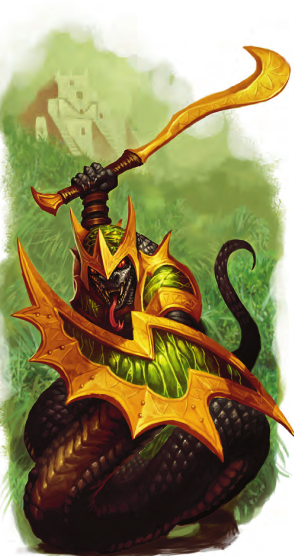
Copyright 2008 Wizards of the Coast This is a Large yuan-ti warrior that seems to always have a snake’s lower body. It’s a Level 14 Soldier with 140 HP who fights with a bastard sword and a shield.
The sword marks for a turn and does ongoing poison damage (save ends). The abomination can use a minor action to grab a victim using its grasping coils (melee 2 vs. Reflex), and it can bite a grabbed victim as its attack. This does more damage than the sword, both immediate and ongoing.
Yuan-Ti Malison Chanter (Monster Vault)
This spellcaster is likely a priest of Zehir. It’s Level 15 Artillery with 118 HP. While bloodied, its Bloody Scales trait grants it a +2 bonus to speed and to all defenses.
The chanter fights in melee with a bite that also causes ongoing poison damage (save ends), and at range with a Mind Warp spell (ranged 20 vs. Will) which does a bunch of psychic damage and inflicts a -2 penalty to attacks for a turn. It can also use Poisoned Domination (ranged 20 vs. Will) against a target taking ongoing poison damage, dominating it for a turn. This is an encounter power that recharges when the chanter is bloodied.
If hit by a melee or ranged attack, the chanter can use Deflect Attack (recharge 4-6) to have it hit an adjacent ally instead. So make sure to surround the chanter with lots of cultists!
Yuan-Ti Malison Incanter (Monster Manual)
As the name hints, this is basically the same monster as the Chanter above, but it’s stat block is different enough it warrants a separate entry.
The Incanter has the same level, HP, and bite as its Vault counterpart, but all the other abilities are different. It has a Zehir’s Shield aura (10) that gives all allies a +2 bonus to all defenses. Mind Warp dazes (save ends) instead of inflicting an attack penalty. Poisoned Domination has a shorter range (5) and has a daze (save ends) after-effect. Bloody Scales is replaced by Slither Away, which is similar but grants a +5 to all defenses instead of a +2.
There’s a new attack too, Zehir’s Venom (ranged 10 vs. Fortitude; recharge 4-6) which is almost exactly identical to Mind Warp but does poison damage instead of psychic. Deflect Attack triggers a little less often (recharge 5-6).
So, in short, this is a much more complicated version of the monster, that’s much more annoyong to fight.
Yuan-ti Malison Disciple of Zehir (Monster Manual)
What a mouthful of a name, eh? This is a Level 17 Controller with 164 HP. It projects Zehir’s Favor as an aura (10) which heals allies inside for 5 HP per turn and does 5 poison damage per turn to enemies.
The disciple fights with a morningstar that has a secondary attack vs. Fortitude to inflict ongoing poison damage (save ends). This does stack with the aura damage. It will also very often whisper Soothing Words (Ranged 5 vs. Will; recharge 3-6), which dominate (save ends) and have a daze (save ends) after-effect.
Yuan-ti Anathema (Monster Manual)
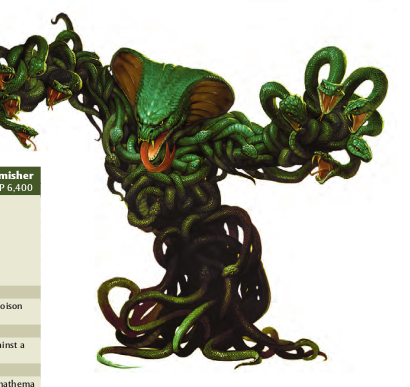
Copyright 2008 Wizards of the Coast Anathema used to be the sovereign rulers of the yuan-ti back in the bad old days, but something happened to drive them mad and turn against their subjects. Now they are kept imprisoned, and the other yuan-ti placate them with sacrifices dropped from a safe distance. This is both out of reverence for Zehir and out of fear that the anathemas will escape their prisons and eat the world.
These snakes-made-of-snakes are Huge Natural Magical Beasts with the Reptile keyword. They’re also Level 21 Elite Skirmishers with 412 HP. Their poison resistance is 20, and their speed is 8.
Their basic attack is a slam that also does ongoing poison damage (because snakes). They can make two of these per action. They can also bite, which does a bit more damage than a single slam and triggers a secondary attack vs. Fortitude. This does more ongoing poison damage than the slam, and inflicts a -4 penalty to attack rolls (save ends both).
The anathema can trample, moving its speed through enemy spaces (subject to opportunity attacks) and making a special attack against vs. Reflex against each one that does damage and knocks them prone. It can also make its horde of snakes lash out at the same time (close burst 1 vs. Fortitude), doing physical and ongoing poison damage to those it hits.
If it cares more about moving than about doing damage, the anathema can disperse into a swarm of snakes, shifting its speed and reforming at the end of the movement. This also recharges Horde of Snakes.
In short, after you’ve cleared the yuan-ti headquarters at the end of paragon tier, you’re going to discover a whole other dungeon level filled with these things and other monsters like them.
Snaketongue Cultist Minions (Monster Manual)
We have two cultist minions here: the Level 7 Initiate, and the Level 12 Zealot, which seem to be skirmishers and are pretty much identical. They have speed 6 and fight with greatswords that do minion-scale damage and have the same “secondary attack/ongoing poison damage” rider some of their bosses display.
Snaketonge Warrior (Monster Manual)
The non-minion version of the cultists discussed above. It’s a Level 8 Brute with 106 HP, and its greatsword attack is a non-minion version of the one described above.
Snaketongue Assassin (Monster Manual)
This Level 9 Lurker has 80 HP and uses a poisoned dagger to fight. It suffers from the “naturalistic design” flaw, but has a “healthy” dose of ongoing poison damage on a hit.
To protect itself, it uses Crowd Shield tactics, gaining a +2 to AC and Reflex if it’s adjacent to one creature, or +4 if it has two or more. Interestlingly, the assassin can also use a move action to assume Serpent Form, transforming into a Crushgrip Constrictor and using all of its stat blocks except for HP, which retains its current value.
Snaketongue Celebrant (Monster Manual)
The bad guy your players fight just before discovering yuan-ti are behind it all. This is a Level 11 Controller with 117 HP. It fights with a Scimitar in melee that has the same secondary poison attack mechanic as the other weapons here. At range it can use a Serpent Lash spell (ranged 5 vs. Will; recharge 4-6) to do psychic damage and force the target to grant combat advantage for a turn. Coils of Despair (area burst 5 within 10 vs. Reflex; recharge 5-6) does no damage but restrains (save ends) and is likely to affect all the PCs at once.
Like the Assassin, the Celebrant can also use Serpent Form to turn into a crushgrip constrictor. In this case you might want to give a +2 to attacks, damage and defenses to the snake form in order for it to match the human form’s level.
Sample Encounters and Final Impressions
The list of Monster Manual sample encounters tries to tell us why it did have to be snakes. There are four encounters:
-
Level 9: a whole bunch of snaketongue cultists and their pet flame snake.
-
Level 11: An abomination, a sharp-eye, and more cultists.
-
Level 16: A disciple of Zehir, an incanter, and 2 shadow snakes.
-
Level 22: 2 dark nagas and an anathema. So now you know what the dark nagas guard.
Wow, that sure was a whole lot of snek. If that wasn’t enough for you, you can also include medusas, since their entry says they some times work together with yuan-ti.
I never really gave yuan-ti much thought, but the whole Zannad backstory here is compelling, and it makes them have a lot in common with Lovecraft’s Serpent Folk.
-
-
Let's Read the 4e Monster Manual/Vault: Wyvern
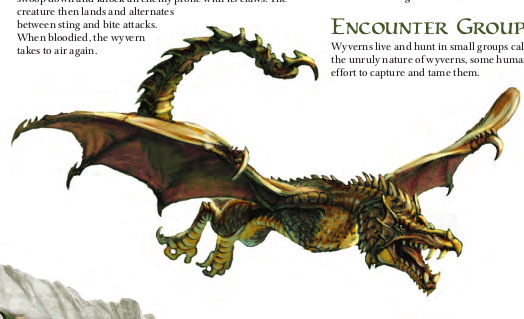
Copyright 2008 Wizards of the Coast This article is part of a series! Click here to see the other entries.
Wyverns have been in the game since its beginnings (or at least since BECMI). Here, they are present only on the Monster Manual.
The Lore
Wyverns are the most famous “not-quite-dragons” of D&D, and the ones most likely to be confused with real dragons from a distance. The most obvious visual difference is that wyverns lack front legs.
There are others, too, which become more evident when you interact more closely with them. Unlike dragons, wyverns are non-sapient animals, and they also lack magical breath weapons. Instead, they have a stinger at the tip of their tails that can inject prey with a potent venom. They’re not as relentlessly voracious as some of the other fantastic predators described in this book, but I imagine they still might put a strain on any herds on their chosen territory.
In the wild, wyverns live in small groups called “flights”, which roost in high places like mountains and hunt the surrounding region together. If you see a flight of wyverns up close, it’s because they’re trying to eat you.
Wyverns can be tamed, but the process has to start shortly after they’re born. As you might expect, there’s a market for eggs and hatchlings, and sapient opponents might bring their pet wyverns to the fight.
The Numbers
We get stats for two species of wyverns here. Both are Large Beasts with the Reptile keyword, and fight with their natural weapons: a bite, claws, and the stinger. Wyverns are good fliers and much more agile in the air than on the ground.
Note that wyvern damage as written is notoriously weak. Fixing this to use the updated math should be a priority before you include them in an encounter.
Wyvern
The more common variety is a Large Natural Beast with the Reptile and Mount Keywords, and a Level 10 Skirmisher with 106 HP. Their land speed is 4, and their flight speed is 8 with Hover.
Wyverns have two basic attacks: a bite with no special effects beyond damage, and a slightly weaker attack with their claws, which can only be done from the air and knocks prone on a hit. Flyby Attack allows them to fly their speed and make one of these attacks at any point along the way without drawing opportunity attacks.
They can also sting, of course, which does a little less damage than the claw and triggers a secondary attack vs. Fortitude that deals ongoing poison damage on a hit (save ends).
If used as a mount, the wyvern’s aerial agility gives its rider +2 to all defenses.
I’m guessing the wyvern doesn’t bite very often. It’s going to use flyby attacks to knock people prone, or sting if that’s not practical. Only a prone, poisoned target will get the bite.
Fell Wyvern
A larger species which originated in the Shadowfell but is also present in places where that plane intersects with the world. It’s a Large Shadow Beast and a Level 24 Skirmisher with 228 HP. Despite not being undead, it has Resist 10 Necrotic and Vulnerable 5 Radiant. Its land speed is 6, and its fly speed is 12 with Hover.
Fell Wyverns fight mostly like wyverns with bigger numbers, and have all the same attacks. Their venom causes “necrotic and poison” damage, so it’s harder to resist. They can also use a pestilent breath (close blast 5 vs. Fortitude; recharge 5-6) that does immediate and ongoing necrotic damage.
Sample Encounters and Final Impressions
There’s a single sample encounter: level 10, an ettin marauder, a basilisk, and 2 wyverns.
I also imagine either wyvern is a pretty close fit to those fell beasts the Ringwraiths rode in Lord of the Rings, though their actual level would depend on how high-powered you view that story as.
Given that wyverns can be mounts, the most clichéd use for them would be to have them as the “hostile humanoid” flying mount of choice, to have proper aerial fights against human gryphon cavalry.
subscribe via RSS