Posts
-
Let's Read the 4e Monster Manual/Vault: Worg
This article is part of a series! Click here to see the other entries.
The first time I see the name “Worg” is in the AD&D 1st Edition Monster Manual, where it was synonymous with “dire wolf”. The word itself comes from the Lord of the Rings, I think. In Fourth Edition, they’re only on the Monster Manual.
The Lore
Worgs are not wolves, though they might be distantly related. Even dire wolves are just animals, but worgs are sapient and evil. They also have some distinctly un-wolf-like physical traits when you look at them from up close.
Worgs like the taste of sapient flesh and prefer it over any other prey. They live in mazelike warrens, which they decorate with trophies of their victims. Worgs on the hunt act as a group, but don’t cooperate very well, since each individual is only interested in satisfying its own thirst for murder.
Worgs willingly ally with other sapient creatures that have a disposition as nasty as their own, often carrying these allies into battle as mounts.
Oh, and the worg also has a larger and meaner relative: the elephant-sized gulvoorg, which looks nothing like a wolf even from very far away.
I’m guessing you won’t find both worgs and normal wolves in the same wilderness region - worgs are beefy enough to overpower even dire wolves in direct fights. They’d enjoy it, too.
The Numbers
Both “strains” of worg are Natural Magical Beasts. They have trained Perception and Darkvision.
Worg
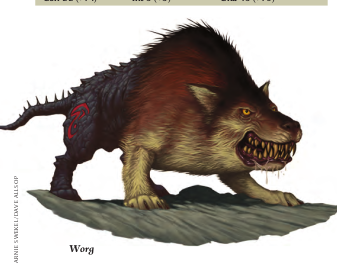
Copyright 2008 Wizards of the Coast The basic model is Large and a Level 9 Brute with 120 HP. It has a speed of 8 and its Frightful Growls act as an aura (3) that gives enemies a -1 attack penalty and allies a +1 attack bonus. Their only attack is a bite which also does ongoing damage on a hit (save ends).
I guess the main benefit of riding a worg into battle is that you’re always in range of its aura.
Gulvoorg
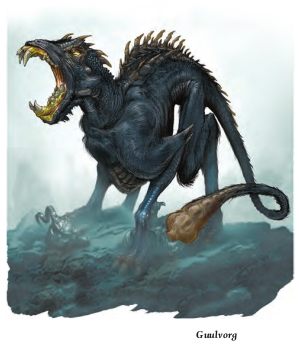
Copyright 2008 Wizards of the Coast These monsters are Huge, and Level 16 Elite Brutes with 384 HP. Their speed is 9, and they still have trained Perception and Darkvision.
Gulvoorg bites are Reach 2, and always knock prone on a hit. They can perform Reach 2 tail slams, which are also considered basic attacks. On a hit, they both knock prone and daze (save ends).
As a standard action they can use Gulvoorg Fury to make both a bite and a slam attack, against different targets and with a -2 attack penalty. That penalty is completely unnecessary, since we’re talking about an elite monster.
Sample Encounters and Final Impressions
The book gives us two sample encounters:
-
Level 10: 3 worgs, 2 razorclaw stalker shifters, and 1 oni night haunter. An oni and its evil henchthings.
-
Level 17: 2 gulvoorgs and 2 cyclops hewers. It’s even possible the cyclopes are riding the gulvoorgs.
Conceptually, I like worgs a lot more than I like dire wolves, and wouldn’t be opposed to merging the two again. That way you get sapient evil worgs with the interesting mechanical bits of dire wolves. Maybe add some wind powers so they can huff, puff, and blow your house down.
-
-
Let's Read the 4e Monster Manual/Vault: Wolves
Copyright 2008 Wizards of the Coast This article is part of a series! Click here to see the other entries.
Wolves are real animals and have been part of the game since its beginnings. Here, they are both in the Monster Manual and in the Monster Vault’s animal appendix.
The Lore
Real-world wolves are pack hunters, and the ancestors of modern dogs. If I recall correctly they mostly stay away from people and only attack when cornered or really desperate. There are enough stories about wolves attacking sheep and other farm animals that it must have happened in the past, but it’s not really a common occurrence any more. And that’s partly because there are very few wolves left in the real world.
D&D wolves are of course a lot more common and a lot more willing to attack people, since a pack of wolves is a classic low-level wilderness encounter. They can be found across a wide variety of climates and terrains. Mountains? Check! Forests? Check! Plains? Check! Deserts? Why not?
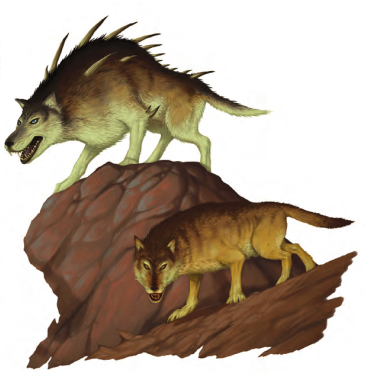
This being D&D, there might be some natural landscapes where your reasonably realistic grey wolf might have trouble competing with the more fantastical and powerful monsters common to the game. Instead, these places might feature dire wolves, which are a larger, smarter and more dangerous variety. As of 3e, they’re also spikier.
In addition to being found in the wild, both common and dire wolves might be trained by humanoids such as goblins or shifters, who have a knack for taming wolves directly without having to spend centuries turning them into dogs. Other creatures might also control large packs of them through magic: vampires are famous for this.
The Numbers
Wolves are obviously Natural Beasts, even the dire variety. They have low-light vision, and their other acute senses are represented by Trained Perception. They run at speed 8, attack with bites and usually do something interesting when they have combat advantage.
Gray Wolf (Both)
Gray wolves are Medium, and Level 2 Skirmishers with 38 HP. As far as natural wolves go, it seems to me these would be on the large end of the scale, which might explain why they’re more eager to attack humans than you’d expect a mundane wolf to be.
Their sole attack is the bite, which does extra damage against prone targets. The bite in the MV version also allows the wolf to shift 4 squares as an effect, so these critters will never stay still if they can help it.
If a wolf has Combat Advantage against a target, its bite will also knock the target prone on a hit. This means a group of wolves has a lot of incentive to flank a specific PC. One of them knocks the victim prone with its first bite, the others pile on with that bonus bite damage. All of them keep moving around with those free shifts. And now you know why they call this “wolf-pack tactics”!
Dire Wolf (Both)
Dire wolves are Large, which means each is roughly horse-sized. They’re Level 5 Skirmishers with the Mount keyword and 67 HP.
Dire wolf bites have larger numbers due to them being higher level, and also do increased damage to prone targets. They also knock the target prone if the wolf has combat advantage against the target, and the monsters have more ways to get that other than plain old flanking.
The text for “combat advantage” in the MM version says the dire wolf has CA against any target who has at least one other ally adjacent to it. No flanking required. This could be interpreted to mean that a dire wolf with a rider always has CA against any enemy adjacent to it! The MV version of this trait, named Pack Harrier, says it only works when the wolf has two or more allies adjacent to the enemy. So the rider still counts, but you need a second ally to get the bonus.
They also have a trait called Pack Hunter, which grants their rider combat advantage if an ally other than the mount is adjacent to the target. So if you go with the MV text, the rider would get CA whenever the wolf got it, and vice-versa.
I’m guessing that the MV version is the “correct” one in all aspects here. A wolf that got permanent combat advantage against everyone would be a little overpowered due to that knockdown effect on the bite.
Sample Encounters and Final Impressions
We have two sample encounters here:
-
Level 3: 3 gray wolves, 2 hobgoblin archers, and 1 hobgoblin warcaster. Your standard hunting party.
-
Level 5: 3 dire wolves, and 2 longtooth shifter hunters. A mounted hunting party.
Werewolves are also quite likely to be leading dire wolf packs, and Count Strahd in the original Ravenloft module quite famously commanded a literal army of dire wolves he could send after the PCs every night until they entered his castle.
Dire wolf-riding goblins are also a classic image, though the levels are a little mismatched as printed. It would be easy enough to level the goblins up or the dire wolves down, and it’s quite plausible for the Small goblins to be riding Medium gray wolves instead of the Large dire ones.
These days “you’re attacked by a pack of wolves while on the road” strikes me as a little uninspired, though I think they’re OK when used as muscle by sapient opposition.
-
-
Let's Read the 4e Monster Manual/Vault: Wight
Copyright 2008 Wizards of the Coast This article is part of a series! Click here to see the other entries.
Wights have been in the game since its beginnings, part of the original Undead Power Ladder. Here, they are present only on the Monster Manual.
The Lore
I might have touched upon this before, but in the implied D&D setting mortal beings are composed of three main metaphysical “pieces”: the body, the soul, and the will. The will is also known by sages as the “animus”, and is the “glue” that holds body and soul together. This is also quite similar to Exalted’s division of the body, “higher soul” and “lower soul”.
What usually happens when someone dies is that the soul separates from the body, and the animus disintegrates. You get undead when something intereferes with this process and the animus sticks around, or when someone introduces an artificial animus into the equation via necromancy. What type of undead you get depends on the final configuration of post-mortem body, soul and animus.
When the soul departs but the animus sticks to the body, you get a wight. Wights are intelligent, since they retain the use of their brain-meats, but they’re not really the same person they were in life. In place of a soul they have this gaping void, which they are compelled to fill by slaying the living and drinking their life force. A wight doesn’t need to do this in order to keep existing, though, so they hang around for a long time in their haunts waiting for a victim to wander by.
Wights typically inhabit the places where they died, though they are not really bound to them. More ambitious wights might take over catacombs and crypts and go about finding victims (and treasure!) in a more proactive way. These can find themselves commanding lesser undead, or perhaps acting as lieutenants for more powerful villains.
The Numbers
Wights are Medium Natural Humanoids with the Undead keyword. As such they’re immune to disease and poison, and have tier-based necrotic resistance and radiant vulnerability. They also have darkvision.
Wights are famously able to drain the life energy of others with a touch. In previous editions this meant they drained levels (in AD&D) or inflicted “negative levels” (in 3e). Here this means they eat your healing surges.
While you can still get them back via a long rest, this does significantly impact your resources, which is a real bummer in those instances where you can’t just plop down and rest for six hours whenever the fancy strikes you.
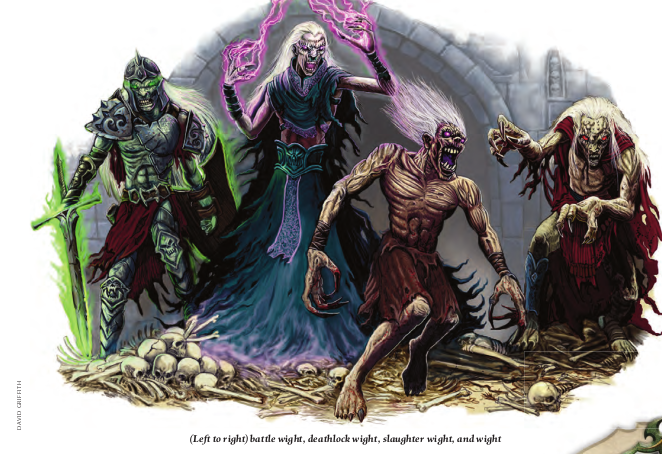
Deathlock Wight
This one was either a necromancer in life, or learned how to be one after it died. It’s a Level 4 Controller with 54 HP and all standard wight traits. Its speed is 6.
A deathlock wight’s basic claw attack does necrotic damage, and causes the target to lose a healing surge. Their Grave Bolt (ranged 20 vs. Reflex) is a much better attack, dealing necrotic damage and immobilizing (save ends). Their magically-enhanced Horrific Visage (close blast 5 vs. Will; recharge 4-6) does untyped damage and pushes victims 3 squares.
Once per encounter they can Reanimate (Ranged 10; minor action) a fallen non-minion undead ally. The target stands back up with 25% of its HP.
The MM stat block for deathlock wights has pitifully low damage all around. Fixing this is a priority if you want to use them.
Wight
The standard model is a Level 5 Skirmisher with 62 HP and all standard wight traits. Its speed is 7.
The basic wight’s only attack are its life-draining claws, which do necrotic damage, eat a healing surge, and allow it to shift up to 3 squares on a hit. It’s simple, but the shift and the life-draining make it quite dangerous since it can reach your squishies and ruin their day.
Battle Wight
A wight with more formal combat training. It wears plate, and wields a sword and shield. It’s a level 9 Soldier with 98 HP and all standard wight traits, plus speed 5.
The battle wight has learned to channel its dark powers through the sword, and so its basic attack is a Souldraining Longsword that does necrotic damage, eats a healing surge and immobilizes (save ends). It can also attack at range with Soul Reaping (ranged 5 vs. Fortitude; recharge 5-6). This only affects immobilized targets, but deals high necrotic damage and heals the wight for 10 HP.
Battle Wight Commander
A smarter and more powerful version of the Battle Wight, this one is a Level 12 Soldier (Leader) with 106 HP and all wight traits. It has the same gear as the basic battle wight, and speed 5.
The commander’s Souldraining Longsword does everything the battle wight’s does, and also weakens on a hit. A save ends both the immobilization and the weakness. Soul Reaping gets upgraded to Soul Harvest (ranged 5 vs. fortitude; recharge 4-6) which works the same but heals both the commander and 2 undead allies within 10 squares.
Slaughter Wight
Much like the basic wight, this one is a monstrosity in rags that attacks with its claws. It’s just a whole lot stronger and tougher.
Slaughter wights are Level 18 Brutes with 182 HP, all standard wight traits, and speed 7. Their claws do necrotic damage and have a lot of riders: eat a healing surge, weaken (save ends), heal the wight for 15 HP, and a partrige in a pear tree.
When killed, these monsters emit a Death Wail (close burst 5 vs. Fortitude), which does necrotic damage to enemies in the area, and allows undead allies in the area to make a basic attack as a free action.
Sample Encounters and Final Impressions
We get several encounters here:
-
Level 3: 1 deathlock wight, 3 zombies, and 6 zombie rotters.
-
Level 11: 1 battle wight commander, 4 battle wights, 1 shadar-kai witch, 2 shadar-kai chainfighters.
-
Level 18: 2 slaughter wights, 3 abyssal ghouls, 1 nabassu gargoyle.
Wights are a very distinctly D&D monster, but at the same time they kinda get lost amid all the other similar undead in the game. This might explain why they were left out of the Monster Vault.
-
-
Let's Read the 4e Monster Manual/Vault: Warforged
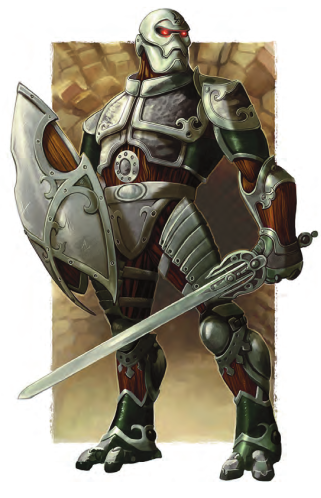
Copyright 2008 Wizards of the Coast This article is part of a series! Click here to see the other entries.
Warforged are a 3e creation, first appearing as a playable option in the Eberron campaign setting. In 4e they would also become playable characters, but their first appearance was in the Monster Manual.
The Lore
The warforged lore given to us by the Monster Manual has been stripped of all Eberron-specific information, which means it’s extremely terse and generic.
Warforged are living constructs created by magic. The “living” part means they’re gifted with true sapience, and with souls. It also means they’re a little less tough than a golem, but they make up for that with their large numbers.
Warforged are created in magical factories called Creation Forges. They’re sexless and can’t reproduce in any other way. As their name implies, the original purpose of the warforged was to serve as an army. In peacetime, individual warforged often end up working as bodyguards and mercenaries for people who share their individual ideals and disposition.
In Eberron, the secret of building and operating creation forges belonged exclusively to House Cannith, who sold warforged armies to all five sides of the Last War but whose main customer was the nation of Cyre. The treaty that ended the War (signed after Cyre got swallowed by a magical disaster) freed all existing warforged from servitude, and I think it also tightly regulated their creation.
Most warforged PCs from Eberron are going to be veterans of the Last War, which is like a combination between our Hundred Years War and World War One. However, in the ruins of Cyre, a powerful warforged supremacist named the Lord of Blades controls a fully working creation forge and is using it to build an army.
Warforged in the 4e implied setting might have been alive to see the fall of Nerath. They could also have been built more recently by someone operating an Nerathian creation forge, or even assembled by hand by an isolated artificer.
The Numbers
Warforged are Medium Natural Humanoids with the Living Construct keyword. Monster Manual warforged have several signature traits: they get a +2 to saves against ongoing damage, they employ Battlefield Tactics that grant them a +1 bonus to melee attack if any ally is adjacen to the target, and they can use the Warforged Resolve encounter power as a minor action when bloodied to recover a healing surge’s worth of HP.
Playable Warforged would appear in the Eberron Player’s Guide: they’d get the save bonus against ongoing damage and a modified form of Warforged Resolve, along with a few other things.
Warforged Soldier
This is a Level 4 Soldier with 56 HP and all standard warforged traits. It wears plate, and wields a longsword and a shield. Its ground speed is 5, and it’s trained in Endurance and Intimidate.
The soldier’s basic (and only) attack is the longsword, which does average damage for its level and marks for a turn. Its Warforged Resolve heals it for 14 HP when used.
The warforged isn’t too different from a human fighter, but its racial traits give significantly more staying power. You can slap them onto any human stat block to get the warforged version. If you use them in a tight formation then most of them will get the +1 Battlefield Tactics bonus all the time when attacking targets directly in front of the formation.
Warforged Captain
This is a Level 6 Soldier (Leader) with 72 HP and all common warforged traits. Its speed is 5 due to armor and its Warforged Resolve heals it for 18 HP when used.
Captains fight with a Reach 2 glaive, which does average damage and marks for a turn. It can use this weapon to performa Tactical Switch maneuver (recharge 4-6), in which it makes a basic attack that also slides the target 1 square. If this hits, the captain or an ally within 10 squares can also shift 1 square.
Captains excel at fighting from the back row of that warforged soldier formation, since they have a reach weapon. Tactical Switch is good for disrupting enemy formations, or interrrupting flanking attempts by individual strikers.
Sample Encounters and Final Impressions
We have a single sample encounter: Level 4, three human guards, 1 warforged soldier, and 1 warforged captain. A mixed force that makes it look like warforged make up the command and elite in this particular army.
Mechanically, these Monster Manual warforged are very simple and present little in the way of exciting surprises other than the fact that they will. Not. Stay. Down. If I’m being honest the book might have done without them entirely.
However, I absolutely love the concept of warforged, both as player characters and as NPCs. I love them so much I adapted them to GURPS here. I understand why the first MM included these: the Eberron books were still a little ways away, and the authors might have felt its fans needed a little reassurance.
-
Let's Read the 4e Monster Manual/Vault: Vine Horror
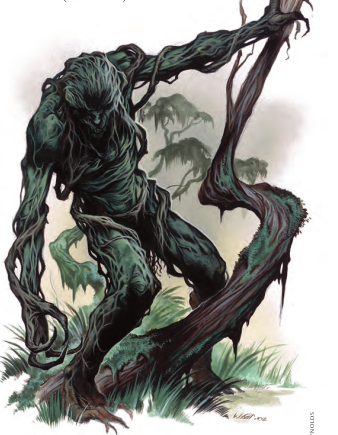
Copyright 2012 Wizards of the Coast This article is part of a series! Click here to see the other entries.
One of the many plant monsters of D&D, I’m not sure where vine horrors first appeared. They look like a 3e thing but could have been in a supplement for an earlier edition. Here, they’re only on the Monster Manual.
The Lore
Like shambling mounds, vine horrors are created “naturally” through an unlikely sequence of events. If an evil person dies in an area touched by the Shadowfell, their blood might end up soaking the earth and infusing the local plant life, which animates as a new vine horror. They’re undead-adjacent, but not undead themselves.
Vine horrors are humanoid plant masses who bear a vague resemblance to the dead person whose blood gave them life. Some times they even display some of that person’s abilities: for example, a vine horror who rises from a wizard might be able to cast a few spells.
Personality-wise, they display human level intelligence and tend to be cruel serial killers. The books say they like to ambush and kill passing sapients, but doesn’t make any mention of them needing to do it. It would make sense if they needed to keep draining blood to live, but it also fits to say that a vine horror feeds on soil and sunlight just like any other plant and just kills people because it likes to.
The Numbers
Vine horrors are Medium Natural Humanoids with the Plant keyword. They have blindsight, a land speed of 6 with both swamp and forest walk, and a swim speed of 6.
A vine horror’s humanoid shape isn’t a constant - they’re Malleable enough to squeeze into any 1-inch or wider opening without slowing down at all. They have claws, and can also partially uncoil to strike their victims with vines whose exact effects vary by stat block.
Vine Horror
The basic model is a Level 5 Controller with 67 HP. Aside from its basic claws, it can use its Vicious Vines once per encounter. This Close Burst 5 vs. Reflex restrains and does 10 ongoing damage on a hit (save ends both).
Its Stealth training, varied movement modes and malleability ensure the horror will be a in a good position to use Vicious Vines as a fight-opener. After that, it and its buddies can go to town on the weakened party.
Vine Horror Spellfiend
An example of a wizard-derived horror who can cast some spells. It’s Level 7 Artillery and has 65 HP. It can only use claws in melee, but has a lot of ranged options.
Shock Orb (ranged 10 vs. Reflex) does lightning damage. Lashing Vine of Dread (ranged 5 vs. Reflex; fear) does physical damage and pushes the target 5 squares on a hit. Caustic Cloud (area burst 1 within 10 vs. Fortitude) does immediate and ongoing acid damage, and also blinds (save ends both).
Looks like spellfiends pair wonderfully with shambling mounds, since their at-will lightning powers can heal the mounds. They can also use their fear vines to herd the party into position for Caustic Cloud, a process that’s a lot quicker if you have a pair of spellfiends in the encounter group instead of just one.
Sample Encounters and Final Impressions
The book does mention the possible shambling mound partnerships, but the example encounter it gives is a little less synergistic: Level 9, 2 spellfiends, 1 bog hag, and 2 trolls. A clever party might be able to turn those caustic clouds to their advantage.
Story-wise vine horrors don’t do much for me. They’re just one creepy plant monster among many others. Mechanically, I’d like to see how an encounter featuring spellfiends and shambling mounds would go.
subscribe via RSS