Posts
-
Let's Read the 4e Monster Manual 2: Ant, Giant
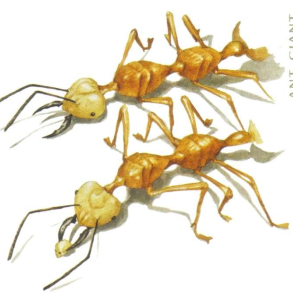
Copyright 2009 Wizards of the Coast This article is part of a series! Click here to see the other entries.
“Ant, Giant” is the actual title for the entry. Now that’s some old-school naming! Giant ants have been part of the game since the beginning, so this style feels appropriate.
The Lore
There isn’t a lot of mystery to giant ants. They’re red ants the size of an adult human. Their colonies can have hundreds of individuals, and though that’s far less than the teeming millions of a mundane anthill, they end up doing a lot more damage due to their larger size. Once a giant ant colony gets going, it will swiftly strip the landscape bare for miles around it.
Most ants are classified as “workers”, and as the name implies they handle the actual work of building the colony and keeping it fed. You also have some larger variants that are more specialized for combat, and protect the workers. And each colony has a single Queen who is responsible for laying eggs and perpetuating the hive. Though the queen is unlikely to leave her chambers once the hive is established, she’s quite dangerous and remains active throughout her life.
Despite being of animal intelligence, giant ants possess the same instinct for teamwork as their mundane counterparts, which means their colonies are more efficiently organized than many sapient societies. They communicate by emitting pheromone clouds, and at this scale the chemicals that make up these clouds can actually be harmful to non-ants. Giant warrior ants are notorious for using them as weapons.
That bit about “stripping the landscape bare” makes me think giant ants combine the traits of both army and leafcutter ants. So they’d both hunt other animals directly and cut up the vegetation to serve as bedding for their vast underground fungus farms. If that’s the case you do not want a giant anthill anywhere near your territory.
The Numbers
Most giant ants are Medium Natural Beasts, with queens being Large. They have low-light vision and tremorsense 10, but none of them are trained in Perception. They all have a climb speed equal to their ground speed, though they lack Spider Climb and so can’t cling to ceilings.
There are several types of giant ant and all of them have some sort of Frenzy ability, which triggers when another giant and within 10 squares drops to 0 HP. The exact effects vary per stat block, but note that if you have a bunch of tightly packed ants the death of a single one will trigger Frenzy for all the rest.
Level-wise they’re all early-to-mid Heroic, on par with the mundane guards and soldiers for most playable peoples. This means fighting the spread of a giant ant colony might be one of the common problems a sapient settlement has to deal with, alongside bandits, stirges, or marauding goblins.
Hive Worker
The weakest and most numerous ant caste. They exist to fulfill the functional needs of the colony and aren’t much good in a fight, but there are a lot of them.
These are Level 1 Minion Skirmishers with ground and climb speeds of 6, and a burrow speed of 2 with Tunneling. They’re the only giant ants with a burrow speed.
Their only attack is a bite. Their Hive Worker Frenzy makes them shift 2 squares, so if you kill one the horde immediately moves to fill the gap.
Hive Warrior
Warriors act as scouts and guards for worker expeditions. They’re Level 2 Skirmishers with 36 HP and a speed of 8. They attack with a Piercing Bite that does physical damage, and also does bonus acid damage if the target was already taking ongoing acid damage. The warrior itself can’t inflict this, so you’ll want to pair it with a soldier, described below.
Their Hive Warrior Frenzy clears any mark or curse on them, and allows them to shift 2 squares. Yes, this will make the party warlock sad.
Hive Soldier
Stronger and scarier than common warriors, soldiers stay inside the hive to guard it unless the queen directs them to sally forth. They’re level 3 Soldiers with 46 HP and speeds of 6.
They fight with their Grasping Mandibles that grab the target on a hit. They can use their Acid Sting against the grabbed victim, dealing both immediate and ongoing acid damage (save ends). Note that this would allow any accompanying warriors to get bonus bite damage against the victim.
When a soldier hits 0 HP it’s wracked by a Death Convulsion (close burst 1 vs. Reflex) which knocks enemies prone. Its Hive Soldier Frenzy gives it +2 to attacks for a turn when an ally dies.
Winged Drones
These flood out of the colony during mating season, ranging far and wide. At the end of the season I guess the males die, and the females shed their wings and burrow to become queens and form their colonies.
A winged drone is a Level 4 Skirmisher with 55 HP. It has ground, climb, and fly speeds of 8. Its basic attack is an Acid Sting that does immediate and ongoing acid damage, and it can perform a classic Flyby Attack maneuver with it. As we already know, this allows the drone to fly its speed without drawing opportunity attacks and sting someone at any point along the movement. Its Hive Drone Frenzy allows it to shift 2 squares and use the sting.
Once bloodied, the drone can choose to violently shed its wings in a maneuver called Shredding Wings (close blast 2 vs. AC), which does high physical damage and causes it to lose its fly speed until the end of the encounter.
Hive Queen
Like their subjects, queens are of animal intelligence. However, they have an instinctive drive for expanding their colony and the capability to direct their subjects to go forth and conquer.
Queens are Level 5 Elite Controllers with the Leader keyword. They’re size Large, and any other ants In the Presence of the Queen (aura 10) gain a +2 bonus to attack and damage. Their greater bulk makes them slower, so they have a ground speed of 6 and a climb speed of 2.
Queens have two basic attacks: a bite and a kick. The kick targets Reflex, does a bit of damage, and pushes the target 3 squares. The queen’s Frenzy allows her to shift 2 squares and use Kick.
Once per encounter the queen can create an Acidic Cloud on a Close Burst 4. This creates a zone that moves with the queen. Any enemy caught inside takes 2 damage for each other giant ant that’s also in the zone. When first bloodied, the queen issues a chemical Call to Arms that instantly summons four giant ant workers to the fight.
They can also spray their pheromones in an Acidic Blast (area burst 3 within 10 vs. Will; recharge 5-6) which does acid damage and dazes (save ends).
Sample Encounters and Final Impressions
Giant ant encounter groups will tend to contain only the various types of giant ants: every other creature is food to them. The sample group is level 1 and has 1 soldier, 2 warriors and 4 workers.
Before reading this entry I don’t remember ever seeing much that differentiated giant ants from all the other giant bugs, but their MM2 lore, sparse as it is, has me unusually inspired. Mundane ant colonies can be a major problem to farmers, and the giant version seems to pose even more of an existential threat than a nearby bandit or goblin lair would.
-
Let's Read the 4e Monster Manual 2: Ankheg
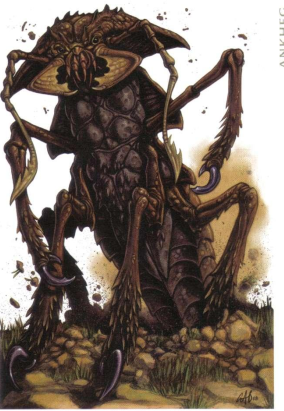
Copyright 2009 Wizards of the Coast This article is part of a series! Click here to see the other entries.
Ankhegs appear in AD&D 1st Edition, and they would go on to achieve minor fame among players because of their lore.
The Lore
Ankhegs are giant burrowing insects who dig mazelike tunnel networks and hunt by bursting through the ground and snatching surface prey with their huge mandibles. They also have acidic saliva, which they can spray at enemies.
These creatures live in “family units” consisting of a mated pair and a small brood of young. These broodlings are rarely seen on the surface - their parents bring prey to them underground. Other things might also be living in ankheg tunnels, since the creatures don’t use all of it as living space.
This is the extent of the lore we get in the MM2, but it was the bits left out that made ankhegs low-key famous. These bits say that ankhegs prefer to dig through soil rich in minerals and organic matter. This means forests, but it also means good farmland. Therefore, these creatures are likely to be found very close to civilized settlements. I think I saw at least one source that said having ankhegs underground actually improved the quality of the soil. If this isn’t true in your campaign, it might very well be a common folk superstition.
Even if ankhegs don’t enrich the soil, their presence might still act as an extra security measure against the many other dangers from the wild, assuming the farmers in question can develop some way of avoiding the beasts themselves. If you walk without rythm, you won’t attract the worm. Unfortunately, it looks like they cannot be tamed, so farming in ankheg country makes for a very interesting life. Fortunately, you won’t find more than one “family” of ankhegs in a given area.
The Numbers
Ankhegs are Natural Beasts, with the adults being Large and the broodlings Small. Both have tremorsense and a burrow speed, and are of animal intelligence.
Ankheg
This adult specimen is a Level 3 Elite Lurker with 100 HP. It has Resist 5 Acid to protect itself from its own saliva, a land speed of 8, and a burrowing speed of 4 with the Tunneling keyword, which means it leaves stable tunnels behind.
The classic ankheg tactic is for the beast to use its Stealth training and burrowing speed to lie in wait underground until it senses prey passing above. Then it’s going to erupt and hit its victims with an Acid Spray (close burst 3 vs. Reflex) which deals immediate and ongoing acid damage and also slows (save ends both). It can do that again it if’s bloodied.
Next it’s going to nab the nearest victim using a Mandible Grab, which damages and grabs (Acrobatics DC 16 or Athletics DC 14 to escape). It can only grab one victim at once, but Mandible Carry allows it to move normally with a grabbed victim. If the victim struggles too much the ankheg can also Gnaw and Scuttle as a minor action, which requires an attack roll and does physical damage and ongoing acid damage (save ends) in addition to allowing the monster to shift 2 squares.
The ankheg can put a lot of distance between itself and its victim’s buddies in a single turn by using a double move and spending a minor action on Gnaw and Scuttle. Still, if someone does manage to reach it while it has a grabbed victim, it can use claw attacks to fight in melee.
Ankheg Broodling
Ankheg attacks are fun for the whole family, because you’re going to be jumped by Mom and Dad, who will then carry you a ways underground so the kids can come out and eat.
Broodlings are Level 1 Minion Brutes, with the same tremorsense as the adults, a land speed of 6 and a burrow speed of 2 with Tunneling. They have basic claw attacks along with a less accurate and more damaging Mandible Rip that deals some “splash” acid damage to enemies adjacent to the target on a critical. Brood Swarm gives them a +4 bonus when attacking a creature grabbed by any ankheg. This more than negates the accuracy penalty from Mandible Rip.
Sample Encounters and Final Impressions
The sample encounter is Level 4: a pair of ankhegs and 6 broodlings plus a rage drake that was likely their original intended victim before the party came along.
My initial impression of anhkegs was that they were just another big bug monster, but the possibility of a setting where ankhegs under your farm fields are just another fact of life makes the more interesting in my eyes. The section on encounter groups also mentions that sometimes giant ants “take control” of a group of broodlings after they drive their parents away, and I can almost hear David Atenborough narrating that nature documentary.
-
Let's Read the 4e Monster Manual 2: Angel
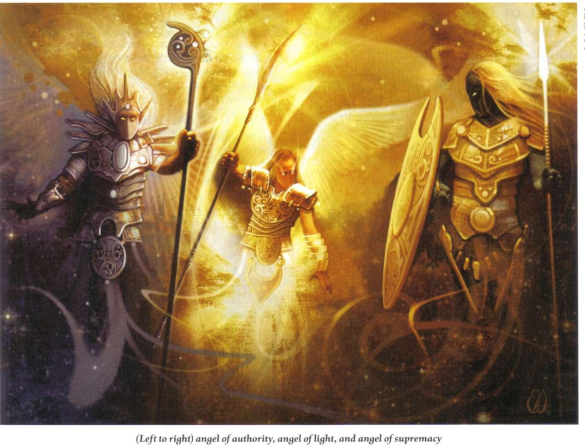
Illustration by Eric L. Williams. Copyright 2009 Wizards of the Coast This article is part of a series! Click here to see the other entries.
The first Monster Manual gave us plenty of lore on this edition’s angels, which you can see by reading my first post on them. The Monster Manual 2 brings us a few stronger angels.
The Lore
Check out my post on MM angels for the basics of angel lore.
The Numbers
Since the original post was one of the first ones I wrote on the Let’s Read, I hadn’t settled on the present structure yet, so I didn’t say much about the common traits of angels.
Angels are Immortal Humanoids with the Angel keyword, which means they don’t need to eat, breathe or sleep. Though they have no legs, they have a land speed of 8 and a fly speed of 12. They’re also immune to fear and have 5/tier Radiant resistance.
Their signature trait is Angelic Presence, a passive ability which inflicts a -2 penalty on any attacks against the angel while it remains un-bloodied.
The angels from the Monster Manual 2 start at where the ones from the first book stopped, in terms of power. This means they’re all epic level and mostly Large in size.
Angel of Authority
These are the heralds and mouthpieces of a deity, and tend to handle some of the most important tasks related to the protection and well-being of a deity’s dominion. Your Metatrons, basically.
They’re Level 22 Controllers with the Leader keyword and 203 HP. They fight with a quarterstaff doing a mix of physical and radiant damage, and shoot lightning bolts (ranged 10 vs. Fortitude) that do lightning damage and daze for a turn.
They can also use their powerful voices for a Majestic Rally (close burst 5 vs. Will). This does a mix of thunder and radiant damage to any enemies caught in the area and hit by the attack, and also weakens them (save ends). A miss does half damage with no riders. Any allied angels in the area instead gain +2 to attacks for a turn. This is why the keyword is important!
Angel of Retrieval
Expert trackers, these angels lead squads of divine servitors and agents tasked with recovering stolen relics or kidnapped creatures. In addition to the abilities described in their combat stat block (below), they’re also trained in rituals that allow it to find their quarry and quickly take the squad to it, like Observe Creature and Planar Portal. They’re Level 22 Artillery with 162 HP and all standard angel traits except Angelic Presence, plus a teleport speed of 5 and blindsight.
As soon as a fight starts, the Angel will use Hunt the Guilty on an enemy within 10 squares, likely the main kidnapper. This will make all the angels attacks deal extra damage against that enemy.
Then it’s going to use its flight and teleport speets to move within reach of the target of the extraction and use Isolating Displacement on it. The power can be either used on an enemy as an attack (reach 2 vs. Reflex) to deal radiant damage, or on an ally as a non-damaging support ability. In both cases, it teleports the target 5 squares, and teleports the angel to a space adjacen to the target. The idea is to teleport the target into the midst of the angel’s more melee-capable allies, who will either protect it and help it run away if friendly, or beat it unconscious and carry it off if hostile.
It will then largely stay away and fire its Angelic Bow (ranged 20/40 vs. AC), which does radiant damage to the target and a smaller amount to any other enemies adjacent to it. Perfect for disrupting tight formations.
Also perfect for disrupting formations is Clear the Way (area burst 3 within 10 vs. Fortitude; recharge 5-6), which deals radiant damage and slides the targets 3 squares. A miss deals half damage and slides 1 square. This could be used to clear a corridor for ther angel’s allies to escape, or to delay pursuers.
If forced into melee, the angel of retrieval will defend itself with a short sword that deals radiant damage, though this is clearly a sub-optimal situation.
Angel of Light
Angels of light are a little different from most of their relatives. They’re the embodiments of a deities subconscious toughts, who form spontaneously in the Astral Sea in their multitudes. Angels of light are driven to enact the thoughts that spawned them, but they’ll also readily work for more powerful angels whose dispositions match theirs. Once formed, an angel of light is an independent individual. There have cases where they end up acting contrary to their originating deity’s wishes because the god has changed their mind, or because the thought was intrusive in the first place.
Angels of Light are the only Medium angels in this entry. They’re Level 23 Minion Skirmishers with all common traits discussed above. They fight with angelic glaives that do radiant damage, and when killed explode in a death burst whose text is a bit confusing. I think the intent is that it’s a close burst 10 vs. Fortitude that does 10 damage to enemies in the area and heals non-minion angels for 10 HP.
Angel of Supremacy
These described simply as “the strongest angelic fighters”, they’re said to guard the homes of the gods and form the backbone of divine strike forces in serious cosmic conflicts. I can’t shake the feeling that Asmodeus was one of these before he rebelled.
Angels of Supremacy are Level 24 Soldiers with 226 HP and all common angel traits. They fight with Reach 3 spears that do a mix of physical and thunder damage, so here’s a surprise for PCs who loaded up on radiant resistance. They also have Threatening Reach, which makes them pretty good at restricting enemy movement.
They’ll likely start a fight by moving into a chokepoint and casting Astral Brilliance (close burst 3 vs. Reflex; encounter). This deals radiant damage and creates a zone that lasts until the end of the encounter. While inside the zone, the angel’s attacks all deal extra radiant damage. Then they’ll attack a particularly troublesome enemy with the Light of Justice (Ranged 10 vs. Fortitude), which deals radiant damage on a hit and marks the target for the whole encounter as an effect. From that point on they can use Summons to Justice (minor 1/round) to pull the marked target 1 square closer to themselves.
Judging by those power names, I think they might have been named Angels of Justice before an editing pass gave them this more sinister name.
Archangel
This isn’t a monster, but a template along the lines of those that first appeared in the DMG 1. It’s meant to represent a higher-ranked angel that might even be the greatest authority in a divine dominion aside from the actual god. The template can be applied to any angel.
Here’s how I would apply it: I’d take a “regular” angel, and add the elite save bonus (+2) and action point. If the angel was already elite, I’d upgrade it to a solo with the +5 save bonuses and a total of 2 action points. In either case I’d double its listed HP.
Then I’d add the template powers: Avenging Strike, which triggers when an allied angel hits 0 HP and allows the angel to shift 2 squares and make a basic melee attack against the slayer. And Overwhelming Presence (close burst 5 vs. Will; enemies only; encounter) which does radiant damage and stuns for a turn.
I would then probably tweak its basic attack so it can be done twice in the same turn, which is common in elite monsters.
So, to ammend my speculation, I’m pretty sure Asmodeus used to be an Archangel of Supremacy.
Sample Encounters and Final Impressions
I like the 4e concept of angels, and so having more of them is cool.
Sample encounters in the MM2 are organized a little differently, with one after each stat block instead of all of them being at the end of the entry. The ones we get here are most all-angel teams, made up of a mix from the MM1 and MM2.
The notable exception is again the Angel of Supremacy encounter, which has three of them along with a Tormenting Ghost (evil!) and a Deva Fallen Star (super-evil!). This is a reminder that not all angels serve good deities, and that creatures with “supremacy” in their names are creepy.
-
Let's Read the 4e Monster Manual 2
As I write this, I have just finished a Let’s Read of the first D&D 4 Monster Manual and Monster Vault in parallel, which took me about one year and four months to complete and and around 2 years and 2 months to finish posting here. This means it’s time to start up on the Monster Manual 2!
Published in 2009, this book includes both more varieties of monsters that appeared in its predecessor, and those that are new either to the game or to this edition of it. There’s not much in the way of preamble in its text: after explaining the same thing I just did in the previous sentence, it launches into a description of the stat block format and then goes right to the monster list.
Before I do the same, I’m going to use this post to describe some useful information for people unfamiliar with either D&D Fourth Edition, or the conventions I’ve adopted over time while going through the first Monster Manual.
Fourth Edition Encounter Basics
While you don’t need to be intimately familiar with Fourth Edition D&D to understand my writeups, it helps to know some basic terminology.
4e uses the same level scale for monsters as it does for PCs. Monsters of the same level are all worth the same amount of XP, and you calculate an encounter’s level by adding up their XP values and adjusting it a bit for the size of your PC party. The game’s platonic ideal of a “balanced encounter” is one where the party faces a group of monsters of the same size and level as themselves. Note that “balanced” here means a fairly easy fight of the sort the PCs can go through several times per day. To make it harder increase either the number or level of monsters, and vice-versa. A “level+1” or “level+2” encounter is challenging, a “level+3” or “level+4” one are boss battle material. A difference of +5 or greater is one of those situations where the PCs might be better off running away.
Levels go from 1 to 30, though some rare monsters meant to be “final bosses” for epic campaigns go a bit beyond that. It’s perfectly possible to have an entire campaign where the party never fights a “balanced”, same-level battle.
Some monsters are “Elite”, which means they are more powerful and are worth two regular creatures in the encounter building formula. Others are “Solos” and are worth four regulars - but despite the name might not make for a fun encounter all by themselves. Combat is a team sport! Last and least, a few are “minions” which do less damage and go down in one hit. Four of these are worth a single regular.
What this means is that you should never evaluate a monster in isolation. Always assume it’s going to fight alongside a team of other opponents with complimentary roles and abilities. This is true even for a lot of solo monsters.
Monster Roles
A monster’s role describes both the sort of tactic you should employ when using it, and acts as a “class” of sorts. A monster’s attack bonuses, defenses, and HP all depend on its level and role, not on what type of creature it is like in 3.x.
-
Skirmishers have baseline stats across the board and abilities that make them highly mobile.
-
Brutes hit hard in melee and take a lot of killin’. They have high HP, high damage, and reduced AC.
-
Soldiers are also melee combatants, but have high AC and tend to have abilities similar to that of a PC fighter, being good at preventing the enemy from targetting their more fragile buddies.
-
Lurkers have attacks that do a lot of damage but require some setup. A typical lurker will have some sort of “routine” where it makes a big attack one turn and spends the following turn setting it up again. This makes them good for ambush scenarios.
-
Controllers have stats similar to those of a skirmisher, but their abilities are a mix of ranged and melee attacks that also inflict negative conditions on the PCs or shape the battlefield in other ways.
-
Artillery monsters are fragile and have lousy melee attacks, but their ranged attacks are stronger and more accurate.
When designing an encounter, you’re usually supposed to mix and match the roles so that they complement each other. In general you want a “front line” made up of soldiers and brutes, with artillery and controllers hanging back and providing ranged support, and with lurkers and skirmishers running around the edges trying to get past the PC’s own front line. The exact composition of your Team Monster will of course alter this in all sorts of interesting ways.
The existence of monster roles means we’ll often encounter monsters with several different stat blocks, which allow you to do something like an “all-bullywug fight” that’s still tactically interesting.
The Dreaded Math Bugs
While the foundation of the encounter design system in 4e was really solid, it took a bit of time for the writers to fine-tune the math. Monsters from the first Monster Manual generally did too little damage. Elites and Solos also had defenses that were too high, and high-level solos in particular had ridiculously large HP totals. All of this could lead to fights that were both too easy and too long to be fun.
In the Monster Manual 2, some of these problems were fixed: Elites and Solos lost their defense bonuses, and Solos have about 20% less HP than they would have under MM1 rules. Brutes and soldiers also had their accuracy fine-tuned (the former missed too much, the latter were too accurate).
From this point on you also start seeing minions with roles: where a MM1 monster might have been described as a “Level 10 Minion”, here you might get a “Level 10 Minion Brute” for example. Role affects a minion’s defenses and damage, but not their HP, which is always 1 with a “minions can’t be damaged by missed attacks” condition.
One problem still remains: damage is still too low, by an amount that increases with monster level. So a level 1 or 2 monster doesn’t suffer from this at all, but a level 25 epic threat will hit like a feather pillow when it should be hitting like a speeding truck.
If you’re preparing a 4e adventure and you need to fix a MM2 stat block yourself, the famous Monster Manual 3 on a Business Card post from Blog of Holding has a wonderful summary of the definitive formulas, which you get in a longer form in one of the DMG update PDFs that WotC published back in the day.
An even quicker fix is to add half the monster’s level to all of its damage rolls, as outlined in this other Blog of Holding post. So, for example, add +5 to all damage rolls for a level 10 monster. This should get you close enough to the “correct” figures.
-
-
Building a GURPS Spaceplane: The Second Iteration
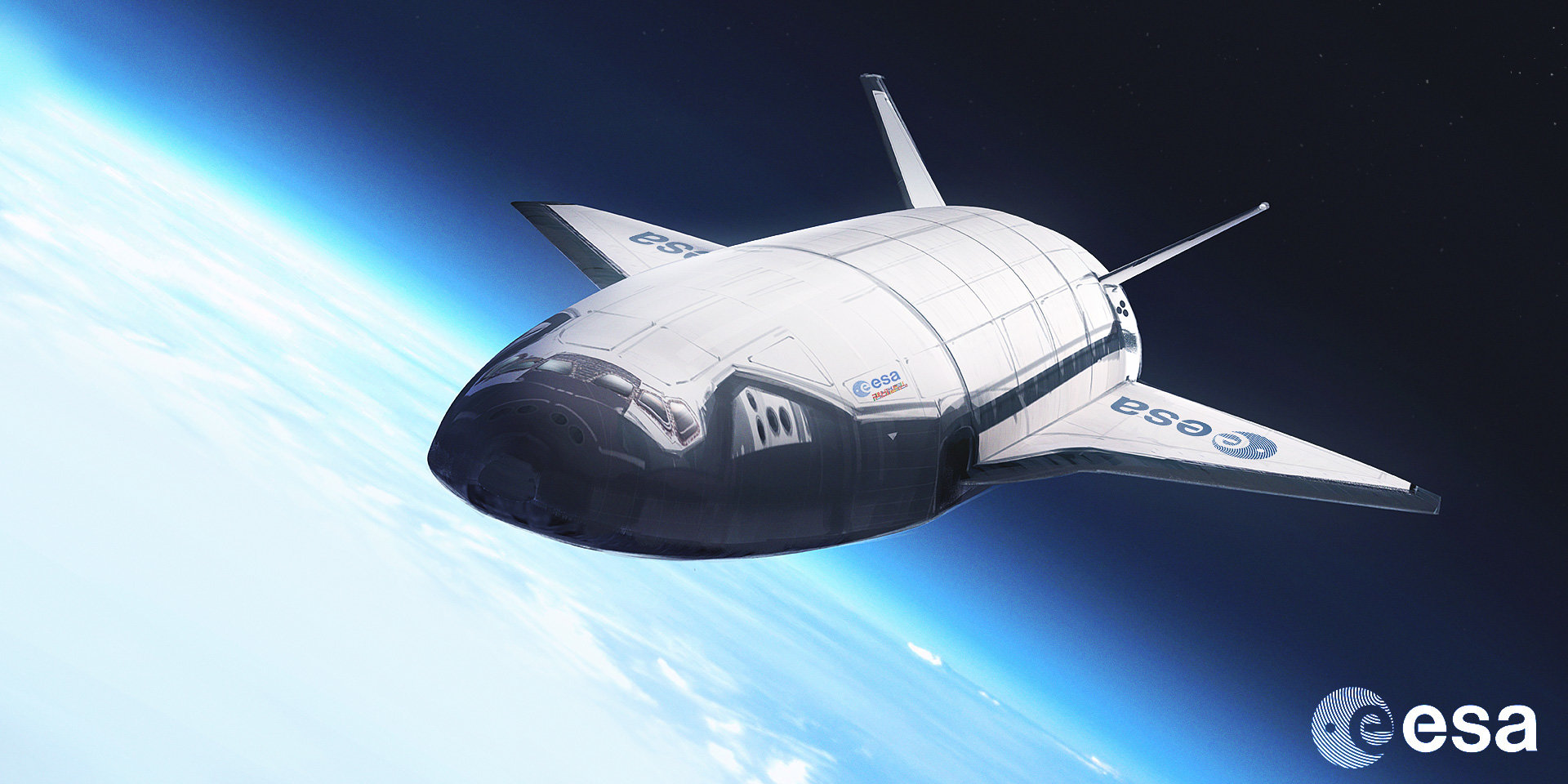
Fictional ESA spaceplane. Illustration by Maciej Rebisz. In our previous post, we used GURPS Spaceships rules to build a “minimum viable spaceplane” at TL8, with no superscience.
Our company, Octopus Aerospace, builds one of those and sells it to the Kerbal Space Program for close to a billion GURPS dollars1, and after using it for a few launches Director Kerbman comes back to us with a few change requests.
His astronauts have complained that the Mark I Spaceplane handles very poorly for its size. They’re entering a phase of their program where future missions will require a lot of precise orbital maneuvers, like docking and such, so they need a ship that can do better at that.
We want to satisfy KSP’s requests because we want a slice of their inifinte budget, but we’re also committed to making only Single Stage To Orbit craft. How can we satisfy both of these requirements?
Building the Mark II
We’re still using “realistic” TL 8 for our Mark II, and it’s still streamlined and winged just like its predecessor.
As we saw in our previous post, a TL8 craft capable of reaching orbit can only spare 10% of its mass to systems that are not fuel tanks or chemical engines. We achieved that in the Mark I by shrinking our control systems and cargo bay, filling the freed space with additional fuel tanks.
We want a full size control system for the second iteration, but having that means we’ll be short on delta-V and can’t make an orbital insertion. We have to shrink something else to compensate. We’re already shrunk the cargo bay, and I don’t want to shrink the armor because I’m envisioning as the craft’s heat shield.
How about the engine?
Our resulting configuration is:
- 1 x Metallic Laminate Armor
- 1 x SM +8 control room
- 1 x 15-ton cargo bay
- 17.33 x Fuel Tanks (865 tons rocket fuel)
- 1 x SM +7 Chemical Rocket Engine (1G Acceleration)
One lone G of acceleration is useless for leaving Earth… in a traditional rocket. We have wings! According to GURPS Spaceships p. 37, a winged craft can take off and reach Earth orbit even if its acceleration doesn’t exceed 1G.
That leaves us with the following stat line for our Mark II space plane: dST/dHP 70; Air Hnd/SR +3/4; Space Hnd/SR -2/4; Move 1G/6.05mps; LWt 1000; Load 15.3; SM +8; Occ 4; dDR 0/2/0.
This model’s Air Handling and Stability is pretty awesome when compared to that of most contemporary airplanes. Its space handling is still not exactly spectacular, but it’s the best we can do for a ship of this size at TL 8, and should help with those delicate maneuvers. It takes longer to reach orbit due to its lower acceleration, but it still has the same Delta-V. Finally, it has space for one additional crew member, allowing KSP to bring extra scientists or other mission specialists along with the payload.
The cheaper engine and more expensive control room balance themselves out. The Mark II costs the same as the Mark I: a nominal $8.8M for the craft and $693,200 for a full load of rocket fuel.
Bonus Notes/Sales Pitch
This is something I forgot to mention in the previous post: both the Mark I and Mark II Octopus Carnival Spaceplanes can take off from conventional runways, dispensing with the need for an expensive launch pad!
The Mark I would probably require a launchpad if you want to use those 3Gs of acceleration right away, but if I remember correctly liquid fuel engines can be throttled. So you can take off using a jet-engine-equivalent 1G and throttle up when you reach a higher altitude.
Even when you multiply their nominal cost by 100 for the extremely limited production run, you still end up with a cost-effective system. SpaceX’s semi-reusable rockets cost between $50M and $150M per launch. The real-world Space Shuttle cost between $500M and $1.5B per launch. The Saturn V cost about $1.6B per launch in modern dollars.
Our fictional spaceplane would cost little more than the cost of a load of fuel. Sure, it’d need to undergo maintenance between flights, but it probably wouldn’t need to be practically rebuilt like the real-world systems. So perhaps we’re looking at $2M per launch or so? It practically pays for itself in six launches or so when compared to the “competition”.
Of course, that’s a very optimistic assumption. In your games you’re always free to assume Octopus Aerospace is full of shit and this thing is a lemon in all its incarnations. It’s what prevented all those real world spaceplane projects from going forward, after all.
-
$880M, or its nominal cost multiplied by 100 because it’s a production run of one. ↩
subscribe via RSS