Posts
-
Let's Read the 4e Monster Manual 2: Barghest
This article is part of a series! Click here to see the other entries.
I think Barghests have been in the game since AD&D 1st Edition, though I don’t think I have the book in which they first appear. Their exact nature has changed a bit between editions.
The Lore
If you described a barghest as a “goblin werewolf”, you’d get the general idea across while being almost completely wrong.
Barghests are born randomly in goblinoid populations. The event is rare, and usually seen as a blessing from Bane. As a result of this reputation and their own powers, barghests often rise to leadership positions in goblinoid society when they grow up.
Barghests are shapeshifters, and possess two forms: one is a goblinoid (goblin, hobgoblin or bugbear), and the other a wolf-like creature. You can’t really mistake them for either normal goblinoids or wolves, though: the creature is merely wolf-like, and the other form always has a specific tell that remains constant across forms. Locks of white hair or a single discolored eye are common.
Barghests aren’t particularly vulnerable to silver nor are they affected by the moon. They’re fairly smart and in full control of their actions in all forms. And they have psionic powers, which usually manifest as some sort of psychic vampirism they use to sap the minds and vitality of their foes.
The Numbers
Barghests are Small or Medium Natural Humanoids with the Shapechanger keyword. They have low-light vision and a ground speed of 6 (8 in wolf form). They can Change Shape with a minor action once per round, and have different basic attacks depending on what their current form is.
They also have some form of harmful psychic power, which varies per stat block. We have two here, both Medium:
Barghest Savager
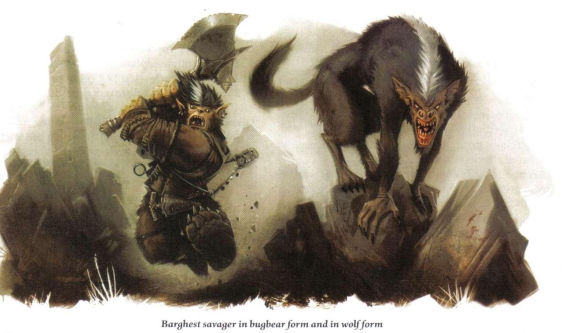
Illustration by Chippy. Copyright 2009 Wizards of the Coast. This is a bugbear barghest whose love of violence is exceptional even for a bugbear. As a leader, it tries to incite its troops to perform frequent raids on any soft targets it can find.
Savagers are Level 4 Brutes with 63 HP. They fight with a battleaxe or with their wolfish bites, and can perform a Jump Strike (recharge 5-6) with either, shifting 3 squares before and after the attack and doing extra damage.
Their mental powers manifest as the Power Feed ability (melee 1 vs. Will; Encounter; Reliable), usable only in wolf form. This does some psychic damage and allows the barghest to use an encounter or daily power it has seen the target use this encounter.
The attack bonus for this will be the same as that of the monster’s other attacks, but damage and other effects will be as if the power had been used by the original PC. This would make the ability worth using on high-damage powers, or those with interesting side effects. When the wizard proclaimed his Sleep spell would end the fight, this was probably not what he had in mind.
The Reliable keyword means the power isn’t spent if the attack misses, so odds are the monster will be able to use this successfully at least once.
Barghest Battle Lord
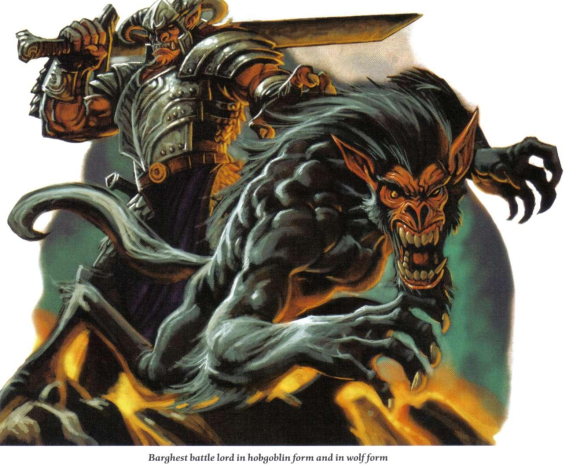
Illustration by Steve Ellis. Copyright 2009 Wizards of the Coast. This hobgoblin barghest has the makings of a legendary general, commanding his troops with great tactical acumen and preferring to bait his enemies into traps. He’s a Level 7 Controller with 82 HP, fighting with a greatsword in humanoid form.
The wolf form’s bites knock the target prone on a hit, and the greatsword makes the battle lord invisible to the target for a turn. In either form he can use a Psychic Howl (ranged 10 vs. Will) which does psychic damage, dazes for a turn, and inflicts a -2 penalty to attacks as an aftereffect (save ends).
He can also use Life Feed (close blast 5 vs. Fortitude; encounter) in wolf form, which does a little bit of necrotic damage and inflicts 5 ongoing necrotic damage (save ends). Whenever the targets take that ongoing damage, the battle lord heals 5 HP. So if four PCs are hit the battle lord will heal at the start of each of their turns, totalling 20 HP per round.
Once per encounter, as a reaction to being hit by a melee attack, the battle lord can Get Some Distance, shifting 2 squares away.
Sample Encounters and Final Impressions
Barghests can be added to any goblin encounter that you think needs an extra kick. The first few times it happens it might catch the PCs by surprise, but it will be interesting to find out if they learn to spot the tells. As mentioned in the lore, barghests will usually occupy leadership positions in whatever group of goblins they hang out with.
I remember barghests had an extremely complicated backstory in previous editions, being fiends from the Neutral Evil plane who happened to be able to shapeshift into goblins and who had a whole complicated hierarchy back home based on how many souls they had devoured. All of that is gone here, which I think is for the best in the end. Some goblins can just wolf out and break your mind with their psychic powers. It’s one of those things that happens.
-
Let's Read the 4e Monster Manual 2: Archons, Water
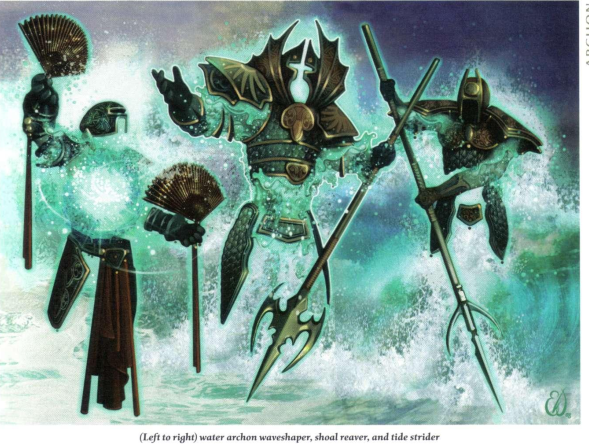
Illustration by Eric Williams. Copyright 2009 Wizards of the Coast. This article is part of a series! Click here to see the other entries.
Finishing our look at the MM2 Archons entry we arrive at Water Archons. All of the lore we saw on the original archon post remains valid here, and as usual they have some additional bits of specific lore to them.
The Lore
Water archons were literally built to rule the seas in a military campaign, a task they do very well. They can fight on land just fine, too, and are fond of using rivers and other waterways as a road network which allows them to move through enemy territory almost unoposed and stage raids and invasions from behind their defensive lines. They advance like the tides, pulling back any enemies who try to escape them. Their gear uses bronze- or brass- colored metal which is often enameled in blues and greens.
When moving in force, water archons ride around in ships which are themselves made out of water, shaped by magic. These also work as submarines, being able to submerge and surface at will and move just as fast in either mode. Not needing air makes the whole process a lot simpler.
The Numbers
We get three different stat blocks for water archons. All are Medium Elemental Humanoids with the Aquatic and Water keywords. They all have a swim speed, of course. When a water archon is hit by cold damage, it’s also slowed for a turn. That doesn’t quite balance out its excellent resistances though.
Wather archons have Resist Acid 10, and are immune to disease, poison and all forced movement. Yep, you read that right. They also get a +2 on saves against the immobilized, restrained, or slowed conditions. I think this might be the first time I’ve seen a whole class of “Fuck You, Controller” monsters.
Water Archon Shoal Reaver
These are Level 13 Brutes with 159 HP and all standard traits. Their ground speed is 5 and their swim speed is 7. They’re enthusiastic raiders who fight with tridents that do physical damage and inflict a -2 AC penalty on the target for a turn.
They can also shoot water harpoons (ranged 5 vs. AC; recharge 5-6) which do more damage than the trident and pull the target adjacent to the archon. You’re not running away so easily!
If surrounded they’ll use a whirlpool of tines (close burst 1 vs. AC; enemies only; recharges when first bloodied) which does physical damage and causes targets hit by it to suffer 2 damage for each square they move (save ends). A miss halves both the immediate damage and the one from the condition.
Water Archon Tide Strider
A surly warrior with big moods and a big spear, the Tide Strider is a Level 15 Skirmisher with 144 HP. Its ground speed is 6, and its swim speed 8. It projects a Body Torrent aura (1) that affects enemies that try to attack the archon in melee, pushing them 1 square whether they hit or miss.
Its greatspear is Reach 2, and if the archon has combat advantage against the target, it will knock the target prone. It can use a maneuver called Way of Water (recharge 6) to shift 6 squares and make a spear attack at any point during the move.
Having a line of these behind a line of shoal reavers might make the PCs think they’re facing a solid phalanx until the tide striders scatter like, well, water, and shift behind the PC’s front line.
Water Archon Waveshaper
This being is pretty much a water-bender, using a pair of war fans to direct the waters around it. It’s a Level 16 Controller (Leader) with 157 HP, a ground speed of 6, and a swim speed of 8.
The waveshaper prefers to stay at a safe distance from the main melee, and support its archon allies from there. It will bombard the enemy with Geysers (Area burst 2 within 10 vs. Reflex; recharge 5-6) which damage, knock targets prone, and prevent them from using immediate actions for a turn.
When things get more chaotic, or while it waits for the geyser to recharge, it will target individual enemies with Dizzying Whirlpool (ranged 10 vs. Fortitude) which does a bit more damage and prevents the target from charging or shifting (save ends).
As a minor action it can use Ocean Call (close burst 10; recharges when bloodied) which allows any allies in range with the Water or Aquatic keyword to shift 3 squares as a free action and gain 10 temporary HP. All water archons have both keywords, of course, and so do a lot of other interesting monsters.
If forced into melee, the archon will use Waveshape as a basic attack that damages, knocks prone, and pushes 1 square.
Sample Encounters and Final Impressions
When not serving the whims of the primordials directly, water archons work for people with similar appetites for destruction and a similar preference for watery environments. As long as their masters allow the archons to indulge in both, they’ll serve loyally.
The sample encounters have troops of archons serving such masters. There’s a level 12 encounter where the master is a human pirate, and a level 14 one where it’s an Aboleth Slime Mage from the MM. That last one includes a waveshaper, whose Ocean Call does also benefit the aboleth.
I like all of the MM2 archons a lot more than I liked the ones from the first book. Their basic mechanics are a lot more functional, though they still suffer from the damage bug, and their themes shine clearly through all of their stat blocks.
-
Let's Read the 4e Monster Manual/Vault: Wraith
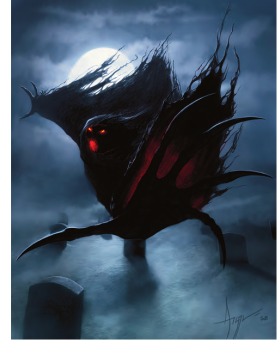
Illustration by Steve Argyle. Copyright 2008 Wizards of the Coast. Looks like I missed this Monster Manual/Vault article due to a small typo when I named its draft. With this, the MM/MV reading is truly completed. Click here to see the other entries.
Wraiths have been in the game since the beginning as a member of the Undead Power Ladder, where they were the logical progression from wights. Here, they appear in both the Monster Manual and the Vault.
The Lore
Wraiths are still kind of a logical progression from wights, in origin if not necessarily in power. As mentioned in the wight entry, living beings in the D&D implied setting are composed of body, soul, and will (also known as the animus). When someone dies in a place filled with strong necrotic emanations, their animus might pop free and roam around on its own. This errant animus is a wraith.
Wraiths perceive the world as if through a heavy shroud. Everything feels cold, colorless, and gauzy. Bereft of a soul and tormented by vague memories of the lost life and sensations they can never recover, they quickly descend into a violent, hateful madness that drives them to attack and slay the living. “Newborn” wraiths at first behave like they did in life, staying near the ground and using doors, but soon they learn that gravity and solid barriers mean nothing to them.
Unlike some other undead we’ve already seen, wraiths don’t originate only from evil people. All it takes is for the person to die under the “right” conditions. A wraith who originated from a good and loving husband is just as violent and dangerous as one that came from a serial killer. In fact, the first wraith might specifically seek out and kill its former family without even knowing why.
Wraiths kill using their life-draining touch. The animus of a recently slain victim will pop free as a brand-new wraith almost instantly. These new wraiths are weak at first, but if allowed to exist for long enough will reach full strength. Even if the victim is brought back to life via magic, its wraith remains - a new animus forms to hold body and soul together. Predictably, this does nothing to improve the wraith’s mood, and it will hunt its former self tenaciously.
Sometimes, when a lot of people die suddenly and simultaneously, their tormented animi coalesce into a single entity known as a Dread Wraith, which is orders of magnitude more dangerous. Individual wraiths who stick around long enough, and who kill enough, may also reach an equivalent level of power.
So there you have it. A flying, insubstantial killer who makes more of itself whenever it kills someone, and who never stops doing that as long as someone is still alive within reach. As RPG.net member Monsieur Meuble pointed out in his own Let’s Read of the 3.5 Monster Manual, that’s a recipe for total extinction. Fortunately for all of existence, wraiths tend to hang out in out of the way places far from population centers.
The Numbers
Most Wraiths are Medium Shadow Humanoids with the Undead Keyword. Dread Wraiths are Large. All have darkvision. They’re immune to disease and poison, Insubstantial, and have a fly speed of 6 with Hover and Phasing capability. They also have 10/tier resistance to necrotic damage. The Monster Manual and Monster Vault versions differ substantially from this point on.
Monster Manual wraiths compete with needlefang drakes, ghouls, and hobgoblins as the most annoying and/or deadly monsters a same-level party can fight. They’re Insubstantial and most of them have attacks with a weakness rider, which means your PCs will spend much of the fight doing a quarter of their usual damage against these monsters. They also have Regeneration, which shuts down for a turn if they take radiant damage but makes them even more durable.
And if a MM Wraith does manage to kill a PC, their Spawn Wraith ability will make another wraith rise from the corpse at the start of the original wraith’s next turn. This new wraith is identical to its creator and starts out at full strength. If this ever happens you might very well be looking at the start of a long, grinding TPK.
MV wraiths attempt to address all of these issues. Their Insubstantiality is the new kind that always takes full damage from force attacks, and it turns off for a turn if the monster takes radiant damage. They have no regeneration, and Spawn Wraith creates a minion that can’t spawn further wraiths instead of a full monster. The weakness rider on their attacks has also been replaced by other effects that retain the same “life-draining” flavor.
The differences between “basic” wraiths are big enough that I’m going to give each book’s version its own sub-section.
Wraith (Monster Manual)
Having said all of that about wraiths in general, I have little left to say about the basic MM wraith. It’s a Level 5 Lurker with 37 HP, Regeneration 5, Necrotic Resistance 10, and Radiant Vulnerability 5. Radiant damage also shuts down the regeneration for a turn, as I said above.
Its Shadow Touch (vs. Reflex) does necrotic damage and weakens (save ends). It does extra necrotic damage if the wraith has Combat Advantage. Once per encounter the monster can use Shadow Glide to shift 6 squares, and any humanoid killed by it produces another full-strength wraith in the next turn.
Wraith (Monster Vault)
Once again, the basic MV wraith is mostly composed of the general traits I discuss above. It’s a Level 5 Lurker with 53 HP and Resist 10 Necrotic. It lacks a numeric radiant vulnerability, but radiant damage does make it substantial for a turn, and it always takes full damage from force attacks. Spawn Wraith produces wraith figments instead of full-strength monsters.
Necrotic damage from the Shadow Touch has been substantially increased, and it further doubles if the wraith was invisible when it started the attack. No weakness rider, though. Shadow Glide is an at-will free action now, triggered whenever the wraith is damaged by an attack that does neither force or radiant damage. It causes the wraith to become invisible until it attacks or until the end of the encounter, allows it to teleport 6 squares, and forbids it from attacking until the end of its next turn.
That’s a evil lurker mechanic. I like it! An unwary party might think they just popped a minion the first time this triggers.
Mad Wraith (Both)
This wraith is different enough from the standard one that it got me wondering that the explanation for it might be. Then it dawned on me that this is a renamed Allip, a monster introduced in 3e that was pretty much a wraith with a stronger insanity theme to it.
This is a level 6 Controller with 54 HP in the MM, and 73 in the MV. Both versions have all common traits for their books, with Necrotic Resistance 10. Let’s start with the MV Mad Wraith, which is the better one.
It has a Mad Whispers aura (3), which does 5 psychic damage to enemies caught inside and slides then 2 squares. It also has the standard Insubstantial and Spawn Wraith traits.
The mad wraith’s basic attack is the Touch of Madness (vs. Will), which does psychic damage and inflicts a -2 penalty to all defenses (save ends). There’s also the Touch of Chaos (vs. Will; Recharge 5-6) which does the same psychic damage, slides the target 5 squares, and forces it make a basic attack against its nearest ally. A miss does half damage and slides the target 2 squares (without the forced attack).
The MM version has the same attacks, the Monster Manual standard traits (and problems), and Radiant Vulnerability 5. Its Mad Whispers aura shuts down for a turn if it takes radiant damage, but otherwise works the same.
Wraith Figment (Monster Vault)
One of these Level 6 Minion Skirmishers gets created whenever a Monster Vault wrait kills a humanoid. They have a standard wraith’s senses, resistances and movement speed, but they lack the Spawn Wraith ability. Their attack is a Shadow Caress (vs. Reflex) that does minion-level necrotic damage and slows for a turn. They can Shadow Glide once per encounter, shifting 6 squares.
Having one of these pop up in a fight is bad news, but not as bad as if they were full strength wraiths. And story-wise they’re still a potential extinction event, as they would eventually grow into “proper” wraiths given enough time.
Sovereign Wraith (Monster Vault)
The strongest MV wraith, it likely belonged to a king or a fighting noble, as it packs an echo of the sword it wielded in life. It’s a Level 8 Soldier with 89 HP and all standard wraith traits with 10 necrotic resistance.
Its basic attack uses the Spectral Sword (vs. Fortitude), which does both immediate and ongoing necrotic damage, and also makes the target grant combat advantage (save ends both). Hit or miss, the target is also marked for a turn.
The sovereign wraith can also inflict a curse of Lonely Death (recharge 4-6), which allows it to make a Spectral Sword attack with an additional rider: on a hit, all creatures except the wraith become invisible to the target. Which is kinda terrifying when you think about it.
Sword Wraith (Monster Manual)
This seems to have the same concept as the Sovereign Wraith at is root, but it’s a lot higher-level and possesses the same issues as all the other MM wraiths.
Sword Wraiths are Level 17 Lurkers with 90 HP and all MM wraith traits with a Necrotic resistance of 20 and Vulnerable 10 Radiant. Their speed is 8. They attack with a Shadow Sword (vs. Reflex) that does necrotic damage and weakens (save ends). They deal extra damage when they have CA, and when they hit 0 HP they can shift 4 squares and make one last basic attack as a Death Strike, doing extra damage if they hit. This seems like it stacks with the bonus damage from CA.
They also have the usual Shadow Glide and Spawn Wraith powers. The printed tactics for them are “fight until bloodied, then run away to regenerate”. You might have noticed they have almost the same HP as the MV Sovereign Wraith, and they also do almost the same damage due to the math bug. The only issue preventing them from being dropped in late-heroic encounters is their high defense and to-hit bonuses.
Dread Wraith (Monster Manual)
This is either an incredibly ancient wraith or one that was formed when hundreds of people died at once and their animi all fused.
Dread Wraiths are Level 25 Lurkers with 124 HP and all MM wraith traits, with Resist Necrotic 30, Vulnerable Radiant 15, and Regeneration 20. Their speed is
- They’re surrounded by a Shroud of Night (aura 5) which weakens all light inside by one step: bright light becomes dim, dim light becomes darkness.
Their basic attack is a Dread Blade (vs. Reflex), which does necrotic damage and weakens (save ends). They do even more extra damage when they have CA, and when they die they release a Death Shriek (close blast 3 vs. Will) which does psychic damage and dazes (save ends). A miss still does half damage. Shadow Glide and Spawn Wraith complete their arsenal. Yes, if a dread wraith kills a PC, they spawn another dread wraith.
Sample Encounters and Final Impressions
There’s a series of increasingly powerful encounters here, pairing dark creepers, evistros, an immolith and a death titan with increasingly powerful varieties of wraith. This section also mentions that wraiths pollute the surrounding area with necrotic energy by their very presence, so now you know how those “necrotic-infused” places that keep giving rise to undead get that way.
The “angry mindless ghost” archetype is useful when designing adventures, but D&D has always been remarkably redundant in this area. 4e went a ways towards reducing this redundancy, but it didn’t go all the way since it still gives us ghosts, specters and wraiths. I did like seeing that the Allip was rolled into the wraith entry, at least.
Mechanically, you should absolutely use the MV versions instead of the ones in the Monster Manual. Level up the sovereign wraith and the figments if you need dread wraiths for the higher levels.
-
Let's Read the 4e Monster Manual 2: Archons, Storm
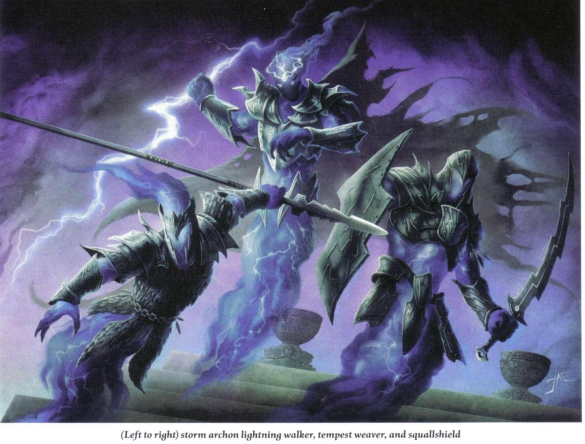
Copyright 2009 Wizards of the Coast This article is part of a series! Click here to see the other entries.
Continuing our look at the MM2 Archons entry we arrive at Storm Archons. All of the lore we saw on the original Archon entry and the extra bits from the Earth Archon post remain valid here, and there’s a bit more that’s specific to them.
The Lore
These beings are more or less the opposite of the earth archons, temperament and tactics-wise. They’re the Raiders on the Storm, so to speak. They live in floating cities made out of storms in the Elemental Chaos, which are always on the move carried by that plane’s winds. Storm archons don’t much care about whatever is under their storms, except when they grow bored and stage massive raids for the fun of it. Their gear is made of silvery or grey metal with a jagged, spiky look. Lightning shaped blades and such.
Storm archons tend to associate with storm giants, since both like to hang out at the same places. The most notable meeting point for the two are the howling black tempests spat forth by the Abyss, which swirl through the Elemental Chaos and beyond. Archons and giants love to ride these storms, whose evil energies make them even more violent and more prone to raiding than usual. Sometimes they also attract demons who follow and fight alongside them.
In less apocalyptic situations, you might also find the archons working as retainers for storm giants, patrolling their domains.
The Numbers
Storm archons are Medium Elemental Humanoids with the Air and Water keywords. They’re immune to disease and poison and have 15 resistance to both thunder and lightning. This makes them immune to a storm giant’s damaging aura, so they do synergize well. They move by flying with a speed of 8 (hover).
Storm Archon Squallshield
Wearing plate and wielding a longsword and shield, these are Level 17 Soldiers with 168 HP. They can surround themselves with a Rain Wall (aura 1) which forces enemies caught inside to make DC 22 Athletics or Acrobatics checks or fall prone. This can knock fliers out of the air. The test itself isn’t terribly difficult for a PC of equivalent level, but the party’s couch potato wizard might have a bit of trouble with it.
The squallshield’s longsword does physical damage and marks for a turn. It attacks at range with Snarling Lightning (ranged 10 vs. Reflex; recharge 5-6), which obviously does lightning damage and also marks (save ends). If the attack hits, enemies adjacent to the target take half damage and are also markec (save ends).
After marking one or more PCs, the squallshield can use Pursuing Storm (move action; recharge 5-6) to teleport to a space adjacent to a marked enemy, which grants combat advantage to them for a turn. Mark of the Tempest means that any marked creature hit by the squallshield is also slowed (save ends).
Despite not being Skirmishers, Squallshields can use a combo of Snarling Lightning and Pursuing Storm to bypass the party’s front line entirely and stick to a squishy, which will have a hard time running away because they’ll be slowed.
Storm Archon Lightning Walker
If the soldier was that mobile, imagine what this Level 18 Skirmisher can do. It has 171 HP and all standard traits.
Walkers fight with spears, which do physical damage and teleport the target 2 squares on a hit. Hit or miss, the archon itself can teleport 2 squares.
When an enemy enters an adjacent square, it can use Booming Retort as a reaction (recharge 4-6). This hits automatically, causes the enemy to take ongoing lightning and thunder damage (save ends), and allows the archon to shift 2 squares.
Once per encounter it can also use a Lightning Pulse (close burst 2 vs. Reflex), which does lightning damage and allows the archon to teleport 10 squares.
Lightning Walkers never stand still, and keep rearranging the party’s formation. Trying to surround them leads to mixed results as they can end up teleporting away anyway, and doing appreciable damage with their Pulse.
Storm Archon Tempest Weaver
The spellcasters of this lot, Tempest Weavers are Level 21 Artillery with 155 HP and lots of storm control powers. Like all artillery they prefer to fight at range. It helps that their Defensive Squall trait gives them a +2 to AC and Reflex against ranged attacks.
A tempest weaver is likely to open up with its Heart of the Tempest spell (area burst 3 within 20 vs. Reflex; targets enemies; encounter), which slides everyone it hits 3 squares, restrains them, and inflicts both 10 ongoing lightning damage and 10 ongoing thunder damage (save ends all). The range on this is so long it can be used as literal artillery, before the archon team makes contact with the PCs. Its selective targeting also makes it a good option for after the archon front-liners have engaged.
Its most common ranged attack is a Resounding Bolt (ranged 10 vs. Fortitude) which does thunder damage and ongoing lightning damage (save ends). If the PCs begin closing in, the tempest weaver can try to clear some space with Lightning Blast (close burst 2 vs. Reflex), which does lightning damage and blinds targets for a round.
If pressed into melee the archon will be reduced to using its Storm Touch (melee 1 vs. Fortitude) to do lightning damage… which is actually kind of a decent basic melee attack! Still, its ranged powers are much better in terms of riders.
Sample Encounters and Final Impressions
We have three sample encounters: one which is all storm archons (level 18), one which has a mix of fire, ice and storm (level 18) and one with 2 tempest weavers, a storm giant, and a thunderhawk (level 22).
I like the contrast between storm and earth archons. Though their damage is still a bit buggy, storm archons also follow a clear theme in their mechanical design. Clearly the WotC staff was following a finalized set of design rules for this book, which wasn’t necessarily true for all the monsters in the first MM.
-
Let's Read the 4e Monster Manual 2: Archons, Earth
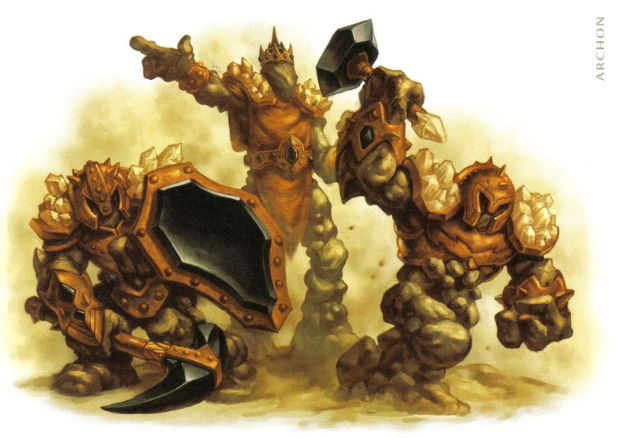
Illustration by Jim Nelson. Copyright 2009 Wizards of the Coast. This article is part of a series! Click here to see the other entries.
Archons in the 4e sense were introduced in the Monster Manual as soldiers created by the primordials to face the angelic legions of the gods in battle. Though some still serve the primordials, others sell their services as mercenaries to other elemental clients.
The first MM had stats for fire and ice archons, and this one brings us three new types: earth, storm, and water. Earth and water archons already made an appearance in our Let’s Read because they’re in the Monster Vault, but chronologically this is their first appearance in the edition. There are enough stat blocks in here that I feel I can give each type its own post. We start with Earth Archons.
The Lore
The basic lore for archons remains the same, as outlined in my post about their first Monster Manual entry. Earth archons have some extra bits specific to them in this book.
Earth archons look like faceless stone humanoids, following the general archon theme. Their armor and weapons are made of copper-colored metal with crystal and obsidian accents. Their military strategy follows the “patient earth” theme: they attack with slow and inexorable advances, and take the time to occupy and fortify any positions they take as they do so.
The greatest earth archon fortress is Thrak-Harda in the Elemental Chaos, which is ruled by the stone titan King Brakkamul and was built to guard the Diamond of Despair. Legend has it that the fortress is meant to protect the outside world from the Diamond, and not the other way around. No one seems to know why it’s so dangerous, but the Dao (cousins of the djinns and efreets) have been obsessed with it for a very long time.
The Numbers
Earth archons are Medium Elemental Humanoids with the Earth keyword. They have Tremorsense 20 and are immune to disease, poison, and petrification. Their ground speed is 6 with Earth Walk, which means they ignore “geological” difficult terrain.
Earth Archon Ground Rager
This archon is a Level 14 Controller with 143 HP and a bunch of earth-bending powers. These start with Ground Liquefaction, an aura (5) that slows any creature without the Earth keyword that starts its turn inside and doesn’t move during it. I guess this is meant to simulate then slowly sinking into shallow quicksand, but as written it also affects fliers. Maybe tendrils of mud reach out to grasp them.
In melee, ragers use slams and shoves to fight. The former are basic attacks, and the later are a bit weaker but push the target 4 squares and knock them prone. Two words: stone sumotori.
At range they can attack with a spell called Raging Earth (ranged 20 vs. Reflex) which counts as a basic attack, does a little damage and immobilizes (save ends). Less often they can cause Ground Eruptions (area burst 1 within 10 vs. Reflex; recharge 5-6) which do a bit more damage and knock prone. On a miss, they do half damage and still knock prone.
The book says ground ragers are drawn to geologically active areas, so you can expect additional earth-based hazards when fighting them. Good luck staying on your feet.
Earth Archon Seismic Striker
The rank and file of earth archon armies is made up of Level 16 Soldiers with 160 HP. They wear plate and wield heavy shields and war picks. They also carry javelins for throwing.
Those picks are high-crit weapons that do a mix of physical and thunder damage. The javelins have range 10/20 and mark the target for a turn on a hit.
They can also use a Seismic Stomp (close burst 3 vs. Fortitude) to deal area damage. A miss does half damage. In either case, the targets are knocked prone. This is a good thing for seismic strikers because the Ground Striker trait makes their attacks stronger against prone targets.
Seismic Strikers have a version of the fighter’s Combat Superiority trait, gaining a +5 bonus to opportunity attack rolls and stopping the movement of any target they hit with such an attack.
As written, the Stomp is not a “friendly” attack, but I’d definitely make at least other earth archons immune to it. This would allow strikers to stay closer together while still keeping enough distance from each other to lure foolish enemies into the “gaps” in their formation, where they’ll be stopped cold by opportunity attacks and knocked prone by overlapping stomps.
Earth Archon Rumbler
Rumblers are shock troops at the spearhead of any attack, which I imagine makes them look like a living avalanche from afar. They are Level 17 Brutes with 204 HP, wearing plate and wielding warhammers.
They can use the warhammers either for basic attacks or for Avalanche Strikes (vs. Reflex), which do less damage but knock prone on a hit. Their Thundering Might trait gives them bonus damage when adjacent to more than one enemy, so they really like to be where the fighting is fiercest.
Sample Encounters and Final Impressions
We get a couple of sample encounters here. A level 14 one with a mix of earth, fire and ice archons; and a level 18 one with a troop of assorted earth archons in the employ of a cambion hellfire magus.
Earth archons seem to have a stronger theme than the MM archons, and better supported by their mechanics. Their damage is still low due to the math bug, but other than that they’re generally well-built and should be OK to use after a damage update.
subscribe via RSS