Posts
-
Let's Read the 4e Monster Manual 2: Centaur
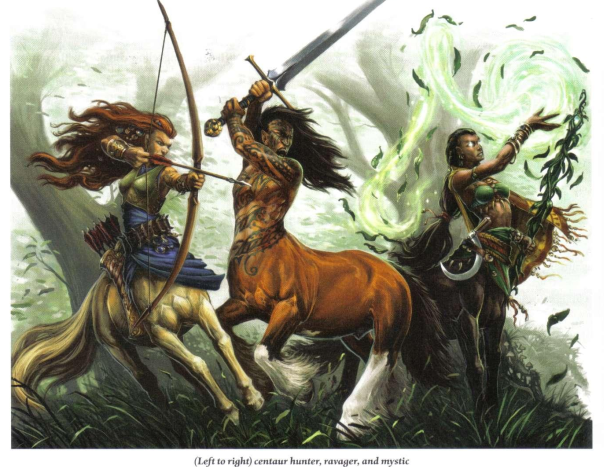
Copyright 2008 Wizards of the Coast This article is part of a series! Click here to see the other entries.
Centaurs are inspired by Greek myth, in which they were The Worst (with rare exceptions). They’ve been in D&D since at least the days of BECMI, which even had a supplement that made them playable.
The Lore
Fourth Edition centaurs are a good deal nicer than their mythological counterparts. Their culture venerates nature in its wilder aspects, and they have an extensive martial tradition. In other words: they’re quite rowdy and love a good fight. Kord and Melora are a lot more popular with them than Corellon, who is otherwise the go-to fey deity. I don’t know if the lore of the primal spirits had been finalized at this point, but centaurs also work great as primal spirit worshippers.
Centaurs like to live in areas that contain vast plains or steppes, but they like to build their settlements on hills or inside caves. The combination gives them a defensible position surrounded by clear sight lines all around, and also gives them the large space they need to run around and to grow their food.
Centaurs are not typically evil, but they’re territorial, mistrustful of strangers, and hate people who despoil nature. Dealing with them peacefully requires careful diplomacy that begins beyond arrow range. The prospective ambassador should spend great effort making their approach both obvious and obviously non-threatening. Once the centaurs recognize you for a friend, though, they can become steadfast allies.
Most centaur settlements are located in the Feywild, though there are some in the world bordering elven forests. Centaur law is simple, and most crimes carry banishment and exile as their punishment. Exiled centaur criminals could easily end up working with other villains.
The Numbers
Centaurs are Large Fey Humanoids, with low-light vision and a ground speed of 8. They have two signature abilities. The first is that their basic attacks do an extra die of damage when used in a charge. The other is a reaction called Quick Kick, which allows them to make a free kick attack against an enemy who moves into a position that flanks the centaur.
Centaur Hunter
If this was a PC, it would be a Twin Strike-spamming ranger. Hunters are Level 12 Artillery with 96 HP and all standard centaur traits.
They fight with classic horse archer tactics, using their superior mobility to keep away and fire on the move. Their main ranged attack is Lightning-Fast Arrows (range 25/50 vs. AC), a standard action that allows them to shoot twice. Though each individual arrow has low damage, the two combined almost line up with MM3 math.
Alternatively, they can use a Charge Arrow (ranged 25/50 vs. Fortitude) to do a bit more single-arrow damage, push the target 3 squares, and knock it prone. I’d say it’s not worth it unless the target is near a cliff or the hunter has melee buddies that would benefit from a prone enemy.
Once per encounter the hunter can speed up even more and deliver a Triple Shot (ranged 25/50 vs. AC), making three attacks whose individual damage is a bit higher.
If someone does manage to engage the hunter in melee, it can defend itself with a bastard sword… but it doesn’t really need to, since the Close-Combat Archer trait makes it not provoke opportunity attacks from the targets of its shots.
Centaur Ravager
The most likely melee buddy for the hunter, this is a barbarian-type. Ravagers are Level 12 Brutes with 150 HP and all standard centaur traits. They fight in melee with their bastard swords, and they can use a Berserk Rush (melee 1 vs. Fortitude; recharges when first bloodied) to do even more damage on a charge, push the target 2 squares, and knock them prone. When first bloodied, they also use Brash Retaliation, a free action attack that does high damage and pushes the targets 2 squares.
All of this suggests shock cavalry tactics: charge, fight in place for a bit, then move away and charge again. Though I guess ravagers have no problem staying in the thick of it either.
Centaur Mystic
A wise primal or divine spellcaster, the mystic takes a priestly role in centaur culture and advises the community on its duties towards nature and the spirits. In combat they use plant- and earth-themed magic.
Mystics are Level 13 Controllers with 132 HP and all standard centaur traits. They wield Reach 2 quarterstaffs which also acts as implements for their magic. The mainstay here is Rootwhip Staff, a melee spell that targets Reflex and does the same damage as a basic staff attack, but also slides the target 3 squares and slows it (save ends).
The mystic’s ranged options are big guns with limited ammo:
Ancestral Chargers is a Close Blast 5 that presumably summons ancestors spirits and has funky mechanics. It targets both Fortitude and Will: you make a single attack roll against both defenses. If the attack beats the target’s Will, they take high psychic damage; if it beats the target’s Fortitude they’re knocked prone and pushed 2 squares. This spell recharges when a friendly centaur within 10 squares drops to 0 hit points, which implies the recharge comes from summoning their recently departed spirit for one last strike.
Biting Earth (Area Burst 2 within 10; recharges when first bloodied) creates a zone that lasts for a turn and can be sustained with standard actions. The biting earth zone immobilizes all enemies within. These enemies can choose to take 3d8 damage to save against the effect as a free action. There’s no regular save, so if the enemy doesn’t want to take damage they’re stuck in place while the zone lasts. When the zone is sustained, the mystic can choose to move it up to 3 squares.
Once per encounter they can also use Mystic Resonance (minor action), which affects all allies within 10 squares. It heals them for 10 HP and allows them to roll a save.
Looks like you want to open with Ancestral Chargers here, and then use Biting Earth to try and hold the PCs in place for the ravagers and hunters to do their stuff.
Centaur Fey Charger
Fey chargers are significantly more powerful than the other centaurs we saw up until now, being better fighters and having a host of storm-themed powers. This would fit a warden or a paladin of Kord.
They’re level 18 Soldiers with 172 HP and all standard centaur traits. They wear mail and carry a shield in addition to the traditional centaur bastard sword, none of which slows them down.
They can fire Stabs of Lightning (ranged 10 vs. Reflex) do to lighthning damage at range while closing in, but the main event is the melee. Once an opening presents itself they close in with a Thunder Charge, a strong attack that does a mix of physical and lightning damage and carries a secondary Close Burst 2 attack that targets Fortitude, does thunder damage, knocks prone and marks for a turn.
Once engaged, their sword attacks mark for a turn, and they can use Thunder Hooves (melee 1 vs. Fortitude) as a reaction to attack anyone who ignores the mark and do thunder damage to them.
Centaur Campaigner
A legendary commander and champion of the centaur people with decades of military experience. The campaigner is a Level 25 Soldier (Leader) with all standard centaur traits and a good deal of supernatural wind- and storm-themed abilities. It wears plate, and carries a shield and a longsword.
The bonus charge damage of the longsword attack is thunder, and the Campaigner is all about that glorious impossible charge. Its Light Hoof trait allows it to ignore all difficult terrain, and Sky Bound (at-will free action) allows it to fly for the duration of its next move, though it must land at the end. If that isn’t possible the centaur will gently float down to the floor, so it doesn’t take fall damage but you might say its momentum gets kinda ruined.
When the campaigner’s charge hits it can use Three Thunder Assault to allow two allies within 10 squares of itself to charge as a free action. These charges deal a bit of bonus thunder damage as well. Combine this with other centaurs (maybe even other campaigners), and you have an instant massive cavalry charge!
Once engaged, Shock Trooper gives the campaigner a small bonus to damage while it’s adjacent to more than one foe. It can also use a maneuver called Hoofed Tornado to perform strong attacks on all enemies in a Close Burst 1, knocking them prone on a hit and marking them for a turn as an effect. This recharges when it’s first bloodied.
Sample Encounters and Final Impressions
Centaurs might be found as members of most fey-themed encounter groups, working alongside elves, eladrin, satyrs, and so on. I imagine the nastier sort of centaur might also work alongside shady customers such as banshrae, hags, or fomorians. For some of those you might want to do some level adjustment either of the centaurs themselves or their associates.
If you want your party to meet centaurs early, knocking 10 levels from the centaur hunter, ravager and mystic would be a good start, making them early-heroic NPCs/enemies.
The sample encounter we get is Level 23: a centaur campaigner plus two eladrin ghaeles of winter mounted on fell wyverns.
I like these centaurs! They can be either friend or foe depending on how they’re treated, and in any case the PCs might find a way to talk to them instead of fighting right away. They’re exactly what I look for in a NPC humanoid species. Their stat blocks also work well at giving the impression of a people for whom infantry tactics and cavalry tactics are the same thing.
-
Streamlined Melee Mastery for GURPS
In GURPS, the Trained by a Master advantage allows a character to perform martial feats on par with those seen in kung fu movies and other similar stories. The Weapon Master advantage does basically the same in a slightly different way. They overlap so much that I’m not sure if they were meant to exist in the same campaign!
I think both advantages are fairly priced on their own, but I don’t think both of them combined are worth 75 points. Choosing to only allow one of them in your campaign is a fairly simple matter, but what if you want to allow both, potentially on the same character?
Most of the differences between the two traits are fiddly matters of skill coverage. Sweeping those aside leaves us with the remaining elephant in the room, the Weapon Master damage bonus.
Elephant Examination: The Damage Bonus
In my experience, the damage bonus is the biggest game changer in the entire WM package. Even if a Weapon Master never learns a supernatural skill and never attacks or parries more than once per turn, they’re still going to feel like an entirely different character from someone who has the exact same stats but lacks the advantage. It feels a bit unfair to me that this bonus is not available to characters that focus on unarmed strikes.
GURPS uses realistic assumptions as a base for its rules, and under those assumptions a combatant with a weapon always has a big advantage over one without. The unarmed fighter risks limb injury on every parry and strike. The armed one has greater reach and much better damage from using swing attacks or simply from doing a better damage type than crushing.
An unarmed fighter with Trained By a Master can approach that by taking other traits… But then they’ve spent 60 points and bought a Hard combat skill to be on par with someone who bought an Average skill and took Weapon Master (single weapon) for 20 points.
I don’t feel a need to keep this “effectiveness gap” between armed and unarmed skills when we’re dealing with a campaign that allows “mastery” advantages in the first place.
New Traits
My solution to the above situation is to rejigger the existing traits. The new and altered traits below are available in any campaign that also allows both Trained by a Master and Weapon Master.
True Master (50 points)
Through either decades of dedication or being some sort of war god, you have mastered all forms of “archaic” combat. You gain all the benefits from having both Trained by a Master and the full version of Weapon Master. Your unarmed strikes enjoy the same damage bonus described under Weapon Master. This bonus does stack with other bonuses from high striking skills and from traits like Claws.
Those two advantages still exist, and represent a slightly less comprehensive form of mastery. You can upgrade from any of them to True Master by spending the difference between their point value and 50.
Iron Limbs (10 points)
Your limbs are immune to incidental injury during unarmed combat. Enemies can’t damage your limbs when they parry your unarmed attacks with a weapon, nor can they switch targets and damage your limbs when you fail to parry their attacks. You also don’t hurt yourself when hitting armored opponents with unarmed strikes. Your limbs can still be deliberately targeted by enemy attacks, however.
This trait replaces Unarmed Master, as it is basically Unarmed Master without the damage bonus.
Conclusion
I like those two traits, though as of this writing I still need to actually field-test them.
In campaigns that use these two new advantages, an unarmed specialist can’t turn their limbs into Strikers. That’s what Unarmed Master did, and we did away with it. IF the specialist in question happens to belong to a non-human species that has natural Strikers, though, those would stack with True Master. Beware of boxing crab-people!
Iron Limbs doesn’t have any prerequisites: you could buy it without having any of the “mastery” advantages. This allows it to be used to represent an extremely focused blessing, or a creature whose limbs are naturally hard to hurt or even naturally made of metal.
Finally, if you feel 10 points for Iron Limbs is too expensive for someone who is already a True Master, you could try rolling it into True Master at no extra cost, and eliminating the separate Iron Limbs advantage.
-
Let's Read the 4e Monster Manual 2: Bullywugs
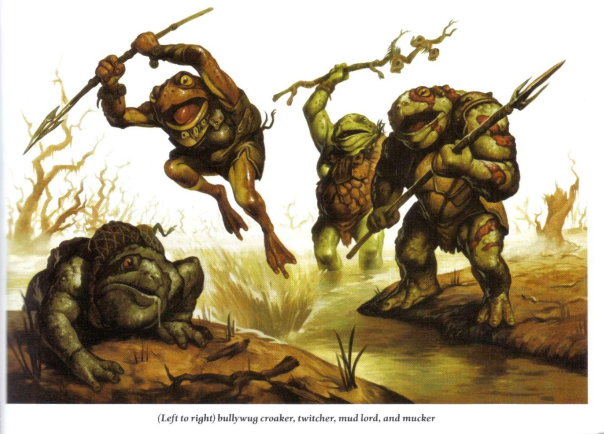
Illustration Copyright 2009 Wizards of the Coast. This is part of a series! Go here to see the other entries.
Bullywugs first appeared in the AD&D 1st Edition Fiend Folio, and featured heavily in the D&D cartoon of the 80’s.
The Lore
Bullywugs are frog-people who claim they were created by the original primordials, not by the gods, and that by living lives of cruelty and violence they can reincarnate as slaads. They also believe the world itself hates them, which they sense as a constant paranoid feeling that everyone is out to get them. And indeed, nature itself seems to breathe in relief when a bullywug is slain in combat.
Bullywug culture places no value in conservation: they move into an area (preferrably a swampy one) and exhaust its resources as quickly as possible. Anything they can’t use they might very well end up destroying. When there’s nothing left, they might resort to cannibalism. Because of this behavior, and possibly because of the divine curse alluded to above, bullywug territory eventually becomes a barren and dismal echo of what it once was. By the book, they’re typically Chaotic Evil with an Int score of 6 and speak Primordial.
As I mentioned several times in the past, I’m not really a fan of Universally Evil Humanoids, so I’d say it’s possible for there to be bullywugs who aren’t Captain Planet villains and who can coexist more peacefully with their neighbors. Who knows, maybe they could be the diplomatic bridge between the humans over in the fields and the lizardfolk deeper in the swamp.
The Numbers
Bullywugs are Medium Natural Humanoids with the Aquatic keyword, which allows them to breathe underwater and gives them combat bonuses while submerged. They have ground speeds of 6 with Swamp Walk, ignoring swamp-flavored difficult terrain. They also have Swim speeds of 4.
The bullywug signature abilities all come from that divine curse. Rancid Air is an aura (2) which causes enemies to become weakened until the end of their next turn if they spend a healing surge while inside. Nature’s Release triggers when the bullywug is killed by a critical hit, and restores a handful of HP to their slayer. Our theoretical non-evil froggy people would lack either of these traits.
Bullywug Mucker
This Level 1 Brute with 34 HP likely makes up the rank-and-file of a bullywug force. It wields a spear in combat, and has a Bully trait that makes it cause extra damage to prone targets.
It can make targets prone with Bullywug Rush (melee 1 vs. Fortitude; recharge 5-6), a charge attack that deals more damage and knocks the target prone. A miss here deals 3 damage to the Mucker and knocks it prone. I’m starting to feel sorry for it.
Bullywug Twitcher
This is a Level 2 Skirmisher with 34 HP, who fights with a Javelin either in melee or at range. Once per encounter the twitching intensifies and it can perform a Spasmodic Hop, ending any marks on it, shifting 4 squares, and making an enhanced javelin attack at the end that also inflicts a -4 attack penalty on the target for a turn.
This power is Reliable, which means it’s not spent if the attack misses. On the other hand, the Twitcher has no other special movement powers. So ironically, it becomes less mobile once it lands its special attack.
Bullywug Croaker
A weak and flabby specimen that uses its remarkably bad breath to make up for its lack of strength. It’s a Level 3 Minion Brute that attacks with claws and with a Foul Croak (Close Blast 2 vs. Fortitude) that does poison damage.
Bullywug Mud Lord
A spellcaster that makes me think that whole business about emulating slaads being a path to power might have some truth to it. Much smarter than the average bullywug, mud lords often end up in leadership positions, and they have absolutely no qualms about sacrificing their pathetic underlings to ensure their own survival.
They’re Level 3 Artillery with 39 HP. Their ranged spells all cover an area, and appear to be more vomited than cast. Fiery Croak (area burst 1 within 20 vs. Reflex) does fire and thunder damage, and Electric Reflux (close blast 3 vs. Reflex; recharge 6) does cold and lightning damage, half on a miss.
Neither of these attacks are selective. In fact, if they include at least one ally in their area, Necessary Sacrifices grants the mud lord a +2 attack bonus. Okay, this dude isn’t pathetic, he’s despicable.
Sample Encounters
We have two here:
-
Level 1: 1 bloodthorn vine, 2 croakers, 2 muckers, and a twitcher.
-
Level 6: A mud lord, 3 twitchers, 3 ettercap fang guards and 1 ettercap webspinner.
It’s unclear whether the vine or the ettercaps are working with the bullywugs or not. Their lore doesn’t make me think they’d work well with anyone. In fact, they’d probably be in conflict with any other sapients who live in the same swamp as them. If you want to set up a good old-fashioned swamp crawl where the PC can meddle with several factions, a bullywug-goblin-kobold-lizardfolk four-way conflict is an excellent starting point.
-
-
Let's Read the 4e Monster Manual 2: Beholder
This article is part of a series! Click here to see the other entries.
Beholders appeared in the first Monster Manual, and I covered them here. The Monster Manual 2 brings us a few more varieties, including some that also made it into the Monster Vault.
Each of the three beholder varieties here gets its own bit of lore, so let’s combine that with their numbers below.
As before, beholders are Aberrant Magical Beasts. They have All-Around Vision and Darkvision, and a variable fly speed with hover capability. In general their attacks consist of a very weak bite and a whole bunch of thematic ranged attacks from their eye stalks and central eye. Beholder eye rays are Ranged, but don’t provoke opportunity attacks.
Beholder Gauth
This one appeared in the Monster Vault, and so we discussed them a bit here. Gauths are the least of their kind, but they’re still as unpleasant and power-hungry as any beholder. Their relative weakness means they often don’t end up on the top of whatever evil org chart they join, and so they are constantly scheming to rise in its ranks. They’re the most Starscream-like of beholders.
Gauths also like to capitalize on the fearsome reputation of their larger relatives, so people who don’t know better might confuse them for the more dangerous varieties.
I already covered the Monster Vault version of gauths in the post on MM1 beholders. The Monster Manual 2 is pretty much identical, except it suffers from the damage bug and has a remarkably weak bite. Just use the MV stats for this one.
Beholder Eye of Frost
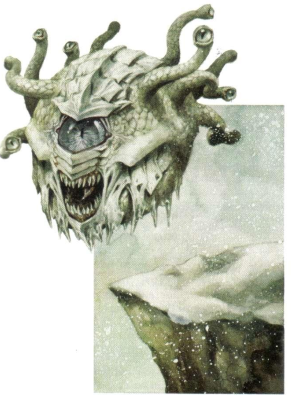
Copyright 2009 Wizards of the Coast A counterpart to the MM1’s Eye of Flame, this is a beholder with a great affinity for elemental ice. It prefers to dwell in very cold climates in the world and Elemental Chaos, where it keeps company such as ice archons, frost giants, and oni. Since eyes of frost aren’t that much stronger than these other ice monsters, they often end up in the same narrative position as gauths, scheming to gain the power and respect they feel is due to them.
Eyes of Frost are Large and have a fly speed of 6. They’re Level 14 Elite Artillery with 222 HP. When first bloodied they coat themselves in Ice Armor, increasing their AC and Fortitude by 2 for the remainder of the fight.
Their bite is super weak: 2d6 damage. You’d need to triple this to get it in line with the new math.
Much more interesting are the eye beams. The Central Eye (Ranged 8 vs. Reflex; minor action 1/round) weakens on a hit (save ends). If a target weakened by this power would become slowed, they become immobilized instead, and this lasts until they’re no longer weakened!
The Eye of Frost has access to 3 Eye Rays, and Eyes of the Beholder allows it to use one of them as a free action against any enemy that starts its turn within 5 squares of the beholder. That enemy also gains Vulnerable 5 Cold until the end of the beholder’s next turn. A ray attack can also be done with a standard action, of course, further increasing the beholder’s rate of fire.
The rays have Range 10, and have the following effects:
-
Freeze Ray: vs. Fortitude, deals cold damage.
-
Telekinesis: vs. Fortitude, slides 6 squares.
-
Ice Ray: vs. Fortitude, deals less cold damage than the freeze ray but also deals ongoing cold damage and immobilizes (save ends both).
Cold resistance on the PCs will go a long way towards making the eye of frost less dangerous, though its control effects will still be a problem.
Beholder Eye of Chaos
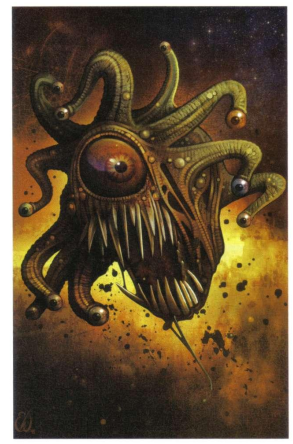
Copyright 2009 Wizards of the Coast Once upon a time, there was a beholder Eye Tyrant who dove into the Abyss in search of the Shard of Ultimate Evil wielded by Tharizdun. Though the creature never found the shard, it nevertheless emerged from the experience infused with all sorts of demonic energies, which increased its power and warped its body and mind. This stat block could represent that individual or one of its descendants, or perhaps another beholder who thought he could do it better.
Eyes of Chaos are still quite capable of concocting complex schemes and directing armies of underlings… only now those underlings tend to be demons more often than not, and those schemes end up having widespread destruction and bloodshed as either their main goals or as desirable side effects.
This twisted thing is Large, and Level 25 Elite Artillery. It has a pretty impressive fly speed of 8, which makes it a lot zoomier than your average beholder.
The bite is once again nothing to write home about, despite all those lovely teeth. The Central Eye (Ranged 20 vs. Fortitude) has the traditional antimagic/enervation effect that forbits the target from using encounter or daily powers until the end of the beholder’s next turn.
After that we get the six eye rays, all Ranged 10:
-
Telekinesis: vs. Fortitude, does physical damage and slides 6 squares.
-
Blinding: vs. Reflex, does physical damage and blinds (save ends).
-
Confounding: vs. Will, does psychic damage, slides 6 squares, and dazes (save ends).
-
Maddening: vs. Will, does psychic damage and dominates until the end of the beholder’s next turn.
-
Fear: vs. Will, does psychic damage and forces the target to move its speed away from the beholder by the safest route possible.
-
Teleporting: vs. Reflex, does physical damage and teleports 10 squares.
The usual Eyes of the Beholder trait means anyone starting their turn within 5 squares of the beholder gets hit with a random eye ray. When the monster is first bloodied it releases a Ripple of Chaos that allows it to target every enemy within 5 squares with a random eye ray and then teleport 6 squares.
I kinda want to make a random roll even for the standard-action eye rays with this critter. For all the randomness, though, it seems the eye ray effects are actually a bit less exciting than those of a “normal” beholder, since there are no sudden death effects here.
Beholder Ultimate Tyrant
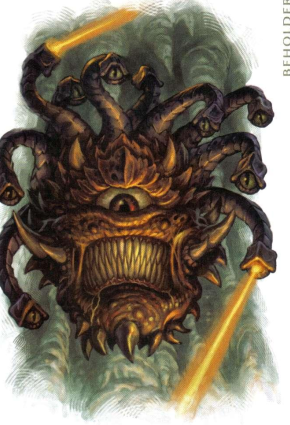
Copyright 2009 Wizards of the Coast If you manage to talk to the Ultimate Tyrant, it will tell you that it has the most valid of reasons for hating all other beholders: they’re a bunch of posers. They were born in the world or otherwise went native, but the Ultimate Tyrant is part of the original generation that came directly from the Far Realm and still keeps its connection to that place.
Depending on the particulars of your campaign it might even be the original beholder. If not, it’s at least among the first to arrive in the world. Perhaps the only creature that might dispute its claims of OG-ness is the Gibbering Orb.
The Ultimate Tyrant is Huge, and a Level 29 Solo Artillary menace with 1080 HP. This can even make it suitable as a final boss for a campaign that ends in the mid-epic levels. Its fly speed is 8, again making it a lot faster than the MM1 beholders. The damage for all of this beholder’s attacks is quite low, and should likely be at least doubled.
There’s the basic bite, and there’s the stuff you’ll actually be using. The Central Eye (Ranged 30 vs. Fortitude; minor action 1/round) does no damage but dazes and slows on a hit (save ends both). This worsens to a full Stun on the first failed save. A miss still slows the target (save ends).
Eyes of the Beholder works as usual, and Spasmodic Rays makes it so the beholder attacks every enemy within 10 squares with an eye ray when it’s first bloodied and again when it dies.
The eye rays themselves are quite scary. Instead of simple ranged attacks, all of them are Area Burst 1 Within 10, and they still don’t provoke opportunity attacks. If the standard Eye Tyrant is a slow-moving battleship, the Ultimate Tyrant is a hyper-mobile orbital laser cannon.
-
Madness: vs. Will; does psychic damage and forces the target to make a basic attack against its nearest ally.
-
Unraveling: vs. Fortitude; does physical damage and 10 ongoing damage (save ends). The first failed save causes an additional 1d10 damage; the second an additional 2d10; the third causes an additional 3d10 and automatically ends the effect. So if you fail all of your saves, you’ll be taking a total of 6d10+30 damage over those three turns.
-
Withering: vs. Fortitude. Does immediate and ongoing necrotic damage (save ends), with the first failed save also weakening the target. There’s a (save ends) after the weakening effect, so I’m guessing that’s a separate save from the ongoing damage.
-
Burning: vs. Reflex. Does immediate and ongoing fire damage, and also inflicts a -2 attack penalty (save ends both).
-
Telekinesis: vs. Fortitude. Slides the target 8 squares and knocks it prone.
-
Frost: vs. Reflex. Cold damage, and a -2 penalty to saves until the end of the beholder’s next turn.
-
Petrifying: vs. Fortitude. Causes slowness (save ends), which worsens to immobilization (save ends) with the first failed save and with petrification with the second. Petrification is permanent until cured.
-
Disintegrate: vs. Fortitude. Physical damage, and ongoing 15 physical damage (save ends). There’s also an ongoing 10 damage after-effect, so in practice passing that first save only reduces the ongoing damage a bit.
-
Attraction: vs. Reflex; -5 penalty to all defenses, and at the start of the target’s turn the beholder pulls it 2 squares (save ends). There’s also a -2 penalty to defenses as an after-effect (save ends).
-
Repulsion: vs. Reflex. -2 penalty to Reflex, and at the start of the target’s turn the beholder pushes it 6 squares (save ends). As an after effect, the target gets pushed 3 squares in the same way (save ends).
Though the Ultimate Tyrant only has one outright deadly effect among its ray selection, it has a few other very interesting effects: the increasing ongoing damage from the Unraveling Ray, the extra-sticky ongoing damage from Disintegrate, and the first instances I’ve seen of ongoing forced movement!
It bears repeating that all of these are area attacks. Yes, even the free-action ones from Eye of the Beholder and Spasmodic Ray. This thing is an army-killer.
Sample Encounters and Final Impressions
We get a total of four sample encounters here.
-
Level 5: A gauth, 2 barghest savagers, and a goblin underboss. The gauth is likely the leader here, making the goblins think it’s a fully powered beholder.
-
Level 13: An Eye of Frost, an oni mage and two wyverns. What haunts the cold mountain at night.
-
Level 24: An Eye of Chaos and a Chaos Hydra. That enough chaos for you?
-
Level 29: The Ultimate Tyrant and 2 Slaughterstone Hammerers. What if the kaiju teamed up with the giant robots?
I love beholders and it’s always good to have more. The Eye of Frost feels weirdly limited in what it can do, like is fiery counterpart in the first MM, but the Ultimate Tyrant is an absolute unit.
-
-
Let's Read the 4e Monster Manual 2: Behir
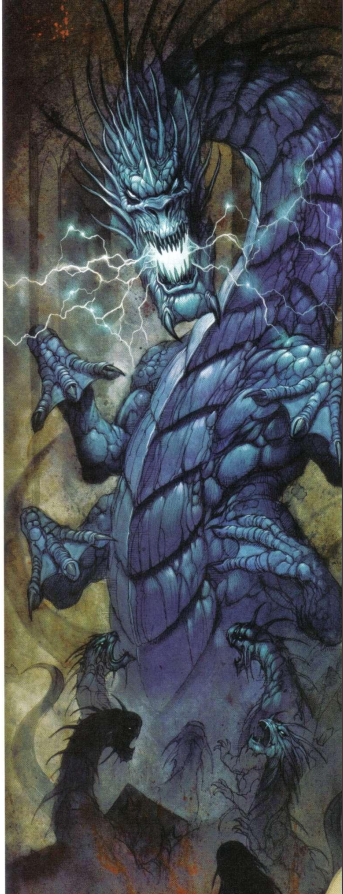
Copyright 2009 Wizards of the Coast This article is part of a series! Click here to see the other entries.
Behirs first appear in AD&D 1st Edition, and are one of the game’s many “not-quite-dragon” monsters.
The Lore
Behirs are giant reptilian creatures with serpentine bodies, many legs (8 or 12, depending on edition), and innate electrical powers. They’re sapient but anti-social and uninterested in the trappings of civilization. They don’t even tolerate each other’s presence for longer than absolutely necessary. A behir mother will eject her young from the lair shortly after they’re born, forcing them to fend for themselves.
Though a behir makes lairs in pretty much the same places you’d expect to find dragons, it accumulates neither treasure nor servants. All it wants is to hunt and be left alone. Like a lot of D&D super-predators it doesn’t usually care about the sapience of its victims, but it can be reasoned with or bribed if you can get it to listen to you. Behirs can communicate both in Common and Draconic.
This means that some people try to recruit behirs into service. Though this can end badly if the behir’s terms are not met, a successful negotiation will allow the foolhardy employer to obtain the services of a formidable monster.
The Numbers
Behirs are Huge Natural Magical Beasts, and have Tremorsense 10 and Resist Lightning 15. They fight with a combination of natural weapons and lightning attacks, which vary per stat block. They’re Unaligned, and have a typical Int score of 7.
Behir
This represents the typical specimen found in the wild. It’s a Level 14 Solo Soldier with 564 HP. Their ground speed is 7, and they have a climb speed of 5. In combat they project a Lightning Storm aura (5) that causes 5 lightning damage to anyone caught inside.
The behir fights with its claws and bite, both of which are Reach 3 and do the same damage. The claw is a basic attack, and the bite does a mix of physical and lightning damage.
It can also Devour a Medium or smaller victim (Reach 3 vs AC), doing bite damage and swallowing it whole. This counts as a grab! While it lasts the victim only has line of sight and effect to the behir, and no one else has line of sight or effect to the victim. A creature can escape the grab by the usual means, appearing adjacent to he behir, and can also automatically crawl out of a dead behir as a move action. With a minor action, the behir can sustain the grab and deal an automatic 15 damage to the victim. Only one victim at a time fits in its gizzard.
The monster can also use a Lightning Breath (close blast 5 vs. Reflex; recharge 5-6), which does “high” lightning damage and dazes (save ends), and does half damage on a miss. Its Thunderleg Stomp (close burst 3 vs. Fortitude) does “low” physical damage and knocks targets prone on a hit.
The damage on all of these is too low due to the math bugs: the basic attacks do an average of 15 damage when they should be doing 22. The tactics section says behirs begin by swallowing a squishy even if they have to eat a few opportunity attacks to do it, and then favoring their area attacks unless sorely pressed by a single character. With a damage upgrade across the board, these tactics are quite sound, since the Stomp becomes a more viable option.
Being solo monsters, behirs have a neat initiative trick: they don’t roll initiative at all! Instead, Lightning Reflexes gives them three turns per combat round at initiative counts 30, 20, and 10. This means that the poor swallowed victim might be looking at 45 automatic damage per round if they fail to escape the grab on their own turn. Using that first action on Swallow is definitely a worthy investiment.
Behir Bolter Whelp
A young specimen, not yet fully grown. It’s merely Large, and a Level 8 Solo Soldier with 352 HP and Resist 10 Lightning. It’s standard damage is 12, and it should be around 16 with the update. It has a ground speed of 8 and a climb speed of 5.
The bolter is going to start the fight by targetting a squishy Knockdown Rush (Reach 2 vs. AC; minor action; recharge 4-6), which allows it to charge and knock the target prone on a hit. Then, since this was a minor action, it’s going to follow that up with a claw or bite, which work the same as the adult’s with smaller numbers and Reach 2.
When the PCs inevitably surround it, the bolder will emit a Lightning Shock pulse (close burst 2 vs. Reflex; recharge 5-6 and when first bloodied) which does “high” lightning damage, half on a miss. When hit by a melee attack, it can respond with a claw as a reaction (Rip-Claw Response).
Despite being young, the bolter already displays Lightning Reflexes, acting on initiative counts 20, 15, and 5, so with enough luck on those recharge rolls it can keep bouncing between PCs for a while.
Behir Stormsteed
This “domesticated” behir was recruited and trained as a mount by storm giants. It’s a Level 24 Soldier with 229 HP. It has Resisnt Lightning 15, a ground speed of 8, and replaces the usual climb speed with a Fly speed of 8 (hover). This is explained as the creature having the ability to walk on the lightning it generates.
The math bug affects the stormsteed particularly hard since it’s an epic creature. Its standard damage is a woeful 18, and it should be 32!
Its basic attack is a bite that does a mix of physical and lightning damage, and it can also use its Lightning Breath (close burst 3 vs. Reflex, recharge 4-6) to deal lightning damage all around itself. I wonder if that was meant to be a blast.
When mounted, the stormsteed can use Ride The Lightning, which grants the rider a +2 to attack with lightning powers, and allows the steed itself to use Lightning Breath once per turn as a minor action indepentently of the recharge counter. Perfect for storm giants or someone like a bluespawn godslayer.
Sample Encounters and Final Impressions
We get two sample encounters: a level 8 one with a bolter whelp and three bugbear wardancers, and a level 14 one with an adult, a medusa, and a yuan-ti incanter. If something even remotely looks like a snake, Zehir has an interest in it.
Behirs are one of those monsters I never really got into in previous edition. A closer reading of this MM2 entry does give me a few ideas of how to use them, but I still can’t say I’m pumped about them.
subscribe via RSS