Posts
-
Let's Read the 4e Monster Manual 2: Couatl
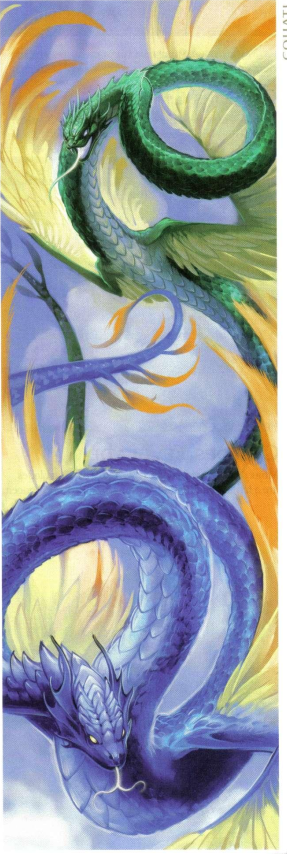
Art by Eva Widermann. Copyright 2009 Wizards of the Coast. This article is part of a series! Click here to see the other entries.
Couatls are inspired by Aztec mythology and have been in the game since at least AD&D 1st Edition. They were given a significant role in the lore of Eberron, and I guess this entry brings that to their generic depiction.
The Lore
Couatls are sapient winged serpents widely known for their great virtue, wisdom and power. They have opposed demons and other servants of evil since ancient times.
All of this is true, but it’s not the whole truth. It’s less widely known that couatl righteousness can end up crossing the line into self-righteousness. Each individual tends to have specific plans that they pursue with single-minded dedication, and being convinced of their own rectitude they tend to not see people who get in the way of those plans with good eyes.
Those plans are never actually evil, of course: they’re stuff like protecting a village or other region, pushing a mortal along a destined path, sealing a planar breach, or preventing one from opening in the first place. Still, it’s very possible for a bunch of well-meaning PCs ignorant of the wider picture to get in the way of a couatl’s plans and draw the creature’s wrath.
Ancient legends say that couatls were born of the world’s first light, and that they fought alongside the gods during the Dawn War. They were supposedly responsible for binding a great number of powerful and dangerous creatures in the world or in other planes, and a lot of those mysterious plans have something to do with keeping those creatures bound.
Couatls have the innate ability to travel from any plane to the Astral Sea in 10 minutes, arriving at a random location or at a teleporation circle they know. They can likely also use standard rituals to travel from the Sea to elsewhere.
In Eberron, if I’m not mistaken, couatls are the ones responsible for binding the demonic Lords of Dust in the distant past, and their magic have a lot to do with the deepest secrets of the Silver Flame.
The Numbers
Couatls are Large Immortal Magical Beasts with the Reptile keyword. They have a ground speed of 6 and a flight speed of 8 with Hover. And they also have two signature traits:
Radiant Absorption makes it so that when a couatl takes radiant damage, its own attacks deal 5 extra radiant damage until the end of its next turn. Twist Free allows them to roll saves against the immobilized and restrained conditions both at the start and end of their turns. This applies even when the conditions would end after a set time instead of being (save ends): in that case, the start-of-turn save could terminate the condition early.
The two stat blocks we get here are Unaligned, which I guess is what you get when you combine “opposes evil” with “is a smug snake”.
Couatl Cloud Serpent
Cloud Serpents are Level 18 Artillery with 135 HP and all standard couatl traits. They prefer to fight by shooting lasers and lightning from above (and far away).
This most often takes the form of a Sky Bolt (Ranged 20 vs. Reflex) which deals lightning and radiant damage. If the opposition clusters together they’ll use Snaking Arcs (Area Burst 3 within 20 vs. Reflex), which is a little weaker but covers an area. It recharges once they’re first bloodied.
If an enemy manages to get close to them they can use a Reach 2 bite, which is a bit weak but deals ongoing poison and radiant damage (save ends). Even their venom is shiny! They can also push the interloper away with Hurtling Coils (Reach 2 vs. Fortitude, minor action 1/round), a non-damaging attack that pushes targets 2 squares and knocks them prone.
Couatl Star Serpent
Star Serpents are Level 15 Elite Controllers with 286 HP. They’re a lot more fond of melee combat than their cloud serpent cousins, and love to use constricting attacks.
Their bite is the same as the cloud serpent’s. The venom does a little less ongoing damage, but also slows (save ends all). Their Righteous Coils (Reach 2 vs. Fortitude; minor action 1/round) do a bit of damage and grab. Grabbed targets grant combat advantage to the star serpent, and it can move them without needing to make Strength tests like the standard grapple rules say. There’s no state limit to the number of grabbed victims; conceivably, the whole party could be wrapped in the serpent’s coils. The escape DC is 27.
The couatl can Constrict (vs. Fortitude; minor action 1/round) a grabbed target, dealing decent physical damage and dazing them for a turn.
The star serpent also has two magic encounter powers: Purifying Scream (close burst 5 vs. Will) does psychic damage and also stuns the target for a turn if it’s taking ongoing fire, poison or radiant damage. Couatl Radiance grants the creature the insubstantial and phasing traits and allows it to shift 8 squares. The goal here is to pass through as many allies and enemies as possible: every ally the couatl passes through regains 15 HP and can spend a healing surge; every enemy suffers an attack vs. Will that, on a hit, deals both immediate and ongoing fire and radiant damage. This nicely sets them up for a Purifying Scream.
Sample Encounters and Final Impressions
Couatls can be found hanging out with other creatures that share a similar desire to oppose or guard against evil. They might also engage in a bit of smug snake realpolitik and work alongside shadier allies with the goal of thwarting a worse evil.
The book gives us two sample encounters:
-
Level 14: a star serpen, 3 deva knights-errant, and 1 phoelarch warrior.
-
Level 20: 2 cloud serpents, 2 marut executioners, 1 marut prosecutor.
I like couatls! This more ambiguous portrayal of them gives me plenty of hooks to hang plots from, which I can’t say was something the purely Lawful Good version did.
-
-
Let's Read the 4e Monster Manual 2: Colossus
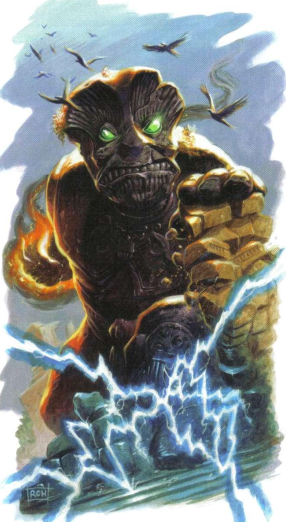
Art by Brian Valenzuela. Copyright 2009 Wizards of the Coast. This article is part of a series! Click here to see the other entries.
The Lore
As we saw back in the Colossus entry for the Monster Manual, colossi are at the top of the tech tree for traditional constructs, and only gods and near-divine spellcasters have the power to create them. They’re the kind of thing that was used as a weapon in the Dawn War. Well, here we learn that the gods weren’t the only side of that war that could make colossi.
In the post linked above, I made a reference to the giant monsters from the Shadow of the Colossus game. The primordial colossus we’re looking at here fits them much better than the godforged variant from the first Manual.
Most primordial colossi were created at the time of the Dawn War, and being as ageless as their creators they still exist today. Some roam the planes seeking to fulfill the orders of their long-gone masters, but others lie dormant looking for all the world like shattered ruins or broken parts of the landscape. When someone approaches them, they rise and smash the intruder.
The magic that goes into a primordial colossus is a little wilder and less controlled than the one that goes into the god-forged variant. The principles behind it are such that a primordial colossus might be created by accident in any event that causes the release of a massive amount of elemental energy. This includes the awakening or destruction of a mighty elemental being. It’s also possible for an epic spellcaster to acquire and perform the ritual to create one of these constructs.
The Numbers
Once again we get a single stat block here, so let’s get right to it.
Primordial Colossus
This baby is a Huge Elemental Animate with the Construct keyword, and a Level 29 Elite Brute with 640 HP. It’s immune to disease, fear, poison and sleep, and has a Variable Elemental Resistance 15 switchable 3 times per encounter. Its ground speed is 10.
Primordial colossi really lean into that mechanic for composite energy damage. They have an Elemental Presence aura (5) that deals 15 damage of the “acid, cold, fire, lightning, and thunder” type to anyone caught inside. You need resistance to all five types in order to not take full damage from it.
Their basic slams do physical damage, but they likely prefer to use a Colossal Slam maneuver (close blast 3 vs. AC), which does the same damage over an area and triggers a secondary attack vs. Fortitude that does a bit of extra five-type elemental damage.
When an enemy moves adjacent to the colossus, it can use a Reactive Kick as a reaction, targetting Fortitude, doing a good bit of five-type damage, pushing the target 4 squares and knocking it prone. This recharges once the colossus is first bloodied.
Staying away does you no good, since it can throw Primordial Stones (Ranged 20 vs. Reflex) that do only a bit less damage than the slam and have a secondary area attack (Close Burst 5 vs. Fortitude) which does that sweet five-type damage.
Sample Encounters and Final Impressions
The two sample encounters have primordial colossi guarding ancient ruins alongside other similarly powerful apotropaics:
-
Level 26: 1 primordial colossus, 2 great flameskulls, 1 slaughterstone hammerer.
-
Level 27: 1 primordial colossus, 1 primordial naga.
Maybe an epic adventure centered on Far Realm opposition could have some horrible aberrant secret guarded by both godforged and primordial colossi - something so terrible the gods and primordials actually joined forces to protect.
Mechanically, I find those Big Balls of Elemental Damage in the colossus’ stat block to be a lot of fun. It’s so hard to resist you’d get the same result by just using straight physical damage, but describing it this way reinforces the elemental nature of the creature… and you get to see the look on your players’ faces as you announce they took acid, cold, fire lightning and thunder damage.
-
-
Let's Read the 4e Monster Manual 2: Cockatrice
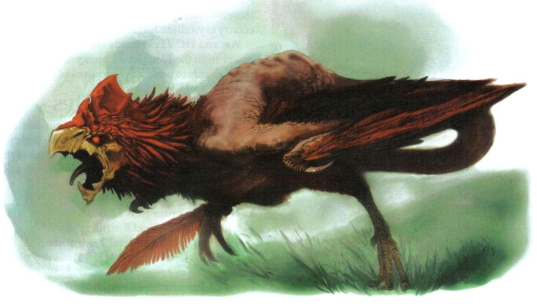
Art by Brian Valenzuela. Copyright 2009 Wizards of the Coast. This article is part of a series! Click here to see the other entries.
As far as I know both cockatrices and basilisks are based on the same vague lump of medieval folklore about an animal that can turn you to stone. The exact name, description and proportion of snake/lizard/chicken traits this animal has varies in each specific story. D&D, of course, turned each possible name for the same thing into a totally different monster. They’ve been in the game since at least the days of BECMI.
The Lore
Cockatrices are bird-like monsters whose bite can turn a victim to stone. Unlike a lot of other deadly creatures, though, they don’t actually seem to be predators. Their petrification powers are a defense mechanism, which they will use while trying to run away from whatever enemy threatens them. So yeah, you could say cockatrices are a bit chicken.
Still, cockatrice lairs tend to have the little statue gardens common to petrifying monsters, all likely made from predators who thought they could handle it or from innocent creatures who had no idea whose lawn they were stepping on. I imagine careful adventurers can just avoid the area entirely if they see the statues, though there are reasons they would seek it out instead: the freshly plucked feathers of a cockatrice can be used to brew a potion that undoes petrification if applied within 24 hours. A single dose requires a whole cockatrice’s worth of feathers, which in turn likely requires killing the beast.
Cockatrices are themselves immune to petrification, which makes them good pets for medusas. The book also says other reptilians, like lizardfolk and yuan-ti, also make use of them. They’re definitely easier to handle than a basilisk.
The Numbers
We only get a single stat block here, so let’s get right to it.
Cockatrice
This is a Small Natural Beast and a Level 5 Skirmisher with 63 HP and low-light vision. It’s immune to petrification as discussed earlier, and has a ground speed of 4 and a flight speed of 6 (clumsy). As a reminder, the Clumsy keyword means the creature has a -4 to attacks when using that movement mode.
The cockatrice’s basic attack is its bite, which is kinda weak but triggers a secondary attack vs. Fortitude. A hit there does no damage and slows the victim (save ends). This worsens to Immobilized on the first failed save, and to “permanent until cured” petrification on the second.
If an enemy moves adjacent to the cockatrice it can use Buffeting Wings (recharge 4-6) as an interrupt, which allows it to bite the triggering enemy and shift 3 squares.
Sample Encounters and Final Impressions
Given their low level, cockatrices are likely to be the first petrifying monsters a party encounters. They’re simple, but their main attack is scary enough to make up for that. They could be made into higher-level threats if, in addition to leveling them up, you made them more mobile and gave them an extra special attack.
The sample encounter is Level 5: 2 cockatrices and a trio of lizardfolk using them as attack animals.
-
Let's Read the 4e Monster Manual 2: Chaos Shard
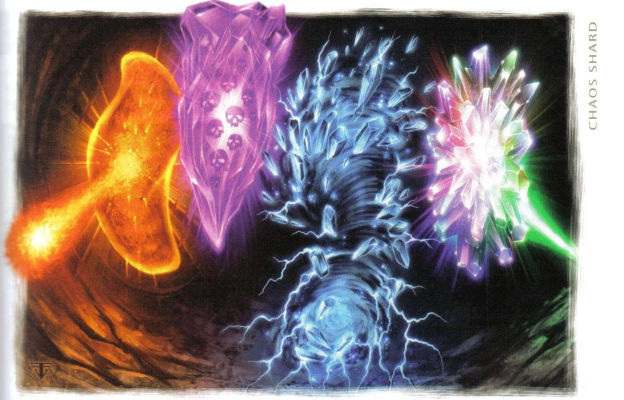
Copyright 2008 Wizards of the Coast This article is part of a series! Click here to see the other entries.
The Lore
In any edition of D&D it’s easy to get obsessed with its fiend taxonomy, but there are always some creatures that end up slipping through its cracks. Take chaos shards, for example. They form spontaneously at the edges of the terrible maelstrom that exists at the border between the Elemental Chaos and the Abyss, when the energies of those two planes clash in a particular way.
These crystalline entities are sapient, violent, and cruel. Since they don’t have any biological needs to distract them, they’re quite content with roaming around and blasting everything they see with elemental energies. I imagine they give preference to targets that can scream and suffer.
Despite having themes tied to the Abyss, being Chaotic Evil, and even having variable elemental resistance, these things are not demons. They do have some sort of metaphysical connection to the Shard of Pure Evil at the bottom of the Abyss, though. Legend has it that the most powerful chaos shards are splinters of that legendary blight upon the universe.
Some wizards trap chaos shards for use as power sources, which I bet is not at all dangerous or likely to result in death and suffering.
The Numbers
We get a handful of stat blocks for shards covering from the mid-Heroic to the mid-Paragon tiers. All are Medium Elemental Magical Beasts. They have Darkvision, immunities to disease and poison, and a variable elemental resistance similar to that of demons.
They’re all Artillery monsters, and their movement is fairly slow, though they do fly. Most are strongly aspected towards a specific element, and have damaging auras that get a bit stronger if their enemies are suffering from some condition.
Storm Shard
This Level 4 Artillery shard has 44 HP and aspected towards lightning and thunder. Its ground and fly speeds are 3, and it projects a Static Storm aura (2) that deals 3 lightning and thunder damage to those enemies caught inside. This rises to 5 if the enemy is immobilized. They have the standard senses and immunities, and their variable resistance is 5 and can be switched once per encounter.
They fire Shock Bolts (vs. Fortitude) that do some lightning damage and “strongly incentivize” the target to move: if they don’t end their next turn at least 4 squares away from their current position, they take lightning damage roughly equal to triple that of the initial attack.
If forced into melee, the shard attacks with Thunder Strikes (vs. Fortitude) which deal thunder damage and knock the target prone if it’s bloodied.
When killed, storm shards explode! This Storm Shatter (Close Burst 3 vs. Fortitude) attack deals lightning and thunder damage, pushes the targets 3 squares, and deafens them (save ends).
A note on damage types: the expression “lightning and thunder damage” above denotes an attack with a single damage roll that is of both types at once. Targets use the smallest of their relevant elemental resistances against this damage. In this specific example, someone with Lightning Resistance 10 and Thunder Resistance 5 would subtract only 5 from the rolled damage. Someone that resists only one of the component types takes full damage.
Death Shard
Aspected towards necrotic energies, Death Shards are Level 8 Artillery with 71 HP. It has all the standard traits including Variable Resistance 5 (1/encounter), and also Necrotic Resistance 10. Its speed is 3.
This thing projects a Death Shadow aura (2) that deals necrotic damage to enemies caught inside, which increases if the enemies are slowed. It fires Death Bolts (ranged 10 vs. Fortitude) that deal necrotic damage and slow (save ends). In melee, it cuts you with a Razor Shard, a regular basic attack dealing physical damage.
It’s a bit less volatile than the Storm Shard, but still dangerous: when hit by a critical, it reacts with a Critical Fracture (close burst 2 vs. Fortitude), which deals necrotic damage and weakens.
If the death shard resists damage (i.e, if it’s hit with something covered by its resistances), all of its attacks deal extra damage until the end of its next turn. This trait is named Life to Death.
Flame Shard
These Level 12 Artillery monsters have an even 100 HP and are a bit more literal about this whole artillery business than most of their compatriots. Their speed is 4 and their variable resistance 10 (switchable twice per encounter).
The flame shard’s main ranged attack is Flame Burst (area burst 2 within 10 vs. Reflex) which is basically like an at-will fireball, though its damage is rather low. In melee it stabs people with a Burning Shard that does fire damage, and it projects a Heat Wave aura (2) that deals fire damage and inflicts a -2 penalty against ongoing fire damage.
When killed they explode in a final attack that’s much like a Flame Burst centered on themselves, and which also does ongoing fire damage (save ends).
Prismatic Shard
Living proof that “Radiant” doesn’t always mean “Good”… it can also mean “evil disco ball”! These are Level 16 Artillery monsters with 123 HP. To the standard list of shard immunities they add an immunity to radiant damage, making the party’s divine characters very sad. Their variable resistance is 10 and can be switched four times per encounter.
Their aura (2) is named Prismatic Corona. It does radiant damage and inflicts a -2 penalty to all saving throws during made during the affected enemy’s turn.
All of the Prismatic Shard’s attacks do radiant damage. The melee Prism Flare (vs. Reflex) has nothing else going on for it. The Iridescent Bolt (ranged 20 vs. Will) also blinds for a turn. Its Flashing Colors (close burst 3 vs. Will; minor action) do no damage but daze (save ends). And the Prismatic Shatter (close burst 3 vs. Will) attack it uses when it dies also blinds (save ends).
Sample Encounters and Final Impressions
As I said before, chaos shards don’t have frail organic bodies to worry about, so they can live solely for the fun of seeing people explode from their elemental blasts. They hang out with creatures who are equally appreciative of this highly refined form of entertainment, including slaads, demons, and certain types of Internet troll.
They can also be summoned and controlled through elemental magic, which makes them popular with certain spellcasters.
The sample encounters are:
-
Level 7: 2 death shards, a bloodseep demon, and 2 evistros.
-
Level 17: 1 prismatic shard, 3 blue slaads, and 1 green slaad.
Chaos shards fulfill the important mechanical niche of providing artillery support for demons and slaads, since these monster types are all about melee and tend to lack ranged firepower. They also further confuse the taxonomy of “things from the Abyss”, something which I’m finding more and more interesting as I progress through these monster books.
-
-
Let's Read the 4e Monster Vault 2: Centipede
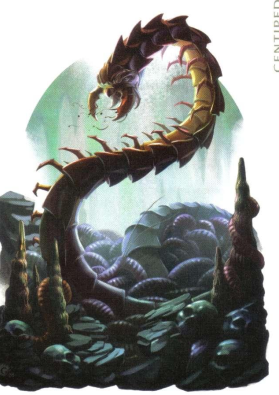
Copyright 2009 Wizards of the Coast This article is part of a series! Click here to see the other entries.
Monstrous centipedes have been in the game since the beginning, and are based on real-world animals. Let’s see what 4e makes of them.
The Lore
I only recently realized D&D centipedes aren’t as fantastical as I always thought. There are thousands of real-world centipede species, and the ones I was familiar with were pretty small and generally not dangerous to people. However, some species can reach up to 30cm (a foot!) in length, and have a poisonous bite that might cause fever and chills in people. It’s possible for someone to be allergic to centipede venom, and in that case their bite can cause anaphylatic shock.
So the only fantastical thing about the D&D centipede in early editions of the game was the fact that its venom was always save-or-die. Its size was realistic, and so was its venom in later editions when it became less deadly. Of course, the game also had truly giant centipedes which were entirely fantastical, and this remains true here.
Centipedes can be found in woodlands, caves, and lots of other environments. They’re ferocious predators and aggressive enough to attack much larger creatures if they feel threatened. The larger specimens are of a scale large enough to see humanoids as potential prey, too.
Despite all this aggressiveness, it seems lots of sapient creatures are able to keep them as pets and guard animals. I suspect magic might be involved. Centipedes are particularly popular pets for Torog worshippers, who consider them sacred.
The Numbers
Centipedes are Natural Beasts of varying size. The game gives them Darkvision, though it might be more accurate to give them blindsight instead. The authors didn’t consider a single foot-long centipede to be a worthy threat, so we get stats for a swarm of them and for a giant specimen.
Centipede Swarm
This Medium swarm is a Level 2 Brute with 44 HP. It has ground and climb speeds of 6, with Spider Climb (which allows them to cling to ceilings). It has all standard swarm traits, taking half damage from melee and ranged attacks, and 10 extra damage from close and area attacks.
Its Swarm Attack aura (1) deals 3 automatic damage to each enemy caught inside, +2 per centipede swarm adjacent to the enemy. This is deceptively dangerous, particularly if you assume multiple swarm auras stack! An enemy adjacent to a single swarm will take 5 damage at the start of their turn. An enemy adjacent to 2 of them would take 14, or 7 if the auras don’t stack.
The swarm’s basic attack is a Swarm of Mandibles (vs. Reflex), which deals a little bit of physical damage, which increases by 1 with each adjacent centipede swarm. A hit also deals ongoing 5 poison damage (save ends). If the enemy is already taking ongoing poison damage, they’re weakened (save ends).
If the swarm is hit by an area or close attack, their Survival Instinct causes them to shift 3 squares as a reaction.
An interesting monster: despite being a brute, its attack is kinda weak. Most of the damage comes from the swarm aura, particularly if you assume multiple centipede swarm auras stack. You’ll never encounter just one swarm either - there should be at least two in the group to enjoy those cool exponential bonuses. More than two might be pushing a bit, though.
Centipede Scuttler
A proper giant, this is a single Medium individual. It’s a Level 4 Skirmisher with 51 HP and both ground and climb speeds of 8. Can’t run away from it.
Its bite targets AC and does a little more damage than the swarm’s, but has the same riders. Against a weakened creature (which likely got that way from its venom) it can Feed, dealing roughly triple the damage of a basic bite.
As an at-will move action, the Scuttler can, well, Scuttle, which allows it to shift 4 squares. When it shifts into an ally’s space while scuttling, that space doesn’t count as one of the 4 squares. Be sure to give it lots of buddies when building the encounter.
Sample Encounters and Final Impressions
We get two encounters:
-
Level 4: 1 ankheg, 2 bloodthorn vines, and 2 centipede swarms. What rotten luck that all of them would be hanging out next to each other.
-
Level 5: 2 scuttlers, 1 gnoll huntmaster, 2 gnoll marauders. So they keep more than hyenas as pets.
I liked the old save-or-die centipedes and these feel properly scary as well, while also being distinct from all the other giant creepy crawlies.
-
subscribe via RSS