Posts
-
Let's Read the 4e Monster Manual 2: Demogorgon (Part 2)
This article is part of a series! Click here to see the other entries.
Continuing from the previous post, this time we’ll be looking at Demogorgon’s Exarchs.
“Exarch” is the term D&D 4 uses for the “lieutenants” of a god or equivalent entity. They might preside over a narrower slice of their master’s portfolio, or simply help run their operations in the world and other planes. Though subordinate to someone else, exarchs are in no way weak: in the god-ranking system used in previous editions, all of them would have ranked as anything from demigods to intermediate deities themselves.
Orcus, which we looked at in the Monster Manual let’s Read, had one exarch: Dorensain, the King of Ghouls. Demogorgon has two, described below.
Kazuul
Kazuul used to be a human champion of Erathis a long time ago, and in her service he carved many a swath of order through savage lands. I guess that in the end something convinced him that this “carving a swath” business didn’t make him any different from the “savages” he claimed to oppose, and so he decided to embrace that and pledge himself to Demogorgon.
The demon lord gave him a gift of size and strength, making him double in size and become deformed by his over-developed demonic musculature. Kazuul now fights in the name of Hethradiah, the “brutal but cunning” head, driving a horde of demons before him to raid places in the Abyss and elsewhere in the multiverse. I guess Kazuul is a big inspiration to those shrieking cultists we saw in the last post.
Being a former human, Kazuul fights with weapons. Being a former adventurer, he’s always on the lookout for better weapons. If he notices one of his opponents is wielding something particularly sweet (say, a level 28+ magical weapon), he will engage that opponent and ignore everyone else until he’s taken the weapon for himself. Otherwise, he will just focus on killing whoever is closest and repeating that until there is no one else to kill.
This obsession with magic weapons stems in part from the fact that Kazuul used to own a legendary sword named Gorgorin the Shatterer. He lost it in a battle against Hainard, one of Pelor’s exarchs. He’s still sore about that, and looking for a way to either get his sword back or to find a suitably awesome replacement.
Kazuul’s current weapons are quite awesome already: there’s The Tooth of Grom, a sword forged from the tooth of a fire titan lord, and The World Splitter, an axe taken from Clangeddin Silverbeard, one of Moradin’s Exarchs.
There’s an ancient prophecy which proclaims that when Kazuul recovers Gorgorin, he will use it to slay Demogorgon and then displace Yeenoghu as the lord of gnolls. This prophecy has caused lots of infighting amongst demons, and there have been several failed attempts by all factions involved to find the blade’s current hiding place.
The Numbers
Kazuul is a Large Elemental Humanoid with the Demon tag, making him an official demon. He’s a Level 28 Elite Soldier with 528 HP. He has Darkvision and demonic Variable Resistance 10, switchable 3x/encounter. He has ground and fly speeds of 5.
He has two basic attacks with his sweet magic weapons: the Tooth of Grom (Reach 2 vs. AC) does physical damage and forces the target to make a melee basic attack against a target of Kazuul’s choice on a hit; the World Splitter (reach 2 vs. AC) also does physical damage and inflicts a -4 AC penalty (save ends). Wrath of Kazuul allows him to attack with both weapons in a single standard action. Oh, and Threatening Reach allows him to make opportunity attacks against any enemy he can reach.
If his enemies are beyond the reach of his blades, Kazuul can attack with Abyssal Flames (area burst 3 within 20 vs. Reflex) at will, doing fire damage on a hit. He also has a couple of handy spells for use when he gets closer:
Word of Doom (close burst 3 vs. Will; encounter) does heavy physical damage and allows Kazuul to crit against the targets on a natural roll of 15-20 (save ends). This is scarier than it might sound for someone used to 3.x! In Fourth Edition, criticals happen only on a natural 20. Only a handful of powers in the entire game increase that range. Word of Doom is the only one I can think of that widens it this much.
Vortex of Blades (close burst 3 vs. Reflex; enemies only; encounter) does double the damage of a basic attack and stuns (save ends). Simple, but still scary: stun (save ends) is a pretty serious condition.
Thrarak
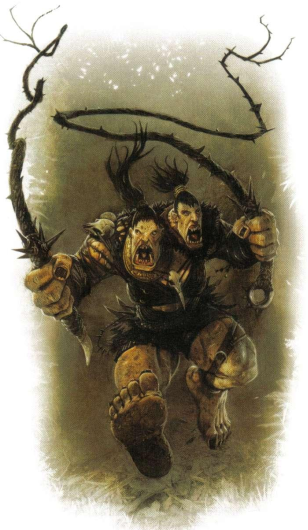
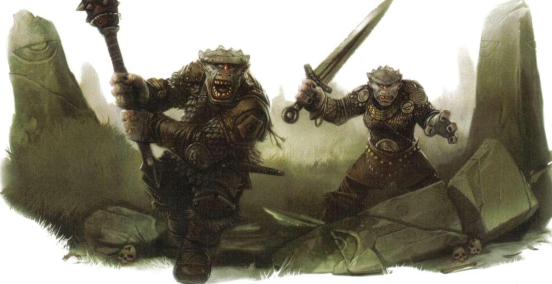
Art by Chippy. Copyright 2008 Wizards of the Coast. Thrarak’s origins are closely tied to the mythological origns for ettins that I wrote about during the first Monster Manual/Vault Let’s Read. It starts with Demogorgon fighting the god Amoth, who split his head in two. Before that wound had even healed, the earth primordial Storralk ambushed him and tried to take him down.
As the linked post says, Demogorgon defeated the would-be usurper handily, and bound his broken but still-living form under his throne. It was Dagon who gave him the idea for a bit of extra cruel punishment: using a ritual provided by Dagon, Demogorgon caused the first Ettins to be born from Storralk’s spilled blood, and to scatter through the world. Each one contains a small fraction of Storralk’s essence, so whenever an ettin feels pain, Storralk’s body feels it as well.
One of those first ettins chose to stay at Demogorgon’s side, and to seek his favor by alternatively healing and cutting Storralk’s flesh. This eventually got his attention and Demogorgon made her one of his exarchs: Thrarak, the Flayed Maiden.
Thrarak is specifically the Exarch of Ameul, the cunning head. She acts as Demogorgon’s emissary of vengeance, going after mortals and other entities that have angered the Prince of Demons or those who have the potential to become threats in the future. An expert torturer, she fights using twin lashes and yelling streams of maddening lore that’s dangerous to hear. She prefers to focus on one opponent at a time, which will either be the target of her master’s ire or the closest available enemy. Once she chooses a target she will ignore any other enemies to focus on it.
Legend has it that if Thrarak is slain and her heart burned upon Demogorgon’s throne, Storralk will finally break free of his prison. Freeing him could be an important step in defeating Demogorgon himself.
The Numbers
Thrarak is a Large Elemental Humanoid (giant) and a Level 26 Elite Brute with 596 HP. She has all the traits common to all Ettins: trained Perception, darkvision, ground speed 8, and the Dual Brain and Double Actions traits described in the original ettin post.
Her basic melee attack is the Lash of Ruin (Reach 3 vs. AC) which does physical damage, knocks prone, and dazes for a turn on a hit. She can sometimes increase her rythm and perform a Lashing Flurry maneuver (close burst 3 vs. AC; recharge 5-6), dealing physical damage and dazing (save ends) all she hits.
Once per encounter she can perform a Howl of Madness (Close Blast 5 vs. Will), which does psychic damage, slides the targets 3 squares, and forces them to make a melee basic attack against a target of Thrarak’s choice.
Those ettin traits I linked to are quite important to all of this: Thrarak has two full turns per round and some resistance to restrictive conditions. She can do a lot, which makes her dangerous to those enemies she’s focusing on. She should be put in charge of a monster team who can keep the remaining PCs off her back.
Sample Encounters and Final Impressions
We have one encounter for each Exarch:
-
Level 25: Thrarak, 1 abyssal rotfiend, and 2 nycademons.
-
Level 27: Kazuul, 1 marilith, and 1 balor.
It feels appropriate to add a whole bunch of minions to either encounter, if you think they’re not dangerous enough.
I think I like these two as villains more than I like Dorensain, Orcus’ exarch. Mechanically, Thrarak is just an epic ettin, but she has an interesting backstory tied to her people’s mythological origins. Kazuul’s magic weapon obsession is also interesting, and the Gorgorin lore has a lot of potential as an adventure hook.
-
-
Popcorn Initiative in GURPS

GURPS uses a fairly traditional initiative system to determine who goes first in combat. Like all such systems, it works well for “real-time” gaming, but it tends to get in the way of good “flow” for a Play-by-Post or other asynchronous game.
In the past I tried to solve that by having players declare 3-5 turns’ worth of actions in advance and resolving those on my side, but that ended up being a lot of work and after a while I burned out on it.
It was at about this time that I first read Lancer, and noticed it used an interesting initiative system. One of the PCs always acts first in a turn, followed by an enemy. We alternate that way until all people on one side have acted, and then the remaining combatants on the other side act one after the other. The players themselves decide who acts during each “player activation”, and the GM decides who acts during each enemy activation. The order in which characters act can therefore vary from turn to turn, but the order of activations always remains the same.
I’d later find out this model was known as “Popcorn Initiative”. It worked well for me in the couple of sessions of real-time Lancer I ran, and I’d get a lot more experience with it when I joined a forum game of Zeitgeist using D&D 4th Edition rules.
Popcorn Initiative works extremely well in that game. Post flow during combat is pretty much uninterrupted as long as there’s anyone available to post. We get through a whole combat round in a single day if everyone is on point, a formidable pace for an asynchronous game.
It worked so well, it made me think I’d only run an async GURPS game if I could use popcorn initiative in it. And it turns out adding popcorn initiative to GURPS is not hard at all!
The Rule
Instead of using Basic Speed values to determine turn order, use the system described at the start of this post, and repeated here for ease of reference:
-
A PC always goes first, followed by an enemy.
-
The two sides then alternate taking their turns until all members of one side have finished.
-
The remaining combatants then take their turns one after the other.
-
Repeat the above procedure for each 1-second round in the combat.
-
Players decide which PC acts on each player turn. The GM decides who acts on each enemy turn. The order doesn’t have to remain constant from second to second.
Traits and maneuvers that give extra actions or extra attacks all affect the character’s own turn, as normal. A character’s defenses “reset” at the start of their turn as usual. Surprise still works the same, and limits your actions in the same way. All this rule change is how to determine the order in which turns happen in a 1-second round.
If the battle involves one or more characters with Enhanced Time Sense, then all of them get to go before the less enhanced combatants, using the rules above among themselves. It effectively splits the second into two “sub-rounds”.
Having a high Speed here is still useful because it gives you more Dodge and more Move. Changes to Basic Speed cost the same as under the standard rules.
Popcorn Examples
Example 1: A party of four fantasy adventurers fights a group of 6 orcs. The heavily armored warrior PC goes first and positions himself to protect his squishier buddies. An orc goes next, then a PC, and so on until all PCs have acted. The final two orcs act one after the other.
Example 2: Two of the orcs in the battle above attack the warrior, who blocks once and parries once. This leaves him with penalties for further defenses. If he is not the first to act next round, the penalties will stay with him until he does take his turn.
Example 3: The same four adventurers meet a Giant Enemy Crab who has Extra Attack 1. Again one of the PCs goes first. The crab goes next, and he can make 2 attacks during his turn as in the normal rules. Then the remaining PCs act.
Example 4: A group of 6 WW2 British Commandos ambushes a patrol squad of 8 Nazi soldiers. The Nazis are surprised and are considered Mentally Stunned as per the standard rules. Though the GM gets to choose the order in which the enemy soldiers act, all they can do on their turns is attempt to recover from the stun.
Example 5: A 6-person squad of the Solar Patrol runs into a pack of three homicidal robots while exploring a ghost spaceship! All of the robots have Enhanced Time Sense, and so does one of the PCs who is a robot themselves. So the PC robot acts first, then the three enemy robots, and then the rest of the PCs.
Conclusion
This is definitely a system I want to try out when I next GM an async GURPS game. I tried to change the standard rules as little as possible. Lancer does a few more things, like giving certain powerful enemies multiple activations per round, but I want to experiment with this base version before I try doing that in GURPS.
-
-
Let's Read the 4e Monster Manual 2: Demogorgon (Part 1)
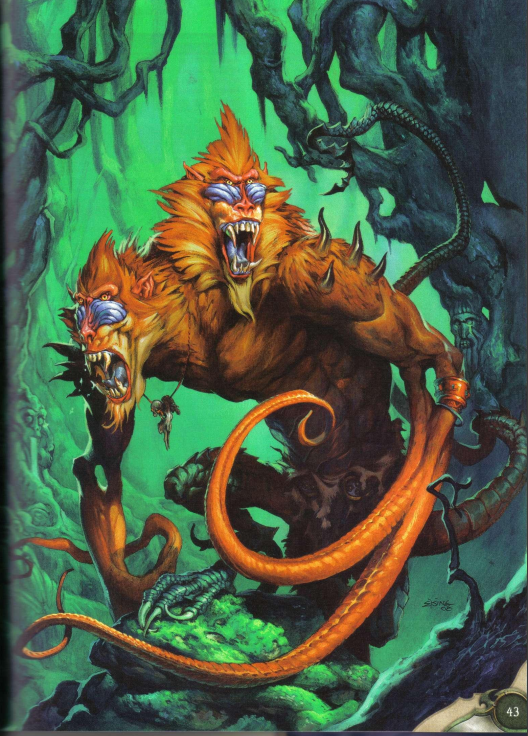
Art by Jesper Ejsing. Copyright 2009 Wizards of the Coast. This article is part of a series! Click here to see the other entries.
We got to the Big Cheese of this book quite early, for his name starts with D: it’s Demogorgon! He’s been in the game since the days of AD&D 1st Edition. The name became quite famous when Stranger Things aired, though I don’t think it refers to the same creature.
This entry is like the Orcus entry in the MM1: It includes not only the stats for the titular demon lord but also its associates, aspects, exarchs, and even cultists. I’m going to go through them in reverse order, starting with the cultists and moving up the levels.
The Lore
Demogorgon is a demon lord’s demon lord. His credo is quite simple: through strength, cruelty and slaughter the strong prosper and the weak die. Be strong, be cruel, and slaughter the weak. That doesn’t mean he’s stupid, though! Each head has its own personality and highly developed intellect: Aameul is cunning but brutal and Hethradiah brutal but cunning. They hate each other and argue a lot but generally end up working towards compatible goals.
Demogorgon also has another business partner who is not himself, which makes him a bit unique among demon lords: Dagon, a Demon Lord inspired by the fishy entity of Lovecraftian fame. A keeper of secrets and cosmic mysteries, he shares these secrets with Demogorgon, but only whispers a given secret to one of the heads. This keeps their mutual hatred and jealousy going strong, and furthers Dagon’s own goals. Their servants and cults can be found cooperating some times.
We’ll eventually discuss the big bosses in more detail, but for now let’s begin by looking at their cults.
Cults of Demogorgon
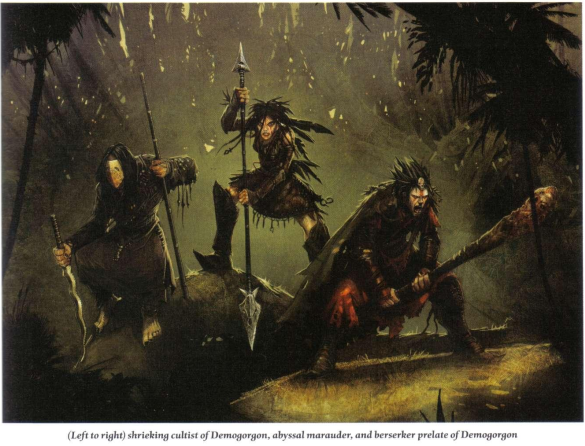
Copyright 2008 Wizards of the Coast Demogorgon’s cults gain prominence when war or other wide-ranging disasters ravage the land, as people turn to him in a desperate attempt to survive and end up becoming murderous marauders themselves. I imagine this tends to prolong the problem that caused the cult to rise in the first place. These cultists wander around like berserking pirates, pillaging and destroying everything in their path. What makes them different from, say, gnolls? Well, they’re more interested in taking your stuff than in eating you, and unlike gnolls or orcs they’re a very diverse crowd.
Members include individuals from any of the “civilized” species as well as troglodytes, kuo-toa and other aggressive humanoids. Note that none of them “naturally” worship Demogorgon: even troglodytes and kuo-toa typically venerate other deities. This means that every cultist of Demogorgon is a heretic to their own people. A lof of them were probably press-ganged into the cult during one of those raids I mentioned in the previous paragraph.
There are also some cultists who go deeper into the demon lord’s mysticism, believing that like their boss they are of two minds: a civilized mind who acts as a shackle to a an instinctive, destructive second self. Some try to explore this duality, while others try to cast of these shackles entirely, worshipping only Hethradiah, the most aggressive of the two heads.
Whatever their individual views, these cultists are all Chaotic Evil by any reasonable definition of the alignment.
Cults of Dagon
Dagon has his own cults too, and these are as Innsmouthy as you’d expect. His temples are undewater, though they include air-filled rooms to accommodate visiting terrestrial worshippers. These tend to congregate in coastal communities, and to sacrifice sapients to their master. Dagon’s demands grow with time, forcing his cultists to perform ever greater sacrifices in order to avoid being swallowed by tidal waves or other disasters sent by their overlord.
His worshippers also frequently include wizards and sages willing to bargain with him for some of those cosmic secrets. These tend to rise to the position of cult leaders. The most powerful among them might be able to visit Dagon personally in his doubly-abyssal domains, and barter legendary artifacts for the lore they seek.
Yeah, Vecna hates Dagon and their cults fight a lot. How did you guess?
The Numbers
We get quite a few cultist stat blocks here, all human. You can easily combine them with standard stat blocks from other humanoid species to get the diversity hinted at in the lore, or add the signature traits of those humanoids to the Demogorgon-flavored stat blocks from this entry.
Abyssal Marauder
Abyssal marauders roam the land in loose warbands, and the sea in rickety warships they barely know how to sail. When they see a village or ship, they attack, kill everyone, take what they can and burn what they can’t. In doing this they honor their demonic overlord.
Some pirate captains or land-bound warlords manage to hire bands of abyssal marauders to bolster their ranks for big raids, paying them mostly with the promise of plentiful loot and chances to kill people. Unless they can keep providing that loot between battles, though, it’s very hard to keep the marauders in line.
Marauders are Level 6 Skirmishers with 69 HP and a speed of 6. Their piecemeal protections are equivalent to leather armor, and they carry a long spear and a pair of throwing axes to battle.
Both the spear (reach 2 vs. AC) and the throwing axes (Ranged 5/10 vs. AC) count as basic attacks, and both allow the marauder to shift 1 square on a hit. They’ll usually open the fight with a Howling Charge, which allows them to throw an axe at someone and immediately charge them with the spear.
When bloodied, marauders are taken over by a Death Fury, which allows them to make two basic melee attacks per standard action at a -2 penalty to each. It also forbids them from using any of their other attacks!
Reach weapons and plentiful shifting make marauders work well when paired with a “wall” of sturdier allies, like the shrieking cultists we’ll see below.
Berserker Prelate of Demogorgon
Prelates are priest-types, preaching the credo of Demogorgon to their fellow cultists as their leader or (in the book’s words) their “spiritual pet”. Unlike the cultist priests of other demon lords, berserker prelates lead from the front and join the fight alongside their flock.
Prelates are Level 8 Controllers with the Leader keyword and 86 HP. Their speed is 5, they wear hide, and carry a big club into battle.
The greatclub is their basic melee attack, and allows them to push the target 1 square on a hit. At range they fling Abyssal Bolts (ranged 10 vs. Will) that do physical damage and slide the target 2 squares on a hit.
Their leadery skill is Bloodletter’s Call (Close Burst 3). Against enemies, this is an attack vs. Will that does psychic damage and dazes for a turn. On allies, it instead acts as a buff giving them +2 to attack for a turn.
As the name might imply, berserker prelates are gripped by the same Death Fury as their marauder buddies when bloodied.
Shrieking Cultist of Demogorgon
These psychos have given up on any semblance of restraint and rationality, seeking to emulate Hethradiah, the most violent of Demogorgon’s heads. When a lot of them gather, people who are themselves on the path to madness might discern the demonic hymn hidden in their collective shrieking.
These cultists are Level 7 Brutes with 94 HP. They wear mail, so their speed is 5. They wield a greataxe and carry a brace of javelins, which are basic attacks doing heavy damage as expected of a Brute. Once per encounter they can intensify their incoherent screaming into a Howl of Fury (close blast 3 vs. Will) that does psychic damage and immobilizes the targets for a turn on a hit.
They can also make their fury solid with Death Wrath (close burst 1 vs. AC; encounter), which does physical damage and creates a zone of horrible noise that moves with the cultist, in effect working like an aura 1. Anyone caught inside takes 5 physical damage.
Shrieking Cultists lack the Death Fury trait from their other two correligionists: for all practical purposes, they’re always in this state already.
Doom Flayer
Doom Flayers are wizards who worship Dagon to gain access to his secrets, offering sacrifices to him and helping further his plots. They will likely tell you they are perfectly rational and can stop the demon worship any time they want.
They’re Level 8 Artillery with 65 HP, wielding a dagger for emergencies and otherwise using a large collection of Dagon-themed spells to fight:
Force Lash (Ranged 10 vs. Reflex) does force damage and slows the target for a turn.
Grasping Tentacles (Ranged 10 vs. Fortitude; recharge 5-6) does physical damage and immobilizes (save ends). Until the target saves, any enemy starting its turn adjacent to the target is slowed (save ends).
Doom Foretold (Ranged 10; minor; encounter) auto-hits and makes the target grant combat advantage for a turn.
Churning Vortex (area burst 1 within 10 vs. Reflex; encounter) does physical damage, slides 1 square, and knocks the targets prone on a hit. It does half damage on a miss.
The encounter powers work as a good fight-opener, and you should use them that way or you might miss the chance to do so if the party decides to focus fire on the flayer.
Sample Encounters and Final Impressions
This entry has a bunch of sample encounters but only two are cultist-themed:
-
Level 7: 1 abyssal marauder, 2 shrieking cultists, 1 berserker prelate, and 1 tiefling darkblade. Remember what I said about using other stat blocks as cultists?
-
Level 7: 1 doom flayer, 2 troglodyte thrashers, 2 abyssal marauders, 1 gnaw demon. And here’s that Dagon/Demogorgon partnership at work.
D&D has a lot of hordes of murderous raiding cultists, and making them different from each other can be a tough job for a writer. I feel they succeeded here, though. Demogorgon’s cultists are the only ones with a diverse membership by the book, and the Death Fury trait makes them look properly “two-faced”, going from canny fighters to frothing nutjobs as the fight progresses.
-
-
Let's Read the 4e Monster Manual 2: Darkmantle
Copyright 2008 Wizards of the Coast This article is part of a series! Click here to see the other entries.
Darkmantles feel like a very AD&D kind of monster, but I can’t find mention of them in the Monster Manuals for those editions. Either they appeared in a supplement, or they’re actually introduced in 3.x.
The Lore
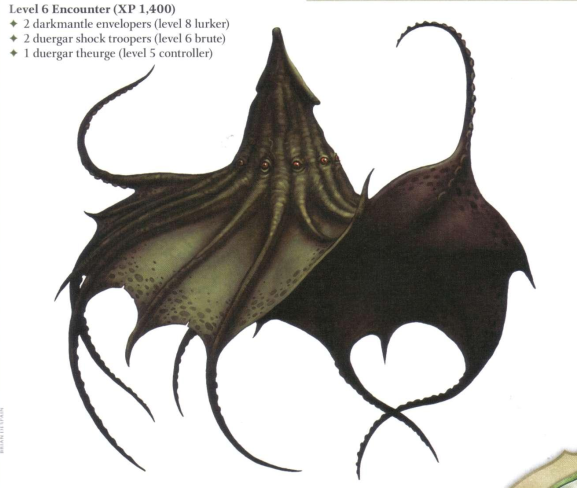
The darkmantle is a creature native to the Shadowfell, which predictably means it likes hanging out in dark places such as caves and underground ruins. Being both pointy and membranous, they hunt by hanging from the ceiling disguised as stalactites and dropping on unsuspecting prey from above.
Darkmantles have animal intellect, and are about as smart as dogs. As such, they’re often tamed by shadow- and underground-themed humanoids to act as guards and/or living traps.
The Numbers
There’s only one stat block here, so we’ll get right to it.
Darkmantle Enveloper
This is described as a Large Shadow Magical Beast, though I think it should be labeled a Beast instead. Beasts “look and behave like animals”, and magical beasts “look like animals and behave like people”. Well, the label is just descriptive, so it makes no difference in the stats.
The Darkmantle Enveloper is a Level 8 Lurker with 76 HP. It has both Blindsight 8 from echolocation, and Darkvision. It emits a Shadowy Field aura (5) that reduces bright light to dim light, which I guess it only activates once its presence is known. It has ground and climb speeds of 2, and a fly speed of 6.
Its basic attack is a Tentacle Lash that does regular physical damage, but the main event is Engulf (melee 1 vs. Reflex), which does the same damage and grabs the target. The target is considered blinded until the grab ends, and the creature can spend a minor action to sustain it and deal an automatic 5 damage to the target. Only one victim can be engulfed at once.
If the victim’s buddies try to help them, the darkmantle can use a Shadowcry (close burst 3 vs. Fortitude; minor action; encounter) to keep them at bay. This does light thunder damage and dazes for a turn.
When someone manages to damage the darkmantle, it can react with a Shadowjump (recharge 5-6), which allows it to teleport 6 squares to a space in darkness or dim light. The creature arrives invisible and with its aura turned off, both of which last for a turn.
One small mechanical issue: since Engulf is not a basic attack, it can’t be used as part of a charge. This could be interpreted to say that the darkmantle can’t drop from the ceiling and use Engulf, but that’s clearly not the intention here. I’d say the attack can be used as part of a “drop charge”.
Sample Encounter and Final Impressions
The sample encounter is level 6, and feature a pair of darkmantles acting as guards for a trio of duergar.
Eh… it’s another underground ambusher that disguises itself as a rock formation. The most a darkmantle has ever interested me is when it was part of a joke about gygaxian deathtrap dungeons (“the stalactites are darkmantles; the stalagmites ropers…”).
-
Let's Read the 4e Monster Manual 2: Cyclops
Art by Chippy. Copyright 2009 Wizards of the Coast. This article is part of a series! Click here to see the other entries.
This is another one of those entries that gives us more stat blocks for monsters introduced in the first Monster Manual.
The Lore
We already covered the bulk of cyclops lore in the corresponding Monster Manual post, so I’ll going to say it’s super cool and ask you to read the original post again.
We get some specific lore for the two new variants: Cyclops Crushers are employed as slave minders, directing their crushing towards any who step out of line. Feyblades are pampered bodyguards who rarely engaged in manual labor, and like to lord their superior status over their less important colleagues.
The Numbers
The original post also contains the traits for cyclopes, but I’ll summarize them again for convenience: they’re Large Fey Humanoids, trained in perception, and have Truesight, which lets them see invisible creatures and objects. They all also have some sort of Evil Eye ability that varies per stat block.
Cyclops Crusher
This one appears in the Monster Vault, so it’s also covered in the original post. Its MM2 stat block is identical as far as abilities go, but suffers from all the math bugs common at the time of publication. Go with the Monster Vault stat block and you won’t be missing anything.
Cyclops Feyblade
The first cyclops we haven’t already seen in our Let’s Reads is a Level 21 Soldier with 200 HP, which means it’s significantly stronger than all the other cyclopes we’ve seen so far. It wears mail and fights with a longsword. Its speed is 8. It’s more or less equivalent to a simplified PC swordmage.
Despite its greater level the feyblade is actually very mechanically simple. The Longsword is its most basic and best attack, doing physical damage with no riders. The Evil Eye is a Ranged 20 minor action that marks a target automatically, lasting until the end of the encounter or until the feyblade marks someone else.
This cyclops earns its title because it knows Wildstep, an immediate interrupt that triggers when the marked victim ignores the mark. The feyblade can then teleport 10 squares to be adjacent to the victim and make an attack to it that deals sligthly less damage than the basic sword.
Sample Encounters and Final Impressions
Not all cyclopes are slaves to the fomorians, but the MM2 seems to want to emphasize their “natural” position as someone else’s goons and mentions they can also be found serving firbolg and drow. This would eventually be elaborated into a code of honor that prevents oaths of servitude from being broken.
The sample encounter is Level 13: 2 crushers, 2 eladrin bladesingers and 1 firbolg moon seer.
Cyclopes are cool, and more of them means more choice for a fey paragon campaign versus the Fomorians. So I like these ones.
subscribe via RSS