Posts
-
Let's Read the 4e Monster Manual 2: Drakkoth
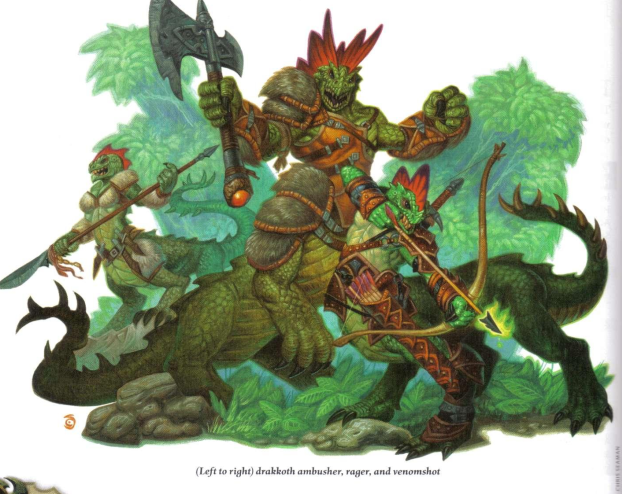
Copyright 2009 Wizards of the Coast This is part of a series! Go here to see the other entries.
Drakkoths, also known as Dracotaurs, have been around since at least 3e. They also look like something I’d find in some of the more exotic BECMI supplements.
The Lore
Like a number of other peoples, drakkoths are distant relatives of dragons. Their humanoid half looks like a crested dragonborn, and their quadruped half like a small wingless dragon.
Drakkoths are nomadic, somewhat insular and territorial, and have enough technology to make steel weapons. Their preferred terrain are forests and jungles, and the borders of their claimed territory tend to shift slightly over time.
According to the book some drakkoth communities worship Tiamat, but others choose to venerate an individual dragon patron instead. This is most often an elder or ancient green, given their common terrain preference. I imagine you could have communities of Bahamut-worshipping or good-dragon-venerating drakkoths as well. Some dragons actively seek to set themselves as the bosses of a drakkoth community, because as far as potential servants go they’re a lot more useful than kobolds.
The Numbers
Drakkoths are very strong and tough, and quite smart as well. They mostly fight with weapons, to which they apply poison. They tend to wear hide and leather armor, but you could also say their scaly hides are naturally tough if you’re so inclined. Their superior movement speed means they favor “cavalry” and skirmishing tactics.
They can also breathe poison in a manner similar to a green dragon, and are prone to flying into a rage that leaves them immune to pain when bloodied.
Common Traits
Drakkoths are Medium Natural Humanoids with the Reptile keyword. They have low-light vision, and their four legs give them a respectable speed of 7. Though all of them have a breath weapon and a rage ability, the exact effects vary with each stat block.
Drakkoth Ambusher
This is a Level 13 Skirmisher with 131 HP. It fights with a Reach 2 glaive that does a mix of physical and poison damage. It can also employ a Sudden Rush maneuver (move action; recharge 5-6), allowing it to shift its speed and make attacks vs. the Reflex of every enemy it moves adjacent to. This does no damage, but knocks prone on a hit. They also do extra “sneak attack” damage against an enemy granting combat advantage to them.
Their breath weapon is a very dragon-like Venomous Hiss (close blast 2 vs. Reflex; recharges when first bloodied). It does poison damage, and ongoing poison damage (save ends).
While bloodied the ambusher enters a Drakkoth Rage, which makes it tougher by granting it 10 temporary HP whenever it hits with an attack.
Drakkoth Rager
A Level 15 Elite Brute with 366 HP, the rager is a lot more direct in its approach to combat. It wields a battleaxe and can perform a Raging Cleave that does the same damage as the basic attack plus a bit of extra poison damage in a Close Burst 1. It wants to be surrounded.
Its Venomous Hiss and its Drakkoth Rage have all the same effects as those of the ambusher, but the rage also gives it a +2 to attacks and +5 to damage.
Drakkoth Venomshot
This archer is Level 16 Artillery with 125 HP, and carries a longsword and a longbow into combat. Its arrows have a rider that gives the target Vulnerable 10 Poison (save ends), which pairs nicely with the poisoned weapons of its buddies.
Instead of the standard Venomous Hiss, it can use a Venomshot Hiss that does less damage but can be used more often, recharging at the end of any turn where the venomshot is bloodied. Its Rage is the same as the ambusher’s.
Sample Encounters and Final Impressions
In addition to palling around with dragons, drakkoths also train creatures native to their territories to fight alongside them, and they can make short-term alliances with neighbors to take down powerful threats.
We get two sample encounters:
-
Level 14: a rager, two venomshots, and a viscera devourer. I bet there’s an interesting story behind that one.
-
Level 16: 3 ambushers, 2 venomshots, and a roc!
I didn’t even remember drakkoths existed before I got to this entry, but these look interesting. I’m sure you could also reskin bog-standard centarus into drakkoths and vice-versa.
-
-
Let's Read the 4e Monster Manual 2: Drakes
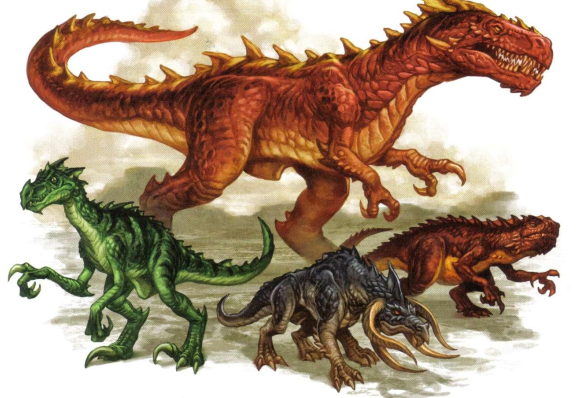
Copyright 2009 Wizards of the Coast This is part of a series! Go here to see the other entries.
Drakes make their debut on the first 4e Monster Manual, and this entry brings us a few more of them. They remain a popular choice of animal for domestication but the intro text mentions they retain a wild side.
Bloodseeker Drake
These expert trackers were included in the Monster Vault, so we already looked at them here.
Horned Drake
In the wild, horned drakes are pack predators who spend most of the day sleeping and basking in the sun, going out to hunt at night. They have an excellent instinct for teamwork, and a pack of them is able to take down much larger prey.
I imagine that, when domesticated, they make stronger alternatives to the bog-standard guard drake, treating their handlers as part of the pack.
The Numbers
Horned Drakes are Medium Natural Beasts and Level 5 Skirmishers with 63 HP. They have low-light vision and a speed of 6.
This drake’s basic attack is a bite that does standard physical damage and allows the creature to shift 2 squares on a hit. The Pack Movement reaction also allows them to shift 2 squares when an enemy adjacent to them is hit by a melee attack. This makes them great a setting up flanks with their fellow drakes or with their handlers.
The drake can also make a Goring Horns attack, which does high physical damage and knocks prone on a hit. It also has a +1 attack bonus over the basic attack, which indicates to me that it’s meant to be a charge.
So, these drakes are set up charge an enemy, then surround and run circles around it.
Scytheclaw Drake
Another species of pack predator, scytheclaws inhabit forests and grasslands. They are known for their cunning and for their devious tactics. If you see one scytheclaw, odds are there are two or three others approaching you from behind.
In other words, they’re Jurassic Park raptors!
The Numbers
Scytheclaws are Medium Natural Beasts and Level 10 Skirmishers with 105 HP, which explains why the Jurassic Park protagonists had such trouble with them. Their ground speed is an amazing 10.
Their basic attack is the titular Scytheclaw, which deals physical damage and knocks the target prone. If used against an already prone target, it hits harder and inflicts 5 ongoing damage (save ends).
When the drake hits with its basic attack, it can immediately use Springing Step (free action; recharge 4-6), which allows it to jump 8 squares and attack someone else at the end of the jump. This doesn’t provoke opportunity attacks from the target of the original attack, making it safe to move away from most PCs.
If a prone enemy within reach tries to get up, its Overwhelming Attacker trait allows it to make an opportunity attack against that enemy. If this hits, the target remains prone.
Scytheclaws are therefore set up to bounce between PCs while knocking them prone, and they will absolutely kick you when you’re down.
Fang Titan Drake
If you include the Raptors, you almost certainly have to include the T-Rex as well. And sure enough, here it is. The largest species of drake, few creatures other than dragons can pose much of a treat to them. Mostly solitary, they claim large territories and chase away all other big predators, so ironically creatures beneath the fang titan’s notice end up enjoying a measure of protection.
In most settings, such a creature would be impossible to domesticate, but in D&D’s implied setting some sapients such as giants can manage it due to not being that much smaller than them.
The Numbers
Fang Titans are Huge Natural Animals and Level 18 Elite Controllers with 348 HP. Their ground speed is 8.
Their basic attack is a humongous bite that can target one or two creatures, dealing physical damage and dazing them (save ends). They can also grab one of the targets on a hit.
They can also attack with a Tail Sweep (close burst 2 vs. Reflex; recharge 4-6) that does high physical damage and knocks prone. Their Furious Roar works exactly like a dragon’s Frightful Presence, and when they’re bloodied they recharge it and use it immediately as a free action.
Sample Encounters And Final Impressions
Two sample drake encounters in this entry:
-
Level 3: A lizardfolk hunting party with a pair of bloodseeker drakes.
-
Level 19: A quartet of fire giants and their pet fang titan.
As I mentioned during my reading of the MM/MV, I love drakes and more of them are always welcome. For many of them, it’s also easy to “de-skin” them as dinosaurs if you’re so inclined, but making them a distinct type of creature also frees the authors (and you!) from having to adhere to best paleontological practices.
-
-
Let's Read the 4e Monster Manual 2: Dragon, Silver
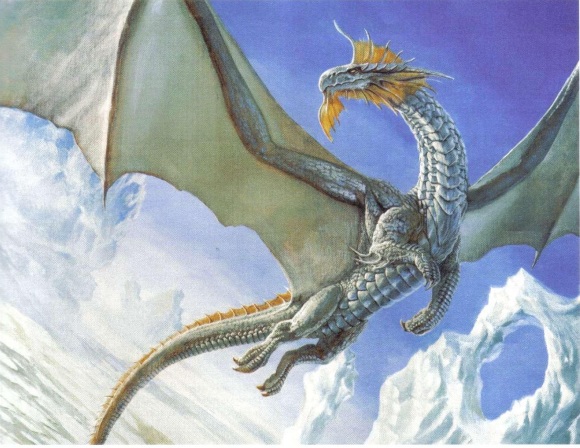
Copyright 2009 Wizards of the Coast This is part of a series! Go here to see the other entries.
Silver dragons have been in the game since the days of AD&D 1st Edition, as part of the classic metallic dragon set.
The Lore
Silver dragons are described by the book as “the knights-errant” of dragonkind. They like to travel the world looking for “interesting conflicts”, and then throwing themselves at the center of those. When not doing that, they chill in their lairs, which are usually in cold mountain-tops or in cloud castles.
Silver dragons are highly susceptible to flattery, but get angry when the people talking to them behave in an arrogant or aggressive manner. They breathe ice, but they prefer to mix it up in melee. They can fly, but their flight is slower than that of most other dragons.
All of this kinda make me think of the “Outrageous!” incarnation of Aquaman from the “Batman: The Brave and The Bold” cartoon. A silver dragon patterned after him would be a true ally of justice who travels in search of wrongs to make right, and who is also really loud and boisterous about it.
You can still have ambiguous or evil silver dragons without changing the written text, though. Note that it doesn’t make any mention of which side in those interesting conflicts a silver dragon prefers to join. So a villainous one could be a mercenary who’s interested in chances to inflict violence and who joins whoever pays him the most (and the villains almost always have more money in these scenarios).
The Numbers
Generally speaking, a silver dragon will want to be where the fighting is thickest. They’re all about beating people up in melee, and the more surrounded they are the better their offense becomes. Their cold breath weapon isn’t their most damaging attack, but it makes enemies vulnerable to damage from other sources.
Silver dragons are Solo Brutes. They have darkvision, and cold resistance that starts at 15 and increases by 5 in each subsequent age category. Their ground speed starts at 6, increases to 8 at Adult, and to 10 at Ancient. Their flight speed is always equal to the ground speed, making them indeed slower than other dragons.
Their size progression is pretty standard: starts at Large, grows to Huge at Elder and Gargantuan at Ancient.
Young Silver Dragon
These are Level 8 with 376 HP. They have the usual Reach 2 bite and claws as basic attacks, doing Brute-level damage. Dragon Onslaught allows them to make a claw attack against every enemy in range in a single action.
The Breath Weapon (close blast 5 vs. Fortitude; Recharge 5-6) does light cold damage and makes targets vulnerable 5 to all damage (save ends). Bloodied Breath and Frightful Presence work as usual.
The dragon’s reaction skill is Wing Slice, which triggers when it’s hit by an attack from an enemy flanking it. It makes an attack vs. AC dealing light physical damage to both the attacker and the other enemy flanking the dragon.
Adult Silver Dragon
Adults are level 15 with 608 HP. They have all the abilities of youngsters with some upgrades and additions.
Dragon Onslaught adds an extra bite attack, so it’s a claw against everyone in reach and a bite against a target of the dragon’s choice. They also gain Threatening Reach, allowing them to make opportunity attacks against anyone they can reach.
Elders Silver Dragon
Elders are Level 22 with 840 HP. They’re Huge, but their melee reach remains at 2. They have bigger numbers and all the abilities of adults, with the following two additions:
Tail Slam (close blast 5 vs. AC) does high physical damage and dazes (save ends). It’s also an at-will action!
Unstoppable is a passive trait that allows the dragon to roll extra saves against ongoing damage at the start of its turns.
Ancient Silver Dragon
Ancients are Level 29 with 1072 HP. It has all the abilities of an Elder, with bigger numbers. It doesn’t gain new abilities, but its bite reach increases to 3, which benefits from Threatening Reach and also improves Dragon Onslaught.
Sample Encounters
The sample encounters play up the goodly tendencies of a silver dragon, pairing it up with similarly “righteous” creatures. There’s a Level 8 encounter with a young’un and 2 eladrin twilight incanters, and a level 17 one with an adult and 2 daeva zealots.
Other likely companions include dwarves, dragonborn, and angels. Mechanically, you want monsters that can benefit from being shielded by a big brute.
Final Impressions
Outrageous! I now totally want to include Arthur the Boisterous Heroic Silver Dragon in my next game.
-
Let's Read the 4e Monster Manual 2: Iron Dragon
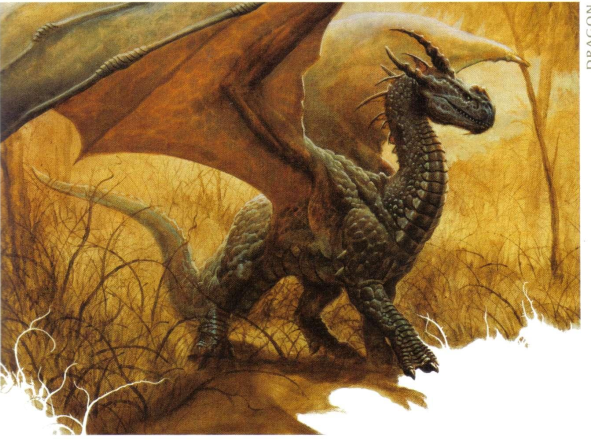
Copyright 2009 Wizards of the Coast This is part of a series! Go here to see the other entries.
Iron Dragons were bit players in 3e, appearing in Dragon Magazine #356 seemingly as part of an effort to make a dragon for each element in the periodic table. In 4e, they are promoted to the Monster Manual 2 alongside adamantine dragons to replace the bronze & brass duo that was removed.
The Lore
Iron dragons are kind of the black sheep of the metallic family, since unlike most of their relatives they’re surly, anti-social, and underhanded. They lair in isolated places and prefer terrain that contains plenty of hills, forests, and other features that provide plenty of hiding spots for large predators such as themselves.
They still gather followers and henchthings with the promise of generous pay and/or loot, but they see those as expendable dupes. They’ll send those followers first to intercept any intruders, and will only join the fight themselves if doing so looks like it will bring victory. If the hench-people are severely outmatched, the dragon will get away and leave them to their fate.
As you might have gathered, iron dragons are sneaky and prefer to attack from ambush. They breathe lightning, and their metallic scales become tougher the older they get.
The Numbers
Iron dragons are Solo Lurkers, and have Darkvision like all other dragons. They’re not actually very lurkery aside from a basic level of sneakiness (Stealth training). Their abilities focus on damage mitigation with a side order of control, all on top of the standard dragon loadout.
Young’uns start out Large, growing to Huge at Elder and Gargantuan at Ancient. They have Resist Lightning 15, increasing by 5 per age category beyond Young. Their speed starts out at 8 both in the ground and in the air, growing to 9/9 at Elder and 9/10 at Gargantuan.
Young Iron Dragon
Young iron dragons are Level 5 with 268 HP. They have a bite that does a mix of lightning and physical damage, and a claw that does about half that in physical damage. The usual Double Attack allows them to claw twice, allowing them to spread some damage around.
The Breath Weapon does lightning damage, as described earlier, and also pulls 3 squares on a hit. Maybe it magnetizes the dragon for a moment? Bloodied Breath and Frightful Presence are here and work as usual.
There’s also Wing Block, an interrupt with triggers when the dragon is hit by a melee attack. This gives the dragon Resist 5 against that attack, and allows it to make a melee attack dealing light physical damage against the attacker.
Adult Iron Dragon
This one is Level 11 with 472 HP and all the traits of a youngster with bigger numbers. No new abilities appear at this level.
Elder Iron Dragon
Elders are Level 19 and have 740 HP. They have all of the adult’s abilities, again with bigger numbers all around. Their Double Attack turns into a Triple Attack, allowing for three claw swipes with a single action.
They also gain Wing Defense (minor action; recharge 5-6), which grants the dragon a +2 bonus to all defenses for a turn. As long as it keep recharging, they can keep using it every turn.
Ancient Iron Dragon
Ancients are Level 26 with 992 HP. They have all of the elder’s abilities and gain two new ones:
Predator’s Response is a reaction that triggers when the dragon is hit by a melee or close attack. It allows the dragon to make a claw attack against the triggering enemy and shift 2 squares. I now notice the dragon’s reach remains 2 even though it’s now Gargantuan. Either their limbs and neck are comparatively tiny, or you should increase the reach for the Elder to 3 and the Ancient to 4.
Iron Wing Shroud (minor action; recharge 6) allows them to make a close burst 3 vs. AC attack dealing physical damage, and gain resist 15 to all damage until the start of its next turn. While the damage resistance is active, the dragon can’t make any attacks. I guess this represents the dragon hiding behind its wings and catching surrounding enemies in the movement.
The Shroud’s “can’t make attacks” clause is less of a disadvantage than it seems - an ancient iron dragon can make all of its attacks for the turn and use the Shroud ability as its last minor action. It will lose access to opportunity attacks and Predator’s Response, but will be able to act normally when its next turn rolls around.
Sample Encounters
We have two encounters:
-
Level 7: A young iron dragon and 3 dwarf hammerers.
-
Level 13: 1 adult iron dragon and 2 minotaur warriors.
Both of them would follow the standard pattern I described in the Lore section, with the lackeys being mercenaries lured by the promise of treasure, only to be abandoned by their boss when the fight begins to go sideways.
Final Impressions
Iron dragons are the ones who least fit the classic metallic dragon stereotype, which makes sense given their origins as an obscure magazine-only 3.x dragon. Also I guess it’s hard to make a draconic Lurker who doesn’t sound shady as fuck.
Still, I like that they’re here. That shadiness is one point in favor of them as far as their utility in a story goes.
-
-
Let's Read the 4e Monster Manual 2: Dragon, Gold
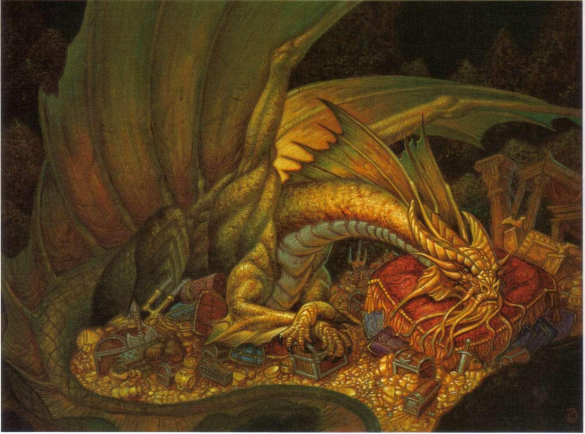
Copyright 2009 Wizards of the Coast This is part of a series! Go here to see the other entries.
Gold dragons are the original metallics and have been around since the beginning of D&D.
The Lore
Gold dragons are among the most powerful children of Io, with the oldest being among the most dangerous creatures in existence. And yet they’re among the dragons who most enjoy the company of mortals. I guess a lot of the “scholarly metallic dragon” stereotype comes from them.
Their preferred terrain are plains or rolling hills, but that’s a secondary concern. Proximity to a sapient society, or to some great source of magic, are much more important. Gold dragons like to rule, but it seems they don’t need to make much of a fuss about it like the other dragons. It just happens! Any community or society located in gold dragon territory will soon find itself being heavily influenced or ruled outright by that dragon.
Gold dragons are usually honest and fortright in their dealings, but the more selfish ones don’t really care about the concerns of “lesser beings”. These individuals tend to shape the societies under their influence to suit their own long-term plans regardless of what the actual people who live there might want. And of course, you can still find more traditionally “Good” gold dragons out there as well.
Gold dragons breathe fire, and as they age they gain more affinity with radiant energy as well.
The Numbers
As usual, we get a stat block for each significant age category of gold dragon. They’re all Solo Controllers, and have Darkvision.
Young dragons start at size Large, with 15 fire resistance, a ground speed of 8, and a flight speed of 10 with Hover. They gain another 5 fire resistance with each subsequent age category, and their flight speed increases to 12 at Elder. They grow to size Huge at Elder, and Gargantuan at Ancient.
Young Gold Dragon
Young Golds are Level 9 Solo Controllers with 380 HP. Their melee reach is 2, and their basic attacks are a bite that does a mix of physical and fire damage, and a weaker claw. Double Attack allows them to claw twice in a single action, bringing claw damage almost to parity with the bite. I guess it’s good if they want to spread damage around rather than concentrate it.
If an adjacent creature hits the dragon, it can hit back with a Fiery Wing Riposte (melee 1 vs. Fortitude), which pushes the impudent mortal 5 squares and inflicts 5 ongoing fire damage (save ends).
Their Breath Weapon (close blast 5 vs. Reflex; recharge 5-6) does fire damage and weakens (save ends), or half damage on a miss. Bloodied Breath and Frightful Presence work as usual.
Adult Gold Dragon
Adults are Level 17 with 652 HP. As usual they have all the attacks of a youngster with bigger numbers. This includes the ongoing damage from the Riposte, which is now 10.
They also gain a new ability: Burning Tomb (area burst 1 within 20 vs. Reflex; recharge 6) is a spell that does the same fire damage as the breath weapon, immobilizes (save ends), and creates a zone that does 15 fire damage to anyone who starts their turn inside and can be sustained with minor actions.
Elder Gold Dragon
Elders are Level 24 with a cool 888 HP. They have all the abilities of adults with bigger numbers. Their Melee Reach increases to 3 due to their Huge size.
This is at the age where their radiance begins to have a game effect, giving them a new ability: Beguiling Glow (close burst 8 vs. Will; enemies only; recharge 5-6) is a minor-action attack that does no damage and pulls targets 5 squares on a hit, nicely setting them up for Burning Tomb or the breath weapon.
They also project an aura (2) of Weakening Flames, which forces enemies caught inside to choose between taking 15 fire damage or being weakened for a turn.
Ancient Gold Dragon
Ancient Gold Dragons are Gargantuan Level 30 Solo Controllers with 1088 HP. This puts them on par with the friggin’ Tarrasque both in size and danger level. The Tarrasque has more HP, but that’s before you apply the MM2 Solo HP fixes. And the dragon is much smarter.
They have all the abilities of Elders with bigger numbers, including in reach, aura size and damage, and ongoing damage from Riposte. Double Attack becomes Triple Attack, allowing three claw swipes in one action. Their new “capstone” skill is Ancient Radiance (close burst 4 vs. Fortitude; enemies only; recharge 6) which does radiant damage and dazes for a turn. After the daze clears, the target gains Vulnerable 10 Radiant (save ends). This is important because the dragon’s Breath Weapon now does “fire and radiant” damage!
Sample Encounters and Final Impressions
Gold dragons surround themselves with allies and subjects that match their individual dispositions. The evil ones employ beings such as evil minotaurs, ogres and trolls as dumb disposable muscle. The good ones have a variety of willing allies acting as guards.
The sample encounters are:
-
Level 10: a young gold dragon and 2 angels of valor.
-
Level 19: an adult gold dragon and 3 savage minotaurs.
Level-wise, these are certainly the most powerful of dragons. The Ancient is a match for the Tarrasque and could put up a decent fight against beings such as demon lords or other “campaign end bosses”.
They do have the same problem as the Tarrasque in that they lack strong condition mitigation powers - that +5 to saves from being a solo might not be enough to prevent stun-locking by an epic party. They also wouldn’t do so well on their own against Demogorgon, so if you want to have a kaiju fight you might want to use the dragon as an ally of the PCs instead of sending it in alone.
-
subscribe via RSS