Posts
-
Let's Read the 4e Monster Manual 2: Fell Taint
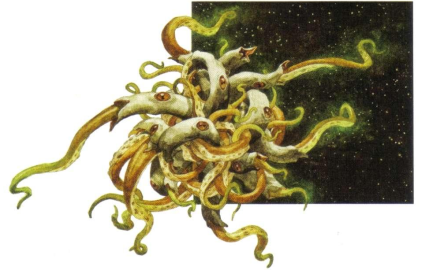
Copyright 2009 Wizards of the Coast This article is part of a series! Click here to see the other entries.
I think fell taints are new to 4e - at least, this book is where I first heard of them. If they showed up in previous editions, it was probably in 3e.
The Lore
I confess the name made me think of something you might find staining an ogre’s underwear, but that’s not the case. Fell Taints are small predators from the Far Realm, where they occupy a niche more or less equivalent to that of our foxes. However, they’re quite a bit more dangerous when they cross into the world, which they can do rather easily in places where the border between it and the Far Realm is even a little bit thinner than usual.
Their presence acts as a beacon for more powerful and dangerous Far Realm denizens, and slowly erodes the barrier between dimensions. So if you have fell taints in a place, you’ll soon get bigger horrors from beyond popping up.
The taints themselves are also dangerous on their own, since they hunt by destroying the mind of their intended prey with their psychic powers. This is not exactly something most mortal creatures have a strong defense against.
One of the bizarre things about Fell Taints is that they’re only half real. The other half is formed by the minds of those who see them.
The Numbers
Fell Taints are Baby’s First Elder Things, with levels in the early-to-mid Heroic tier. If you’re starting an aberrant-themed campaign from Level 1, they’re going to be the first genuine Far Realm denizens your party meets.
Fell Taints can fly quite well with a speed of 6 and hover capability, or crawl along the ground at speed 1 if they must. They’re insubstantial due to that half-real thing, but vulnerable to psychic damage. The touch of their tendrils causes psychic damage, and they usually have mind-affecting special attacks as well. They’re all Aberrant Magical Beasts, and most are Small.
An ability they all share is Fell Taint Feeding: when they manage to get a victim helpless or unconscious, they can begin to feed. This causes them to lose their fly speed and become substantial until the end of their next turn, but allows them to perform a coup de grace against the victim. If this kills the victim, the fell taint immediately recovers all of its hit points. Yeah, they’ll absolutely attempt to kill any PC that drops to 0 HP during the fight.
Fell Taint Lasher
Lashers are Level 1 Soldiers with 20 HP and all standard traits outlined above. Their special attack is Tendrils of Stasis, which does a bit less damage than the basic tendril slap and immobilizes the target for a turn. When making an opportunity attack, they can shift as a free action.
Fell Taint Pulsar
Pulsars are Level 1 Artillery with 18 HP and all common traits. Their special attacks are a Range 20 tendril pulse that does psychic damage, and a Ranged 10 tendril flurry that makes a slightly weaker attack against up to three targets.
Fell Taint Tought Eater
These are Level 2 Controllers with 26 HP and all standard traits. They have two special attacks.
Spirit Haze is a Range 10 attack that does psychic damage and dazes for a turn. Tought Fog (recharge 5+) is a Close Burst 5 that only targets enemies, does no damage, and slows. This worsens to immobilization after the first failed save.
Fell Taint Warp Wender
This Level 4 Controller is Medium, and has 38 HP. Its single special attack is Psychic Transposition, which does light psychic damage, dazes (save ends) and makes the taint and the victim teleport to exchange places.
Sample Encounters and Final Impressions
The sample encounters are mostly mixed fell taint groups, because they rarely work with anyone else. Still, they might be coincidentally found alongside undead or oozes, creatures they find unapettizing. I imagine some cultists and such might also know how to bind them.
As a party’s first contact with the Far Realm, I think these creatures are quite nifty. They look weird enough to unsettle, and each has a single distinctive mechanical trick.
-
Let's Read the 4e Monster Manual 2: Elemental
This article is part of a series! Click here to see the other entries.
Technically, any creature with the “elemental” origin is an elemental, but as we saw in the Elemental entry from the first monster manual the name is also used for a particularly wild subset of that plane’s denizens.
As you can see in that earlier post, Elementals proper are some of the “basest” life forms of the Elemental Chaos, with bodies that share a lot more with their constituent elements than with any sort of living organism. Unlike demons they’re not actively malicious, but they’re mercurial and easy to provoke into a rampage.
As magical beasts, they’re technically sapient, but their intellects tend to be rather limited. These creatures are also often bound by elementally-inclined ritual casters such as mortal wizards, efreets, and others.
The MM2 presents us with more elementals ranging from the mid-Heroic to the early Epic tier.
Chillfire Destroyer
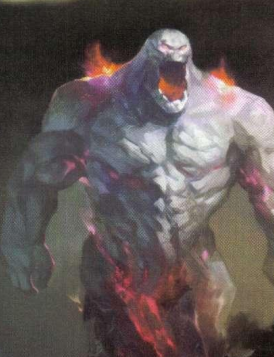
Copyright 2009 Wizards of the Coast A Large humanoid made of ice wrapped around a fiery core, which means it has zero chill. It’s a Level 14 Brute with 173 HP, lumbering about at Speed 5. It has 10 resistance to cold and fire, and is immune to disease and poison. Its fists do a mix of fire and cold damage, and it can also move its speed and trample anyone it comes into contact with during this movement.
As this elemental gets damaged, its shell begins to crack. Once it’s bloodied, its Leaking Firecore acts as an aura (radius 2) that deals fire damage to anyone caught inside. Once it reaches 0 HP, a Firecore Breach causes it to explode! This explosion is a Close Burst 3 vs. Reflex, dealing heavy fire damage.
Dust Devil
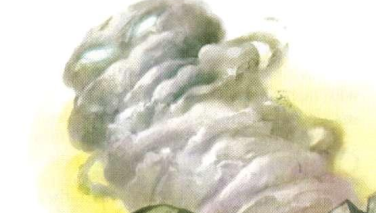
Copyright 2009 Wizards of the Coast A being or air and earth, this capricious living whirlwind has a tendency to sandblast anyone who makes it angry. It’s Small, and a Level 3 Skirmisher with 47 HP and a ground speed of 8. No, they can’t fly. It’s immune to disease and poison, and it suffers a -2 penalty to all of its defenses if slowed or immobilized.
Its basic attack is Grasping Winds, which targets Reflex, does some physical damage and slides the target 3 squares. Gale Blast allows it to shift 5 squares by moving really fast, and try to knock anyone in the way prone (attack vs. Fortitude).
Once per encounter it can do that sandblasting trick with Stinging Sands (close burst 3 vs. Fortitude), which does heavy damage and blinds for a turn.
Flamespiker
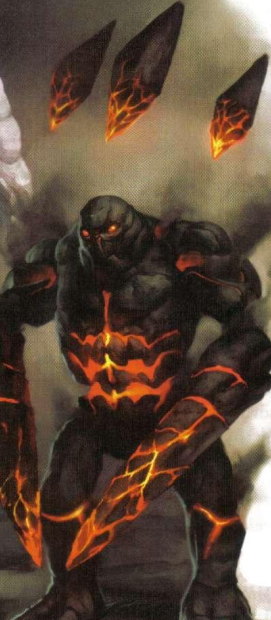
Copyright 2009 Wizards of the Coast These are a triple combination of air, earth, and fire, taking the form of a Medium stony humanoid who can use high-pressure air to fire red-hot spikes from its fiery core. They’re more like people than wildlife, and often end up hired as front-line muscle by other sapient elementals.
Flamespikers are level 5 soldiers with 66 HP and a ground speed of 7. Their immunities include disease, poison, and petrification, and they also have 10 fire resistance.
The flamespiker fights with its Reach 2 Stonespikes in melee, and can also fire them at out to range 10 as Spikebolts. Both attacks do physical damage, and the melee one also makes the target vulnerable to fire damage until the end of the spiker’s next turn. So it pairs really well with fire elementals.
If an enemy within reach shifts, the stonespiker can react with a Thunderfire Thrust (recharge 5+), which is a basic melee attack with an extra follow-up against Fortitude that does 5 thunder damage and stuns (save ends). This makes slipping past them a difficult proposition.
Geonid
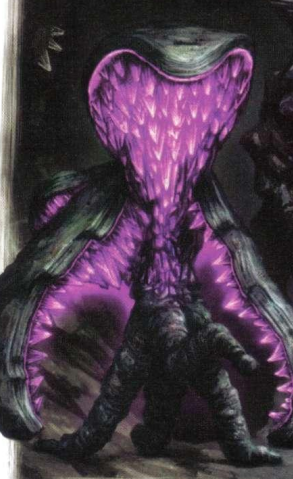
Copyright 2009 Wizards of the Coast This Large creature has more of a metabolism than most elementals, and needs to hunt. A stony oyster-like creature, the geonid is extremely hard to tell apart from a boulder when its shell is closed. When it reveals itself, we can see that it’s yet another tentacular ambush predator that lives in the shallow Underdark.
They were initially created to guard the secret pathways of the world, and the secret caches of weapons, dormant war-beasts, and treasure hidden there by the forces of the primordials. Some of those caches are still out there, as are their guardians.
Geonids are Level 6 Lurkers with 56 HP. They’re immune to disease, petrification and poison, and cal roll around at speed 4. With its shell closed, potential victims must pass a DC 28 Perception check to realize it’s not a harmless boulder. At level 6, this is hard even for the party’s “radar”.
Once the geonid strikes, it fights with tentacle slaps that do standard physical damage. It can also use a capturing grab that consists of two weaker tentacle attacks. If both hit, it grabs the target (escape DC 17).
Once it’s grabbed someone, the geonid will close itself with Shell Slam, which does a lot of things at once. It slides a grabbed victim to the geonid’s space, and it tries to knock everyone in a close burst 2 prone (vs. Fortitude).
While the shell is closed, the geonid has a ground speed of 0 and a +5 to all of its defenses, and it can’t target anyone other than the grabbed victim it pulled inside its shell. The victim can also only target the geonid, but on the bright side it won’t have to contend with the defense bonus. If the victim escapes, it gets spit out and appears adjacent to the geonid, who can open its shell with a minor action.
Mudlasher
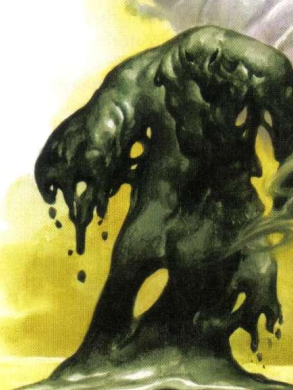
Copyright 2009 Wizards of the Coast Another sapient elemental predator, mudlashers are made of well, mud. They slam and drown their victims, and then sit atop the corpse as a puddle to slowly digest it. They’re Medium Level 4 Brutes with 63 HP.
Their basic Slams do physical damage, and once per fight they can upgrade that to a Drowning Slam that targets Fortitude and adds an ongoing damage follow-up (save ends).
They can also fling mud balls at range (vs. Reflex), which do no damage but slow their targets. If a target is already slowed, it’s immobilized instead. This is good because the mudlasher gets a +2 to attacks against slowed or immobilized targets. A save will end either condition.
Rockfist Smasher
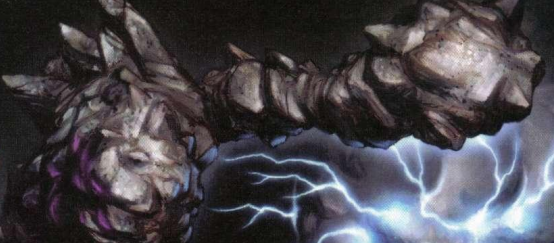
Copyright 2009 Wizards of the Coast The name says it all: they’re humanoid rocks that like to smash with their fists. Smashers don’t need to eat, so they do that for fun. People who build elemental themed dungeons like to gather a bunch of these and lock them in chambers and at the bottom of pits as living traps.
These hooligans are Large, Level 10 Brutes with 125 HP, the standard suite of earth-creature immunities, and a speed of 5. Their Granite Punches do good damage and knock bloodied targets prone.
When a smasher gets bloodied itself, its Internal Avalanche triggers and begins accumulating kinetic energy. This gives the smasher 20 temporary HP. If it still has any temp HP at the start of its next turn, it gains an action point that must be used in that turn.
Shardstorm Vortex
Copyright 2009 Wizards of the Coast These are living blizzards made of stone instead of ice. Despite this impressive description, they’re just Medium in size and are the scavengers of the Elemental Chaos. Shardstorms follow in the wake of more impressive beings and feed on what remains of their battles. In battle they work like slightly stronger dust devils.
They’re level 7 skirmishers with 80 HP. Their ground speed is 0, but they fly at speed 8 with hover capability and project a Sandblast aura (radius 1) that inflicts a -2 to all defenses of anyone caught inside.
Their basic attack is a Abrasive Slam that targets Fortitude and does physical damage. They can also perform Whirling Blasts (recharge 5+) that allow them to shift 4 squares and an attack at the end. This does heavy damage and pushes 1 square on a hit. It does half damage on a miss.
We also get two variant stat blocks for them as minions at levels 13 and 23. They still have the aura and the basic attack, but instead of the Blast they get a Vortex Step, an at-will 4-square shift with no built-in attack.
Stormstone Fury
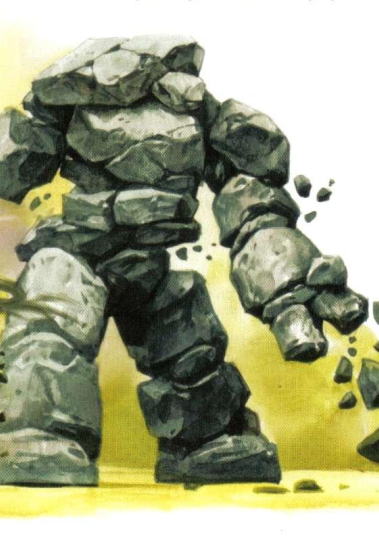
Copyright 2009 Wizards of the Coast This is a Medium stone humanoid infused with the power of a storm. It can throw explosive stones, cause shrapnel to fly outward from its body, and meld into the ground for a quick escape. When fighting as part of a team they don’t really care about catching allies in their blasts, so if you find yourself on the same side as one of these, bring some thunder protection.
Furies are Level 14 Artillery with 113 HP and Speed 6. They have the usual immunity suite, and 10 thunder resistance. Its Grinding Stones melee basic attack is terrible, but its Hurtling Thunderstones have Range 20 and do half damage on a miss. Hit or miss, they also cause a follow-up explosion (burst 2 vs. Fortitude) that does thunder damage.
Shrapnel Burst is their “keep away from me” power, sending shrapnel that pushes 2 squares and does physical and thunder damage in a close burst 2 (vs. AC). If that fails, Meld to Ground removes them from the map for a turn, after which they reappear up to 10 squares away.
Tempest Wisp
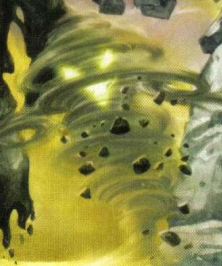
Copyright 2009 Wizards of the Coast This gaseous creature is a bit smarter than your average elemental, and actively seeks to either ally with or coerce other creatures to form groups that cooperate against threats. It uses its wind powers to push enemies around the battlefield, and hides behind its allies to avoid damage.
Tempest Wisps are Level 13 Controllers with 134 HP. They’re immune to disease and poison, and are insubstantial while not bloodied (i.e, while at over 50% HP). They have a flight speed of 7 with hover capability.
Their basic attack is an Air Slash (vs. Reflex) that does physical damage, and they can attack at range with Whistling Wind (ranged 10 vs. Reflex) for about the same damage and a 1-square slide.
Their limited special attack is hilarious! Named Tumbling Updraft (ranged 10 vs. Fortitude; recharge 5+), it does no immediate damage but instead lifts the target 20 feet up on a hit and restrains them (save ends). Each failed save causes the victim to be tossed up another 20 feet. On a successful save, the victim falls! That’s a minimum of 2d10 fall damage, plus another 2d10 for every failed save. It’s all subject to the standard rules for falls, though, so you might be able to reduce or avoid this damage in the usual ways.
Windfiend Fury
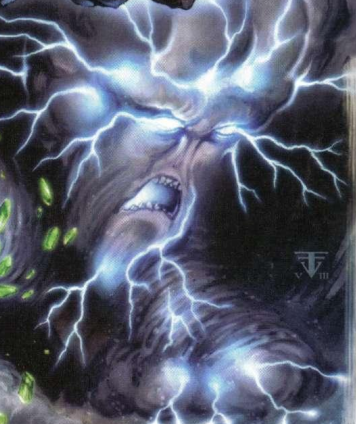
Copyright 2009 Wizards of the Coast Yet another Angry Tornado, this one more purely “stormy” than the others. These Large beings like to hang around elemental storms, and so tend to get swept away into other planes. Sometimes archons will capture them and bind them to their flying ships as a power source and as a means to travel to other planes. You can also say these are the beings trapped at the core of those Eberron flying ships.
These are Level 12 Controllers with 123 HP and a flight speed of 8. Aside from the usual immunities to disease and poison they have 15 resistance to lightning and thunder.
They attack in melee with Flying Debris, and toss Lightning Strikes at range that do lightning damage and daze for a turn. Their “keep away!” power is a Storm Burst that does thunder damage and teleports them to just outside the area of effect.
Windstriker
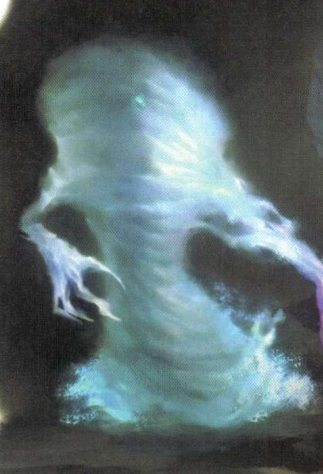
Copyright 2009 Wizards of the Coast Our final Angry Tornado is Medium, and a Level 9 Lurker with 56 HP. They have the usual immunities and full-time insubstantiality, along with a flight speed of 8. It attacks unpredictably, though apparently not to feed.
All of their attacks do “cold and thunder” damage. They’re probably going to open up with Searching Wind (ranged 10 vs. Will), which knocks prone on a hit and marks the target as the windstriker’s quarry as an effect. Then they’ll follow that up with Lethal Windstrike (melee 2 vs. AC), which hits hard but only works against the quarry. Their basic Windstrike is a lot weaker, so it’s for emergencies only.
If the windstriker takes damage, it activates Shifting Wind as a reaction, which gives it the ability to ignore opportunity attacks and pass through enemy spaces during its next turn. So it’s going to be flitting back and forth to alternate marking someone as a quarry and attempting to assassinate them.
Encounters and Final Impressions
There’s a whole bunch of sample encounters here, but they’re all easily to described: assorted elementals of similar level, occasionally with someone who might be the spellcaster binding them, like a tiefling heretic or a beholder.
I like the lore of elementals in 4e on principle, and we have lots of mechanically varied stat blocks here… but there’s so many of them that they all kinda started blurring together by the end. I almost wish we had gotten an elemental “plug-in” module for the 4e monster design system rather than this long list full of angry rock giants and angry living tornadoes.
-
Let's Read the 4e Monster Manual 2: Eladrin
Copyright 2009 Wizards of the Coast This article is part of a series! Click here to see the other entries.
We already discussed the lore of the Eladrin over here, along with how they differ from your standard elves and from the celestials of 3e. I recommend reading that post again for those basics.
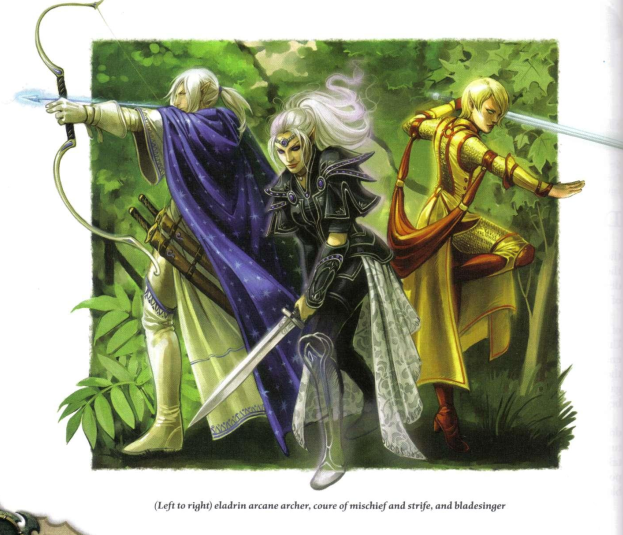
The Monster Manual 2 contains three more eladrin stat blocks, along with a bit of additional lore on their society. I find it very funny that two of them correspond to very popular elfy classes of editions past, debuting in 4e in the form of monster entries. It would be some time before playable versions of them were published, which I imagine must have made their fans quite anxious.
Eladrin Arcane Archer
Arcane Archers are more than just wizards who can shoot a bow. They practice an art that’s seamless fusion of the two disciplines, and whose secrets are jealously kept by certain eladrin societies. The Bow Mage minions we saw in the MM1 are likely to practice the same style. This entry would represent a more advanced, experienced, or narratively important practitioner.
I don’t think we ever explicitly got an Arcane Archer class in 4e. The Seeker tries to implement the concept using primal magic but ends up not being very effective. I think there’s also a way to build a Bard specializing in magic ranged attacks with a bow.
The Numbers
Arcane Archers are Level 5 Artillery with 51 HP. Their speed is 6 and they have low-light vision, along with the standard Fey Step power all eladrin get.
In a fight, they stay at range and repeatedly fire Scorching Arrows from their bows. This ability is kinda like a better version of the PC Ranger’s Twin Strike, allowing them to make two attacks that target the lower of AC and Reflex. The arrows have the same range as mundane ones, and individually deal a low-ish mix of physical and fire damage. This adds up, though: an arcane archer that consistently hits with both attacks punches a fair bit above its weight class.
They can also fire an arrow that explodes into an Eldricht Burst (area burst 1 within 20 vs Fortitude; recharge 4+). This deals force damage and knocks enemies prone on a hit.
Eladrin Bladesingers
Ah, bladesingers. I first heard of them in 2e and I can’t remember a more controversial class from that edition, at least here in the Brazilian fan community. People either really loved them or really hated them. While I was eventually convinced that their highly cinematic combat style was cool, I never liked that they were an elf-only option.
Anyway, 4e bladesingers are eladrin practitioners of an ancient martial art that joins swordplay and magic. The resulting style resembles something a Jedi knight or wuxia hero might use, employing lots of empowered sword strikes and magic-assisted acrobatic maneuvers. Their code of conduct has elegance as an important principle, so they put real effort into making their combat techniques both graceful and effective.
The same code also compels them to behave honorably, so they tend to treat opponents with respect and despise those who slaughter the weak and defenseless. Despite this, there are many possible reasons for even a party of good-aligned PCs to come into conflict with bladesingers: they might have offended the eladrin’s liege, or a given group of bladesingers might have fallen to the Dark Side of the Force.
You can get pretty close to a playable bladesinger by playing a Swordmage, and apparently there was also a “bladesinger” class published late in the edition. More obliquely, a Blade Pact Fey Warlock could also fit the concept.
The Numbers
The MM2 bladesinger is a Level 11 Skirmisher with 114 HP. They have a very nice ground speed of 8, in addition to the low-light vision and Fey Step power all eladrin get.
They wear mail and wield a longsword, both of which are probably magical or at least very high quality. Their basic attack is a Brilliant Blade strike, which deals radiant damage and gives the target a -3 penalty to attack the bladesinger during the target’s next turn.
Dance of Brilliance is an at-will combination that allows them to make an attack dealing light radiant damage, shift 3 squares, and make a basic Brilliant Blade attack against another target.
They have two encounter powers. Crippling Strike targets Fortitude and deals no damage, but is guaranteed to slow the target even on a miss. On a hit it also weakens them. In both cases the conditions are “save ends”.
Wyvern Strike is much better, allowing the bladesinger to fly 8 squares without provoking opportunity attacks and perform a strike at any poing along the movement. This targets Fortitude, deals light physical damage, and 10 ongoing poison damage (save ends).
Finally there’s Combat Shift. This allows them to shift 1 square as a minor action, ending up adjacent to an enemy against which they have combat advantage.
Coure of Mischief and Strife
Time for more surreal fey nobility! Like “bralani” and “ghaele”, “coure” is a noble title whose meaning can be a little confusing to mortals. One of the reasons for this is that while most eladrin societies use the same names for the titles, the actual rank they confer, and the amount of influence attached to them, varies from culture to culture. So in this city state ghaeles might be the rulers, but on that kingdom over there they’re just minor provincial nobles and it’s the coures who call the shots. Attaining a noble title is rarely a matter of inheritance - there’s a lot of mystery and mystycism involved.
Whatever their rank, though, these titles always have some natural phenomenon or abstract concept attached to them, like “autumn winds”, “winter”, or “mischef and strife” in this entry. The noble in question will always have powers relating to this area of influence.
So yeah, a coure of mischief and strife is a pointy-eared Loki.
The Numbers
This coure is a Level 17 Lurker with 129 HP. It has the usual low-light vision and Fey Step ability, which in this case is completely redundant because the coure also has a teleport speed of 6 to complement its ground speed of 6. It wears leathers and fights with a rapier.
The coure can become invisible at will as a standard action, and this lasts until it takes damage or misses with an attack. If it attacks and hits, it stays invisible! If for some reason the eladrin doesn’t already starts the fight invisible, this is going to be its very first action.
Once the invisible trickster is close to the party, Winds of Luck’s Mischief is a good fight opener: a Close Burst 3 vs. Will that does no damage, but makes everyone it affects miss all attacks whose attack rolls were odd. This is a “save ends” condition, so it might stick around for a while! Good luck trying to damage an invisible enemy when half of your blows veer off course.
While invisible the coure can also use Spark of Strife, a Ranged 10 attack vs. Will that deals psychic damage and is stronger than the rapier. A hit also forces the target to charge its nearest ally, or make a melee basic attack if it’s already close. This compelled attack is a free action, so it doesn’t eat into the PC’s turn. However, if the compelled attack hits, the coure gets to use Spark of Strife against the ally that was hit by it as a free action as well! A series of lucky rolls is going to rapidly turn the party’s well-tuned battle formation into a Three Stooges skit.
Sample Encounters and Final Impressions
The sample encounter here is level 10: 3 bladesingers, an eladrin twilight incanter from the first MM, and a will-o’-wisp which I guess might be the incanter’s familiar.
I love how the different eladrin celestial types from 3e became a bizarre system of nobility ranks with a lot of that good faerie flavor. As one rises in rank, one becomes less tied to the mortal world.
-
Let's Read the 4e Monster Manual 2: Duergar
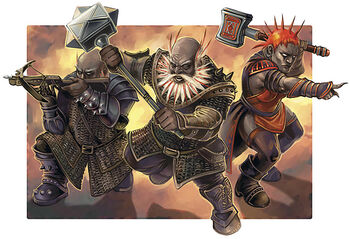
Copyright 2009 Wizards of the Coast This is part of a series! Go here to see the other entries.
Chronologically, the first appearance of Duergar in 4e is in the Monster Manual 2, but they were also in the Monster Vault so we covered their basic lore here. In this post, we’ll covered the duergar that appeared in the MM2 but weren’t updated in the MV.
Previously on Octopus Carnival…
For your information, these are the duergar entries we covered previously: Scout, Guard, Thug, Raid Leader, Infernal Consort, and Devil-Bred Duergar.
This still leaves us with a sizable selection of stat blocks that didn’t make it into the Monster Vault. They include some elite warrior types, and several Hell-themed spellcasters that resemble either warlocks or clerics.
As we saw in that earlier post, all duergar share two signature traits: resistance to fire and poison that increases with their level, and the ability to shoot out their Infernal Quills at someone, once per fight as a minor action. This has a Range of 3, does light physical damage and a tiny bit of ongoing poison damage. It also inflicts a -2 penalty to attack rolls. A single save ends both the ongoing damage and the attack penalty.
Duergar Theurge
The weakest of the spellcasters we’re going to look at here. Theurges wear robes and wield warhammers in melee. At range they fight with a number of spells themed around fire, smoke, and despair.
Despite the name they feel a bit more wizardly than the others, who are more clearly priests of some kind.
The Numbers
Theurges are Level 5 Controllers with 63 HP. They wear robes and fight with warhammers in melee. Their basic ranged attacks are Hellbolts (ranged 10 vs. Reflex) that do fire damage.
They also have a few more powerful spells. Brimstone Hail (recharge 5-6) does fire damage over a fireball-sized area and knocks targets prone on a hit. Vile Fumes (recharges when first bloodied) does poison damage over the same area and blinds for a turn on a hit. And Wave of Despair is a daily blast 5 vs. Will and does psychic damage, slows, and dazes (save ends both).
Duergar Shock Trooper
Shock troopers are somewhat similar to the guards we saw in the first article, but stronger and more suited to open warfare. They wield mauls instead of puny warhammers and have the ability to grow bigger when the fight grows more intense!
The Numbers
Troopers are Level 6 Brutes with 84 HP. Their mauls have no special effects aside from hitting hard, and their Infernal Quills attack works as usual.
When first bloodied, they can Expand as a free action, growing to size Large. This makes them take up 4 squares and pushes anyone who was adjacent to make room for their new bulk. It also gives them a +2 attack bonus and a +5 damage bonus.
Duergar Fleshtearer
With a name “Fleshtearer”, you’d expect this duergar to be a mindless berserker, but it’s actually a sneaky magical assassin that fights with claws made of smoke and can become invisible to better slice you with them and make your wounds bleed faster.
The Number
Fleshtearers are Level 11 Lurkers with 89 HP. Their claws also do ongoing damage. If they have combat advantage they can instead attack with a Quill Stab that has the same effect as the signature Infernal Quills power as a melee attack. This one recharges whenever the duergar hits with the basic claw.
Underdark Sneak (minor action) requires them to be in dim light or darkness, or adjacent to some cover. It makes them invisible for a turn or until right after they attack. Shadow Scourge is a passive trait that builds on this by doubling the ongoing damage the duergar causes if it attacks from invisibility.
Duergar Hellcaller
This caster-type has focused their infernal magic on having the most fabulous set of quills in the Underdark. They can fire quills all day long, unlike their less well-endowed compatriots. Rounding out their arsenal is a small set of diabolic curses and summoning spells.
The Numbers
Hellcallers are Level 12 Artillery with 96 HP. They wield maces for emergency, but as usual for artillery monsters the real interesting bits are the ranged attacks.
Their Infernal Quills are an at-will Ranged 10 attack, and have the same effects as the encounter version for other duergar. They can momentarily increase their rate of fire to make this attack as a minor action, and to fire off a Quill Storm (area 2 within 10 vs. Reflex) that covers an area and deals more ongoing damage than usual. Both of these special uses are encounter powers.
Once per encounter they can also conjure Asmodeus’s Ruby Curse (close blast 5 vs. Will; enemies only) that deals psychic damage and slides those hits to the outside of the affected area. This movement does provoke opportunity attacks.
If someone manages to get close enough to make a melee attack against the hellcaller, it can use Devilish Sacrifice as an interrupt. This causes the duergar to shift beyond the attack’s reach, and to summon a legion devil hellguard into its former position. The attack targets the new minion, and if it misses the devil gets to act right after the hellcaller in the initiative order from now on.
Duergar Blackguard
This evil paladin-type uses its martial skills and magic powers to isolate and pursue individual PCs across the battlefield. It wears plate and wields both a shield and a warhammer.
The Numbers
This is a Level 13 Elite Soldier with 260 HP. Its basic attack is a Blighted Warhammer that deals damage as usual and triggers a secondary attack against Fortitude with similar effects to the standard Infernal Quills power.
The blackguard’s own quills are a bit stronger than usual, replacing the standard power with a Quill Burst that does the same damage in a Close Burst 3 around the duergar.
The “isolate and pursue” part comes from a pair of abilities: Darkfire Mark (minor action 1/round) marks an enemy and compels it to approach and attack the blackguard - if the enemy fails to do both in its next turn, it takes 10 fire and necrotic damage. Infernal Footwork is a reaction that allows the blackguard to shift 2 squares in pursuit of an adjacent enemy who tries to get away from it. If that enemy is marked, the blackguard also gets to make a hammer attack against it.
Duergar Blasphemer
The strongest priest-type we’ll see here, weaker only than the Infernal Consort from the Monster Vault article. Like the Hellcaller, the Blasphemer also has Big Quill Energy, though its other magic is more focused on disruptive mind control effects.
The Numbers
Blasphemers are Level 14 Controllers (Leaders) with 140 HP who wield greatclubs in battle. Like Hellcallers, they can fire Infernal Quills at will and use a Quick Quill Strike once per encounter.
Aside from the quills, they have three spells:
-
Preach Submission (Close burst 10 vs. Will; minor action 1/round) does no damage but marks on a hit (save ends). An already-marked target is instead knocked prone.
-
Eyes of Asmodeus (Ranged 10 vs. Fortitude) also does no damage, but weakens and marks for a turn on a hit. On a miss, or as an after-effect on a hit, the target is slowed (save ends). This combos nicely with Preach Submission to knock someone prone immediately.
-
Sinner’s Slip is an interrupt that redirects an attack made against the blasphemer to the attacker’s closest ally. If no allies can be targeted in this way the attacker is instead knocked prone and takes some psychic damage.
Sample Encounter and Final Impressions
There’s one sample encounter here. It’s Level 4, consisting of 2 guards, 1 scout, 1 theurge, and 4 orc drudges that are probably their slaves.
That sure is a lot of duergar, and it further increases the variety and level range of the available opposition if you want your PCs to go up against a whole fortress full of them.
-
-
Let's Read the 4e Monster Manual 2: Drakkoth
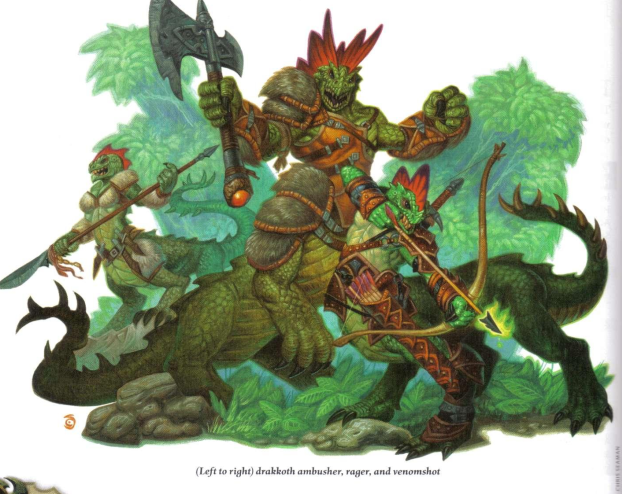
Copyright 2009 Wizards of the Coast This is part of a series! Go here to see the other entries.
Drakkoths, also known as Dracotaurs, have been around since at least 3e. They also look like something I’d find in some of the more exotic BECMI supplements.
The Lore
Like a number of other peoples, drakkoths are distant relatives of dragons. Their humanoid half looks like a crested dragonborn, and their quadruped half like a small wingless dragon.
Drakkoths are nomadic, somewhat insular and territorial, and have enough technology to make steel weapons. Their preferred terrain are forests and jungles, and the borders of their claimed territory tend to shift slightly over time.
According to the book some drakkoth communities worship Tiamat, but others choose to venerate an individual dragon patron instead. This is most often an elder or ancient green, given their common terrain preference. I imagine you could have communities of Bahamut-worshipping or good-dragon-venerating drakkoths as well. Some dragons actively seek to set themselves as the bosses of a drakkoth community, because as far as potential servants go they’re a lot more useful than kobolds.
The Numbers
Drakkoths are very strong and tough, and quite smart as well. They mostly fight with weapons, to which they apply poison. They tend to wear hide and leather armor, but you could also say their scaly hides are naturally tough if you’re so inclined. Their superior movement speed means they favor “cavalry” and skirmishing tactics.
They can also breathe poison in a manner similar to a green dragon, and are prone to flying into a rage that leaves them immune to pain when bloodied.
Common Traits
Drakkoths are Medium Natural Humanoids with the Reptile keyword. They have low-light vision, and their four legs give them a respectable speed of 7. Though all of them have a breath weapon and a rage ability, the exact effects vary with each stat block.
Drakkoth Ambusher
This is a Level 13 Skirmisher with 131 HP. It fights with a Reach 2 glaive that does a mix of physical and poison damage. It can also employ a Sudden Rush maneuver (move action; recharge 5-6), allowing it to shift its speed and make attacks vs. the Reflex of every enemy it moves adjacent to. This does no damage, but knocks prone on a hit. They also do extra “sneak attack” damage against an enemy granting combat advantage to them.
Their breath weapon is a very dragon-like Venomous Hiss (close blast 2 vs. Reflex; recharges when first bloodied). It does poison damage, and ongoing poison damage (save ends).
While bloodied the ambusher enters a Drakkoth Rage, which makes it tougher by granting it 10 temporary HP whenever it hits with an attack.
Drakkoth Rager
A Level 15 Elite Brute with 366 HP, the rager is a lot more direct in its approach to combat. It wields a battleaxe and can perform a Raging Cleave that does the same damage as the basic attack plus a bit of extra poison damage in a Close Burst 1. It wants to be surrounded.
Its Venomous Hiss and its Drakkoth Rage have all the same effects as those of the ambusher, but the rage also gives it a +2 to attacks and +5 to damage.
Drakkoth Venomshot
This archer is Level 16 Artillery with 125 HP, and carries a longsword and a longbow into combat. Its arrows have a rider that gives the target Vulnerable 10 Poison (save ends), which pairs nicely with the poisoned weapons of its buddies.
Instead of the standard Venomous Hiss, it can use a Venomshot Hiss that does less damage but can be used more often, recharging at the end of any turn where the venomshot is bloodied. Its Rage is the same as the ambusher’s.
Sample Encounters and Final Impressions
In addition to palling around with dragons, drakkoths also train creatures native to their territories to fight alongside them, and they can make short-term alliances with neighbors to take down powerful threats.
We get two sample encounters:
-
Level 14: a rager, two venomshots, and a viscera devourer. I bet there’s an interesting story behind that one.
-
Level 16: 3 ambushers, 2 venomshots, and a roc!
I didn’t even remember drakkoths existed before I got to this entry, but these look interesting. I’m sure you could also reskin bog-standard centarus into drakkoths and vice-versa.
-
subscribe via RSS