Posts
-
Let's Read the 4e Monster Manual 2: Ghost Legionnaire
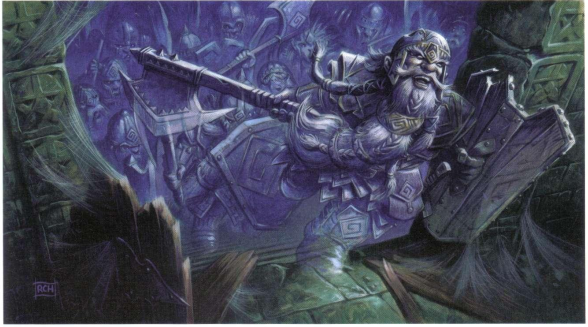
Copyright 2009 Wizards of the Coast The first Monster Manual already includes a bunch of ghosts, and it even has a basic Phantom Warrior. Here we have a more specific implementation of that concept.
The Lore
These creatures are the ghosts of soldiers who died in battle more or less at the same time as the entire rest of their units. The emotional bonds between them and the trauma of their violent massed deaths causes their spirits to fuse and to rise as undead.
Legionnaires always appear as a unit, and they look like individuals acting in concert, but they’re all part of the same collective ghost. So it might have been more accurate to title this entry “Ghost Legion”. Members of the legion can possess the living and make them experience the soldiers’ last moments.
When a ghost legionnaire is damaged, it always displays the wounds it suffered in its final battle rather than the ones that were actually inflicted on it. So a squad killed by some wizard’s acid-infused fireball would grow progressively more burned and melted as the PC paladin stabs them.
A ghost legion might be endlessly reliving its last battle when found, seeing any living intruders as their enemies. It might also be following the orders of a more powerful undead being, particularly if that being was one of its commanders in life.
The Numbers
An individual legionnaire is a Medium Natural Humanoid with the Undead keyword, and a Level 13 Soldier with 100 HP. Despite being a ghost, it’s not considered insubstantial, but it has 10 necrotic resistance and isn’t especially vulnerable to radiant damage.
Legionnaires fight with the same weapons they had in life, making devastating cuts with their melee weapons or shooting ghost arrows that do necrotic damage. They can also use their Battle Visions power to possess a target. This has range 20, targets Will and deals psychic damage with a Dominate (save ends) rider. While the target is dominated, the ghost is removed from the map. When the target finally makes their save, the ghost reappears in an adjacent space.
This ghost’s main weakness takes the form of a trait named Call to History. It allows a PC to make a DC 25 History check as a minor action to recall details about the legionnaire’s original unit. A success here makes the PC’s next attack against that ghost deal 10 extra damage. I don’t think you can stack multiple checks in a single attack, but you can make a check every turn before you attack. Someone who was possessed and made their save has a +5 bonus to these tests for the rest of the fight, as those horrifying battle visions act as extra reference material.
The collective nature of a ghost legion is expressed by the Soul Link trait. Basically, you combine the HP totals of all legionnaires present in the fight into a single pool. Damage to any individual legionnaire is subtracted from this combined pool. The whole unit is destroyed when this pool is reduced to 0, but until that happens all legionnaires remain in the fight! This makes the usual “focus fire” strategy considerably less effective against them.
Sample Encounters and Final Impressions
The sample encounter is Level 15, and quite straightforward: a 5-ghost unit and a human lich wizard from the MM. A Nerathi squad plus their former commanding officer.
I really like the “collective HP” gimmick! It shouldn’t be too hard to add or subtract levels from the stat block given here, either, meaning you can bring the Fun (TM) of ghost legions to the party no matter what their level.
There isn’t much of a story difference between a ghost legionnaire and a phantom warrior, as you can see by their names. This suggests that one way to get a level 4 legionnaire would be to remove Insubstantial from the warrior and add Soul Link in its place. You can likely do the same with any other thesaurus buddies that might come along (banshee battlers, figment fighters, spectral soldiers, wraith warriors…).
-
Let's Read the 4e Monster Manual 2: Genasi
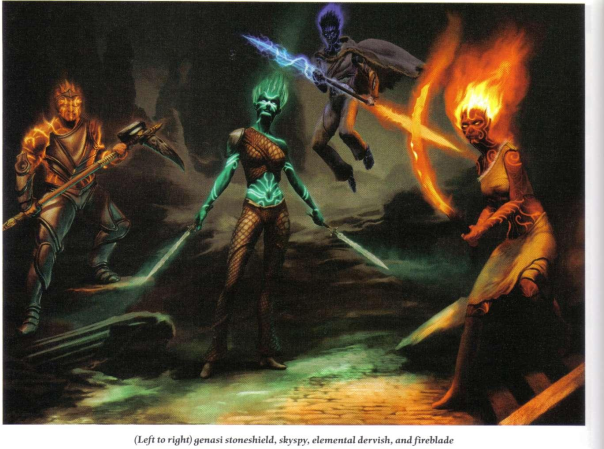
Copyright 2009 Wizards of the Coast The concept of “people touched by the elements” is a 3e thing, but genasi as presented in Fourth Edition are slightly different than what came before them. They debuted in the Forgotten Realm Player’s Guide as a playable option, and would later appear in the MM2 in “monster” format.
The Lore
In previous editions genasi were humans with “genie blood”, but in Fourth they’re simply humanoid sapients from the Elemental Chaos. They’re given no cosmically significant origin story like tieflings or daeva, so I must assume they simply evolved naturally in that plane.
Genasi look more or less human and have human proportions, but each of them also has an elemental manifestation. The five known manifestations are “firesoul”, “watersoul”, “windsoul”, “stormsoul”, and “earthsoul”. Each genasi is born with one of these and an individual’s manifestation has more to do with their environment than with genetics. A genasi community built inside a volcano is going to have a lot of firesouls, and so on.
A genasi’s manifestation accents their physical appearance and defines some of their inborn powers and resistances. It’s an always active part of their being, not something they can turn off. Some of them train to acquire additional manifestations. PCs can have two at most, but some NPCs can have more.
Genasi live primarily in the Elemental Chaos. They have an easier time of it than most other mortals but still must step lightly around efreeti and the like. They can also be found in the world or in the Feywild, since they don’t have any more difficulty living there than a human would.
The Numbers
Genasi are Medium Elemental Humanoids, with a ground speed of 6. They tend to have keywords corresponding to their elemental manifestations: a fire genasi will have the Fire keyword, and so on. Their manifestation also determines what elements they are resistant to, if any, and the themes of their powers. What those powers are is mostly a function of training, so varies per stat block.
Genasi Elemental Dervish
“I’m the Avatar, and you’re gonna have to deal with it!” This is a genasi warrior who has learned to manifest multiple elements, and trained extensively with the double sword. They can move equally well on the ground, in the water, or in the air. Their sword attacks can cause several different types of elemental damage, as can their magic.
Elemental dervishes are Level 18 Elite Controllers with 344 HP and keywords for the four “classic” elements (air, earth, fire, water). They have ground, swim, and fly speeds of 6, and 10 resistance to cold, fire, and lightning damage.
At the start of its turn, the Dervish chooses an between fire, lightning and thunder. Their double sword attacks will deal both immediate and ongoing damage of that type. They can make two of those per action, being elites.
When a dervish is hit by an adjacent enemy, it can use its reaction to respond with a Fiery Riposte, which targets Reflex and inflicts 10 ongoing fire damage (save ends). If the enemy was already on fire, their existing ongoing fire damage increases by 10 instead.
Their special attack is Primordial Storm (recharge 5+), which allows them to shift 6 squares and perform three attacks in order against different targets at any point along the movement. The first is Promise of Storm, which deals thunder damage and makes the target Vulnerable 5 to thunder (save ends). The second is Earth Shock, which deals physical damage and stuns for a turn. The third and last one is Lightning Cut, which deals lightning damage and inflicts 10 ongoing lightning damage.
The elemental dervish is flashy and awesome, and given enough time or well-selected comrades they can set up some interesting elemental damage combos.
Genasi Fireblade
A very straightfoward hot-headed warrior who charges into combat with a flaming falchion. It’s a Level 11 Brute with 139 HP.
The falchion it wields is a High-Crit weapon and inflicts ongoing fire damage. It has the same Fiery Riposte as the dervish, dealing 5 ongoing damage instead of 10. Its other power is Fan The Flames (Close Burst 1 vs. Reflex; recharge 5+), which sets people on fire and gives them a -2 penalty to saves against ongoing fire damage.
Fireblades are going to charge into combat, Fan the Flames, and then get to work on cutting people up and setting them on fire at the same time.
Genasy Hydromancer
AKA, a waterbender that’s also partially made of water. This Level 8 Controller has 91 HP, a swim speed of 8, and fights with a high-crit Scimitar and lots of water powers.
The basic Wave Bolt (ranged 5) deals physical damage and slides targets 3 squares; Whirling Vortex (recharge 5+) does the same in a burst around the hydromancer that affects only enemies; Drowning Touch inflicts ongoing damage on a single target (save ends), but only recharges once the target saves or drops to 0 HP.
The “partially made of water” bit is expressed by two other abilities: Liquid Body is a reaction that allows them to take half damage from the triggering attack, and Swift Current (encounter) allows them to shift their speed with the ability to move through enemy spaces and basically ignore all terrain effects while doing so.
Genasi Skyspy
A windsoul genasi that fights with paired shortswords and uses their mobility powers to enhance their hit and run tactics. They’re a Level 7 Skirmisher with 78 HP and 5 cold resistance.
Their basic short sword attack allows them to shift 1 square on a hit, and they can make two of those against an opponent granting them combat advantage. Feather-Footed gives them an AC bonus against opportunity attacks, and Sky Jaunt (recharge 4+) allows them to fly until the end of their current turn.
Should the PCs manage to surround the skyspy, the genasi can use Manifest Whirlwind (close burst 2; encounter) to do some damage, push them 1 square, and knock them prone. This should help clear some space.
Genasi Stoneshield
A heavily armored earthsoul warrior wielding a heavy pick in battle. It’s a Level 10 Soldier with 106 HP. Stoneshields are difficult to push around - any forced movement applied to them is reduced by 1 square.
The war pick is a High Crit weapon, and it also marks on a hit. This mark is remarkable for being (save ends) instead of only lasting a turn. Marked targets take a -5 penalty to damage against the stoneshield’s allies. They can also attack with a Mighty Bull Rush that does the same damage as the pick and pushes the target 1 square. It also allows the stoneshield to move into the target’s previous position.
Finally, they can stomp really hard and cause a non-damaging Earth Shock (minor action; encounter) that covers a Close Burst 2 and knocks enemies prone on a hit.
Sample Encounters and Final Impressions
Genasi can be found alongside a large variety of other creatures, particularly elementals. They’re as morally varied as humans, so a villain could certainly employ genasi henchpeople. We have three example encounters here:
-
Level 8: 3 genasi skyspies riding hipogriff dreadmounts, accompanied by their pet shardstorm vortex elemental.
-
Level 10: 2 fireblades, 2 stoneshields, and a trained magma strider.
-
Level 19: Two storm archons (a squallshield and a tempest weaver) and two elemental dervish mercs.
Reading about genasi doesn’t give me the sort of instant adventure inspiration that some of the other monsters do, but I like that they exist. Their presence in the Elemental Chaos gives you an excuse to place “normal everyday communities” in that plane for your PCs to interact with. Not every EC settlement is a githzerai monastery or the City of Brass.
-
-
Let's Read the 4e Monster Manual 2: Fomorian
Fomorians first appeared in the first Monster Manual, and we covered them here. This entry gives us more fomorian stat blocks, and a few more bits of lore.
First, we have a bit of general lore, which is really a logical extension of the fact that Fomorians believe themselves the most important creatures in the universe. They hate all other fey, but that hate manifests as a desire to subjugate rather than exterminate them. Their perfect world is one where fomorians rule absolute over the Feywild and have all its other inhabitants forever toiling to please their masters.
Because of this obsession, fomorians are eternally at war with the other fey civilizations. It’s likely they’ll never succeed in conquering all of the Feywild, but they’ll never stop trying either. I suppose there must also be some level of internecine strife among them, because it seems to be they’re very likely to fight over who gets to be supreme ruler.
The remaining bits of lore concern the individual stat blocks here, and so will be covered in those stat blocks.
Numbers-wise, fomorians still retain their common traits from the first article: they’re Huge Fey Humanoids with the Giant keyword; they’re extremely perceptive (trained Perception, Truesight 6); and they have some sort of “evil eye” ability that varies per stat block.
Fomorian Ghost Shaman
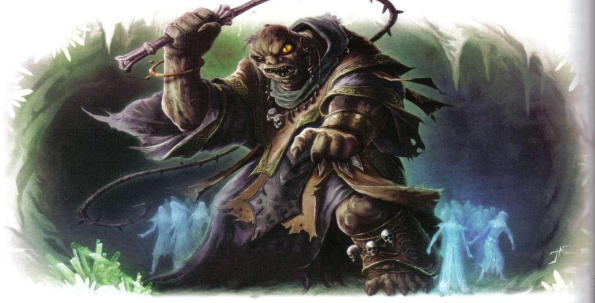
Copyright 2009 Wizards of the Coast Ghost shamans are necromancers who enslave the spirits of those they kill. They command these spirits as if they were puppets, enacting sadistic plays for their own amusement. They also use enslaved spirits as weapons in combat.
Ghost shamans are Level 16 Elite Controllers with 312 HP. They have darkvision in addition to the other fomorian traits. All of their attacks are magical in nature and, except for the Evil Eye, target Fortitude. Their basic melee attack is Death’s Touch, which deals necrotic damage and slows (save ends). Their Evil Eye is a minor-action ranged attack that inflicts ongoing necrotic damage (save ends).
At will, they can use Spirits of Possession (close blast 3), which targets people taking ongoing necrotic damage and dominates them on a hit (save ends). A bit less often they can use Darksoul Mist, which is like a necrotic fireball that leaves a zone of darkness in the affected area. This blocks line of sight for anyone without darkvision.
Fomorian Cackler
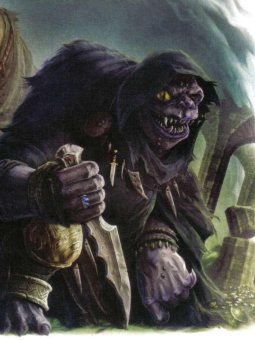
Copyright 2009 Wizards of the Coast Cacklers are sly but unhinged assassins who get their name because they constantly laugh a disturbing laugh. They can be silent when they want to be, though, and are amazingly stealthy for someone the size of a house. They can also use magic to shrink down to Medium size, which helps a lot.
Cacklers are also excellent at disguising themselves, since their minds can easily construct entire fake personalities to aid in that. It’s possible for previously discarded personalities to momentarily come to the fore again, though, which is part of why they’re so unstable.
They fight with daggers bigger than the average human greatsword, which they can use in melee or throw out to range 10. The thrown dagger attack can target one or two enemies, and they return after it resolves.
Their Evil Eye makes them invisible to the affected enemy, and they get a big bonus to damage against targets that can’t see them. Size Alteration lets them switch between Huge and Medium as a minor action.
Fomorian Totemist
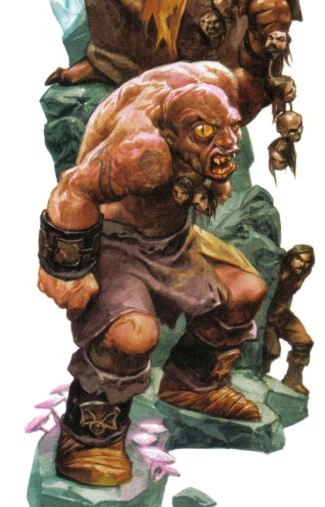
Copyright 2009 Wizards of the Coast Totemists are fomorian spellcasters that collect the heads of those they kill and build chains out of them. Each head in the chain is imbued with necromantic power, and can channel a different curse. Most totemists have a preference for a particular type of head - one might favor eladrin heads, another dwarves, and so on. Some of them select prospective additions to their chains year in advance, following the lives of their future victims until the time is right for the “harvest”.
Totemists are Level 18 Elite Skirmishers with 352 HP. They fight with the afore-mentioned Chain of Heads, which is Reach 4, does physical damage and inflicts ongoing necrotic damage. They can also channel curses through the chain as a minor action, with an ability with the very unfortunate name of Voodoo. There are three possible effects: the Glorious Head blinds, the Wasting Head weakens, and the Bewildering Head forces the target to make a melee basic attack against an ally in reach. After attacking, the totemist can shift 1 square.
Their Evil Eye does light necrotic damage and inflicts a -2 penalty to saves, which helps that blindness or weakness last longer. And finally we have Fresh Rage, a passive trait that makes their first succesfful attack in their turn deal extra damage.
Fomorian Blinder
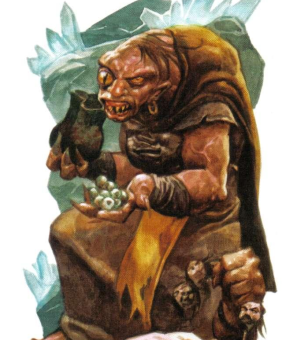
Copyright 2009 Wizards of the Coast Blinders have more specialized and discerning tastes than totemists. They collect eyes instead of lugging whole heads around. Blinders are the scholars and sages of fomorian-kind, acting as repositories of their civilization’s lore. They’re also very good at eye-based magic - if anyone knows how to make a defense against the Evil Eye, it’s them.
Blinders are Level 20 Elite Artillery with 296 HP. They use quarterstaffs for melee combat but their forte is eye magic. Acid Eye is a ranged attack that deals acid and necrotic damage, and whose enervating properties prevent the use of encounter or daily powers for a turn. Shower of Ichor (encounter) deals the same damage over a wider area, and also inflicts ongoing acid and necrotic damage.
The blinder’s actual Evil Eye is quite powerful: it does no damage by itself, but someone cursed by it will take the same damage the fomorian inflicts on other enemies with their other attacks. It ends when the victim saves successfully, or when the fomorian uses this on someone else.
Ironically, blinders have no abilities that actually blind people.
Fomorian Butcher
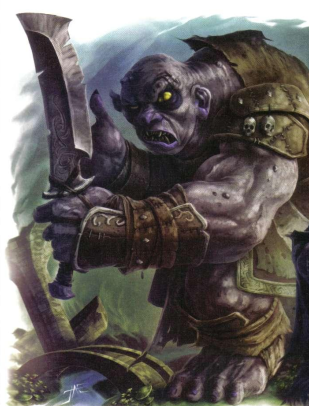
Copyright 2009 Wizards of the Coast Butchers are big fomorians with big blades who like to cut people up for fun. Such simplicity is a bit disappointing after we saw all those esoterically evil fomorian casters and assassins, but they’re still very dangerous and just as ambitious. In fact, they go to absurd lengths to fulfill their serial-killer urges, and will often trade their souls to devils and make other dangerous deals in exchange for more power.
Butchers are Level 22 Elite Brutes with 514 HP. They use titan-sized falchions, which are High-Crit weapons. They’re all about focusing on a single victim and hacking them apart with repeated strikes: when they score a critical, they can make another free attack with the falchion against the same victim, and their attacks deal a bunch of extra damage against a victim they already hit earlier in the same turn. Their Evil Eye restrains (save ends).
There are several ways they can get that extra damage from a “subsequent” hit: the bonus attack from a critical, spending an action point to attack again, and I’d say hitting with the Evil Eye also counts for this. So they’ll always try that before swinging their blades.
Sample Encounters and Final Impressions
Most of the sample encounters here are “Assorted Fomorians” from this book and the MM. One of them also involves drow and Lolthbound Goblins. Generally speaking you can also frequently find fomorians accompanied by cyclops slaves, or by other evil fey they’ve enslaved or allied with. Devils could also make an appearance, since it seems Fomorian diabolists are somewhat common.
This lot is quite a bit more flavorful than the fomorians in the MM, and the extra lore does justice to the basics laid down by the first book. “Voodoo” is a very unfortunate name for an ability, but it’s easy enough to change.
-
Let's Read the 4e Monster Manual 2: Firbolg
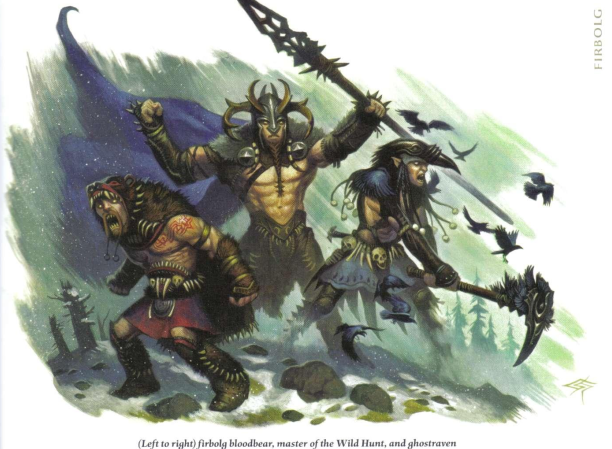
Copyright 2009 Wizards of the Coast This article is part of a series! Click here to see the other entries.
Firbolgs are inspired by Celtic myth, and I’m sure they must have appeared in earlier editions in some form. I think their 4e presentation in this book is new, though.
The Lore
Firbolgs are giants (not Giants) native to the Feywild. Their culture values independence and courage, and their religion is a variant of the Maiden-Mother-Crone triumvirate. This variant has a different goddess in each role: Sehanine is the Maiden, Melora is the Mother, and the Raven Queen is the Crone. This generally results in a religion that’s themed around the night, the moon, autumn and winter, instead of the more balanced “classical” version.
Firbolgs live in and protect the deep wilderness of the Feywild, building their settlements on precarious peaks, floating earth motes, and other such hazardous heights. Leadership positions are occupied by their mightiest warriors and their moon seers (priestesses), both of whom wear masks or helmets styled after one of their deities. They place great value on clan and family ties.
Back when I discussed the Hounds of the Wild Hunt, I speculated that the hunters would be high-powered eladrin. Well, I was wrong! Turns out the Wild Hunt is a Firbolg tradition.
You see, while firbolgs are fond of treasure, they place even greater value in oaths and promises. And when someone breaks an oath made to the firbolgs, they convene a Wild Hunt to track and punish the infractor. Even people who didn’t betray the firbolgs directly still have reason to fear them, as there’s a ritual that allows someone to sic a Wild Hunt on an oathbreaker. And I imagine they might also ride out to fulfill sacred missions revealed in the moon seers’ visions.
Wild Hunts vary in size and composition, and might include allied sapients whose goals and temperament are close to those of the firbolgs themselves. The mightiest and scariest hunts are led by firbolgs with the oficial title of Master of the Wild Hunt, who usually act as community leaders while not fulfilling that role.
PCs might find themselves fighting firbolgs when they stumble on their territory, since a firbolg attack will likely be the first sign that they did it. They could also find themselves on the path of a Wild Hunt, or even as their main target if they manage to piss off someone who can convince the Hunt the PCs are oathbreakers.
Still, it’s possible to negotiate with firbolgs and even approach them peacefully. The Wild Hunt is harder to parley with, but it’s still not impossible unless the PCs really are oathbreakers. Of course, should their interests align, the PCs might find themselves riding alongside the hunters.
The Numbers
Firbolgs are Large Fey Humanoids, and all the ones we see here are Unaligned. They all have low-light vision and a natural ground speed of 8. They also have Regeneration 5 (10 at Epic tier), which can be shut down for a turn by necrotic damage.
They also have a +2 bonus on saves against charm effects, and the immobilized, slowed and restrained conditions. For elite firbolgs, this stacks with the +2 on all saves elites get.
Their signature power is Moonfire (Ranged 10 vs. Will; minor action; recharge 4+), which prevents the target from benefitting from cover or concealment for a turn. It also has additional effects that vary per stat block, but all generally make the target more vulnerable to that firbolg’s attacks. All of their other powers come from martial or magic training, and their magic has the same themes as their religion.
Firbolg Hounder
Hounders are members of firbolg hunting parties whose job is to attack and drive prey into a position that makes them vulnerable to the other hunters. They wear scale and wield axes and shields. They’re Level 11 Soldiers with 113 HP.
Their basic attack is a Reach 2 Battleaxe, and they can use it in a Hounding Strike maneuver that has the same basic stats and also slides the target 2 squares on a hit. Drive Prey is an even more powerful version of that, doing more damage and allowing a secondary attack vs. Will. If that hits, the target must move or shift away from the hounder with its first action on its next turn, or become dazed until the end of that turn. This ability recharges when the hounder is first bloodied.
At range, the hounder can throw Handaxes, which do light physical damage and knock the target prone. Their Moonfire power also marks the target for a turn. Finally, the Hunter’s Leap passive trait makes them immune to opportunity attacks while jumping. They use the standard jumping rules for that.
So it looks like these firbolgs will use Hounding Strike and Drive Prey to slide enemies into a vulnerable position, and then either stay away and throw handaxes, or move into melee to try and keep the enemy pinned in place while the other hunters do their jobs.
Firbolg Hunter
These are the people the hounder (above) works with. They’re level 12 Skirmishers with 123 HP, wear light armor and bring spears and javelins to bear agains their prey.
All of their powers enhance their weapon attacks. Crippling Strike (recharges when first bloodied) adds extra damage to an attack and makes it immobilize the target (save ends) with a Slow after-effect. Mobile Attack allows them to move 8 squares and make a basic attack without provoking opportunity attacks from the target, or from making ranged attacks. Their Moonfire also makes their weapon attacks do +1d6 damage to the affected target for a turn.
And finally, they also have Hunter’s Leap. It’s really hard to run from them, particularly when there hounders pinning you down.
Firbolg Moon Seer
Moon Seers are those priestesses I talked about. They’re Level 14 Controllers with 141 HP. They wear masks and light armor, and fight with moon- and fate-themed magic.
A seer’s basic melee attack is a Moon Mace that targets Reflex, deals Radiant damage, and blinds the target until the start of its next turn. Their Moonfire has the additional effect of making targets grand combat advantage to the seer for a turn. After hitting someone with Moonfire, the seer can use Moonstrike (vs. Will) to deal psychic damage to that victim and dominate them until the end of the seer’s next turn.
There’s two other spells Spirit Hounds and Ban of the Raven.
Spirit Hounds is a blast that targets Reflex and only affects enemies. It deals psychic damage, slows, and prevents the target from teleporting (save ends), which is handy when hunting down eladrin or other fey.
Ban of the Raven is the big gun, an encounter power that’s a Ranged 10 vs. Fortitude attack. It deals heavy necrotic damage and worsens critical hits! The affected victim takes critical hits on a natural 18-20 instead of only a 20, and each such hit deals an extra 10 necrotic damage on top of whatever it would normally deal. Once the victim saves against that there’s still a weaker aftereffect that makes the victim suffer crits on a 19-20.
Firbolg Bloodbear
Bloodbears mix in a bit of viking into their Celtic trappings, being able to turn into bear hybrids. They’re Level 15 Elite Brutes with 240 HP.
They fight unarmed, and start out in firbolg form. Once bloodied, they assume Bloodbear Form, recover all of their HP, and double their regeneration. This also upgrades all of their attacks. This transformation lasts until they’re bloodied again, and then it reverts. So in effect they have 360 HP, and will become bears for the middle third of that health bar.
In firbolg form, they fight unarmed with slams, and they can slam twice with Double Attack. If they hit both attacks, they can also try to grab the target. Bloodbear Maul allows them to automatically deal heavy physical damage against the grabbed victim. They have Moonfire, but it’s only the basic version.
In bloodbear form their slams turn into claw attacks that gain increased damage, they gain a bite that does even more damage and deals ongoing damage if the target is granting AC, and Bloodbear Maul also allows them to make a free bite attack against the grabbed target.
Firbolg Ghostraven
These are Raven Queen themed assassins. They fight with heavy war picks, which are not the kind of weapon you’d expect an assassin to use. They can assume the form of a ghostly raven, which allows them to better hide in shadows and ambush their intended victims.
Ghostravens are Level 16 Elite Lurkers with 238 HP. Their picks are High-Crit weapons, and they can attack twice with them. If both attacks hit the victim is blinded (save ends). Assuming Ghostraven Form is a minor action that makes them intangible, gives them a fly speed of 8, and gives them concealment while in dim light or darkness. When a ghostraven attacks someone who can’t see it, it deals increased damage.
Firbolg Master of The Wild Hunt
What it says on the tin. These hunt masters usually serve as leaders of firbolg communities when they’re not heading a Wild Hunt.
Hunt Masters are Level 22 Elite Skirmishers with 404 HP. They wear the classic stag helmet and fight with a Spear of the Hunt that can make both melee and ranged attacks (it returns when thrown). Being elites, they can attack twice per action.
Their Moonfire also marks and makes the target grant combat advantage until the end of the master’s next turn. They deal increased damage to targets affected by Moonfire (from any firbolg, not just their own).
Their special attack is a Mortal Strike, which allows them to make a basic attack against a bloodied enemy that’s an automatic critical and deals 6d6 additional damage. If this reduces the target to 0 HP, it gives an extra action point to the huntmaster. Action Points, as a reminder, can be spent to give their owner a whole extra standard action on their turn. All elites start out with one, and the hunt master is one of the few who can gain more during a fight.
Sample Encounters and Final Impressions
We get two encounters:
The first is Level 13, a moon seer, a hunter and two hounders plus 2 centaur hunters. This is either a “lesser” Wild Hunt or just a normal hunting party/patrol. It hints that there’s likely a joint Centaur/Firbolg culture out there somehwer.
The second is a proper scary Wild Hunt: the Master of the Wild Hunt along with two Wild Hunt hounds, a bloodbear, and 2 ghostravens. It’s level 22, which means relatively few things in the setting can really stand up to it.
I like firbolgs more than I though I would! There’s plenty of information on them here, and it does plenty to differentiate them from the more standard giants.
One thing I found a bit awkward are the bits of text in the book that say they value “the middle path between good and evil”. This is derived from one of Sehanine’s commandments, which is equally awkward. What does this mean? Are they supposed to feed a puppy one day and kick it on the next to keep things balanced? A more charitable interpretation might be that they’re not any more inclined to trust people who claim to be champions of good than they are anyone else, and try to stay out of those particular cosmic struggles.
-
Let's Read the 4e Monster Manual 2: Fey Lingerer
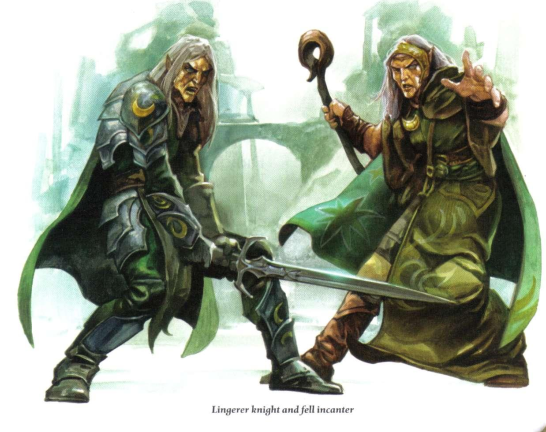
Copyright 2009 Wizards of the Coast This article is part of a series! Click here to see the other entries.
I think it’s fair to say that eladrins can be overachievers. Their societies produce a lot of gallant knights and powerful spellcasters, who go on to accumulate glory and renown to their name. They’ll be the first to say the world is a better place due to their efforts.
Sometimes, though, things go wrong. A knight perishes with a quest unfulfilled, or a mage dies just before making that one crucial breakthrough that would get him tenure at Lórien Polytechnic. Whether from violence, accident or natural causes, such deaths are incredibly frustrating for the eladrin in question, so they simply refuse to go. The entity that results from this is known as a Fey Lingerer.
Fey lingerers resemble the people they were in life, but the book describes then as “withdrawn from elven grace”. In other words, they look clearly dead, their formerly shiny countenances now decomposed or dessicated. They’re also quite cruel and anti-social, their personalities now dominated by the frustration and anger that kept them from passing on.
Lingerers generally try to accomplish whatever it is they were trying to do when they died, and can linger on even after that, looking for ways to gain the glory and fame they feel were due to them while they lived. They might employ other undead in this, and sometimes they also gather living eladrin followers who are willing to help their fallen heroes.
When a fey lingerer is destroyed in combat, its spirit emerges angrier than ever. This vestige knows it can never complete its objectives now that its body has been destroyed, and becomes obsessed with taking revenge on those responsible.
The Numbers
Fey lingerers are corporeal undead, and since they used to be overachieving eladrin luminaries, they’re usually mid-to-late Paragon-tier. As is standard for undead, they have Darkvision plus some level of Necrotic resistance and Radiant Vulnerability.
Lingerers retain the eladrin Fey Step power, and add an aura of Spiraling Despair (radius 3) which inflicts a -2 penalty to attacks and saves to enemies caught inside. They also have an extra bonus on saves against charm effects.
They’re Elite monsters, but this is implemented in a novel and very interesting way. Normally an Elite would have double HP, but Fey Lingerers have the normal amount. However, when they hit 0 HP they become Vestiges, incorporeal undead with their own stat blocks. They start in the same position as the original lingerer, and act on the same initiative order, but are otherwise treated as if they had just entered the fight: full HP, all abilities unused.
Vestiges aren’t worth any additional XP when fought as part of a lingerer fight since the lingerer’s XP total accounts for them. You can design encounters with vestiges directly, though, and in that case they’re worth XP as normal for a regular monster of their level.
Lingerer Knight
These knights usually died when trying to fulfill an important mission or quest, and are driven to complete it. They might have been honorable sorts before their deaths, but now they’re just desperate. Bearing the same weapons they did in life, they can infuse their strikes with necrotic energy and force enemies to experience their rather unhealthy mental state.
Lingerer Knights are Level 16 Elite Soldiers with 152 HP. They have all standard lingerer traits and a speed of 6. Their necrotic resistance is 10, and their radiant vulnerability 5. The one in the book fights with a Longsword that also inflicts ongoing necrotic damage (save ends). Double Attack allows it to perform two sword attacks in a single action.
They can also perform a spell called Spirit Sword Circle (recharge 5+), a Close Burst 1 vs. Reflex that does slightly less damage than a double attack and also inflicts ongoing necrotic damage (save ends).
That unhealthy mental state manifests as two different powers: Desperate Challenge (Ranged 10; Encounter) allows the knight to mark a target until the end of the fight or until the knight discorporates, whichever comes first. Marked targets take some automatic necrotic damage when they make an attack that doesn’t target the knight. Spiritual Despondence triggers when the knight is first bloodied and deals automatic necrotic damage in a Close Burst 3.
Fey-Knight Vestige
A destroyed lingerer knight becomes one of these. It’s a Level 16 Lurker with 75 HP. It has all standard lingerer traits, a ground speed of 6, and a fly speed of 6. Its resistances and vulnerabilities increase by 5 each, and it’s also insubstantial.
The vestige fights with a Ghostsword that targets Fortitude instead of AC, does necrotic damage, and makes the target grant combat advantage to the vestige (save ends). This means it can do its “Lurker thing” while staying in the front lines, which is a bit unusual but matches the “knight” flavor. Desperate Dash (move; recharge 5+) allows it to shift 6 squares and possibly escape being surrounded.
Lingerer Fell Incanter
Fell Incanters hang around for more open-ended reasons than knights, and are usually obsessed with obtaining more arcane knowledge and power in order to Show Them All. Their magic is tinted with their hatred, so all of it does necrotic damage. So they’re kind of Lich-Lite.
Fell Incanters are Level 18 Elite Artillery with 130 HP and all standard lingerer traits. They’re armed with a quarterstaff that also inflicts ongoing necrotic damage (save ends).
At range they can fire Soul Bolts (ranged 10 vs. Fortitude) that deal necrotic damage and immobilize (save ends). Double Attack allows them to shoot two of these in one action. After they’re bloodied, they can also use a Soul Blast (close blast 3 vs. Fortitude; recharge 5+) that does necrotic damage and weakens until the end of the incanter’s next turn.
Fey-Incanter Vestige
When a fell incanter is destroyed, it becomes one of these. It’s a Level 18 Lurker with 91 HP. Its resistances and vulnerabilities are increased by 5 each, it gains a fly speed, and becomes insubstantial.
Incanter vestiges have no melee attacks. Their basic attack is a Ray of Humility (Ranged 5 vs. Will) doing both immediate and ongoing necrotic damage. It also inflicts 5e disadvantage (roll 2d20 and take the lowest die) on the victim’s saves, with a successful save ending both this and the ongoing damage.
There’s also Ray of Spring’s Rejection (ranged 5 vs. Will; recharge 5+), which does more damage and makes the target grant combat advantage to the vestige (save ends). And, like the knight vestige, this one deals increased damage to people granting CA to it.
This results in an enemy that’s a bit similar to the knight vestige but with a ranged focus. It’s also a lot harder to save against its CA-granting effect.
Sample Encounters and Final Impressions
The sample encounter is Level 18: two lingerer knights, 1 fell incanter, and a living bralani of autumn winds who is probably one of the incanter’s fan-elves.
I think fey lingerers are really interesting! Though I described them as “Lich Lite”, I actually think they’re a bit more flavorful than standard liches, what with the whole “become a vengeful ghost” mechanic. I always felt D&D 4 could have done a lot more with such multi-stage enemies.
subscribe via RSS