Posts
-
On Warhammer 40.000
This one has been sitting in my drafts folder for a while, and I figured it was time it got finished and saw the light of day.
When I announced my post on Meltaguns on the GURPS Discord server, the following sentence from there generated a little discussion:
There is pretty much no reason to use one of these instead of a
good anti-vehicle missile, but the Imperium of Man never cared for reason.
Some of the people who were in there at the time disagreed with this sentence. They attempted to explain their position1, and while I still don’t agree with them, I could kinda see where they’re coming from.
At the core of that logic is a strong impulse to suspend disbelief in the setting and to willfully ignore the gaps between the fiction and the rules2. To look at the stuff depicted in the setting material and wargame rules, and to build a chain of logic that makes it internally consistent. This is an attitude shared by a lot of fans of the setting, and some of its writers too.
I come at this from a different direction. At the core of my thinking about Warhammer 40.000 is the fact that this setting is utterly ridiculous, and any material I write about it will hold that idea within its heart. The Imperium are a bunch of space nazis whose outlook, equipment, and strategies are entirely oriented towards what would make the best heavy metal album cover. Their claims that they are the only alternative to the end of humanity or even of the universe are entirely bunk. I will never, ever take them the least bit seriously or picture them in a sympathetic light. They will never be better than a joke in my book.
The same goes for pretty much everyone else, though they likely prefer to pose for album covers in different music genres3.
I will gladly adapt stuff from that setting to GURPS, and I would even GM a game in that setting, but in both cases I will always keep that ridiculousness in mind, lampshade it at every opportunity, and make sure every shade of nazi in there is an eminently punchable antagonist. As you might imagine, it’s not very likely that I’ll end up playing in a game with people who take the Imperium at its word, much less people who think it’s way of thinking applies to the real world.
-
Let's Read the 4e Monster Manual/Vault: Chimera
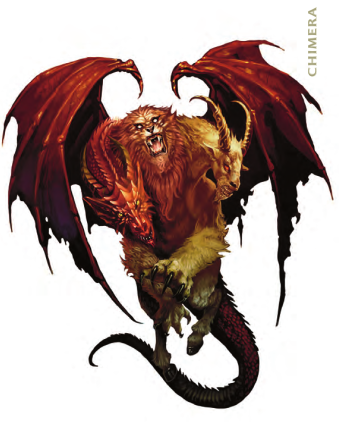
Copyright 2008 Wizards of the Coast This article is part of a series! Go here to see the other entries.
Chimeras come from Greek mythology, where as far as I know it was just The Chimera. D&D likes to make unique monsters into whole species, and this is what happened here. I remember seeing them statted up for AD&D 2nd Edition in the past, and they’re quite likely much older than that. Here, they’re only on the Monster Manual.
Chimeras in 4e have a lion’s body with a dragon’s wings and tail. Its three heads all sprout from the front: the lion in the middle, a goat to the left, and a dragon to the right. They’re Large Natural Magical Beasts, which means they’re both native to the world and sapient. They speak Common and Draconic but aren’t very smart, at Int 5.
A chimera behaves much like the less cerebral types of dragon: it stakes out territory somewhere and roams the surrounding countriside looking for food to line its stomach and shiny treasure to line its lair. Sometimes other creatures will convince a chimera to work for them as muscle, guards, or mounts. They’re Unaligned, but I guess a peaceful interaction with a chimera would be difficult unless you can convince it you’re not prey.
A chimera is a Level 15 Elite Brute with 366 HP. It has both all-around vision and darkvision, so it can hunt at night just fine and can’t be flanked. It also has Resist 10 fire.
The chimera runs with speed 6, flies with speed 10 (clumsy), and has overland flight 15. Creatures with overland flight can fly at the listed speed outside of combat for extended periods, basically. You can run into a chimera quite far from its lair.
In combat, the chimera will usually attack with all three heads: bites from the lion and dragon, and a gore from the goat (which knocks prone in addition to doing damage). The lion bite is its basic attack, but it can attack with all three heads as a standard action. When it charges it uses the goat head, causing a little more damage than the standing gore attack.
The dragon head can also breathe fire on a close blast 5, targeting Reflex and doing fire damage plus ongoing 10 fire damage (save ends) to anyone it hits. This is an encounter power, but when the chimera is bloodied it will immediately recharge its breath and use it again as a free action. In other words, it works exactly like the breath from a real dragon.
The pictured chimera breathes and resists fire because it has red dragon bits, but they come in all the colors of Tiamat. Just change the element: a black chimera would use and resist acid, a blue one lightning, and so on.
The suggested encounters are both level 15. The first is 2 chimeras and 2 hill giants, and the second a chimera, an azer taskmaster, and 6 azer minion warriors.
-
How I Accidentally Hijacked a D&D Campaign and Turned it Into GURPS
There’s a very important reason for the increasing delay between my Let’s Read Hell’s Rebels posts: for the past few months I’ve been GMing a Dungeon Fantasy campaign.
It all started, ironically, when a friend of mine invited a bunch of people to start a D&D 5th Edition game. He had just acquired a copy of Tales From the Yawning Portal, the book that adapts a lot of older adventures to 5th edition, and wanted to make a casual campaign out of it. I accepted because I liked the idea of participating in a game as a player for once and I didn’t actively dislike vanilla D&D 5th.
This was a weekly game, taking place over Google Hangouts every Sunday morning. It went relatively well for a while. We plowed through Sunless Cidatel and much of Forge of Fury in pure dungeon-crawl mode. One day, though, it happened that only the GM, me, and another player managed to make it into the session, and we found out the hard way how essential numbers are in this edition of D&D.
A fight that should have been something of a speedbump to a party of 4-5 turned into a nearly fatal encounter for a duo, and so we became convinced that it was pointless to make a go at any of the actual set-piece encounters in front of us.
So I ended up proposing an alternate game for when we didn’t have a full party for D&D. I had just acquired both the Dungeon Fantasy RPG boxed set and the original Ravenloft module for AD&D, so I proposed a game of DFRPG Ravenloft.
I figured DFRPG delvers would be strong enough to make some progress even when we had a reduced party, and I had a handy list of GURPSified Pathfinder Iconics for them to pick from so that was character creation taken care of.
Pretty much the whole D&D party picked their DFRPG characters - we had Valeros the Fighter, Harsk the Ranger, Kyra the Cleric, Ezren the Wizard, and Seelah the Paladin. The week after that, I GMed the introductory session following the guidelines in the module, and went all-out in roleplaying it and narrating things.
They loved it. It seems at least one of the players was genuinely scared. I’m not bragging about my own skills - rather, I’m saying OG Ravenloft is that good.
There was never an officially announced decision or anything, but our “D&D” group never played another D&D session after that. The backup GURPS Ravenloft game became our main event. I never set out to do this intentionally, but I can’t say I’m not happy with the result.
Tune in next time to learn how Ravenloft claimed yet another party of unwary adventurers.
-
Let's Read Hell's Rebels Adventure 2: Conclusion

This article is part of a series! Click here to see the rest.
In the last post I said it was time to finally end Turn of the Torrent, but that was a little hasty. The last post covered the big dungeon - this one is the denouement.
Clearing the Lucky Bones hideout completely and reactivating the magical pump makes the place usable as the official home base of the Silver Ravens, increasing the maximum power of the rebellion. Over the course of this adventure the PCs have also likely gained the support of the Torrent Knights, earned a number of favors from a powerful Navy captain, and caught a notorious serial killer.
Those last three goals are supposed to help cement the Silver Ravens’ reputation as heroic protectors among the people of Kintargo. Catching the Temple Hill Slasher is obviously a big PR coup, plus I guess the contact networks of the remaining Torrent Knights and Captain Sargaeta would be pretty dilligent in spreading the good word about the PCs, making the people like them more even as Barzilai’s administration likes them less. All of this forces Barzilai to officially acknowledge the existence of the Silver Ravens, and to be diplomatic about it.
Thrune hosts an award ceremony at the Kintargo Opera House and issues a very public invitation to the PCs. During the ceremony he makes a speech praising their civic-mindedness and hands out valuable gifts.
While The Barzilai has it out of the PCs, he will not try to hurt them here, and will do his best to appear civil. The gifts are even magic items tailored to be useful to the PCs! The trick here is that the items are distinctive enough to be tracked via locate object (D&D) and Seeker (GURPS), which will likely come to bite the PCs unless they’re very crafty. Really, the best thing they can do with these “rewards” is ditch them far away from the Lucky Bones, but there’s a good chance they won’t think about the tracking angle and keep them.
And speaking of crafty, PCs who don’t try to pick a fight during the ceremony gain a XP reward for being discreet. According to the book, stabbing Thrune in front of a crow of thousands might be satisfying, but is unlikely to be productive at this point in time.
The book also says that Barzilai has completed one of the rituals necessary for becoming a genius loci not long before the public ceremony, and so is looking a bit haggard and pale. He’ll be back in top form in time for the fight against the PCs, of course.
After the ceremony, you should give the group access to the full map of the Lucky Bones basement, secret passages and all, and let them have fun turning it into a deathtrap dungeon using the resources of the Silver Ravens. The defenses they install here will be very relevant if/when Thrune discovers its location and orders his goons to mount an attack.
Going Off the Rails
The book seems to treat the award ceremony as sort of a closing cutscene in this adventure, but if you think about it a bit more there are a few things that can make it go off the rails. Here I’ll discuss these things and how to adapt if they happen.
Thing 1: Silver Who?
It could be that your PCs were so good at covering their tracks that they performed all the deeds the books consider flashy and public in a very discreet manner. Maybe they let someone else take the credit for catching the Slasher and otherwise did their utmost to prevent their Notoriety from rising. On the one hand, Thrune would know almost nothing about them. On the other, he’d have no reason to host the ceremony, preventing the “tense encounter”.
I imagine it’s actualy better for the PCs in the long run if it doesn’t happen, as the Silver Ravens should gather at least some fame and notoriety for their deeds. The people of Kintargo can’t support you if they don’t know who you are! Still, if your PCs are this committed to being stealthy ninjas, the ceremony would either not happen at all, or it would have whoever the PCs pinned their successes on as the guest of honor. This would also change a few other things down the line.
Thing 2: We’re Not Going to the Fucking Opera House.
The PCs could simply not show up to the ceremony! Even here they could do this in one of several ways, from simply ghosting Barzilai to issuing this section’s title as a public statement.
However they handle it, this is sure to have a polarizing effect on Kintargo’s citizens. People who already liked them will love this, people who already liked Thrune will hate it, and some of those who were on the fence will fall to whatever side they were closest to. Mechanically, this is an increase both in the rebellion’s number of supporters and its Notoriety score, modified by the specific response the PCs chose to give and by their actions in this adventure.
Interestingly enough, this shouldn’t have much of an impact in the future direction of the campaign. The biggest one is that PCs who didn’t attend the ceremony are sure to not be carrying Barizilai’s trap items when that becomes relevant.
Thing 3: Hi there! Prepare to Die!
What if your PCs do stab Barzilai in front of a crow of thousands? The book tries to discourage this by describing Barzilai’s entourage, which includes a dozen beefy hellknights, Kintargo’s High Priest of Asmodeus, and two very large three-headed hellhounds. This might work as a deterrent on Pathfinder, since it sends the message that “this encounter would be much higher level than your party”, but it might not be enough to dissuade a party of foolhardy Dungeon Fantasy delvers from having a go. It would likely still not be an easy battle, but hey, Barzilai is less than three feet away, he’s weakened from his sinister ritual, and if he dies anything but a natural death his master plan is foiled! Fast-Draw, behead, profit!
Should the PCs succeed in killing Barzilai Thrune here, they haven’t exactly “won” Hell’s Rebels yet. They still have a rebellion to conduct and that just got a lot harder. Kintargo will be thrown into open conflict much earlier than the books predict, as Thrune’s cronies will have the perfect excuse to go fully genocidal on the citizenry and the central Cheliax government will feel pressured to send an army to respond to this event even though they didn’t like Barzilai all that much. All of the things that needed to happen for the overall revolution to be successful now need to happen a lot faster, and likely without the help of those friendly factions that conditioned their support on the PCs not being violent hotheads.
In other words, the overall challenge level of the campaign will swiftly rise to match the level of power and audacity of a party that manages to kill Barzilai in the ceremony and get away with it. If the players aren’t confident that they have that level of badassitude, then the PC that goes up to shake Barzilai’s hand had better not be Impulsive and/or Bloodthirsty.
-
Let's Read the 4e Monster Manual/Vault: Carrion Crawler
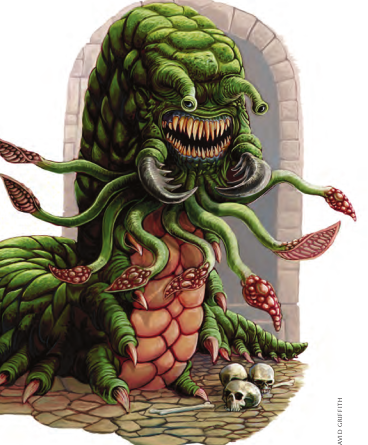
Copyright 2008 Wizards of the Coast The first version of D&D I ever player was one of the many Basic boxes, and I remember carrion crawlers being there. It’s quite likely they’ve been a thing since the beginning.
Back then I had a hard time seeing why they were dangerous, since their main attack did no damage and their bite was weak. This is because I didn’t know what a big deal paralysis was, being a kid and new to the game. If you have fond memories of those BECMI-or-earlier crawlers, you’ll be happy to know they still paralyze here.
Carrion Crawlers are present on both the Manual and the Vault. The Monster Vault has updated versions of both crawlers that show up on the Monster Manual, plus two new varieties, so you don’t loose anything by going with the Vault versions only.
The Lore
The Monster Manual blames a Cocaine Wizard whose name is lost to history for creating the first crawlers. The Vault elaborates on that story a bit more: this wizard didn’t create the monsters, she opened a portal to the Far Realm in an attempt to learn its secrets. A whole lot of bad stuff went through and destroyed the city she was in. The crawlers came through on the wake of that main wave drawn by all the corpses.
The Vault also has a bit more to say about their habits of these tentacly worms. They feed on carrion but don’t like to compete for it with other scavengers, to they lair in places where food is plentiful but mobility is limited for the competition: caves, sewers, dungeons, swamps choked with vegetation, and so on. They’re also drawn to battlefields and cemeteries. A city dealing with a siege or plague is in even more trouble than usual if it has crawlers in its sewers.
Carrion crawlers are territorial and will attack any trespassers. It’s also possible for a crawler to follow a party of adventurers from a distance and, when they meet other monsters, rush in to help them along the way to becoming carrion.
The Numbers
Let’s go through the crawlers as presented by the Monster Vault. I’ll note any differences between these and the MM versions as appropriate. All crawlers except for the last one are Large Aberrant Beasts and have darkvision. They also have a climb speed equal to their land speed with the “spider climb” special that also allows them to cling to ceilings.
First we have the MV-only Carrion Crawler Scuttler, a Level 5 Skirmisher with 63 HP. It’s the fastest of the lot, with Speed 8. Its basic attack is a bite that does extra damage to stunned targets. It can also attack with its tentacle, which target Fortitude, have a bonus to hit prone targets, and do no damage but stun on a hit (save ends). After stunning the target, the scuttler can shift its speed and pull them along. As a move action it can perform an Unsettling Scuttle, shifting its speed and making an attack targetting Fortitude against anyone whose space it goes through. On a hit, this does no damage but knocks the target prone.
This is how it fights: scuttle next to someone to knock them down, hit them with the paralyzing tentacles and scuttle away with the victim to chomp at them in peace. In the proper terrain, this makes it as dangerous as an horror movie monster.
The classic Carrion Crawler is a level 7 Soldier with 81 HP. Its basic attack are the tentacles, which target Fortitude, do damage plus ongoing poison damage and slow. The first failed save worsens this to immobilized, and the second to stunned. All the while, the target is still taking that poison damage - this variety’s poison is less paralytic but more toxic. Even on a miss it still slows for a turn. It also has a bite.
This one exists in both books, and the main difference is that the MV crawler’s tentacle and bite damage has been fixed - the original’s was extra-low for some reason. On the other hand, saves against the MM crawler’s tentacles took a -2 penalty.
Next is the Carrion Crawler Putrefier, a level 15 soldier with 148 HP. It emits a Nauseous Stench on a 3 square radius that does ongoing poison damage and slows anyone who starts their turn in there (save ends both). Its tentacles target Fort , do necrotic damage and allow the crawler to pull and immobilize the target. This worsens to stunned and ongoing necrotic damage on the first failed save. It bites too, but that’s just physical damage.
Finally, we have the Enormous Carrion Crawler, which I guess is what you get when a classic crawler has a few decades to grow. It’s a Level 17 Elite Soldier with 332 HP. Its tentacles and bite are up-gunned versions of the classic crawler’s, and it also has threatening reach 3. Additionally, it can attack with either two tentacles or a tentacle and a bite in its turn, and it can use a Tentacle Flurry to hit everyone in a Close Blast 3 with its tentacles. The flurry recharges once the crawler is bloodied, so it can be used twice per fight.
The MM version is the same, with much lower damage and a -5 penalty on saves against tentacle effects.
Encounters And Final Thoughts
I guess the MM versions of the crawler are the ones who best capture my BECMI memories, because they do piddly damage but their paralytic poison is particularly dangerous. I can see why they changed it, though.
Stunned is right there with dominated as one of the most hated conditions in 4e. It’s the condition that best represent paralysis - you can’t do anything until you save. This makes the lowly carrion crawler scuttler one of the scarier monsters in the MV lineup, because it can stun instantly and carry you away. Fighting it in terrain where it can scuttle out of reach of the PCs while carrying one of their friends is going to be unnerving.
Since most crawlers are standard monsters, they won’t be found alone. You might not want to pit the PCs against an equal number of crawlers (or scuttlers!), though, since that has the potential to stunlock the entire party. On the other hand, that was a real danger in the BECMI days too.
The proposed encounter in the MV is level 7: two crawlers and three othyugs. Makes sense, since they could share an habitat and not compete for food.
subscribe via RSS