Posts
-
Let's Read the 4e Monster Manual/Vault: War Devil
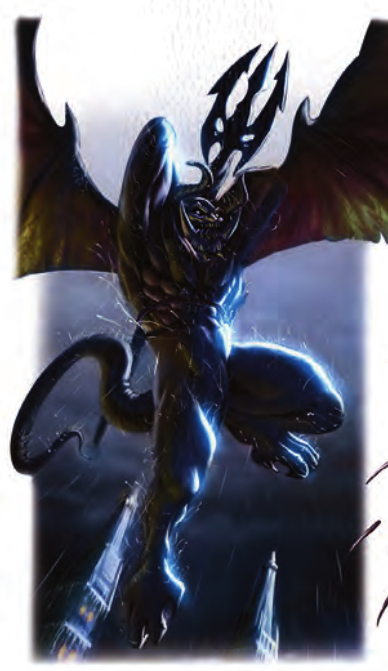
Illustration Copyright 2008 Wizards of the Coast. This is part of a series! Go here to see the other entries.
The War Devil, previously known as the Horned Devil and also known as the Malebranche, has been a staple of D&D since at least AD&D First Edition. You know those traditional images of winged, horned devils poking the damned with tridents? They depict these guys. In 4e, they’re only on the Monster Manual.
The Lore
A War Devil is about the most powerful devil that’s likely to be found in the service of a summoner. In the overall diabolic hierarchy they only take orders from pit fiends or archidevils. It some mortal tyrant is summoning up a literal army from Hell, a malebranche is going to be at the head of that army, and will have ice devil senior officers. At Int 15, that malebranche is also likely cooking up a scheme to bring his pit fiend boss into the world for a hostile takeover of the tyrant’s operation.
The Numbers
The War Devil is a Level 22 Brute (Leader) with 255 HP. It has a speed of 8, and a clumsy flight speed of 8. Like all devils it has darkvision and is highly resistant to fire (resistance 30, in this case).
Its attacks are a little weird. The basic melee attack is a Reach 1 claw which, as usual for devils, is weak and useless. The infamous trident is Reach 2 and, weirdly enough, recharges on a 4-6 instead of being at-will. It does more damage than the claw, but way less than it should for a level 22 brute. On a hit the target also takes a bit of ongoing damage, slides to a square adjacent to the malebranche, and is knocked prone.
Despite being a brute, the war devil has a very soldierly minor action at-will ability called Besieged Foe. This automatically marks a target within line of sight of the malebranche, and gives the monster’s allies +2 to attacks made against it. This lasts until the malebranche uses the ability against someone else, or until the end of the encounter.
As an at-will move action it can use Devilish Transposition, a teleport power which makes it swap places with an allied devil within 20 squares.
And as a minor action that recharges on 5-6, it can employ Fiendish Tactics to direct up to two equal-or-lower-level devil allies to make a move action or a basic attack out of turn.
As a brute the War Devil wants to be right on the front lines tying up your defenders. Then when one of its more mobile buddies manages to make it to your squishies, it’s going to swap places with them and direct its other buddies to run closer for a proper stomping.
War devils pair exceedingly well with… other war devils! They can each use Besieged Foe on a different target and engage someone else they’re not marking, and can use Fiendish Tactics on each other. They also go well with other highly mobile devils to set up transposition combos, and can be pretty dangerous when combined with a ridiculous number of legion devils.
The sample encounter is level 21: 1 war devil, 1 ice devil, 2 bone devils and 12 legion devil legionnaires (the level 21 variant). Remember that both the bone devils and the legionnaires can teleport at will!
Final Impression
The tactical aspect of the war devil’s powers is quite interesting, but they suffer heavily from the math bug. Personally, I’d make their trident an at will attack with level-appropriate damage and get rid of the claw while keeping everything else. I’d also make them soldiers instead of brutes, since the flavor of their powers is a lot more “soldierly” than “brutish”.
Flavor-wise… I guess I can kinda see why they were left out of the Monster Vault. Even back in previous editions I imagine it would be hard to distinguish a horned devil from, say, a bearded devil if you were not already familiar with the monster entries. Changing their name to War Devil was probably an attempt at making them more distinctive, but the success was mixed. Mechanically they’re a bit like junior pit fiends, so if you’re strapped for space and are already including pit fiends in your lineup, I can see leaving these guys out.
-
Let's Read the 4e Monster Manual/Vault: Succubus
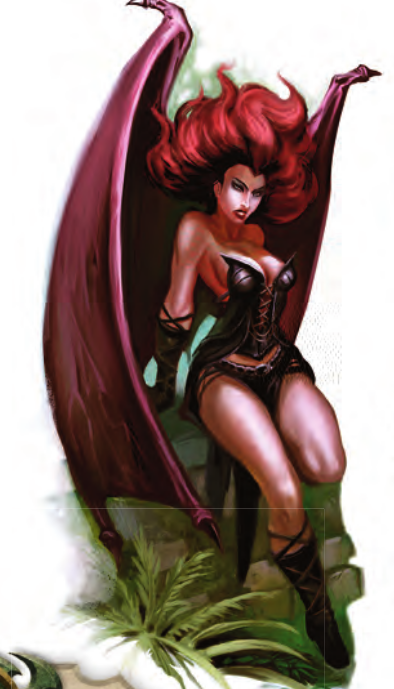
Illustration Copyright 2008 Wizards of the Coast. This is part of a series! Go here to see the other entries.
Succubi are very traditional D&D monster. Just like mariliths (the other sexy fiend), they’ve been a part of the game since the start. Unlike mariliths, sexiness is their main schtick. Here we can find them both in the Monster Manual and in the Monster Vault.
The Lore
Now, the first thing anyone familiar with older editions will notice is that there’s something very non-traditional about succubi in Fourth Edition. They’re devils!
You see, from at least AD&D 1st edition all the way to 3.5, succubi were demons. I suspect this was mainly due to their Chaotic Evil alignment, since they’ve always been beautiful and cunning manipulators with superlative skill in seduction and other mind games. They’re still all those things in Fourth Edition, which has approximately nothing to do with the demon idiom while being a 100% culture fit for Hell. Making them devils makes a lot of sense from that perspective. As devils, their alignment is Evil.
A succubus is all about the classic concept of infernal temptation, using their guile and good looks to convince foolish mortals to sign away their souls and perform evil deeds. They might also be sent to the world as emissaries to important mortals, establishing channels of communication between these villains and the lords of Hell.
There’s no Succubus Lore entry in the MM, possibly because of space concerns, but there is one very interesting detail in their description: unlike in previous editions there is absolutely no mention of a succubus’ natural form being that of a beautiful woman with bat wings (even though the illustration depicts one like that). Instead, the description says they take the form of beautiful men and women to tempt mortals.
This means there’s no separate “incubus” monster, and opens up a lot of other possibilities. Maybe all succubi are genderfluid! Maybe their real appearance is the lumpy hunchbacked goblin-thing of medieval legend… or it could just be a real pretty bat-winged humanoid of any gender (including “none”). I mean, they are fallen angels, and angels are androgynous.
The Numbers
The MM and MV versions are quite similar, so we can discuss both of them simultaneously. Succubi are Medium Immortal Humanoids (devils, shapechangers). The Shapechanger keyword applies to any monster who can change their shape in some way. It’s mostly there for reference, since the actual rules related to this will be in the monster’s stat block.
Succubi are Level 9 Controllers with 90 HP. They have ground and fly speeds of 6, and the usual devil traits of Darkvision and Fire Resistance 20.
A succubus can Change Shape as a minor action, altering its physical form to that of any Medium humanoid until it decides to change again or drops to 0 HP. It can duplicate any specific individual that fits that category and whom it has seen before. Noticing the deception requires passing a DC 30 Insight check according to the MV.
Going by the difficulty table, that’s considered a Hard check for Level 15 characters, meaning a level 15 character with both high Wisdom and Insight training but no further Insight min-maxing will pass this around 50% of the time. Level-appropriate PCs will find it even harder to spot a succubus in disguise unless they spend a lot of effort on that min-maxing.
The succubus’ basic melee attack is a Reach 1 Corrupting Touch which which does untyped damage and is otherwise uninteresting. The real beauty is in its other attacks. There’s a straight-up Dominate attack that targets Will at range 5, and dominates for a turn on a hit. Dominated targets act under the direction of the dominator, but also count as dazed.
Then there’s the infamous Charming Kiss, which is more insidious. It’s reach 1 and targets Will. A hit means the target can’t attack the succubus, and will interpose itself between any melee or ranged attacks targeting the devil if the two are adjacent to each other. This lasts until one of the succubus’ allies attacks the target, or until the succubus is reduced to 0 HP. This effect can be sustained indefinitely out of combat as long as the succubus can kiss the target at least once every 24 hours. More on that under Final Impressions.
As mentioned before, there isn’t much difference between versions, and most of them are in the Charming Kiss. The MM version has the effect described above as a secondary attack, requiring an successful (non-damaging) attack against AC before the attack against Will can be rolled. The MV version has the attack against Will as the primary, which I like. It also specifies that the interposing effect is an Imediate Interrupt, which IIRC limits it to once per turn. I like this change less, because it sounds a bit less fun to the cruel GM in me.
The sample encounter is level 9, 1 succubus, 2 snaketongue assassins (yuan-ti) and 2 constrictor snakes. Zehir wasn’t mentioned by name under “gods who are friends with Asmodeus”, but this is like the third snake-themed encounter in the multi-entry, so I guess he’s included in that group.
Final Impression
The succubus is the iconic “sexy monster”… in theory. My impression is that if you want to turn even the most impulsive lecherous barbarian into a chaste ascetic all you have to do is announce a succubus is somewhere nearby. And if you want to turn that barbarian into a chaste ascetic contract lawyer, you show them the description of Charming Kiss. They’re going to spend all their time between turns looking for loopholes in there. It’s wonderful!
Let’s enumerate a few of them… A PC under the effect of Charming Kiss can’t attack the succubus, but they are in no way compelled to attack the other PCs and can still attack the succubus’ allies normally. They are compelled to take attacks aimed at the succubus if the two are adjacent, but are not compelled to stay adjacent to it.
I mean, clearly the intent is that the Kiss makes the target fall in love with the succubus. They’d want to stay close to her and make impassioned pleas for the party to spare her and so on. But I think few players would enjoy roleplaying that to the detriment of the group, particularly in the middle of a fight. So here you have our brave barbarian gloating that he’s far too clever to be taken in by the succubus’ devilish wiles… when in truth the succubus has succeeded in turning him into a chaste ascetic contract lawyer who keeps running away from her.
The succubus can pursue by flying, and can keep trying to charm other people. There’s no restriction on the number of charmed targets! And there’s always Dominate for preventing the PCs from running away. Clearly, the best succubus encounter isn’t the one described above, but a succubus surrounded by innocent charmed victims who will do anything to protect their love.
-
GURPS Illuminati University
I originally wrote this as a comment on It Came From the Bookshelf, but it looks like Blogger’s comment system simply ate it. So I’m expanding it as a response post instead.
As I mentioned earlier, It Came from the Bookshelf is a blog by John Frazer, who is using it to review every single book in his extensive RPG collection. This includes a few GURPS books, and not too long ago he finished making very insightful comments about pretty much the entire Transhuman Space line.
And a few days ago he made a post about GURPS Illuminati University! His review is quite negative and I’d even say scathing. While I can see where he’s coming from, I don’t think I’d go quite that far.
You know those times when a player tries to tell a story to their friends about this absolutely hilarious thing that happened in the player’s campaign? And that hilarious story ends up getting some polite chuckles at most, because it was only funny if you were there when it happened.
I’m sure lots of us have been on both ends of this situation multiple times, and know how it feels. And well, GURPS IOU is that hilarious story in book form.
If I remember its introduction correctly, there was this private BBS maintained by some people at SJG and their friends, and they used to run a silly campaign full of in-jokes and silly references to the Illuminati books and to lots of other media they liked. And then they turned that campaign into a book and published it. And that’s GURPS IOU: the story that’s only funny if you were there, in book form.
I can totally see how someone would loathe this silly, in-jokey setting if they were going into it right after reviewing every Transhuman Space book. I can totally see how someone can read it and simply not find it funny, too.
It’s probably not something Steve Jackson Games would have published today, but the mid-90’s were the golden age of cheaply-bound GURPS Third Edition books on exceedingly specific settings and topics. There were hundreds of the things! What’s one more? And their home game gets to be immortalized with an ISBN and everything! Plus it has illustrations by their artist player! Who happens to be Phil Foglio…
That “reference barrage” school of nerdy humor also seems to have been in vogue back then, which helps. Teenagers from Outer Space was out around the same time, for example, and was widely regarded as the state of the art in anime RPGs. It was basically a bundle of very specific anime references wrapped around a tiny handful of rules.
I read GURPS IOU very early in my “nerd career”, when I was really into that sort of humor. I was just learning about this whole world of stuff and it felt really awesome to get all the references (“Dr. What! I know what that is!”). And when I finally moved to another city for college and actually met enough people who also knew about those things, it felt awesome to tell these jokes to them and have them understand the references too. I didn’t get all of the jokes, but I got enough to spark those feelings above, and to add some of my own equally horrible ones to the lot when I GMed.
Call it weirdness, call it bad taste, but I got at least a couple of sessions of hilarious enjoyment out of this book. It holds a special nostalgic place in my heart for that. Even though it’s only funny if you were there.
-
Let's Read the 4e Monster Manual/Vault: Spined Devil
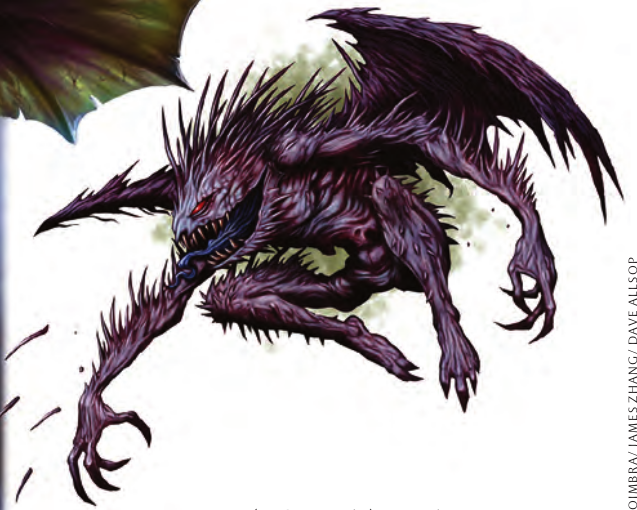
Illustration Copyright 2008 Wizards of the Coast. This is part of a series! Go here to see the other entries.
The book says spined devils serve as “scouts and sentries” in the Hells, and sometimes as “spies and messengers” to powerful figures. Everything else about them suggests they are terrible at these jobs, because what they really love is flying around in bands and tormenting anything that crosses their path with a rain of flaming, poisonous spines.
Also known as spinagons, they’re frequently summoned both because their relative weakness makes the process easy, and because they’ll do what the summoner says as long as they’re given ample opportunity to fling spines at people.
The Numbers
Spinagons exist only in the Monster Manual. They’re Medium Immortal Humanoids (devils), and Level 6 Skirmishers with 70 HP. Like most other devils, they have darkvision and 20 fire resistance. Their ground speed is 5, and they’re nimble fliers with speed 7 and the ability to hover.
Their basic attack is a claw, and their favorite attack is the Rain of Spines I keep mentioning. A spinagon can fling the spines covering its body at victims by flexing real hard. These have Range 10 and target Reflex. They do a mix of physical and fire damage on a hit, and trigger a secondary attack against Fortitude that slows and does ongoing poison damage (save ends).
The spines actually do the right amount of damage on average, though it’s expressed a bit differently than you’d expect (1d10 physical + 1d6 fire + 5 ongoing poison). The fix here would be to remove the secondary attack against Fortitude and have the ongoing damage and slow happen on any hit from the spines. That would make these kinda scary for a level-appropriate party, since getting hit with the spines makes it harder for someone to get away from future shots.
The claws do need a handful more damage, but like all artillery monsters you’ll only be using their melee basic attack if you mess up.
The sample encounter in the book is level 6: two spinagons and a trio of lizardfolk composed of a mystic and two bruisers. A pretty effective formation, and a clue to a diabolist cult growing in the depths of the swamp.
Final Impressions
Spinagons feel a bit underwhelming as a follow-up to pit fiends. Not only are their stats really simple, their looks, disposition and attack forms would all fit a demon better than a devil. They fight with natural weapons, have animalistic traits, and like to kill people for the lulz.
Still, if you pair them with appropriate enemies that can capitalize on the slow effect of their spines, they can make for memorable fights. The sample encounter is a good example of this… and to make my point about these guys looking more like demons, they also pair really well with evistros.
-
Let's Read the 4e Monster Manual/Vault: Pit Fiend
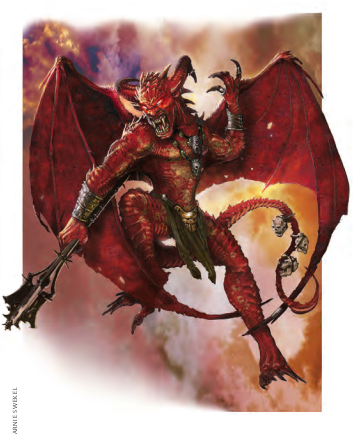
Illustration Copyright 2008 Wizards of the Coast. This is part of a series! Go here to see the other entries.
Pit fiends are the lords, barons, viziers and generals of the Nine Hells. In other words, its upper management, just below the VPs (the archdevils) and the CEO (Asmodeus). As such, they’re both on the Monster Manual and on the Vault.
The Lore
Each of the archdevils commands no more than a dozen or so pit fiends, each of whom fulfills an important role in the workings of that layer, commanding a whole army of lesser devils. The impression I get is that the Lords of the Nine are much more concerned with internecine political struggles than with actually running the business, so most of those diabolical schemes the PCs find themselves fighting are actually hatched by pit fiends and carried out by those lesser devils under them.
Pit fiends don’t usually get involved in the schemes they manage. They only show up in person when a big scheme is about to succeed… or when a band of plucky adventurers is about to seriously mess it up. When they do show up, they bring not only their own considerable power to bear, but also a number of backup plans and dirty tricks. Your typical pit fiend has Int 22, making it much smarter than its demonic counterpart, the Balor.
We’ll take a look at each version of the pit fiend separately, as there are some significant differences between them. In both cases they’re Large Immortal Humanoids (devils), and Level 26 Elite Soldiers (Leaders) with 486 HP.
Pit Fiend (Monster Manual)
The Monster Manual pit fiend has darkvision, Fire Resistance 30, and Poison Resistance 15. It fast as, well, a bat out of hell, running and flying at speed 12 (the latter with clumsy maneuverability). It can also teleport 10 squares at will.
The fiend projects auras of fear and fire out to 5 squares. Both affect only enemies caught inside, with the first inflicting a -2 penalty to all attacks and the other doing 15 fire damage per turn.
Its basic attack is a Reach 2 Flametouched Mace, which does both instant and ongoing fire damage. If you add both up, then you get a figure that’s actually appropriate for a monster of this level! The fiend can also attack with its Reach 2 tail sting, which does a bit less physical damage and allows a secondary attack against Fortitude for a bit more ongoing poison damage plus weakness (save ends both). As an elite monster, the pit fiend can use a standard action to attack both with the mace and with the tail sting at once.
Its “leaderly” ability is Tactical Teleport, which takes a standard action and recharges on 4-6. This teleports two allies up to 10 squares away from the fiend to any other square in that same radius. Instant flanking!
It has two minor actions. The first is the ability to create a Point of Terror in someone’s mind, a Ranged 5 attack that targets Will and inflicts a -5 penalty to all defenses for a turn. The second is the Irrestistible Command, which targets a lower level devil within 10 squares, slides it 5 squares, and causes it to explode and automatically deal some fire damage to everyone in a close burst 2.
Oh, and remember how fiends of all kinds in previous editions had the ability to summon others of their kind somewhat randomly? The MM pit fiend can still do that with a 100% chance success, once per encounter. The fiend can call up either 8 legion devil legionnaires, 2 war devils, or 4 legionnaires and 1 war devil. These are always explicitly an add-on to whatever encounter group the pit fiend is originally part of, and they’re not worth extra XP. While none of these are as individually powerful as the fiend itself, War Devils are strong enough to be concerning and the legionnaires make wonderful fodder for Irresistible Command.
Pit fiends start any fight they engage in by summoning reinforcements, because why wouldn’t they? They then use Tactical Teleport to set up some flanking situations, soften targets up with Point of Terror, and then charge into the fray to bash and sting fools to death.
The sample encounter is level 25: 1 Pit Fiend, 2 war devils, 2 astral stalkers, and 1 marut concordant. This doesn’t include the pit fiend’s summoned reinforcements! A harrowing boss battle for level a level 22 party, and the GM gets to come up with a fun reason for the marut and abominations to be working with devils. It’s not implausible, it just demands some backstory.
Pit Fiend (Monster Vault)
The Monster Vault pit fiend has exactly the same resistances, senses, and movement modes as the Monster Manual version. Its Aura of Fear is a bit different, marking all targets caught within it instead of giving them a general -2 penalty to attacks. The fire aura is the same.
The Flaming Mace attack is the first attack I see on a MV monster that has the exact same damage as it did on the MM! Clearly ongoing damage is supposed to be always be included in the average damage for the monster’s level. Makes sense, as it will almost always get applied at least once.
The tail sting has been simplified into a single attack that targets Fortitude, deals 25 ongoing poison damage and weakens (save ends both). The original only dealt 15, which was typical for epic monsters. 25 ongoing poison denotes a “blood of the Lernean Hydra” level of toxicity. The pit fiend remains able to make both a mace and a stinger attack as a single standard action.
The damage from the Irresistible Command explosion has increased a bit, and remains automatic. It also retains the use of Tactical Teleport, which remains identical.
The other big change here is that the summoning ability is gone. This is understandable, as it wreaks all sorts of havoc with 4e’s carefully tuned encounter design rules. In its place is Nightmarish Punishment, which triggers every time an enemy within 2 squares tries to shift or make an attack that doesn’t target the pit fiend. The fiend gets to make what amounts to a free mace attack against the target, only it slides them adjacent to the fiend instead of dealing ongoing fire damage. No escape!
Final Impressions
I find it inevitable to compare pit fiends to balors, since both are technically the strongest creatures in their respective factions that don’t get individual names and backstories in the books.
If you look only at their individual stats, I think Balors feel scarier in personal combat. They have more HP, variable resistance, and their direct attacks do more damage. Still, pit fiends put up a respectable show in that department, and are much more capable of acting as a force multiplier for whatever other monsters are fighting with them. As with all devils, team composition is vital to make a combat encounter seem dangerous and scary. Even without the summoning ability, I’d encourage GMs to make pit fiend fights include a very large number of opponents, and have some of those appear by being summoned mid-fight.
subscribe via RSS