Posts
-
Let's Read the 4e Monster Manual/Vault: Dragonborn
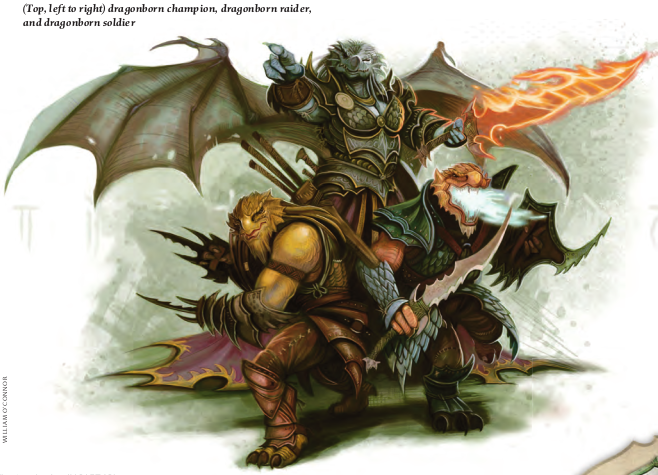
Copyright 2008 Wizards of the Coast This is part of a series! Go here to see the other entries.
Dragonborn are a 4e original! The name appears in 3.x, but it was used for a different concept there. They’re introduced as a PC race in the Player’s Handbook, and in this entry we get stats for them as possible opposition for a range of levels. They’re present on both the Monster Manual and the Monster Vault.
The introduction of dragonborn was one of the many things that fueled the edition wars, as traditionalist fans complained about how these newfangled dragon-people had replaced gnomes in the PHB lineup. They dropped this particular complaint from their repertoire pretty quickly, though! It turns out the ability to play a dragon person from level 1 was really, really popular among the majority of the player base, far more than the ability to play a gnome. It helps that dragonborn are really interesting on their own, too!
The Lore
Dragonborn have a special creation myth. While most other races were pretty much all the direct creation of a deity or another, they were created from the blood of Io when he was split in half by the King of Terror. Whether this is true or not depends on the GM, as with all creation myths.
Whatever the truth might be, you can’t deny they share a lot in common with dragons. There is of course their appearance - tall and muscular with draconic-looking heads, scale-covered skin. There’s also the elemental breath weapon possessed by each individual. Dragonborn scale colors vary, but they don’t stick to the usual dragon pallete or have any relation to the element of their breath weapon.
Their culture was heavily influenced by this draconic connection. In ancient times they used to run the world-spanning empire of Arkhosia, which eventually fell due to a cataclysmic war with the human empire of Bael Turath. Today they don’t have a nation to call their own, and live both in small communities and intermingled in more diverse societies. The value Arkhosia placed on personal honor and martial excellence still remains a strong trait of the surviving dragonborn communities.
Many dragonborn adventurers are paladins or other champions of justice - their emphasis on honor makes this a popular path for them. However, “honorable” doesn’t always mean “good”, so they’re just as likely to appear as opposition for a group of Good adventurers as members of any other sapient race.
The Numbers
All dragonborn are Medium Natural Humanoids, and despite their draconic connection they do not have the Dragon keyword. This doesn’t mean much, but I thought I should note it. Their signature abilities are the same as those of PC dragonborn - an elemental breath weapon usable once per encounter, and an ability that grants them +1 to all attacks while bloodied. The MV entries are both unaligned, but all the ones in the MM have an alignment of “Any”, which is really something that should appear more in D&D monster entries.
Going in order of level, our first entry is the MV-only Dragonborn Mercenary, a Level 2 Skirmisher with 38 HP. It wears hide armor and fights with a battleaxe, whose attacks allow it to shift 2 squares on a hit in addition to their damage. Once per encounter it can use an Overwhelming Strike that does roughly double damage and causes the target to grant combat advantage (save ends) on a hit. On a miss, it still does half damage. The mercenary also breathes lightning.
For passive traits, the mercenary has Skirmish, which is shared by some other skirmisher monsters: if he ends a move on his turn at least 4 squares from his starting position, he gains +1d6 damage with all attacks until the start of his next turn. This incentivizes him to keep moving around and charge whenever possible. He also gains +1 to all attacks while bloodied.
Next we have the Dragonborn Soldier, present in both books. This is a Level 5 Soldier with 63 HP. It wears scale, wields a light shield and a longsword, and breathes cold. It has a couple of triggered abilities to go with its basic longsword attack: Impetuous Spirit is at-will and allows it to make a free basic attack against an enemy that leaves its reach, even when that enemy does so by shifting; Martial Recovery allows it to essentially reroll a missed basic attack, and recharges when the soldier uses Impetuous Spirit. A few of these in formation would be pretty awesome!
All other entries from here on are MM-only.
The Dragonborn Gladiator is a Level 10 Soldier with 106 HP. It wears scale, wields a bastard sword, and breathes fire. The gladiator has a distinctive fighting style expressed in a couple of passive traits: Lone Fighter grants it a +2 attack bonus when adjacent to only one enemy; Gladiator’s Strike makes its opportunity attacks knock the target prone on a hit. Against a bloodied target, the Gladiator can use a Finishing Blow, which does extra damage and gives its allies +2 to hit the target for a turn. This is an at-will power!
The gladiator really wants to isolate a weak PC from the rest of the group and sword it to death. You should pair it with some different soldier monsters to make it harder for the PCs to help their buddy and with some artillery to take advantage of Finishing Blow.
The Dragonborn Raider is a Level 13 Skirmisher with 129 HP. It wears leather, wields paired katars, and breathes acid. Katars are a High Crit weapon, so the raider’s basic attack has that property as well. If it doesn’t perform move actions in a turn, it can shift 1 square and attack twice with the katars, in any order. If it has combat advantage, it deals +1d6 damage on its attacks.
Finally, it has an Infiltrating Stride ability that allows it to shift 3 squares. This recharges after it uses the twin katar strike, and it’s a move ability (so it can’t use both abilities on the same turn).
To close this entry, we have the epic Dragonborn Champion, a Level 26 Soldier with 239 HP. It wears plate, wields a heavy shield and a bastard sword, and breathes lightning. It also has 30 resistance to every chromatic dragon element (acid, cold, fire, lightning and poison)!
Its basic bastard sword attack allows a secondary attack against Fortitude on a hit, which stuns the target for a turn and knocks it prone. The champion also does extra damage against prone targets. When first bloodied, it can attack everyone in a Close Burst 1 with the sword (though that doesn’t have the secondary attack). Its final ability is Shake it Off, a free action that allows it to immediately succeed on a saving throw against a (save ends) effect. This recharges on a 2-6, so it’s almost always ready but wouldn’t allow it to shake multiple effects off.
Amazingly, the champion good at both fighting and helping chromatic dragons, since they would have little to fear from their breath weapons either way. Dragons also tend to have powers that knock people prone, and an at-will stun is an excellent thing to use against a dragon.
Sample Encounters
The MM has two sample encounters for this whole lot:
-
Level 6: 1 dragonborn soldier, 2 tiefling darkblades, 1 rage drake and 5 human lackeys. Some sort of bandit gang, probably.
-
Level 13: 3 dragonborn raiders, 1 firebelcher dragonspawn and 1 ogre warhulk. The dragonspawn there clearly indicates this is a task force of Tiamat cultists.
Final Impressions
I like dragoborn! I pretty much enumerated the reasons for this back at the start. They make an excellent addition to the roster of playable character races, and WotC obviously agrees with me since they kept them around mostly unchanged for 5th edition.
The specific stat blocks here work well enough, and I particularly like the soldier and the champion (if its damage is fixed).
-
-
Let's Read the 4e Monster Manual/Vault: Dracolich
This is part of a series! Go here to see the other entries.
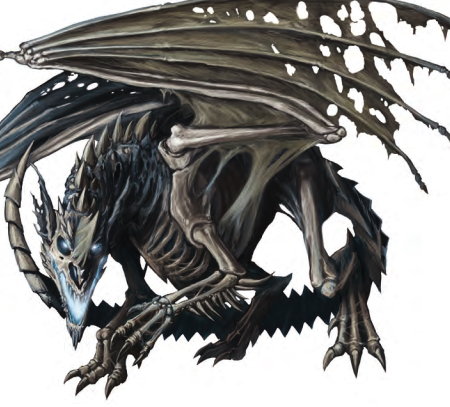
A Dracolich is what you get when a dragon decides to perform the unspeakable rites of lichdom. Due to the vagaries of alphabetical ordering, we get to look at them before we dive into the huge “Dragon” entry. They’re present on both the Monster Manual and the Vault, though they’re mixed in with the living dragons in the later.
The Lore
I simply must start this section by making a direct quote from the MM: “Dracoliches are selfish, greedy, and interested only in amassing more power and treasure.” So, pretty much like standard dragons? Both books have a lot more about them, I just thought that sentence in particular was funny.
Dragons are long-lived but not immortal, so a dragon might choose to become a lich to escape death much like a human wizard would. It’s also possible for a dragon to be made into a dracolich against its will, usually by some sinister cults looking to bag themselves a powerful servant.
Needless to say, dracoliches are pretty evil. The voluntary version of the ritual requires the same sort of livelie awfulnesse that only true villains would be willing to perform - if you weren’t officially Evil before performing it, you certainly are afterwards. The involuntary version leaves the dragon under the control of the (also inevitably evil) group who performed it.
I suppose a dracolich who was turned involuntarily and manages to break free of its controllers could be unaligned or even good depending on how it was in life. Of course, if it was your typical evil chromatic then freedom won’t do much to improve its disposition.
Dracoliches aren’t reliant on phylacteries at all. The involuntary ritual produces one as the key to controlling the dracolich, so you actually have a situation where the lich wants to destroy its own phylactery here. In either case, destroying the dracolich’s body slays it for good, with the control phylactery shattering if it still exists when the monster dies.
The Monster Vault adds that lichdom makes dragons more scheming and manipulative than they were in life. They’ll develop intricate plans and conspiracies to increase their own power, and establish large networks of minions and servants to accomplish these goals. If your dragons already do that, then I guess dracolichs are even more meddlesome. Or maybe they go after living dragons with much less regard for diplomacy than usual, since it’s likely they see themselves as superior to their living brethren.
Dungeons and Dragons has never been a game to provide just one stat block for a given type of dragon, and here this extends to the dracolich as well. The Monster Manual has no less than three variants, and the Monster Vault has two more. I’ll cover each book in its own section.
The Numbers (Monster Manual)
The “basic” MM Dracolich is a Huge Natural Magical Beast (dragon, undead). This is a perfect example of how the undead keyword is different from the shadow origin! This dracolich is a Level 18 Solo Controller with 885 HP, equivalent to an elder dragon. It has darkvision and trained Perception. It’s immune to disease, fear, and poison, has 30 necrotic resistance and 10 radiant vulnerability. It runs at Speed 8 and flies at Speed 10 (but clumsily). Like all solo monsters, it has +5 to all saves and 2 Action Points. Being a high-level MM monster, its attacks suffer pretty heavily from the damage bug, so you’d need to fix that before using it.
Its basic attack is a Reach 3 bite that does physical damage, and extra necrotic damage to stunned targets. It can also attack with a Recharge 5-6 breath weapon, a Close Blast 9 that targets Reflex. A hit does necrotic damage and stuns for a turn. A miss still does half damage but doesn’t stun. And either way the targets lose any necrotic resistance they had (save ends).
You know I actually don’t mind this breath having low damage so much. That’s a huge area and some pretty heavy riders. You might as well say every PC is affected every time unless one of them is a ranger who likes to snipe from off the map or something. Measuring the exact area of effect of the dracolich’s necrotic breath becomes more important if it has allies. This isn’t a party-friendly attack and even undead will be negatively affected by it.
This cloud of death isn’t the only source of stuns for the dracolich. It also has Frightening Presence, that draconic staple. This is an encounter power that affects a Close Burst 10 (i.e, every PC) and targets Will. Targets hit by the attack are stunned for a turn, and take a -2 penalty to attacks until the end of the encounter.
If that isn’t enough, it still has a couple of triggered actions. As an interrupt when someone makes a melee attack against it, it can deploy a Mesmerizing Glare. This attack against Will stuns for a turn on a hit, and inflicts a -2 penalty to attacks for a turn on a miss. Since it’s an interrupt, either effect can preempt the attack that triggered it. Oh, and it’s a Close Blast 3, so it can end up stunning more people than just the attacker. And then we have the other draconic staple, Bloodied Breath, which allows the dracolich to recharge and use its breath immediately upon being bloodied.
The written tactics for it are to use the breath first, then enter melee and spend an action point to use Frightful Presence. The last action point should be saved for a tactical retreat - this guy is a mastermind, not a “fight to the death” type.
Following this we have the Blackfire Dracolich, a bigger and badder version. It’s Gargantuan (the largest size category in 4e), and a Level 23 Solo Controller with 1095 HP. It has all of the basic model’s traits with numbers increased due to level. Its necrotic resistance is 35, but its radiant weakness is still at 10. The reach of its melee attacks is 4.
The Blackfire Dracolich has one extra attack on top of all the things from the basic model: the titular Blackfire, a secondary breath weapon that affects a Close Blast 5, hits automatically, does necrotic and ongoing fire damage, and recharges on a 4-6.
To finish it off we have the Runescribed Dracolich, a yet more powerful version. This one is a Level 29 Solo Controller with 1335 HP. It has everything the Blackfire Dracolich has, and a few things more. Its necrotic resistance is 40, which I think is the highest resistance I’ve seen anywhere so far (not counting complete immunities). It’s “final boss” material for a campaign that reaches the mid-epics, and could be an exarch or lieutenant for an undeath-focused final boss like Orcus.
This top-end variation has all of the Blackfire Dracolich’s attacks, plus Runescribed Retaliation. This is an interrupt that triggers when the dracolich is targeted by a ranged attack. It allows the monster to make a very accurate attack against the attacker’s Will, and on a hit the monster can redirect the incoming attack to any other target within 5 squares of it. The attacker still has to roll to hit the new target, but they can’t miss on purpose.
It appears that MM dracoliches in general are less focused on performing multiple actions and more focused on denying the PC’s actions, with this liberal use of at-will stunning.
The sample encounter here is Level 20: a basic dracolich and a party of high-powered yuan-ti. You can stop wondering about which sort of cult would want their own dracolich lackey.
The Numbers (Monster Vault)
The Monster Vault starts us off at a more humble place with the Deathbringer Dracolich. It’s Large, and a Level 12 Solo Controller with 492 HP, equivalent to an adult dragon. Like the MM variants, it has trained Perception and Darkvision. It’s immune to disease and poison, but not fear. It’s necrotic resistance is 10, as is its radiant vulnerability. It runs at speed 6 and flies clumsily at speed 8.
Like a living dragon, this dracolich has Action Recovery, which automatically ends any dazing, stunning or dominating effects on the monster when it ends its turn. It also can use its Mesmerizing Gaze (below) automatically on an initiative of 10+its initiative result for the fight.
Its basic attack is a Reach 2 bite that does physical damage and ongoing necrotic damage. It can instead make two Reach 2 Claw attacks, which slide the target 2 squares even if they don’t hit. Its breath weapon is a Close Blast 5 that targets Reflex, does necrotic damage and weakens (save ends). On a miss it still does half damage and weakens for a turn.
The afore-mentioned Mesmerizing Gaze is a minor action Ranged 10 attack, targetting Will and dominating (save ends) on a hit. On a miss it does 15 psychic damage if the target willingly moves closer to the dracolich before the end of the target’s next turn. Either way it slides the target 2 squares. Make sure to keep these effects in mind, because this attack is going to happen a lot.
Then we have the Dracolich Doomlord, a Huge Level 22 Solo Controller with 840 HP whose power level is on par with the living elder dragons from this book. Its necrotic resistance increases to 15, and is speed to “8, fly 10”. Everything else is comparable to the basic model aside from level-based number increases.
The doomlord gains a new passive trait: the Aura of Doom has a radius of 3 and prevents any enemies inside from regaining HP or gaining temporary HP. Yikes! Its breath weapon regains the ability to remove necrotic resistance (save ends) as an effect, but its mesmerizing gaze loses the “take damage if you come closer” curse on a miss. Here’s someone who will try to keep the whole party within the aura of doom at all times, and likely go for the healers first. It has enough HP to eat a few opportunity attacks from defenders in order to do that.
Final Impressions
Dracoliches feel somehow scarier than the Tarrasque, even though they’re lower level. Fighting the MM variants in particular seems like it would be pure agony for the players, with the stuns flowing freely. I can see why they switched to a more multi-action solo stat block for the MV. I can also see why the MV lumped them in with the other dragons. As we’re about to see, they’re really very similar, and fill the Controller niche that was missing from lineup of living chromatics.
-
Let's Read the 4e Monster Manual/Vault: Doppelganger
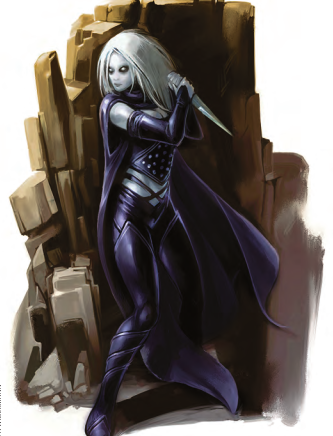
Copyright 2008 Wizards of the Coast This is part of a series! Go here to see the other entries.
Doppelgangers have been in D&D forever, in one form or another. As is common with 4e, they’re a little different here than they were in older editions. This time, however, it’s 3.5’s fault. They’re in both the Monster Manual and the Vault.
The Lore
4e Doppelgangers are essentially Eberron’s Changelings given a more generic treatment. In earlier editions changelings were people who descended from a “real” doppelganger, but here the two words mean the same thing. I don’t think anything of value has been lost with the change - the defining trait of a doppelganger in any edition is its ability to change shape, and that has been retained.
Much like humans, doppelgangers are people who can have any disposition and alignment imaginable. They don’t have any kingdoms or settlements of their own, and tend to live in those of other races, usually in disguise. I suspect most of them really do want to live peaceful lives, and maybe have a private space where they can drop the disguises and relax a bit.
When they turn to riskier pursuits, though, their abilities make excellent at infiltration, spying, and all sorts of other underhanded activities. That’s great when they’re on your side, and terrible when they’re on the enemy’s.
About 90% of the lore entry for the Monster Vault then goes on to describe the terrible things an infiltrated doppelganger cell can do. They can live undercover for years if necessary! They can disable a city’s defenses from the inside! Kill and impersonate anyone! Your whole family could have been replaced by doppelgangers and you’d have no way to tell! Fear! Uncertainty! Doubt! Despite the assertion that doppelgangers can be of any alignment the tone here assumes none of them are ever up to any good.
I’m guessing the peaceful folks have a really hard time with prejudice from “righteous citizens” who think they’re all evil infiltrators.
As you’d expect, the Eberron setting treats them a lot better, and makes them valid PC choices.
The Numbers
Doppelgangers are Medium Natural Humanoids (shapechangers). They have a base speed of 6, and their signature ability is Change Shape. This minor action lets them take the form of any Medium humanoid. It can be used at will, and they can hold any given form indefinitely, though the disguise drops automatically if they hit 0 HP.
It’s possible to copy specific individuals. Discovering the ruse requires an Insight check on the part of the observer. According to the MM, this is opposed by the doppelganger’s Bluff with a +20 bonus; the MV gives fixed DCs for each stat block that are somewhat lower than that, though still quite hard.
Any additional abilities doppelgangers have aside from changing shape are the product of training, same as with humans. Technically this means they could be paladins and wizards and so on, but all the stat blocks we get here are for the stereotypical rogue-types.
The Doppelganger Sneak is a Level 3 Skirmisher with 45 HP, present in both books. It attacks with a short sword for level-appropriate damage, has a rogue-like sneak attack ability, and can use a Shapeshifter Feint as an at-will minor action that targets Will to gain combat advantage against someone for a turn if they don’t have it from other sources. It’s Unaligned, and the Insight DC for its Change Shape is 30 in the Vault.
The Doppelganger Assassin is a Level 8 Lurker with 69 HP, present only in the MM. It uses a dagger as a weapon, deals more sneak attack damage than the sneak, and can use Shapeshifter Feint. It has one additional ability in Cloud Mind. This encounter power targets the will of everyone in a Close Burst 5. The assassin becomes invisible to anyone it hits with this attack. It lasts for as long as the assassin sustains it (which requires a minor action on its turn), and drops if it either attacks or is hit by an attack. This one is Evil because it’s an assassin, not because it’s a doppelganger. Since it shares a lot of abilities with the sneak and Cloud Mind is more of an escape hatch than an attack power, it should really be a skirmisher.
The Doppelganger Infiltrator is a Level 11 Lurker with 90 HP present only in the MV. In addition to the Change Shape ability shared by all doppelgangers, it also has an improved version called Perfect Replica. This is a standard action that targets an adjacent Medium creature and hits automatically. The doppelganger copies the target’s appearance (including gear!) and immobilizes it for a turn. If the infiltrator attacks the target with its dagger while it’s so immobilized, it deals an extra 6d8 damage, which is considerable given its basic dagger damage is 2d4+6.
If someone attacks the doppelganger whie it’s affecting someone with Perfect Replica, it can use an opportunity action to automatically swap places with the victim so that the attack targets them instead. It’s the classic “who is the real one?” scenario, but no matter who you choose, you’ll choose wrong. The Insight DC for its Change Shape ability is 32.
Finally we have the Doppelganger Master Assassin, a Level 19 Lurker with 142 HP present only in the MV. This seems to be a properly lurker-ish version of the Assassin we already saw. It also uses a dagger to fight, and has a special Assassin’s Strike that does a whole pile of necrotic damage on top of the usual dagger damage, recharging when the master assassin uses Vanish. Vanish, in turn, is a standard action that makes the doppelganger invisible for a turn and allows it to shift its speed.
As a passive trait, the master assassin has Blend In: it can make Stealth checks to become hidden as long as it’s adjacent to at least one other creature. It remains hidden even if it doesn’t have cover or concealment, which is significant since stealth rules had become a lot more strict by the time the MV came out. This is perfect for disappearing in the midst of a crowd, or again for re-enacting the “who’s the real one?” scenario when the adjacent creature is a PC. Only this time you can choose the right one if you have enough Insight. I guess the assassin spent more time training to stab people than honing their shapeshifting like the infiltrator. This assassin is Unaligned, and their Insight DC is 38.
The sample encounter in the MM is level 3: a sneak, 3 human guards, and a human mage. Looks like this sneak just wants to live out a regular life as a member of the city watch. It’s likely its buddies don’t even know it’s a doppelganger.
Final Impressions
I like Eberron changelings so much I wrote them up for GURPS. They work well as a PC race! As possible opposition these stat blocks work well. If some villain is going to hire assassins to go after a late-paragon party, those assassins are probably going to be doppelgangers or the equivalent.
-
Let's Read the 4e Monster Manual/Vault: Displacer Beast
This is part of a series! Go here to see the other entries.
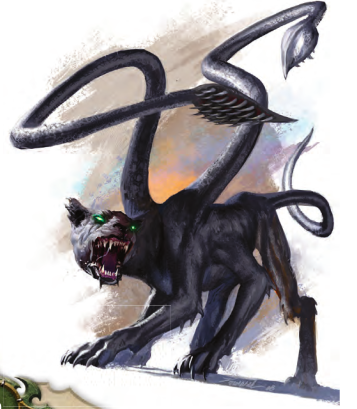
Like beholders and mind flayers, Displacer Beasts are one of those monsters who are so uniquely D&D that they’ve been excluded from the SRD. They look like big black panthers with two squid-like tentacles protruding from their shoulder blades. The trait that gives them their name, however, is the ability to look like they’re about two meters to the left of their real location. They appear both on the Monster Manual and on the Monster Vault.
The Lore
The Monster Manual contains only the usual couple of paragraphs for its entries, but the MV piles on the lore.
Displacer beasts are native to the Feywild, but can also be found in the world. They’re cunning carnivores who make extensive use of their illusory powers both to hunt and to escape from danger. Their preferred habitats are dense forests with plenty of foliage and caves to use as hiding spots. When hunting, they stalk their prey and attack from ambush at the most opportune time.
These creatures have gained such fame for their strength and cunning that they often feature in heraldic devices for noble houses and organizations that want to be known for possessing these qualities.
As magical beasts they’re smarter than most animals, but still have a bestial disposition. They have no language or civilization, but they are quite able to set up really clever ambushes, track prey by following clues in addition to using their scent, remember good hunting spots like, say, a seasonal trade route. They’re also smart enough to retreat if outmatched, and prefer attacking animals to humanoids.
Though displacer beasts rarely gather in groups larger than a mated pair, particularly large and intelligent specimens have been known to form and lead packs composed mostly of other, lesser predators. Some humanoids can also befriend them and employ them for hunting, war, or guarding territory.
The Numbers
The standard Displacer Beast has MM and MV versions. In both, it’s a Large Fey Magical Beast, and a Level 9 Skirmisher with 97 HP. Its Speed is 12, it’s trained in Perception and has low-light vision.
The displacer beast has two passive traits: Threatening Reach and the expected Displacement. The first makes it able to perform opportunity attacks against targets anywhere within the reach of its attacks, and applies mainly to the tentacles. The displacement power has significantly different wording between versions.
The Monster Manual says all melee and ranged attacks have a 50% chance to miss the beast. The effect ends when the beast is hit by an attack but it resumes when it moves 2+ squares on its turn.
The Monster Vault clarifies the miss chance: any melee or ranged attack that would hit the beast actually misses if the attack roll was odd. You can see how 13th Age evolved from D&D 4 here! The effect still stops when the beast does get hit, but it resumes automatically at the start of its next turn.
Its basic attack is a Reach 2 tentacle, which in the MM suffers from the damage bug. It also has a slightly stronger Reach 1 bite. The MM version has a Beast’s Fury standard-action ability that allows it to make two tentacle attacks and a bite against a single target it has combat advantage against. The MV trades that for Cunning Blitz, which allows it to shift half its speed (6 squares!) and make tentacle attacks against one or two targets.
Both versions can shift 1 square as a reaction when an attack misses them, though the MM version weirdly restricts that to attacks that miss because of the displacement. I prefer the broader MV power here.
The MV-only Savage Displacer Beast is the slower, beefier variant. A Level 11 Brute with 136 HP, it loses the Perception training and runs at “only” Speed 8.
The Displacement and Threatening Reach abilities are the same, but this beast prefers to push others around instead of shifting. Its tentacle and bite attacks do level-appropriate Brute damage, and the tentacle pushes 1 square on a hit. The beast can also push someone who misses it with a melee attack 1 square.
And finally we have the Displacer Beast Pack Lord, present in both books. It’s a Huge Fey Magical Beast and a Level 13 Elite Skirmisher with 258 HP. In both books, the Pack Lord has all the same abilities as the standard beast, plus a few additions.
First, while the other two types of displacer beats have an Int of 4, the Pack Lord has 10! As the name implies, this is the one that can tame other animals and form them into a pack.
In addition to doing more damage with all of its attacks, it has Reach 3 tentacles. The MV version also gains an attack called Clear The Path, which targets Reflex in a Close Burst 3 and slides everyone it hits up to 3 squares. On a miss, it does half damage and still slides the target 1 square. This recharges when the beast is first bloodied.
When someone misses the Pack Lord with an attack, both versions can make a tentacle attack against the attacker in addition to shifting 1 square. It also ignores all difficult terrain and penalties for squeezing, an ability which surely makes it a joy to fight in a thicket tangled with undergrowth.
The sample encounter is level 13: a pack lord, two regular displacer beasts, and a briar witch dryad. This is likely to be an equal partnership between the pack lord and the dryad.
Final Impressions
I definitely prefer the MV writeup on this one. It’s a little more powerful and sounds a little more fun. I also like that the displacer beast is explicitly not an “attacks on sight and fights to the death” monster, and someone who can talk to animals can even make an ally of it. Even the regular variant: it has the brainpower of your average ogre and a much better disposition (they’re Unaligned).
-
Let's Read the 4e Monster Manual/Vault: Devourer
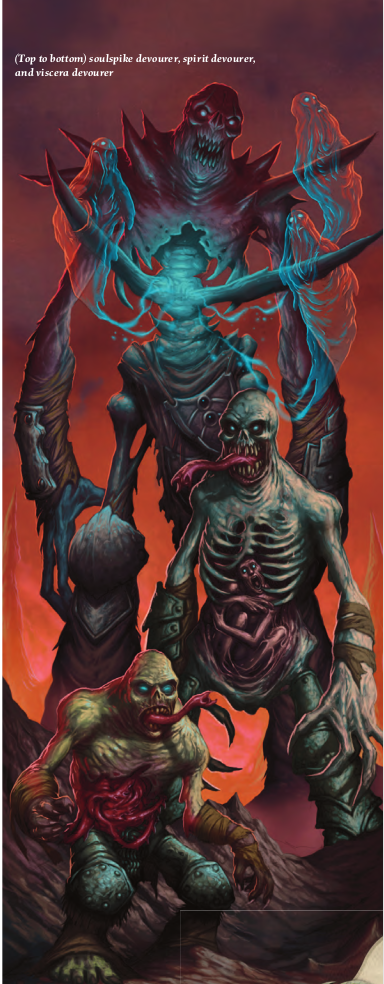
Illustration Copyright 2008 Wizards of the Coast. This is part of a series! Go here to see the other entries.
Rejoice, oh reader, for we are finally done with the devils! Our next monster is no less horrific, but at at least it’s not a fiend.
I think devourers made their first appearance in D&D 3.5. Third Edition tried really hard to create a new generation of iconic monsters with mixed success at best, but I think they got it right here. These things are scary! Despite this, they’re only on the Monster Manual.
The Lore
When a mortal dies their soul goes to the Shadowfell, where the Raven Queen sorts it out and sends it on its way to the great beyond. When a psychotic serial killer dies, there’s a chance their soul goes AWOL once it hits the Shadowfell and builds itself a new body out of other people’s flesh and bones. This is how devourers are made.
Devourers retain all the mental faculties they had in life, which means they get to keep their Evil disposition and Hannibal Lecter-like intellect. There are several varieties of devourer: some enjoy eating their victims still-pulsating viscera, while others go straight for the soft, yummy soul at the center of their flesh wrapping.
I suspect that given time they’d prepare some nicely cooked fava beans and a bottle of Chianti to go with their victims, but they’ll eat them on the spot mid-fight if they’re in a hurry.
Devourers are smart enough to value strategic alliances with other monsters, and they’re even able to hold their unnatural appetite in check to work with living allies. Of course, they’re still only going to ally with creatures that don’t mind their proclivities.
The Numbers
We get three devourer varieties here.
The Spirit Devourer is a Large Shadow Humanoid (undead), and a Level 11 Elite Soldier with 224 HP. It’s trained in perception and has Darkvision. Being undead, it’s immune to disease and poison, has Resist 15 Necrotic, and Vulnerable 5 radiant. It moves with Speed 6.
Its basic melee attack is a Reach 2 claw, but the real star of the show here is Trap Spirit. This has Range 5 and targets the Fortitude of a living humanoid. On a hit, the victim’s body vanishes and its spirit is trapped as an agonizing effigy inside the devourer’s exposed rib cage (save ends). Until the victim saves, it can do absolutely nothing.
While the monster has a victim so trapped, it gains a +2 bonus to all defenses, and access to two other actions. Devour Spirit is an at-will minor action that does 10 damage to the victim, and either heals the devourer by the same amount or allows it to immediately use Spirit Rupture. This is a standard action attack that targets the Will of everyone in a Close Burst 1. On a hit, it does necrotic damage and immobilizes the target for a turn. On a miss, it does half damage without the status effect.
Should the victim be killed by Devour Spirit, it can’t be resurrected by Raise Dead. This is particularly concerning here because I don’t think there’s any other way to bring characters back from the dead at this level. At least, there weren’t at the time this book was published.
The Viscera Devourer is a little different because it’s exposed abdominal cavity comes pre-filled with squirming, drooling intestines tipped with gnashing mouths. It’s a Medium Shadow Humanoid (undead), and a Level 12 Controller with 124 HP. It has the same senses, resistances and speed as the Spirit Devourer.
Aside from the weaksauce basic claw attack, this devourer can use up to four of its tentacle-like intestines as a weapon. Their Reach is 1, and on a hit they do a bit of physical damage and grab the target. The devourer can grab up to four victims this way, or use multiple bowels to grab a single target, giving them a -2 to escape the grab for each extra intestine. Grabbed victims take 5 ongoing necrotic damage for each appendage wrapped around them until they escape, with the devourer gaining the same amount of HP as it drains their life.
Oh, and it also gains a +2 to all defenses while it has at least one person grabbed.
And finally we have the Soulspike Devourer, AKA the Big One. It’s a Huge Shadow Humanoid (undead), and a Level 20 Elite Soldier (Leader) with 376 HP. It has the same speed, senses and resistances as its smaller cousins, though its numbers here are more extreme: resist necrotic 20 and vulnerable 10 radiant.
The Soulspike Devourer’s gimmick is that it impales the souls of its victims on the many bone spikes that protude from where its ribs should be. This happens whenever its basic claw attack reduces a target to 0 HP. When encountered, the devourer will probably have at least one spirit so impaled. It’s maximum “capacity” is 4.
Impaled victims can’t perform actions at all. They can try to make a save to escape when the devourer takes radiant damage, but otherwise they’re helpless. The only other way to free them is to destroy the devourer. If either of these things happen their body reappears next to the monster’s and can be brought back to health in the usual way. The devourer and any allies within 10 squares of it gain a bonus to all their defenses equal to half the number of soulspiked spirits.
The devourer’s other special attack is Soul Shatter, which targets Will on a Close Burst 3, does a lot of necrotic damage, and stuns for a turn, after which the targets are weakened (save ends). This recharges whenever the devourer uses its variant of the Devour Spirit ability.
This, in turn, is a standard action that automatically kills one of the soulspiked spirits and heals the devourer for 75 HP. The victim’s dead body reappears adjacent to the monster, and it would seem that they can be resurrected via Raise Dead normally.
The sample encounters showcase some of those unholy alliances. The first is level 11, a spirit devourer, a vampire lord, and 5 vampire spawn. The second is level 13, 2 viscera devourers working for a posse of drow.
Final Impressions
Spooky! I also can kinda see why they didn’t make it into the Monster Vault - by the time that book came out, monsters that heal themselves had gone out of style. Still, I think they might be fine if used in moderation. The devourers presented here are all in dire need of a damage fix, but otherwise they should be able to scare your players both on a roleplaying and on a mechanical level. The soulspike devourer in particular could literally eat an ice devil for breakfast.
subscribe via RSS