Posts
-
Let's Read the 4e Monster Manual/Vault: Blue Dragon
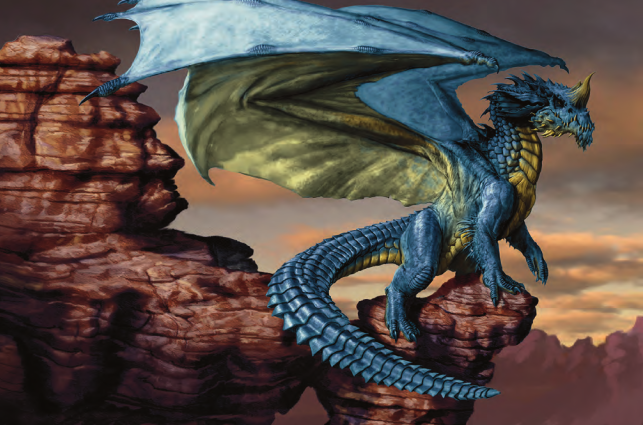
Copyright 2008 Wizards of the Coast This post is part of a series! Go here to see the other entries.
Blue dragons are proud, vain, and like lording over lesser creatures in their domain. Unlike greens, they don’t feel the need to stoop to sleazy extortion schemes - they’ll personally land in the middle of your village and announce they’re your new ruler. This, ironically, makes blues one of the more reasonable dragon types, because they’ll take this ruler business seriously if you keep their egos well-inflated.
Their breath weapon is lightning. Previous editions had them prefer deserts, but 4th Edition says their preferred environments are coastal regions and seaside caves. It makes sense, as thunderstorms are closely associated with the sea and blue isn’t exactly the best color for desert camouflage.
Aside from any people they might claim as subjects, blue dragons are known to associate with other coastal or sea monsters, like sahuagin or storm giants. However, they are not themselves aquatic, so their domains likely don’t extend to the depths unless those sahuagin are really enthusiastic about serving the dragon. As usual, they’re Natural Magical Beasts with the Dragon keyword.
Blue Dragon (Monster Manual)
MM Blue Dragons are all Artillery. They have Darkvision, and trained Perception, Athletics, Insight and Nature. They also have an age-dependent amount of lightning resistance. They move on land and fly well enough to hover.
That honking big horn in the illustration means their basic attack is not a bite but a Gore, which does a mix of physical and lightning damage. Their claws also count as a basic attack, and they can use Draconic Fury as an action to make one gore and two claw attacks.
Those melee attacks aren’t the real stars of the show, though. The Breath Weapon is a bolt of lightning that targets 1 creature up to 10 squares away, jumps to another one up to 10 squares away from the first, and then jumps again to a third target up to 10 squares away from the second. Despite looking like a ranged attack, it does not provoke opportunity attacks. It targets Reflex, does lightning damage (half on a miss), and recharges on a 5-6.
The dragon can also spit a Lightning Burst at will. This is an Area 2 within 20 attack that targets Reflex and does a bit less lightning damage than the breath weapon (half on a miss). Finally, we have Frightful Presence as an encounter power and Bloodied Breath as a triggered action.
Young Blue Dragons are Large Level 6 Solo Artillery with 296 HP. Their lightning resistance is 15, their land speed 8 and their flight speed 10 (overland flight 15). Their melee Reach is 2.
Adult Blue Dragons are Large Level 13 Solo Artillery with 655 HP and Lightning Resistance 20. They are otherwise identical aside from icreased level-based stats (accuracy, damage, defenses).
Elder Blues are Huge Level 20 Solo Artillery with 960 HP and Lightning Resistance 25. Their land speed goes up to 10 and their flight speed to 12. To all the powers listed above they add Thunderclap, an at-will Close Burst 3 that targets Fortitude. On a hit it does thunder (AKA sonic) damage and stuns for a turn. On a critical hit, the stun becomes (save ends). So these do have a reason to land: to claw and gore a stunned victim. Its melee reach is 3.
Ancient Blues are Gargantuan Level 28 Solo Artillery with 1290 HP and Lightning Resistance 30. To the elder’s abilities they add Wingclap, a move action that recharges on 5-6 and allows the dragon to fly its speed and make a melee attack with its wings that targets Fortitude and does thunder damage. This doesn’t provoke opportunity attacks! Its melee reach is 4.
Blue Dragons (MV)
Monster Vault Blue Dragons have the same senses as their MV counterparts, dropping Overland Flight as usual. Their bite does pure lightning damage, with fixed math. The claw is no longer a basic attack, but they can still claw twice.
The wording on the lightning breath has been vastly simplified: it’s a Close Blast 10 that targets up to three creatures in the blast. This means the dragon can’t use it on someone 30 squares away any more, and that Lightning Burst is now its longest-ranged attack.
As usual for MV dragons, they lose Frightful Presence but retain Bloodied Breath. Blues also have Wing Backblast, which triggers whenever someone hits them with a melee attack and represents the dragon suddenly taking off. It’s a Close Burst 2 that targets Fortitude and knocks prone with no damage on a hit. Hit or miss, the dragon flies half its speed straight up.
For passive traits, they have Action Recovery and Uncontained Lightning, an Aura 5 that activates when the dragon is bloodied and causes 5 lightning damage to anyone who enters or starts its turn inside. The instinctive action allows them to fly their speed without provoking opportunity attacks and use Lightning Burst at any point in the movement.
The Young Blue Dragon is Large Level 6 Solo Artillery with 296 HP and all the abilities outlined above. Its resistance is 10 and its melee reach 2.
The Elder Blue is Huge Level 20 Solo Artillery with 756 HP, resistance 15 and melee Reach 3. To the youngun’s abilities it adds Thunderclap. This has the same name as the MM ability but it’s pretty different! This is an Area 3 within 20 attack. It targets Fortitude and on a hit does thunder damage and stuns for a turn. On a miss, it does half damage and dazes for a turn. The area of the elder’s breath weapon increases to 20 as well.
Sample Encounters
There are two sample encounters in the MM:
-
Level 13, an adult blue dragon and 3 dragonborn raiders. Pirates! Arrrr!
-
Level 24, an elder blue dragon and 2 thunderwaks (which are like Rocs, but lightning-infused). Just taking the pets out for a leisurely flight along the coast.
Final Impressions
Neither book’s blue dragons have reason to land when fighting PCs. Lightning Burst allows them to outrange everything except the ranger’s arrows and the wizard’s Magic Missiles. The MV variant can actually keep itself even further away and use its instinctive actions to swoop into range, fire off a burst, and move away again. A blue dragon who wants to play it safe can force the party into a very boring extreme-range artillery battle.
Fortunately, very few blue dragons would want to play it safe - they should be closing in to use their more powerful breath weapon, and should land to gore and claw anyone they manage to stun. If that seems like a bad bet even for these vain pirate kings, you should provide them with some lightning-resistant henchthings who will engage and hold the party in position for a bombardment. This should give your melee fighters something to do as well.
You can still play the “long range artillery battle” angle as a run up to the final battle with the dragon - the approach to its lair should have a layout that allows the dragon to bombard the PCs while they deal with the enemies and traps guarding it. Periodic Lightning Burst attacks become another hazard they have to contend with as the blue dragon taunts them from afar.
-
-
Let's Read the 4e Monster Manual and Monster Vault: Green Dragon
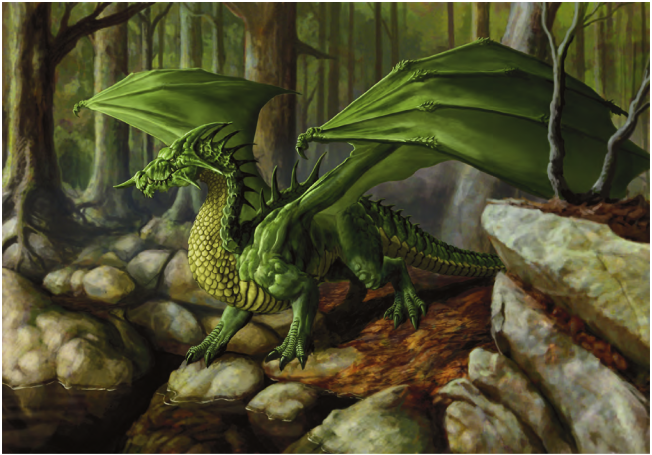
Copyright 2008 Wizards of the Coast This is part of a series! Go here to see the other entries.
Green dragons are sly manipulators, which makes me think that the first sign you’ll get that one has decided to lair near your village is when it invites you to negotiate its tribute. They like dense forests and places with connections to the Feywild.
They’re excellent fliers and quite agile in the ground as well. Their breath weapon is a cloud of poisonous gas. Some sources describe that as chlorine, but that would be more caustic than poisonous.
Aside from the usual kobold riffraff, their preferred allies and minions are fey creatures. They can also travel in pairs or even in packs. Don’t believe it when a green dragon says it’s alone.
Like all dragons, they’re Natural Magical Beasts with the Dragon keyword. We’ll look at them book-by-book.
Green Dragon (Monster Manual)
The MM green dragons have darkvision, plus training in a wide variety of skills: Bluff, Diplomacy, Insight, Intimidate and Perception. They also have an age-dependent amount of poison resistance. They’re fast runners and even faster fliers.
In all age categories it has two basic attacks: a bite that does physical damage plus ongoing poison damage, and a weak claw that can attack twice as a standard action. It can also perform flyby attacks, flying up to its speed and biting at any point along its movement without provoking opportunity attacks. This recharges on a 5-6.
The Breath Weapon is a Recharge 5-6, Close Blast 5 poison cloud that targets Fortitude, does immediate and ongoing poison damage, and slows (save ends both). There’s also a slow aftereffect, meaning that you need to pass two saves to stop being slowed. I guess that poison is some sort of nerve gas! Unusually, the breath weapon doesn’t do anything on a miss, so it must decay fast.
Aside from the familiar Frightful Presence, the green dragon can also use a Luring Glare, a minor-action charm power that targets Will and slides the target 2 squares. It uses this to pull people into its breath weapon’s area of effect.
For triggered actions, it has Bloodied Breath and a Tail Sweep that targets adjacent enemies that don’t move in their turns. It targets Reflex, does some damage, and knocks prone on a hit.
These dragons don’t have a reason to land as long as they have one of Breath Weapon or Flyby Attack available. With enough luck on the dice they can stay up there quite a while, and will take off again as soon as they can.
Young Green Dragons are Large. They’re Level 5 Solo Skirmishers with 260 HP, Poison Resistance 15, a land speed of 8, and a fly speed of 10 with overland flight 15. Their melee Reach is 2.
Adult Green Dragons still Large. They’re Level 12 Solo Controllers, which doesn’t look right to me as I’d expect the role of a given dragon to remain constant. Anyway, they have 620 HP, with poison resistance 20 and the same speed and reach as the young green dragon. They also have all the same abilities, which confirms that the Controller label is a mistake. On top of those they add Lashing Tail, an Aura 1 that makes its area difficult terrain for anyone other than the dragon while it’s on the ground.
The Elder Green Dragon is basically an up-gunned adult, size Huge. They’re Level 19 Solo Controllers (see above) with 910 HP. Their poison resistance is 25, their land speed is 10, their flight speed 14 with overland flight 18. Their melee reach is 3, the area of their Frightful Presence is 10, and so is their ongoing damage. Everything else is the same.
The Ancient Green Dragon is Gargantuan, a level 27 solo controller with 1250 HP. Its Lashing Tail is an Aura 2, its poison resistance is 30, and its speeds are the same as the elder’s. It has all the same abilities with appropriately increased damage and melee Reach 4, and adds a new one.
Mind Poison is a Ranged 20 charm power that targets the Will of a target taking ongoing poison damage. On a hit, it inflicts a -2 penalty to attacks and skill/ability checks by that character. After the first failed save, the target os also dazed. And after the second failure, the target can no longer act to harm the dragon and the effect becomes permanent until the dragon is slain or a ritual like Remove Affliction is used to cure them. Yay, another gradual doom effect!
Now, it’s not 100% clear to me if the daze and -2 penalties persist once the victim fails the second save. Personally, I’m inclined to say it doesn’t, and that the victim becomes a NPC servant of the dragon who’s able to act with their full capacity. This is an epic power from one of the scariest monsters in the book.
Green Dragon (Monster Vault)
Monster Vault green dragons are skirmishers at all age categories. They have the same senses as their MV counterparts, and their stat blocks drop Overland Flight and add Forest Walk to their land speed, allowing them to ignore forest-themed difficult terrain.
Its bite still does physical and ongoing poison damage on a hit, and does a bit of poison damage on a miss. Its claws are only slightly weaker, and allow the dragon to shift 2 squares on a hit. It can still make two claw attacks on its action, but only against the same target. So it could use the first shift to get around the target, and the second to get away!
The Breath Weapon is largely the same, down to the slow aftereffect. Flyby Attack is still here but no longer forbids opportunity attacks. On the other hand, the dragon can use its breath instead of a bite if it’s recharged.
Luring Glare is still a minor action, and has been turned into a Close Blast 10 that affects one creature. The practical effect of this change is that it no longer provokes opportunity attacks.
Tail Sweep and Frightful Presence are gone, but Bloodied Breath remains. For passive traits we have the usual Action Recovery, plus Poisonous Wounds and Instinctive Flyby.
Poisonous Wounds is an Aura 1 that becomes active once the dragon is bloodied. Enemies take age-dependent poison damage when they enter or start their turns there, and that damage doubles if the enemy is also bloodied. Instinctive Flyby is an automatic flyby attack at 10+rolled initiative, granting a +4 bonus to defenses against opportunity attacks. As usual for instinctive actions, if the dragon can’t perform it due to a stunning or dominating effect then that effect ends.
The Young Green Dragon is a Large Level 5 Solo Skirmisher with 252 HP, 10 poison resistance, land speed 8 (forest-walk) and fly speed 10. It has all the abilities outlined above with Melee reach 2.
The Elder Green Dragon is a Huge Level 19 Solo Skirmisher with 720 HP, 15 poison resistance, land speed 10 (forest-walk) and fly speed 14. It has all the abilities above (with melee Reach 3) plus Cunning Glance, which allows it to use Luring Glare as a reaction to an enemy shifting to a square within 2 squares of itself.
You can use some interpolation to get the other dragon age categories, and I’d be tempted to add Mind Poison to the late-Epic Ancient Green Dragon too.
Encounters
The MM gives us two sample encounters.
-
Level 7, a young green dragon and assorted kobold riffraff. Pretty standard.
-
Level 13, an adult green dragon and a couple of banshrae warriors. It makes perfect sense that a green dragon would buddy up with evil fey when you think about it.
Final Impressions
From what I’ve seen in published material, it usually feels like green dragons tend to be somewhat ignored by writers. Black dragons live in pretty similar environments and are more outwardly sinister, so they’re a bit more popular.
Still, I think their abilities make them effective as solo encounters, particularly in the MV version, and Mind Poison is a surprisingly scary ability. Personality-wise they’re also cool, since they’re highly likely to talk to the party instead of attacking right away. Sure, they’re lying liars who lie, but it at least makes for some interesting banter.
Adult or older green dragons could conceivably end up joining a fey court. So your party arrives to fight the dragon extorting the nearby kingdom and find themselves drawn into a Feywild court where the dragon is a respected noble with enough connections to make itself immune to a direct assault. Can they convince the other courtiers that the beast is a villain? Would they care if it was?
-
-
Let's Read the 4e Monster Manual/Monster Vault: Dragons
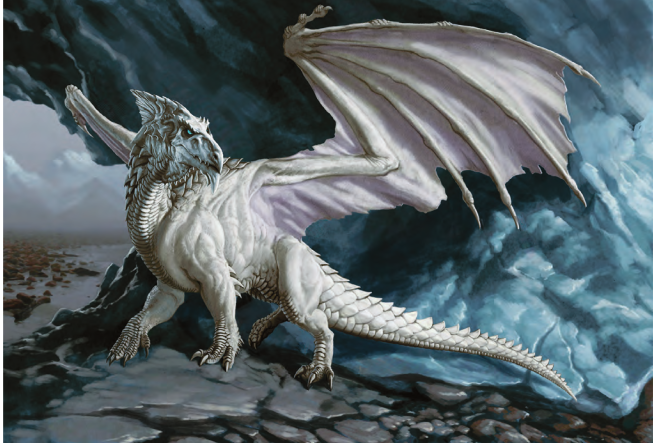
Copyright 2008 Wizards of the Coast This is part of a series! Go here to see the other entries.
Compared to the other chromatics, white dragons are stupid and kinda runty. They’re still dragons, though, so adventurer parties should take them a little more seriously than their cousins do.
This is a rare case where the Monster Manual has a little more information about this specific monster than the Monster Vault. Still, both agree that white dragons are gluttonous and greedy, and usually like making their lairs in very cold places like arctic regions, permafrost-covered mountaintops, or near rifts to a cold part of the Elemental Chaos. This is just personal preference, though - they’re not particularly vulnerable to fire and heat. You could meet one in more temperate or warm terrain either because it likes the heat or because it chose to make its lair cold with its ice powers (which grow in number and potency as the dragon ages).
White dragons are very interested in increasing the size of their hoards and securing their next meal, but aren’t fond of hatching complicated plots to do either of those things. They’re also a bit lazy, so they can be bribed to prevent more damaging attacks on inhabited regions. Treasure-wise, they favor gems and like clear diamonds above all others… but a pile of meat will do the job just as well as a pile of diamonds.
Like all dragons, whites are Natural Magical Beasts (dragons). Let’s look at their stats in order of level (and age).
Fledgling White Dragon
Present only in the Monster Vault, this almost makes me a liar when I said 4e doesn’t give any stats to hatchlings. A fledgling is a dragon who just learned how to fly, which takes long enough for it to grow to size Large. This is a Level 1 Solo Brute with 128 HP.
The fledgling has trained Athletics and Perception, darkvision and 5 cold resistance. It has land and flight speeds of 6 with ice walk, which means it ignores ice- or snow-based difficult terrain.
The fledgling is not yet old enough to engage in initiative-based shenanigans, but it does have a Savage Blood trait which causes it to score criticals on a 17-20 while bloodied.
Its basic attack is a Reach 2 bite that does more damage than expected for a Level 1 brute, which makes sense given the lack of multi-attack abilities here. Instead of biting it can make 2 claw attacks that also have Reach 2 and do standard physical damage.
The fledgling’s icy breath weapon is a Close Blast 5 that targets Reflex, does cold damage and slows on a hit, and recharges on 5-6. On a miss, it does half damage.
It someone hits the dragon while flanking it, it can retaliate with a Tail Slap as a reaction, which targets Fortitude, does some physical damage, and pushes the target 3 squares.
As usual for dragons, as soon as it becomes bloodied it recharges and uses its breath weapon immediately. This trait is named Bloodied Breath and I will refer to it as such from now on.
This is literally Baby’s First Dragon, meant to be easy both for the PCs to fight and for the GM to run. It dispenses with several of the more complicated dragon tricks like instinctive actions and Frightful Presence. It could serve as the first “boss battle” at the end of a low-level dungeon that doesn’t give the PCs time for a long rest. Or you could take a page from OD&D and put one of these guarding a sizable pile of treasure in a side area that requires a little effort to find - an easy dragon fight and its attendant hoard are one of the classic dungeon “bonus areas”.
Young White Dragon
This one is present in both books. It’s grown enough to have the full array of dragon abilities, but it’s still size Large. It’s a Level 3 Solo Brute with 200 HP and the same senses and movement as the fledgling. Its cold resistance is raised to 10. The MM also lists an Overland Flight speed of 10, which I think was dropped as a concept from the MV stat blocks. This means it’s better at covering long distances outside of combat.
From here on out the stat blocks are almost entirely different, so we’ll start with the MM version and then the MV one.
The MM version has two basic attacks: a Reach 2 bite that does a mix of physical and cold damage with extra cold damage if it’s an opportunity attack; and a Reach 2 Claw that does physical damage. These are combined in the Dragon’s Fury ability, a standard action that allows the dragon to make two claw attacks and bite a target that it hits with both.
The breath weapon is similar to the fledgling’s, and both slows and weakens on a hit in addition to its cold damage (save ends both). In addition to Bloodied Breath, the young white dragon gains Frightful Presence, a standard-action encounter power that targets Will and affects all enemies in a Close Burst 5. On a hit this stuns for a turn, with a -2 attack penalty as an aftereffect (save ends).
The MV version is a lot more similar to the fledgling, but with increased stats due to its higher level. The bite does a goodly amount of pure cold damage, and does some damage even on a miss. The breath weapon doesn’t weaken, but still slows. Savage Blood, Tail Slap and Bloodied Breath are still here, but instead of Frightful Presence the MV young white has two other dragon signature traits from the late-4e era: Action Recovery and an automatic “instinctive” action.
Action Recovery is a passive trait that ends any dazing, stunning or dominating effect on the dragon when its turn ends. This is equivalent to saying the dragon automatically saves against these effects, and is an important element in making it viable as a solo enemy.
The automatic action for white dragons is Instinctive Rampage. On an initiative of 10+the dragon’s score, it can make a free move action during which it gains Resist 5 to all damage. It can go through enemy spaces, and make a free claw attack against each enemy whose space it crosses. If this claw attack hits, the target also falls prone. If the dragon can’t take this action due to a stunning or dominating effect, that effect ends instead. Got all that?
Overall, I think the MV dragon is clearly the best of the two. The Instinctive Rampage is a little more complex than the MM powers, but in the end I prefer it over the traditional Frightful Presence, which oscillates between “wasted action” and “frustrating for players” depending on how successful it is. In addition the MV dragon is simply harder to pin down and more capable of making multiple attacks, a theme we’ll find persists throughout this multi-entry.
Adult White Dragon
This one is present only in the Monster Manual. It’s still Large, but likely bigger than the young version. It’s a Level 9 Solo Brute with 408 HP. Its land and flight speed go up to 7, and its cold resistance to 20. It is otherwise pretty much an upgunned young white dragon, with the same abilities at its disposal.
You could get the equivalent Monster Vault variant by increasing the level of its own Young White Dragon.
Elder White Dragon
This one is present in both books. A dragon this old is Huge, and a Level 17 Solo Brute with 850 HP (668 in the MV). Its land and flight speed go up to 8, and its cold resistance to 25 (15 in the MV). The lower HP and cold resistance is notable here, and likely a product of the new monster math.
Both versions have all the same abilities of their respective Young versions, only its melee reach is now 3. There’s an important addition in the form of Icy Tomb, a standard-action power that recharges on a 5-6. In both versions, it’s a Ranged 10 ability that targets Reflex and encases the target in ice, but its mechanical representation differs quite a bit.
In the Monster Manual, it does about 75% of the damage of the dragon’s breath and both restrains and stuns the target (save ends both). In the Monster Vault, it stuns, explicitly spells out that the target cannot be pushed, pulled or slid, and does 45 ongoing cold damage (save ends all).
Clearly an elder white dragon is going to spend one of its action points on Icy Tomb shortly before it uses its breath. There’s no better way to say “I hate you specifically” to the party’s fire sorcerer.
Ancient White Dragon
This MM-only entry is a Gargantuan Level 24 Solo Brute with 1145 HP! It can do everything the MM Elder White Dragon can, and has Cold Resistance 30 and movement speed of 9 in the ground and in the air.
The big addition here is the Aura of Winter, which has a radius of 5. Any creature caught in the area takes 30 cold damage, the ground within is treated as difficult terrain, and flying creatures halve their speed. Creatures in the aura have concealment against ranged attacks. This includes the dragon, of course, and it might prompt some adventurers to try to stay inside to reduce the chances of being hit with Icy Tomb… If they are hit with it, though, they’re looking at 75 cold damage per turn.
This dragon is likely to be encountered as a truly solo boss for level 21-22 characters, since there are few creatures that can stand its aura. A squad of ice devils would work very nicely as backup, though.
Sample Encounters
The two sample encouinters in the MM are:
-
Level 4, a young white dragon and a dragonborn soldier. This one likely happens at the end of a dungeon filled with kobold cultists and the occasional dragonborn lieutenant.
-
Level 11, an adult white dragon and a trio of galeb duhrs (humanoid earth elementals). This is likely more of an accidental symbiotic relationship than a proper organization.
-
-
Let's Read the 4e Monster Manual and Monster Vault: Black Dragon
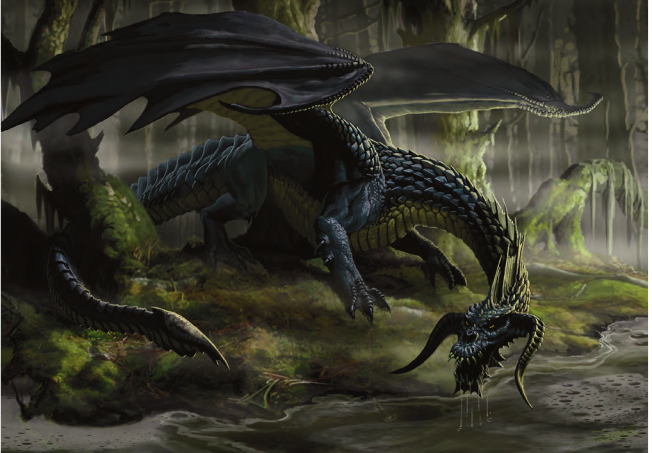
Copyright 2008 Wizards of the Coast This is part of a series! Go here to see the other entries.
Black dragons are the sneakiest, and gothiest, of the chromatics. Their favorite environment is a dismal dark swamp beneath whose fetid waters they can hide to ambush their victims. Gloomy forests, acidic lakes under dank mountain dungeons and places that touch the Shadowfell are also good lair material.
Every chromatic dragon seems to have some signature personality trait in addition to greed. For black dragons, that trait is cruelty. These sadistic creatures will hunt even when they’re not hungry just for the pleasure of torturing and killing a victim. For minions, they typically enlist tribes of lizardfolk and other swamp-dwellers. They’re also the first dragons in the chromatic power ladder that might engage in complex plots to acquire more treasure and power over their surroundings.
Black dragons breathe sprays of acid, and can envelop themselves in a shroud of darkness. So even if a black dragon’s lair isn’t naturally gloomy and caustic, they’ll make it so. They’re also amphibious, which is particularly annoying to adventurers since it means their hoards will often be hidden underwater.
Like all dragons, they’re Natural Magical Beasts with the Dragon keyword. Unlike other dragons, they also have the Aquatic keyword, which allows them to breathe underwater and enjoy a +2 attack bonus against non-aquatic opponents while in there.
All black dragon age categories in each book represent increasingly powerful versions of the same monster, with the main differences being between the MM and MV representations, so we’ll discuss the stats by book and not by age category.
Black Dragon (Monster Manual)
The MM black dragon has trained Perception, Nature and Stealth, along with Darkvision and Acid Resistance that varies with age. It can move equally fast on land, water and in the air, with a further increased overland flight speed.
In every age category it has two basic attacks: a bite that does physical damage and ongoing acid damage (save ends), and a weak claw. Its Double Attack ability allows it to make 2 claw attacks as a standard action. The breath weapon is the usual Reflex-targeting Close Blast 5 that recharges on a 5-6. It does acid damage, ongoing acid damage, and gives a -4 penalty to AC (save ends both). Its final standard-action abilities are our familiar Frightful Presence and Cloud of Darkness.
The Cloud of Darkness ability creates a zone of darkness on a Close Burst 2, which blocks line of sight for all creatures except the dragon. Anyone fully inside it (except the dragon!) is also blinded, so darkvision won’t save you here. The zone lasts a turn but can be sustained with a minor action, and the power recharges on a 3-6. I’m guessing this is more of an inky chemical smoke thing than simple darkness.
For triggered abilities, it can count on the traditional Bloodied Breath, and on a Tail Slash that triggers as a reaction when someone misses the dragon with a melee attack. This is attack does a bit more damage than a claw and pushes the target 1 square.
Young black dragons are Large Level 4 Solo Lurkers with 208 HP, Acid Resistance 15, speed 7, and Reach 2 on their melee attacks. They’re clumsy fliers, but have an overland flight speed of 10.
Adult black dragons are Large Level 11 Solo Lurkers with 560 HP, Acid Resistance 20, speed 8, overland flight 10, and Reach 2 on their melee attacks. Their flight is no longer clumsy and gains the “hover” keyword.
Elder black dragons are Huge Level 18 Solo Lurkers with 860 HP, Acid Resistance 25, Speed 9, overland flight 12, and Reach 3 on their melee attacks. They also gain a new ability: Vitriolic Spray, an encounter power that’s basically a new breath weapon. It does a bit less damage than the standard breath, but blinds on a hit (save ends). Obviously, the dragon retains its normal breath weapon attack as well.
Ancient black dragons are Gargantuan Level 26 Solo Lurkers with 1190 HP, Acid Resistance 30, Speed 10, Overland Flight 15, and Reach 4 on their melee attacks. They replace the standard Cloud of Darkness with Acid Gloom, which works the same but also deals acid damage to any creature that enters or starts its turn within. While the dragon itself would technically take this damage, its resistance makes it immune to it.
Black Dragon (Monster Vault)
The MV black dragons have the same senses, trained skills and movement modes as the MM versions. Their acid resistance is a bit smaller, and it seems their speed is a bit lower at the higher ages. Oh, and they gain Swamp Walk, allowing them to ignore swampy difficult terrain. I only now realize the MM dragons didn’t have this, which is a glaring oversight.
At all age categories, their basic attack is a bite that does physical damage plus ongoing acid damage on a hit, and a little bit of acid damage on a miss. They can instead make two slightly weaker claw attacks, which end up stronger than the bite if both hit the same target. The breath weapon does acid damage and ongoing acid damage, without the AC penalty from the MM version.
Cloud of Darkness is replaced with Shroud of Gloom, a Close Burst 5 that automatically gives everyone caught in it acid vulnerability and a -2 penalty to attacks until the end of the encounter. A PC can spend a standard action to make a Heal check and clear this condition from an ally. The DC of this test is age-based, but not very hard - clearly the cost here is wasting a standard action on it. Think of it as a thin layer of caustic gunk that must be scraped off. I suppose a generous GM might allow a healing power to be used instead, but this is purely a personal decision. This power is Recharge 6, too, so it’s going to be a problem more than once per battle.
For passive traits, they have the already-familiar Aquatic and Action Recovery, plus Acid Blood and Instinctive Devouring. Acid Blood deals acid damage to everyone adjacent to the dragon every time it takes damage while bloodied. Instinctive Devouring allows the dragon to bite or charge someone as its 10+rolled initiative action, or to end any stunning or dominating effect that would prevent it from doing so.
Its triggered actions are Bloodied Breath and Tail Sweep. That last one is triggers when someone misses the dragon with a melee attack. It has a Reach 1 greater than standard for the age category, and targets Reflex. On a hit the target takes damage, falls prone, and everyone adjacent to it takes some automatic physical damage.
Young Black Dragons in the MV are Large Level 4 Solo Lurkers with 208 HP. Their acid resistance is 10, their speed 7, their melee Reach 2 (3 for the tail), and their ongoing/incidental damage for the acid powers and the tail is 5.
Elder Black Dragons are Huge Level 18 Solo Lurkers with 676 HP. Their acid resistance is 15, their speed 8, their melee reach 3 (4 for the tail) and their ongoing/incidental damage 10. They also gain a new ability, Acid Gob, a Ranged 10 attack that targets Reflex. On a hit, the target is blinded and takes 30 ongoing acid damage (save ends both).
You should be able to easily interpolate the other age categories based on this.
Sample Encounters
The two sample encounters in the MM are:
-
Level 5, a young black dragon and 2 dark creepers. This is that Shadowfell flavor at work.
-
Level 13, an adult black dragon, 2 trolls and a bog hag. Swamp dwellers unite!
Final Impressions
In my experience, black dragons are the second most popular variant, being the go-to choice for when you think a white is too weak and a red too strong. I note that both versions of black dragons lack powers that would do increased damage when it attacks from hiding, though I think that’s actually OK here. This is a solo lurker, so it needs to be able to do something effective every turn or the fight will take twice as long. Still, this is a dragon that benefits even more from being a part of an encounter group than the others.
The second sample encounter above is the more effective of the two, since the trolls would be good at occupying the party’s attention while the dragon strikes from ambush. For added Fun(TM), you can say the dragon or the hag have used a ritual to give them acid resistance and/or eliminate their weakness against acid. If Pathfinder: Kingmaker can do it, so can you!
Elder black dragons sound like they could hang out with aboleths, since their lairs could conceivably reach into the depths of the Underdark. The question then becomes, who is using who? Clever GMs can find a way to make the answer be “Both”.
-
-
Let's Read the 4e Monster Manual/Monster Vault: Dragons
“Of all the monsters in the world, dragons are the most feared”. That’s the opening sentence for this large multi-entry. One could also say that of all the D&D monsters in the real world, dragons are the most hyped.
They’re in the game’s title, of course, and have been a part of its bestiary since the very beginning. And while dragons have indeed always been dangerous, their stat blocks underwent a period of massive inflation starting with AD&D 2nd Edition, when Ed Greenwood’s extra-powerful Forgotten Realms dragons became the standard.
In my experience, all of this seems to have had the opposite effect to what previous designers intended. Dragons became so awesome in the minds of Game Masters everywhere that most never really felt their groups were up to the challenge. Though all campaigns had plenty of dungeons, many ended before a single dragon appeared. I know mine did.
I have a whole lot more to write about that mindset, but this is not the article for it. It suffices to say that the designers of Fourth Edition seemed to be quite aware of this problem, and so took some steps to address it.
This article will talk about the lore and mechanics for 4e Dragons in generic terms, and subsequent ones will look at each of the dragon varieties statted out in the first Monster Manual and Monster Vault.
The Lore
Like demons and devils, dragons also get a mythology sidebar in the Monster Manual about their creation myth:
Way back at the dawn of time, there used to be a god named Io. Io was a badass, and his arrogance was proportional to his badassitude. When the gods set about creating mortal peoples in their image, Io created the dragons. He meant them to be the pinnacle of mortal form (or at least that’s what dragons say). The power of the Elemental Chaos ran through their veins and surged from their breath, and yet they possessed keen minds and refined spirits that tied them to the Astral and the gods.
When the gods went to war agains the primordials, Io joined the effort but scoffed at the idea of teaming up with his fellow deities. He challenged the primordial Erek-Hus, called the King of Terror, to a duel. And the King of Terror split Io clean in half with a titanic adamantine axe.
As soon as the two halves of the split god hit the floor, they each became a new deity: the left half became Bahamut, and the right half Tiamat. The two new gods teamed up and killed Erek-Hus. When the dust settled, they took a good look at each other… and started fighting right then and there. For you see, each of them had inherited half of Io’s personality. Bahamut inherited his sense of justice and desire to protect creation; Tiamat his arrogance, selfishness and covetous nature.
The two fought so bitterly they ignored the pressing threat of the primordials until Tiamat ran away from the duel. And even after that, they still weren’t great team players. I’m guessing Bahamut is a little better about that these days.
Dragons come in a wide variety of types. Aside from the classic Chromatic and Metallic varieties, the MM also mentions Catastrophic, Planar and Scourge dragons (AKA Linnorms). We only get entries for the Chromatics in the first Monster Manual and in the Vault. The other types are covered in other books or in Dragon Magazine articles.
It makes sense for Chromatics to be first. Strongly associated with Tiamat, they’re common as dragons go and usually have the sort of foul disposition that makes them highly likely to get into fights with PCs. There are five types of chromatic dragon: white, black, green, blue and red, in order of power. Chromatic dragons have few allies but lots of servants, from kobold to dragonborn to fanatic cultists or other creatures that happen to share an habitat with them.
While the stereotypical chromatic dragon is still evil, it’s important to note that this is no longer universally true. It’s perfectly possible for an unaligned or good chromatic dragon to exist, and for dragons of any aligment to worship a non-draconic god (or none at all).
The Numbers
Gone is the notion that dragons are “extra special” monsters whom only the most elite of high-level adventurers can hope to fight. 4e dragons are still quite powerful, being the edition’s quintessential solo monsters, but now they span the entire level range. If you want your party of early-Heroic PCs to fight a dragon, they dang well should be able to fight a dragon. In fact, the PHB text describing what PCs at the three tiers of play look like also has a description of what the dragons they face look like at that tier.
Aside from color, dragons are also divided by age, with a smaller list of age categories than in previous editions: Young -> Adult -> Elder -> Ancient. The books contain a stat block for every combination of color and age category, which all in all have you covered from early Heroic to mid-Epic levels.
The Monster Vault is even more spare here, containing stat blocks for Young and Elder dragons of each color (with one exception). This makes sense if you consider an Adult to be an up-leveled Young dragon, and an Ancient to be an up-leveled Elder, though you’ll have to do the leveling yourself.
As it happens with most solo monsters, if you want to use them to build a good “boss battle” you’ll want to use a dragon that’s about 2 or 3 levels higher than the party, or give a weaker dragon some lieutenants that bring the encounter up to that level. Being MM1 monsters, our chromatic dragons lack much in the way of multiple actions and are somewhat vulnerable to conditions that further limit them, like dazing or domination. To counter these factors, the Monster Vault versions of these dragons would gain Instinctive Actions, which happened automatically at an initiative count 10 higher than what you rolled for the dragon. They also gain an Action Recovery that allows them to automatically recover from dazes, stuns, and domination at the end of their turns.
subscribe via RSS