Posts
-
Let's Read the 4e Monster Manual/Vault: Drakes, Part 1
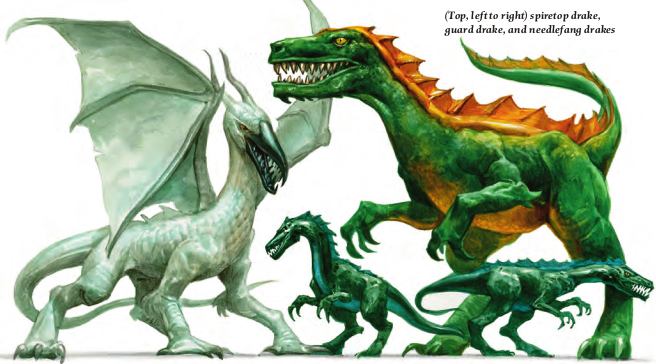
Copyright 2008 Wizards of the Coast This post is part of a series! Go here to see the other entries.
These beasties seem to be new to Fourth Edition, at least as presented here. If I remember correctly, the things 3.x called Drakes were related to dragons - they had the Dragon “monster class” but weren’t technically dragons themselves. As a GM you would use drakes when you wanted a “lite” dragon encounter.
Here, the name is basically another bit of Behemoth-like medieval taxonomy employed by the people people who live in the 4e implied setting. A drake is a clawed, carnivorous reptile that’s not big enough to be called a Behemoth. There are several species of drake: some walk on two legs and have limited manipulation capability, some walk on all fours, some even fly!
I’ve heard that this means they correspond to the smaller varieties of dinosaur, but I think that’s not quite true. While several of them are similar to certain species of dinosaurs, they’re less so than behemoths (where you often can draw a direct visual parallel between a given behemoth and the real-world counterpart).
Drakes in the wild are aggressive and territorial predators, more likely to attack a group of humans than a wolf or bear. Despite this, they’re rather easy to tame, and can be frequently encountered not only as guard or attack animals, but as pets or even mounts!
In short, drakes pretty much fill the same roles as dogs. If you want to make your particular version of the setting feel more fantastical you could even say that it has no dogs, since the sapients here never domesticated wolves. It’s all drakes all the time.
The Monster Vault kinda backs down from this idea a bit, saying that drakes are more aggressive and “alien” than corresponding domesticated mammals and such tend to be feared by common people, though they are often encountered in the service of hostile humanoids. Personally, I would disregard this bit completely and keep them as a common dog-substitute for all sapient peoples.
Both books agree that the larger varieties of drake are harder to domesticate, which would mean good old warhorses are still more common than rage drakes.
All Drakes are Natural Beasts with the Reptile keyword. Between the Monster Manual and the Monster Vault there are quite a few of them, so we’ll split this single entry into multiple posts. This is part 1.
Spiretop Drake
Present only in the MM, this Small drake is a Level 1 Skirmisher with 29 HP. It waddles at Speed 4 but flies with speed 8 and hover capability. They’re a social species that likes to nest in high places, which means clutches of the things nest in towers and spires in large cities and swoop down to steal shiny things from unwary passerby.
Unusually, it has two basic attacks: a bite with its toothed beak that works as usual, and a claw attack that targets Reflex. The claw attack does a measly 1 damage, but a hit also allows the drake to steal a small object from the target, like a single coin, vial or scroll. The fact that the snatching claw is a basic attack is important, because it means the drake can use it as part of a Flyby Attack, where it flies 8 squares while immune to opportunity attacks and performs a basic attack at any point along the movement.
So yeah, having your small, shiny, plot-critical McGuffin stolen by a pack of spiretop drakes is a hazard in urban adventures. Ideally they’d nest atop a crumbling abandoned tower filled with enough bad stuff to count as a dungeon. As a level 1 monster it’s not really affected by the math bug, so you can use it as-is.
Guard Drake
In the wild guard drakes are pack hunters, but they got this name because they’re very commonly used as guard animals, since it’s very easy to train them for this role. Basically, if someone in the real world would use rottweilers for a job, they’ll use guard drakes in D&D. Yes, even as pets.
This Small drake has nearly identical stat blocks in both books. It’s a Level 2 Brute with 48 HP and a single bite attack that does extra damage if the drake is within two squares of an ally. This makes then pair well with any melee monster.
The only difference between the MM and MV versions is that the MM version is immune to fear, which is an interesting detail. I’m inclined to keep it, since it’s flavorful and unlikely to make a PC completely ineffective even at this level.
Needlefang Drake Swarm
From what I hear people saying on the Internet, needlefang drake swarms have been responsible for more PC deaths than most other monsters in this edition. Let’s see why.
Needlefang drakes are cat-sized bipedal lizards, though I guess they’re more like angry chihahuas in temperament. A single individual is not really dangerous, and I imagine some people might want to keep one as a pet. In the wild, they gather in large packs that can take down much larger prey and “strip it to the bone in seconds” according to the book, which also implies some people keep whole swarms of them as “living traps”. Beware needlefang drake hoarders!
A swarm of needlefang drakes is Medium in size and counts as a Level 2 Soldier with 38 HP and the Swarm keyword. Like all swarms it takes half damage from melee and ranged attacks, and extra damage from close and area attacks. It’s immune to fear, and has a Swarm Attack aura 1 that allows it to make a free basic attack against each enemy that begins its turn inside.
This swarm has two actions: a Swarm of Teeth as a basic attack, which deals extra damage against prone targets; and Pull Down, which targets Fortitude and does no damage, but knocks the target prone on a hit.
So why are needlefang drake swarms so dang deadly? Well, as MM1 soldiers, their accuracy is 2 points higher than it should be (something which would be fixed by the new monster math). So a swarm has no reason to ever spend its standard action on anything but Pull Down, which will hit even tough fighters very reliably and set them up for an increased-damage free attack from the aura which will hit even more reliably due to combat advantage.
To make things worse, if you have multiple swarms in play they can position themselves so that anyone they knock down is subject to aura attacks from all of them. That amount of damage per round can take a level 1-2 PC down to 0 quite fast. And to top it off, there’s no in-setting reason for needlefang drakes to follow the sort of combat etiquette that prevents them from attacking downed PCs, so they can potentially keep making free attacks until those PCs hit their death threshold.
These tiny terrors are just the thing to spruce up a kobold lair or the hideout of a sadistic villain, but don’t overuse them. Or at least make sure your wizard knows Thunderwave before using more than one swarm at a time.
-
Dungeon Fantasy Character: Ser Alexa of the Flame, Human Mystic Knight
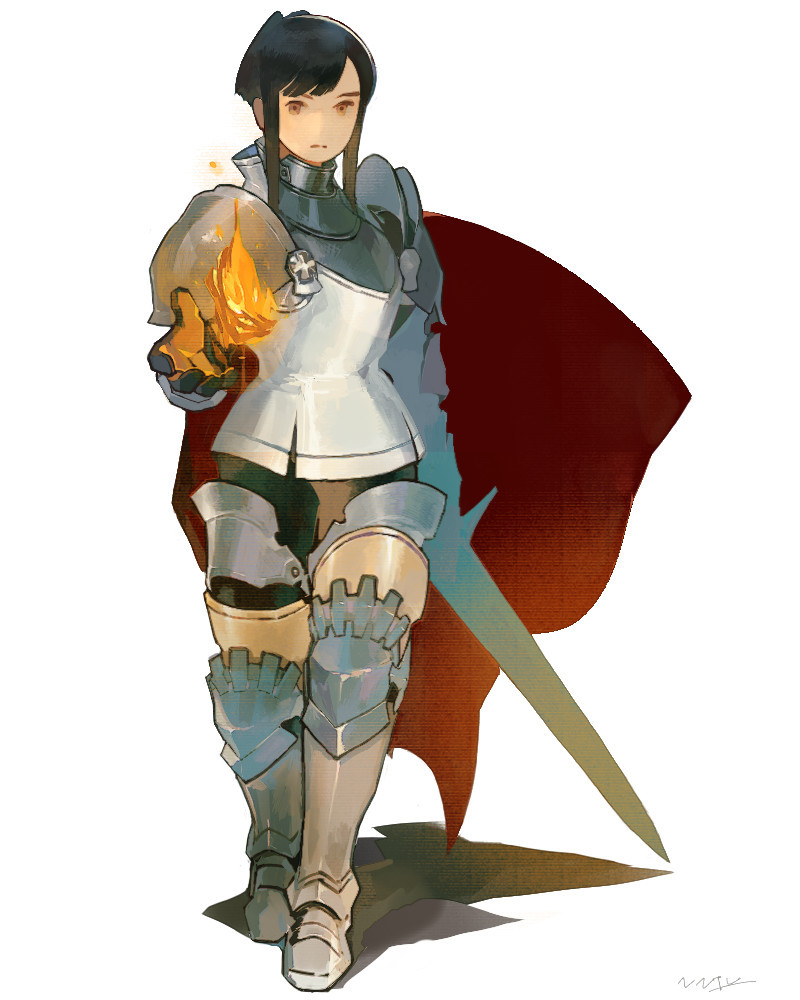
Illustration by Nishio Nanora Years ago, Alexa’s father (a minor baron) sent her to the capital to serve as squire to a somewhat eccentric knight. She returns to her home a knight in her own right, skilled with sword and spell, to find her ancestral lands at the edge of ruin. Against the wishes of her ailing father, Alexa sets forth to bring honor, glory, and wealth back to her family name.
Alexa is made using the spell-based Mystic Knight template from this blog, rather than the Imbuement-based official one. Her Weirdness Magnet is a perfect explanation for why the Odds and Sods party got together in the first place, making her their unnoficial leader.
Alexa, 245-point Human Mystic Knight
ST 14 {40}; DX 13 {60}; IQ 12 {40}; HT 13 {30}
Damage 1d/2d; BL 19.6kg; HP 14; Will 12; Per 12; FP 13; Basic Speed 6.25; Basic Move 6 {0}.
Advantages
- Born War Leader 1 {5}
- Magery 4 {45}
- Weapon Channeling {1}
Disadvantages
- Code of Honor (Chivalry) {-15}
- Obsession (Restore My Family’s Holdings) {-5}
- Sense of Duty (Adventuring Companions) {-5}
- Weirdness Magnet {-15}
- Impulsiveness (12) {-10}
Quirks
- Dislikes entering water {-1}
- Always carries the family sword {-1}
- Writes letters to her departed mother {-1}
- Stands at attention unless she makes a conscious effort not to {-1}
- Hotter to the touch than usual due to fire magic affinity {-1}
Skills
- Armory (Body Armor) (A) IQ+1 {4} - 13
- Brawling (E) DX+1 {2} - 14
- Broadsword (A) DX+4 {16} - 17
- Connoisseur (Weapons) (A) IQ+1 {4} - 13
- Diplomacy (H) IQ-2 {1} - 10
- Fast-Draw (Sword) (E) DX {1} - 13
- Forced Entry (E) DX {1} - 13
- Heraldry (A) IQ-1 {1} - 11
- Hidden Lore (Magic Items) (A) IQ {2} - 12
- Innate Attack (Projectile) (E) DX+2 {4} - 15
- Leadership (A) IQ {1}1 - 12
- Occultism (A) IQ {2} - 12
- Riding (Horse) (A) DX-1 {1} - 12
- Savoir-Faire (High Society) (E) IQ {1} - 12
- Shield (E) DX+3 {8} - 16
- Stealth (A) DX-1 {1} - 12
- Strategy (H) IQ {2}1 - 12
- Tactics (H) IQ {2}1 - 12
- Thaumathology (VH) IQ+1 {1}2 - 13
- Wrestling (A) DX+1 {4} - 14
Spells
All have +4 from Magery.
- Communication and Empathy
- Sense Foes (H) IQ+2 {1} - 14
- Sense Evil (H) IQ+2 {1} - 14
- Fire
- Ignite Fire (H) IQ+2 {1} - 14
- Create Fire (H) IQ+2 {1} - 14
- Shape Fire (H) IQ+2 {1} - 14
- Heat (H) IQ+2 {1} - 14
- Flaming Weapon (H) IQ+3 {2} - 15
- Fireball (H) IQ+3 {2} - 15
- Extinguish Fire (H) IQ+2 {1} - 14
- Fireproof (H) IQ+2 {1} - 14
- Resist Fire (H) IQ+2 {1} - 14
- Healing
- Lend Energy (H) IQ+2 {1} - 14
- Recover Energy (H) IQ+3 {2} - 15
- Protection and Warning
- Shield (H) IQ+2 {1} - 14
- Missile Shield (H) IQ+2 {2} - 15
- Mystic Mist (H) IQ+2 {1} - 14
Loadout
- Fine Medium Shield: DB 2. $600, 5.63kg.
- Light Mail Suit: DR 3/1. 10 FP as a power item. $1500, 18kg.
- Broadsword: Damage sw+1 cut or thr+2 imp. Enchanted with the Staff spell. $630, 1.5kg.
- Quick-Release Backpack: Holds 20kg of gear. Dropping it is a free
action. $300, 1.5kg.
- Blanket: $20, 2kg.
- Canteen: $10, 1.5kg.
- Personal Basics: $5, 0.5kg.
- Rope, 1cm, 10m: Supports 150kg; $5, 0.75kg.
- $430 in coin.
Combat
Assumes Light encumbrance.
- Defenses
- Dodge 8 (10)
- Parry 11 (13)
- Block 11 (13)
- DR 3/1.
- Attacks
- Broadsword (17): 2d+1 cut or 1d+2 imp, Reach 1.
- Shield Bash (16): 1d cr, Reach 1.
- Brawling Punch (14): 1d cr, due to mail gauntlets. Reach C.
- Brawling Kick (12): 1d+1 cr. Reach C, 1.
- Wrestling Grapple (14): 1d+1 control.
- Fireball (15): 1d to 3d burn, Acc 1, Range 25/50. Cost 0 to 2.
- Alexa doesn’t usually charge it for more than 1 turn.
-
Old-School Movement in Dungeon Fantasy
I’ve been looking at some old D&D modules lately and wondering how to convert them to Dungeon Fantasy. One of the things that gave me some trouble was movement.
Dungeon movement in AD&D is by default extremely methodical and done with an almost paranoid level of caution1. This is why even an entirely unencumbered party moves only 120ft/40m over ten minutes. They’re moving reeal slow; they’re trying to maintain stealth; they’re looking for traps and secret passages; someone is mapping. You move five times faster if you don’t have to map, and ten times faster if you throw caution to the wind and tromp through the dungeon at combat speed.
This is important because AD&D wants you to track turns precisely and roll for wandering monsters every so often. As a delver, you ideally want to get in, get the treasure, and get out as soon as possible. Every extra turn you spend in there has a chance of bringing in hostile enemies who don’t have any loot.
Dungeon Fantasy (either version) expects the party to move cautiously but doesn’t have specific or timing rules for it2. So, when you convert AD&D modules to Dungeon Fantasy, how do you handle movement?
The easy solution is to just glom the AD&D turn and movement rules into Dungeon Fantasy! The resulting amalgamented abomination is actually rather playable. Check it out:
Dungeon Fantasy Movement
Time spent inside a dungeon is measured in ten-minute turns, like in ye olde days. When exploring a dungeon, delvers are by default assumed to be moving very cautiously and methodically, keeping their marching order. When moving this way, they cover a distance per turn equal to ten times the Move of the slowest party member, measured in yards or meters. For example, a party containing a heavily armored knight with Move 3 would explore 30 yards/meters in a turn3.
Moving this way is slow, and costs the party 1 FP per 5 turns of movement, but has several benefits:
-
The party is assumed to be on the lookout for danger. They roll to detect traps, enemies and other hazards automatically without having to state they are doing so.
-
Similarly, they can make Stealth rolls to avoid detection by monsters. If they’re walking together, this is a group Stealth roll as detailed in Exploits p. 6. All the usual factors for stealth are still at play here, such as light sources and so on.
-
This is the pace that allows the PCs to map the dungeon as per Exploits p. 18.
Actively investigating a room for treasure and secret doors also takes a turn and requires the normal rolls for these procedures. Turns spent searching do count for tracking FP cost.
The FP cost makes ye olde routine of delving for 5 turns and resting for one an efficient way to proceed, though the delvers can elect to push forward and take the FP loss if they’re pressed for time. The party can elect to move at five times this pace and still retain the first two benefits above, which makes traversing already-mapped portions of the dungeon a lot faster.
These rules are perfect for playing in converted old-school modules. You can use the modules’ own rules for random encounters with them, though obviously you’ll still want to convert the monsters. It’s probably okay to ignore these rules in modules made specifically for the DFRPG, since they tend to assume a faster pace.
-
-
Let's Read the 4e Monster Manual/Vault: Dragonspawn
This post is part of a series! Go here to see the other entries.
Dragonspawn are weird mutants created by the application of an eldricht ritual to an unhatched dragon egg. The ritual mutates the embryo inside, and what hatches from the egg is one of these beasts. The ritual was first developed by cultists of Tiamat.
If this sounds familiar to you it might be because it’s almost the same origin story for Dragonlance’s Draconians, but the result here is different. Dragonspawn are much larger and more dangerous than the gimmicky humanoids of that setting, and have animal-level intellects (with a very dangerous exception). They also breed true, so you can start your very own dragonspawn ranch with a relatively small cache of dragon eggs.
Another big difference is that the dragonspawn depicted here come from chromatic dragon eggs, which indicates that chromatics as a whole don’t form a unified faction in the implied 4th edition setting like they do in Dragonlance. These aren’t the only dragonspawn in existence, as the ritual spread out in the usual way and people started coming up with additional varieties. It works just fine in metallic and other dragon types too.
Dragonspawn are only present in the MM.
Redspawn Firebelcher
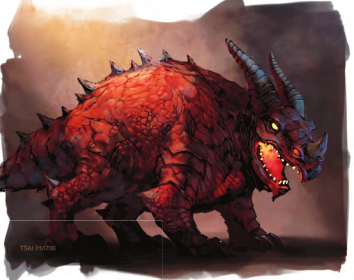
Copyright 2008 Wizards of the Coast This round boy is a Large Natural Beast (reptile), and a Level 12 Artillery beast with 97 HP. It has low-light vision, fire resistance 20, and an aura 5 that grants fire resistance 10 to allies within it. It gambols about at Speed 4.
It attacks with a bite that does physical damage and ongoing fire damage (save ends); Fire Belch, a Range 12 attack that targets Reflex and does physical + ongoing fire damage (save ends); and Fire Burst, an Area 2 Within 10 attack version of the belch that does a bit more damage than it and recharges on a 5-6.
At Int 2, Firebelchers are just smart enough to receive basic combat training: they can recognize friend from foe and understand an attack command. They prefer to attack at range, and their temper combined with their slow speed mean they fight to the death even when overrun. Also of note is the fact that they suffer greatly from the math bug. If you want to use them, you should definitely increase their damage to its proper level and likely make their ranged attacks do fire instead of physical damage.
Blackspawn Gloomweb
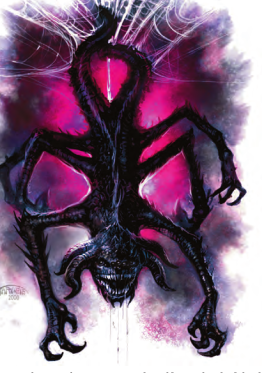
Copyright 2008 Wizards of the Coast This thing has all the cruelty of a black dragon combined with the intellect of your average spider. It likes hiding out in dark caves and catching unsuspecting passerby in its acidic webs. It doesn’t like waiting for the acid to kill its victims before it begins eating them.
Gloomwebs are a bit of a failed experiment in that they’re hard to train properly. So I guess their creators just left them in places their enemies would have to pass through, and later on they became a wild species.
These things are Large Natural Beasts (reptiles), and Level 16 Lurkers with 120 HP. The scuttle with Speed 8, and have the same climb speed (with Spider Climb, obviously). It has acid resistance 15 and constantly exudes a cloud of gloom that grants it concealment in any turn in which it doesn’t move. It’s trained in Stealth.
For attacks, the gloomweb has a bite that deals physical and ongoing acid damage (save ends). It can also perform a Goring Charge that targets Fortitude. On a hit this deals damage, knocks prone, and allows a free bite attack! It can also use a Mobile Melee attack that allows it to scuttle half its speed and bite at any point along the movement, without provoking opportunity attacks. Finally, it can launch an acidic web as a Ranged 10 attack that targets Reflex. On a hit this restrains and deals ongoing acid damage (save ends both).
All of these attacks are at-will and none of them have a stealth prerequisite, so this lurker is really more of a skirmisher with a dash of control. Goring Charge is a good opener, and the Mobile Melee Attack can get the monster into position for another charge.
Bluespawn Godslayer
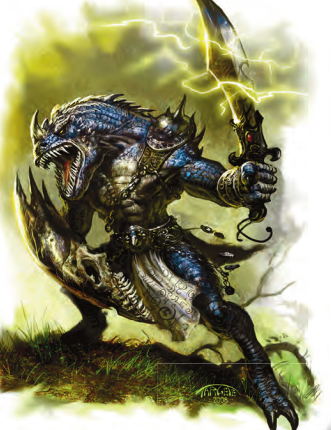
Copyright 2008 Wizards of the Coast This dragonspawn stands out from its fellows not only because its name is Extremely Metal but because it’s sapient. Not a warbeast but a mercenary, the godslayer hires itself out to people who need violence inflicted upon powerful creatures such as angels and other immortals. In other words, “godslayer” is its job description.
These reptilian giants were created by Tiamat cultists to fight their enemies, but their mercenary temperament suggests that the PCs themselves might be able to hire them to help fight opposition such as devils, evil dragons or even those self-same cultists. Yes, the bluespawn is also Evil, but it’s not like evil creatures have any solidarity towards each other.
A bluespawn godslayer is a Huge Natural Humanoid (reptile) and a Level 22 Elite Brute with 510 HP. It has low-light vision, 30 resistance to lightning and thunder, and runs at speed 8. It wields a greatsword one-handed and a heavy shield.
The greatsword deals a mix of physical and lightning damage. It can also be used in to deal an Awesome Blow that does the same damage and allows a secondary attack against Fortitude. If that hits, the target is pushed 3 squares and knocked prone. If the sword isn’t available for some reason, the godslayer can bite for somewhat less physical damage but the same amount of lightning damage.
All of these attacks deal an extra 10 damage against dragons, dragonborn, and immortals. This is why keywords and origins are important even though they don’t have built-in rules of their own! Dragonborn PCs are going to have a bad time here, but this is also what makes it desirable for the PCs to hire a bluespawn to fight their draconic/devilish enemies.
That said, this god-slayer might have some trouble living up to its hype. Aside from fixing the math, I’d probably roll Awesome Blow into the basic sword attack so it can be used in a charge, and make the bite a minor action.
Sample Encounters and Final Impressions
Each dragonspawn gets one.
-
Level 12: 1 redspawn firebelcher and 4 githyanki warriors.
-
Level 16: 1 blackspawn gloomweb and a bunch of kuo-toa.
-
Level 22: 2 bluespawn godslayers and a storm giant.
Basically, anyone who could be found hanging around a given type of chromatic dragon might also be found hanging around the equivalent dragonspawn, though in that case the power relationship is likely inverted. This makes me think that the dragons themselves wouldn’t have a problem hanging around dragonspawn, though obviously they wouldn’t like to have their own eggs turned into these creatures.
Despite the math issues, I find myself liking these monsters more than I expected. They’re certainly a lot better than draconians, which never made much of an impression on me.
-
-
Let's Read the 4e Monster Manual/Vault: Red Dragon
Copyright 2008 Wizards of the Coast This post is part of a series! Go here to see the other entries.
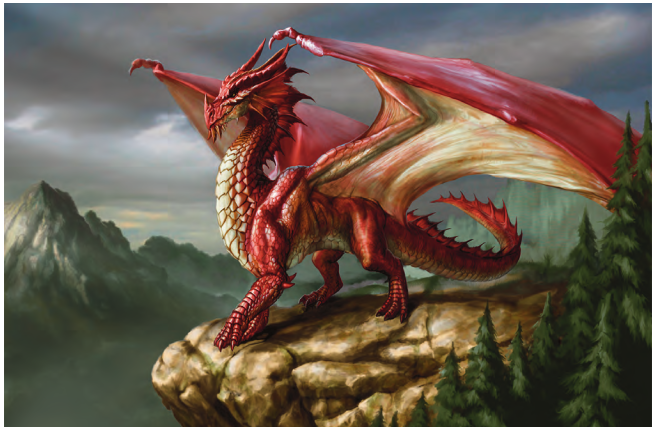
This is it, the one you’ve been waiting for. The most hyped variant of the most hyped monster in the entire game. Red dragons have made it to the cover of the core books in multiple editions, and they’re the ones you think about when you read the words “lays waste to the countryside”.
Part of this increased mystique comes from the fact that D&D red dragons breathe fire, which means they get to take a ride on every classical myth or fantasy novel that features fire-breathing dragons. Personality wise, the book describes them as doubling up on greed. Red dragons pursue treasure much more vigorously than their weaker kin, which ironically means they’re much harder to buy off with tribute. Why wait for you to give them your money a little at a time when they can just raid you and take it all at once? Their preference for mountain or volcanic lairs means a large enough red in search of a new lair might just be strong enough to clear out a dwarf kingdom and make its lair in the treasure vault.
The fiery breath of an older red dragon has an additional trick in this edition: it can strip the fire resistance of those it hits. This means they’re equipped to pull the Dark Schneider Maneuver and kill something like an efreet or fire archon with fire. Or your party’s fire sorcerer.
Red Dragons fill the Soldier role, which means they fight up close and are smart about it. We’ll look at them by book.
Red Dragon (Monster Manual)
MM Red Dragons have trained Bluff, Insight, Intimidade and Perception. Like all dragons they have Darkvision and an age-dependent amount of resistance to their signature element (fire). They move fairly fast on land and fly well enough to hover.
At all ages their basic attack is a bite that does physical and fire damage. They can instead perform two claw attacks if they want. As a reaction, they can use a Tail Strike against an enemy that moves to flank them. This targets Reflex and on a hit does some damage and pushes the target 1 square.
The famous fire breath is a Close Blast 5 that targets Reflex and does a bundle of fire damage, half on a miss. It recharhes on a 5-6. Bloodied Breath and Frightful Presence round out the universal red dragon kit.
Young reds are Large Level 7 Solo Soldiers with 332 HP and fire resistance 15. Their land speed is 6, their flight speed 8 (hover) with Overland Flight 12, and their melee reach 2.
Adult reds are Large Level 15 Solo Soldiers with 750 HP and fire resistance 20. Their numbers are bigger, but they otherwise have the same set of abilities as the young dragon.
Elder Reds are Huge Level 22 Solo Soldiers with 1050 HP, Fire Resistance 25, and melee Reach 3. Their land speed is 8 and their flight speed 10 (hover). To the standard suite of abilities they add Immolate Foe, a Ranged 20 attack that does slightly less damage than the breath weapon plus ongoing 10 fire damage. It targets Reflex and recharges on a 5-6.
An Ancient Red Dragon is a Gargantuan Level 30 Solo Soldier with 1390 HP, Fire Resistance 40 and Melee Reach 4. This puts it on par with the Tarrasque, and makes it a good case for this being the Ancient Red Dragon.
In addition to everything the elder can do, the Ancient has an Inferno aura that extends to 5 squares and does 20 fire damage to anything that enters it or starts its turn there. It also gives everyone inside (including the dragon) concealment against ranged attacks. Its breath weapon gains a secondary attack against Fortitude on a hit, and if that hits it strips all fire resistance from the target until the end of the encounter. This had been hinted at in the lore, but I honestly thought it would kick in earlier in the dragon’s life cycle.
Red Dragon (Monster Vault)
MV Red Dragons have the same senses and movement as their MM counterparts, though they lose training in Intimidate for some reason. As usual for MV dragons, they lose Frightful Presence, retain Bloodied Breath, and gain Action Recovery and an instinctive action. In this case it’s Instinctive Assault, which allows them to bite once or claw twice at 10+rolled initiative.
The basic bite attack got powered up - on a hit it does physical damage and grabs the target with an age-dependent escape DC. Until the grab ends, the target takes ongoing fire damage (which increases if the dragon is bloodied).
The claw attack also grabs the target on a hit, with a slightly easier escape DC. I think the dragon can have up to three grabbed victims - one from the bite and two from the claws. This can be useful to split the party up.
The breath weapon works the same: fire damage on a close blast 5, half on a miss. Tail Strike remains, with a reach 1 greater than the dragon’s basic reach.
The Young Red Dragon is a Large Level 7 Solo Soldier with 332 HP and fire resistance 15. Its melee reach is 2 (3 for the tail strike). Its breath weapon does additional damage if the dragon is bloodied.
The Elder Red Dragon is a Huge Level 22 Solo Soldier with 832 HP and fire resistance 20. Its land speed is 8, with flight 10. Its melee reach is 3 (4 for the tail). In addition to all of the young red’s abilities, the elder can use Immolate Foe, which works much like its MM counterpart.
Sample Encounters
The MM has two, both fairly beefy.
-
Level 18: 1 adult red dragon, and a trio of githyanki. Yes, for some reason red dragons and githyanki get along well. I guess they have a lot in common, since they’re both grasping conquerors and all.
-
Level 24: 1 elder red dragon, 2 fire archon ash disciples, and 2 fire giants. Burn, baby burn! I would probably rewrite the ash disciple stats though.
Final Impressions
Ironically, despite being the strongest and most famous of dragons, reds are somewhat lacking in interesting powers compared to the other chromatics. Their breath is straight damage, and their instinctive action doesn’t grant movement. The ability to strip fire resistance is pretty awesome, but only the MM Ancient has it. If I brought it back I’d at least also give it to the Elder.
The Monster Vault version is better at expressing the monster’s Soldier role. Their grabby attacks allow them to split the party up, and maybe carry a PC or two off if they can’t escape in time.
-
subscribe via RSS