Posts
-
Let's Read the 4e Monster Manual/Vault: Dryad
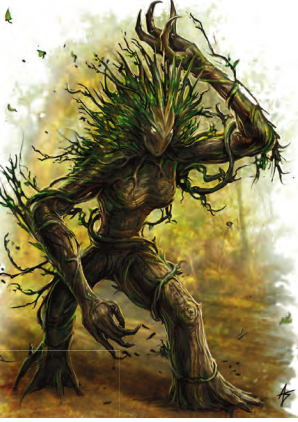
Copyright 2008 Wizards of the Coast This article is part of a series! Click here to see the other entries.
Dryads originated in Greek mythology, where they were a type of nymph. Mythological nymphs were basically female spirits associated with specific natural elements, and dryads were specifically the spirits of trees. They’ve been a part of the D&D bestiary for quite a while, with most editions picturing them as beautiful women with lots of charm-based powers.
Fourth Edition decided to something a little different, either to avoid leaning too hard on the fanservice or to add a bit more variety. “Beautiful woman with lots of charm-based powers” could describe any of a dozen other entries, after all.
Dryads are present in both the Monster Manual and the Vault.
The Lore
D&D 4th Edition Dryads are a type of humanoid, treelike fey. They live in the depths of secluded forests and generally just want to be left alone. While far from evil, they have very little reason to believe humanoids who intrude upon their homes are anything but trouble, and will react accordingly.
The Monster Vault goes on to say that dryads are both shy and impulsive, so those who want to parley with them must be very careful to make their peaceful intentions known at all times. It also sorta tries to bring the “beautiful woman with charm powers” schtick back, going on about how they represent both the beauty and danger of nature. I like that part somewhat less than the rest of their description.
The Numbers
We have a whole bunch of dryad varieties if add up both books. All are Medium Fey Humanoids with the Plant keyword, and have a few signature traits. First, dryads have trained Perception and are fast, moving at Speed 8 with Forest Walk.
Second, they have the Treestride power, an at-will move action that allows them to teleport 8 squares as long as they can begin and end the teleport adjacent to a tree, treant, or any other Large or larger plant. Basically, they use plants as portals.
And finally, there’s Deceptive Veil, an illusion that allows them to disguise themselves as any Medium humanoid. Beautiful humans or eladrin are typical, but there’s no reason for you to stick to the cliche. The MM says piercing the disguise is an opposed check of a PC’s Insight against the Dryad’s Bluff, while the MV gives explicit DCs in the power descriptions. None of them are smaller than 27, so low level parties will have very little chance of piercing the disguise.
A significant difference between the two books is that Deceptive Veil tends to be the only “manipulative” power the MM dryads have, while the MV tends to give them some charm powers as well.
We’ll look at them by level order, from lowest to highest.
Dryad Recluse
This MV entry is a Level 5 Lurker with 50 HP and all common dryad traits. In a fight it relies on its wooden claws and on the Sylvan Charm at-will power, a Ranged 5 attack that targets Will. On a hit, it pulls the target 5 squares to a position adjacent to the dryad, and charms it until it’s no longer adjacent or until the dryad uses the power again.
Charmed victims can’t attack the dryad and are considered immobilized. The victim will redirect half the damage of any melee or ranged attack that hits the dryad to itself, and if the attacker was adjacent to the victim, they will make a melee basic attack against the attacker as a free action. If the dryad teleports using Treestride, it can take a charmed victim along.
This is actually a bit more dangerous than the Succubus’ charm power, in that it has less loopholes for PCs to exploit. Sure, the PC will take less damage from friendly fire, but they can’t move away, can be attacked by the dryad, and have well-defined situations where they must attack their allies. Also note that there’s no save against any of these effects - once the PC is hit by the Sylvan Charm, they remain charmed until the dryad moves (or is pushed) away, or until it decides to charm someone else.
It’s perfectly possible for a dryad recluse to attack from ambush, charm someone, and treestride away with the victim in tow, never to be seen again. At the very least, that’s going to lead to an interesting chase scene.
Dryad Hunter
This MV entry is a Level 7 Skirmisher with 92 HP and all common dryad traits.
The dryad hunter’s claws do extra damage if the target has no allies adjacent to it. It can also employ a Luring Feint that allows it to make a claw attack and shift 4 squares on a hit, pulling the target along. If the attack misses, the dryad instead shifts its full speed (8!). This isn’t a charm power, which means it comes purely from this dryad’s skill as a canny fighter that’s absurdly hard to pin down.
Dryad hunters should ideally focus on one of the party’s squishies, isolating them from their friends with Luring Feint and taking advantage from the increased claw damage against isolated victims. I wouldn’t allow a dryad hunter to miss on purpose in order to get full-speed shifts, but missed attacks should still be seen as opportunities to put some distance between the hunter and the party’s defenders.
Dryad Witch
This MV entry is a Level 8 Controller with 84 HP and all the usual dryad traits. Its basic attack is a Thorny Vine that also slides the target 1 square on a hit, and it can call upon two different charm powers.
Beguiling Verdure is an at-will Ranged 5 attack that targets the Will of a dazed creature. On a hit it allows the dryad to slide the target up to the target’s own speed, and forces the target to make a melee basic attack against a creature of the dryad’s choice at the end of the movement. This combos with Soporific Fragrance, a Close Blast 3 that targets Will and dazes on a hit and recharges on 3-6.
Dryad
The classic model, present in the MM. It’s a Level 9 Skirmisher that ends up being a much simpler version of the Dryad Hunter. Its claws still do additional damage to isolated targets, but it doesn’t have any forced movement or large shift abilities.
This version does have some additional skill training in Bluff, Insight and Stealth. I would still advise you to simply use an up-leveled Dryad Hunter in its place, adding the skills if those prove necessary.
Dryad Briar Witch
This MM entry is a Level 13 Elite Controller with 262 HP. Unlike the “normal” Witch from the MV, this one is all about the thorns.
The Briar Witch has two auras: Curse of Thorns has radius 3 and deals 2 damage to enemies without Forest Walk every time they move into a square in the aura, whether voluntarily or due to forced movement. Thorn Boon has radius 6 and gives a +5 damage bonus to the melee attacks of all allied plant creatures within.
Its basic claw attack is pretty standard and generally not worth using without a damage fix. Its main at-will ranged attack is a Briar Cage, which has range 5 and targets Reflex. On a hit it deals both immediate and ongoing damage, and also restrains the target (save ends both). This is an actual, physical briar cage, so it gives cover to the victim and can be destroyed with physical attacks (it has 25 HP and Resist All 10).
The Briar Witch’s thorny body causes 5 damage at the start of its turn to any creature that grabs it. It also has the common dryad powers.
This dryad could definitely benefit from the damage fix for both its melee and ranged attack. And while I like the detail of Briar Cage creating an actual cage that can be destroyed, it does feel a bit redundant with the (save ends both) clause. I’d probably either remove the destruction mechanic and up the ongoing damage, or remove the save and make the power recharge 4-6. Other than that the briar witch is a major threat even when just standing there, due to her auras.
Bough Dryad
We’re back to the MV for this one, a Level 15 Minion Skirmisher. It doesn’t have Treestride or Deceptive Veil, but it’s still pretty fast. Its claw attack does a smidge more damage against isolated targets, and when it drops to 0 HP it grants 5 temporary HP to an ally within 5 squares. I want to say this stacks, which would make the PCs very hesitant to fireball a group of bough dryads accompanied by a couple of massive monsters.
Sample Encounters
The sample encounter in the MM is level 9, a dryad and four eladrin (1 twilight enchanter, 4 fey knights). Indeed, dryads could be found hanging out with any other fey or natural creatures that love the forest as much as they do.
Final Impressions
I like these tough dryads. My impression of the ones from previous editions is that they usually didn’t have much they could do against PCs they failed to charm. Not only can these do that, some of them don’t even rely on charm powers in the first place!
The MM Dryad can easily be replaced by a slightly up-leveled Dryad Hunter from the MV, but the Briar Witch is still quite usable after you fix its damage and maybe change Briar Cage a bit.
-
Let's Read the 4e Monster Manual/Vault: Drider
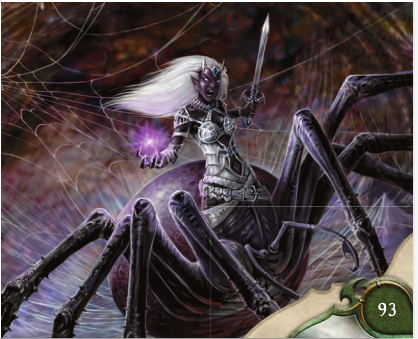
Copyright 2008 Wizards of the Coast This article is part of a series! Click here to see the other entries.
Driders are another classic D&D monster, about as old as the drow they’re thematically attached to. Mechanics-wise, these drow-spider beings still do pretty much what you would expect them to, but their background has changed significantly.
The Lore
In past editions, driders were the result of a curse inflicted by Lolth on drow that displeased her. Driders would he hated and shunned by other drow and would either live in isolation or form communities of their own.
In 4e, driders are instead the result of a blessing bestowed by Lolth on drow that please her. There’s a formal ritual named the Test of Lolth that turns the worthy into driders (and kills the unworthy). Driders can often be found as leaders or prestigious champions in drow communities!
I think this makes more sense than the old background, as driders were always quite a bit more powerful than run-of-the-mill drow.
The MV splits the difference by adding that driders make their own caste in the drow hierarchy, above most others but still subservient to the priestesses of Lolth. Some of them resent this, and some grow to have more empathy towards spiders than towards their fellow dark elves, so you can still meet the odd drider hermit out in the wilds of the Underdark.
The Numbers
Driders usually retain all the abilities they had as drow, including their racial powers, and add to this the increased movement speed, climbing, and web-spinning abilities granted by their spider halves. They’re Large Fey Humanoids with the Spider keyword, which means they count as spiders where that’s important.
The Drider Fanglord is a Level 14 Brute with 172 HP, present in both books. It has trained Perception and Darkvision, with the MM version additionally being trained in Stealth and Dungeoneering. It scuttles at speed 8 and climbs at the same speed with Spider Climb.
This warrior wears leather in its drow half and fights with a greatsword. It can also launch a web as a Ranged 5 attack targetting Reflex, which restrains the target on a hit until they escape using the rules for escaping grabs. The DC for this is quite a bit lower on the MV, which also specifies the target can automatically escape by teleporting. The web recharges on a 4-6.
As a minor action, the fanglord can bite someone against whom it has combat advantage, dealing a piddly 1d4 physical damage and a nice 10 ongoing poison damage (save ends). It also has the Darkfire encounter power we saw in the Drow entry.
The Drider Shadowspinner is a level 14 Skirmisher with 134 HP. It also wears leather, and fights with a shortsword and magic. It has trained Perception, Dungeoneering and Stealth, as well as darkvision. The shortsword does damage as usual and allows slightly different skirmisher shenanigans in each book: in the MM, the drider can shift 1 square before or after the attack; in the MV, it can only shift on a hit, but that shift also ends any mark on it.
The shadowspinner’s ranged attack is a Slashing Darkness spell that has a range of 5, targets Reflex, and does necrotic damage. It can also use the same Web as the Fanglord.
The MM version has the Cloud of Darkness encounter power, which we saw in the Drow entry. The MV version retains the cloud and also gains Darkfire.
As passive traits, the shadowspinner gains concealment from Shifting Shadows if it ends the turn 3 or more squares away from its initial position, and it also gains a sneak attack bonus against targets granting it CA.
Finally we have the plain old Drider, which only appears in the MV. This Level 14 Soldier has 138 HP and Darkvision, but the stat block shows no trained skills. It wields a scimitar and also wears leather.
The scimitar has Reach 2 (unlike the other weapons we saw), and the drider has Threatening Reach with it. Scimitar attacks also mark targets for a turn on a hit. Targets who ignore the mark take 15 necrotic and poison damage if they’re within 10 squares of the drider. Finally, it can use Darkfire.
Sample Encounters
There are two:
-
Level 12: a drider fanglord, a drow arachnomancer, and 3 drow warriors. Here’s some of that “favored champion” action.
-
Level 14: 2 fanglords, 1 shadowspinner, and a demonweb terror spider. This all-spider group could be an elite unit in a drow settlement, or an unhinged hermit family.
Final Impressions
I like the new take on driders as the favored of Lolth. As I say above, it makes more sense than the previous backstory for them, because I never thought that “oh no, I have been cursed with awesome power” made much sense. I mean, yeah, you’re now a horrible half-spider monster, but for Lolth worshippers that should be a plus.
Mechanically they pair really well with drow: the drow stat blocks lack any heavy frontliners, and both the standard Drider and the Fanglord fit neatly into that gap. The web powers from the Shadowspinner and Fanglord also do much to benefit drow warriors or other lurkers, granting them easy and potentially long-lasting combat advantage.
-
-
Let's Read the 4e Monster Manual/Vault: Drow
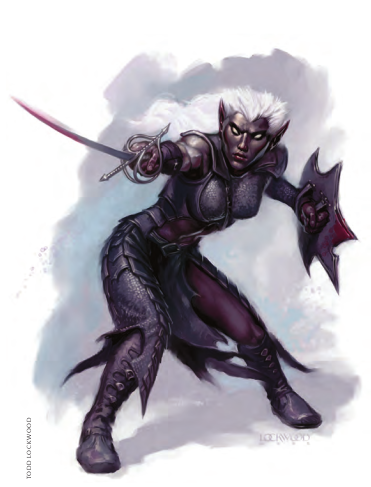
Copyright 2008 Wizards of the Coast This article is part of a series! Click here to see the other entries.
Drow have both fascinated and horrified people since AD&D 1st Edition or thereabouts. Their early descriptions leaned very hard into “evil elf dominatrix” imagery, and their dark skin meant this portrait was often considered racist as well as sexist.
4e seems to attempt to get away from these early unfortunate implications by de-emphasizing the S&M bits, and making your average drow look different from a brown-skinned human. Depending on the specific illustration, drow skin varies from pitch-black to light purple.
Drow are present both in the Monster Manual and in the Vault, though there they’re part of a larger “Elf” entry.
The Lore
Elves, Eladrin and Drow all descend from the same sapient fey people, which was originally created by Corellon and went through something of a diaspora back at the dawn of creation. Eladrin native to the Feywild are the closest to those progenitors, still worshipping Corellon as their main deity. Elves diverged from them after centuries of living in the world, and tend to worship Sehanine, Melora or the primal spirits.
The Drow were recruited into the worship of Lolth and rose up against their kin. They were driven into the Underdark and built a thriving but nightmarish civilization there. The assumption seems to be that drow appearance diverged by the same natural processes that applied to elves, as a form of adaptation for their new environment. Other editions had the dark skin be a curse, which, again, had its Unfortunate Implications.
Drow build great cities in the Underdark, which house a cruel and hierarchical society fanatically devoted to Lolth. Lolth’s priestesses are at the top of the heap and their ranks are only open to women. Men tend to get a little less respect, but still all other positions of authority are open to drow of any gender. Intrigue and backstabbing are extremely common at all levels, both internally and externally. Drow foreign policy can be summed up as “raid those weaker than you for plunder and slaves, make alliances to whose of equal or greater power until you can backstab them”. The Monster Vault outright says that if the drow stopped fighting each other and united into a single empire, they’d be a major existential threat.
When fighting, drow favor light armor and swords (particularly fencing weapons), with hand crossbows being the preferred ranged weapon. These are frequently poisoned. Drow always prefer ambushes and guerilla tactics to anything resembling a fair fight. They also use a whole lot of spider-themed magic, both divine and arcane.
The Numbers
All drow are Medium Fey Humanoids, have Darkvision, and one of two minor-action encounter powers:
-
a Cloud of Darkness that lasts for a turn, blocks line of sight on a Close Burst 1 and blinds everyone who enters it, with the drow being immune to all of this.
-
Darkfire, a Ranged 10 attack that targets Reflex, and makes the target grant combat advantage for a turn, during which they also can’t benefit from concealment or invisibility.
You can use them to make other drow stat blocks. Drow usually move at Speed 6.
We start with the Drow Warrior from the Monster Manual. It’s a Level 11 Lurker with 83 HP, trained in Perception, Dungeoneering, Intimidation and Stealth. The warrior wears mail, and fights with a rapier in one hand and a hand crossbow in another. Both the blade and the bolts are coated in Drow Poison: a hit with either weapon triggers an additional attack against Fortitude, which in turn inflicts a -2 attack penalty (save ends). On the first failed save the target is also weakened, and on the second they fall unconscious until the end of the encounter! The warrior can also use use sneak attacks on its melee and ranged attacks, and it has the Darkfire power.
My impression is that this is meant to be a common drow soldier, which should help explain why everyone else considers them to be so scary.
The MV-only Drow Stalker is a less complicated minion version of the Warrior. A Level 12 Minion Lurker, it too has a sword and a hand crossbow, and can deal extra damage against targets that cannot see it. The crossbow also causes ongoing poison damage on a hit (save ends). It has Cloud of Darkness, which is how it gets its extra damage.
The Drow Arachnomancer is an arcane spellcaster present in both books. It’s Level 13 Artillery (Leader) with 94 HP and training in a host of skills: Arcana, Dungeoneering and Perception, plus Intimidate and Stealth in the MM version. Its leaderly bit comes from Lolth’s Judgement, a passive trait which grants +2 to attacks for a turn to all spider allies that can see the arachnomancer whenever it hits with an attack. We’ll see plenty of spider monsters when we hit the S entries, but for now I’ll just note driders also count as spiders.
The arachnomancer’s basic attack is a Spider Rod in the MM and a Scourge in the MV. The rod does piteous damage, while the scourge benefits from the math fix. Both attacks immobilize on a hit (save ends). Its main at-will ranged attack is the Venom Ray, which has a range of 10, targets Reflex, and does both immediate and ongoing poison damage (save ends).
It also has a few encounter spells. Spider Curse makes spectral spiders crawl all over a target. It’s a Ranged 20 attack that targets Will, does both immediate and ongoing necrotic damage, and weakens (save ends both). Venom Blast is a Close Blast 5 that targets Fortitude and does poison damage, half on a miss.
The MM version has a third encounter power, Lolth’s Grasp, which covers an Area Burst 4 within 10 in those spectral spiders. It targets Reflex and restrains on a hit (save ends). The spider zone remains until the end of the encounter, and anyone who starts their turn there takes 10 necrotic damage. Drow are immune to all of this. Finally, both versions of the arachnomancer can use Cloud of Darkness.
The MV-only Drow Venomblade is a Level 13 Skirmisher with 124 HP, trained in Perception, Acrobatics and Stealth. It uses a longsword in one hand and a shortsword in the other. Both count as basic attacks, and do ongoing 5 poison damage on a hit (save ends). The Blade Mastery ability allows this drow to make attacks with both weapons as a single action, and it also knows Cloud of Darkness. Pretty simple!
The MM-only Drow Blademaster is similar in concept but more powerful. A Level 13 Elite Skirmisher with 248 HP, its blades apparently aren’t poisoned, but it has several fancy techniques at its disposal. Excruciating Stab does a lot more damage than the basic longsword attack and stuns (save ends)! It recharges on 5-6. Whirlwind Attack allows the drow to make a longsword attack against everyone on a Close Burst 1, and a shortsword attack against anyone hit by the longsword. It recharges on a 4-6. Finally, it can make a free longsword attack against anyone who makes an opportunity attack against it.
Our last entry is the MM-only Drow Priest tells me they’re using “priest” as a gender-neutral word here. She is a Level 15 Controller (Leader) with 139 HP and Speed 7, trained in Bluff, Insight, Intimidate, Religion and Stealth. She projects Lolth’s Authority, granting +1 to attacks and +2 to damage for any drow or spider ally who can see her.
Her basic attack is a somewhat weak mace, but once bloodied she grows spider mandibles and can bite for considerably more damage. Her main ranged attack is the Pain Web, which has range 5, targets Reflex, does necrotic damage, and makes the target immobilized and weakened (save ends both). All of this at-will!
With the aid of a willing drow ally, the priestess can invoke Lolth’s Wrath. The ally explodes, showering everyone in a close burst 5 with gore and spectral spiders, which attack Reflex and do a heap of necrotic damage on a hit. This recharges on a 6, so it could happen more than once per fight. A good use for minions.
As a minor action she can use Spider Link, which transfers up to 22 points of damage from the priestess to a spider or drow within 5 squares of her. She can’t transfer more damage than the creature has HP remaining, making this a good use for elite spiders. The priestess also knows Darkfire.
Sample Encounters
We have two:
-
Level 13: 1 drow arachnomancer, 2 drow warriors, 1 mezzodaemon, 5 grimlock minions, and 2 blade spiders. Looks like a typical drow war party to me, sent away from their home with a specific goal in mind. They bring in some summoned/enslaved muscle along.
-
Level 15: 1 drow priestess, 1 drow blademaster, 1 umber hulk, and 3 drow warriors. Now this is something you might find deep within drow territory, a priestess and her personal bodyguard complete with a showy thrall.
Final Impressions
Did WotC succeed in shedding some of their Unfortunate Implications when it comes to drow? The descriptions here make me want to think they had some success, but for all I know 5e backtracked on all of this in the name of nostalgia.
-
-
Let's Read the 4e Monster Manual/Vault: Drakes, Part 3
This is our third and final post on drakes, covering the two species that appear in the Monster Vault but not on the Monster Manual. It’s is part of a series! Go here to see the other entries.
Ambush Drake
This species seem to be a Monster Vault original. At least, it doesn’t seem to appear on any of the Monster Manuals. According to the MV, Ambush Drakes “roam the plains” and frequently attack lone travelers or even whole caravans. No mention seems to be made of domesticated ambush drakes.
These Medium drakes are Level 6 Skirmishers with 71 HP, making them slightly more dangerous than even rage drakes. They run at speed 6, and fly at speed 4 (clumsy). They’re also trained in Stealth. This tells me they likely use their flight ability to scout their surroundings or to silently approach unwary prey from above, but when they fight it’s with feet on the ground.
Their basic attack is a claw, which can also be employed in a Shifting Strike that allows the drake to shift 1 square before or after the attack. When bloodied, they grow Ravenous and gain the ability to shift 2 squares towards a bloodied enemy as an at-will minor action.
Bloodseeker Drake
These Medium drakes first appear on the Monster Manual 2. As their name implies, bloodseekers have a keen sense of smell that’s specially attuned to blood. Domesticated specimens are prized for their tracking ability and used as hunting and patrol animals, but they get a bit hard to control when in the presence of too much blood.
Bloodseeker Drakes are Level 4 Soldiers with 53 HP. They run with speed 6, and are trained in Perception. They attack with a bite that does extra damage against bloodied targets, and if a bloodied enemy adjacent to the drake shifts, they can make a bite as an opportunity attack against that enemy. This is useful because shifts don’t draw such attacks normally.
The MM2 version has a few additional traits that were removed - it was immune to fear while within 2 squares of an ally, and had an extra +5 to track bloodied creatures on top of its Perception training. I don’t see any problem in reinstating these abilities if you want to. Them being gone seems to be more due to a general hardening of the “only show combat-relevant information in stat blocks” stance in the MV than due to any balance concerns.
Final Impressions
This ended up being a short article, since only those two species didn’t appear in the first Monster Manual. I like the bloodseekers, but ambush drakes feel a bit context-less to me. “Wild creature that attacks on sight” is not exactly something that stands out in D&D, you know? Giving them a function when tamed by humanoids would help giving them some more flavor.
-
Let's Read the 4e Monster Manual/Vault: Drakes, Part 2
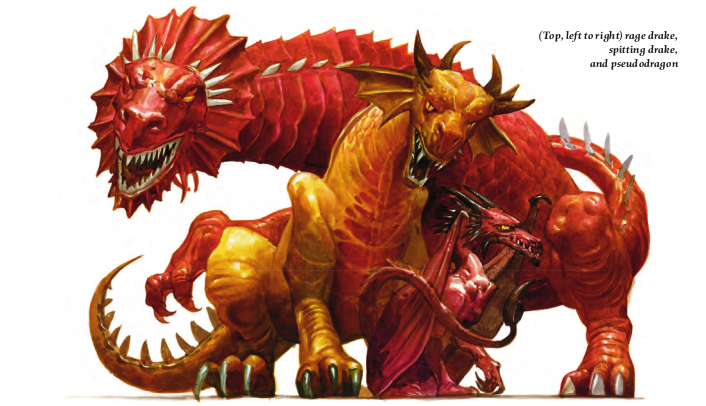
Copyright 2008 Wizards of the Coast This post is part of a series! Go here to see the other entries.
In this post we’ll continue to look at drakes, covering the rest of the ones present in the MM.
Pseudodragon
Ever since Kitty Pride from the X-Men got her pint-sized pet dragon, lots of people have wanted one for their own characters. D&D 3.x finally granted that wish by introducing pseudodragons as a familiar option in one of its early sourcebooks. They return here as a type of drake, being of Small size, and are present in both books.
While needlefang drakes are just “cat-sized”, pseudodragons pretty much are cats, at least personality-wise. Also of note is the fact that they’re really smart! The MM version has Int 6, and the MV equivalent not only has Int 9 but also has two languages listed in its stat block (Common and Draconic). They’re both still classed as Natural Beasts, so you could interpret that as meaning they can understand these languages but aren’t capable of speaking them. According to the MM, they purr, hiss, chirp and growl in the same situations a cat would emit each of these noises.
In the wild, they’re predators and scavengers, but usually stick to small prey and don’t attack animals unless threatened. Their high intelligence makes them highly valued as pets, as well.
MM pseudodragons are Level 3 Lurkers with 40 HP. They walk with speed 4 and fly with speed 8 (hover). They attack with a bite, or with a stinger that does the same amount of damage with some ongoing poison damage on top (save ends) and recharges on 3-6. Both of these count as basic attacks, allowing the pseudodragon to use the stinger when it performs a Flyby Attack. This, as usual, lets them fly their speed without drawing opportunity attacks and make a basic attack at any point.
They also have the ability to turn invisible when they stand still. This is a standard action that recharges whenever the critter is damaged, which makes it useful both for lying in ambush or for escaping an ambush gone wrong.
The MV pseudodragon has the same level, role, HP and speed, but trades Flyby Attack for a less powerful effect on its bite that allows it to fly 4 squares without worrying about opportunity attacks. The stinger remains a basic attack but is also a bit more restricted, as it can only be used on a target that can’t see the pseudodragon. To make up for this, its Invisibility power now allows it to move, and only ends when the pseudodragon makes an attack.
All of this adds up to a more lurkerish monster, which will charge its chosen target with a stinger attack while invisible, then use the bite combined with its high fly speed to get away.
Spitting Drake
Spitting Drakes are Medium, and got their name from their ability to spit gobs of acid. This is their main weapon when hunting, and they’re also easily domesticated to serve as (somewhat messy) guard animals. In the wild, they’ll sometimes join guard drake packs, which I think is an interesting worldbuilding detail. They’re present in both books but their stat block is the same in both cases.
These creatures are Level 3 Artillery with 38 HP, and run with speed 7. Their bite, as standard for artillery, is kinda weak. Their acid spit is a Ranged 10 attack targetting Reflex and doing acid damage.
Rage Drake
When the books say larger drakes are harder to tame, they’re talking about Rage Drakes. Our first Large drake, it also has the Mount keyword. It appears in both the MM and the MV.
Rage Drakes definitly didn’t get this name because they’re gentle! Adult specimens are outright impossible to tame, but a trainer that starts with a hatchling can make it into a combat mount better than any warhorse.
Wild rage drakes are highly territorial hunters. Like other drakes, they’re also social creatures who gather in clutches. In fact, a solitary rage drake will sometimes invite itself into a clutch or guard drakes or other smaller species and become its leader. So yes, it’s possible for your PC party to run into a single drake clutch composed of rage, spitting and guard drakes, all wild and all hungry.
Rage drakes are Level 5 Brutes with 77 HP. They have a single basic attack in the form of a bite, but also have a slightly weaker claw attack. Their Raking Charge ability allows them to charge and make two claw attacks.
When bloodied, Rage Drakes freak out! They become immune to fear, and gain +2 to hit and +5 to damage on all their attacks. If they’re serving as a mount, the rider also gains a +2 to hit on all of their attacks.
The MV version is largely identical, save for the facts that its damage math has been fixed and the damage bonus from being enraged is only a +2. The accuracy bonus for the drake and its rider remains the same.
Sample Encounters
The MM gives us three for the entire “Drake” entry:
-
Level 2: 2 guard drakes, 2 elf archers, 1 elf scout. A patrol and their guard animals.
-
Level 4: 1 pseudodragon, 1 human mage, 2 human guards, and 2 human bandits. Either a bandit squad of bandit-hunting militia, with the mage having brought his familiar along.
-
Level 5: 1 rage drake and a band of assorted lizardfolk protecting their swamp home.
Final Impressions
I really, really like this version of drakes, mainly because of the lore they bring along. Domesticated drakes should be a common sight in any society, which does a lot to make the world feel not only magical but also fresh. I’m actually a bit disappointed that 5th edition seems to have gone back on this and made them related to dragons again.
-
subscribe via RSS