Posts
-
Let's Read the 4e Monster Manual/Vault: Ettin
Copyright 2008 Wizards of the Coast This article is part of a series! Click here to see the other entries.
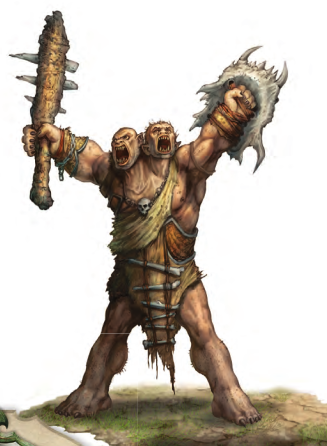
Ettins are two-headed giants who have been a part of the game since at least AD&D 1st Edition. Capitalization is important here - ettins are giants, not Giants, in the sense that they’ve never been part of the Giant entry. They’re present in both books.
The Lore
Fourth Edition maintains the tradition of giving ettins a separate entry from the other giants, but this time it includes a bit more lore to back that decision up. Most of that would be published after the Monster Manual, and is collected in the Monster Vault.
Ettins are kin to giants in that they originate from a primordial, but their creation myth is a bit different. It happened some time after the Abyss had formed - the god Amoth (who isn’t around in the present day) fought Demogorgon and nearly cleft him in twain. The earth primordial Storralk saw that and decided to attack Demogorgon while he was weakened.
Turns out Demogorgon wasn’t very weakened at all, and defeated Storralk in combat. Demogorgon buried Storralk beneath is throne in the Abyss, and as he gazed at the pools of Storralk’s blood with his brand new two heads, the first ettins emerged from that blood.
The big D cast most ettins out into the world, reasoning that since they sprang forth from Storralk’s blood, any pain they suffered would be inflicted on the still-living primordial. The few ettins bright enough to know about this creation myth prefer to associate themselves with Demogorgon rather than with Storralk, since Demogorgon was obviously the stronger of the two and whoever is strongest is bestest. For this reason, demon-worshipping ettin aren’t all that uncommon, and you can often find ettins and demons hanging out together. One of Demogorgon’s exarchs is an ettin.
Even if they’re not demon worshippers, however, ettins are still pretty terrible. Their two heads argue constantly and struggle to take control of the body from the other, but they both tend to agree that hurting and eating people is the height of fun. As a result, ettins are typically Chaotic Evil.
The Numbers
Ettins are Large Natural Humanoids with the Giant keyword. The major ettin signature trait comes from their two heads, and is named Double Actions. Ettins roll initiative twice, and take full actions on both results. They also get two immediate actions, but only one between each of their turns. The two sets of sense organs also mean that all ettins are trained in Perception.
Some of the ettins presented here also have Dual Brain, a trait which allows them to automatically end any dazing, stunning or charm effect on itself at the end of one of its turns.
The Monster Manual has two ettin stat blocks, and the Monster Vault has four. Only one of them is present in both books, so overall you have five unique creatures here. Let’s look at they in order of level.
Ettin Thug (MV)
The classic model, this is a Level 8 Brute with 110 HP. It runs at speed 6. It has Double Actions but not Dual Brain.
Its Smash basic attack has very low damage for a level 8 brute, but that’s because the ettin is going to be making that attack twice per round due to Double Actions. As a move action it can also Kick (Melee 1 vs. Fortitude), which pushes the target 2 squares and allows the ettin to move half its speed.
Ettin Wrath Chanter (MV)
This one is likely one of those demon-worshipping spellcasters. A Level 8 Elite Controller with 184 HP, it has both Double Actions an Dual Brain.
As the name would imply, the wrath chanter constantly sings a Rage Song in battle, which works as an Aura 5 that makes everyone within angry. This gives allies a +2 bonus to attack and damage. Enemies get a -2 penalty to attack but a +2 bonus to damage.
Since it’s an elite, the chanter’s basic Smash attack deals full damage, and additionally knocks the target prone on a hit. It can also use magic to Invoke Fury, a Close Burst 5 that targets a single enemy and hits automatically. It forces the victim to charge or make a melee basic attack against a target of the ettin’s choice! At least the charge doesn’t provoke opportunity attacks.
Against parties that include PCs with decent basic attacks (like Fighters) the war chanter will likely use Invoke Fury most often, sometimes mixing it up with Smash against a squishy to set up a particularly damaging charge. If that’s not the case, it will go the other way around, smashing most often and sometimes using Invoke Fury to screw up the party’s positioning.
Ettin Hunter (MV)
A slightly more sophisticated ettin who knows the value of killing people at range. It’s level 10 artillery with 86 HP, and it carries a brace of 10 javelins into combat. It has Double Actions but not Dual Brain.
All of the ettin hunter’s attacks are considered basic. It can use a javelin in melee (Reach 2) or throw it (Range 20). It can also throw a javelin extra hard to Pinion an enemy (Range 20 vs. AC, recharge 5-6). This does more damage than the normal throw and restrains the target until they can un-impale themselves (DC 18) or teleport away.
Ettin Marauder (Both)
A beefier take on the classic Ettin, this is a Level 10 Elite Soldier with 222 HP. It has both Double Actions and Dual Brain.
It attacks with a full damage Smash that also pushes the target 1 square on a hit and marks them for a turn. It can also Swat anyone who tries to flank it as a reaction (Melee 2 vs. Fortitude), pushing them back 3 squares on a hit.
The MM version is pretty much identical, save that its basic attack is named Club and it specifies that the ettin marauder wields a club in each hand. It’s interesting that none of the MV ettins specify this. Either the authors thought it’d be obvious and not worth the wasted space, or they’re stating ettins normally fight unarmed.
Ettin Spirit Caller (MM)
Another demon-powered spellcaster, this one a Level 12 Elite Controller with 252 HP, Dual Brain, and Double Actions. Its basic attack is a club that pushes the target 1 square. It can instead choose to spend a standard action casting the Curse of Shattered Bone (Ranged 10 vs. Will), which makes the next club attack from the spirit-talker against the target an automatic critical with 1d12 damage added on top of everything else.
The curse isn’t all that impressive - simply attacking twice might be a better bet. It would be a lot more dangerous if it made the next hit from any enemy (or even any ettin) a critical.
This ettin can also perform a Spirit Call which fills a Close Burst 5 with howling demonic apparitions. This targets Fortitude, does necrotic damage, and slides the targets 3 squares on a hit.
Sample Encounter and Final Impressions
There’s one sample encounter in the MM: Level 10, 1 ettin marauder, 2 venom-eye basilisks, and 3 barlgura demons.
I like the way ettins turned out mechanically here. The stat blocks are simple and have a strong signature gimmick. Their levels make them a good fit for an adventure that says “welcome to paragon tier! Now you’re going Against the Giants.” Ettins are weaker than hill giants in this edition, so they’re the first humanoid of unusual size the PCs are likely to fight.
-
Let's Read the 4e Monster Manual and Monster Vault: Ettercap
Copyright 2008 Wizards of the Coast This article is part of a series! Click here to see the other entries.
My first contact with ettercaps was in Neverwinter Nights, where if you found a bunch of giant spiders in a lower-level module you could be sure an ettercap wasn’t far behind. They’ve been around since at least 2nd edition, when they appear in the Monstrous Manual. It’s likely earlier editions featured them in a supplement.
In 4e they still fulfill pretty much the same narrative role as before: hostile, non-drow spider-wranglers. They appear only on the MM.
The Lore
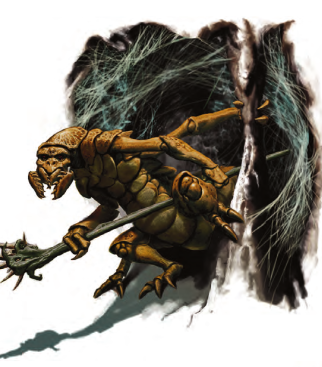
Ettercaps are sapient humanoids, give or take a few extra limbs. They’re not terribly bright with a typical Int score of 5. The book describes them as “primitive, instinctual hunters”, which I guess means Stone Age-level technology. If evolution was a thing in D&D they’d probably be related to spiders in the same way humans are to apes.
Ettercaps are carnivorous and hunt using both weapons and their copious natural gifts, which includes a venomous bite, the ability to produce webs, and a “spiritual kinship” with arachnids that give them a nearly unmatched ability to tame these beasts.
Despite being Unaligned, ettercaps don’t mind including other sapients in their menu, such as your PCs.
The Numbers
The MM gives us two ettercap stat blocks. They’re Medium Natural Humanoids with the Spider keyword. Their signature traits are Resist 10 Poison, a climb speed with Spider Climb, and Web Walker, which allows them to ignore difficult terrain and other movement effects from spider webs and spider swarms.
They also get a spider bite and some sort of web-spinning power, though the exact forms these take vary in each stat block.
Ettercap Fang Guard
This level 4 Soldier has 56 HP and all the common traits described above. Its speed is 5 in all movement modes. It wears leather and wields a greataxe in combat.
The basic greataxe attack has the High Crit property but is otherwise pretty standard. The fang guard’s spider bite requires combat advantage and does a less damage than the axe, but triggers a secondary attack against Fortitude that stuns the victim for a turn and causes ongoing poison damage (save ends).
The fang guard gains +2 to attack and damage rolls against a restrained or immobilized target, and it can try to immobilize them with its Web Tangle attack, which targets reflex and immobilizes (save ends) without doing damage.
I suspect a MV-style makeover would likely make the spider bite a single attack against Fortitude.
Ettercap Webspinner
I believe this one is the closest to the “classic model” from previous editions. A Level 5 Controller with 64 HP, the web spinner also possesses the standard abilities outlined at the start of this section.
It fights with a Reach 2 longspear, and its spider bite doesn’t stun but still does ongoing damage. As a 1/round minor action, the webspinner can cast a Range 5 Web Net that targets reflex and restrains on a hit (save ends; no damage). With a bit of effort it can make a bigger net and create a zone of Webbed Terrain (Area 2 Within 10 vs Reflex), which immobilizes everyone it hits (save ends) and creates a zone of difficult terrain until the end of the encounter. This recharges on a 6, so you might end up with quite a lot of webbing all over the battlefield if you roll well or have multiple webspinners in an encounter.
Any ettercap can safely ignore the difficult terrain from the webs, and this is likely true of a lot of other spider monsters, so they’ll want to use this as often as they can.
Sample Encounter and Final Impressions
The sample encounter is Level 4: 1 webspinner, 2 fang guards, and 2 deathjump spiders.
One mechanical problem I see with these ettercaps is that they must usually choose between doing damage and impairing movement on each of their turns. They’re also built with a more “naturalistic” approach that actually makes the Level 5 webspinner do less damage in its attacks than the Level 4 Fang Guard. If neither issue is fixed, they’ll be less of a threat against the PCs than the numbers might indicate.
In the end I see no reason to include ettercaps in your game unless you’re going all-in on the spider theme, and I don’t lament their absence from the Monster Vault.
-
Let's Read the 4e Monster Manual/Vault: Elf
Copyright 2008 Wizards of the Coast This article is part of a series! Click here to see the other entries.
I’ve mentioned elves plenty of times already, and now it’s time to talk about them properly. They’ve been available as a playable character option since the days of Basic (though arguably Basic elves were closer to eladrin).
This entry is for the elves you might meet as enemies or NPC allies. They’re present in both the MM and the MV.
The Lore
We’ve already looked at drow and eladrin, so we know that 4e elves are an offshoot of an ancient fey people created by Corellon who migrated from the Feywild to the world and went through some adaptative changes over the generations.
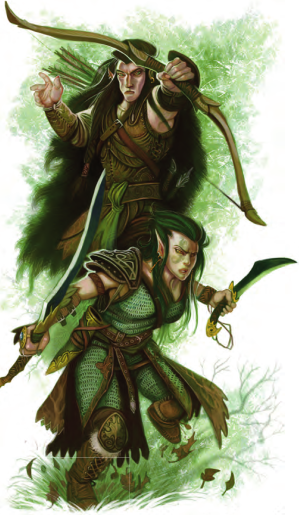
They look pretty much like what you’d expect a D&D elf to look: slender, sharp features, pointy ears. They’re about as tall as humans, perhaps a tiny bit shorter. Their hair has “earthier” colors than those of eladrin, with several shades of brown being the most common along with tones like moss-green, autumn orange, and so on. Their eyes can be brown, green, blue or violet, and have a more familiar “sclera and iris” arrangement than the solid orbs of color found in eladrin. Elf skin tones are the same as those found in humans, with the darker tones being more common.
Elves primarily worship Melora and the primal spirits, so their relationship with nature is more reverent and has a greater conservationist bent than that of eladrin. Eladrin alter a forest with magic so that it grows harmoniously around and within their shining cities; elves prefer to adapt their own lifestyle and settlements to fit the existing natural landscape, which is how you get treetop villages.
To a human elves usually seem laid-back and flighty, as their lifespans are still large enough that they take a long view of most things. Still, they’re less aloof and disinterested than the eladrin, since they do live in the world and care about what happens here.
The Numbers
We have four elf stat blocks here, two of which are exclusive to the MM and all of which are early-Heroic. Elves are Medium Fey Humanoids with the same signature traits they get as PCs:
- Low-light vision
- Speed 7.
- Wild Step, which lets them ignore difficult terrain when shifting.
- Elven Accuracy, which lets them re-roll an attack once per encounter.
The MM versions also get Group Awareness, which gives +1 to the Perception tests of all allies within 5 squares. This is absent from the MV, as it’s more relevant to PCs than to monsters.
Elf Archer
Can’t get more typical than this! Present in both books, the archer is Level 2 Artillery with 32 HP and all common elf traits. It also gets Archer’s Mobility, gaining a +2 bonus to attacks in turns where it moves 4+ squares.
It wields a longbow and has a shortsword for emergencies, neither of which is affected by the damage bug. It also has a triggered ability called Not So Close, which allows it to shift 1 square and make a ranged attack against an enemy that makes a melee attack agains it. This is a reaction, so the enemy attack has to be resolved before the elf can get away.
Crossbowdwarves fight in close formation; eladrin bow mages spread out a bit more; elven archers are tree-hopping ninjas that never stay still.
Elf Scout
Okay, you can get more typical than that. The Elf Scout took the two-weapon path instead of going with archery. As such, it’s a Level 2 Skirmisher with 39 HP and all common elf traits. It’s present in both books.
It wields a longsword in one hand and a shortsword in the other, each counting as a basic attack. It can attack with both in one action using Two-Weapon Rend, dealing a bit of extra damage if it hits with both blades. It also sneak attacks for 1d6 extra damage. Yes, the two effects can stack.
No special mobility powers other than the common traits, which already make the scout pretty mobile.
Elf Hunter
A Level 2 Minion Skirmisher, the elf hunter is likely a literal hunter that has to defend themselves in a pinch. It lacks Elven Accuracy but has all other common traits. It fights with a shortsword, and its basic attack allows it to shift 2 squares on a hit or 1 on a miss.
Elf Noble Guard
Wearing mail and wielding a longsword, the noble guard is a Level 3 Soldier with 46 HP and all common elf traits. It retains its Speed 7 even in mail. As expected of a soldier, the longsword attack marks for a turn. It can also use a Hobbling Strike which does more damage and immobilizes for a turn on a hit. On a miss it does half damage and slows instead. This also counts as a basic attack, so it can be used in charges and the like, but it recharges on 5-6 so the simpler longsword blow will still see plenty of use.
If someone ignores the noble guard’s mark, it can attack that enemy as a reaction, dealing standard longsword damage and immobilizing the target on a hit.
Sample Encounter and Final Impressions
There’s one sample encounter in the MM: Level 2, two archers, two scouts, and two grey wolves. A typical war party made up of typical members.
These stat blocks do a good job of conveying that wood elf flavor. In most campaigns I think it’s more likely that the PCs will end up having some of them as NPC allies than as enemies, just as with dwarves. Still, plenty of campaigns are likely to have at least one enclave of paranoid forest guardians who shoot strangers on sight.
A little rejiggering of signature traits and the addition of spiders can also turn the sample encounter into a party of drow scouts for some early-Heroic foreshadowing of Underdark shenanigans.
-
Let's Read the 4e Monster Manual/Vault: Elemental
Copyright 2008 Wizards of the Coast This article is part of a series! Click here to see the other entries.
Elementals have been part of D&D since its very beginnings. Their basic definition has remained the same throughout: they’re living aglomerations of elemental matter who often take roughly humanoid forms and have powers related to their constituent element. They often get summoned by wizards to fight their enemies, or can be found either as bound guards or as fantasy wildlife.
In earlier editions, you had your four classic elemental planes: Fire, Air, Water, Earth. They were pretty much composed entirely of their naming element and were basically places to summon elementals from, since nothing else could live there. AD&D and its Great Wheel cosmology added a bunch of “quasi-“ and “para-“ elemental planes that served as sources of more exotic elementals. You know how it goes: water and fire equals steam, so there’s a steam plane that’s home to steam elementals, and so on.
Fourth Edition instead has the Elemental Chaos, which we already looked at when talking about demons. It contains all elements, whether they’re the classic four or some of the other mixes. It’s also a lot more interesting in that it’s possible for PC adventurers to go there and have adventures in fantastic and varied landscapes without much in the way of magical life support. It has entire cities and civilizations of creatures with the Elemental origin.
And it also has small-e elementals! Their basic nature remains the same, and they make up much of the “wildlife” of the Elemental Chaos, but much like their new home plane they can be made up of multiple elements. In fact, 4e went so hard for these amalgam beings that traditionalist players began to complain that they never saw plain old single-substance elementals any more. The classics would finally appear in the Monster Vault.
Elementals don’t necessarily band together by element type. Many of them follow orders from more powerful beings from the Elemental Chaos such as efreets and titans, and will form up in whatever way their orders require. “Wild” elementals do like to stick together with others who share one or more of their elements though.
Let’s look first at the Monster Manual elementals, then at the Monster Vault ones.
Monster Manual Elementals
The MM gives us four elementals, all two-element and with levels spanning the paragon and early epic tier. As usual, the reasoning for these levels is that the Elemental Chaos is a place you explore when you hit paragon tier, and so these creatures are a sample of what might oppose you once you’re there. All of them are Large Elemental Magical Beasts, with keywords corresponding to their constituent elements. They have Int scores between 6 and 8, so they’re not mindless but not geniuses either.
Firelasher
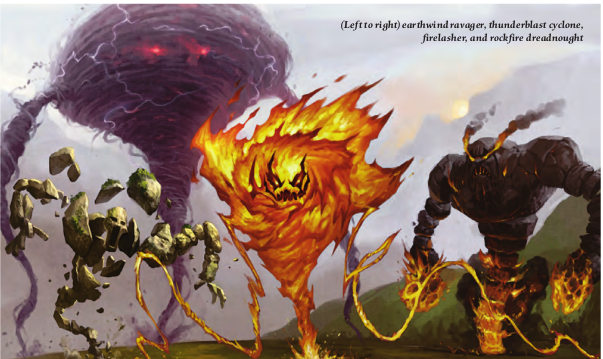
Made of Air and Fire, the firelasher looks like a fire whirlwind with long, thin tentacles for arms. It’s a Level 11 Skirmisher with 108 HP, immune to disease and poison, and with fire resistance 25. It flies with speed 8 (hover).
Its basic melee attack is the titular fire lash (Melee 2 vs. Reflex, fire damage). It also has a special attack named Wildfire Cyclone (Close Burst 2 vs. Reflex, recharge 5-6). This does fire damage on a hit, in addition to pushing the targets and knocking them prone. On a miss, it still does half damage. And it can also make a Whirlwind Dash, which allows it to fly twice its speed without provoking opportunity attacks and deal 10 automatic fire damage against anyone whose squares they fly through. This recharges on a 6 and will likely be used whenever available.
This one pairs very well with other creatures that are resistant to fire, since it won’t need to worry about hurting them with its Whirlwind Dash.
Rockfire Dreadnought
Sitting at the other end of Paragon Tier, this Earth and Fire beast is a Level 18 Soldier with 170 HP. It’s immune to disease, petrification and poison, and has Resist 25 fire. It runs at speed 8.
This one really feels like it should be a Brute, because it has two very simple attacks: the Fist of Flame (basic, Melee 2 vs. Reflex, fire damage) and a chucked Brimstone Rock (Ranged 10/20 vs. AC, physical and fire damage). No marks, no additional riders.
Earthwind Ravager
A cyclone full of rocks! It’s a Level 23 Controller with 219 HP. It’s immune to disease, petrification and poison, and flies with speed 8 (hover).
The ravager’s basic attack is a simple Slam (Melee 2 vs. Fortitude, physical damage). It can also trap a victim in a Wind Devil (Ranged 5 vs. Fortitude). This does some damage on a hit and immobilized the victim for a turn. It can also be sustained with a minor action, causing the victim to remain immobilized for another turn and take some automatic damage.
The ravager can also surround itself with a Whirlwind (Close Burst 1 vs. Fortitude) which does damage and pushes targets 2 squares on a hit. And finally it can use a Buffeting Blast (Close Blast 3 vs. Fortitude, recharge 5-6) which does damage and stuns for a turn if it hits.
One of your PCs will remain immobilized for the duration of the combat unless they can stop the ravager from spending that minor action every round. Immobilized PCs are of course prime targets for the Buffeting Blast.
Thunderblast Cyclone
To close it out we have a living storm made of Air and Water. It’s Level 26 Elite Artillery with 382 HP, and Huge instead of Large. Immune to disease and poison, it also has Resist 30 to lightning and thunder and a fly speed of 10 (hover).
This elemental has two basic attacks, a Reach 3 Lightning Arc and a Range 10 Lightning Bolt, both of which target Reflex and do lightning damage. It can also emit Thunderclaps (Close Burst 2 vs. Fortitude) that cause thunder damage.
When cornered, it can respond by generating a Charged Mist in a Close Burst 3, which hits automatically for some lightning damage and turns the creature insubstantial for a turn. Insubstantial creatures can still be hit by attacks, but they halve all damage they take (including ongoing damage).
Using Charged Mist also charges up the Lightning Storm power (Area Burst 3 Within 20 vs. Reflex), which does a generous amount of thunder and lightning damage, half on a miss.
Monster Vault Elementals
The Monster Vault tries to address some long-standing criticism from those traditionalists I mentioned at the start of this post: that the good old single-element quartet was nowhere to be seen, and that there were few elementals suitable for low-level adventurers.
It presents us with four entries, the Lesser Elementals of Air, Earth, Fire and Water. They’re all level 1 or 2, and Small in size. Presumably there’s a 3.x-like progression of increasingly powerful traditional elementals, but those are left as an exercise for the reader.
Lesser Air Elemental
This Level 1 Lurker has 23 HP, flies with speed 6 (hover), and has Vulnerable 5 fire for some reason. It has a passive trait named Phantom on the Wind, which makes it automatically turn invisible whenever it starts its turn without an enemy adjacent to it. This lasts for a turn or until the elemental makes an attack.
Its basic attack is a relatively weak slam. Its main trick is the Grasp of Storms (Melee 1 vs. Reflex), which can only target creatures that can’t see the air elemental. A hit does more damage than the slam and grabs the target (escape DC 12). Grabbed targets take 5 ongoing damage and absorb half the damage of any attack directed against the monster while the grab lasts. Only one victim at a time can be grabbed.
A whole pack of these striking from ambush would be Fun (TM), particularly if they manage to grab multiple PCs. More powerful versions, in addition to being bigger and having a higher level, could probably turn Grasp of Storms into a close burst and be able to maintain more grabs at once.
Lesser Earth Elemental
This Level 2 Soldier has 42 HP. It walks and burrows at speed 5, and has Tremorsense 5, allowing to sense anyone in that radius as long as they’re in contact with the ground or a wall.
Its Earth Glide trait allows it to phase through earth and rock at will, and its Brittle Skin trait means it takes a -2 to its defenses for a turn if it takes any thunder damage.
Its only attack is a slam, which does damage as usual and prevents hit targets from shifting for a turn. There’s also the Overwhelming Stone ability, which triggers when a nearby enemy hits one of the elemental’s allies with a melee attack. The elemental automatically knocks the attacker prone! This recharges once the elemental is first bloodied.
More powerful versions can probably use Overwhelming Stone more often, and likely turn it into an attack that can do damage.
Lesser Fire Elemental
A Level 1 Skirmisher with 27 HP, the lesser file elemental runs at speed 8 and flies at speed 4 (clumsy). Its passive traits mean it cannot shift for a turn if it takes cold damage, and causes 3 damage to anyone who misses it with a melee attack.
Its slam attack targets Reflex is remarkable for not doing any immediate damage - it only does ongoing fire damage (save ends). Lesser fire elementals can also shift as a minor action instead of a move one.
More powerful versions should likely add immediate fire damage to their melee attacks, and more damage on missed attacks.
Lesser Water Elemental
A Level 1 Controller with 29 HP, the lesser water elemental walks and swims with speed 6. It is of course Aquatic, and taking cold damage causes it to take 5 extra damage from the next attack that hits it.
Its slam does relatively little immediate damage, but also does ongoing 5 damage. I guess it fills the target’s lungs with water. It also has an encounter power called Whelm (Close Blast 3 vs. Fortidude, affects only enemies). On a hit this does damage, pushes the target 2 squares and knocks it prone.
As a minor action, the elemental can slide each creature taking ongoing damage from its slam by 1 square as it uses the water in their lungs to push them around.
More powerful versions likely can use Whelm more often and perhaps have it cause ongoing damage as well.
Sample Encounters and Final Impressions
The MM has two encounters:
-
Level 11: A firelasher and a bunch of yuan-ti cultists, placing the elemental as summoned muscle.
-
Level 18: A rockfire dreadnaught, 2 fire giants, and a mind flayer mastermind. I guess ol’ squidface managed to snag himself some beefy thralls.
As for the MV lessers, I guess it’s actually possible to fight all four of them at once, as they don’t actually get in each other’s way! I’d likely add a second air elemental to make it a proper five-monster band. You can also add them to any band of low-level opponents that include a spellcaster who could plausibly summon them.
-
-
Let's Read the 4e Monster Manual/Vault: Eladrin
Copyright 2008 Wizards of the Coast This article is part of a series! Click here to see the other entries.
I’ve already talked about eladrin in passing when discussing drow, and now I’m going to get into more detail on them. They’re present in both books, though they’re mixed into the general “Elf” entry on the Monster Vault.
“Eladrin” is one of those names that used to refer to something else entirely in previous editions. In this case, the name belonged to a set of Chaotic Good Outsiders from Arcadia, only some of whom resemble elves. Now it belonges to a playable race that has its roots in the Feywild.
While no D&D player expects elves to be Santa’s little helpers, there are several competing visions of what a “proper” elf should be. Woodsy archers who wear earth-toned cloaks and shoot bows really well, like Legolas? Ethereal fey wizards who live in resplendent silver cities, like Galadriel? Several of the game’s settings in previous editions made attempts to accommodate both concepts, and Eladrin are part of 4e’s own effort.
In short: Legolas is an elf, Galadriel is an eladrin.
The Lore
As we saw with drow, back in the dawn of time there was only a single “proto-elven” fey people, created by Corellon the god of magic and beauty. They lived in the Feywild, where they built fantastic empires powered by arcane magic.
Over time this ancient people underwent something of a diaspora, with part of them migrating to the world and adapting to its local conditions, becoming the elves we know today. Some of those would in turn convert to the worship of Lolth and get driven into the Underdark, becoming the drow.
Those who stayed in the Feywild are known today as the Eladrin. Are they still the same ancestral fey of legend, or have they undergone changes of their own? Only your GM can tell.
Eladrin and elves still look somewhat similar, but still have some obvious visual differences that make distinguishing the two easier. The most striking of those are the eyes, which are solid orbs of blue, green or violet. Eladrin hair also tends to be a brilliant white, or a metallic color like silver or gold. Their skin can be of any tone found in humans, but the lighter tones are more common. Less obviously, eladrin also tend to be a bit taller than elves, and they’re longer-lived.
Most eladrin live in those fabulous Feywild cities, which are usually built in places that touch the world with some frequency. Thus they’re a common enough sight in the world to justify their inclusion as a playable character option.
Your typical eladrin citizen has a somewhat detached view of the world, particularly since their cities weren’t affected by any of the bad stuff that took down Nerath. Still, that typical citizen is still pretty relatable all things considered.
The higher-up an eladrin is in their society, the more magically powerful and weird they tend to be. Eladrin nobles are fully involved with the Fey Courts, taking titles relating to the seasons or other abstract concepts. The most powerful among them are quite likely to have become true fae and be the sort of entity who makes pacts with warlocks.
The Numbers
The Monster Manual and Monster Vault give us four eladrin stat blocks each. Two of them (the Fey Knight and Twilight Incanter) appear in both books. The ones in the Monster Vault are clustered around the late-Heroic tier, but the ones in the MM start there and go all the way to epic. All the MM ones have an alignment of “Any”, while the MV ones are listed as unaligned. In either case this means they can be either enemies or allies depending on the specific individuals that appear in your stories.
All eladrin are Medium Fey Humanoids, and their most famous signature trait is Fey Step, an encounter power which allows them to teleport 5 squares as a move action. They also have low-light vision, and a +5 bonus to saves against charm effects.
Eladrin Bow Mage
The bow mage is Level 7 Minion Artillery. It has Speed 6, is trained in Perception and carries a magic bow that fires Force Arrows: Ranged 20 vs. AC, a hit does force damage and pushes 1 square. These wouldn’t be stealthy tree-climbing snipers, but rather battlefield archers that fire in formation. You’ll want to have then in a loose formation, though, to avoid those area-effect attacks.
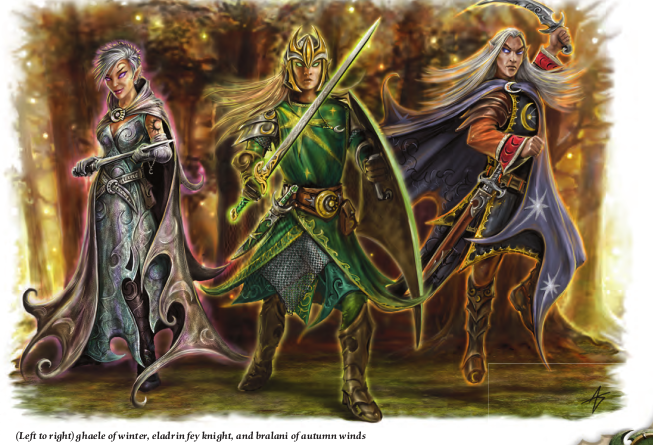
Eladrin Fey Knight
This one exists in both books. It’s a Level 7 Soldier with 77 HP. It wears mail, and wields a light shield and a longsword. The MV version is clearly the best of the two, so let’s start with that.
The fey knight cuts a striking presence in the battlefield, projecting a Feywild Tactics aura in a 5-square radius that allows allies in range to score criticals on a roll of 19-20 rather than just on a natural 20. There are very few abilities in 4e that mess with critical range - IIRC this is the first one I’ve seen on this Let’s Read.
Beyond the basic longsword attack, the fey knight can also attack with a Stab of The Wild: Recharge 5-6, Melee 1 vs. AC, a hit does more damage than the basic attack and restrains the target for a turn with what I assume are entangling vines. As a minor action it can issue a Feywild Challenge to mark a target within a Close Burst 5. It’s kinda like a paladin mark, lasting until the end of the encounter or until the knight uses the challenge again, and dealing a bit of radiant damage to the target when it doesn’t attack the eladrin on its turn.
The fey knight can also protect its allies with Harvest’s Sorrow, an immediate interrupt that allows it to take half the damage of an attack directed at an ally within 5 squares. It of course also has Fey Step.
The MM version is similar but a bit clunkier aside from the damage bug. Stab of The Wild works the same but the knight can’t use its sword while a target is entangled. Feywild Challenge has a range of 10 but is an encounter power. Use the MV version if possible.
These are knights, so you can probably give them some sort of gallant fey steed if you need to. They’re the ones fighting at the front and protecting that unit of bow mages, and also make up the core of a noble’s guard detail.
Eladrin Twilight Incanter
This wizard is a Level 8 Controller with 82 HP, present in both books. It wields a spear in combat, and its strikes slow the target for a turn in addition to doing damage. Since the incanter is a Controller, its spear attack actually has decent accuracy and damage!
The incanter is also dangerous at range, with a suite of spells. Binding Bolt (Ranged 5 vs. Reflex) does force damage and immobilizes for a turn. On a miss, it instead slows for a turn. Teleporting Bolt (Ranged 5 vs. Reflex) does force damage and teleports the target 3 squares on a hit. On a miss it still teleports the target 1 square. Its final spell is Dazzling Blast (recharge 5-6, close blast 3 vs. Will), which does radiant damage and blinds for a turn on a hit.
The MM version has Range 10 on the bolt spells, and specifies that Teleporting Bolt can’t teleport someone to an unsafe square. That’s just no fun, so I see why it’s gone from the MV version. I suppose the teleport victim can still roll a save to throw itself at an adjacent safe square at the last minute, as standard for forced movement.
Eladrin Battle Dancer
This is a MV-only Level 9 Skirmisher. It has speed 6 despite wearing mail, and fights with a longsword. The basic sword attack, named Dancing Blade, causes the battle dancer to become invisible to the target for a turn! It also has a Battle Dance encounter power that allows it to shift its speed and perform a basic attack against any enemies it passes adjacent to.
It seems the Battle Dancer has also put some extra practice into its teleportation, for it replaces the usual Fey Step with a Surprise Fey Step. The range is the same, but it recharges on a 3-6 and grants the dancer combat advantage against every enemy it appears next to.
Bralani of Autumn Winds
The MM sends us right into the late Paragon tier! A bralani used to be a type of outsider in 3.x, but now it’s apparently a rank in the fey courts. This wind-themed noble is a Level 19 Controller with 180 HP. It has Resist 20 Radiant and is vulnerable to necrotic damage, which slows it for a turn. The bralani is surrounded by the Cloak of Autumn Winds, an aura 5 that makes its enclosing volume difficult terrain for enemies - even if they’re flying.
Its basic longsword attack does nothing special aside from the damage, but once per encounter the bralani can curse someone with Autumn Chill (Ranged 5 vs. Will), which weakens the target until the end of the encounter! It can also use an at-will Whirlwind Blast (Close Blast 5 vs. Fortitude). On a hit this does thunder damage and pushes targets 2 squares (3 on a critical). On a miss it still does half damage.
Ghaele of Winter
A bit higher up in the totel pole is the Ghaele of Winter, Level 21 Artillery with 134 HP. It has 25 cold and radiant resistance, and the same necrotic vulnerability described for the bralani. This ghaele is, well, an Elsa. Its basic attack is Winter’s Touch, which does cold damage. It can cast Freezing Rays (Ranged 12 vs. Reflex) that do cold damage and slow (save ends).
It can create bursts of Chilling Defiance (Close Burst 3) at will, which hit automatically, do a flat 10 cold damage and slow for a turn. For each target that takes damage from this, the ghaele regains 2 HP. It can also command someone to let it go with its Imperious Wrath (minor action, Close Burst 3 vs. Will), which dazes targets until the end of the encounter. This recharges whenever the ghaele regains 4 HP or more from a single casting of Chilling Defiance. Fey Step rounds out its abilities.
So yeah, this is an artillery monster you do not want to go near.
Sample Encounters and Final Impressions
There is one sample encounter here, but thematically, it’s a doozy: Level 21, 1 ghaele of winter and 4 wild hunt hounds. Yup, the Wild Hunt exists in this setting, and it’s run by and for the less friendly sort of epic-level eladrin.
As far as attempted solutions to Elf Overload go, I like eladrin a lot. Their name doesn’t include the word “elf” anywhere, making it a bit easier to remember which is which. They’re an entirely different race mechanically, which is a better solution than others I’ve seen that ended up loading up a single “elf” race with bonuses related to both concepts. They’re also really atmospheric on their own, of course, and allow players to portray genuine fae folk from level 1 if they so choose.
subscribe via RSS