Posts
-
Let's Read the 4e Monster Manual/Vault: Galeb Duhr
Copyright 2008 Wizards of the Coast This article is part of a series! Click here to see the other entries.
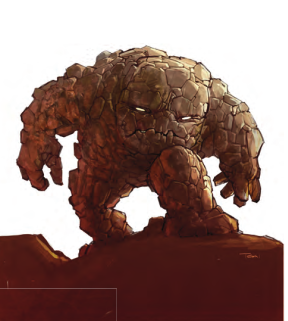
The Galeb Duhr apears in the AD&D 2nd Edition monster manual, and I believe in supplements for earlier editions, as this boulder-shaped creature that mostly just likes to hang out in rocky places. In Fourth Edition they get a slightly more humanoid appearance and some additional backstory. They appear only on the Monster Manual.
The Lore
Like the Azers, Galeb Duhrs were originally dwarves who failed to escape the yoke of the giants, and who were mutated through the ensuing eons of servitude. Unlike the Azers, they’re aspected to Earth, and so look like people made out of rock.
Today, many Galeb Duhrs are free and live in the world, where I suspect they’d behave much like the ones from AD&D. Still, many of them are still subservient to the earth giants both in the world and back in the Elemental Chaos, which makes them potential opponents to PCs. Even free galeb duhrs might end up fighting you if you anger them, of course, and as beings of earth they’re very hard to calm down once angry.
The Numbers
Galeb Duhrs have a few signature traits, starting with Tremorsense 10. As creatures of earth, they’re immune to petrification and poison. Their ponderous steps carry them at speed 4, but they can burrow at speed 6. They’re Medium Elemental Humanoids with the Earth keyword.
Power-wise, galeb duhrs are pretty much earthbenders. Earlier editions gave them all sorts of earth-based spells, and these ones have powers that manipulate soil and rocks in ways that fit their roles.
Galeb Duhr Earthbreaker
The earthbreaker is Level 8 Artillery with 73 HP. Its basic attack is a slam, but it will mostly Hurl Stones (Area Burst 1 Within 10 vs. AC), which deals a bit of physical damage and makes the affected area difficult terrain. There’s an explicit note in the power saying that the creature can create its own ammunition if none happens to be available in the surrounding area.
If someone gets too close, the earthbreaker can cause a Shock Wave (Close Burst 2 vs. Fortitude; Recharge 5-6) that does a bit of damage, pushes 1 square, and knocks prone.
Damage from Hurl Stones is actually about right for a level 8 area attack; the others need to be increased a bit.
Galeb Duhr Rockcaller
This Level 11 Controller has 118 HP. Its slam is a little beefier, and it can also use a Rolling Attack which works as a charge that targets Fortitude, pushing the target 1 square and knocking them prone in addition to doing slam damage.
The rockcaller can also use Earthen Grasp against a target who is touching the ground (Ranged 10 vs. Fortitude). This does no damage but restrains (save ends) on a hit. Only one creature can be so restrained at a time.
As an at-will minor action, the Rockcaller can also turn 4 earth or stone squares inside a Close Burst 10 into difficult terrain. These don’t need to be contiguous! Unless you’re fighting over a frozen lake or atop a solid cloud, the whole battlefield will become difficult terrain given enough time.
Sample Encounter and Final Impressions
The sample encounter is level 11: 1 rockcaller, 4 gargoyles, and 1 bulette. The bulette is surely there as a surprise interloper who will go for the combatants most obviously made of meat: the PCs.
You are also likely to find galeb duhr in earth giant strongholds, as slaves and guards. Like the azer, they’d be the first line of defense against invaders, covering those entry points too small to fit a giant. Also like azer, you might be able to persuade them to rebel.
I like galeb duhrs, and their shared origin with the azers and dwarves. It’s still perfectly possible to have interactions with them that resemble the ones you’d have with their 2e counterparts, but the added backstory gives you more hooks from which to hang your plots. Their culture is less complex and craft-based than that of the azers, but then again so is that of their giant masters.
-
Let's Read the 4e Monster Manual/Vault: Foulspawn
Copyright 2008 Wizards of the Coast This article is part of a series! Click here to see the other entries.
I haven’t seen Foulspawn before 4e, though I suppose they could be a very late 3.x creation. Here, they’re present only on the Monster Manual.
The Lore
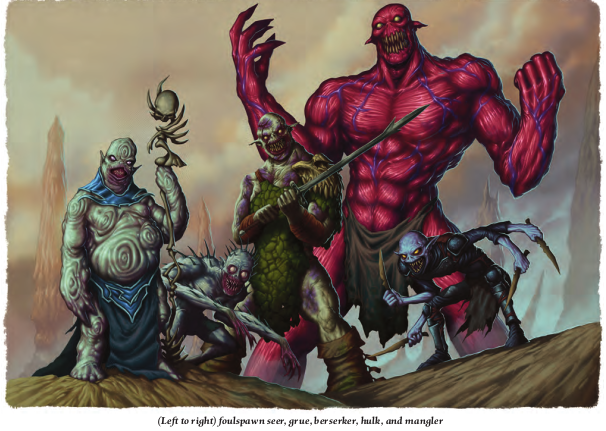
Foulspawn are humanoids corrupted by contact with the lovecraftian Far Realm or its energies. This warps them both physically and mentally, turning them into knife-toothed monstrosities with a hatred for the natural world and its inhabitants, and a compulsion to serve powerful aberrant creatures like aboleths, beholders, or mind-flayers.
That’s all the lore we get in the MM, though it does make room for some speculation. Deranged cultists are a traditional trope in adventures where the Big Bad is a cthulhoid monster, and foulspawn seem to be basically the end state for those cultists once they get deep enough into their trade. So their insane mindset might very well be something they already had with them when they underwent the physical transformation into foulspawn.
Does this mean you could find a foulspawn who was involuntarily transformed and still holds something of its memories to become an ally of the party? That’s interesting, so I’m saying yes.
They’d also be the terrible fate hangs over star pact warlocks who can’t cut it, mirroring the “eternal damnation” and “get turned into a mushroom” threats that hang over the other pacts.
The Numbers
Foulspawn are Aberrant Humanoids of varying size. They have low-light vision, and little else in the way of universal traits. Their magic, when they have it, tends towards psychic powers or stuff that bends time and space in that classic “non-Euclidean nightmare” style. Their typical alignment is Chaotic Evil.
Some foulspawn, but not all, also gain miscellaneous bonuses when they’re bloodied.
All of the foulspawn in this entry suffer very heavily from the damage bug, as their designer took a mistaken “naturalistic” approach when writing them up. This would probably be fine in 5e or 3.x, but here monster damage has to be purely a function of level. Making a monster’s basic attack deal 1d4+3 damage because it holds a dagger and has STR 16 makes it too weak even at level 1.
Foulspawn Grue
The one that eats you if you linger in the dark for too long. These Small Level 8 Controllers have 87 HP, and are fairly slow with Speed 4. They also have a teleport speed of 4, allowing them to come at you from unexpected angles.
They suffer quite a bit from the damage bug, as their basic claw attack is on the weak side. Its riders are pretty good, though - slow (save ends), or daze (save ends) if the target is already slowed.
Once per encounter they can infect someone with a Mind Worm (Ranged 10 vs. Will), which does no damage but inflicts a -2 penalty to Will and slows (save ends both). They can also utter Whispers of Madness (Recharge 5-6, Ranged 5 vs Will), which do a nice bit of psychic damage and have the same riders as the claw attack. Deafened targets are immune to the whispers, which might prompt some PCs to plug their ears (and become more vulnerable to the grue’s lurker buddies).
Foulspawn Mangler
This four-armed Medium terror is a Level 8 Skirmisher with 86 HP. It gains +2 to AC, Reflex and Speed when bloodied, taking its native speed of 7 up to 9.
Though the mangler is armed with four daggers its basic attack consists of a single, ridiculously weak stab (1d4+3 for a level 8 monster!). There’s a Dagger Dance ability that allows it to stab four times and shift 1 square between each attack, but that’s only usable twice per encounter.
The mangler can also throw 2 of those daggers at-will (Ranged 5/10 vs. AC), which doesn’t quite leave it weaponless because it has four backup weapons. It also deals +2d6 sneak attack damage and gains a +5 to AC against opportunity attacks from movement.
One way to bring the mangler’s damage up to speed is to simply make Dagger Dance an at-will action. Making its dagger damage something like 4d4+3 or 2d6+5 is probably still the better option though.
Foulspawn Berserker
This Medium Level 9 Soldier has 102 HP. Its projects a Berserker Aura (Aura 1); anyone within who makes a melee attack targets a random creature in their reach! You’ll want to keep your allies well away from the party’s fighter when fighting this monster. The berserker gains +2 to Fortitude and damage rolls when bloodied, is immune to fear, and runs at speed 7.
It fights with a greatsword, which once again suffers from a case of ill-thought-out naturalistic design. The berserker also deals 5 extra damage on a charge, and causes Mental Feedback on anyone who hits with a charm effect. This does 10 damage to the attacker and to the berserker, which means charm effects are actually a good choice for a PC who doesn’t mind getting a little hurt in the process.
Foulspawn Seer
This spellcaster is Level 11 Artillery with 86 HP and the Leader keyword. It projects an aura of Foul Insight out to 10 squares, giving any ally in range who can hear the seer a +2 to one roll (attack, ability, skill, or save) on their turn. It moves at Speed 6 and also has a teleport speed of 3.
Its attack powers are similarly all about warping space: the Warp Orb (Ranged 10 vs. Reflex) deals physical damage and dazes (save ends). The Distortion Blast (Daily; Close Blast 5 vs. Fortitude) does the same but is a little stronger and only does half damage to aberrant creatures. It can also teleport 3 squares as an interrupt when an attack would hit it, a defense which recharges on a 5-6.
Finally, it has a basic melee attack with its staff, which does physical damage and pushes the target 1 square on a hit.
This looks like a solid enough controller if you fix its overall low damage, as it suffers from the same “naturalistic” design flaw.
Foulspawn Hulk
This Large-sized foulspawn is a Level 12 Brute with 150 HP and absolutely nothing in the way of special attacks.
Its sole attack is a basic slam which does about half the damage it should. It becomes about 50% stronger when the hulk is bloodied, a state which also grants it +2 Fortitude.
You might as well rewrite the hulk’s stat block from the ground up - a level 12 monster who just stands there making basic attacks for the whole fight is a failure of design.
Sample Encounter and Final Impressions
The sample encounter is level 11: 1 seer, two berserkers, three grues, and a grell. That’s a lot of dazing and stunning attacks that are going to be thrown the party’s way. If the party is level 11 it’s likely not a lot of them will hit, but if this is being used as a boss fight for level 8 PCs they’re going to have a bad time.
I’m somewhat disappointed in these foulspawn. I kinda like them conceptually as the end-state for aberrant cultists. All their dreams of power and mad devotion has led them to this, and the fact that foulspawn are not all that weird or powerful leads a certain pathos to the whole thing.
Mechanically, though, they’re pretty bad for all the reasons we’ve already discussed. The Foulspawn Hulk is particularly galling for being so uninteresting.
-
Let's Read the 4e Monster Manual/Vault: Fomorian
Copyright 2008 Wizards of the Coast This article is part of a series! Click here to see the other entries.
We’ve heard a bit about fomorians back when we discussed cyclopes, and now we finally arrive at their own entry. I believe fomorians appeared in 3.x, and might date from earlier, but their lore for 4e is mostly new.
They appear only in the Monster Manual - the Monster Vault nas no F monsters at all. I believe this is a major missed opportunity on their part, since 4e fomorians are super awesome. If I had to pick a list of “essential” 4e monsters I would definitely have picked fomorians over, say, duergar or ropers.
The Lore
Creatures native to the Feywild are often more fantastical reflections of those from the world or other places. That doesn’t just apply to animals, either. The Fomorians arose as fey reflections of the Titans, those mighty creations of the primordials.
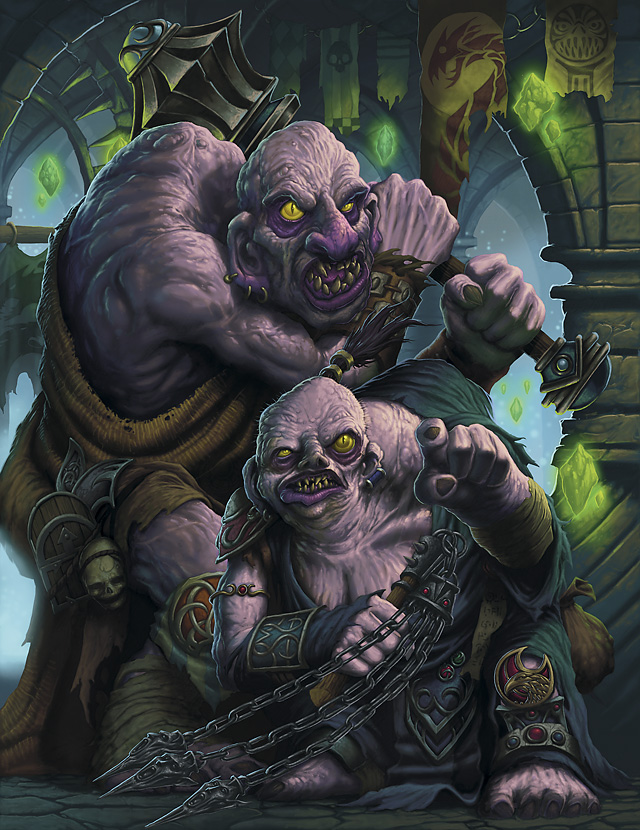
Fomorians are Titan-sized, with purple-gray skin and a horribly deformed countenance. They see themselves as the most important beings in the universe, and so pay homage to no god or primordial. They live in the Feywild’s version of the Underdark, inside huge caves lit by glowing crystals and filled with subterranean ecosystems.
In the center of these caves are majestic castles and fortresses, where the fomorians dwell surrounded by all sorts of finery. A fomorian’s clothing and equipment is always masterfully crafted, in stark contrast to the ugliness of their bodies and hearts. All of this is built by the cyclopes they enslaved eons ago.
Every fomorian has the Evil Eye: one of their eyes is much larger than the other, and its stare can cause all sorts of unpleasantness to their enemies. Rumor has it the Evil Eye is a gift of Gruumsh to allow them to inflict more pain upon Corellon’s creations, but no one knows if that’s really true. Fomorians don’t like Gruumsh any more than they like any other deity.
The Numbers
Fomorians are Huge Fey Humanoids with the Giant keyword, and their power level is indeed comparable to that of a Titan - mid-Paragon to early-Epic elites. Their signature traits are trained Perception, Truesight 6, and an Evil Eye ability that does something different for every variety of fomorian, usually complementing its other abilities. They are typically Evil.
We get two stat blocks in the MM. There are more on the MM2.
Fomorian Warrior
A Level 17 Elite Soldier with 332 HP, this fomorian wears hide armor and fights with a mace. Its basic attack has Reach 3, and deals a good chunk of extra damage against immobilized creatures. Its Evil Eye (minor action; Ranged 5 vs. Will) immobilizes (save ends), giving you an obvious combo.
Updating the fomorian warrior to MV standards would involve fixing the damage, and likely making the basic mace attack mark for a turn as an effect and giving it a reaction mace attack against people who ignore the mark.
Fomorian Painbringer
This spellcaster is a Level 19 Elite Controller with 362 HP. It wears hide and fights with a flail, with a Reach 3 basic attack.
Its Evil Eye (minor action; Ranged 5 vs. Will) makes the target take a goodly amount of automatic damage whenever it damages the fomorian. This lasts until the fomorian uses the ability against someone else. As a separate ability, the painbringer also gains +2 to all attacks made against the victim of its evil eye.
Its other abilities are Funnel Pain (Ranged 8 vs. Will), which does physical damage; and Painful Visions (Close Burst 4 vs. Will), which dazes all affected targets (save ends). That last one is an encounter power, but the others are at-will.
Sample Encounters and Final Impressions
The sample encounter is level 19: a warrior, a painbringer, and four assorted cyclops slaves. The book also says you can find all sorts of evil underground fey in their domain, as well as visiting dignitaries from the drow or other similarly inclined people.
The two stat blocks we get here seem a little underwhelming to me, given the lore, but they do their jobs relatively well. We get a much more varied selection of fomorians when we hit the MM2.
-
The Only Good Metaplot
I’m not much of an “OSR” person. I started playing in the 90’s, and while I played some D&D here and there it was never my main system, and I moved away from it as soon as I found others I liked more. While I do feel some nostalgia when looking at some iterations of its rules, reading them again mostly reminds me why I stopped playing them in the first place.
There’s one specific thing that the very earliest editions of that game did that I feel should be ported to the present unmodified: the way they handled metaplot and “canonical” NPCs.
Before D&D was even published you basically had two campaigns being run using draft versions of its rules. There was Dave Arneson’s Blackmoor, and Gary Gygax’s Greyhawk. They were separate settings, but as far as I know they were run in a similar way.
Each had one main GM, and started with an “original” party of players. This original party goes on adventures, slays monsters, finds treasure. The survivors level up and become more powerful.
And then new PCs start coming in. Maybe the GM convinces another group of friends to play on a different day of the week, or the older players roll up new starting characters for a bit of variety, or maybe they begin playing their henchmen when they go out on missions of their own. It’s likely a combination of all of the above, happening over an extended period of time.
So now there are multiple PC parties having adventures in the same setting! What each party does changes the setting in ways that can be felt by the others. If a party delves a dungeon on Monday, loses a fighter to a gelatinous cube and retreats, another one might go in there on Thursday and loot the dead fighter’s cool magic sword. If the high-level originals shake the pillars of Heaven on Saturday, the Monday and Thursday parties might hear about it and feel its consequences in their games.
And that’s metaplot in its original, “platonically ideal” form. It’s what happens at the table, propagating to the other PC parties that are part of the same gaming group. This is practical because the setting is owned by a single GM or a small circle of them, who run the games for all groups involved and keep track of it all. As for “canon NPCs”, there are none. It’s PCs all the way down, though I suppose some of them might transition fully to NPC status when they retire, becoming less active in the process.
To me, an ideal setting is one that enables groups to create their very own shared world in that mold.
-
Let's Read the 4e Monster Manual/Vault: Flameskull
Copyright 2008 Wizards of the Coast This article is part of a series! Click here to see the other entries.
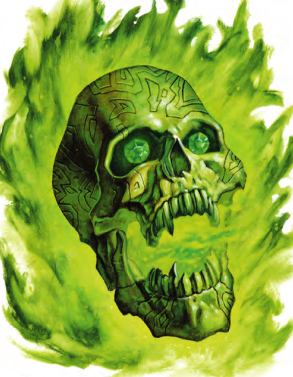
Flameskulls! Skulls that are on fire! I don’t know if they existed in previous editions, but the illustration makes me think of old-school demiliches a bit. They’re present only in the MM.
The Lore
Flameskulls are intelligent undead created from the skulls of spellcasters. The book doesn’t specify if they contain the soul and memories of the skull’s original owner or if they’re new individuals. It’s possible multiple versions of the ritual exist and each does something different.
One thing that is certain from the information here is that the “intelligent” part is an understatement - the standard model has Int 22 and the greater one Int 30! Not only do flameskulls speak at least 2 languages, they’re also Unaligned, meaning it’s quite possible one of them would appear as a neutral or allied NPC instead of a simple hostile monster. I think there’s at least one published 4e module or comic that does exactly that.
Flameskulls are usually created to serve as guardians, and the ritual that creates them is apparently older than recorded history, so you can find them in all sorts of forgotten places. “Younger” flameskulls might be found accompanying their creators as servants or bodyguards.
The Numbers
Flameskulls are Natural Animates with the Undead keyword. As undead they’re immune to disease and poison.
Flameskull
The standard model is Level 8 Artillery with 70 HP. It’s size is Tiny, and it flies at speed 10 (hover). It has Resist 10 fire, Resist 5 necrotic, and Vulnerable 5 radiant. It also has Regeneration 5, which means I have to explain how that works now.
Regeneration in 4e is actually similar to 3.5’s Fast Healing. Monsters with regeneration regain the specified amount of HP at the start of their turn as long as their current HP total is above 0. That’s it! Any other associated bells and whistles like those of trolls will be listed as separate traits.
Back to the flameskull: it attacks with a weak Fiery Bite in melee or a much better Flame Ray (Ranged 10 vs. Reflex) at range. Once per encounter it can use a Fireball which works more or less like the PC version: Area Burst 3 Within 20 vs. Reflex. Does fire damage on a hit, half on a miss, and the flameskull can exclude two allies from the effect.
The skull can also manipulate objects using Mage Hand, and it sheds bright light out to 5 squares, though it can reduce that to dim light out to 2 squares if it’s trying to be stealthy.
Great Flameskull
This one is either very old or made using a more powerful version of the ritual. It’s Level 24 Artillery with 174 HP and size Small. Do flameskulls grow with age, or is this something like the skull of an oni?
Stat-wise, it’s pretty much a scaled-up flameskull. Its resistances, vulnerabilities and regeneration are doubled in intensity, and it’s fireball is now a Fire Storm (Area 4 within 20 vs. Reflex) whose flames last for a turn and deal 10 damage to anyone starting their turns there in addition to their initial attack damage.
Sample Encounters and Final Impressions
There’s one sample encounter: a flameskull, 2 mummy guardians and an oni night haunter who probably created the other monsters.
I like them! I cannot help but remembering Murray from the Monkey Island games when I see the flameskull illustration, which I guess is a factor in this. The fact that flameskulls are unaligned and not necessarily hostile is my favorite thing about them. I’d have to fix their damage before using them, of course.
subscribe via RSS