Posts
-
'Superheavy' Melee Weapons in GURPS
Over- and undersized weapons are a popular trope for fantasy and fantasy-adjacent stories. Those giants and pixies need something to fight with, and human-scale warriors with huge swords is a itself a popular genre trope.
GURPS already has a pretty good set of cinematic rules for representing these. The best source of these is the Scaling Weapons and Armor section found in GURPS Low-Tech Companion 2: Weapons and Warriors. GURPS Dungeon Fantasy uses a limited subset of those in DF1 and 3.
However, there are a few other tropes that mess around with weapon weights in a supernatural way. Let’s take a look at how to represent them in GURPS.
Superheavy Weapons
This is a melee weapon that’s the same size as its mundane counterpart, but it’s a lot heavier. It’s probably made out of a non-standard material, which depending on the weapon might be a fruit of superscience or magic. Such weapons are usually built for legendarily strong wielders! The increased weight not only makes the weapons more deadly, but also allows its owner to employ their full strength when fighting.
To model these weapons, use the Scaling Weapons and Armor rules, with a few modifications:
-
Either pick a final weight for the weapon, or note the strength of its intended wielder if you already know that.
-
Go to page 21 of Low-Tech Companion 2, and pick the line whose “Typical User ST” column most closely matches that of the wielder.
-
If you started with the weight, divide final weight by the “base” weight of the weapon and pick the line whose Weight column is closest to the result.
-
Modify the weapon’s Damage, required ST, Weight and base cost as written in LTC2. Do not modify Reach or SM.
And there you have it! And yes, you can combine this with normal weapon scaling to make a weapon whose weight is abnormally large for its size. In that case, two extra steps apply after completing the procedure above:
-
Multiply the weapon’s Reach by the value in the table row corresponding to the SM of the intended wielder.
-
Cost is the higher of the weapon’s final modified cost, or the cost of a standard SM 0 weapon.
Example 1: We’re making a super-strong martial artist character and we want him to use an iron quarterstaff that’s ten times heavier than the wooden variety. Looking at the table on LTC2 p. 21, we see that the closest multiplier is 12.25, for the SM+3 line.
After applying the modified process above, we end up with a weapon that has the following qualities: Damage sw+7 cr or thr+7 cr; Reach 1, 2; Parry +2; Cost $122,50; Weight 20kg (40 lbs); ST 25. So our hero would need at least ST 25 to properly wield such a weapon.
Example 2: We’re making a pixie barbarian using Dungeon Fantasy rules. Her ST is 13, which is legendary for a people whose SM is -6 and whose typical ST score is 5. We want her to wield a weapon that’s superheavy for a pixie.
The chosen base weapon is a Dueling Halberd. We use the SM -6 row in the table for the halberd’s Reach multiplier, and the SM -2 row for everything else. Our resulting halberd will weight only a quarter of the human version, but it will be 25 times heavier than a “standard” pixie polearm, and weight more than its wielder! Since its modified cost of $30 is lower than its base cost of $150, it costs the same as a full-sized halberd.
The final stats are: Damage sw+2 cut or sw+2 imp or thr+2 imp; Reach C; Parry 0U or 0; Cost $150; Weight 1.25kg (2.5 lbs); ST 6++. Note that our super-strong pixie can wield this halberd one-handed without it becoming unready.
Magically Attuned Weapons
This trope is popular in the Exalted roleplaying game. Magic weapons in that setting are based both on some tales of classical mythology and on modern media such as action anime and certain video games. The heroes who wield these weapons “attune their essence” to them, which makes the weapons feel like they have normal weight to their owners, while still being superheavy to everyone else - particularly their targets.
This means that characters wielding these weapons don’t have to be generically super-strong, and that the ability to handle one weapon doesn’t give them the ability to wield others.
To create such a weapon, use the same process outlined above for “superheavy” weapons. Attunement is represented by a new advantage, which the weapon’s owner must purchase in order to use it.
Attunement (Variable Cost)
You’re attuned to a specific magical weapon which is super-heavy, oversized, or both. You can wield it just as if it was a normal-sized weapon, though its targets will still feel the full weight of your blows.
To calculate the cost of this advantage, subtract your actual ST from the weapon’s minimum ST and multiply it by 1.6, rounding up. Add 1 to the total if the weapon is also oversized.
Attunement in no way “protects” your weapon! If it’s permanently lost or destroyed, you lose all the points invested in it.
Details: This is just enough levels of Lifting and Striking ST with the limitation “Only for this weapon” (-80%) to cover the difference between the character’s ST score and the minimum ST for the weapon. The extra point for oversized weapons is a specialized version of the Giant Weapons perk that removes all penalties due to size difference, but only works for that single weapon.
Example: If the Iron Staff from the previous section was a magic artifact in the style described here, a reedy ST 8 hero could attune to it by paying 28 character points. 25 - 8 is 17, which multiplied by 1,6 gives us 27,5, which is then rounded up. This allows the hero to fight with the Staff as if he had ST 25, and to ignore its great weight when carrying it, but he’ll still be ST 8 for all other purposes.
“Whomsoever wields this hammer, should he be worthy…”
The third and final special weapon covered in this article are those powerful magical artifacts that only allow those they deem worthy to even lift them. Thor’s hammer from the Marvel comics and movies is a famous example.
Lifting and using these weapons is not a matter of muscle mass, but of moral strength. When you touch them, they judge you! If you pass that judgment, then you can lift and wield the weapon as if it was a normal specimen of its kind.
You don’t actually need to make these weapons superheavy or oversized. Instead, they look for certain traits in a prospective wielder. Those who have these traits are worthy. Those who don’t can’t even lift the weapon, even if they’re the strongest being in the universe muscle-wise. I generally consider this to be a story effect and wouldn’t try to put a price tag on it.
A weapon like movie-Mjolnir might look for one or more virtues along the lines of Honesty, Selfless, Charitable and so on. An evil weapon would instead look for Bloodlust or Sadism. They would of course also avoid traits opposite to those they like.
If the weapon in question is also superheavy or oversized, then it could grant worthy wielders the ST to use it, similar to how Attunement works, at no cost to the wielder. If you’re writing up the weapon as a character, this would be a benefficial Affliction granting the Attunement advantage described in the previous section of this article. Simplify its cost by having it grant a number of levels of ST equal to the minimum needed to wield the weapon regardless of the wielder’s current ST.
Example: The Iron Staff belonged to the Monkey King! Though it will shun Bloodthirsty, Callous, Greedy or Sadistic individuals, it will deem worthy anyone who shows its former master’s heroic spirit, martial prowess, or love of mischief. Anyone with at least two of Selfless, a Code of Honor or Higher Purpose to fight evil, Trained by a Master, Curious, or Trickster could be deemed worthy and be considered to have ST 25 when wielding the staff.
-
-
Let's Read the 4e Monster Manual/Vault: Bugbears
Copyright 2008 Wizards of the Coast This article is part of a series! Click here to see the other entries.
Like the other goblinoids, bugbears have been in the game since the beginning, when they were the most powerful of the “proper” humanoids at 3+1 HD. The next step up from them were ogres, who occupied that nebulous area between “humanoid” and “giant”.
The Lore
As we’ve already seen, bugbears are the biggest and strongest members of their “family”, and tend to organize into small roving bands when by themselves. They can also be found living alongside goblin communities, which they rule through fear and frequent beatings.
Bugbears are quite violent and prefer actions to words, which means they never talk with people they can beat up instead. To get a bugbear to negotiate you have to show them there’s a clear and obvious advantage to doing so. That could be because you’re too tough to bully, or because working with you will bring them more rewards in the long run. They tend to fit into hobgoblin-led forces as elite shock troops or commandos. Yes, bugbears can be surprisingly sneaky despite their bulk and predilection for direct violence.
One interesting bit of lore in the MM is that bugbears like to decapitate their enemies in honor of Hruggek, a culture hero and exarch of Bane who was known for doing that. That’s quite the feat given that their preferred weapon is the morningstar.
The Numbers
We only get a total of four bugbear statblocks, two in each book. They’re Medium Natural Humanoids with low-light vision and Speed 6. All of them also have training in Stealth. Their signature abilities vary per book.
In the MM they have Predatory Eye, a minor-action encounter power that gives them a small damage bonus in the next attack they make with combat advantage. In other words, it’s a crappier Sneak Attack that only works once per encounter.
In the MV this was replaced with the much better Bushwhack, which gives them a +4 attack bonus against creatures that have no adjacent allies. If you use MM bugbears, I suggest you replace their Predatory Eye with Bushwhack in addition to any other changes.
Bugbear Thug (MV)
This Level 4 Brute has 65 HP and all common traits for MV bugbears. It fights with a morningstar whose basic attack has built-in “sneak attack” bonus damage, and carries 2 handaxes it can throw while it closes the gap with the PCs.
Simple and effective! If attacking an isolated PC from ambush, the thug can start the fight with a bang, though unlike a full lurker it will not seek to hide again once that happens.
Bugbear Warrior (MM)
This Level 5 Brute has 76 HP and all common traits for MM bugbears. It’s likely an earlier version of the Thug. It also fights with a morningstar.
To go with its weak Predatory Eye ability, the warrior has an encounter power named Skullthumper. This requires combat advantage and is a morningstar attack that also knocks the target prone and dazes them (save ends).
I’m guessing it’s also meant to combine these two abilities for that first strike from ambush. To update it, level a bugbear thug up to 5 and give it Skullthumper.
Bugbear Backstabber (MV)
This Level 5 Skirmisher has 63 HP and all MV bugbear traits. It fights with a greatsword, widely known as a good backstabbin’ weapon. It also carries 4 handaxes for throwing.
In addition to Bushwhack, this bugbear is also an Expert Ambusher, which gives it a damage bonus when it attacks from hiding. And as an at-will move action it can employ Stealthy Positioning to shift its speed and make a Stealth check to hide if it ends behind cover.
These monsters want to ambush the party in a place with lots of cover. They’ll charge from hiding, hit with the sword while benefitting from Expert Ambusher, and will immediately use Stealthy Positioning to move back into hiding and do it again next turn. They’re skirmishers because they can do this every turn, instead of alternating like a lurker.
Bugbear Strangler (MM)
These Level 6 Lurkers have 82 HP and were the cause of some early battles in the edition war.
They fight with a morningstar but keep a rope garrote in reserve. When they have CA against a target, they can Strangle it (Melee 1 vs. Reflex). A hit does some damage and grabs the target until they escape. The strangler can use its subsequent standard actions to automatically deal the same damage to the target.
If someone attacks their AC or Reflex then while they have a victim grabbed in this way, they can use Body Shield (recharge 4-6) as an interrupt to have the attack target the victim instead.
This was what caused those battles, since the Strangler was published as a preview ahead of the game and it was one of the first instances of a “custom” 4e monster ability people had laid their eyes on. We already saw several monsters who can do something like this, but since bugbears are relatively “mundane” it led to some 3.x diehards complaining that there should be feat chains and such that allowed a PC to do the same.
Final Impressions
While only one of the stat blocks depicts an actual lurker, they’re all well-provided with abilities that allow them to attack from ambush to good effect. Forget goblins, bugbears are the real sneaky gits here.
-
Let's Read The 4e Monster Manual/Vault: Golem
Copyright 2008 Wizards of the Coast This article is part of a series! Click here to see the other entries.
Golems have been in the game since the beginning. They became so popular that they ended up giving rise to the whole construct taxonomy as more things that were like them were published to capitalize on the hype.
The word itself comes from the myth of the Golem of Prague. Here, golems are present in both books.
The Lore
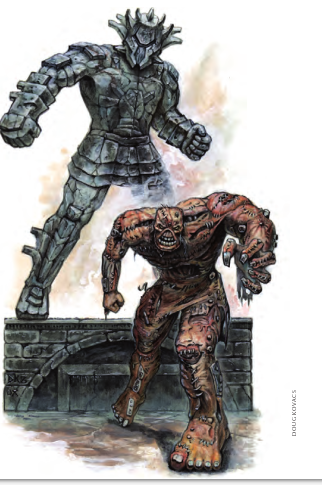
Like in pretty much every edition of D&D, golems are humanoid constructs created by powerful spellcasters or masters of secret lore. They faithfully obey their creator’s orders and tirelessly follow the last commnand they received if the creator is not around.
The process of creating a golem is quite involved and expensive. The body must be crafted to exacting specifications, a process that often involves hired artisans if the creator doesn’t have the skill themselves. The creator them performs a complex ritual upon the finished body, opening a small rift to the Elemental Chaos and pulling a bit of the same spark used by the gods and primordials to craft the world. This animating spark gives the golem motion and a desire to obey its creator, and nothing else in the way of personality.
There are several versions of the animating ritual. All require a sacrifice of treasure plus one of blood or spirit. The more evil the ritual, the less of the former and more of the latter it requires. The resulting golem itself, however, is always Unaligned.
While golems are not actually mindless, they’re not really people. A golem has the ability to understand its master’s orders perfectly, but it can’t speak or understand anyone else. It also employs very direct and physical approaches to fulfilling those orders. If a golem is given an order it can’t fulfill, it will either just stand there or rampage until told to stop. Never try to make your golem work as an accountant!
Golems really excel when used for their intended purpose, though. They never tire, never complain, never disobey, and last pretty much forever. They’re hard enough to make that their creators tend to be people who value those traits above all else. Maybe it’s a dwarf kingdom who needs eternal guardians for their treasure vaults. Maybe it’s a tyrannical wizard who wants absolutely loyal bodyguards who won’t flinch when ordered to dismember someone as an example. And so on.
The Numbers
The full Golem Lineup got quite large over the editions, but here we get a limited slice of it to start with. The MM contains flesh and stone golems; the MV has those two plus iron golems.
I imagine clay golems were left out of the MM because the Eidolons already filled the “divine construct” niche, and out of the MV because the Frankenstein-inspired Flesh Golem became more popular.
Most golems are Large Natural Animates with the Construct keyword. Constructs don’t need to breathe, eat or sleep and don’t count as living creatures, making them immune to effects that only target the living. All golems also have darkvision and though they move with Speed 6 they cannot shift. They tend to be Paragon-tier elite brutes. Everything else varies with the type of golem.
Flesh Golem (Both)
Flesh golems are inspired by Frankenstein’s monster, and built from corpse parts. This makes them look like large angry zombies, but they’re explicitly not undead. I don’t believe they decompose either.
They’re Level 12 Elite Brutes with 304 HP. Unlike all other golems, they are not immune to disease and poison. They fight with their fists and can perform two slams per action. When bloodied, they also make additional slam attacks against a random adjacent target as a reaction to being hit by an attack.
The golem’s other special attack is Golem Rampage, which allows it to move its Speed+2, pass through enemy squares, and make a slam attack against any enemy whose square they pass through. This provokes opportunity attacks as normal, and recharges on a 5-6.
The MV version has all of the same abilties with improved damage, and leans even harder on the Frankenstein story with two new passive traits. I suppose they’re also a callback to the extensive list of immunities and weird spell effects every golem had in previous editions.
Primal Fear causes it to run away from anyone who deals fire damage to it, moving up to its speed as a free action. If it can’t move at least half that distance it grants combat advantage for a turn instead. Life-Giving Jolt allows it to make a free basic attack when it takes lightning damage.
Use the MV version for its numbers, and feel free to remove the new passive traits if they don’t fit your needs.
Stone Golem (Both)
While flesh golems are the weaker variety, you can say stone golems are the most basic. They’re Level 17 Elite Brutes with 336 HP, and are immune to disease and poison.
They fight with slams, and can also make one or two of those per turn. They have the same Golem Rampage power as the flesh golem, and a Death Burst that triggers when they die. This explosion is a Close Burst 1 vs. AC doing physical damage from stone shrapnel, and causing the area to become difficult terrain “until cleared”.
Aside from fixing the damage bug, the versions in the two books are identical.
Iron Golem (MV)
Iron golems were the top of the golem ladder until the 3e Epic Level Handbook came along. It appears in 4e for the first time on the MM2. The iron golem is a Level 20 Elite Soldier with 386 HP. Like other non-flesh golems it’s immune to disease and poison.
Iron golems are filled with a self-replenishing reservoir of chemical weapons! While they’re bloodied, these leak and work like an Aura 2 that deals poison damage to any creature that enters it or starts their turn inside.
Other elemental magic also has strange effects on them: they can shift 2 squares when they take fire damage for the first time in a turn (even though they can’t otherwise shift). When they’re hit with lightning, they’re also slowed for a turn.
An iron golem’s basic attack is an Iron Blade that does some pretty good damage and marks on a hit. It can Cleave to make this basic attack against two different targets. Its other main weapon is a breath weapon that uses those chemical weapons I mentioned. It’s a Close Blast 3 vs. Fortitude that deals a big chunk of poison damage and some quite respectable ongoing poison damage (save ends). It recharges on a 5-6.
When a creature marked by the golem and within 2 squares of it moves, the creature can use a Dazing Fist as a reaction (Melee 2 vs. Fortitude), which does no damage but dazes (save ends). And when the golem dies it detonates is poison gas reservoir, dealing immediate and ongoing poison damage in a Close Burst 3.
The MM2 iron golem is pretty much identical, though it suffers from the damage bug and lacks the special fire and lightning effects.
Sample Encounters and Final Impressions
There’s a single sample encounter here: Level 14, 2 flesh golems and a lamia. Lamias are one of those people who would have trouble hiring sapient bodyguards, but no shortage of raw material for flesh golems.
I don’t think I ever ran a fight against a golem but I like that they’re in the game. I also like that their description here doesn’t even pretend that someone could confuse a golem with a statue. They look pretty distinctive and are not subtle enough to stay still when an intruder enters the space they’re guarding.
A 4e golem is much less of a puzzle monster than it used to be in previous editions, where they had a blanket immunity to magic except for those exotic effects. 3e already poked some holes into that by making them only immune to spells that were affected by spell resistance, and 4e did away with it entirely. It’s understandable - pretty much anything an arcane or divine character can do against a monster is technically “magic”, so you don’t want to make half the party completely useless against golems. Also, spell resistance is not a thing in this edition.
-
Let's Read the 4e Monster Manual/Vault: Hobgoblins
Copyright 2008 Wizards of the Coast This article is part of a series! Click here to see the other entries.
Like other goblinoids, hobs have been in D&D since the beginning, where they used to fit right above Orcs in the Humanoid Power Ladder. Having 1+1 HD prevented them from being casually cleaved by OD&D fighters.
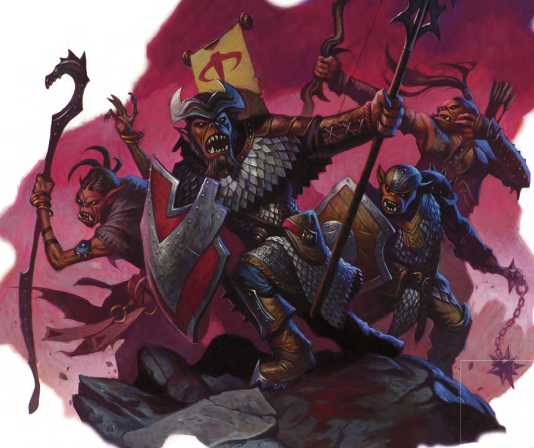
In 4e, as I’ve already discussed, they’re the most disciplined and militaristic of goblinoids, and likely to be in charge in any situation where the three types are working together. They produce their fair share of empire-building commanders, and can also be found working as mercenaries for any number of clients. Their discipline makes them the most reliable goblinoid mercenaries money can buy.
Once again we have seven hobgoblin stat blocks in the MM and four in the MV. Let’s look at them by order of level.
The Numbers
Hobgoblins are some of the monsters that changed the most between books, and this includes their standard traits. Both versions have Speed 6 and low-light vision, but the signature powers are pretty different.
Monster Manual hobgoblins have two such traits: Hobgoblin Resilience is a reaction that allows them to immediately make a save when hit by an effect a save can end. And Phalanx Soldier is a passive trait that gives them a +2 bonus to AC when adjacent to at least one other hobgoblin. All hobs have the first, and only warrior-types have the second.
You can probably see the problem here - these two traits make hobgoblins a lot harder to kill than their level would indicate. A fight against hobgoblins could drag on for a long time, particularly when the players are still inexperienced.
The signature trait for Monster Vault hobgoblins is Phalanx Movement, a move action that allows both the user and each ally in a Close Burst 1 to shift 1 square, as long as they all end up adjacent to each other. This allows a group of hobgoblins to slowly advance as a unit, with no gaps in their formation. Hobgoblin Resilience still makes an appearance in the MV stat blocks, but only once.
Hobgoblin Grunt (MM)
The rank and file of a hobgoblin army, these are Level 3 Skirmisher minions. They wear leather and wield a light shield and a longsword. They have Hobgoblin Resilience and Phalanx Soldier, but no other special tricks.
There’s also a Hobgoblin Warrior that’s identical to the grunt, but is level 8.
Hobgoblin Archer (MM)
These are Level 3 Artillery with 39 HP. They have Hobgoblin Resilience, but no formation-related traits. Their gear is similar to the grunt’s with the addition of a longbow and quiver of arrows.
Their longsword attacks are nothing special; longbow attacks grant an ally within 5 squares of the target a +2 bonus to hit it on their next attack. The little “tactics” paragraph for archers says they have a Coordinated Fire trait, but that’s absent from the actual stat block. Not sure if it was ever added on errata or not.
Still, they do very well as support for melee combatants in addition to being a source of ranged damage themselves. With “coordinated fire” not being a thing, you should spread your archers out in a loose skirmish line beyond the reach of melee PCs.
Hobgoblin Soldier (MM)
Hobgoblin Soldiers are Level 3 Soldiers with 47 HP, and a very good case study of how Hobgoblin Resilience and Phalanx Soldier together can be frustrating.
Being soldiers, their AC is already higher than normal - in fact, at 20, it’s 1 point higher than the new math says it should be. Phalanx Soldier gives then another +2 on top of that when you have multiple adjacent hobgoblins (which you will always have). They’ll also outright ignore about half of the effects that require saves that are thrown their way.
They will usually be facing level 1-3 PCs, which will likely not be able to throw multiple save effects per round to overcome their resilience. And they’ll be as hard to hit with AC attacks as level 6 soldiers until there is one lone hobgoblin left. The party is in for a long fight.
Offensively, hob soldiers fight with flails. Their basic attack both marks and slows for a turn, and they can also perform a Formation Strike that does the same damage and allows them to shift 1 square to end up adjacent to another hobgoblin. So that fight is going to last even longer because the PCs will spend much of it slowed and will find it hard to knock the hobs out of formation.
You will most likely want to leave these guys out of your game entirely, and use Battle Guards in their stead.
Hobgoblin Battle Guard (MV)
This is the updated version of the Soldier above. It’s a Level 3 Soldier with 49 HP and most of the original’s frustrating features removed.
The flail attack still marks, but no longer slows. Hobgoblin Resilience is gone, and Phalanx Soldier has been replaced by Share Shield, an interrupt that grants an adjacent ally +2 to AC and Reflex against one attack that targets either of those two defenses. Being an interrupt, it will only work once per turn, so it can be overwhelmed by PCs without too much trouble. The Battle Guard gets Phalanx Movement as well.
So in the end you have a soldier-type that gets stronger when it’s in a tight formation with its fellow soldiers, but not so strong as to make the fight impossible or super-long. It’s also easier to disrupt that formation.
Hobgoblin Spear Soldier (MV)
A Level 3 Skirmisher with 48 HP, the spear soldier was made to complement the Battle Guard above. It wields a longspear and carries a sheaf of javelins.
You want to have a line of spear soldiers in formation behind a line of battle guards. All of them will advance together via Phalanx Movement. The spearhobs will throw those Range 20 javelins as the unit closes in, and once melee starts will attack with their Reach 2 spears from behind the safety of the battle guard shield wall. Yes, Share Shield works on allies behind the user. If a PC manages to get adjacent to one of them, they can shift 3 squares as a reaction.
Hobgoblin Beast Master (MV)
Beast masters are Level 3 Controllers (Leaders) with 47 HP. While goblins prefer to use their tamed beasts as mounts, these hobs are trained to wrangle a pack of attack animals. They wield a goad (works as a war pick) in one hand and a whip in the other.
Whenever a beast or magical beast ally adjacent to the beast master hits with an attack, it gains 5 temporary HP. The beast master’s goad is a basic attack. The whip does damage and knocks down on a hit, and can slide the target 1 square as an effect. It can also choose to give an attack order to an adjacent beast or magical beast ally, giving it a Lazy Warlord-style free basic attack.
The beast master has Phalanx Movement, which does work on its beasts since the ability doesn’t specify the affected allies must be hobgoblins.
Hobgoblin Warcaster (MM)
A Level 3 Controller (Leader) with 46 HP, representing a wizard who specializes in electricity and force spells.
Warcasters carry staffs that do piddly damage as basic attacks, but which can be charged with electricity (Melee 1 vs. AC; recharge 4-6) to do respectable lightning damage and daze for a turn.
They can attack at range with force spells: Force Lure (Ranged 5 vs. Fortitude; recharge 5-6) does force damage and slides 3 squares on a hit; Force Pulse (Close Blast 5 vs. Reflex; Recharge 6) also does force damage, pushes 1 square and knocks targets down. On a miss, it does half damage with no riders.
The warcaster doesn’t get special bonuses from being in formation, but it benefits from Hobgoblin Resilience.
Hobgoblin Warmonger (MV)
This Level 4 Artillery (Leader) monster has 46 HP and is basically an upgraded version of the Archer we already saw. It uses a mace in melee and a longbow at range.
Its arrows do a fair bit of damage and cause the target to grant combat advantage for a turn, which is simpler and more powerful than the archer’s rider. It can also use a Battle Cry (Area burst 1 within 10 vs. Will) that has a somewhat complicated effect.
Each ally in the burst gets to charge or make a basic attack as a free action. If they hit, they gain 5 temporary HP. Each enemy in the burst is subject to an attack against their Will, and if hit must make a basic attack against a creature of the warmonger’s choosing. It yells “kill the wizard!” with such conviction even the PCs must make an effort not to follow the order! Less facetiously, this is likely some sort of Bane-powered charm, as it does have the charm keyword.
Unlike the archer, the warmonger has Phalanx Movement, meaning it can march in lockstep with its unit of bodyguards.
Hobgoblin Commander (Both)
A rare goblinoid stat block that has the same name in both books. Commanders are Level 5 Soldiers (Leaders) with 64 HP. They wear scale and wield heavy shields and spears.
The commander’s spear attacks mark for a turn. It also has a Lead from the Front trait which gives its allies +2 to attack and damage for a turn against anyone it hits with the spear.
While the commander lacks Phalanx Movement, it can issue orders for a Tactical Deployment (Close Burst 5; recharge 5-6; minor action) to allow allies in the burst to shift 3 squares. And it’s the sole MV hobgoblin to have Hobgoblin Resilience.
The older MM version is pretty much identical, except it has worse damage and can shift 1 square if it hits with an opportunity attack.
Hobgoblin Hand of Bane (MM)
Likely a powerful paladin of Bane. This is a Level 8 Elite Soldier with 184 HP. It wears plate, carries a heavy shield, and wields a flail.
This is the Flail of Dread, whose basic attacks mark for a turn and allow a secondary attack against Will. A hit on that one gives the target -2 to all defenses for the rest of the encounter or until the Hand of Bane dies. Yikes!
The flail can also be used in a Flail of Tyranny attack (recharge 6), which does more damage and stuns for a turn on a hit.
Bane’s Blessing gives the Hand a +4 to its damage rolls once it’s first bloodied, and it also has Hobgoblin Resilience. It lacks any formation-based tricks, though.
Final Impressions
The hobgoblin niche of being the “organized, militaristic” humanoids actually makes them the most reasonable of the bunch. That’s admitedly not a very high bar to clear in a “bunch” that includes gnolls and orcs, but it’s already something.
A given band of hobgoblins is likely to be pursuing an objective more complex than “kill everyone and raze every building”, and doesn’t need to be defeated with that same tactic. They’ll leave if you can prevent them from accomplishing their goals, and the truly reasonable among them will also leave if you manage to negotiate a nonviolent solution.
Heck, it’s not impossible for a paragon or epic party to hire themselves a company of hobgoblin mercs to help deal with a some aspect of a major threat. A morally risky move, but not an impossibility.
Eberron goes further on this by making them not actually villainous. Its human nations view the goblin kingdom of Darguun with suspicion, and it might become a real menace if the wrong clan ascends to power, but it’s at it root no better or worse than any other Khorvairian nation.
-
Let's Read the 4e Monster Manual/Vault: Goblins
Copyright 2008 Wizards of the Coast This article is part of a series! Click here to see the other entries.
Like all goblinoids, Actual Goblins have been a part of D&D since the beginning, occupying the second rung of the Humanoid Power Ladder in those editions where it was a thing. In Fourth Edition, they remain one of the first enemies a PC party is likely to fight. Because of this they get a large number of stat blocks across both books.
Since we’re already looked at goblin lore earlier, let’s skip right to…
The Numbers
Goblins are Small Natural Humanoids, with low-light vision and Speed 6. Their signature power is Goblin Tactics, a reaction that allows them to shift 1 square when missed by a melee attack. This power does a lot to distinguish them from kobolds, the other low-level humanoid opponents, who are shifty in a different way. Skill-wise, pretty much all goblin variants we see here are trained in Stealth and Thievery.
There are no less than seven goblin variants on the Monster Manual and another four on the Monster Vault. The idea is, of course, that you should be able to stock an entire dungeon with nothing but goblins. They are typically Evil.
Goblin Cutter (MM) and Goblin Sniper (MV)
The Cutter is a Level 1 Minion skirmisher. It wears leather is armed with a shortsword, and has no other special powers aside from Goblin Tactics.
The Sniper from the MV is Level 1 Artillery, armed with a short sword and a short bow. The ranged attack is the main difference from the Cutter, and being Artillery it also has slightly lower AC. If a sniper fires from hiding and misses, it remains hidden.
Both of these fill the same niche and are probably the closest to the classic half-HD goblins from editions past. There’ll be a lot of them, they’ll swarm or ambush you, and the survivors will flee as soon as they realize they’re losing the battle. Snipers are better for those unfair ranged ambushes, but the higher AC of cutters gives them better staying power in melee.
Goblin Blackblade (MM) and Goblin Cutthroat (MV)
Our first non-minion Goblin is a Level 1 Lurker with 25 HP and all common traits. It fights with a shortsword that suffers from the “naturalistic design” flaw, which doesn’t hurt it much due to its low level. Blackblades can sneak attack, and have a trait called Sneaky that allow them to switch places with another level 1 ally when they shift.
Cutthroats are the MM updated version, Level 1 Skirmishers with 30 HP. The damage of their shortswords has been updated, and they can attack at range 10 with thrown daggers. Sneaky gets replaced by Deft Scurry, a move action that allows them to shift 3 squares.
Goblin Warrior (MM)
This one is a Level 1 Skirmisher with 30 HP. It has a spear for fighting in melee, and a sheaf of javelins for ranged combat.
Both attacks deal extra damage if the warrior moves at least 4 squares before attacking, and it can also perform a Mobile Ranged attack that allows it to shift half its speed and throw a javelin without provoking opportunity attacks. This makes it rather easy for their javelins to get that extra damage.
Goblin Beast Rider (MV)
Meant to be used alongside a mount, the beast rider is a Level 1 Skirmisher with 29 HP. It uses javelins both in melee and at range. It has the same “extra damage after moving 4 squares” ability as the warrior above, but only when mounted.
Its Goblin Tactics also only works when mounted, but it also triggers when the mount is missed by a melee attack.
Goblin Sharpshooter (MM)
Essentially a nonminion version of the MV Sniper, above, this one is Level 2 Artillery with 31 HP. It uses a short sword and a hand crossbow, and has the same Sniper ability that prevents a missed shot from canceling its stealth.
Goblin Hexer (MM) and Goblin Hex Hurler (MV)
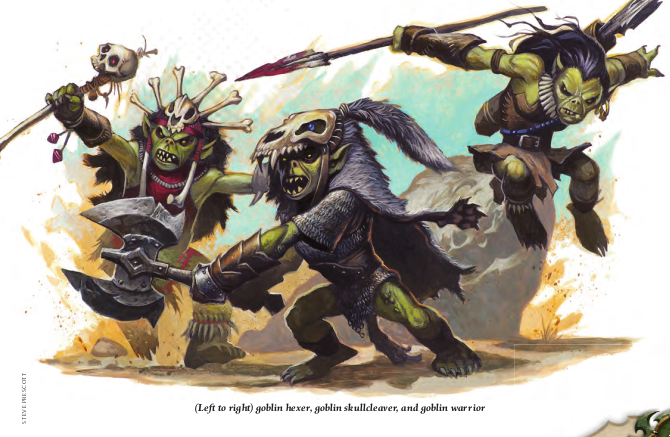
Despite the different names these are essentially the same monster, a goblin spellcaster specializing in curses. The hexer is a Level 3 Controller (Leader) with 46 HP and all standard goblin traits.
The MM version fights with a very weak “naturalistic” rod in melee, and mainly relies on its ranged spells. Blinding Hex (Ranged 10 vs. Fortitude; at-will) does damage and blinds (save ends); Stinging Hex (Ranged 10 vs. Will; recharge 5-6) damages the target if it moves in its next turn.
Vexing Cloud (Area Burst 3 Within 10; encounter) is some sort of enchanted flatulence that creates a zone of the specified size. Enemies inside gain a -2 penalty to attack rolls, and allies gain concealment. It lasts a turn and can be sustained with a minor action.
The hexer also has several triggered actions in addition to Goblin Tactics:
Incite Bravery (Ranged 10) allows an ally to shift 2 squares and make an attack when Goblin Tactics activates for the hexer. This is deceptively powerful: note the “an ally” and “an attack” wording! This works with any ally and it allows them to use any of their available special attacks. Want to give that young dragon some extra actions? Give him a hexer buddy!
Lead from the Rear is an interrupt that allows the hexer to redirect a ranged attack targeting it to a nearby ally.
The Hex Hurler is very similar: it trades the weak rod for a staff that does the right amount of damage and slides 1 square, and it loses Incite Bravery. That last bit kinda makes sense once you realize how powerful it was.
You’ll generally want to use the Hex Hurler for all your hexing purposes.
Goblin Skullcleaver (MM)
The Skullcleaver is here to show you even goblins can be brutes. A Level 3 Brute with 53 HP, it wears mail and wields a battleaxe in combat.
This one mostly works as a slightly beefier standard goblin until it gets bloodied. Then it goes berserk, losing Goblin Tactics and dealing an extra 1d10 damage with its axe. In this state, it will always move to attack the closest enemy, charging to reach it if possible.
Goblin Underboss (MV)
This Level 4 Elite Controller (Leader) might represent the chieftain of a smaller goblin band or a lieutenant in a more numerous one. It has 110 HP, all common goblin traits and is trained in Perception.
The Underboss wears mail and wields a shortsword. Unlike other elite monsters, it can only attack once with the sword, but if it misses then an adjacent underling can immediately perform a melee basic attack against the same target. This goblin’s strong Survival Instinct grants it +3 to all defenses while it’s bloodied, making it a lot harder to kill than might appear at first.
Its Goblin Tactics are upgraded to Superior Goblin Tactics, which allow the underboss itself and up to 2 other allies to shift 1 square when it triggers.
In addition to fixing its damage, I’d suggest removing Survival Instinct and giving it the ability to make two shortsword attacks with a standard action. I’d also probably change its role from Controller to Soldier, since it doesn’t seem to have a lot of controller-y abilities.
Sample Encounters
In addition to their cliche role as monstrous raiders lairing just off the trade route between two starting villages, goblins can be found working as mercenaries. They’re also frequently enslaved by more powerful villains, which must no doubt contribute to make their foul disposition worse. They will also often be found accompanied by whatever attack beasts they’ve managed to tame.
Of course, if you don’t feel like looking for beasts or employers, you can easily make all-goblin encounters with the stat blocks provided by the MM and MV.
The all- or mostly-goblin encounters from the MM are:
- Level 1: 2 warriors, 2 fire beetles, 1 blackblade.
- Level 3: 2 sharpshooters, 4 warriors, 4 cutters.
- Level 5: 1 hexer, 2 skullcleavers, 2 sharpshooters, 12 cutters. That’s likely the “boss room” in a goblin lair.
We don’t get any goblins of a level higher than 4 in these books, but you can certainly create some yourself if you give them the common traits outlined above.
Final Impressions
If you’re playing D&D you gotta have goblins, though these days I tend to be a bit wary of the “two-legged vermin” image that has been traditionally ascribed to them by older editions.
I’ll still include the occasional gang of goblin bandits and/or hired goons, of course, but I also want to leave open the possibility that there are communities of unaligned goblins out there, possibly even living alongside humans and other “civilized” folk. Out of all the goblinoids, they seem like the ones more likely to do that.
Eberron kinda went this way, if I recall correctly. 5e has gone in the other direction and turned goblinoids as a whole into some sort of unstoppable fascist army.
subscribe via RSS